


 Скачать презентацию Present Status of VEPP-5 Control System D Yu
3d3dd2d15d7fac283d6b2811a1e30f70.ppt
- Количество слайдов: 1
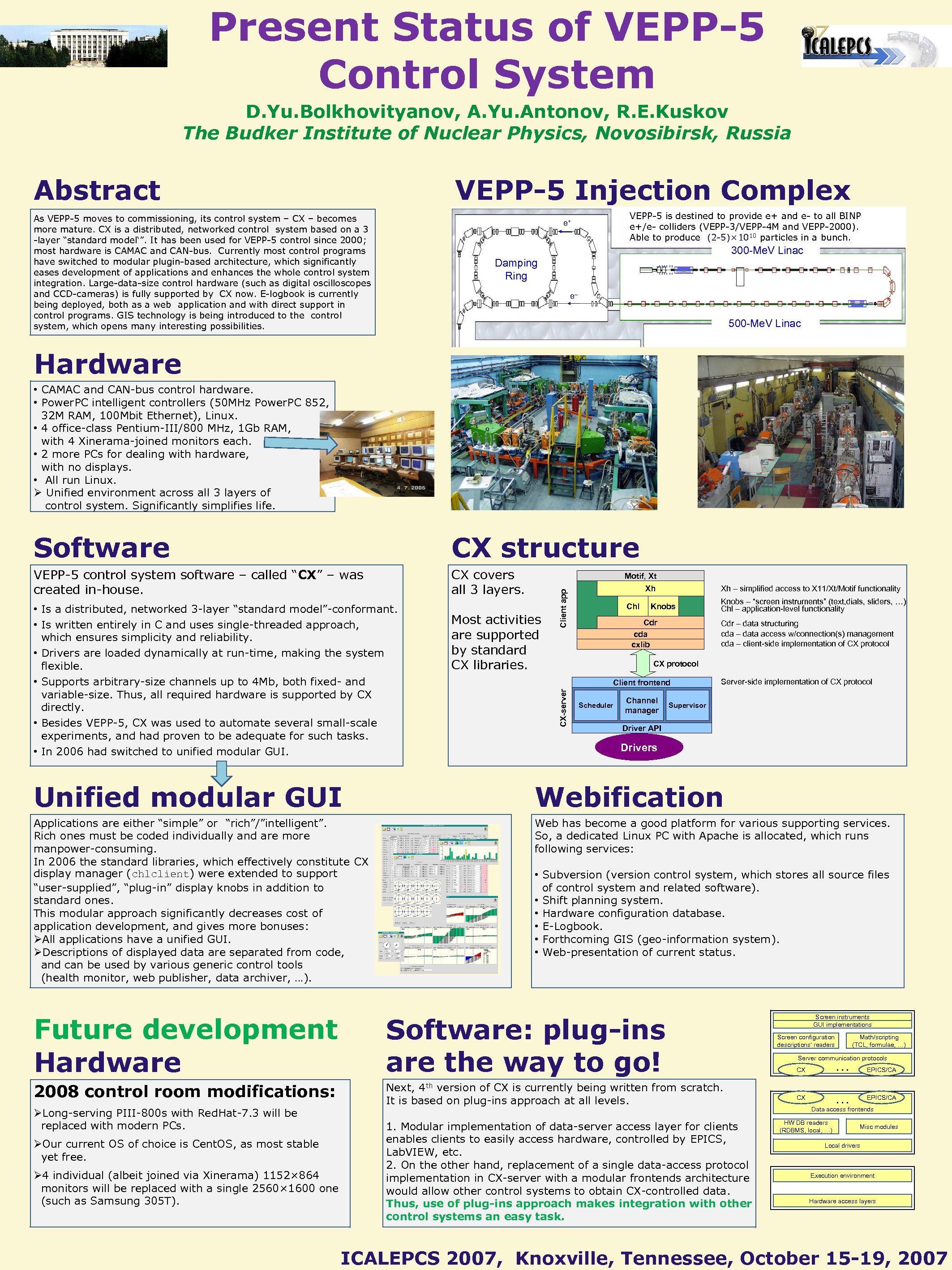 Present Status of VEPP-5 Control System D. Yu. Bolkhovityanov, A. Yu. Antonov, R. E. Kuskov The Budker Institute of Nuclear Physics, Novosibirsk, Russia Abstract VEPP-5 Injection Complex As VEPP-5 moves to commissioning, its control system – CX – becomes more mature. CX is a distributed, networked control system based on a 3 -layer “standard model‘”. It has been used for VEPP-5 control since 2000; most hardware is CAMAC and CAN-bus. Currently most control programs have switched to modular plugin-based architecture, which significantly eases development of applications and enhances the whole control system integration. Large-data-size control hardware (such as digital oscilloscopes and CCD-cameras) is fully supported by CX now. E-logbook is currently being deployed, both as a web application and with direct support in control programs. GIS technology is being introduced to the control system, which opens many interesting possibilities. VEPP-5 is destined to provide e+ and e- to all BINP e+/e- colliders (VEPP-3/VEPP-4 M and VEPP-2000). Able to produce (2 -5)× 1010 particles in a bunch. e+ 300 -Me. V Linac Damping Ring e– 500 -Me. V Linac Hardware • CAMAC and CAN-bus control hardware. • Power. PC intelligent controllers (50 MHz Power. PC 852, 32 M RAM, 100 Mbit Ethernet), Linux. • 4 office-class Pentium-III/800 MHz, 1 Gb RAM, with 4 Xinerama-joined monitors each. • 2 more PCs for dealing with hardware, with no displays. • All run Linux. Ø Unified environment across all 3 layers of control system. Significantly simplifies life. Software CX structure VEPP-5 control system software – called “CX” – was created in-house. CX covers all 3 layers. Xh Client app Most activities are supported by standard CX libraries. Chl Xh – simplified access to X 11/Xt/Motif functionality Knobs Cdr cda cxlib Knobs – “screen instruments” (text, dials, sliders, …) Chl – application-level functionality Cdr – data structuring cda – data access w/connection(s) management cda – client-side implementation of CX protocol Client frontend CX-server • Is a distributed, networked 3 -layer “standard model”-conformant. • Is written entirely in C and uses single-threaded approach, which ensures simplicity and reliability. • Drivers are loaded dynamically at run-time, making the system flexible. • Supports arbitrary-size channels up to 4 Mb, both fixed- and variable-size. Thus, all required hardware is supported by CX directly. • Besides VEPP-5, CX was used to automate several small-scale experiments, and had proven to be adequate for such tasks. • In 2006 had switched to unified modular GUI. Motif, Xt Scheduler Channel manager Server-side implementation of CX protocol Supervisor Driver API Drivers Unified modular GUI Webification Applications are either “simple” or “rich”/”intelligent”. Rich ones must be coded individually and are more manpower-consuming. In 2006 the standard libraries, which effectively constitute CX display manager (chlclient) were extended to support “user-supplied”, “plug-in” display knobs in addition to standard ones. This modular approach significantly decreases cost of application development, and gives more bonuses: ØAll applications have a unified GUI. ØDescriptions of displayed data are separated from code, and can be used by various generic control tools (health monitor, web publisher, data archiver, …). Web has become a good platform for various supporting services. So, a dedicated Linux PC with Apache is allocated, which runs following services: • Subversion (version control system, which stores all source files of control system and related software). • Shift planning system. • Hardware configuration database. • E-Logbook. • Forthcoming GIS (geo-information system). • Web-presentation of current status. Future development Hardware Software: plug-ins are the way to go! 2008 control room modifications: Next, 4 th version of CX is currently being written from scratch. It is based on plug-ins approach at all levels. ØLong-serving PIII-800 s with Red. Hat-7. 3 will be replaced with modern PCs. ØOur current OS of choice is Cent. OS, as most stable yet free. Ø 4 individual (albeit joined via Xinerama) 1152× 864 monitors will be replaced with a single 2560× 1600 one (such as Samsung 305 T). 1. Modular implementation of data-server access layer for clients enables clients to easily access hardware, controlled by EPICS, Lab. VIEW, etc. 2. On the other hand, replacement of a single data-access protocol implementation in CX-server with a modular frontends architecture would allow other control systems to obtain CX-controlled data. Thus, use of plug-ins approach makes integration with other control systems an easy task. Screen instruments GUI implementations Screen configuration descriptions’ readers Math/scripting (TCL, formulae, …) Server communication protocols CX . . . EPICS/CA Data access frontends HW DB readers (RDBMS, local, …) Misc modules Local drivers Execution environment Hardware access layers ICALEPCS 2007, Knoxville, Tennessee, October 15 -19, 2007