Скачать презентацию PRESENT SATELLITE RADIO NAVIGATION SYSTEMS THEIR PERFORMANCE AND
Zadar_ELMAR_2004_Presentation_Vejrazka.ppt
- Количество слайдов: 73
 PRESENT SATELLITE RADIO NAVIGATION SYSTEMS, THEIR PERFORMANCE AND USER RECEIVER CONCEPTS František Vejražka, Pavel Kovář, Libor Seidl, Petr Kačmařík, Josef Špaček, Pavel Puričer Department of Radio Engineering Czech Technical University in Prague Czech Republic
 Abstract This contribution gives an overview of present and future navigation systems and their augmentations such as GPS, GLONASS, GALILEO, WAAS, EGNOS, MSAT, QZSS, BEIDOU, GAGAN. Performance of the systems depends on their technical parameters. We will try to evaluate these and to present our opinion on their advantages for different applications and in various situations (reception of weak signals suffering from great attenuation under vegetation canopy, in urban canyons, influence of reflections and multipath). The last part of the contribution deals with an application of software radio technology for user receiver design and results obtained from experiments with different algorithms of processing the satellite navigation systems signals.
 Terminology Satellite (Radio) Navigation Systems ~ Radio Determination Satellite Systems ~ Systems for radio position determination using satellites
 Satellite Navigation Systems Historical Satellite Navigation Systems (not realized) • GPS - NAVSTAR 601 • TIMATION • . . . • GEOSTAR • REXSTAR
 Satellite Navigation Systems Past Satellite Navigation Systems • NNSS - Transit • Tsikad GPS - NAVSTAR realized but cancelled
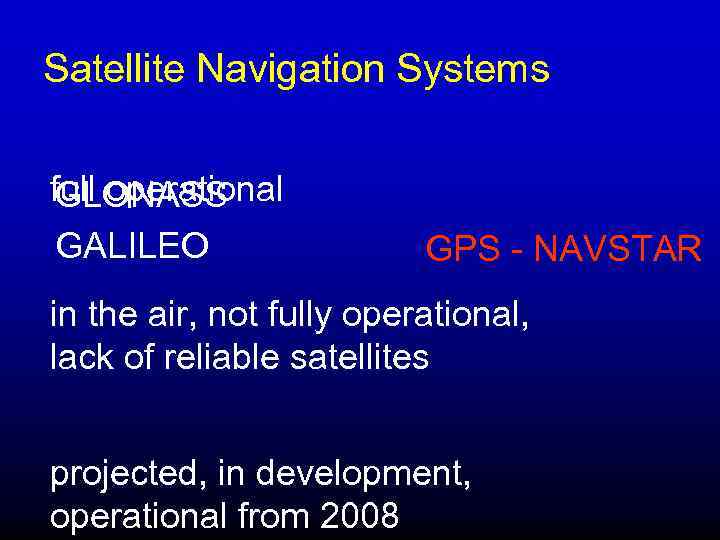 Satellite Navigation Systems full operational GLONASS GALILEO GPS - NAVSTAR in the air, not fully operational, lack of reliable satellites projected, in development, operational from 2008
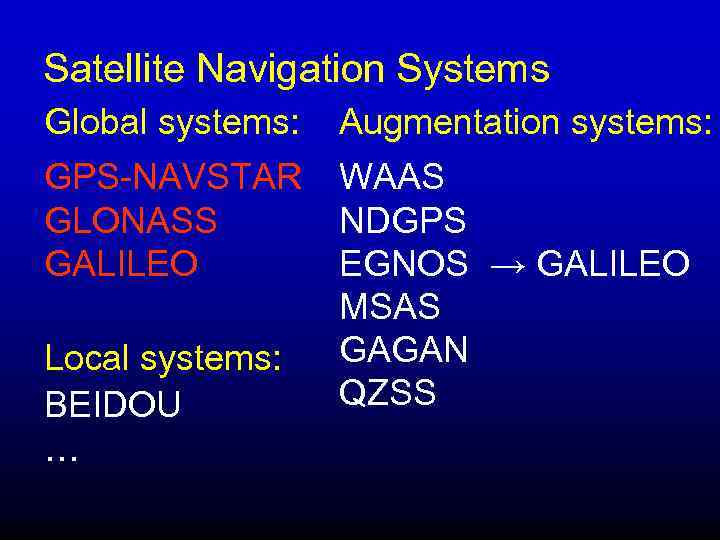 Satellite Navigation Systems Global systems: Augmentation systems: GPS-NAVSTAR GLONASS GALILEO WAAS NDGPS EGNOS → GALILEO MSAS GAGAN QZSS Local systems: BEIDOU …
 Principles of Satellite Navigation Systems • Doppler systems • Ranging systems
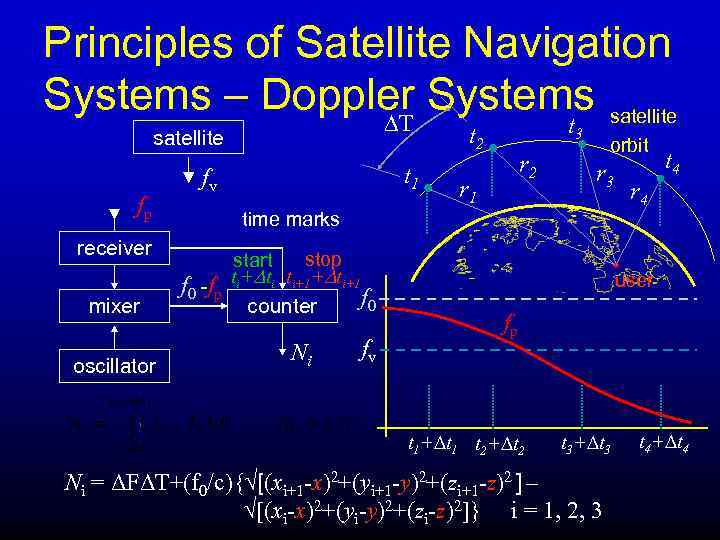 Principles of Satellite Navigation Systems – Doppler Systems satellite T fp oscillator t 1 fv r 2 r 1 orbit r 3 time marks receiver mixer t 3 t 2 satellite f 0 -fp stop start ti+Dti ti+1+Dti+1 counter f 0 Ni fv t 4 r 4 user fp t 1+ t 1 t 2+ t 2 t 3+ t 3 Ni = ΔFΔT+(f 0/c){√[(xi+1 -x)2+(yi+1 -y)2+(zi+1 -z)2 ] – √[(xi-x)2+(yi-y)2+(zi-z)2]} i = 1, 2, 3 t 4+ t 4
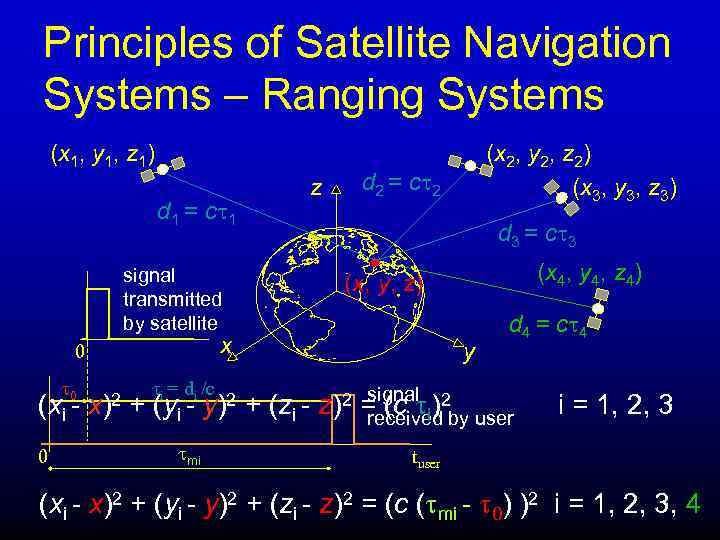 Principles of Satellite Navigation Systems – Ranging Systems (x 1, y 1, z 1) d 1 = c 1 signal transmitted by satellite (xi 0 d 2 = c 2 d 3 = c 3 x)2 (x 4, y 4, z 4) (x, y, z) x 0 0 z (x 2, y 2, z 2) (x 3, y 3, z 3) y i = di /c d 4 = c 4 signal + (yi - y)2 + (zi - z)2 = (c i)2 by user received mi i = 1, 2, 3 tuser (xi - x)2 + (yi - y)2 + (zi - z)2 = (c ( mi - 0) )2 i = 1, 2, 3, 4
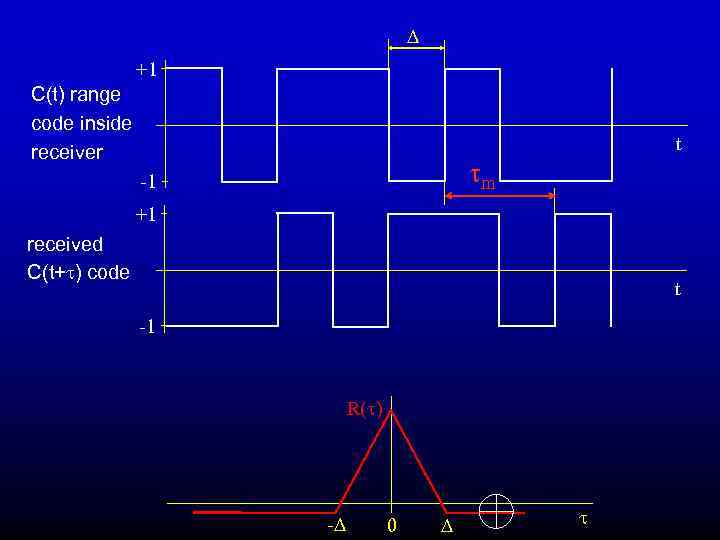 +1 C(t) range code inside receiver t m -1 +1 received C(t+ ) code t -1 R( ) - 0
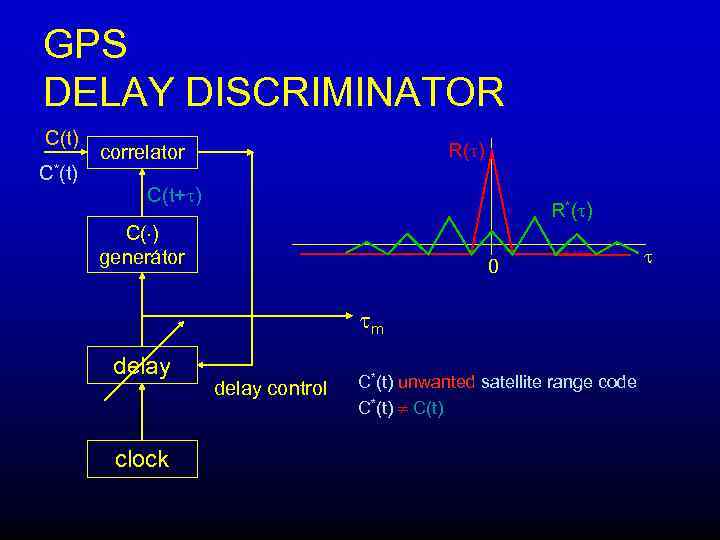 GPS DELAY DISCRIMINATOR C(t) C*(t) R( ) correlator C(t+ ) R*( ) C( ) generátor 0 m delay clock delay control C*(t) unwanted satellite range code C*(t) C(t)
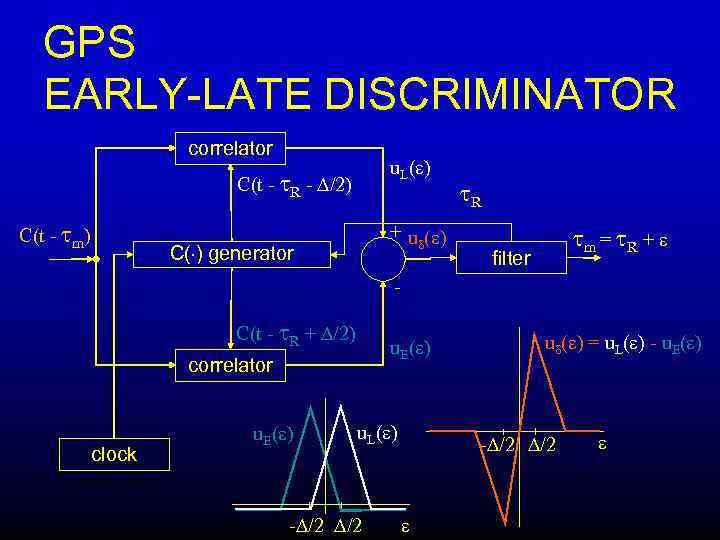 GPS EARLY-LATE DISCRIMINATOR correlator u. L( ) C(t - R - /2) C(t - m) + u ( ) C( ) generator R m = R + filter C(t - R + /2) u. E( ) correlator clock u. E( ) u. L( ) - /2 /2 u ( ) = u. L( ) - u. E( ) - /2 /2
![Receiver Principle C(t) D(t) cos(2 f t) [C(t) D(t) (1+cos(4 f t))] ( )2](https://present5.com/presentation/62691037_415872765/image-14.jpg "Receiver Principle C(t) D(t) cos(2 f t) [C(t) D(t) (1+cos(4 f t))] ( )2") Receiver Principle C(t) D(t) cos(2 f t) [C(t) D(t) (1+cos(4 f t))] ( )2 C 2(t) = 1 D 2(t) = 1 phase lock C(t) D(t) 2 C (t) D(t) = D(t) cos(2 f t) delay discriminator C(t) m pseudorange
Receiver Principle C(t) D(t) cos(2 f t) [C(t) D(t) (1+cos(4 f t))] ( )2 C 2(t) = 1 D 2(t) = 1 phase lock C(t) D(t) 2 C (t) D(t) = D(t) cos(2 f t) delay discriminator C(t) m pseudorange
 Systems Parameters (Properties) We will deal with systems: • GPS – NAVSTAR • GLONASS • GALILEO
 GPS - NAVSTAR
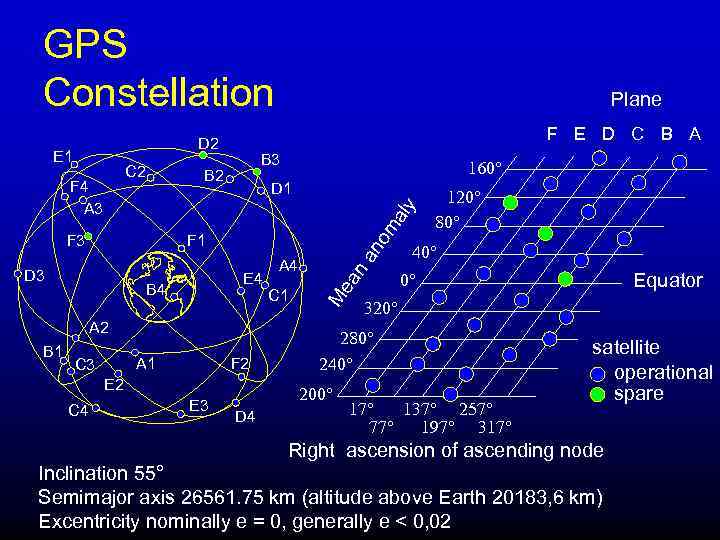 GPS Constellation F E D C B A D 2 C 2 F 4 A 3 B 2 F 3 D 1 A 2 F 2 A 1 C 3 E 2 C 4 E 3 ea C 1 n A 4 M E 4 B 4 an o F 1 D 3 B 1 160° m aly E 1 Plane 40° Equator 0° 320° 280° 240° 200° D 4 120° 80° 17° 137° 257° 77° 197° 317° satellite operational spare Right ascension of ascending node Inclination 55° Semimajor axis 26561. 75 km (altitude above Earth 20183, 6 km) Excentricity nominally e = 0, generally e < 0, 02
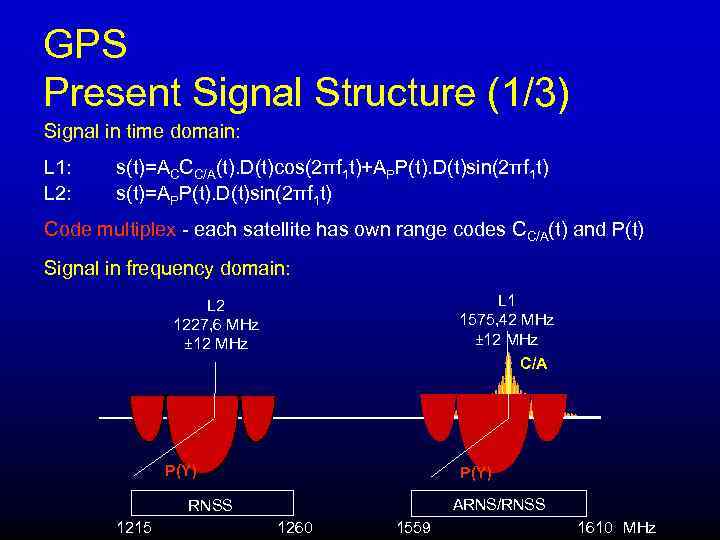 GPS Present Signal Structure (1/3) Signal in time domain: L 1: L 2: s(t)=ACCC/A(t). D(t)cos(2πf 1 t)+APP(t). D(t)sin(2πf 1 t) s(t)=APP(t). D(t)sin(2πf 1 t) Code multiplex - each satellite has own range codes CC/A(t) and P(t) Signal in frequency domain: L 1 1575, 42 MHz ± 12 MHz C/A L 2 1227, 6 MHz ± 12 MHz P(Y) ARNS/RNSS 1215 1260 1559 1610 MHz
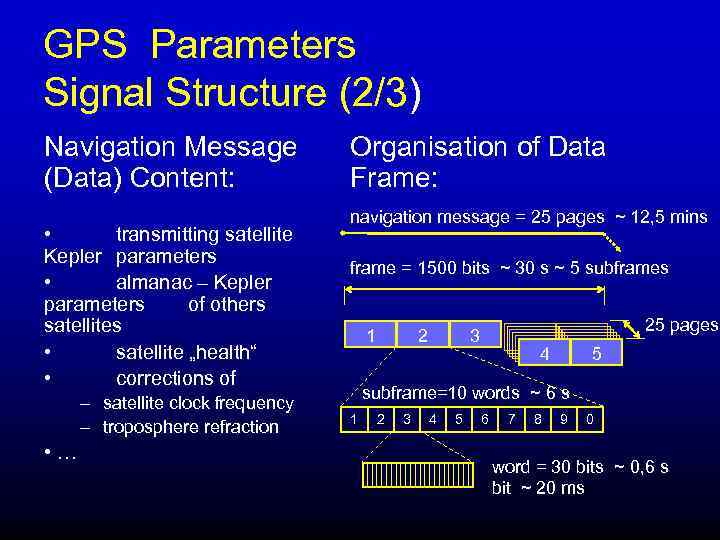 GPS Parameters Signal Structure (2/3) Navigation Message (Data) Content: • transmitting satellite Kepler parameters • almanac – Kepler parameters of others satellites • satellite „health“ • corrections of – satellite clock frequency – troposphere refraction • … Organisation of Data Frame: navigation message = 25 pages ~ 12, 5 mins frame = 1500 bits ~ 30 s ~ 5 subframes 2 1 25 pages 3 4 5 subframe=10 words ~ 6 s 1 2 3 4 5 6 7 8 9 0 word = 30 bits ~ 0, 6 s bit ~ 20 ms
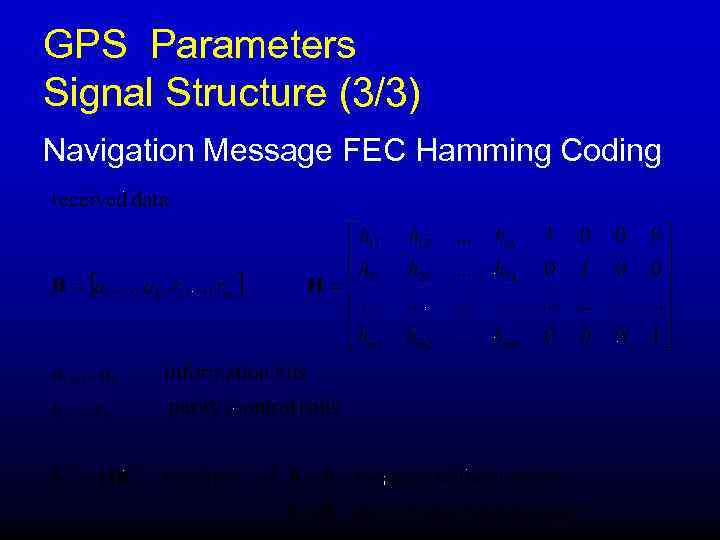 GPS Parameters Signal Structure (3/3) Navigation Message FEC Hamming Coding
 GPS Services • SPS – Standard Positioning Service only C/A code accessible • PPS – Precision Positioning Service for authorized users P(Y) code accessible
 GLONASS
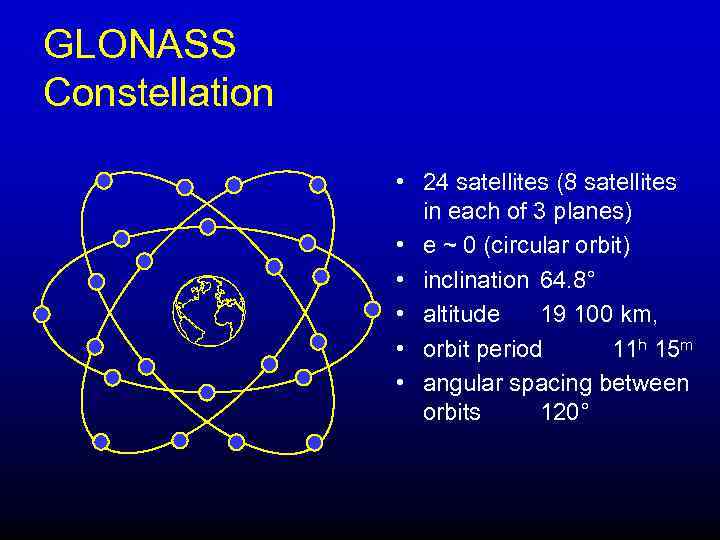 GLONASS Constellation • 24 satellites (8 satellites in each of 3 planes) • e ~ 0 (circular orbit) • inclination 64. 8° • altitude 19 100 km, • orbit period 11 h 15 m • angular spacing between orbits 120°
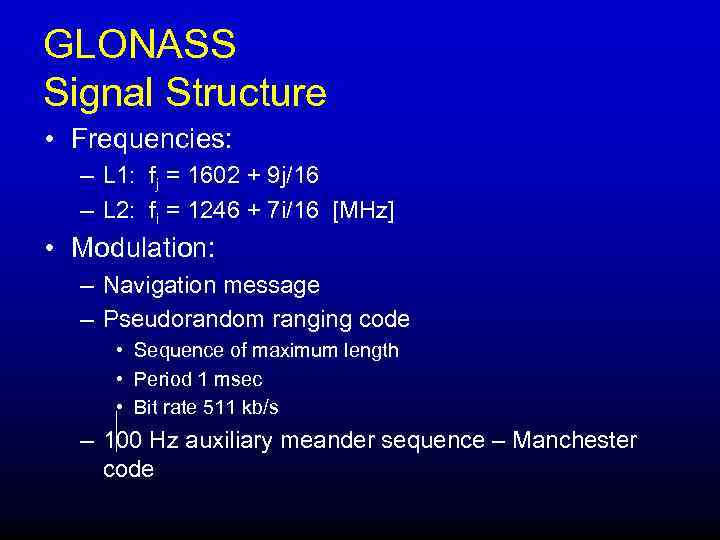 GLONASS Signal Structure • Frequencies: – L 1: fj = 1602 + 9 j/16 – L 2: fi = 1246 + 7 i/16 [MHz] • Modulation: – Navigation message – Pseudorandom ranging code • Sequence of maximum length • Period 1 msec • Bit rate 511 kb/s – 100 Hz auxiliary meander sequence – Manchester code
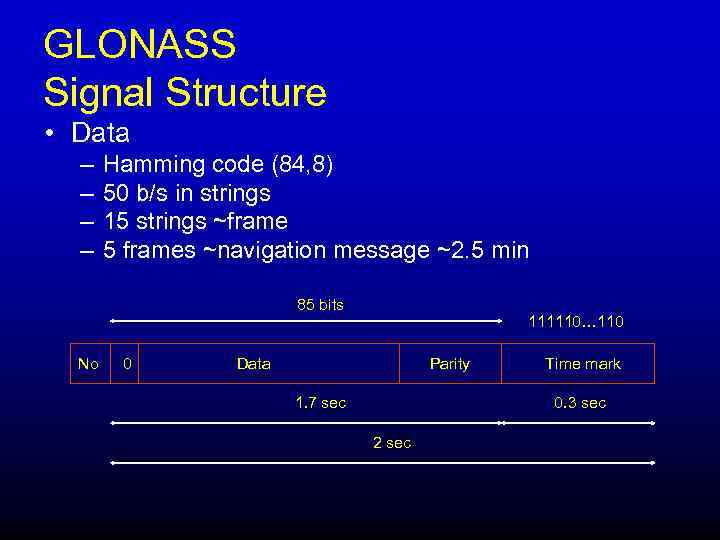 GLONASS Signal Structure • Data – – Hamming code (84, 8) 50 b/s in strings 15 strings ~frame 5 frames ~navigation message ~2. 5 min 85 bits No 0 111110… 110 Data Parity 1. 7 sec Time mark 0. 3 sec 2 sec
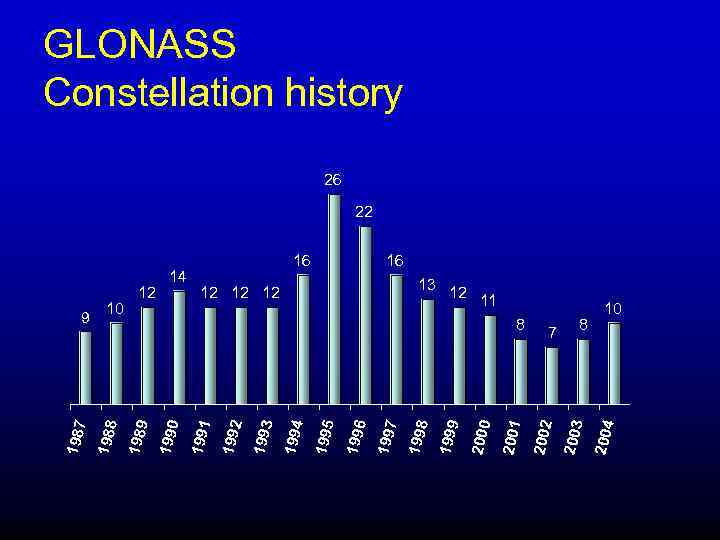 10 8 8 2002 2003 13 12 11 2004 7 2001 2000 1999 12 12 12 1998 16 1997 1996 1995 1994 1993 1992 14 1991 12 1990 1989 9 1988 1987 GLONASS Constellation history 26 22 16 10
 GALILEO
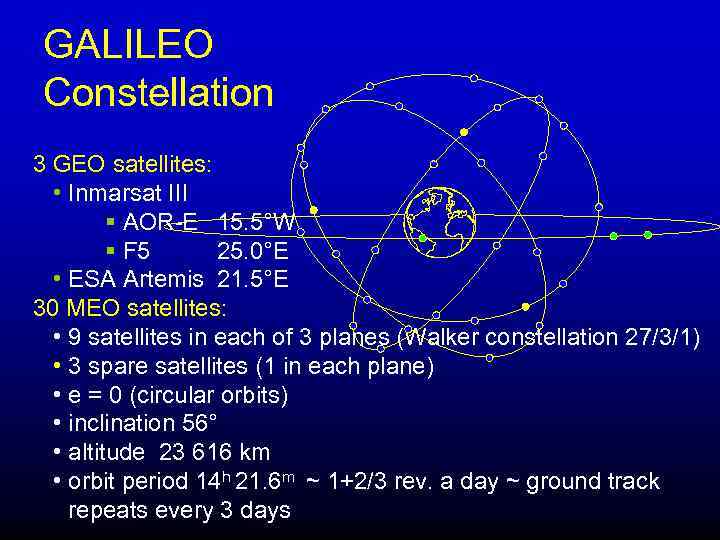 GALILEO Constellation 3 GEO satellites: • Inmarsat III § AOR-E 15. 5°W § F 5 25. 0°E • ESA Artemis 21. 5°E 30 MEO satellites: • 9 satellites in each of 3 planes (Walker constellation 27/3/1) • 3 spare satellites (1 in each plane) • e = 0 (circular orbits) • inclination 56° • altitude 23 616 km • orbit period 14 h 21. 6 m ~ 1+2/3 rev. a day ~ ground track repeats every 3 days
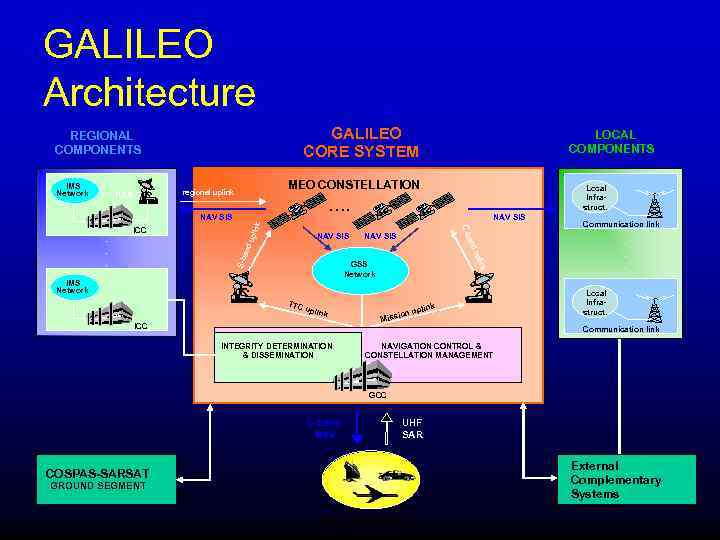 GALILEO Architecture GALILEO CORE SYSTEM REGIONAL COMPONENTS IMS Network MEO CONSTELLATION regional uplink IULS upl ink NAV SIS -ba C-b NAV SIS Communication link . . . S-b l upl and n nd GSS Network k ink . . . Local Infrastruct. …. NAV SIS ICC LOCAL COMPONENTS IMS Network TTC u plink ICC plink ion u Miss Local Infrastruct. Communication link INTEGRITY DETERMINATION IMS & DISSEMINATION NAVIGATION CONTROL & CONSTELLATION MANAGEMENT GCC L-band NAV UHF SAR External Complementary Systems COSPAS-SARSAT GROUND SEGMENT USER SEGMENT
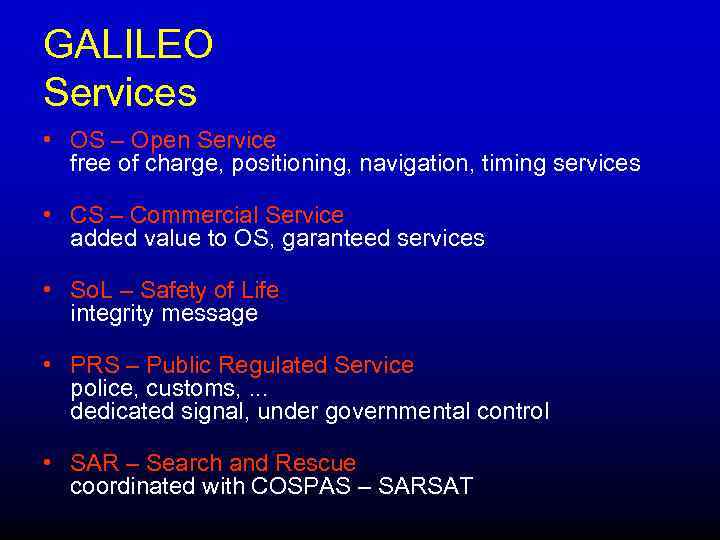 GALILEO Services • OS – Open Service free of charge, positioning, navigation, timing services • CS – Commercial Service added value to OS, garanteed services • So. L – Safety of Life integrity message • PRS – Public Regulated Service police, customs, . . . dedicated signal, under governmental control • SAR – Search and Rescue coordinated with COSPAS – SARSAT
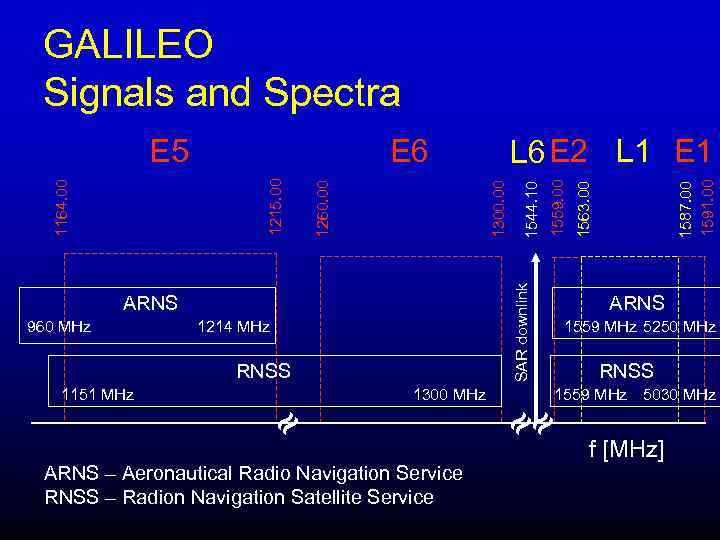 GALILEO Signals and Spectra 1214 MHz RNSS ≈ ARNS – Aeronautical Radio Navigation Service RNSS – Radion Navigation Satellite Service 1587. 00 1591. 00 ARNS 1559 MHz 5250 MHz RNSS 1559 MHz 5030 MHz ≈ ≈ 1300 MHz 1151 MHz 1563. 00 1559. 00 1544. 10 SAR downlink ARNS 960 MHz L 6 E 2 L 1 E 1 1300. 00 1164. 00 1260. 00 E 6 1215. 00 E 5 f [MHz]
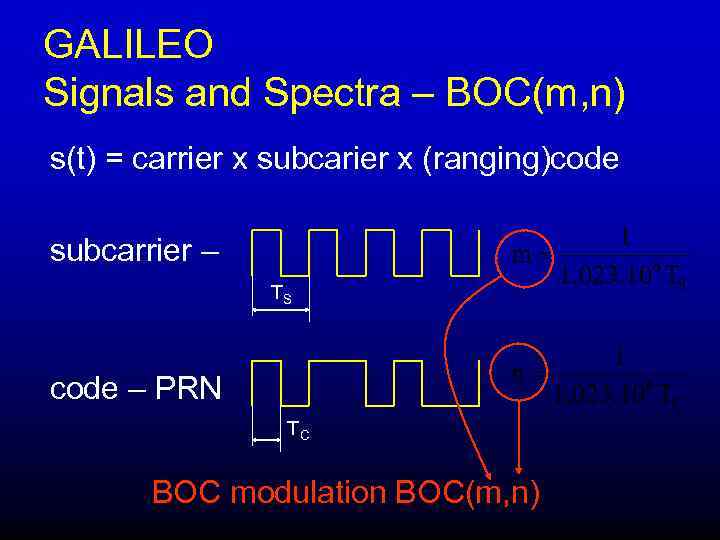 GALILEO Signals and Spectra – BOC(m, n) s(t) = carrier x subcarier x (ranging)code subcarrier – TS code – PRN TC BOC modulation BOC(m, n)
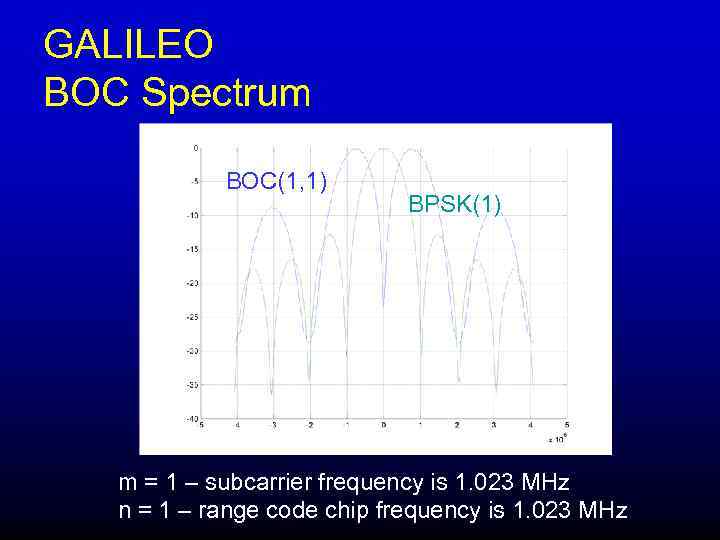 GALILEO BOC Spectrum BOC(1, 1) BPSK(1) m = 1 – subcarrier frequency is 1. 023 MHz n = 1 – range code chip frequency is 1. 023 MHz
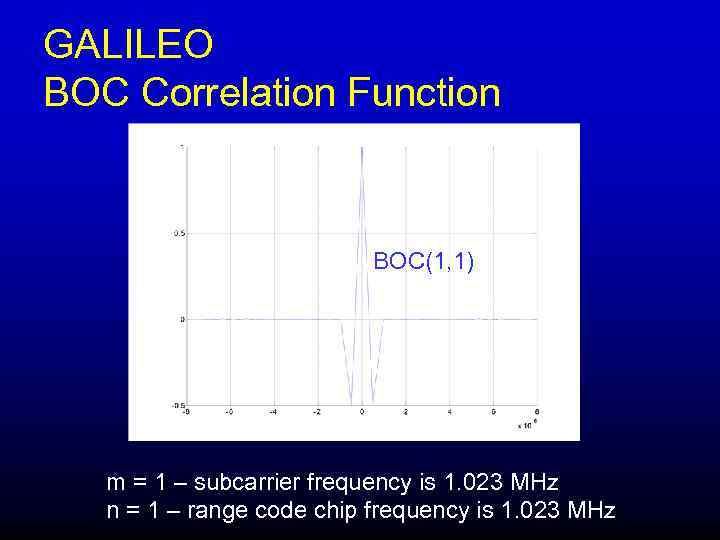 GALILEO BOC Correlation Function BOC(1, 1) m = 1 – subcarrier frequency is 1. 023 MHz n = 1 – range code chip frequency is 1. 023 MHz
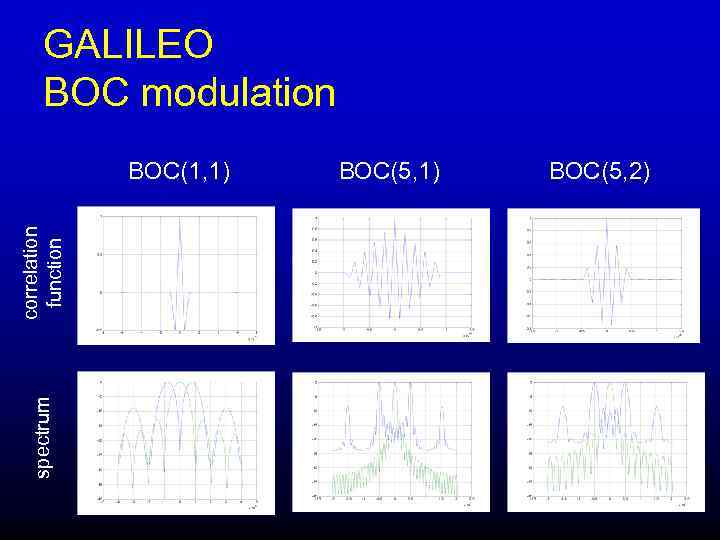 GALILEO BOC modulation spectrum correlation function BOC(1, 1) BOC(5, 2)
![GALILEO Signals, Services and Spectra data rate [symbol/s] data encryption PRS BOC(15, 2. 5)](https://present5.com/presentation/62691037_415872765/image-36.jpg "GALILEO Signals, Services and Spectra data rate [symbol/s] data encryption PRS BOC(15, 2. 5)") GALILEO Signals, Services and Spectra data rate [symbol/s] data encryption PRS BOC(15, 2. 5) yes 100 yes OS/So. L/ CS BOC(1, 1) none 250 some (CS) OS/So. L/ CS BOC(1, 1) none no data („pilot“) - modulation subcarrier frequency MHz code rate Mchips/s BOC(15, 2. 5) 15. 345 2. 5575 BOC(1, 1) 1. 023 1575. 420 742 589. 98 1. 0 Q So. L uses the same signals as OS with integrity message 56 IN QU AD R cos ATU R () E IN PHASE sin() I E 2 L 1 E 1 1587. 00 1591. 00 code encryption 1563. 00 modulation 1559. 00 service
GALILEO Signals, Services and Spectra data rate [symbol/s] data encryption PRS BOC(15, 2. 5) yes 100 yes OS/So. L/ CS BOC(1, 1) none 250 some (CS) OS/So. L/ CS BOC(1, 1) none no data („pilot“) - modulation subcarrier frequency MHz code rate Mchips/s BOC(15, 2. 5) 15. 345 2. 5575 BOC(1, 1) 1. 023 1575. 420 742 589. 98 1. 0 Q So. L uses the same signals as OS with integrity message 56 IN QU AD R cos ATU R () E IN PHASE sin() I E 2 L 1 E 1 1587. 00 1591. 00 code encryption 1563. 00 modulation 1559. 00 service
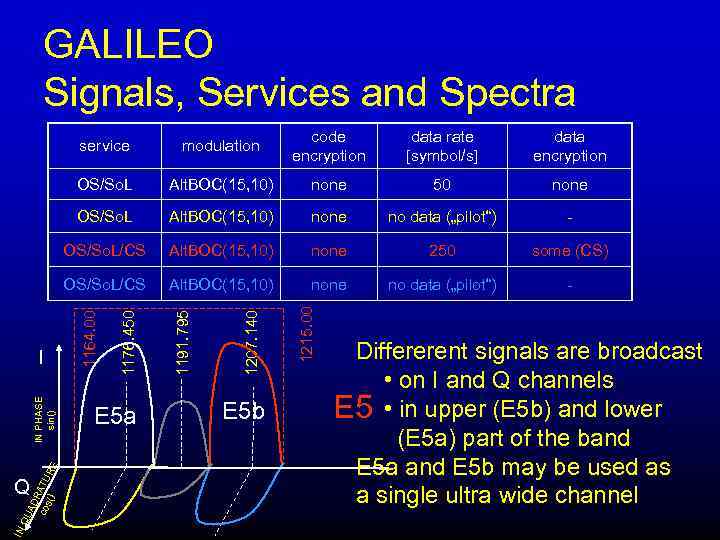 GALILEO Signals, Services and Spectra IN PHASE sin() Alt. BOC(15, 10) none no data („pilot“) - Alt. BOC(15, 10) none 250 some (CS) Alt. BOC(15, 10) none no data („pilot“) - E 5 a E 5 b 1215. 00 none 1207. 140 50 1191. 795 none 1176. 450 Alt. BOC(15, 10) OS/So. L/CS QU AD R cos ATU RE () data encryption OS/So. L/CS IN data rate [symbol/s] OS/So. L Q code encryption OS/So. L I modulation 1164. 00 service Differerent signals are broadcast • on I and Q channels E 5 • in upper (E 5 b) and lower (E 5 a) part of the band E 5 a and E 5 b may be used as a single ultra wide channel
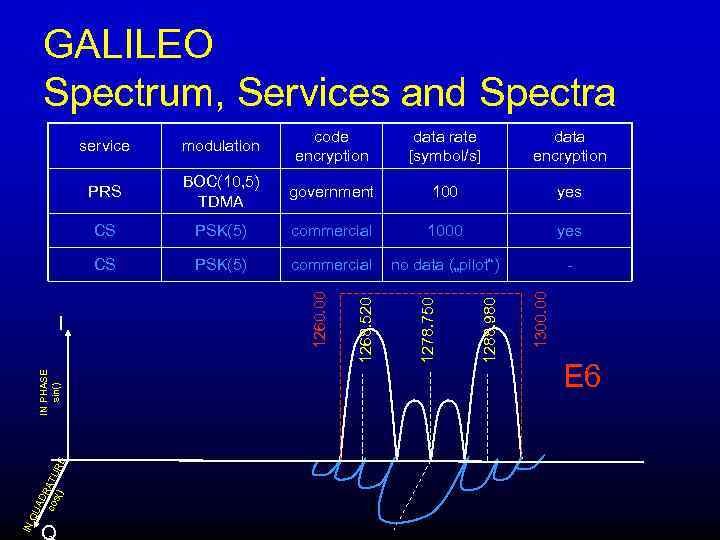 GALILEO Spectrum, Services and Spectra E IN PHASE sin() QU AD R cos ATU R () yes PSK(5) commercial 1000 yes PSK(5) commercial no data („pilot“) 1300. 00 1288. 980 government 1278. 750 BOC(10, 5) TDMA 1268. 520 data encryption CS IN data rate [symbol/s] CS Q code encryption PRS I modulation 1260. 00 service E 6
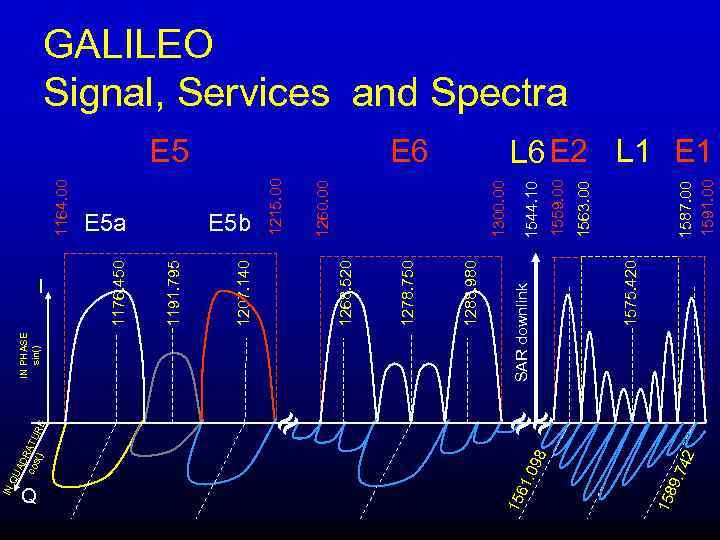 IN Q 42 9. 7 1575. 420 SAR downlink 1587. 00 1591. 00 1563. 00 1559. 00 1544. 10 1300. 00 E 6 158 8 ≈ ≈ 1288. 980 1278. 750 1260. 00 1215. 00 E 5 b 1268. 520 1207. 140 1191. 795 1176. 450 1164. 00 E 5 15 61. 09 IN PHASE sin() I E 5 a ≈ AD R cos ATU RE () QU GALILEO Signal, Services and Spectra L 6 E 2 L 1 E 1
![GALILEO Service Parameters Open Service (OS) Coverage Accuracy h-horizontal v-vertical [m] Availability Integrity global](https://present5.com/presentation/62691037_415872765/image-40.jpg "GALILEO Service Parameters Open Service (OS) Coverage Accuracy h-horizontal v-vertical [m] Availability Integrity global") GALILEO Service Parameters Open Service (OS) Coverage Accuracy h-horizontal v-vertical [m] Availability Integrity global h=4, v=8 dual frequency h=15, v=35 single frequency Commercial Service (CS) global local <1 three frequency access <10 cm local augmented signals Public Regulated Service (PRS) Safety of Life Service (So. L) global local global h=6. 5 v=12 1 local augmented signals 4 -6 dual frequency 99. 9% 99 – 99. 9% No Value added service Yes
GALILEO Service Parameters Open Service (OS) Coverage Accuracy h-horizontal v-vertical [m] Availability Integrity global h=4, v=8 dual frequency h=15, v=35 single frequency Commercial Service (CS) global local <1 three frequency access <10 cm local augmented signals Public Regulated Service (PRS) Safety of Life Service (So. L) global local global h=6. 5 v=12 1 local augmented signals 4 -6 dual frequency 99. 9% 99 – 99. 9% No Value added service Yes
 BEIDOU
 BEIDOU „China‘s „Beidou“ navigation system is a regional positioning system mainly covering the country and its neighbouring areas, thus making vertical positioning impossible and limiting the number of users. “ • 3 geostationary satellites • circular orbits
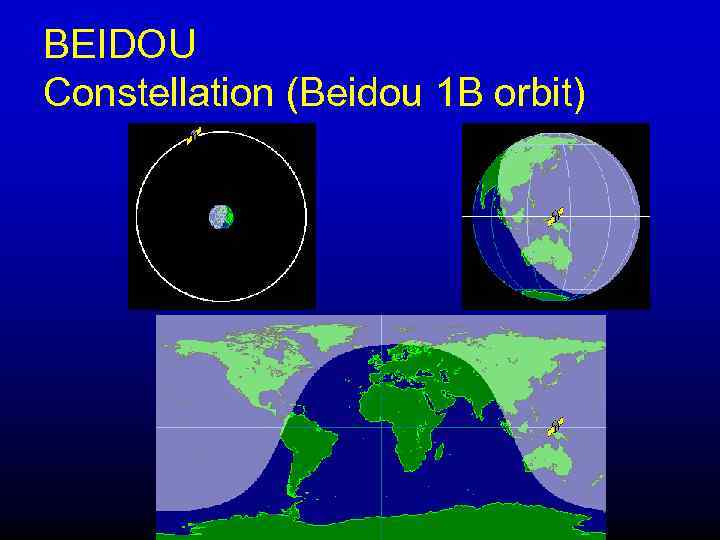 BEIDOU Constellation (Beidou 1 B orbit)
 Augmentations
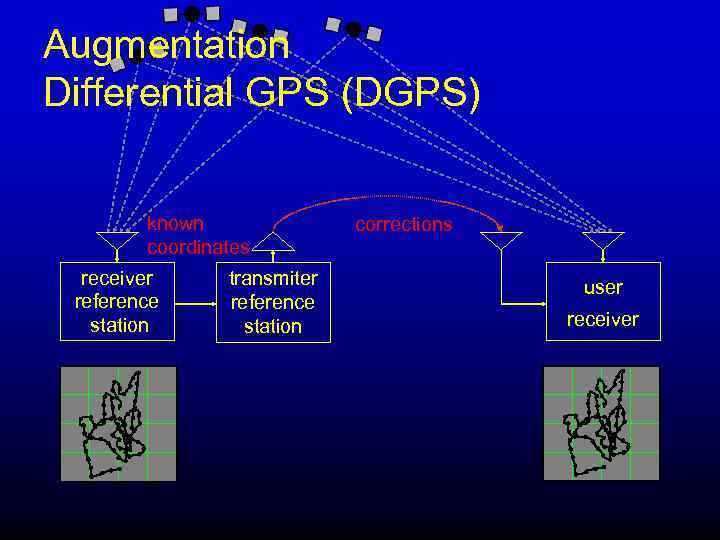 Augmentation Differential GPS (DGPS) known coordinates receiver reference station transmiter reference station corrections user receiver
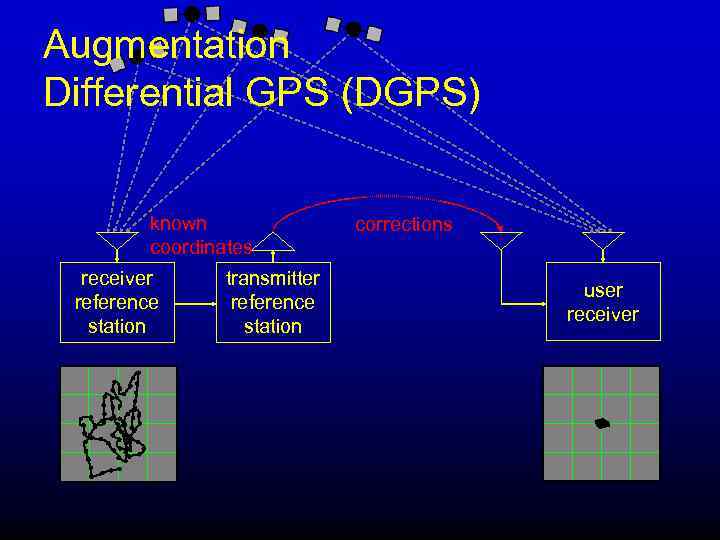 Augmentation Differential GPS (DGPS) known coordinates receiver reference station transmitter reference station corrections user receiver
 Augmentations • Many systems – NDGPS – maritime systems • Systems with satellite channel for corrections transmission – WADGPS – SBAS (ICAO) – Satellite Based Augmentation Systems • • WAAS MSAS EGNOS → future part of GALILEO …
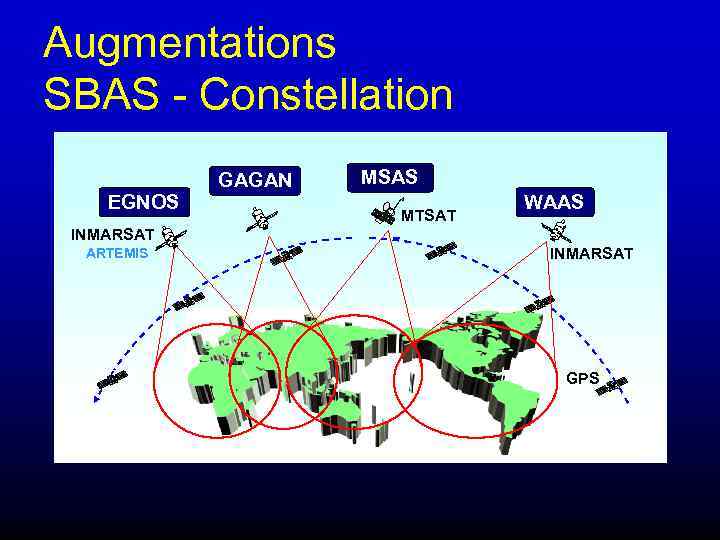 Augmentations SBAS - Constellation EGNOS GAGAN MSAS MTSAT WAAS INMARSAT ARTEMIS INMARSAT GPS
 Augmentations SBAS - signals Similar to SATNAV systems signals
 Augmentation QZSS
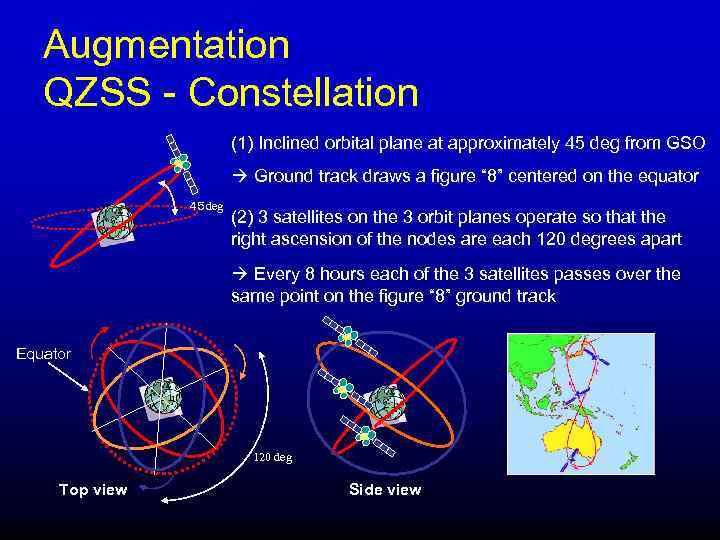 Augmentation QZSS - Constellation (1) Inclined orbital plane at approximately 45 deg from GSO Ground track draws a figure “ 8” centered on the equator 45deg (2) 3 satellites on the 3 orbit planes operate so that the right ascension of the nodes are each 120 degrees apart Every 8 hours each of the 3 satellites passes over the same point on the figure “ 8” ground track Equator 120 deg Top view Side view
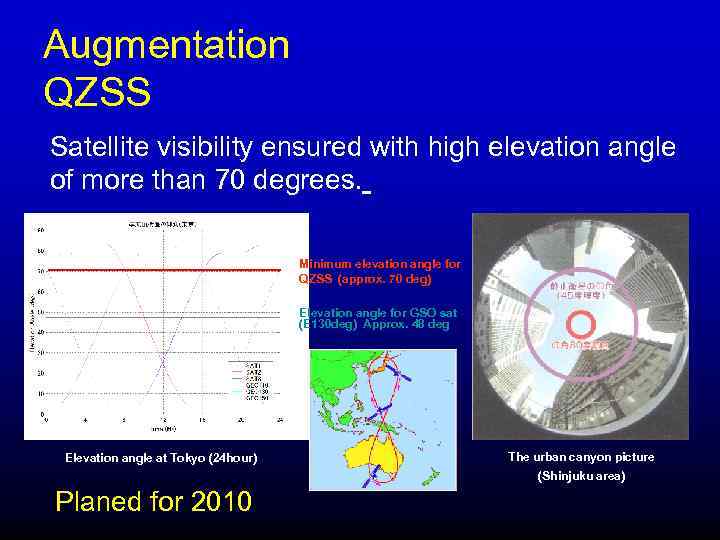 Augmentation QZSS Satellite visibility ensured with high elevation angle of more than 70 degrees. Minimum elevation angle for QZSS (approx. 70 deg) Elevation angle for GSO sat (E 130 deg) Approx. 48 deg Elevation angle at Tokyo (24 hour) The urban canyon picture (Shinjuku area) Planed for 2010
 MODERNISATION GPS
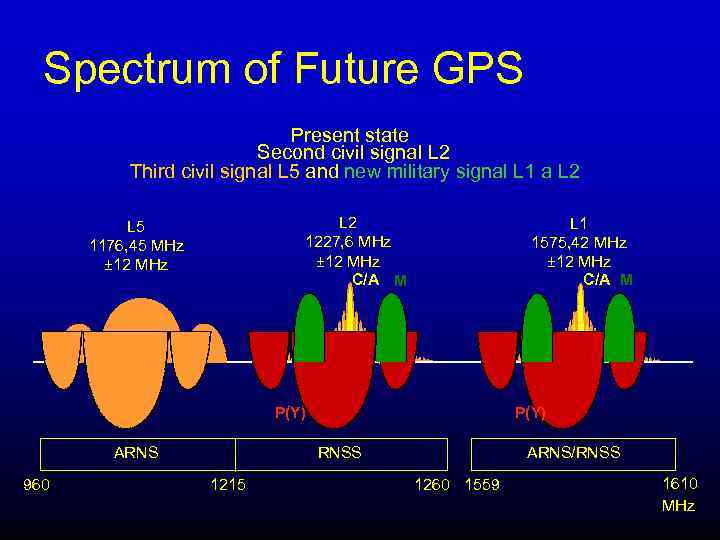 Spectrum of Future GPS Present state Second civil signal L 2 Third civil signal L 5 and new military signal L 1 a L 2 1227, 6 MHz ± 12 MHz C/A M L 5 1176, 45 MHz ± 12 MHz L 1 1575, 42 MHz ± 12 MHz C/A M P(Y) ARNS 960 P(Y) RNSS 1215 ARNS/RNSS 1260 1559 1610 MHz
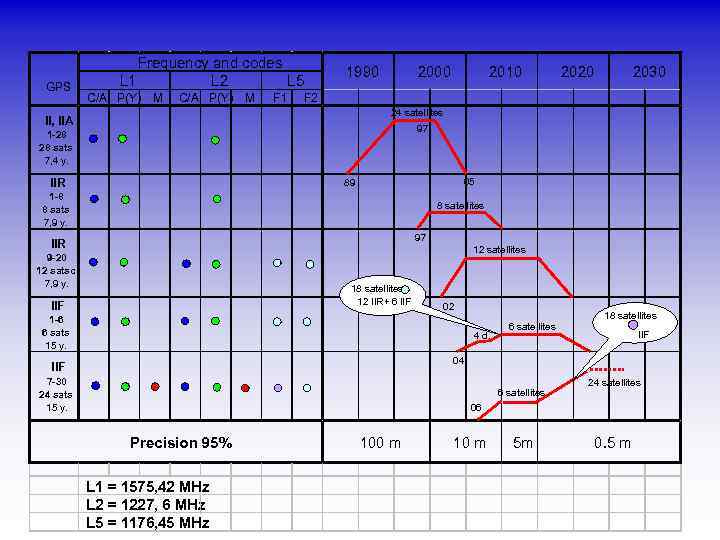 GPS Frequency and codes L 1 L 2 L 5 C/A P(Y) M F 1 1990 2000 2010 2020 2030 F 2 24 satellites II, IIA 97 1 -28 28 sats 7, 4 y. IIR 05 89 1 -8 8 sats 7, 9 y. 8 satellites 97 IIR 12 satellites 9 -20 12 satsc 7, 9 y. 18 satellites 12 IIR+ 6 IIF 02 1 -6 6 sats 15 y. 4 d. 6 satellites 18 satellites IIF 04 IIF 7 -30 24 sats 15 y. 6 satellites 24 satellites 06 Precision 95% L 1 = 1575, 42 MHz L 2 = 1227, 6 MHz L 5 = 1176, 45 MHz 100 m 10 m 5 m 0. 5 m
 Comparison of Systems
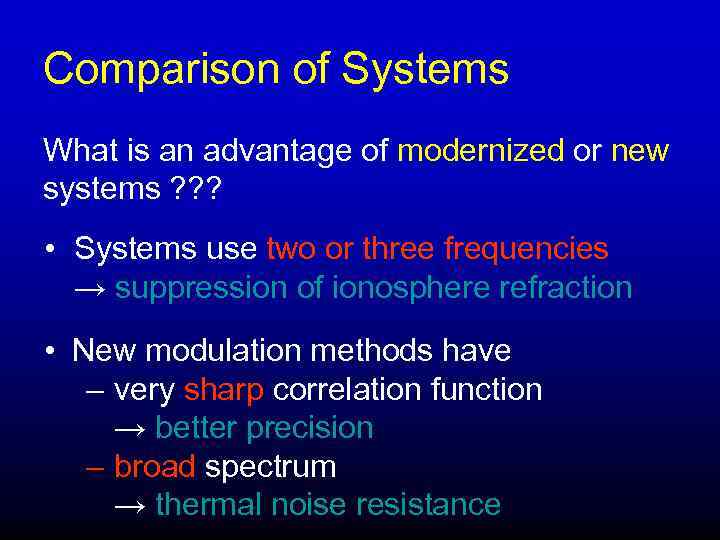 Comparison of Systems What is an advantage of modernized or new systems ? ? ? • Systems use two or three frequencies → suppression of ionosphere refraction • New modulation methods have – very sharp correlation function → better precision – broad spectrum → thermal noise resistance
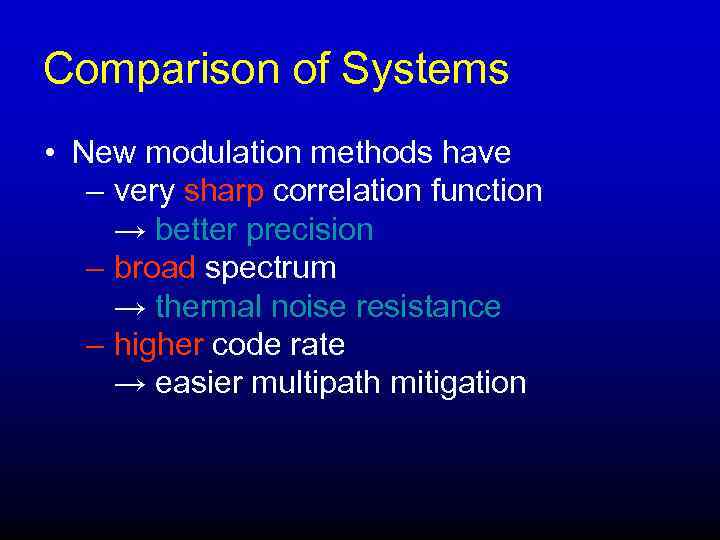 Comparison of Systems • New modulation methods have – very sharp correlation function → better precision – broad spectrum → thermal noise resistance – higher code rate → easier multipath mitigation
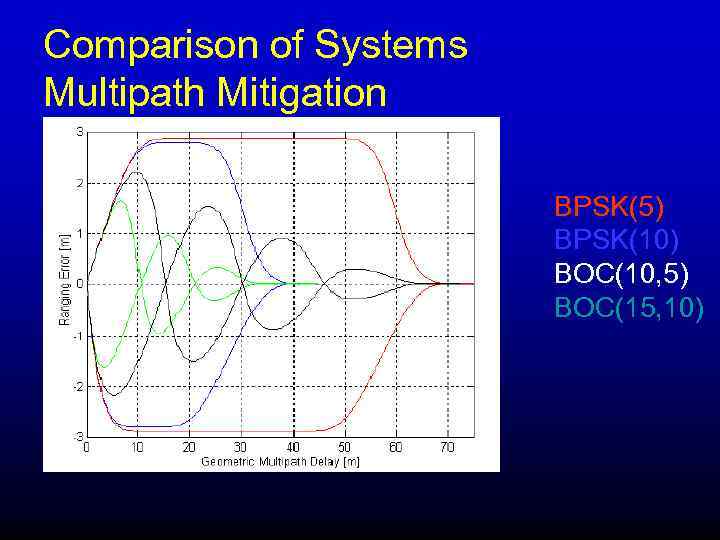 Comparison of Systems Multipath Mitigation BPSK(5) BPSK(10) BOC(10, 5) BOC(15, 10)
 Comparison of Systems • New modulation methods have – very sharp correlation function → better precision – broad spectrum → thermal noise resistance – higher code rate → easier multipath mitigation • Constellations ensure better satellite visibility → lower PDOP → better precision, integrity, …
 RECEIVER ARCHITECTURE Requirements • Processing of all known and planned SATNAV signals: – – GPS L 1, L 2, L 5 GLONASS GALILEO Augmentations • EGNOS • WAAS • Flexible design and development of powerful algorithms of signal processing • Easy implementation of them • Rapid and simple prototyping and testing Software Defined Radio
 RECEIVER ARCHITECTURE Requirements Software Defined Radio What processor to use ? ? ? • DSP • FPGA
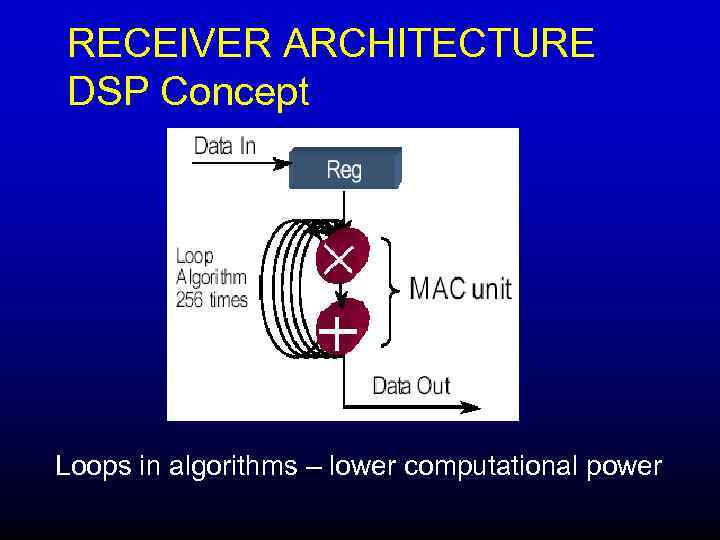 RECEIVER ARCHITECTURE DSP Concept Loops in algorithms – lower computational power
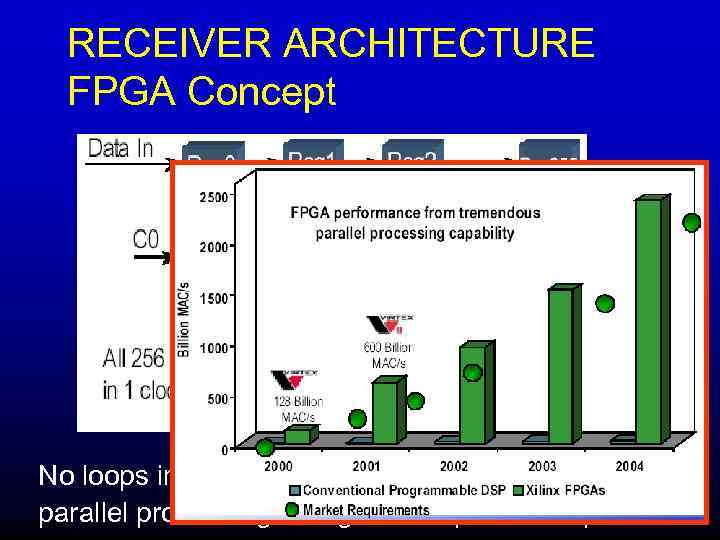 RECEIVER ARCHITECTURE FPGA Concept No loops in algorithms parallel processing → higher computational power
 RESULTS at CZECH TECHNICAL UNIVERSITY Experimental receiver
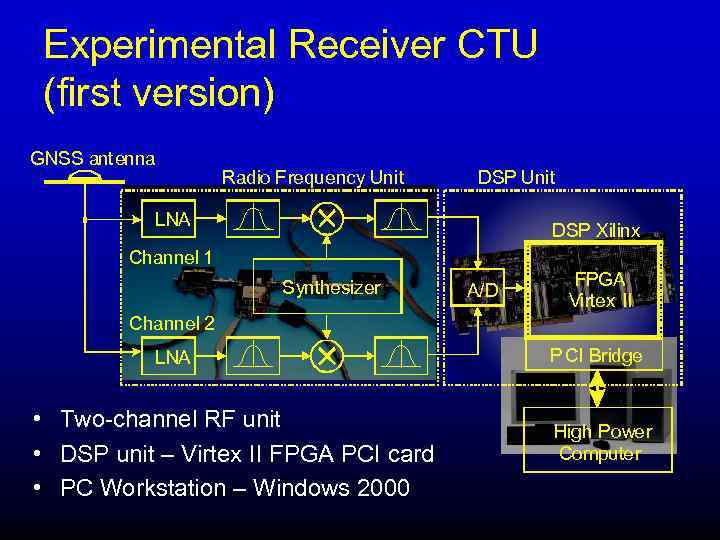 Experimental Receiver CTU (first version) GNSS antenna Radio Frequency Unit DSP Unit LNA DSP Xilinx Channel 1 Synthesizer A/D FPGA Virtex II Channel 2 LNA • Two-channel RF unit • DSP unit – Virtex II FPGA PCI card • PC Workstation – Windows 2000 PCI Bridge High Power Computer
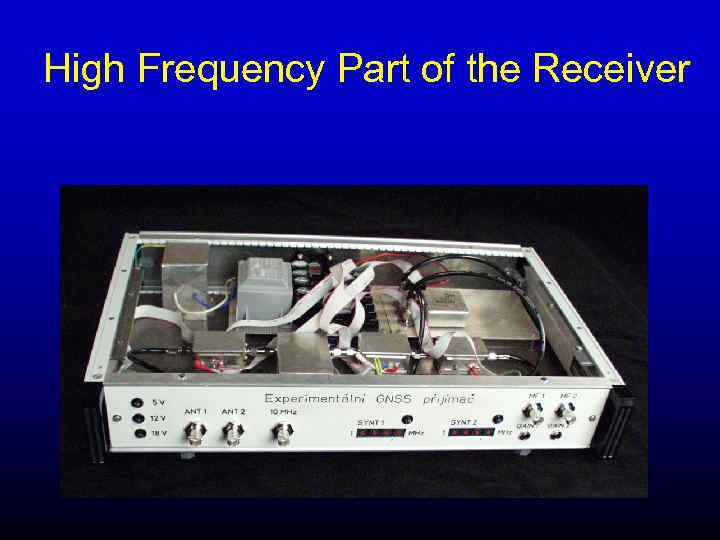 High Frequency Part of the Receiver
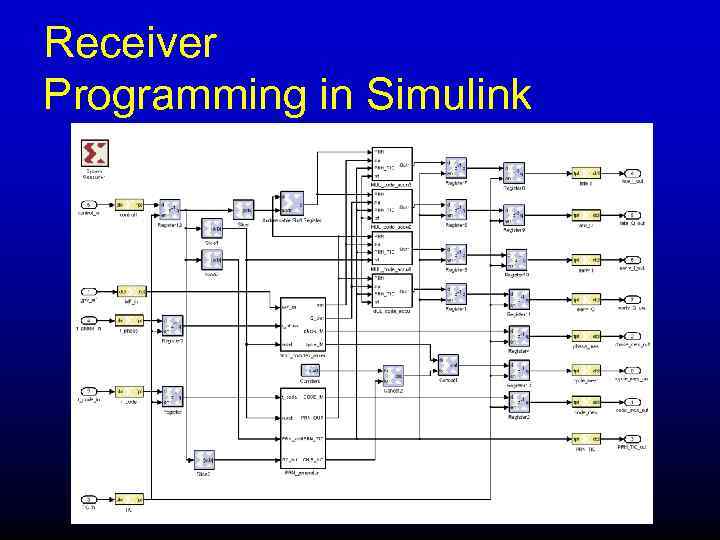 Receiver Programming in Simulink
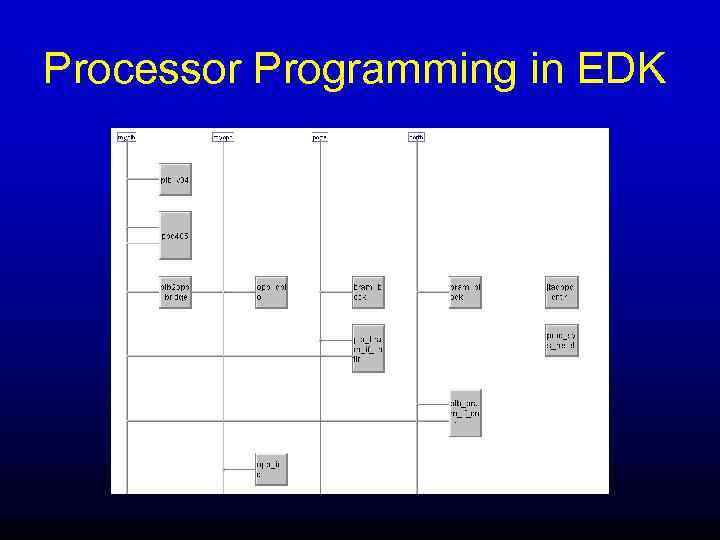 Processor Programming in EDK
 Conclusions • Software Radio is prospective technology for multi-systems GNSS receivers, as well as FPGA technology • This technology make possible design of receivers for hard receptions conditions (leaves canopy, urban environment, etc. )
 Thank you for your attention. Pavel Kovář & František Vejražka & Libor Seidl Czech Technical University Prague, the Czech Republic http: //radio. feld. cvut. cz/personal/vejrazka