


 Скачать презентацию Present Continuous now at the moment this
Present Continuous.pptx
- Количество слайдов: 5
 Present Continuous now at the moment this …
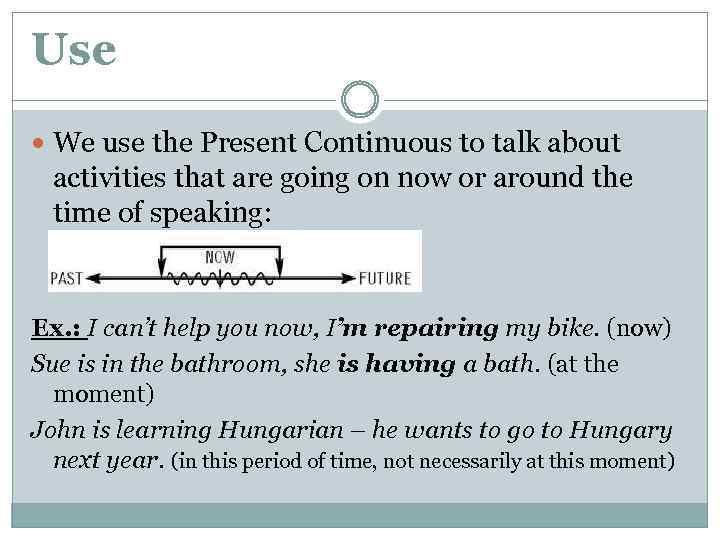 Use We use the Present Continuous to talk about activities that are going on now or around the time of speaking: Ex. : I can’t help you now, I’m repairing my bike. (now) Sue is in the bathroom, she is having a bath. (at the moment) John is learning Hungarian – he wants to go to Hungary next year. (in this period of time, not necessarily at this moment)
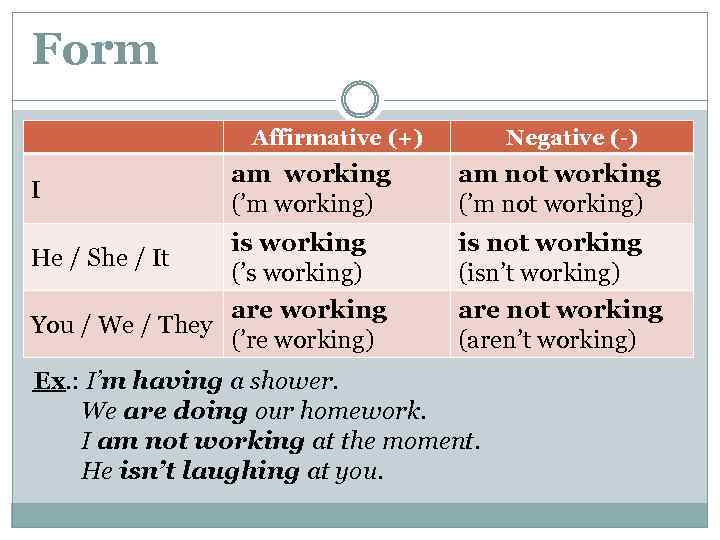 Form Affirmative (+) Negative (-) am working (’m working) am not working (’m not working) is working He / She / It (’s working) are working You / We / They (’re working) is not working (isn’t working) are not working (aren’t working) I Ex. : I’m having a shower. We are doing our homework. I am not working at the moment. He isn’t laughing at you.
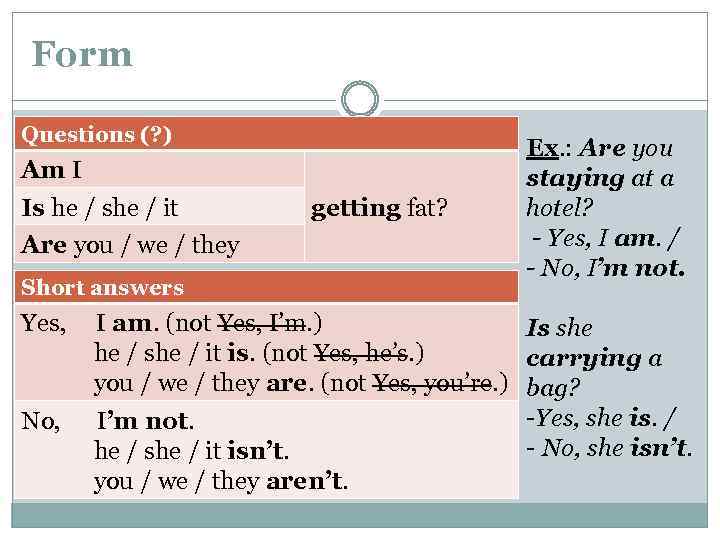 Form Questions (? ) Am I Is he / she / it Are you / we / they getting fat? Short answers Yes, No, I am. (not Yes, I’m. ) he / she / it is. (not Yes, he’s. ) you / we / they are. (not Yes, you’re. ) I’m not. he / she / it isn’t. you / we / they aren’t. Ex. : Are you staying at a hotel? - Yes, I am. / - No, I’m not. Is she carrying a bag? -Yes, she is. / - No, she isn’t.
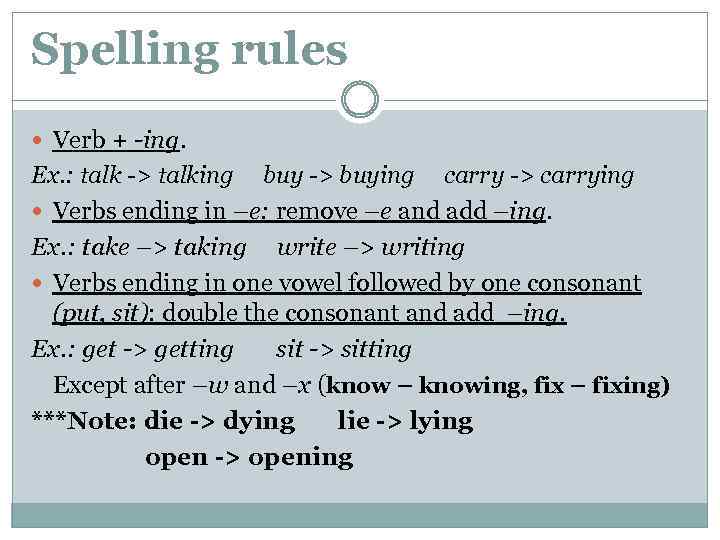 Spelling rules Verb + -ing. Ex. : talk -> talking buy -> buying carry -> carrying Verbs ending in –e: remove –e and add –ing. Ex. : take –> taking write –> writing Verbs ending in one vowel followed by one consonant (put, sit): double the consonant and add –ing. Ex. : get -> getting sit -> sitting Except after –w and –x (know – knowing, fix – fixing) ***Note: die -> dying lie -> lying open -> opening