


 Скачать презентацию Preretirement Planning TRSC 4832 -0311 2011 Transamerica
6a4271040bfe29f2e1ff5e0c1cc4b6e6.ppt
- Количество слайдов: 35
 Preretirement Planning TRSC 4832 -0311 © 2011 Transamerica Retirement Services Corporation. All rights reserved. FOR EDUCATIONAL USE ONLY
 Preretirement Planning Today’s Agenda ü How much have you saved? ü How much will you need? ü Managing risks in retirement. ü Strategies in retirement.
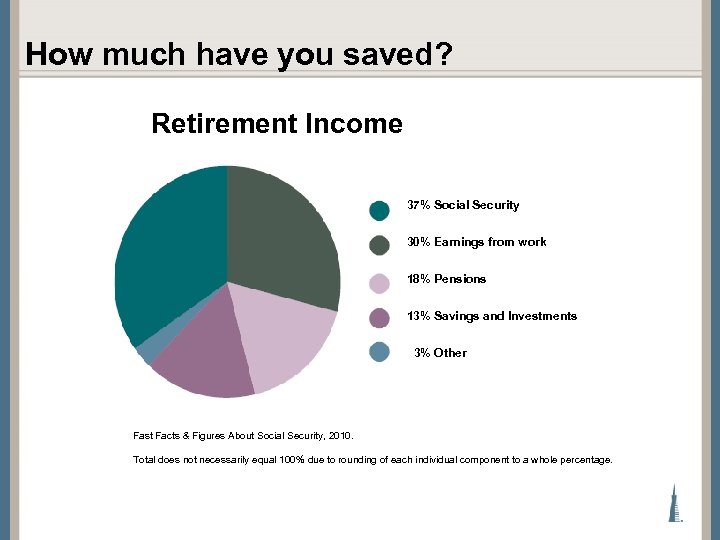 How much have you saved? Retirement Income 37% Social Security 30% Earnings from work 18% Pensions 13% Savings and Investments 3% Other Fast Facts & Figures About Social Security, 2010. Total does not necessarily equal 100% due to rounding of each individual component to a whole percentage.
 How much have you saved? Employer-Sponsored Retirement Savings Plans IRAs Stocks, Bonds, Cash Other: $__________ TOTAL $_____
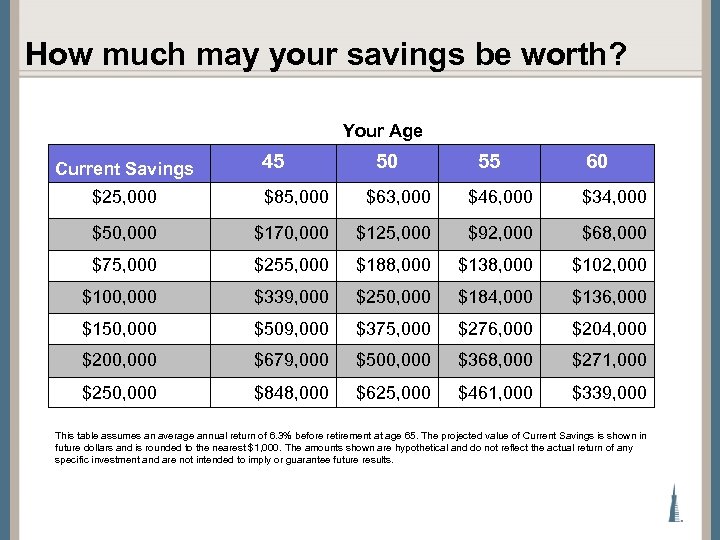 How much may your savings be worth? Your Age Current Savings 45 50 55 60 $25, 000 $85, 000 $63, 000 $46, 000 $34, 000 $50, 000 $170, 000 $125, 000 $92, 000 $68, 000 $75, 000 $255, 000 $188, 000 $138, 000 $102, 000 $100, 000 $339, 000 $250, 000 $184, 000 $136, 000 $150, 000 $509, 000 $375, 000 $276, 000 $204, 000 $200, 000 $679, 000 $500, 000 $368, 000 $271, 000 $250, 000 $848, 000 $625, 000 $461, 000 $339, 000 This table assumes an average annual return of 6. 3% before retirement at age 65. The projected value of Current Savings is shown in future dollars and is rounded to the nearest $1, 000. The amounts shown are hypothetical and do not reflect the actual return of any specific investment and are not intended to imply or guarantee future results.
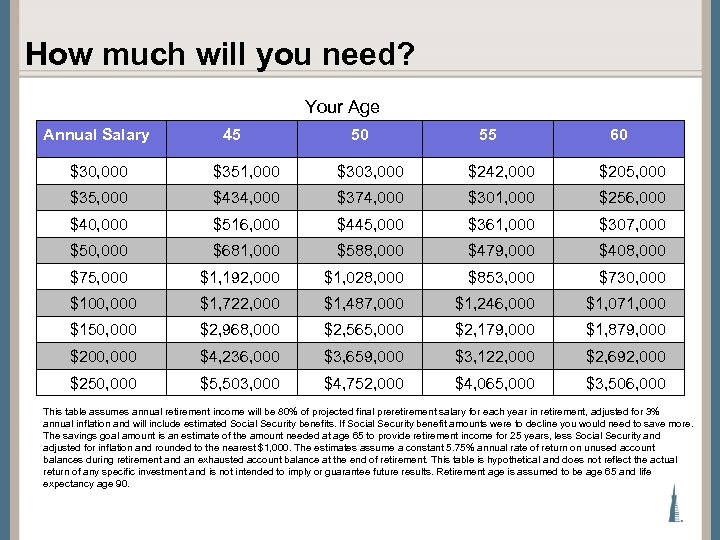 How much will you need? Your Age Annual Salary 45 50 55 60 $30, 000 $351, 000 $303, 000 $242, 000 $205, 000 $35, 000 $434, 000 $374, 000 $301, 000 $256, 000 $40, 000 $516, 000 $445, 000 $361, 000 $307, 000 $50, 000 $681, 000 $588, 000 $479, 000 $408, 000 $75, 000 $1, 192, 000 $1, 028, 000 $853, 000 $730, 000 $100, 000 $1, 722, 000 $1, 487, 000 $1, 246, 000 $1, 071, 000 $150, 000 $2, 968, 000 $2, 565, 000 $2, 179, 000 $1, 879, 000 $200, 000 $4, 236, 000 $3, 659, 000 $3, 122, 000 $2, 692, 000 $250, 000 $5, 503, 000 $4, 752, 000 $4, 065, 000 $3, 506, 000 This table assumes annual retirement income will be 80% of projected final preretirement salary for each year in retirement, adjusted for 3% annual inflation and will include estimated Social Security benefits. If Social Security benefit amounts were to decline you would need to save more. The savings goal amount is an estimate of the amount needed at age 65 to provide retirement income for 25 years, less Social Security and adjusted for inflation and rounded to the nearest $1, 000. The estimates assume a constant 5. 75% annual rate of return on unused account balances during retirement and an exhausted account balance at the end of retirement. This table is hypothetical and does not reflect the actual return of any specific investment and is not intended to imply or guarantee future results. Retirement age is assumed to be age 65 and life expectancy age 90.
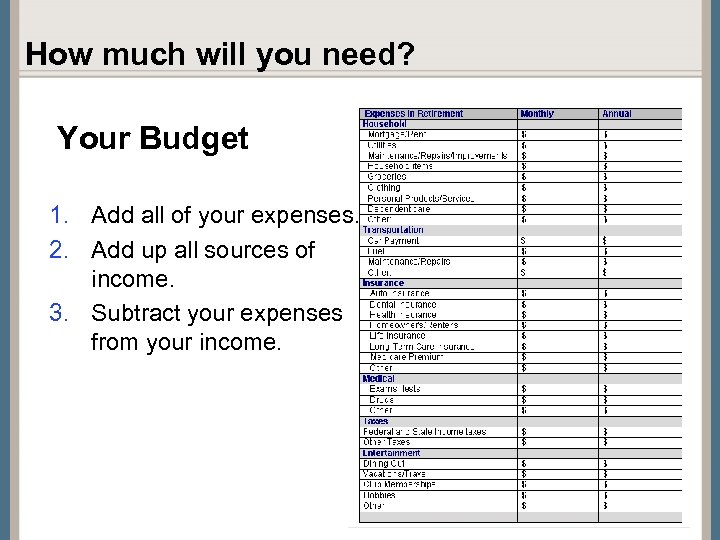 How much will you need? Your Budget 1. Add all of your expenses. 2. Add up all sources of income. 3. Subtract your expenses from your income.
 Closing the Gap: What can you do now? ü Save more now ü Change investment mix* ü Work longer *Asset allocation and diversification do not assure or guarantee better performance and cannot eliminate the risk of investment losses.
 Closing the Gap: What can you do at retirement? ü Spend less in retirement ü Work part-time in retirement ü Change investment mix* *Asset allocation and diversification do not assure or guarantee better performance and cannot eliminate the risk of investment losses.
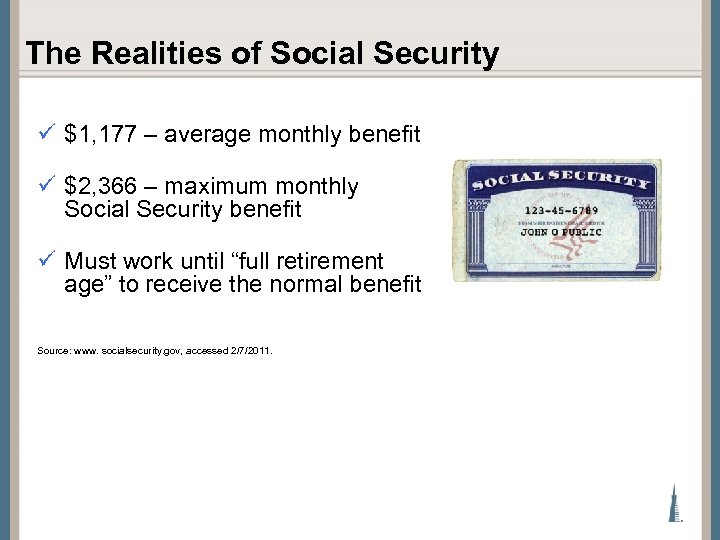 The Realities of Social Security ü $1, 177 – average monthly benefit ü $2, 366 – maximum monthly Social Security benefit ü Must work until “full retirement age” to receive the normal benefit Source: www. socialsecurity. gov, accessed 2/7/2011.
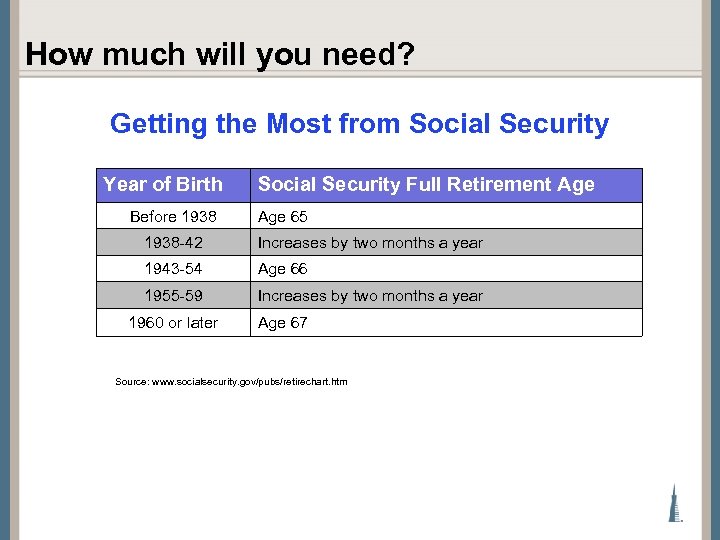 How much will you need? Getting the Most from Social Security Year of Birth Before 1938 Social Security Full Retirement Age 65 1938 -42 Increases by two months a year 1943 -54 Age 66 1955 -59 Increases by two months a year 1960 or later Age 67 Source: www. socialsecurity. gov/pubs/retirechart. htm
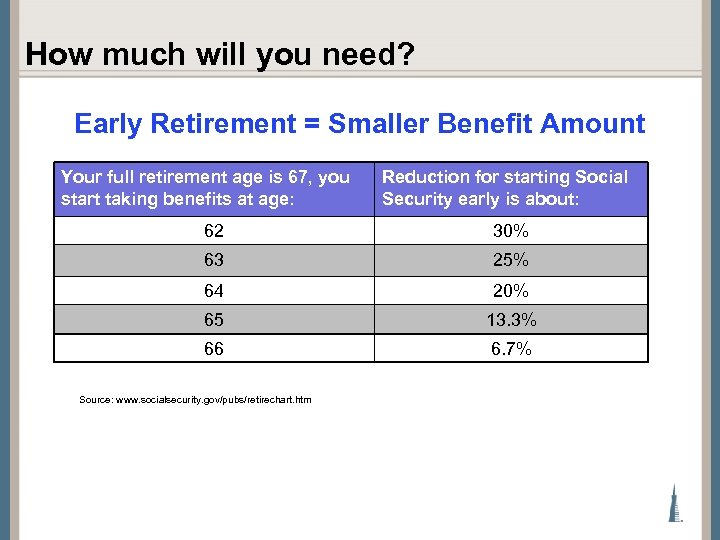 How much will you need? Early Retirement = Smaller Benefit Amount Your full retirement age is 67, you start taking benefits at age: Reduction for starting Social Security early is about: 62 30% 63 25% 64 20% 65 13. 3% 66 6. 7% Source: www. socialsecurity. gov/pubs/retirechart. htm
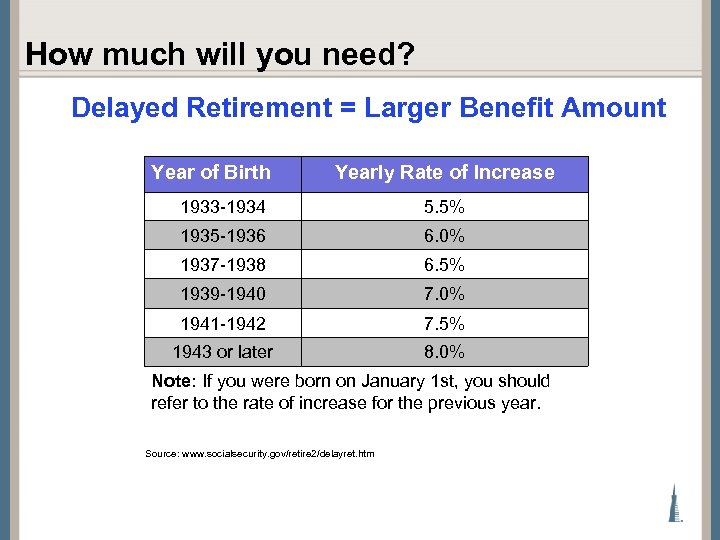 How much will you need? Delayed Retirement = Larger Benefit Amount Year of Birth Yearly Rate of Increase 1933 -1934 5. 5% 1935 -1936 6. 0% 1937 -1938 6. 5% 1939 -1940 7. 0% 1941 -1942 7. 5% 1943 or later 8. 0% Note: If you were born on January 1 st, you should refer to the rate of increase for the previous year. Source: www. socialsecurity. gov/retire 2/delayret. htm
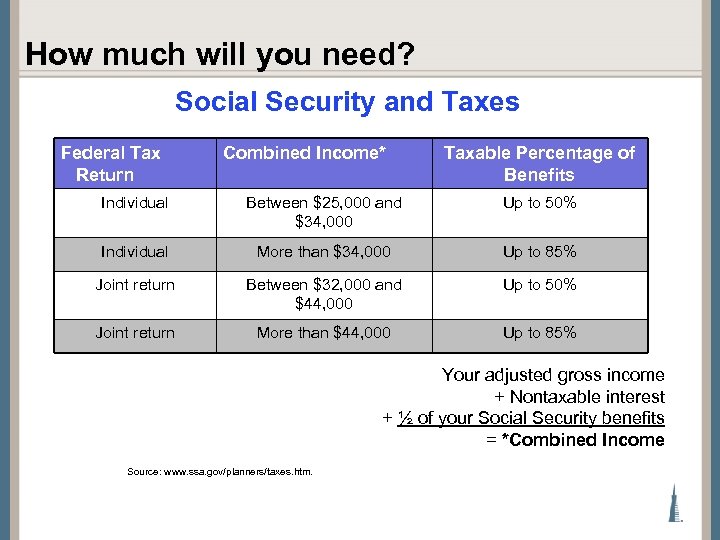 How much will you need? Social Security and Taxes Federal Tax Return Combined Income* Taxable Percentage of Benefits Individual Between $25, 000 and $34, 000 Up to 50% Individual More than $34, 000 Up to 85% Joint return Between $32, 000 and $44, 000 Up to 50% Joint return More than $44, 000 Up to 85% Your adjusted gross income + Nontaxable interest + ½ of your Social Security benefits = *Combined Income Source: www. ssa. gov/planners/taxes. htm.
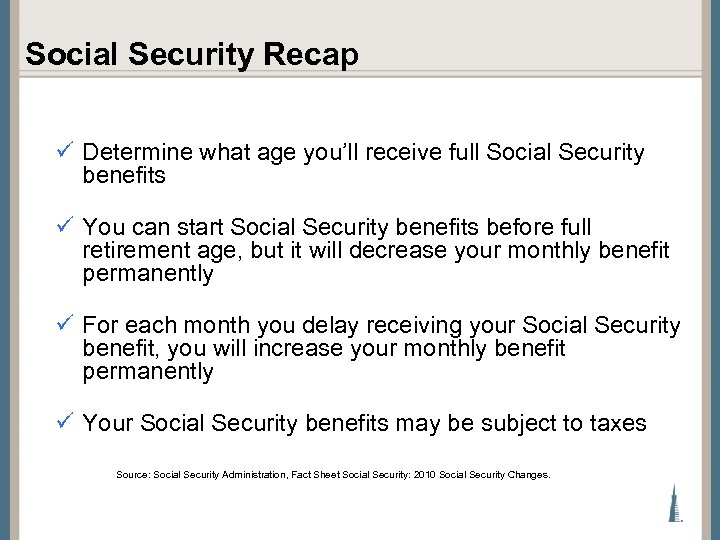 Social Security Recap ü Determine what age you’ll receive full Social Security benefits ü You can start Social Security benefits before full retirement age, but it will decrease your monthly benefit permanently ü For each month you delay receiving your Social Security benefit, you will increase your monthly benefit permanently ü Your Social Security benefits may be subject to taxes Source: Social Security Administration, Fact Sheet Social Security: 2010 Social Security Changes.
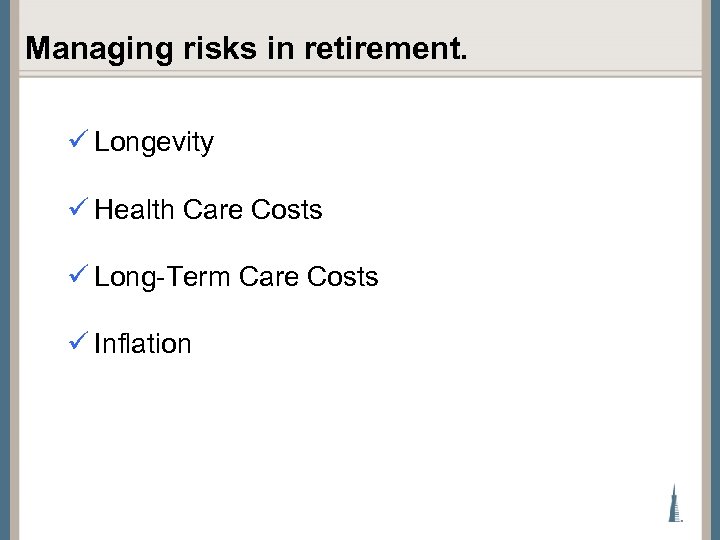 Managing risks in retirement. ü Longevity ü Health Care Costs ü Long-Term Care Costs ü Inflation
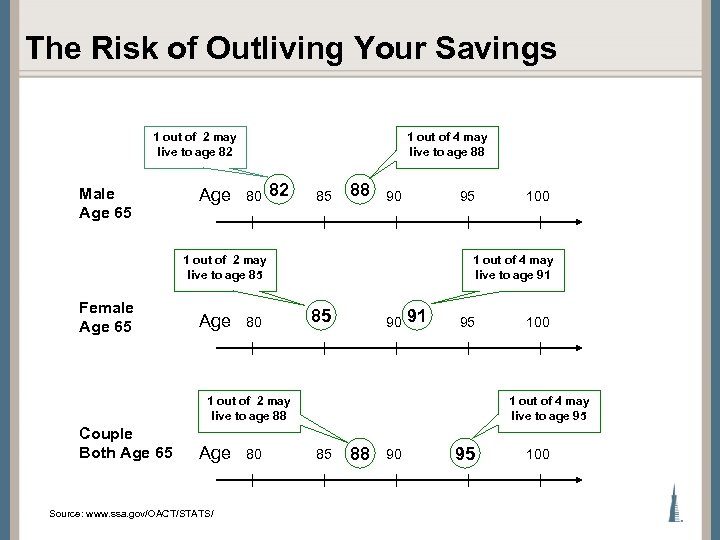 The Risk of Outliving Your Savings 1 out of 2 may live to age 82 Male Age 65 Age 1 out of 4 may live to age 88 80 82 85 88 90 95 1 out of 2 may live to age 85 Female Age 65 Age 80 1 out of 4 may live to age 91 85 90 91 95 1 out of 2 may live to age 88 Couple Both Age 65 Age Source: www. ssa. gov/OACT/STATS/ 80 100 1 out of 4 may live to age 95 85 88 90 95 100
 Managing Longevity Risk ü Start saving more now ü Grow your retirement savings ü Educate yourself on investment products that provide a guaranteed lifetime benefit
 Health Care Risk ü A man retiring at age 65 would need about $125, 000 in savings to cover heath care expenses ü A woman retiring at age 65 would need about $143, 000 in savings to cover heath care expenses ü Health care and long-term care costs could be your biggest expenses and pose the greatest threat to your future financial security Source: Employee Benefit Research Institute, Issue Brief No. 351, December 2010.
 Managing Health Care Risk ü Consider the advantages of purchasing Medigap insurance ü Elect health coverage under your spouse’s plan ü Purchase individual health insurance ü Investigate COBRA benefits ü Consult with an insurance professional
 Long-Term Care Risk ü At age 65, you face a 40% lifetime risk of entering a nursing home ü By 2020, 12 million Americans will need long-term care ü About 10% of retirees who enter a nursing home will stay there five or more years Source: www. medicare. gov/Long. Term. Care/Static/
 Managing Long-Term Care Risk ü Buy insurance at the right time ü Buy the coverage you need ü Consult with an insurance professional
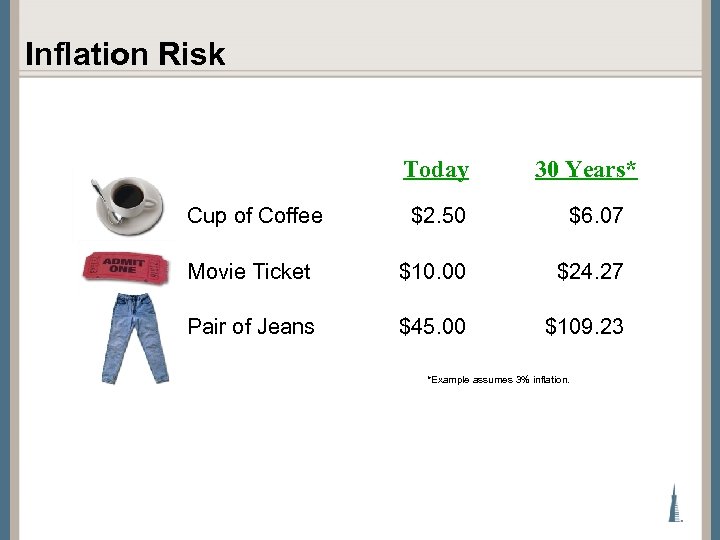 Inflation Risk Today 30 Years* Cup of Coffee $2. 50 $6. 07 Movie Ticket $10. 00 $24. 27 Pair of Jeans $45. 00 $109. 23 *Example assumes 3% inflation.
 Inflation Risk ü Start saving more now to make up for inflation later ü Cover your basic living expenses with inflation adjusted income such as Social Security ü Fight inflation by taking more investment risk with a portion of your retirement savings
 Strategies In Retirement ü Investment Strategies ü Withdrawal Strategies
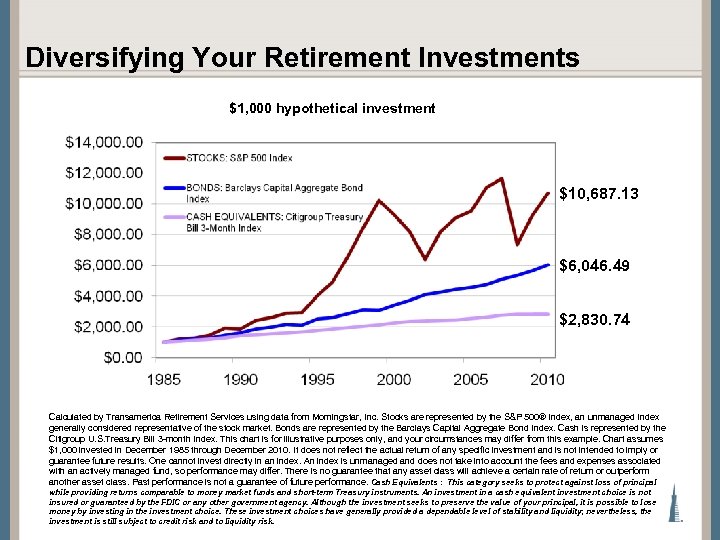 Diversifying Your Retirement Investments $1, 000 hypothetical investment $10, 687. 13 $6, 046. 49 $2, 830. 74 Calculated by Transamerica Retirement Services using data from Morningstar, Inc. Stocks are represented by the S&P 500® Index, an unmanaged index generally considered representative of the stock market. Bonds are represented by the Barclays Capital Aggregate Bond Index. Cash is represented by the Citigroup U. S. Treasury Bill 3 -month Index. This chart is for illustrative purposes only, and your circumstances may differ from this example. Chart assumes $1, 000 invested in December 1985 through December 2010. It does not reflect the actual return of any specific investment and is not intended to imply or guarantee future results. One cannot invest directly in an index. An index is unmanaged and does not take into account the fees and expenses associated with an actively managed fund, so performance may differ. There is no guarantee that any asset class will achieve a certain rate of return or outperform another asset class. Past performance is not a guarantee of future performance. Cash Equivalents : This category seeks to protect against loss of principal while providing returns comparable to money market funds and short-term Treasury instruments. An investment in a cash equivalent investment choice is not insured or guaranteed by the FDIC or any other government agency. Although the investment seeks to preserve the value of your principal, it is possible to lose money by investing in the investment choice. These investment choices have generally provided a dependable level of stability and liquidity; nevertheless, the investment is still subject to credit risk and to liquidity risk.
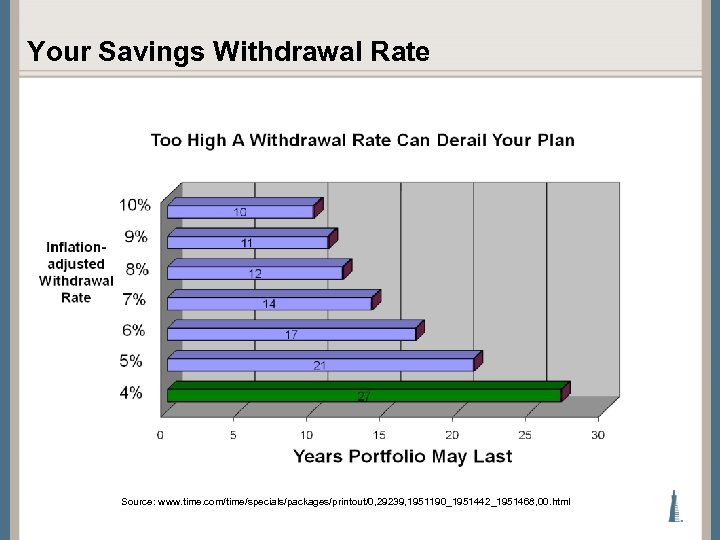 Your Savings Withdrawal Rate Source: www. time. com/time/specials/packages/printout/0, 29239, 1951190_1951442_1951468, 00. html
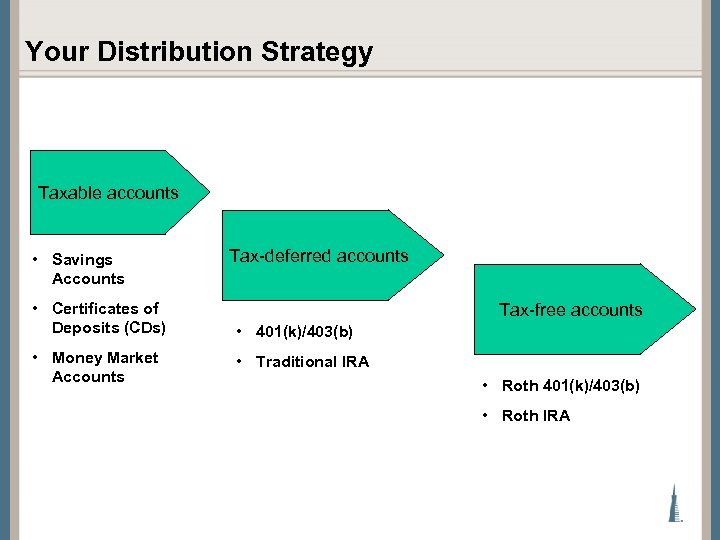 Your Distribution Strategy Taxable accounts • Savings Accounts • Certificates of Deposits (CDs) • Money Market Accounts Tax-deferred accounts Tax-free accounts • 401(k)/403(b) • Traditional IRA • Roth 401(k)/403(b) • Roth IRA
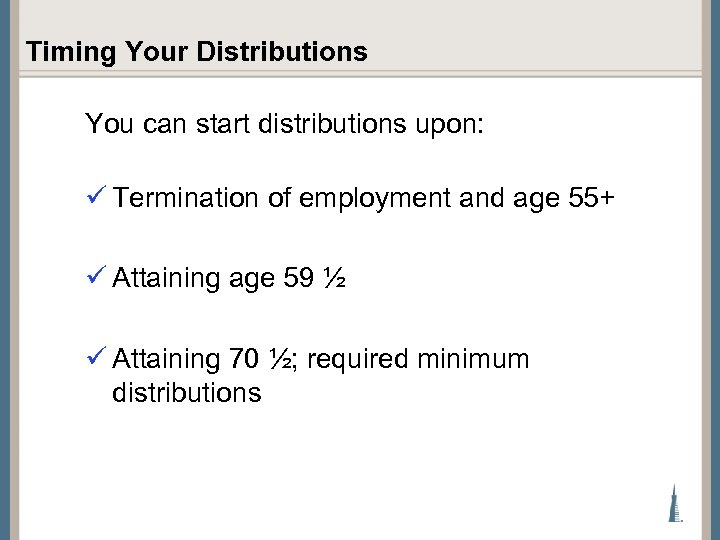 Timing Your Distributions You can start distributions upon: ü Termination of employment and age 55+ ü Attaining age 59 ½ ü Attaining 70 ½; required minimum distributions
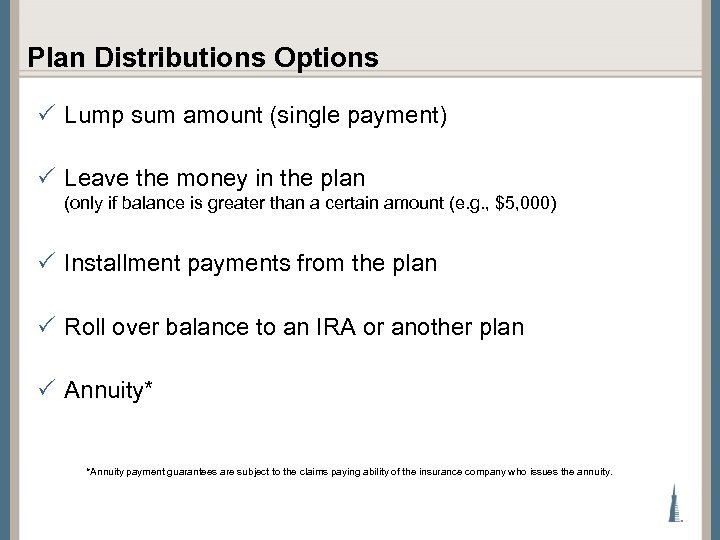 Plan Distributions Options P Lump sum amount (single payment) P Leave the money in the plan (only if balance is greater than a certain amount (e. g. , $5, 000) P Installment payments from the plan P Roll over balance to an IRA or another plan P Annuity* *Annuity payment guarantees are subject to the claims paying ability of the insurance company who issues the annuity.
 Strategies In Retirement üReview the assets you have set aside for retirement üDetermine an order and timing for withdrawals üWork with your tax professional and financial/estate adviser
 Resources ü Visit: www. TA-Retirement. com to check the balance on your 401(k) plan account ü Go to www. ssa. gov or call (800) 772 -1213 to request a statement of your personal Social Security benefit projections ü Contact the HR department of employers that provided you a pension for an estimate of your pension benefits
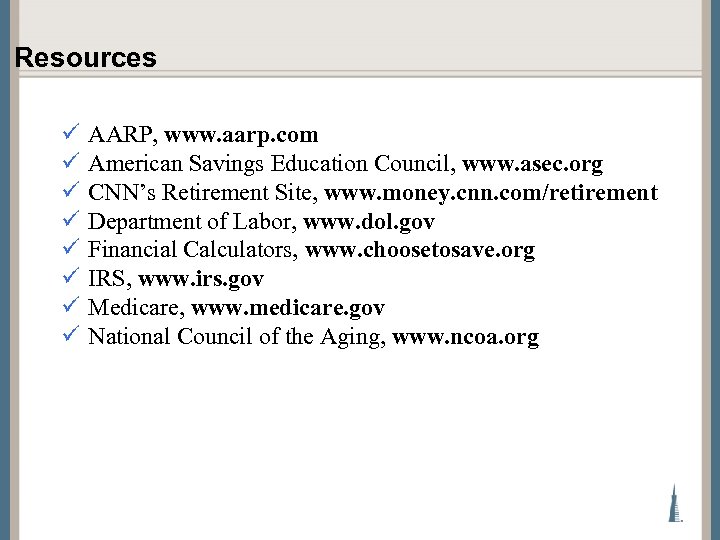 Resources ü ü ü ü AARP, www. aarp. com American Savings Education Council, www. asec. org CNN’s Retirement Site, www. money. cnn. com/retirement Department of Labor, www. dol. gov Financial Calculators, www. choosetosave. org IRS, www. irs. gov Medicare, www. medicare. gov National Council of the Aging, www. ncoa. org
 Any Questions?
 Disclosures Transamerica or Transamerica Retirement Services refers to Transamerica Retirement Services Corporation, which is headquartered in Los Angeles, CA. Transamerica Retirement Services and its representatives cannot give ERISA, tax, or legal advice. This material is provided for informational purposes only based on our understanding of material provided and should not be construed as ERISA, tax, or legal advice. Clients and other interested parties must consult and rely solely upon their own independent advisors regarding their particular situation and the concepts presented here. Although care has been taken in preparing this material and presenting it accurately, Transamerica Retirement Services disclaims any express or implied warranty as to the accuracy of any material contained herein and any liability with respect to it. Asset allocation and diversification do not assure or guarantee better performance and cannot eliminate the risk of investment losses. Transamerica Retirement Services does not provide investment advice. Clients and other interested parties must consult and rely solely upon their own independent advisors regarding their particular situation. Transamerica Retirement Services does not act as a fiduciary. Transamerica Retirement Services Corporation is an affiliate of Diversified Investors Securities Corporation (DISC). Securities are offered by DISC, 440 Mamaroneck Avenue, Harrison, NY 10528.