 Скачать презентацию Prequalification of essential medicines Technical Briefing Seminar Salle
80785d9bf2cae9a3736fdbae512d4349.ppt
- Количество слайдов: 27



Prequalification of essential medicines Technical Briefing Seminar Salle G, WHO Main building Geneva, 28 September 2004 Andre van Zyl, M. Pharm. Project Manager Health Technology and Pharmaceuticals Cluster, Essential Drugs and Medicines Policy, Quality Assurance and Safety: Medicines Tel: +41. 22. 791. 3598 Fax: +41. 22. 791. 4730 World Health Organization E-mail: vanzyla@who. int
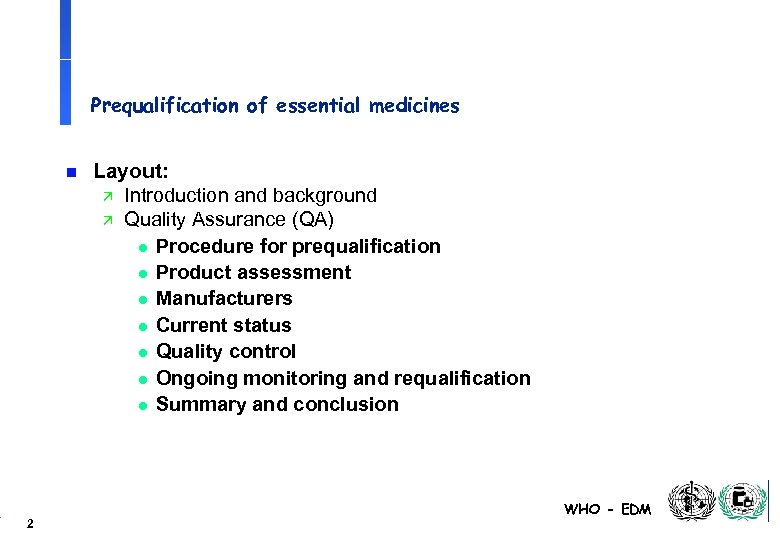
Prequalification of essential medicines n 2 Layout: ä Introduction and background ä Quality Assurance (QA) l Procedure for prequalification l Product assessment l Manufacturers l Current status l Quality control l Ongoing monitoring and requalification l Summary and conclusion WHO - EDM
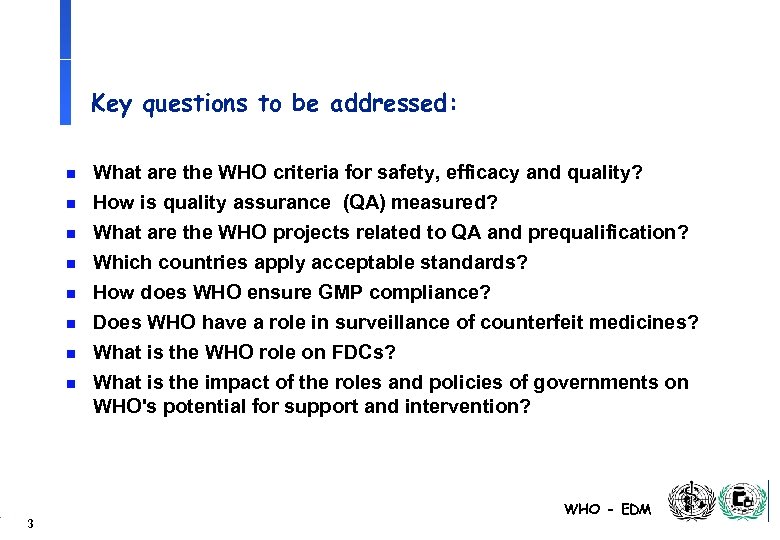
Key questions to be addressed: n n n n 3 What are the WHO criteria for safety, efficacy and quality? How is quality assurance (QA) measured? What are the WHO projects related to QA and prequalification? Which countries apply acceptable standards? How does WHO ensure GMP compliance? Does WHO have a role in surveillance of counterfeit medicines? What is the WHO role on FDCs? What is the impact of the roles and policies of governments on WHO's potential for support and intervention? WHO - EDM
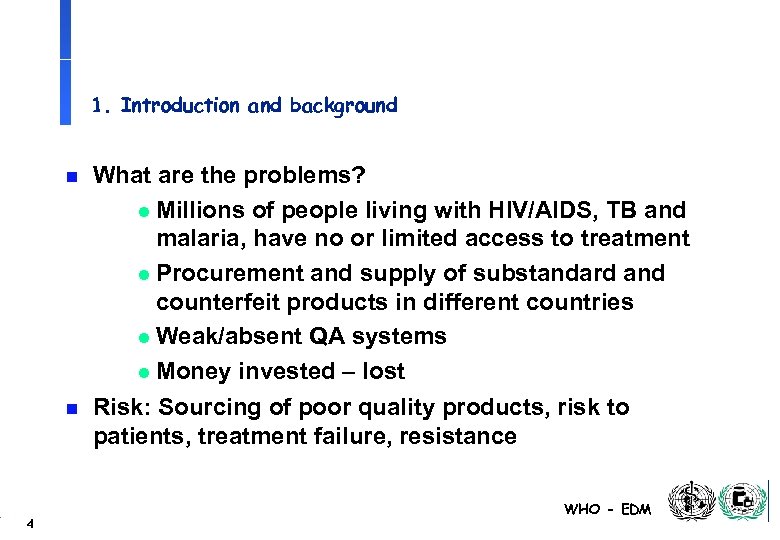
1. Introduction and background n n 4 What are the problems? l Millions of people living with HIV/AIDS, TB and malaria, have no or limited access to treatment l Procurement and supply of substandard and counterfeit products in different countries l Weak/absent QA systems l Money invested – lost Risk: Sourcing of poor quality products, risk to patients, treatment failure, resistance WHO - EDM
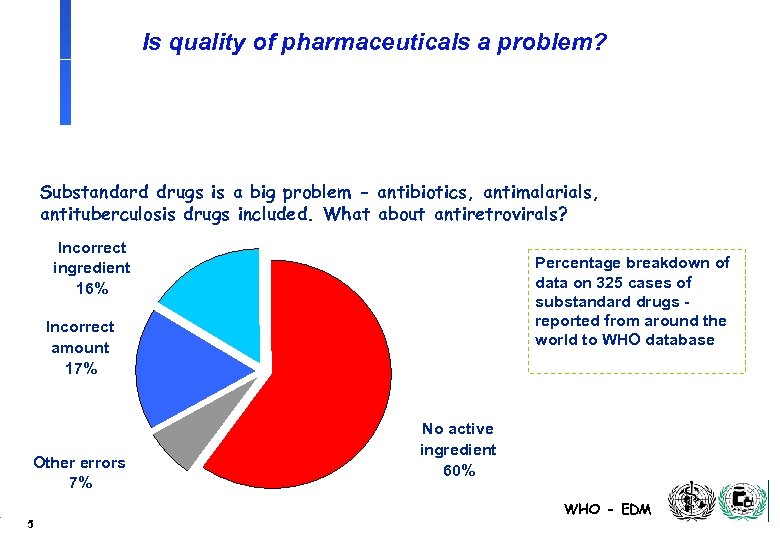
Is quality of pharmaceuticals a problem? Substandard drugs is a big problem - antibiotics, antimalarials, antituberculosis drugs included. What about antiretrovirals? Incorrect ingredient 16% Percentage breakdown of data on 325 cases of substandard drugs reported from around the world to WHO database Incorrect amount 17% Other errors 7% 5 No active ingredient 60% WHO - EDM
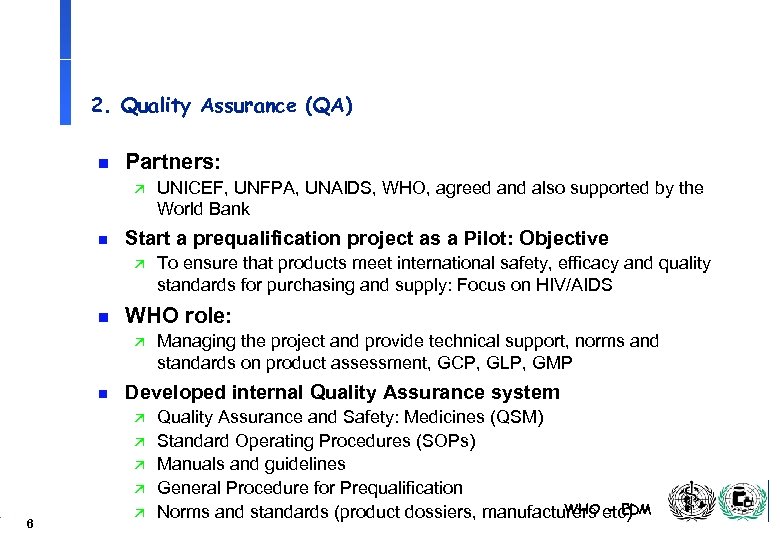
2. Quality Assurance (QA) n Partners: ä n Start a prequalification project as a Pilot: Objective ä n Managing the project and provide technical support, norms and standards on product assessment, GCP, GLP, GMP Developed internal Quality Assurance system ä ä 6 To ensure that products meet international safety, efficacy and quality standards for purchasing and supply: Focus on HIV/AIDS WHO role: ä n UNICEF, UNFPA, UNAIDS, WHO, agreed and also supported by the World Bank ä Quality Assurance and Safety: Medicines (QSM) Standard Operating Procedures (SOPs) Manuals and guidelines General Procedure for Prequalification WHO - EDM Norms and standards (product dossiers, manufacturers etc)
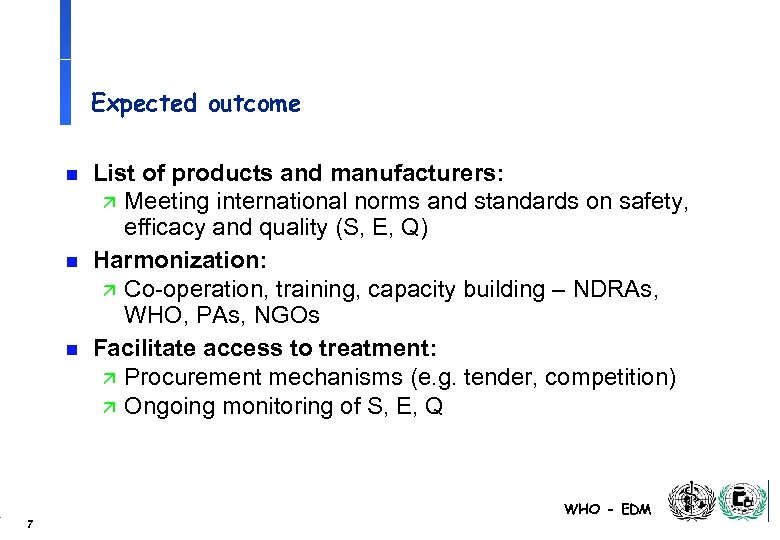
Expected outcome n n n 7 List of products and manufacturers: ä Meeting international norms and standards on safety, efficacy and quality (S, E, Q) Harmonization: ä Co-operation, training, capacity building – NDRAs, WHO, PAs, NGOs Facilitate access to treatment: ä Procurement mechanisms (e. g. tender, competition) ä Ongoing monitoring of S, E, Q WHO - EDM
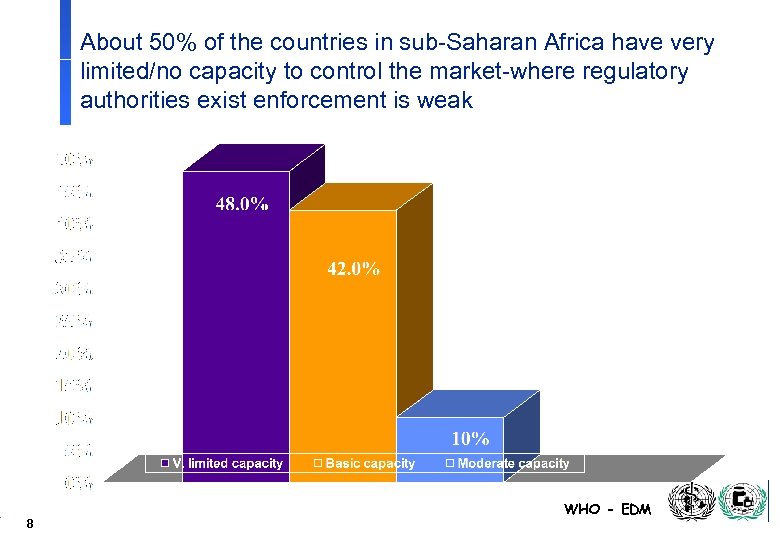
About 50% of the countries in sub-Saharan Africa have very limited/no capacity to control the market-where regulatory authorities exist enforcement is weak 8 WHO - EDM
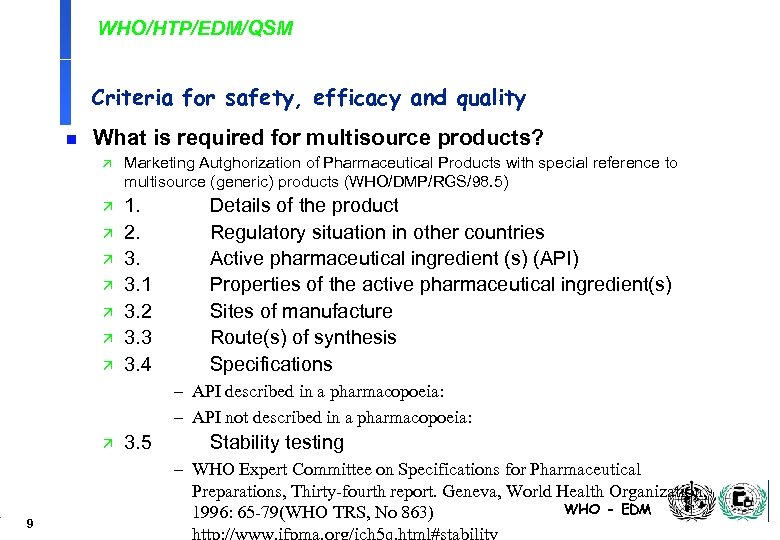
WHO/HTP/EDM/QSM Criteria for safety, efficacy and quality n What is required for multisource products? ä Marketing Autghorization of Pharmaceutical Products with special reference to multisource (generic) products (WHO/DMP/RGS/98. 5) ä 1. 2. 3. 3. 1 3. 2 3. 3 3. 4 ä ä ä Details of the product Regulatory situation in other countries Active pharmaceutical ingredient (s) (API) Properties of the active pharmaceutical ingredient(s) Sites of manufacture Route(s) of synthesis Specifications – API described in a pharmacopoeia: – API not described in a pharmacopoeia: ä 9 3. 5 Stability testing – WHO Expert Committee on Specifications for Pharmaceutical Preparations, Thirty-fourth report. Geneva, World Health Organization, WHO - EDM 1996: 65 -79(WHO TRS, No 863) http: //www. ifpma. org/ich 5 q. html#stability
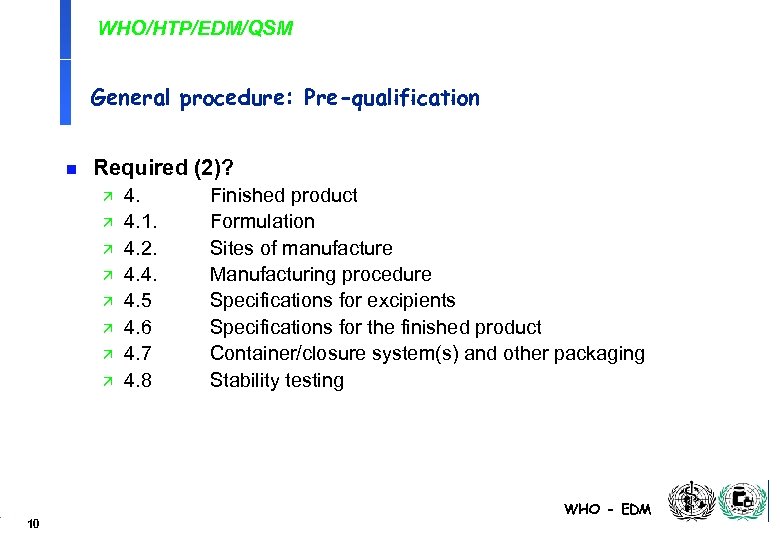
WHO/HTP/EDM/QSM General procedure: Pre-qualification n Required (2)? ä ä ä ä 10 4. 4. 1. 4. 2. 4. 4. 4. 5 4. 6 4. 7 4. 8 Finished product Formulation Sites of manufacture Manufacturing procedure Specifications for excipients Specifications for the finished product Container/closure system(s) and other packaging Stability testing WHO - EDM
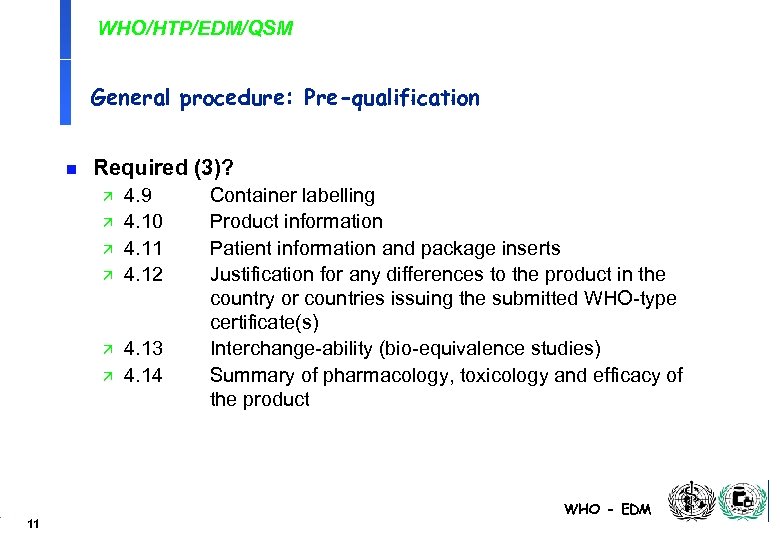
WHO/HTP/EDM/QSM General procedure: Pre-qualification n Required (3)? ä ä ä 11 4. 9 4. 10 4. 11 4. 12 4. 13 4. 14 Container labelling Product information Patient information and package inserts Justification for any differences to the product in the country or countries issuing the submitted WHO-type certificate(s) Interchange-ability (bio-equivalence studies) Summary of pharmacology, toxicology and efficacy of the product WHO - EDM
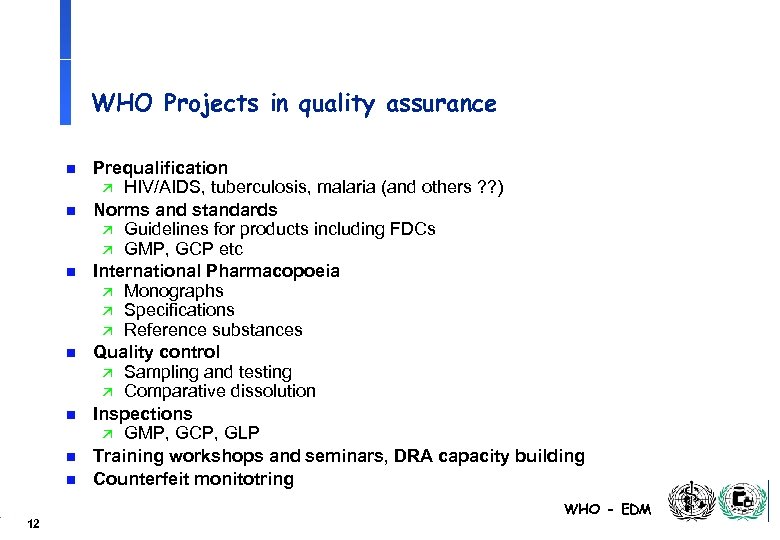
WHO Projects in quality assurance n n n n 12 Prequalification ä HIV/AIDS, tuberculosis, malaria (and others ? ? ) Norms and standards ä Guidelines for products including FDCs ä GMP, GCP etc International Pharmacopoeia ä Monographs ä Specifications ä Reference substances Quality control ä Sampling and testing ä Comparative dissolution Inspections ä GMP, GCP, GLP Training workshops and seminars, DRA capacity building Counterfeit monitotring WHO - EDM
3. QA: Prequalification. www. who. int/medicines n n n 13 Invitation for EOI – voluntary participation Guidelines for product dossier compilation (data and information on S, E, Q) Screening and assessment of dossiers and product samples SMF and manufacturing site inspection Reports on outcome of assessments Assessment of additional data and information Follow up inspection Quality control (testing of samples) Listing the outcome (compliance) Ongoing assessment Ongoing monitoring Requalification WHO - EDM
3 QA: Product data and information n Innovator products ä n Multisource products ä ä ä n n Full dossier with data and information Quality - including API details, specifications, stability data, formulation, manufacturing method, packaging, labelling etc Bio-equivalence study report Sample for verification and possible analysis Assessment teams: ä 14 Assessment report from DRA, CPP, Batch certificate, changes DRA assessors from Brazil, Canada, Denmark, France, Germany, Philippines, Sweden, Switzerland, Zimbabwe and others WHO - EDM
3. QA: Manufacturing sites and Contract Research Organizations (CROs) n Manufacturers: GMP compliance ä ä ä n CRO: GCP and GLP compliance ä ä ä 15 Team of inspectors: WHO plus PIC/S member DRA plus local DRA inspector(s) QM, premises, equipment, materials, validation, QC, documentation Product and site specific and includes data verification (BMR, specifications, stability data, validation report, dossier etc) Team of inspectors Ethics, clinical, analytical Product and site specific: as per dossier and includes data verification on subject data, method validation, calculations etc) WHO - EDM
Current status n n n Started March 2001 Five EOIs including ARVs, antibiotics, anticancer, antifungal products have been published Ongoing assessments and follow-up ä n n 16 Products, manufacturing sites and CROs June 2004: 277 product dossiers for innovator and multi-source products Samples tested 15 th edition of the List of prequalified products and manufacturers published Second tender published WHO - EDM
Quality Control (QC) on Antiretrovirals (ARVs) and problems experienced Quality control: n n n n n 17 Assessment: Samples selected for analysis Three independent laboratories used Standard Test Procedures (STP) and methods as well as specifications used (dossiers) Lack of monographs in pharmacopoeia until recently Lack of official reference standards All products tested met specifications After purchasing: Samples selected – comparative dissolution study Protocol prepared, independent laboratory used WHO - EDM
Quality Control (QC) on Antiretrovirals (ARVs) Monographs and specifications – International Pharmacopoeia n Draft monographs for ARVs Discussion with manufacturers and other pharmacopoeia Internationally validated methods for monographs n Preparation of official reference standards n n 18 WHO - EDM
Quality Control (QC) on Antiretrovirals (ARVs) Post purchase inspections: n Assess GMP compliance at the manufacturing site for the batches supplied n Assess records and data for the batches including comparison of: ä ä ä 19 ä Batch manufacturing record, Specifications and dossier information, Raw data including quality control tests and results, Validation protocol and report, Changes and deviations, OOS investigations, WHO - EDM Bio-batch records
Quality Control (QC) on Antiretrovirals (ARVs) Quality problems experienced (products and dossiers): n n 20 Non prequalified products (although under assessment) supplied to several countries where it is known that these products do not meet international standards Product dossiers lacking data and information including ä API: source of API, synthesis, specifications, method validation, stability ä Pharmaceutical development data ä Formulation and manufacturing process ä Validation (consistency) ä Stability ä No bio-equivalence studies or incomplete study reports WHO - EDM
Quality Control (QC) on Antiretrovirals (ARVs) n n n 21 Manufacturing sites and CROs (GMP, GCP, GLP) ä Poor design, layout and construction ä Lack of validation (process, utilities, equipment etc) ä Hormones, antibiotics such as penicillin, in same areas ä Lack of raw data ä Cross-contamination and mix-ups ä Lack of quality control on materials Time to take corrective action needed as manufacturers have to perform studies to generate data e. g. stability Validation of manufacturing processes Upgrading of manufacturing facilities Perform (new) bio-equivalence studies Different requirements and standards: local market versus export WHO - EDM
Ongoing monitoring and requalification n Samples taken after supply Routine inspections and additional inspections n Changes and variations controlled n ä Products and manufacturers n n 22 Requalification (re- assessment) every 3 years World Health Assembly resolution: WHA 57. 14 of May 2004 WHO - EDM
FDCs and policies n FDCs: ä ä ä n New guidelines: ä n FDA and WHO Government roles and policies ä ä 23 Essential Medicines List Advantages and disadvantages of FDCs Licensing of FDCs in USA and EU Treatment plans and policies Recommended treatments Licensing – prequalification Different standards applied e. g. no bio-equivalence required in some countries, differences in GMP legislation and requirements WHO - EDM
Prequalification n Tuberculosis: n First line as well as second line TB drugs About 150 product dossiers All assessed, 8 products prequalified Including 3 x 4 FDC (Pakistan, India and South Africa) n Others: Await additional data n n n 24 WHO - EDM
Prequalification n n n n 25 Malaria: 41 product dossiers Four cancelled or withdrawn Mainly ACTs Only 2 prequalified to date: Coartem and Artesunate Problems: Lack of quality specifications Lack of clinical data being presented Lack of GMP compliance WHO - EDM
Prequalification n n 26 Future? Reproductive health products Others? Need capacity and resources including finance, staff WHO - EDM
Summary and conclusion n n n 27 Several lists published (HIV: 15 th edition) QA and prequalification continue to facilitate access to a wide range of products meeting international standards Ongoing quality control, monitoring, assessment and requalification is needed Mechanisms should be in place to prevent the supply of counterfeit and substandard medicines Harmonization in assessments and increased capacity building Ensure safe, effective, quality products are purchased and supplied WHO - EDM
Скачать презентацию Prequalification of essential medicines Technical Briefing Seminar Salle
80785d9bf2cae9a3736fdbae512d4349.ppt