


 Скачать презентацию PREPOSITIONS PREDLOZI Definicija Predlozi su nepromenljive reči
767c30d2af736b9d400048fbe58e7adc.ppt
- Количество слайдов: 24
 PREPOSITIONS PREDLOZI
 Definicija Predlozi su nepromenljive reči koje iskazuju odnos između imenice ili zamenice i drugih reči u rečenici: I got a present from my friends. The glasses are in the kitchen. The stone was thrown through the window. There’s a garden behind the house. The button came off his coat.
 Predlozi sa imenicama, zamenicam i drugim rečima obrazuju predloške fraze (prepositional phrases) koje služe kao dodaci imenici, zamenici, glagolu, pridevu, prilogu, itd. I live in this room. (dodatak glagolu) Neither of these solutions will do. (zamenici) She was secretary to the President. (imenici) We are fond of classical music. (pridevu)
 Vrste predloga Prosti: at, by, down, for, from, in, off, on, over, through, till, to, up, with. Složeni: about, above, across, after, among, around, before, behind, beside, between, except, inside, into, outside, since, under, upon, within. Predlozi koji se sastoje od grupe reči: according to, ahead of, because of, instead of, in front of, with regard to.
 Mesto predloga Ispred reči ili grupe reči na koju se odnosi: She lives in this house. The patients are waiting for the doctor. I can’t remember a word of what he said. We can’t do anything except sit and wait. This is a photo of us at the seaside.
 Predlog često stoji na kraju rečenice, naročito u pitanjima. What is the table made of? Who are you waiting for? What were you thinking about? This is the place I was talking about. He is a man we can count on.
 Glagol + predlog Neki predlozi mogu da menjaju značenje glagola. He laughed at me. Osnovno značenje glagola je nepromenjeno. Look at him! Look after him! (Pazi na njega!) Look for him! (Potraži ga!) Značenje glagola menja se zavisno od predloga koji je upotrebljen.
 Upotreba predloga Pravilna upotreba predloga – kompleksna stvar u engleskom jeziku. Ne postoji analogija sa upotrebom u srpskom jeziku. I saw him in the street. NE *on the street The plane is in the sky. *on the sky Come at five o’clock. *in five o’clock See you on Sunday. *in Sunday
 AT/ON/IN (vreme) Najčešći predlozi u engleskom su AT/ON/IN i koriste se i za vreme i za mesto. Uporedi: They arrived at 5 o’clock. (Stigli su u 5 sati. ) They arrived on Friday. (Stigli su u petak. ) They arrived in October. /in 2009. (Stigli su u oktobru. )
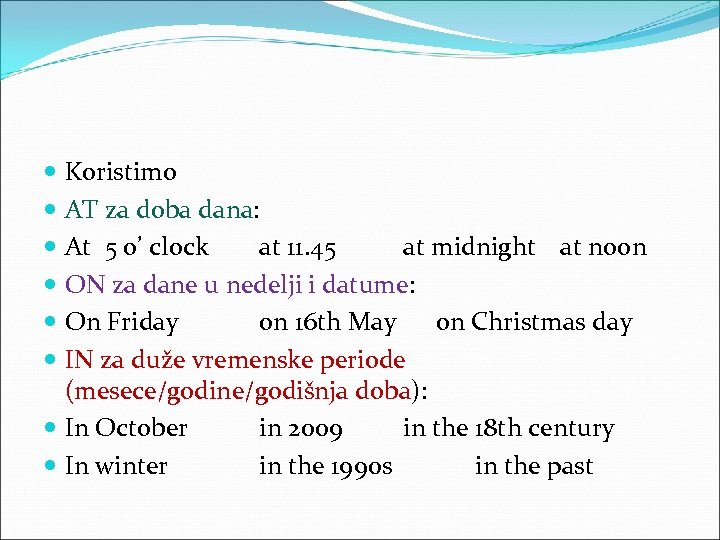 Koristimo AT za doba dana: At 5 o’ clock at 11. 45 at midnight at noon ON za dane u nedelji i datume: On Friday on 16 th May on Christmas day IN za duže vremenske periode (mesece/godine/godišnja doba): In October in 2009 in the 18 th century In winter in the 1990 s in the past
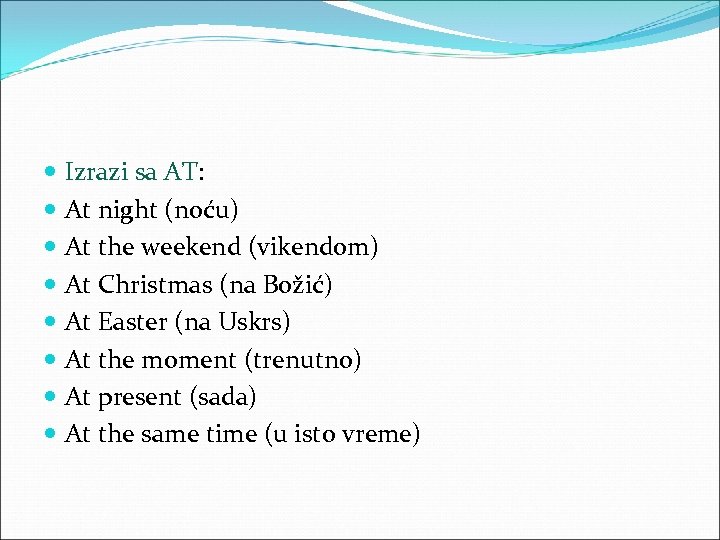 Izrazi sa AT: At night (noću) At the weekend (vikendom) At Christmas (na Božić) At Easter (na Uskrs) At the moment (trenutno) At present (sada) At the same time (u isto vreme)
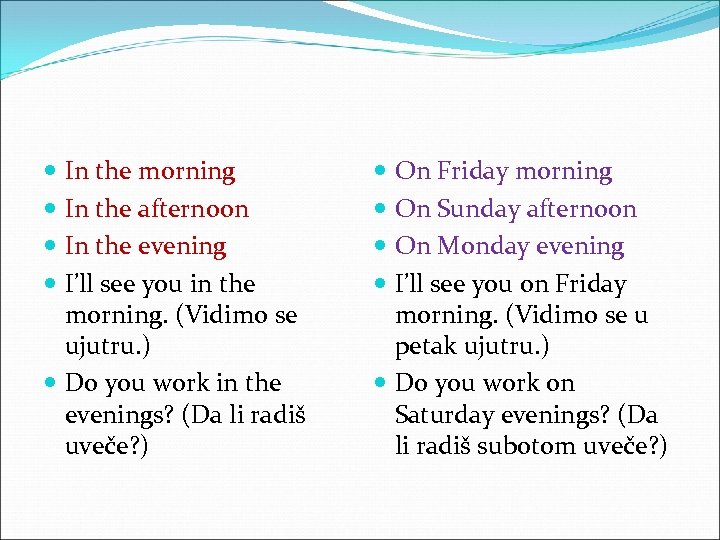 In the morning In the afternoon In the evening I’ll see you in the morning. (Vidimo se ujutru. ) Do you work in the evenings? (Da li radiš uveče? ) On Friday morning On Sunday afternoon On Monday evening I’ll see you on Friday morning. (Vidimo se u petak ujutru. ) Do you work on Saturday evenings? (Da li radiš subotom uveče? )
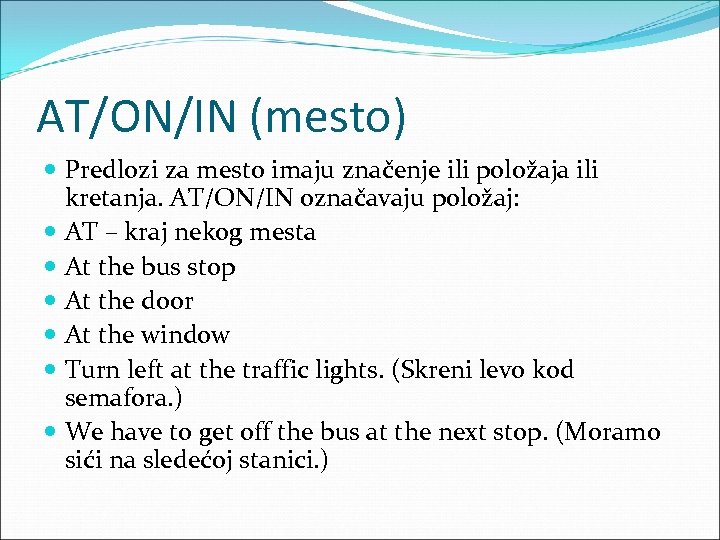 AT/ON/IN (mesto) Predlozi za mesto imaju značenje ili položaja ili kretanja. AT/ON/IN označavaju položaj: AT – kraj nekog mesta At the bus stop At the door At the window Turn left at the traffic lights. (Skreni levo kod semafora. ) We have to get off the bus at the next stop. (Moramo sići na sledećoj stanici. )
 ON – na površini nekog mesta: On the ceiling On the door On the wall On the floor You’ll find the answer on page 7. (Naći ćeš odgovor na sedmoj strani. ) The children were playing on the grass. (Deca su se igrala na travi. )
 IN – u unutrašnjosti nekog mesta In a room in a building In a box In a garden When we were in Italy, we spent a few days in Venice. (Kad smo bili u Italiji, proveli smo nekoliko dana u Veneciji. ) There were some people swimming in the pool. (Neki ljudi su plivali u bazenu. )
 Uporedi IN i AT: There were a lot of people in the shop. (Bilo je puno ljudi u prodavnici. ) Go along this road, then turn left at the shop. (Idi ovom ulicom, a onda skreni levo kod prodavnice). I’ll meet you in the hotel lobby. (Čekaću te u holu hotela. ) I’ll meet you at the entrance to the hotel. (Čekaću te kod ulaza u hotel. )
 Uporedi IN i ON: There is some water in the bottle. (U boci je malo vode. ) There is a label on the bottle. (Na boci je etiketa. ) Uporedi AT i ON: There is somebody at the door. Shall I go and see who it is? There is a notice on the door. It says: “Do not disturb. ”
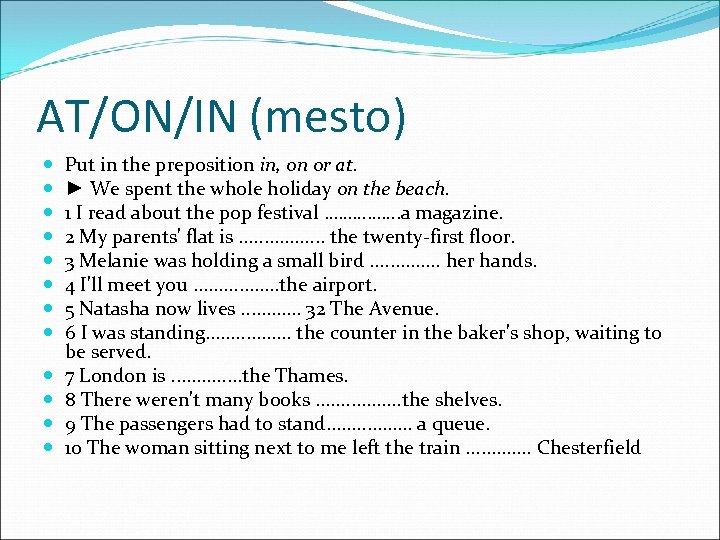 AT/ON/IN (mesto) Put in the preposition in, on or at. ► We spent the whole holiday on the beach. 1 I read about the pop festival ……………. a magazine. 2 My parents' flat is. . . . the twenty-first floor. 3 Melanie was holding a small bird. . . her hands. 4 I'll meet you. . . . the airport. 5 Natasha now lives. . . 32 The Avenue. 6 I was standing. . . . the counter in the baker's shop, waiting to be served. 7 London is. . . the Thames. 8 There weren't many books. . . . the shelves. 9 The passengers had to stand. . . . a queue. 10 The woman sitting next to me left the train. . . Chesterfield
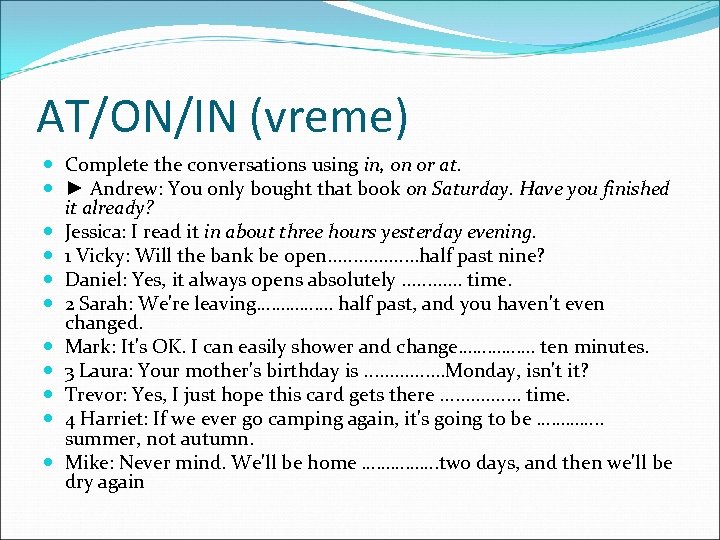 AT/ON/IN (vreme) Complete the conversations using in, on or at. ► Andrew: You only bought that book on Saturday. Have you finished it already? Jessica: I read it in about three hours yesterday evening. 1 Vicky: Will the bank be open. . . . half past nine? Daniel: Yes, it always opens absolutely. . . time. 2 Sarah: We're leaving……………. half past, and you haven't even changed. Mark: It's OK. I can easily shower and change……………. ten minutes. 3 Laura: Your mother's birthday is. . . . Monday, isn't it? Trevor: Yes, I just hope this card gets there. . . . time. 4 Harriet: If we ever go camping again, it's going to be …………. . summer, not autumn. Mike: Never mind. We'll be home ……………. two days, and then we'll be dry again
 TO/AT/IN/INTO (kretanje) TO – kretanje prema nekom mestu Go to Travel to Come to Get to Been to When are you going back to Italy? I’ve never been to Rome. What time did they get to London?
 Međutim, sa “arrive” ne može se koristiti TO, već AT/IN. IN ako je u pitanju grad ili zemlja: They travelled to Spain by car. They arrived in Spain last night. AT ako je u pitanju mesto ili događaj: When did they arrive at the hotel / at the party?
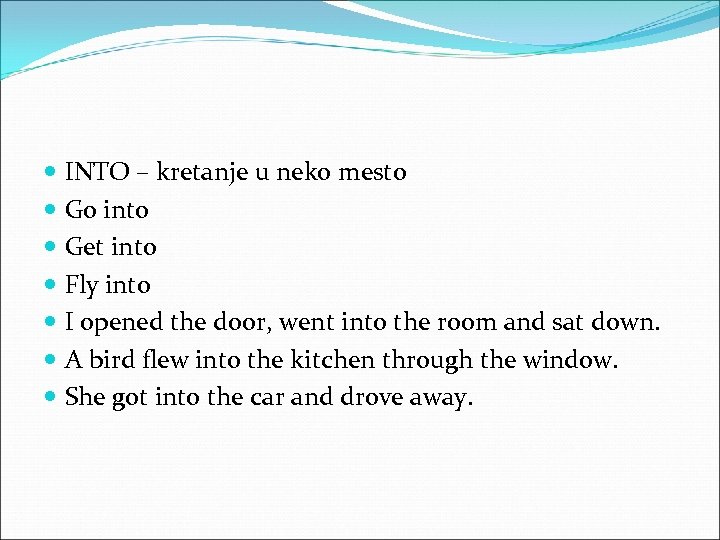 INTO – kretanje u neko mesto Go into Get into Fly into I opened the door, went into the room and sat down. A bird flew into the kitchen through the window. She got into the car and drove away.
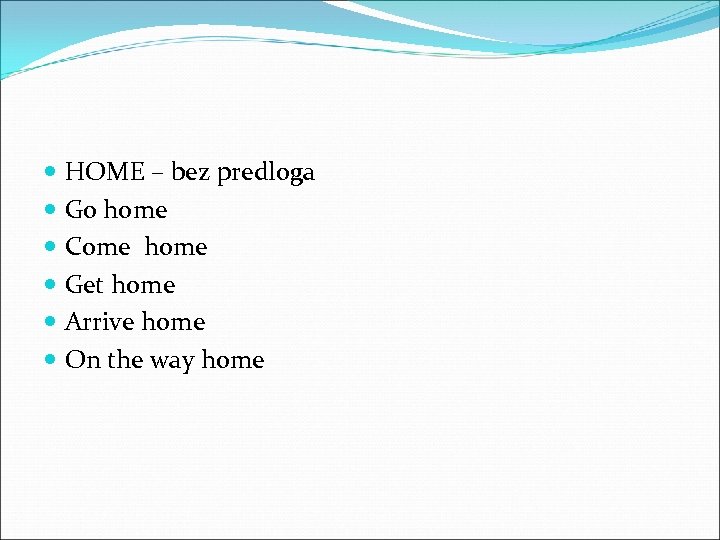 HOME – bez predloga Go home Come home Get home Arrive home On the way home
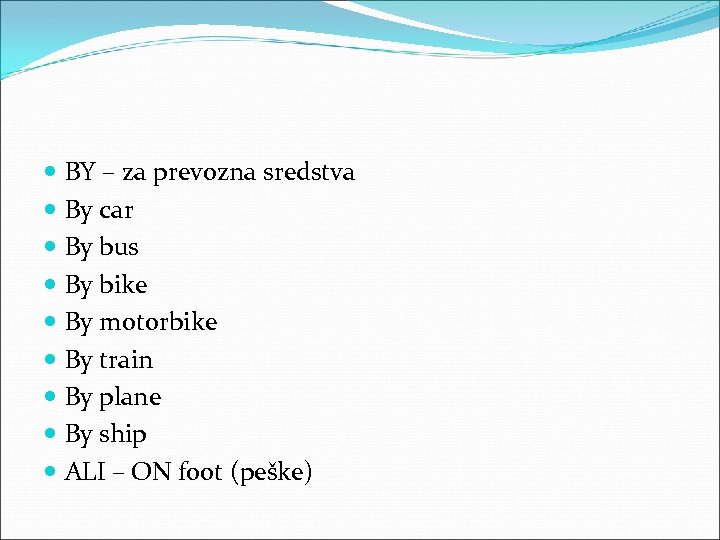 BY – za prevozna sredstva By car By bus By bike By motorbike By train By plane By ship ALI – ON foot (peške)