


 Скачать презентацию PREPOSITION POWER What are PREPOSITIONS
preposition-power-place.pptx
- Количество слайдов: 26
 PREPOSITION POWER !!
 What are PREPOSITIONS? • Words which show relationships among other words in the sentence. • The relationships include direction, place, time, cause, manner and amount.
 PREPOSITIONS OF PLACE
 ‘‘ AT ’’ • We use “at” to refer to a specific & precise place. (when we see it as a point) • At the bus stop. At the back of the bus. At home. At the bottom of the page. At the front of the cinema.
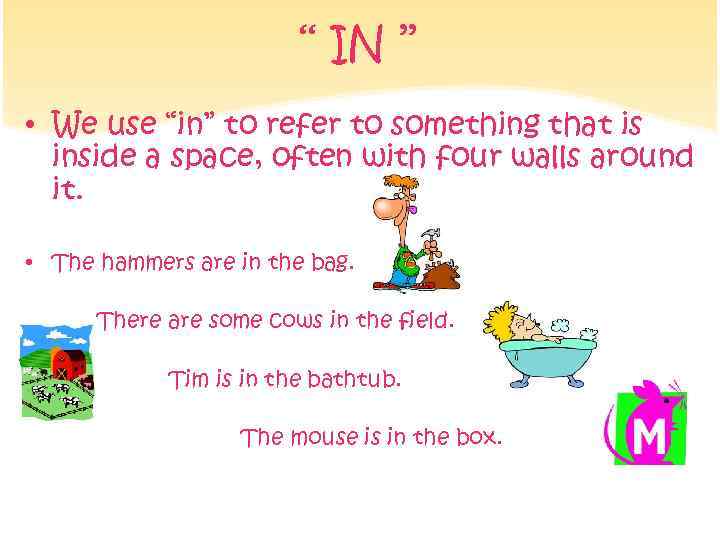 ‘‘ IN ’’ • We use “in” to refer to something that is inside a space, often with four walls around it. • The hammers are in the bag. There are some cows in the field. Tim is in the bathtub. The mouse is in the box.
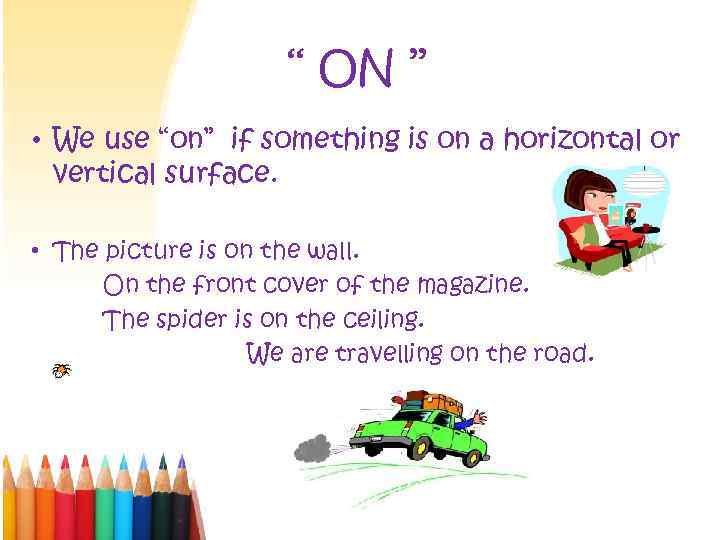 ‘‘ ON ’’ • We use “on” if something is on a horizontal or vertical surface. • The picture is on the wall. On the front cover of the magazine. The spider is on the ceiling. We are travelling on the road.
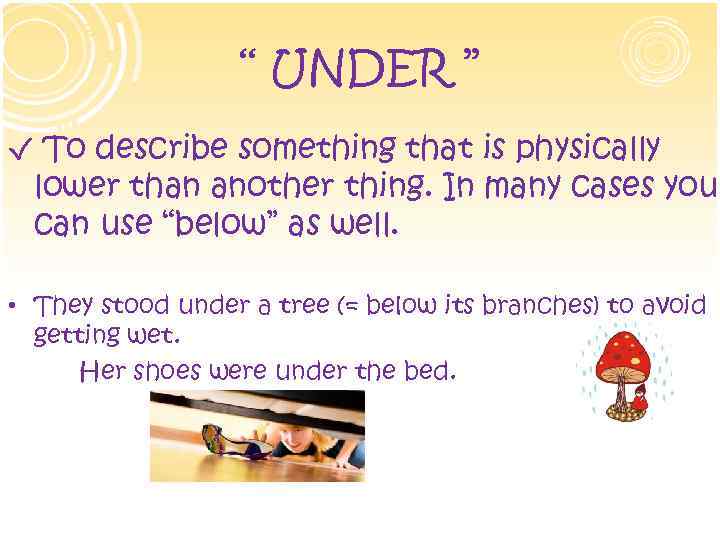 ‘‘ UNDER ’’ √ To describe something that is physically lower than another thing. In many cases you can use “below” as well. • They stood under a tree (= below its branches) to avoid getting wet. Her shoes were under the bed.
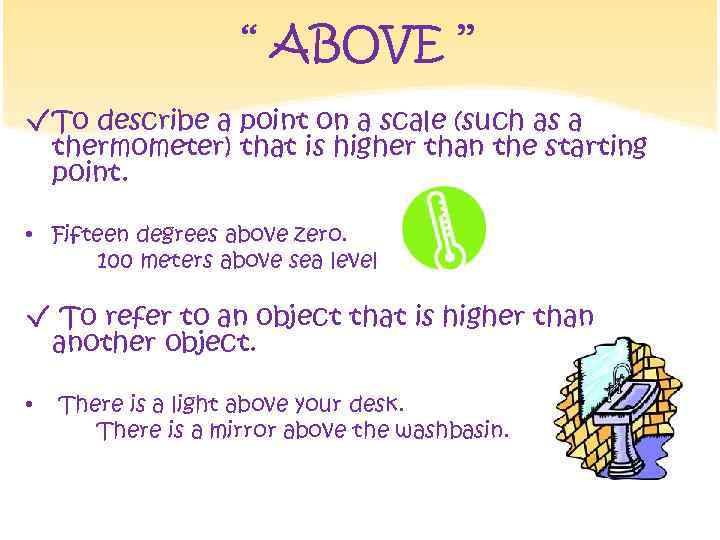 ‘‘ ABOVE ’’ √ To describe a point on a scale (such as a thermometer) that is higher than the starting point. • Fifteen degrees above zero. 100 meters above sea level √ To refer to an object that is higher than another object. • There is a light above your desk. There is a mirror above the washbasin.
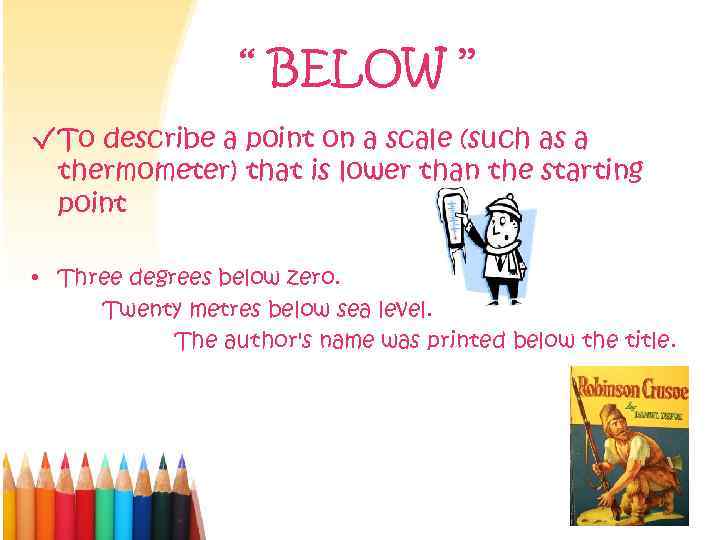 ‘‘ BELOW ’’ √ To describe a point on a scale (such as a thermometer) that is lower than the starting point • Three degrees below zero. Twenty metres below sea level. The author's name was printed below the title.
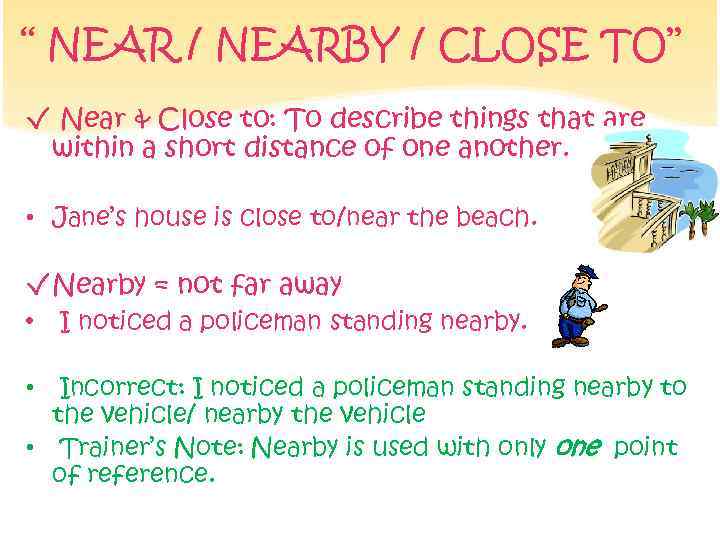 ‘‘ NEAR / NEARBY / CLOSE TO’’ √ Near & Close to: To describe things that are within a short distance of one another. • Jane’s house is close to/near the beach. √ Nearby = not far away • I noticed a policeman standing nearby. Incorrect: I noticed a policeman standing nearby to the vehicle/ nearby the vehicle • Trainer’s Note: Nearby is used with only one point of reference. •
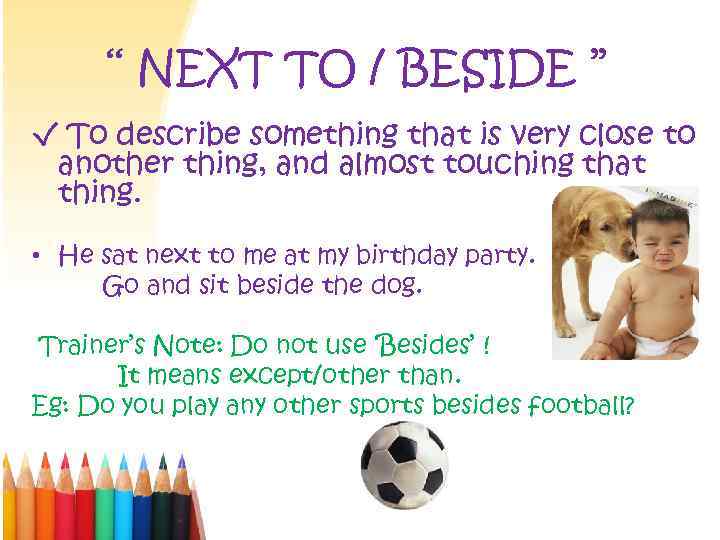 ‘‘ NEXT TO / BESIDE ’’ √ To describe something that is very close to another thing, and almost touching that thing. • He sat next to me at my birthday party. Go and sit beside the dog. Trainer’s Note: Do not use ‘Besides’ ! It means except/other than. Eg: Do you play any other sports besides football?
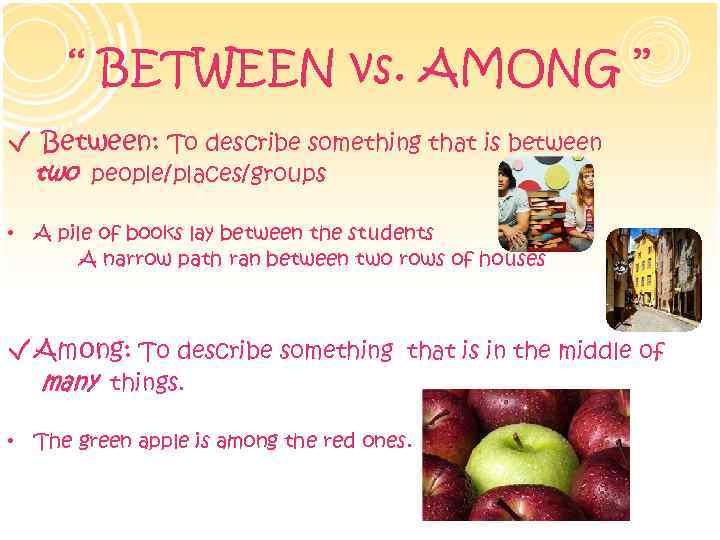 ‘‘ BETWEEN vs. AMONG ’’ √ Between: To describe something that is between two people/places/groups • A pile of books lay between the students A narrow path ran between two rows of houses √ Among: To describe something that is in the middle of many things. • The green apple is among the red ones.
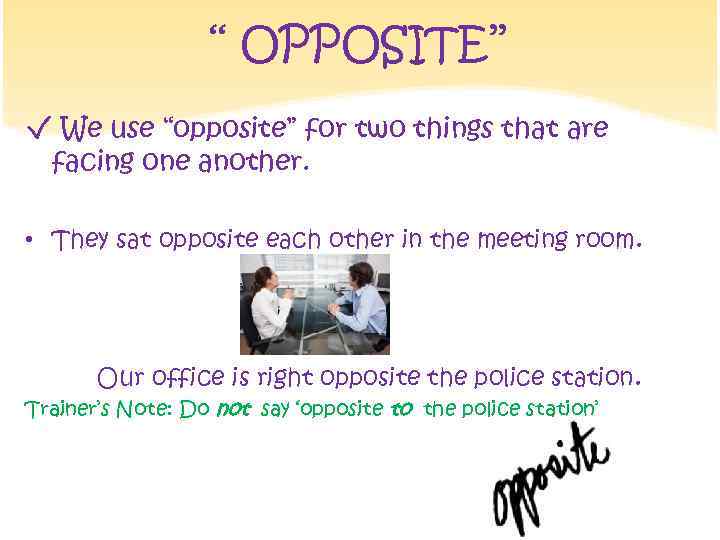 ‘‘ OPPOSITE’’ √ We use “opposite” for two things that are facing one another. • They sat opposite each other in the meeting room. Our office is right opposite the police station. Trainer’s Note: Do not say ‘opposite to the police station’
 Hmmm…. I was just wondering. .
 In the bed OR On the bed ? ? • Both. ON the bed = laying (or standing/sitting) on top of the covers of the bed. IN the bed = between the covers, retired for the night, and preparing to sleep; or possibly between the covers and resting due to sickness, etc. In the corner OR At the corner ? ? • We say 'in the corner of a room', but 'at the corner (or 'on the corner') of a street‘
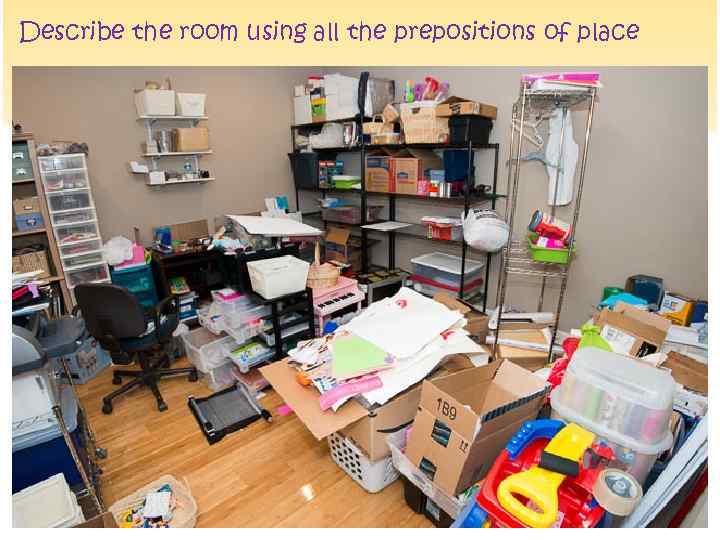 Describe the room using all the prepositions of place
 PREPOSITIONS OF TIME
 ‘‘ AT ’’ √ Used with time of the day. • “He comes to the office at 8: 30 a. m. ” ü At night; At weekend(s); At + holidays (Christmas) • • “My husband sleeps well at night”. “We used to give each other presents at Christmas” ü Used with precise time. • • “Call me later – I’m busy at the moment!” “Lets meet at lunchtime, shall we? ”
 ‘‘ ON ’’ √ Used with days (days of the week/other days). • “What do you enjoy doing on rainy days? ” • “I’ve never worked on Sunday in my life. ” • “On the 3 rd of June we are flying to Canada”.
 ‘‘ IN ’’ √ Used with seasons. • “In summer children usually have holidays. ” √ Used with months, years, centuries etc. • • • “When’s your Birthday? – In August. ” “First Coca-Cola was bottled in 19 th century. ” “In the 2015 I will learn to drive a car. ” √ Used with “the morning”, “the evening”, “the afternoon” (but not “night”!) • “Many people wake up early in the morning – I wake up in the afternoon”
 Hmmm…. I was just wondering. .
 On Monday morning or in Monday morning? ü On, never in if there is a name of the day of the week. At Christmas or on Christmas? ü Both: On Christmas refers exactly to the Christmas day, At Christmas means during the holiday itself. At, on or in the next week? ü No preposition is used with « next » , « last » , « this » , today, tomorrow, every day.
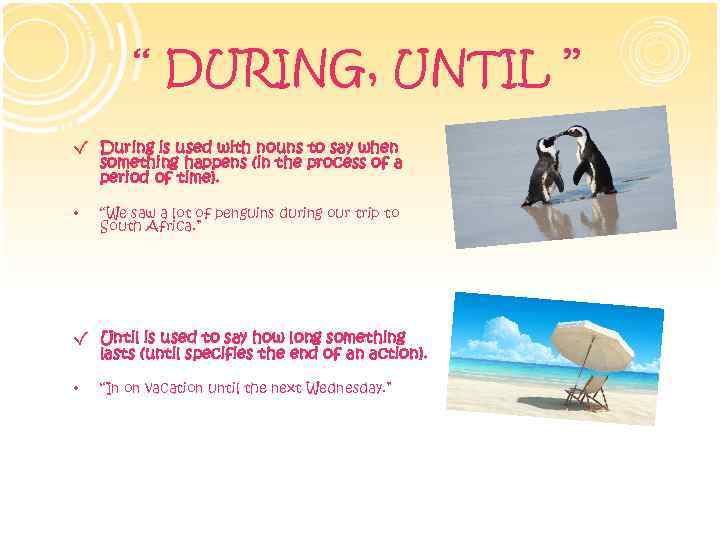 ‘‘ DURING, UNTIL ’’ √ During is used with nouns to say when something happens (in the process of a period of time). • “We saw a lot of penguins during our trip to South Africa. ” √ Until is used to say how long something lasts (until specifies the end of an action). • “In on vacation until the next Wednesday. ”
 ‘‘ FOR, SINCE’’ √ For + period of time is used to highlight the duration. • “I’ve taught English for more than 4 years. ” √ Since + starting point is used to show when something begins • “I’ve taught English since graduating from High. School. ”
 Hmmm…. I was just wondering. .
 Until or Till? ü There is no difference between these two. ü Use the one you like more From to or From until? ü Once again – no difference!