


 Скачать презентацию Preposition Definition Prepositions are a class of words
preposition(alina soroko).pptx
- Количество слайдов: 11
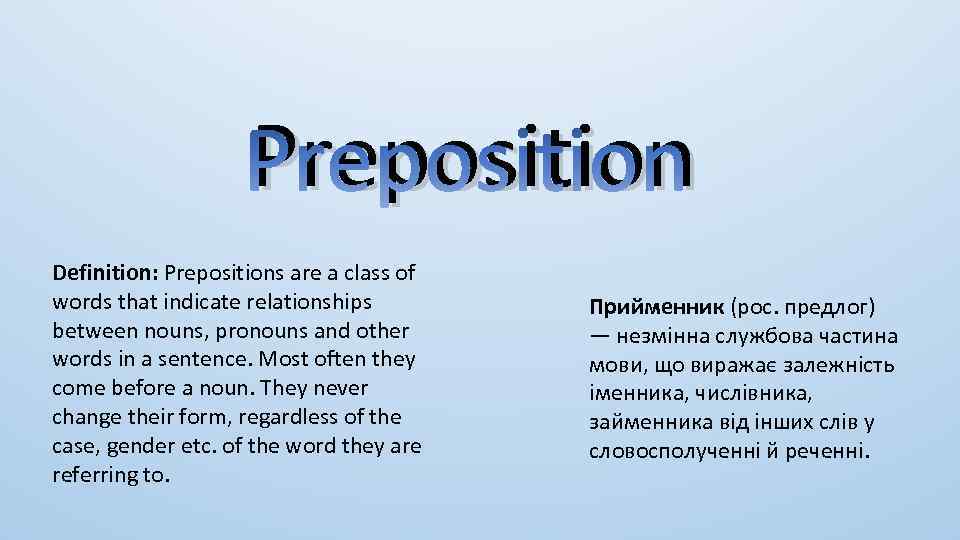 Preposition Definition: Prepositions are a class of words that indicate relationships between nouns, pronouns and other words in a sentence. Most often they come before a noun. They never change their form, regardless of the case, gender etc. of the word they are referring to. Прийменник (рос. предлог) — незмінна службова частина мови, що виражає залежність іменника, числівника, займенника від інших слів у словосполученні й реченні.
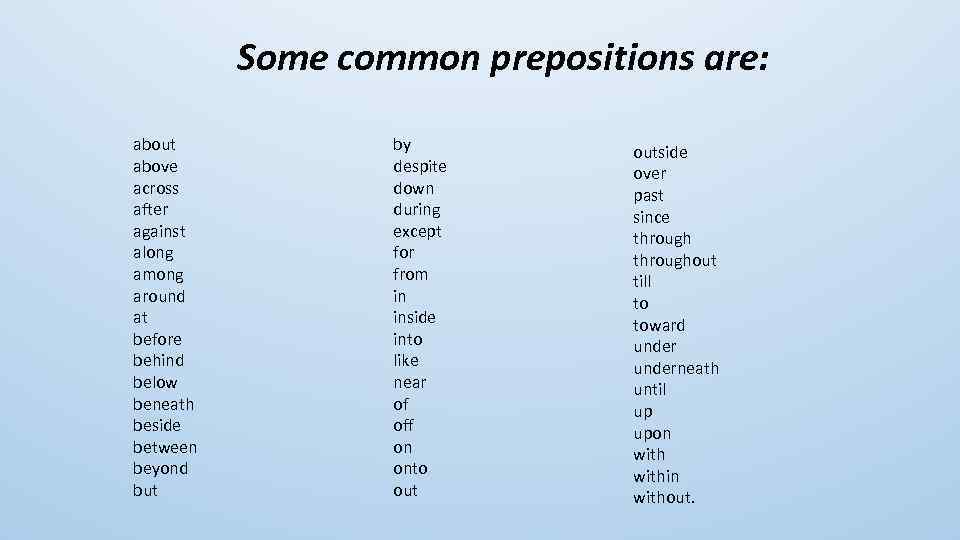 Some common prepositions are: about above across after against along among around at before behind below beneath beside between beyond but by despite down during except for from in inside into like near of off on onto outside over past since throughout till to toward underneath until up upon within without.
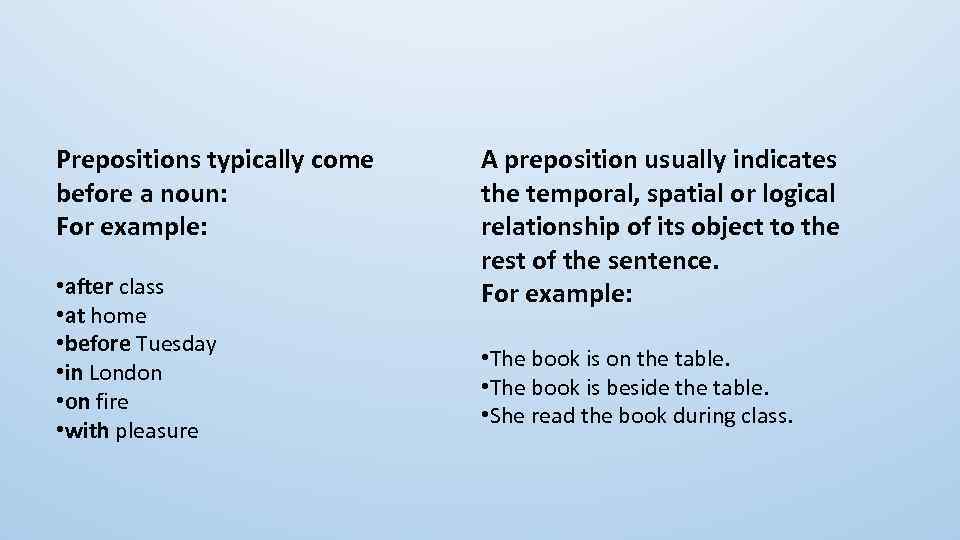 Prepositions typically come before a noun: For example: • after class • at home • before Tuesday • in London • on fire • with pleasure A preposition usually indicates the temporal, spatial or logical relationship of its object to the rest of the sentence. For example: • The book is on the table. • The book is beside the table. • She read the book during class.
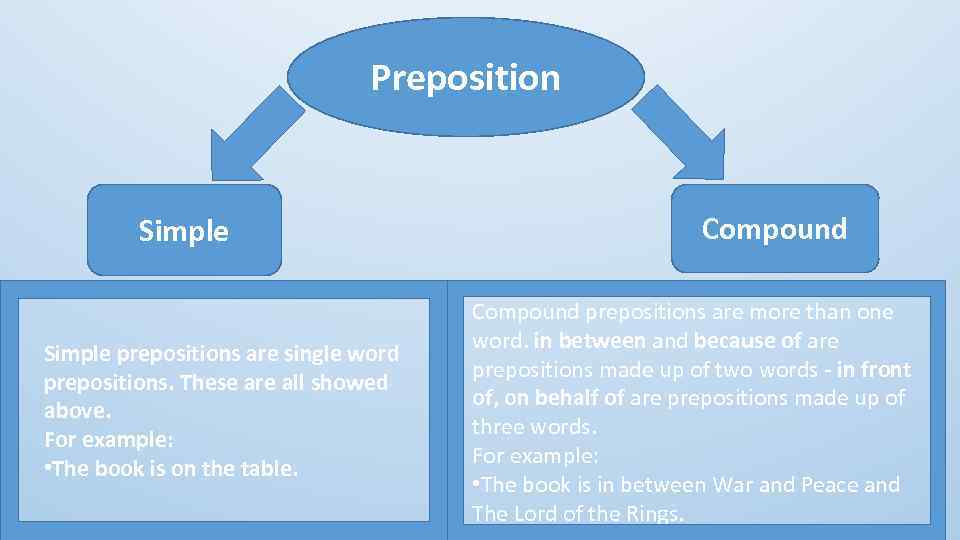 Preposition Simple prepositions are single word prepositions. These are all showed above. For example: • The book is on the table. Compound prepositions are more than one word. in between and because of are prepositions made up of two words - in front of, on behalf of are prepositions made up of three words. For example: • The book is in between War and Peace and The Lord of the Rings.
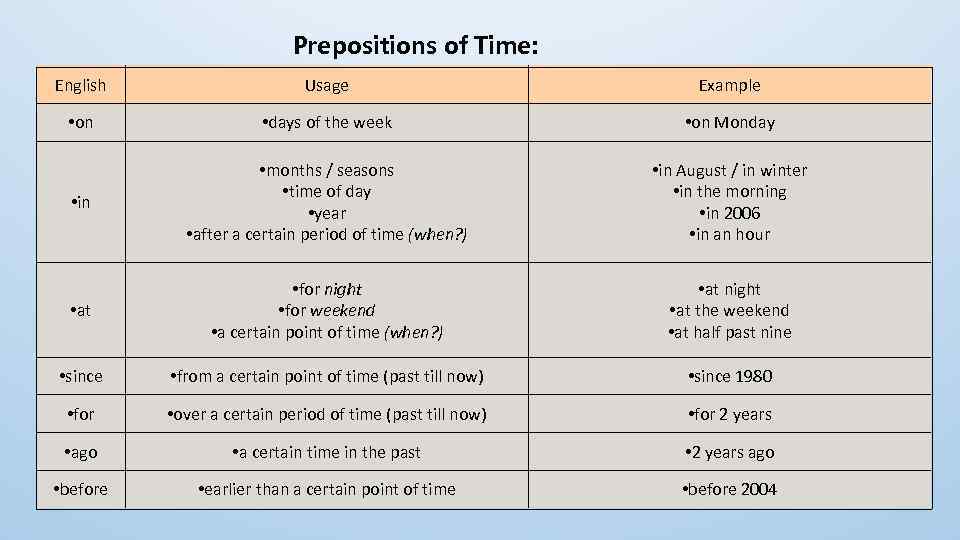 Prepositions of Time: English Usage Example • on • days of the week • on Monday • in • months / seasons • time of day • year • after a certain period of time (when? ) • in August / in winter • in the morning • in 2006 • in an hour • at • for night • for weekend • a certain point of time (when? ) • at night • at the weekend • at half past nine • since • from a certain point of time (past till now) • since 1980 • for • over a certain period of time (past till now) • for 2 years • ago • a certain time in the past • 2 years ago • before • earlier than a certain point of time • before 2004
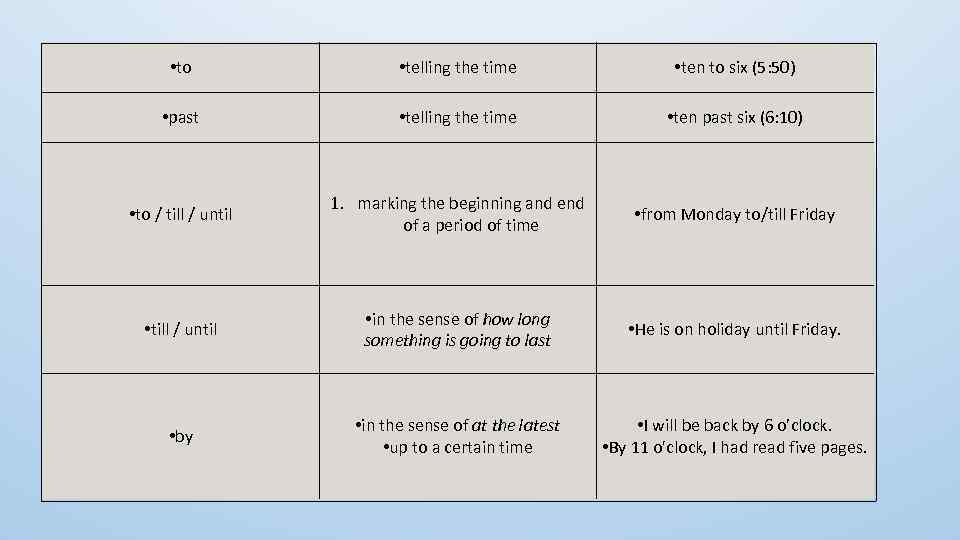 • to • telling the time • ten to six (5: 50) • past • telling the time • ten past six (6: 10) • to / till / until 1. marking the beginning and end of a period of time • from Monday to/till Friday • till / until • in the sense of how long something is going to last • He is on holiday until Friday. • by • in the sense of at the latest • up to a certain time • I will be back by 6 o’clock. • By 11 o'clock, I had read five pages.
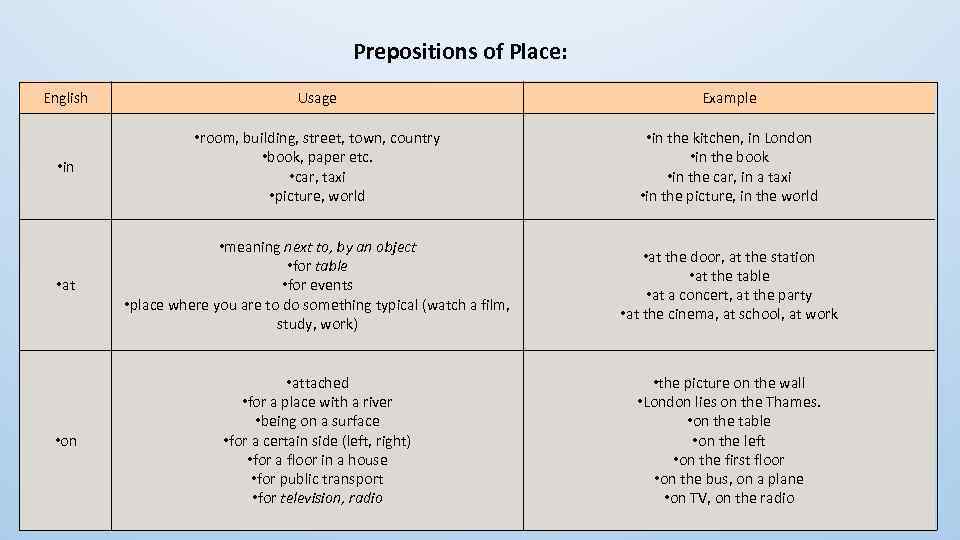 Prepositions of Place: English Usage Example • in • room, building, street, town, country • book, paper etc. • car, taxi • picture, world • in the kitchen, in London • in the book • in the car, in a taxi • in the picture, in the world • at • meaning next to, by an object • for table • for events • place where you are to do something typical (watch a film, study, work) • at the door, at the station • at the table • at a concert, at the party • at the cinema, at school, at work • on • attached • for a place with a river • being on a surface • for a certain side (left, right) • for a floor in a house • for public transport • for television, radio • the picture on the wall • London lies on the Thames. • on the table • on the left • on the first floor • on the bus, on a plane • on TV, on the radio
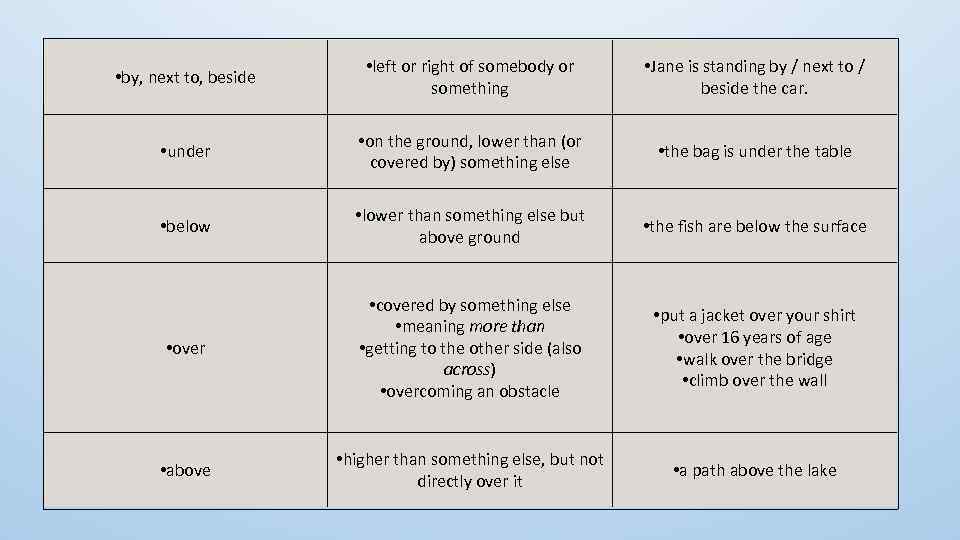 • by, next to, beside • left or right of somebody or something • Jane is standing by / next to / beside the car. • under • on the ground, lower than (or covered by) something else • the bag is under the table • below • lower than something else but above ground • the fish are below the surface • over • covered by something else • meaning more than • getting to the other side (also across) • overcoming an obstacle • put a jacket over your shirt • over 16 years of age • walk over the bridge • climb over the wall • above • higher than something else, but not directly over it • a path above the lake
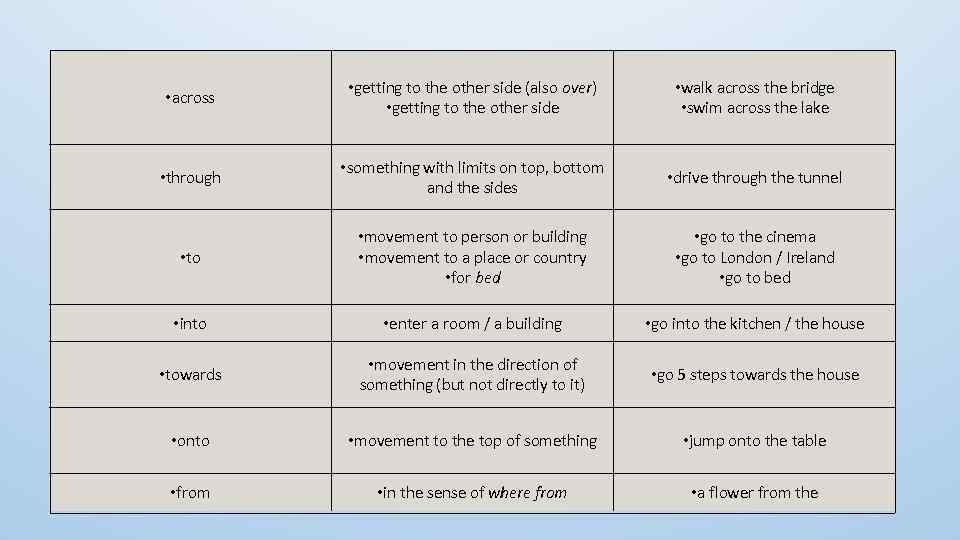 • across • getting to the other side (also over) • getting to the other side • walk across the bridge • swim across the lake • through • something with limits on top, bottom and the sides • drive through the tunnel • to • movement to person or building • movement to a place or country • for bed • go to the cinema • go to London / Ireland • go to bed • into • enter a room / a building • go into the kitchen / the house • towards • movement in the direction of something (but not directly to it) • go 5 steps towards the house • onto • movement to the top of something • jump onto the table • from • in the sense of where from • a flower from the
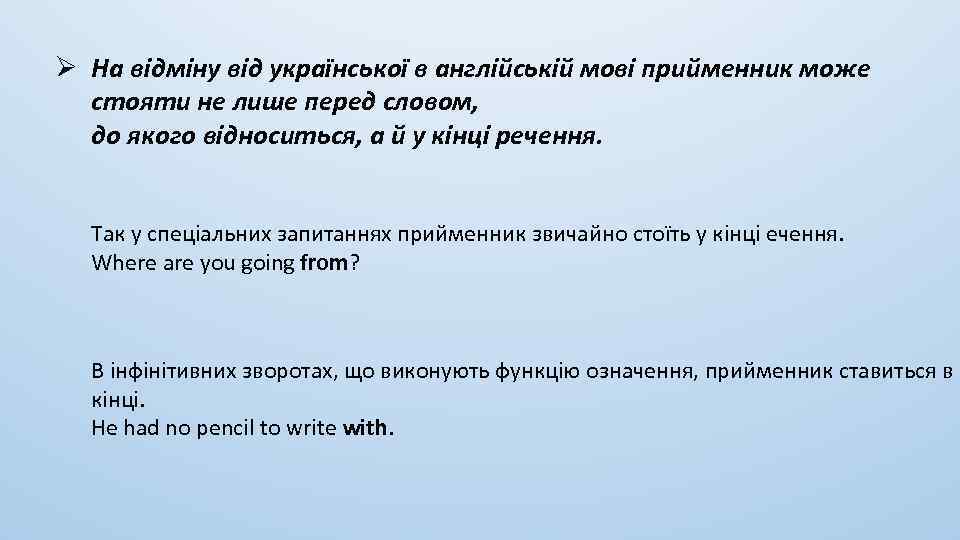 Ø На відміну від української в англійській мові прийменник може стояти не лише перед словом, до якого відноситься, а й у кінці речення. Так у спеціальних запитаннях прийменник звичайно стоїть у кінці ечення. Where are you going from? В інфінітивних зворотах, що виконують функцію означення, прийменник ставиться в кінці. He had no pencil to write with.
 Made by Alina Soroko