


 Скачать презентацию Preparing Spatial Data to Archive Yaxing Wei Environmental
11aacf18f5bf7a82c0b033e8db7b9f2b.ppt
- Количество слайдов: 29
 Preparing Spatial Data to Archive Yaxing Wei Environmental Sciences Division Oak Ridge National Laboratory
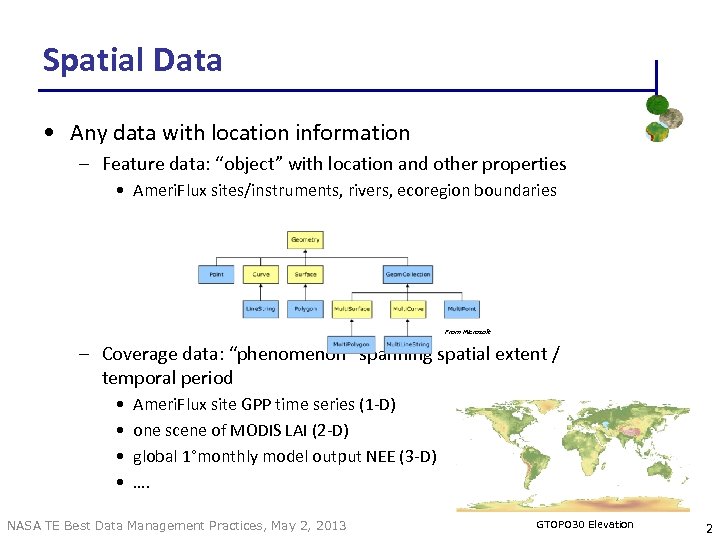 Spatial Data • Any data with location information – Feature data: “object” with location and other properties • Ameri. Flux sites/instruments, rivers, ecoregion boundaries From Microsoft – Coverage data: “phenomenon” spanning spatial extent / temporal period • • Ameri. Flux site GPP time series (1 -D) one scene of MODIS LAI (2 -D) global 1°monthly model output NEE (3 -D) …. NASA TE Best Data Management Practices, May 2, 2013 GTOPO 30 Elevation 2
 Critical Things for Spatial Data • Where: spatial information – Spatial Reference System: datum and projection – Spatial extent/resolution/boundary • When: temporal information – Calendar – Time units & extent/resolution/boundary • What: data content – Data format: structure & organization – Units, scale, missing value, … NASA TE Best Data Management Practices, May 2, 2013 3
 Bottom Line These critical things have to be PROVIDED and CORRECT, even if they are provided in human-understandable ways! NASA TE Best Data Management Practices, May 2, 2013 4
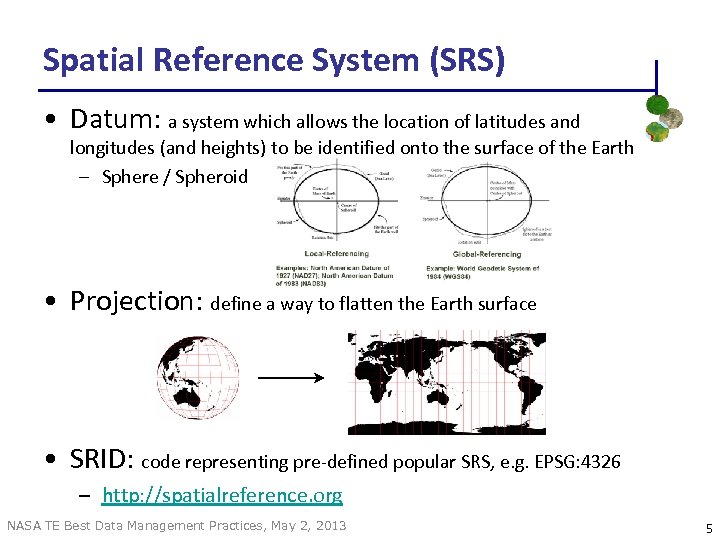 Spatial Reference System (SRS) • Datum: a system which allows the location of latitudes and longitudes (and heights) to be identified onto the surface of the Earth – Sphere / Spheroid • Projection: define a way to flatten the Earth surface • SRID: code representing pre-defined popular SRS, e. g. EPSG: 4326 – http: //spatialreference. org NASA TE Best Data Management Practices, May 2, 2013 5
 Spatial Example (1) • Where is an Ameri. Flux site located? Valles Caldera Mixed Conifer / US-Vcm – Latitude: 35. 8884 – Longitude: -106. 5321 – Elevation: 3003 m • Precision: on the order of 10 meters • Datum: shape and center of the earth – NAD 83 (e. g. USGS NHD) or WGS 84 (e. g. GPS) – Do I care? Not if 1 -2 meters difference doesn’t matter – Vertical datum NASA TE Best Data Management Practices, May 2, 2013 6
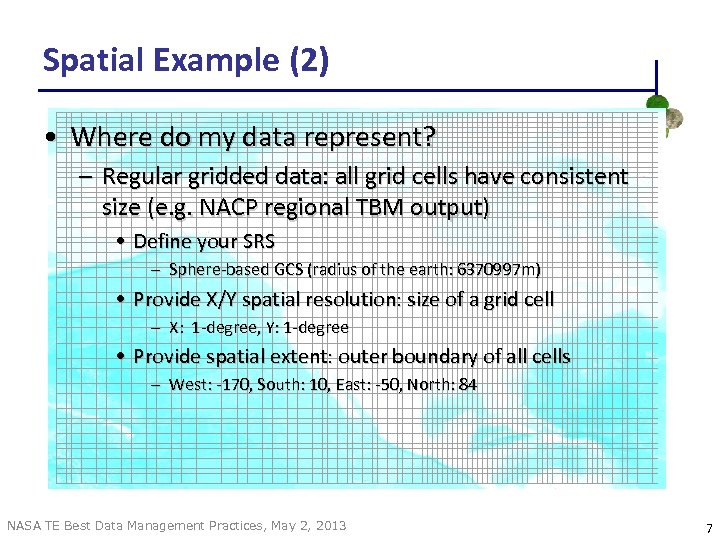 Spatial Example (2) • Where do my data represent? – Regular gridded data: all grid cells have consistent size (e. g. NACP regional TBM output) • Define your SRS – Sphere-based GCS (radius of the earth: 6370997 m) • Provide X/Y spatial resolution: size of a grid cell – X: 1 -degree, Y: 1 -degree • Provide spatial extent: outer boundary of all cells – West: -170, South: 10, East: -50, North: 84 NASA TE Best Data Management Practices, May 2, 2013 7
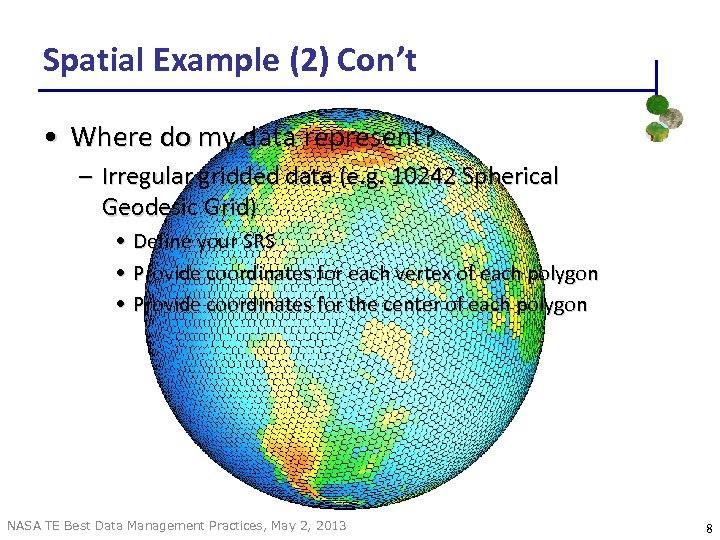 Spatial Example (2) Con’t • Where do my data represent? – Irregular gridded data (e. g. 10242 Spherical Geodesic Grid) • Define your SRS • Provide coordinates for each vertex of each polygon • Provide coordinates for the center of each polygon NASA TE Best Data Management Practices, May 2, 2013 8
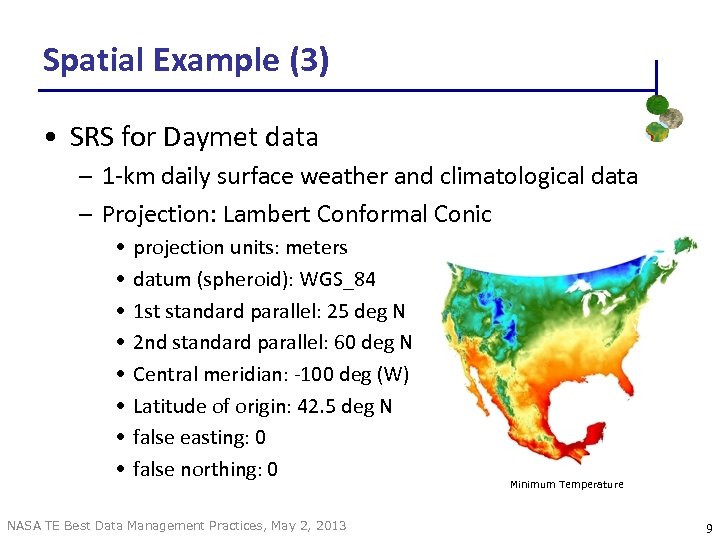 Spatial Example (3) • SRS for Daymet data – 1 -km daily surface weather and climatological data – Projection: Lambert Conformal Conic • • projection units: meters datum (spheroid): WGS_84 1 st standard parallel: 25 deg N 2 nd standard parallel: 60 deg N Central meridian: -100 deg (W) Latitude of origin: 42. 5 deg N false easting: 0 false northing: 0 NASA TE Best Data Management Practices, May 2, 2013 Minimum Temperature 9
 Temporal Example (1) • What calendar does a model use? – julian: one leap year in every 4 years – gregorian: leap year if either (i) it is divisible by 4 but not by 100 or (ii) it is divisible by 400 – proleptic_gregorian: gregorian calendar extended to dates before 1582 -10 -15 – 365_day: no leap year, Feb. always has 28 days – 360_day: 30 days for each month – 366_day: all leap years gregorian is the internationally used civil calendar Ms. TMIP project chose proleptic_gregorian calendar NASA TE Best Data Management Practices, May 2, 2013 10
 Temporal Example (2) • Specify the time a measurement was made – “the measurement was made at 6 in the afternoon on March 22, 2010 and it took 1 hour 20 minutes and 30 seconds” - BAD • ISO 8601: representation of dates and times – Time point: YYYY-MM-DDThh: mm: ss. s. TZD (201003 -22 T 18: 00. 00 -06: 00) – Duration: P[n]Y[n]M[n]DT[n]H[n]M[n]S (PT 1 H 20 M 30 S) NASA TE Best Data Management Practices, May 2, 2013 11
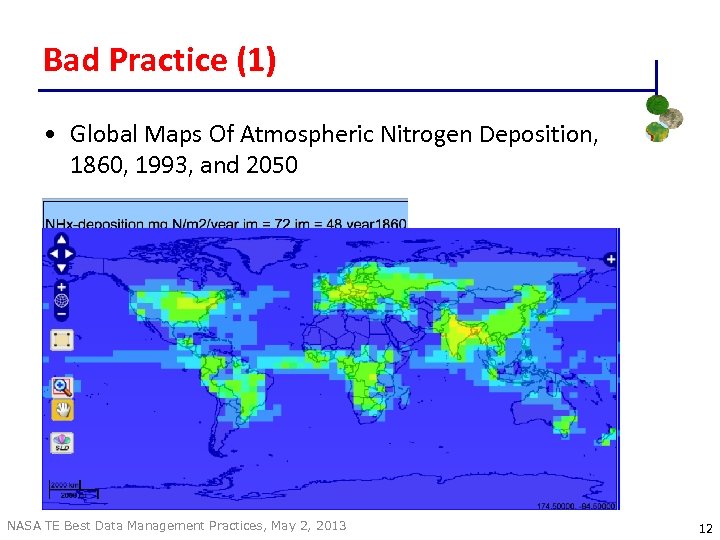 Bad Practice (1) • Global Maps Of Atmospheric Nitrogen Deposition, 1860, 1993, and 2050 NASA TE Best Data Management Practices, May 2, 2013 12
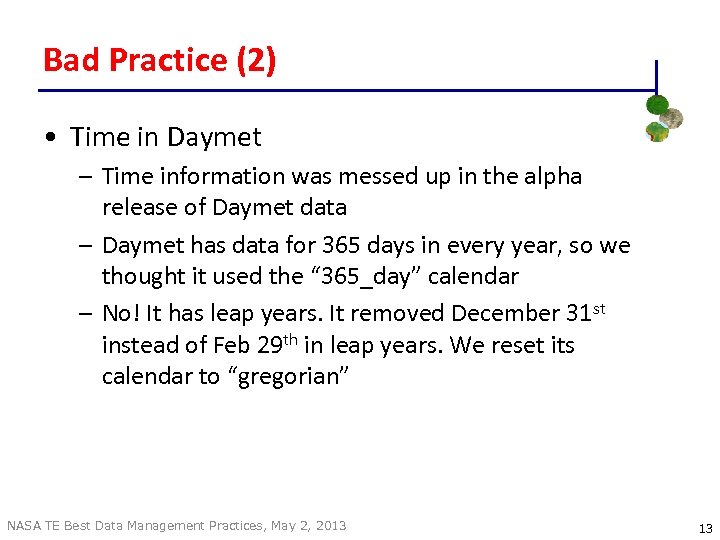 Bad Practice (2) • Time in Daymet – Time information was messed up in the alpha release of Daymet data – Daymet has data for 365 days in every year, so we thought it used the “ 365_day” calendar – No! It has leap years. It removed December 31 st instead of Feb 29 th in leap years. We reset its calendar to “gregorian” NASA TE Best Data Management Practices, May 2, 2013 13
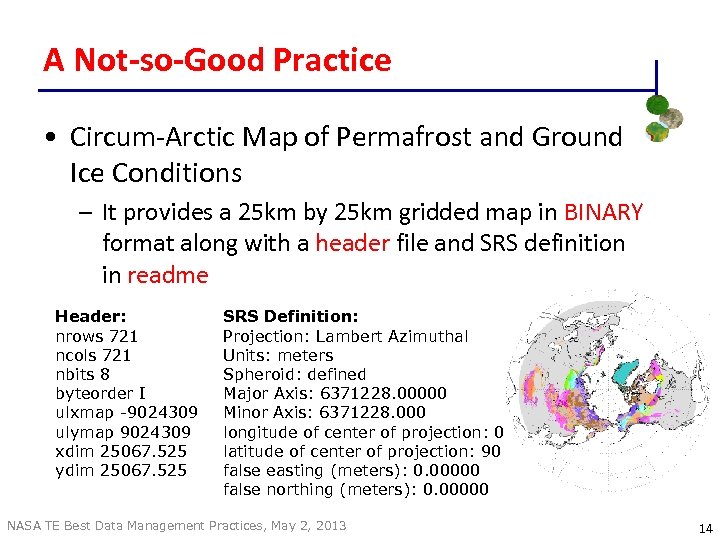 A Not-so-Good Practice • Circum-Arctic Map of Permafrost and Ground Ice Conditions – It provides a 25 km by 25 km gridded map in BINARY format along with a header file and SRS definition in readme Header: nrows 721 ncols 721 nbits 8 byteorder I ulxmap -9024309 ulymap 9024309 xdim 25067. 525 ydim 25067. 525 SRS Definition: Projection: Lambert Azimuthal Units: meters Spheroid: defined Major Axis: 6371228. 00000 Minor Axis: 6371228. 000 longitude of center of projection: 0 latitude of center of projection: 90 false easting (meters): 0. 00000 false northing (meters): 0. 00000 NASA TE Best Data Management Practices, May 2, 2013 14
 Make a Step Forward Choose “GOOD” formats to store your spatial data and provide spatial/temporal information in STANDARD ways NASA TE Best Data Management Practices, May 2, 2013 15
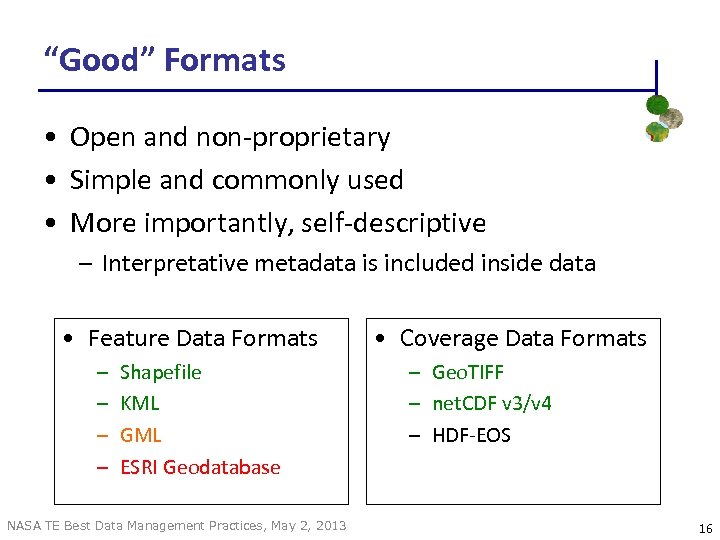 “Good” Formats • Open and non-proprietary • Simple and commonly used • More importantly, self-descriptive – Interpretative metadata is included inside data • Feature Data Formats – – Shapefile KML GML ESRI Geodatabase NASA TE Best Data Management Practices, May 2, 2013 • Coverage Data Formats – Geo. TIFF – net. CDF v 3/v 4 – HDF-EOS 16
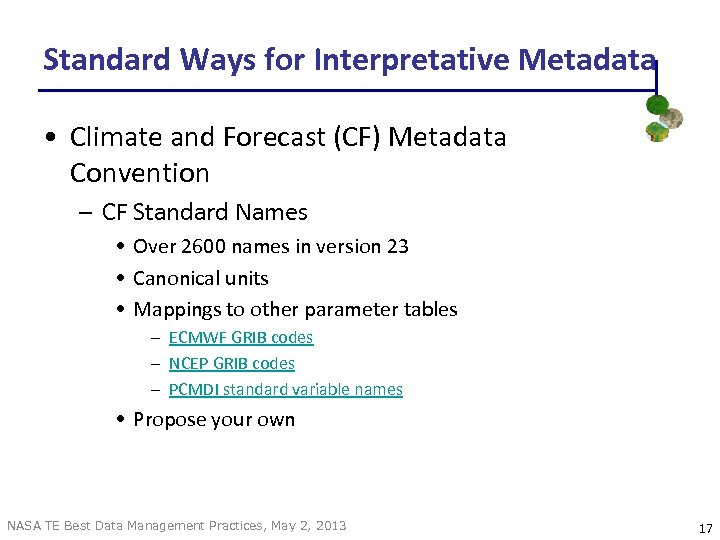 Standard Ways for Interpretative Metadata • Climate and Forecast (CF) Metadata Convention – CF Standard Names • Over 2600 names in version 23 • Canonical units • Mappings to other parameter tables – ECMWF GRIB codes – NCEP GRIB codes – PCMDI standard variable names • Propose your own NASA TE Best Data Management Practices, May 2, 2013 17
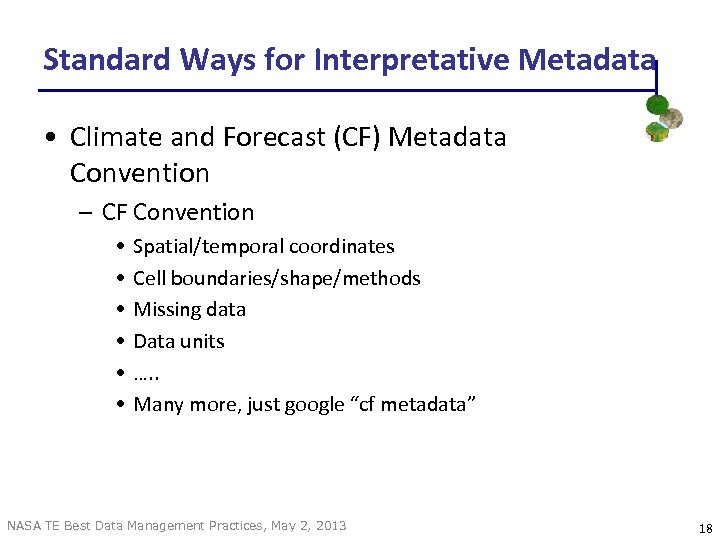 Standard Ways for Interpretative Metadata • Climate and Forecast (CF) Metadata Convention – CF Convention • • • Spatial/temporal coordinates Cell boundaries/shape/methods Missing data Data units …. . Many more, just google “cf metadata” NASA TE Best Data Management Practices, May 2, 2013 18
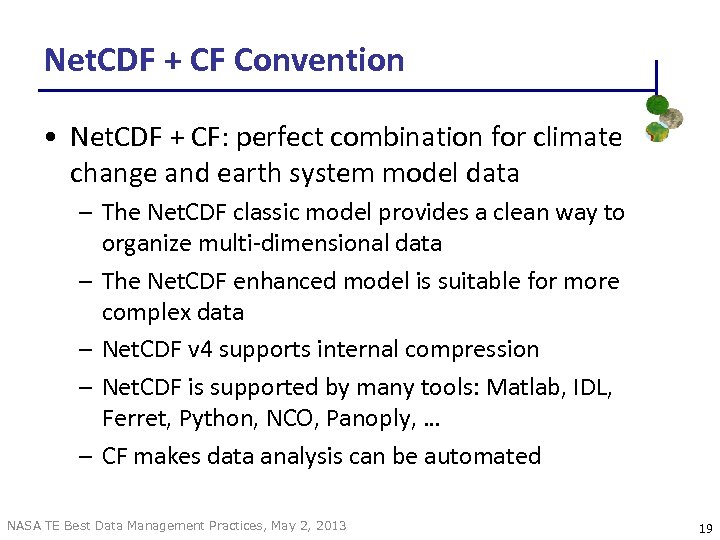 Net. CDF + CF Convention • Net. CDF + CF: perfect combination for climate change and earth system model data – The Net. CDF classic model provides a clean way to organize multi-dimensional data – The Net. CDF enhanced model is suitable for more complex data – Net. CDF v 4 supports internal compression – Net. CDF is supported by many tools: Matlab, IDL, Ferret, Python, NCO, Panoply, … – CF makes data analysis can be automated NASA TE Best Data Management Practices, May 2, 2013 19
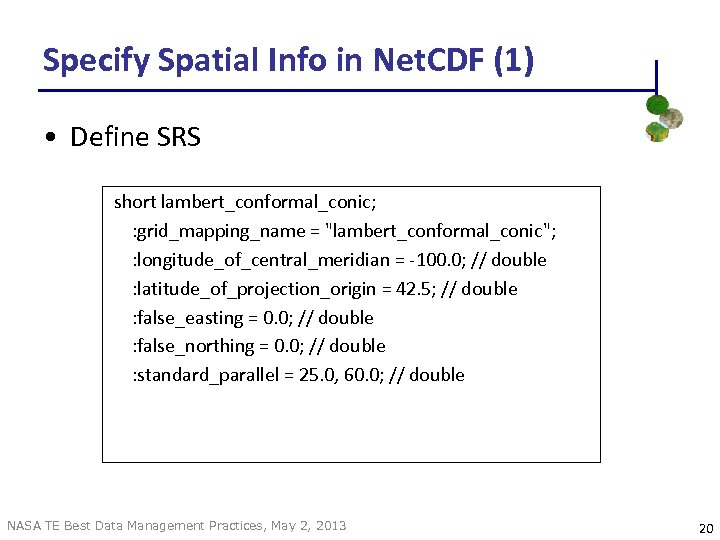 Specify Spatial Info in Net. CDF (1) • Define SRS short lambert_conformal_conic; : grid_mapping_name = "lambert_conformal_conic"; : longitude_of_central_meridian = -100. 0; // double : latitude_of_projection_origin = 42. 5; // double : false_easting = 0. 0; // double : false_northing = 0. 0; // double : standard_parallel = 25. 0, 60. 0; // double NASA TE Best Data Management Practices, May 2, 2013 20
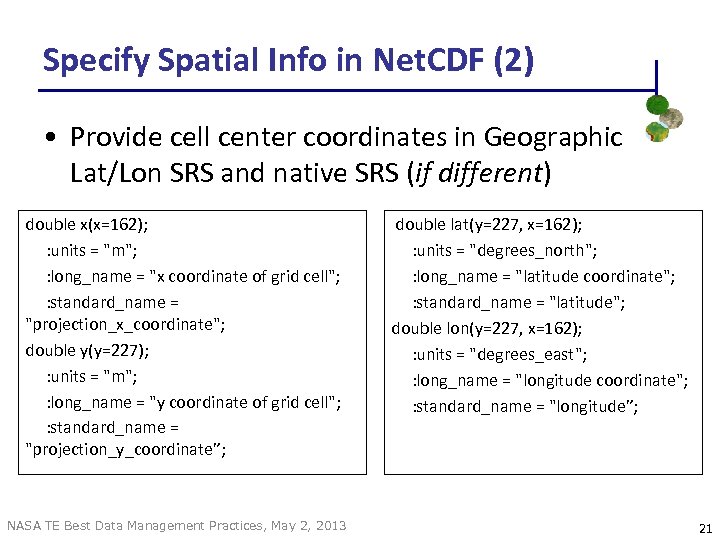 Specify Spatial Info in Net. CDF (2) • Provide cell center coordinates in Geographic Lat/Lon SRS and native SRS (if different) double x(x=162); : units = "m"; : long_name = "x coordinate of grid cell"; : standard_name = "projection_x_coordinate"; double y(y=227); : units = "m"; : long_name = "y coordinate of grid cell"; : standard_name = "projection_y_coordinate”; NASA TE Best Data Management Practices, May 2, 2013 double lat(y=227, x=162); : units = "degrees_north"; : long_name = "latitude coordinate"; : standard_name = "latitude"; double lon(y=227, x=162); : units = "degrees_east"; : long_name = "longitude coordinate"; : standard_name = "longitude”; 21
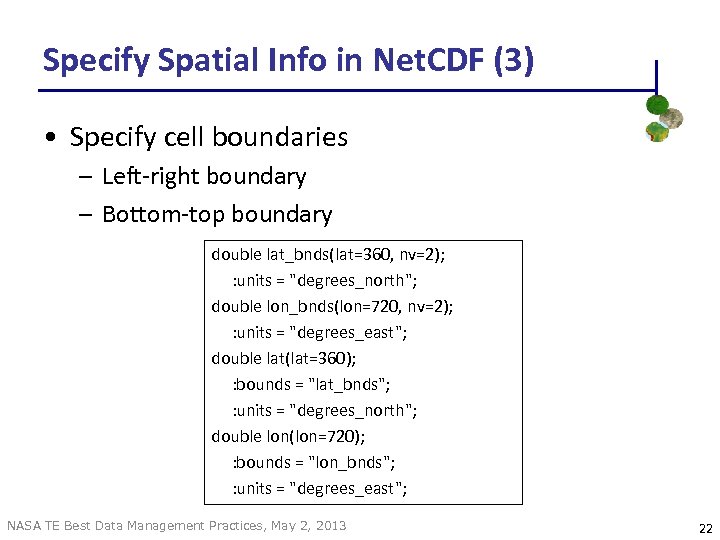 Specify Spatial Info in Net. CDF (3) • Specify cell boundaries – Left-right boundary – Bottom-top boundary double lat_bnds(lat=360, nv=2); : units = "degrees_north"; double lon_bnds(lon=720, nv=2); : units = "degrees_east"; double lat(lat=360); : bounds = "lat_bnds"; : units = "degrees_north"; double lon(lon=720); : bounds = "lon_bnds"; : units = "degrees_east"; NASA TE Best Data Management Practices, May 2, 2013 22
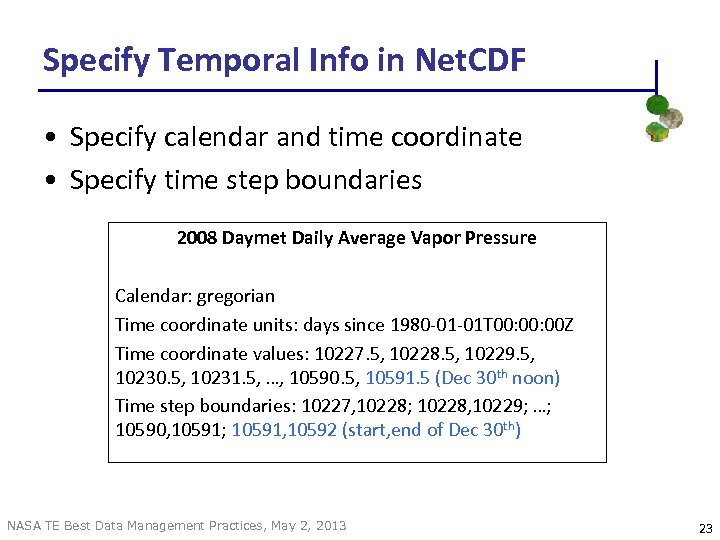 Specify Temporal Info in Net. CDF • Specify calendar and time coordinate • Specify time step boundaries 2008 Daymet Daily Average Vapor Pressure Calendar: gregorian Time coordinate units: days since 1980 -01 -01 T 00: 00 Z Time coordinate values: 10227. 5, 10228. 5, 10229. 5, 10230. 5, 10231. 5, …, 10590. 5, 10591. 5 (Dec 30 th noon) Time step boundaries: 10227, 10228; 10228, 10229; …; 10590, 10591; 10591, 10592 (start, end of Dec 30 th) NASA TE Best Data Management Practices, May 2, 2013 23
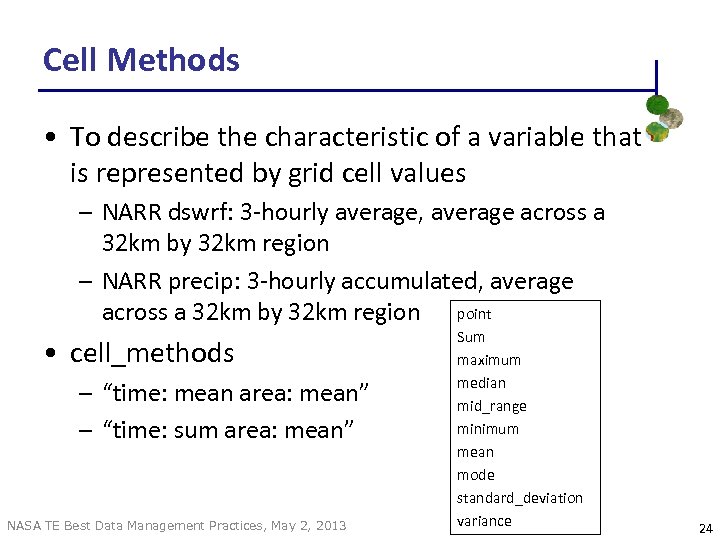 Cell Methods • To describe the characteristic of a variable that is represented by grid cell values – NARR dswrf: 3 -hourly average, average across a 32 km by 32 km region – NARR precip: 3 -hourly accumulated, average across a 32 km by 32 km region point • cell_methods – “time: mean area: mean” – “time: sum area: mean” NASA TE Best Data Management Practices, May 2, 2013 Sum maximum median mid_range minimum mean mode standard_deviation variance 24
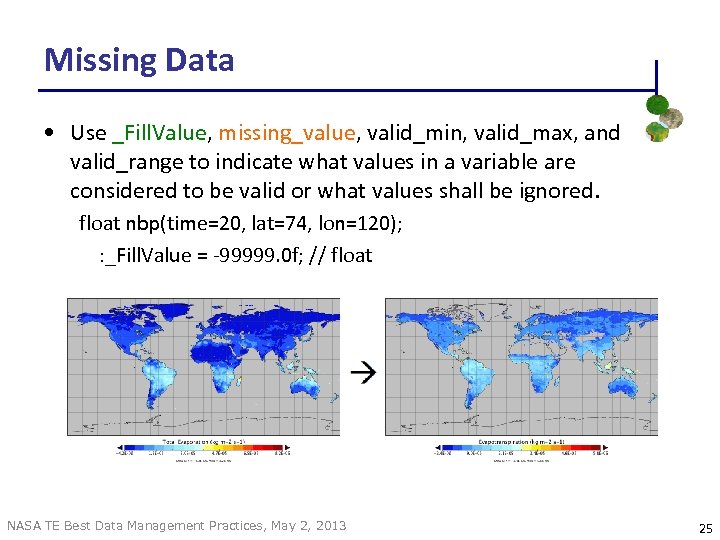 Missing Data • Use _Fill. Value, missing_value, valid_min, valid_max, and valid_range to indicate what values in a variable are considered to be valid or what values shall be ignored. float nbp(time=20, lat=74, lon=120); : _Fill. Value = -99999. 0 f; // float NASA TE Best Data Management Practices, May 2, 2013 25
 Data Units • UDUNITS – Support conversion of unit specifications – Support arithmetic manipulation of units – conversion of values between compatible scales of measurement Follow the rules and computers can then do a lot of work for you and others. Units for Gross Primary Productivity (GPP) kg m-2 s-1 Kg/m 2/month kg. C m-2 s-1 NASA TE Best Data Management Practices, May 2, 2013 26
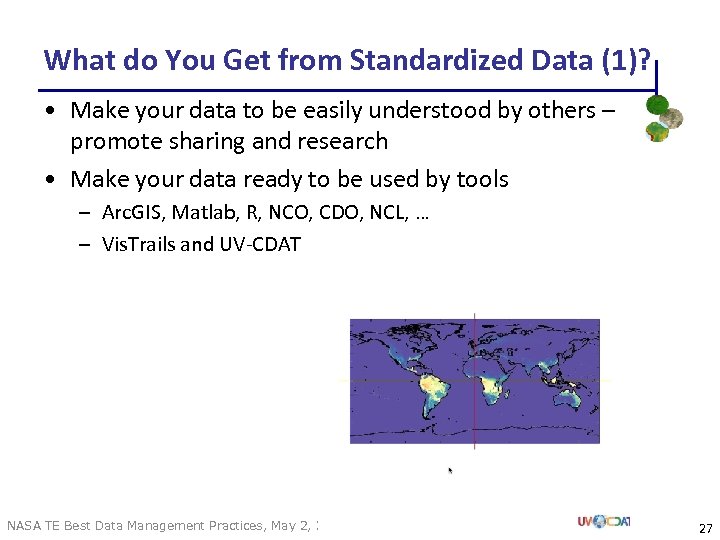 What do You Get from Standardized Data (1)? • Make your data to be easily understood by others – promote sharing and research • Make your data ready to be used by tools – Arc. GIS, Matlab, R, NCO, CDO, NCL, … – Vis. Trails and UV-CDAT NASA TE Best Data Management Practices, May 2, 2013 27
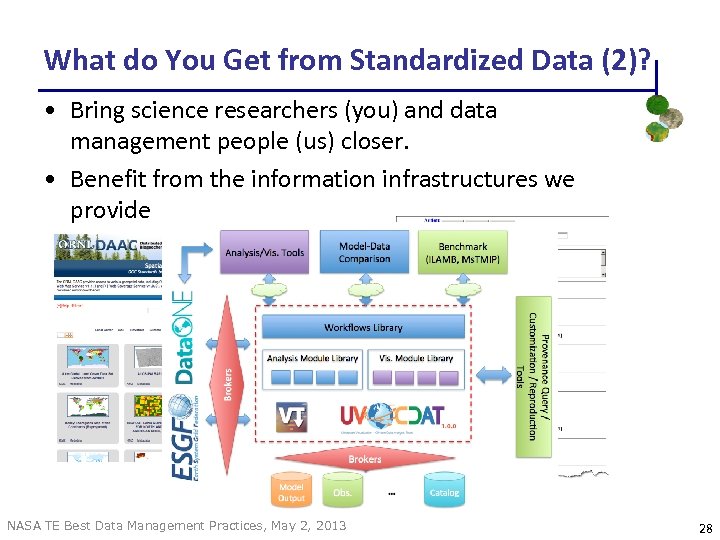 What do You Get from Standardized Data (2)? • Bring science researchers (you) and data management people (us) closer. • Benefit from the information infrastructures we provide NASA TE Best Data Management Practices, May 2, 2013 28
 Summary • Provide spatial and temporal information completely and accurately • Choose good formats to organize the data content and make them self-descriptive • Provide interpretative metadata in standard ways • You will be returned a lot by doing this – Your data will be easily understood by not only users but also computers – A lot of data visualization and analysis can be automated – Your data can be ingested into many existing Web services to provide on-demand data distribution to users – Value of your data can be preserved longer into the future NASA TE Best Data Management Practices, May 2, 2013 29