


 Скачать презентацию Preparing Leadership for the st Century 21 May
7b8650b6fad89cb7a4ef202fff38652b.ppt
- Количество слайдов: 70
 Preparing Leadership for the st Century 21 May 9, 2005 Michigan Education Policy Fellowship Program Learning Team Seminar
 Team Members • • • Patricia Gilcrest-Frazier Beatrice Harrison Viola C. Hubbard Camille B. Jones Miguel L. Rodriguez Krafus Walker
 Objectives • Participants will be able to distinguish the difference between leadership and management. • Participants will be able to identify influences on leadership as a result of changing demographics (i. e. Culture, Ethnicity, and Economics). • Participants will be able to identify how leaders lead and survive in dysfunctional work groups. • Participants will understand the challenges of leading in education, business, and non-profit organizations.
 Agenda • • • Opening Session Attitude Charades Leadership in Education Break Leadership in Non-Profits Break Leadership in Private Business Break Every Which Way to Lead Closing Session 1: 00 pm – 1: 20 pm – 1: 30 pm – 2: 20 pm – 2: 30 pm – 3: 20 pm – 3: 30 pm – 4: 20 pm – 4: 30 pm – 4: 45 pm – 5: 00 pm
 Opening Session 20 Minutes • Leadership Overview • Five Dysfunctions 10 Minutes
 Leadership Overview Pat Gilcrest-Frazier
 Leadership is……. Kouzes, James M. and Posner, Barry Z. , The Leadership Challenge, pg. 20 • an identifiable set of skills and practices that are available to all of us. • is a relationship between those who aspire to lead and those who choose to follow.
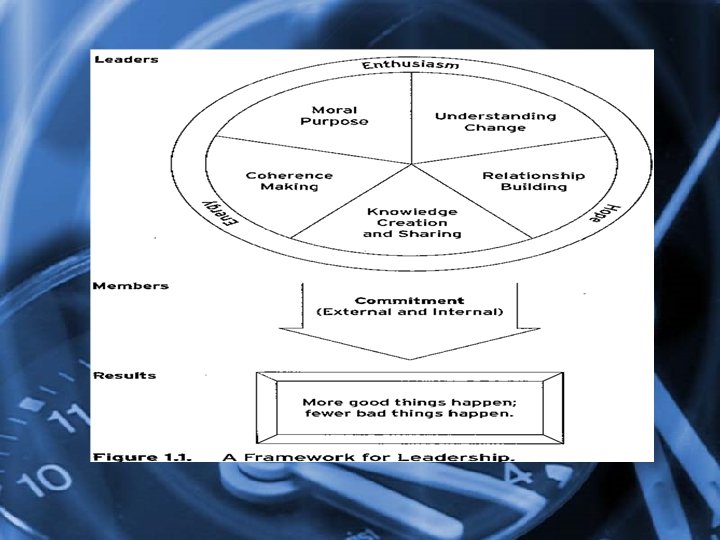
 Leadership Framework Fullan, Michael, Leading in a Culture of Change, pgs. 1 -11.
 The Twentieth and Twenty-first Century Organization compared Kotter, John P, Leading Change, pg. 172
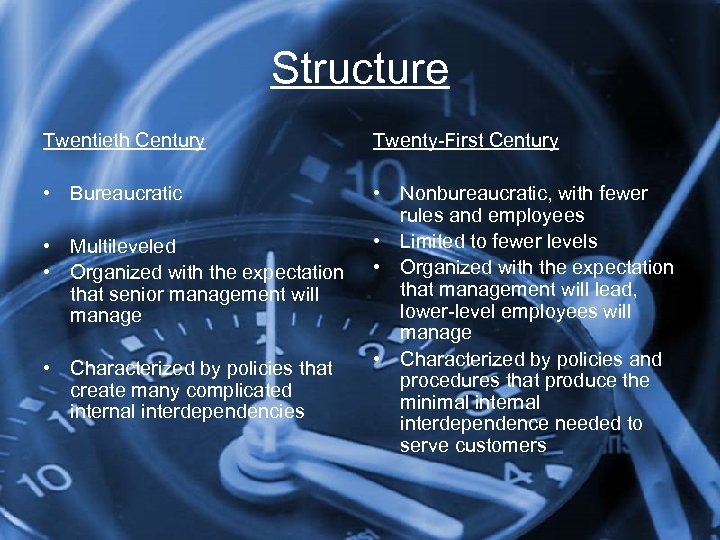 Structure Twentieth Century Twenty-First Century • Bureaucratic • Nonbureaucratic, with fewer rules and employees • Limited to fewer levels • Organized with the expectation that management will lead, lower-level employees will manage • Characterized by policies and procedures that produce the minimal internal interdependence needed to serve customers • Multileveled • Organized with the expectation that senior management will manage • Characterized by policies that create many complicated internal interdependencies
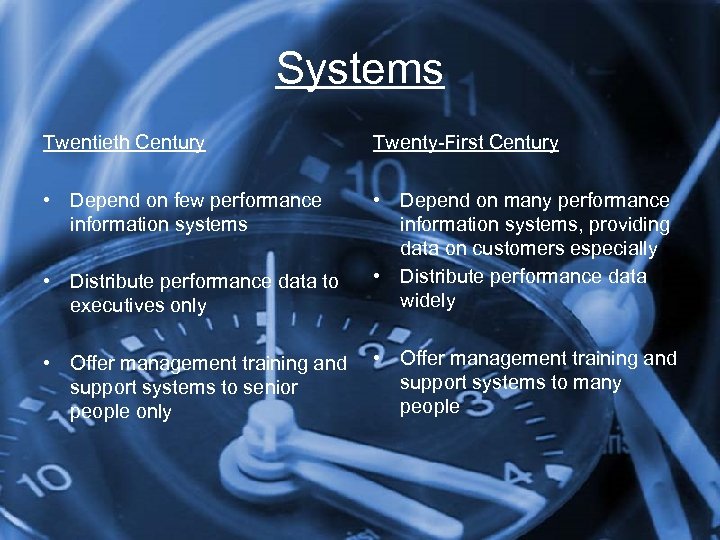 Systems Twentieth Century Twenty-First Century • Depend on few performance information systems • Distribute performance data to executives only • Depend on many performance information systems, providing data on customers especially • Distribute performance data widely • Offer management training and support systems to senior people only • Offer management training and support systems to many people
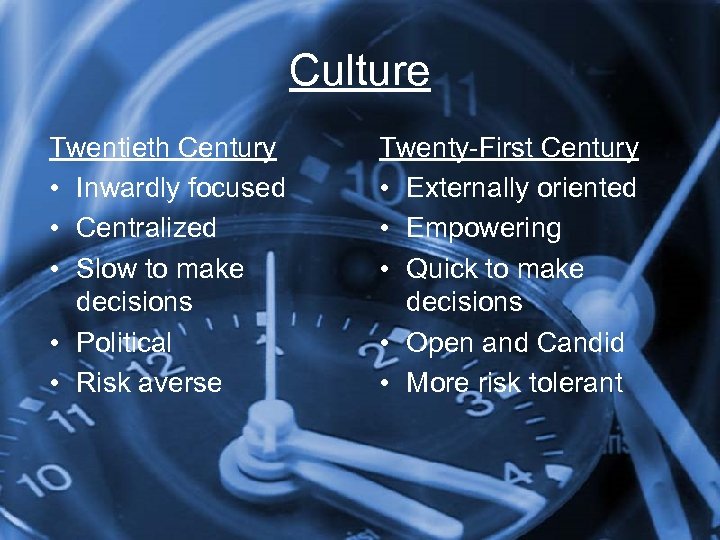 Culture Twentieth Century • Inwardly focused • Centralized • Slow to make decisions • Political • Risk averse Twenty-First Century • Externally oriented • Empowering • Quick to make decisions • Open and Candid • More risk tolerant
 Managers vs. Leaders Covey, Stephen R. , The 7 Habits of Highly Effective People, pg. 101 Kotter, John P. , Leading Change, pg. 165
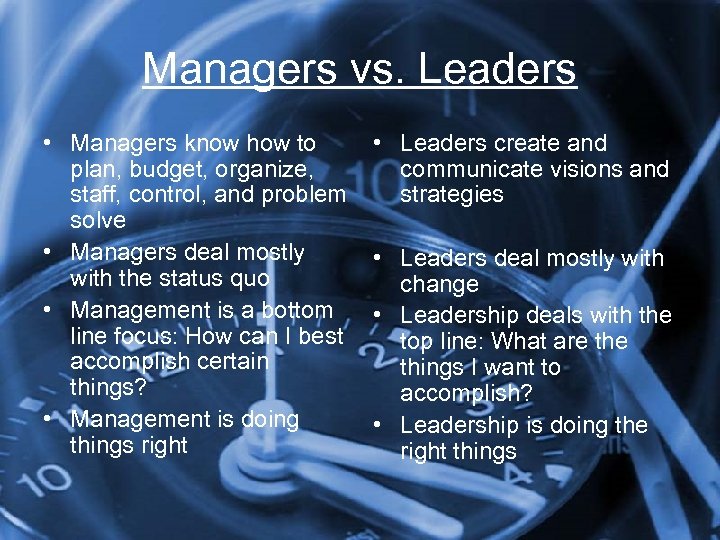 Managers vs. Leaders • Managers know how to plan, budget, organize, staff, control, and problem solve • Managers deal mostly with the status quo • Management is a bottom line focus: How can I best accomplish certain things? • Management is doing things right • Leaders create and communicate visions and strategies • Leaders deal mostly with change • Leadership deals with the top line: What are things I want to accomplish? • Leadership is doing the right things
 Leadership Styles Fullan, Michael, Leading in a Culture of Change, pgs. 35 -49
 Six Leadership Styles Goleman (2000, pgs. 82 -83) • Coercive-the leader demands compliance. (“Do what I tell you. ”) • Authoritative-the leader mobilizes people toward a vision. (“Come with me. ”) • Affiliative-the leader creates harmony and builds emotional bonds. (“People come first. ”) • Democratic-the leader forges consenus through participation. (“What do you think? ”) • Pacesetting-the leader sets high standards for performance. (“Do as I do, now. ”) • Coaching-the leader develops people for the future. (“Try this. ”)
 Five Practices of Exemplary Leadership Kouzes, James M. and Posner, Barry Z. , The Leadership Challenge, pgs. 13 -20
 Exemplary Leadership • • • Model the Way Inspire a Shared Vision Challenge the Process Enable Others to Act Encourage the Heart
 Five Dysfunctions Leaders Face Krafus Walker
 5 Dysfunctions Leaders Face Taken from “The Five Dysfunctions of a Team “ and “ Overcoming The Five Dysfunctions Of A Team” by Patrick Lencioni
 5 Dysfunctions Leaders Face • • • The dysfunction How teams operate with the dysfunction How teams operate without the dysfunction Suggestions for overcoming the dysfunction The role of the leader
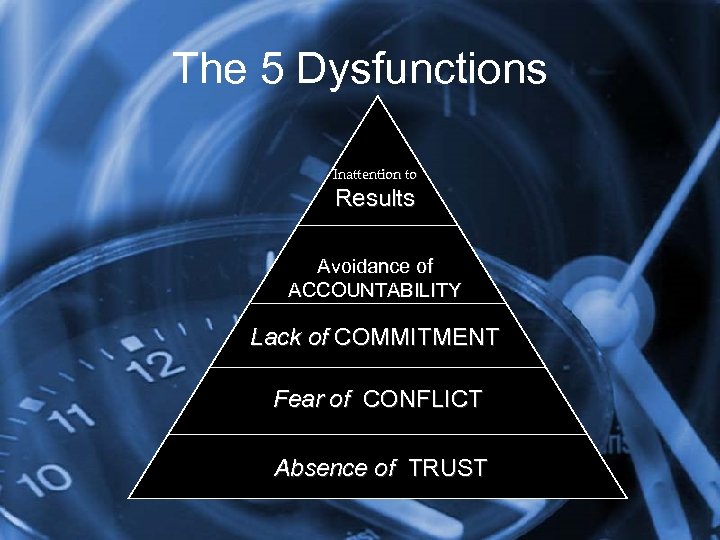 The 5 Dysfunctions Inattention to Results Avoidance of ACCOUNTABILITY Lack of COMMITMENT Fear of CONFLICT Absence of TRUST
 #1—the absence of TRUST • “It simply makes no difference how good the rhetoric is or even how good the intentions are; if there is little or no trust, there is no foundation for permanent success. ” • ~Stephen Covey
 What is TRUST? Think of two people: one that you trust and the other that you don’t. In the context of team building, trust is the confidence among team members that their peers’ intentions are good, and that there is no reason to be careful around the group
 Members of teams with an with absence of trust. . 1. Conceal their weaknesses and mistakes from one another 2. Hesitate to ask for help or provide constructive feedback 3. Hesitate to offer help outside their own areas of responsibility 4. Jump to conclusions about the intentions and aptitudes of others without attempting to clarify then 5. Fail to recognize and tap into one another’s skills and experiences 6. Waste time and energy managing their behaviors for effect 7. Hold grudges 8. Dread meetings
 Members of trusting teams. . . 1. Admit weakness and mistakes 2. Ask for help 3. Accept questions and input about their areas of responsibility 4. Give one another the benefit of the doubt before arriving to a negative conclusion 5. Take risks in offering feedback and assistance 6. Appreciate and tap into one another’s skills and experiences 7. Focus time and energy on important issues, not politics 8. Offer and accept apologies without hesitation 9. Look forward to meetings and other opportunities to work as a group
 Overcoming the Absence of Trust • Personal History Exercise – Have team members to answer a short list of questions about themselves • Team effectiveness Exercise – Have team members to identify the single most important contribution that each of their peers makes to the team, as well as the one area that they must either improve upon or eliminate for the good of the team • Personality and Behavioral Preference Profiles – Myers Briggs Type Indicator
 The Role of the Leader • Demonstrate Vulnerability
 #2—the fear of CONFLICT • “Much unhappiness has come into the world because of bewilderment and things left unsaid. ” • ~Fyodor Dostoyevsky
 Is conflict ever positive? • What is an example of healthy conflict? • What happens to make it quality? • What doesn’t happen that keeps it good? Teams that engage in productive conflict know that the only purpose is to produce the best possible solution in the shortest period of time
 Teams that fear conflict. . . 1. Have boring meetings 2. Create environments where back-channel politics and personal attacks thrive 3. Ignore controversial topics that are critical to team success 4. Fail to tap into all the opinions and perspectives of team members 5. Waste time and energy with posturing and interpersonal risk management
 Teams that Engage in Conflict. . . 1. Have lively interesting meetings 2. Extract and explore the ideas of all team members 3. Solve real problems quickly 4. Minimize politics 5. Put critical topics on the table for discussion
 Suggestions for overcoming fear of conflict • Mining – Extracting buried disagreements within the team and sheds the light of day on them • Real Time Permission – Coaching one another not to retreat from healthy debate
 Role of the Leader • Demonstrate restraint when team members engage in conflict • Personally model appropriate conflict behavior
 #3—the lack of COMMITMENT • “Always remember the distinction between contribution and commitment. Take the matter of bacon and eggs. The chicken makes a contribution. The pig makes a commitment. ” • ~John Mack Carter In the context of a team, commitment is a function of two things: clarity and buy-in
 Enemies of Commitment:
 1. The need for consensus • sometimes in the pursuit of unanimity we seek artificial harmony, and that leads to low levels of commitment.
 2. The fear of failure • this is the most common reason people do not commit. They would rather not ever take a stand on something than risk being “wrong. ”
 3. Lack of communication • if someone is not being heard or listened to, they will not invest in any decisions or goals.
 4. Mismatch • a person who is in the wrong position for him or her will not contain the interest or passion necessary to achieve high levels of commitment.
 A team that fails to commit… 1. Creates ambiguity among the team about direction and priorities 2. Watches windows of opportunity close due to excessive analysis and unnecessary delay 3. Breeds lack of confidence and fear of failure 4. Revisits discussions and decisions again and again 5. Encourages second-guessing among team members
 A team that commits… 1. Creates clarity around direction and priorities 2. Aligns the entire team around common objectives 3. Develops an ability to learn from mistakes 4. Take advantage of opportunities before competitors do 5. Move forward without hesitation 6. Change direction without hesitation or guilt
 Suggestions for overcoming the lack of commitment • Cascading Messaging • Deadlines • Contingency and Worst-Case scenario Analysis • Low-Risk Exposure Therapy
 The Role of the Leader • Be comfortable with the prospect of making a decision that ultimately turns out to be wrong • Constantly push the group for closure around issues and adherence to schedules the team has set
 #4—avoidance of ACCOUNTABILITY • “The secret of discipline is motivation. When a man is sufficiently motivated, discipline will take care of itself. ” • ~Sir Alexander Paterson In the context of teamwork, accountability refers specifically to the willingness of team members to call their peers on performance of behaviors that might hurt the team
 Quick Self Check— see how your team does • 3—usually 2—sometimes 1—rarely _____ We call out one another’s deficiencies or unproductive behaviors. _____ We are deeply concerned about the prospect of letting down our peers. _____ We challenge one another about our plans and approaches.
 A team that avoids accountability… 1. Creates resentment among team members who have different standards of performance 2. Encourages mediocrity 3. Misses deadlines and key deliverables 4. Place an undue burden on the team leader as the sole source of discipline
 A team that holds one another accountable … 1. Ensures that poor performers feel pressure to improve 2. Identifies potential problems quickly by questioning one another’s approaches without hesitation 3. Establishes respect among team members who are held to the same high standards 4. Avoids excessive bureaucracy around performance management and corrective action
 Suggestions for overcoming avoidance of accountability • Team Rewards • Explicitly communicate goals and standards of behavior • Regularly discuss performance versus goals and standards
 The Role of the Leader • Allow the team to serve as the first and primary accountability mechanism • Be willing to serve as the ultimate arbiter of discipline when the team itself fails
 #5—inattention to RESULTS • “Teamwork is the quintessential contradiction of a society grounded in individual achievement. ” • ~Marvin Weisbord
 “The ultimate dysfunction of a team is the tendency of members to care about something other than the collective goals of the group. ” ~Patrick Lencioni
 Distracters • Team Status—to some people just being on the team means that they have met their goals, and because of this no longer buy into the goals, vision, and/or mission of the team • Individual Status— success of a specific person without regard to the status of the team as a larger unit. The desire for individual credit erodes the focus on collective success.
 A team that is not focused on results… 1. 2. 3. 4. Stagnates/fails to grow Rarely defeats competitors Loses achievement-oriented employees Encourages team members to focus on their own careers and individual goals 5. Is easily distracted
 A team that focuses on collective results… 1. Retains achievement-oriented employees 2. Minimize individualistic behavior 3. Enjoys success and suffers failure acutely 4. Benefits from individuals who subjugate their own goals/interests for the good of the team 5. Avoids Distractions
 Overcoming inattention to … • Public declaration of results • Results-based rewards
 The Role of the Leader • Set the tone for a focus on results • Be selfless and objective, reserve the rewards and recognition for those who make real contributions to achievement of group goals
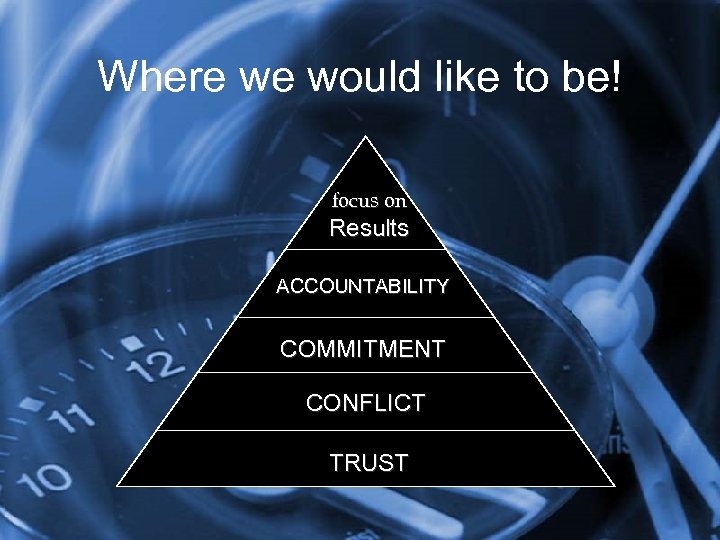 Where we would like to be! focus on Results ACCOUNTABILITY COMMITMENT CONFLICT TRUST
 Attitude Charades Group Activity 10 Minutes
 Leadership in Education Mr. Ira Rutherford Superintendent Flint Community Schools
 Break! Take 10 Minutes
 Leadership in Nonprofit Ms. Robin Lynn Grinnell Director Michigan Nonprofit Leadership Institute
 Break! Take 5 Minutes
 Viola Hubbard Demographic Influences on Leadership
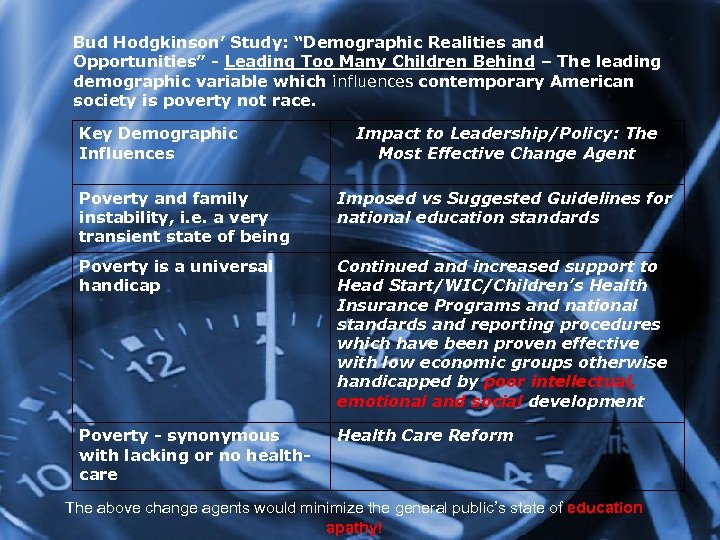 Bud Hodgkinson’ Study: “Demographic Realities and Opportunities” - Leading Too Many Children Behind – The leading demographic variable which influences contemporary American society is poverty not race. Key Demographic Influences Impact to Leadership/Policy: The Most Effective Change Agent Poverty and family instability, i. e. a very transient state of being Imposed vs Suggested Guidelines for national education standards Poverty is a universal handicap Continued and increased support to Head Start/WIC/Children’s Health Insurance Programs and national standards and reporting procedures which have been proven effective with low economic groups otherwise handicapped by poor intellectual, emotional and social development Poverty - synonymous with lacking or no healthcare Health Care Reform The above change agents would minimize the general public’s state of education apathy!
 Leadership in Business & Public Sector Mr. Ed Sarpolus Vice President EPIC/MRA
 BREAK!!!! Take 10 Minutes
 Every Which Way to Lead Group Activity 15 Minutes
 Closing Session It’s almost over… 15 Minutes