


 Скачать презентацию Preparing for the School Crisis Response A workshop
cfd6fb36c7b4afeb3cd84b9223a001d4.ppt
- Количество слайдов: 60
 Preparing for the School Crisis Response A workshop presented by Stephen E. Brock Lee Huff Doug Siembieda CASP Crisis Intervention Specialty Group
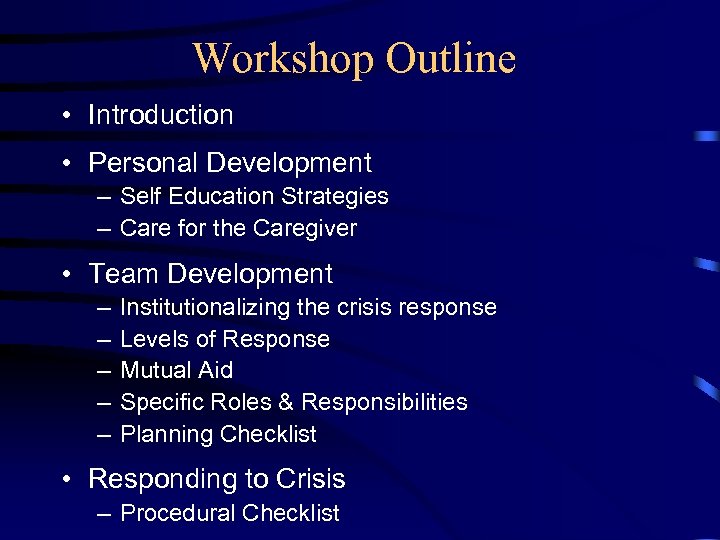 Workshop Outline • Introduction • Personal Development – Self Education Strategies – Care for the Caregiver • Team Development – – – Institutionalizing the crisis response Levels of Response Mutual Aid Specific Roles & Responsibilities Planning Checklist • Responding to Crisis – Procedural Checklist
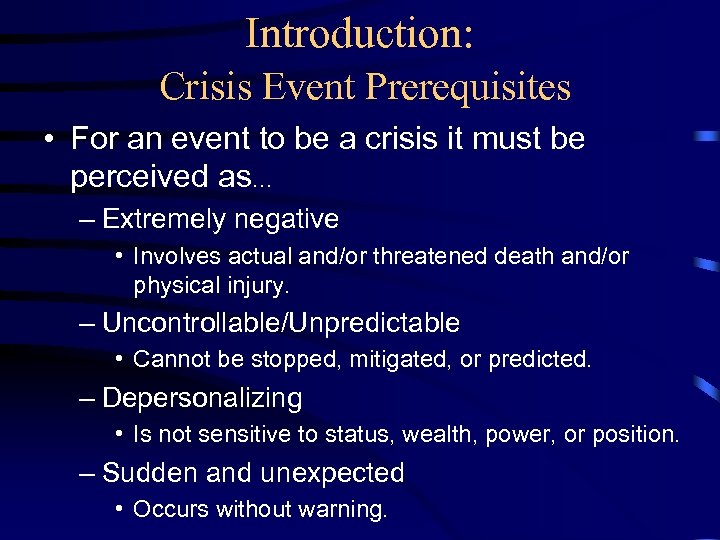 Introduction: Crisis Event Prerequisites • For an event to be a crisis it must be perceived as… – Extremely negative • Involves actual and/or threatened death and/or physical injury. – Uncontrollable/Unpredictable • Cannot be stopped, mitigated, or predicted. – Depersonalizing • Is not sensitive to status, wealth, power, or position. – Sudden and unexpected • Occurs without warning.
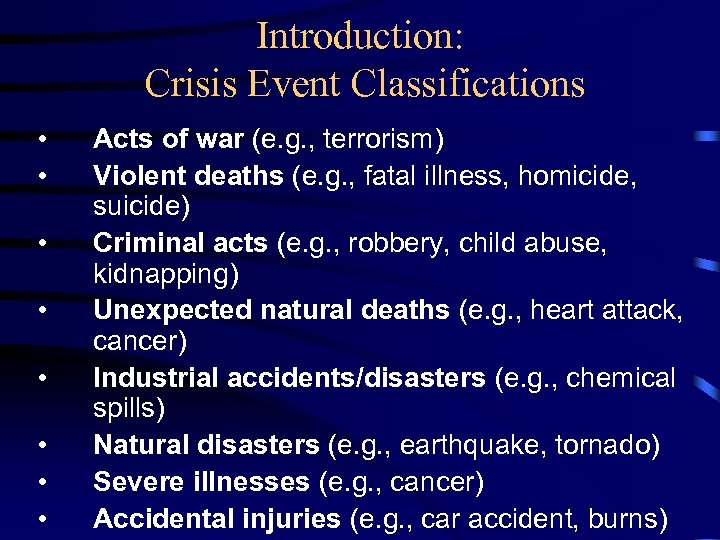 Introduction: Crisis Event Classifications • • Acts of war (e. g. , terrorism) Violent deaths (e. g. , fatal illness, homicide, suicide) Criminal acts (e. g. , robbery, child abuse, kidnapping) Unexpected natural deaths (e. g. , heart attack, cancer) Industrial accidents/disasters (e. g. , chemical spills) Natural disasters (e. g. , earthquake, tornado) Severe illnesses (e. g. , cancer) Accidental injuries (e. g. , car accident, burns)
 Introduction: Variables That Affect Traumatic Potential • Type of disaster • • Natural disasters are typically less traumatic than are man-made disasters or human caused crises. Source of physical threat/injury • • Physical threat or injuries due to accidents/illness are less traumatic than are threats and/or injury due to assaultive violence. Presence of fatalities • • Crises resulting in non-fatal trauma to significant others are less traumatic than are events that result in sudden and unexpected death. In addition, events that involve sudden and unexpected death will be complicated by grief reactions.
 Introduction: Phases of a Crisis Event 1. Baseline – Normal school functioning 2. Pre-impact – The period before an anticipated crisis 3. Impact – When the crisis occurs 4. Recoil – Immediately after the crisis 5. Post-impact – Days to weeks after the crisis 6. Recovery/Reconstruction – Months or years after the crisis
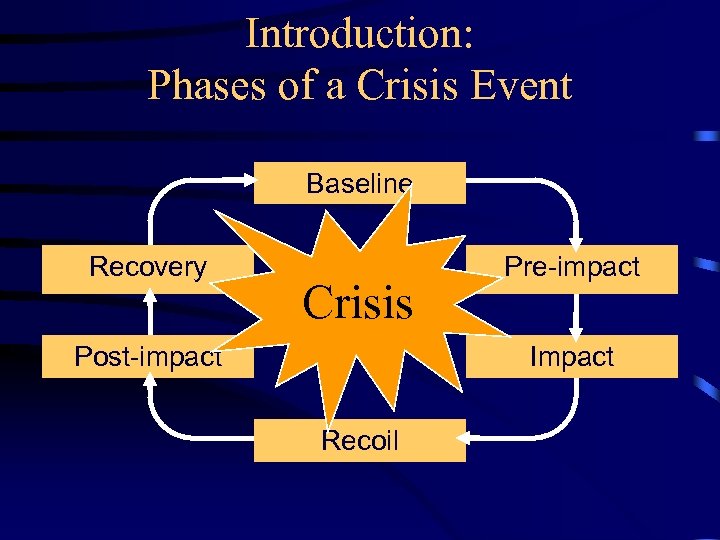 Introduction: Phases of a Crisis Event Baseline Recovery Crisis Post-impact Pre-impact Impact Recoil
 Introduction: School Crisis Team Activities • Crisis Prevention – Reduce the incidence of crisis events. • Crisis Preparedness – Ensure response readiness for crises that are not, or cannot be, prevented. • Crisis Response – After a crisis event minimize crisis damage and restore equilibrium. • Crisis Recovery – Repair crisis damage and return to baseline (or precrisis) operation/functioning.
 Introduction: SCT activities during the different phases of a crisis.
 Introduction: Key Terms and Definitions • Situational Crisis Event An extremely negative, sudden, and unexpected event that generates apparently unsolveable problems for crisis victims. • Crisis State The acute distress generated by having a problem that is (at least initially) judged by the person-in-crisis as not having a solution. • Psychological Triage Sorting and classification of individuals according to the degree to which they are judged to have been traumatized by a crisis event.
 Introduction: Key Terms and Definitions • Crisis Intervention The immediate helping response offered by a caregiver to the person-in-crisis. • Crisis Response The immediate helping response offered by a crisis response team to a school following a crisis event. • Levels of Crisis Response – School-site level. – School-district level. – Community mutual aid level. • Mutual Aid “Agreements between traditionally unassociated agencies that allow for the sharing of resources during emergency situations. ”
 Crisis Preparedness: Personal Development • Self Education – Obtain background knowledge • Care for the Caregiver – – – Warning signs Caring for others Caring for oneself
 Obtaining Background Knowledge • School Crisis Response Books & Readings • Internet Resources • Training Programs • Crisis Response Evaluations
 School Crisis Resource CD • This compilation of resources should be valuable in school crisis prevention, preparedness, response, and intervention activities. • Includes the foundation papers that provide the empirical basis for much of the workshop. • Also includes a variety of materials that are available from NASP, FEMA, CA OES, NIMH, U. S. Department of Education, and other valuable resources.
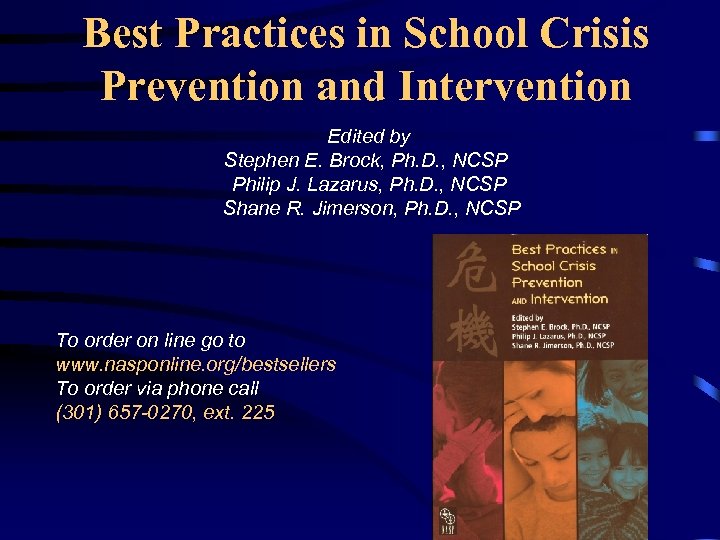 Best Practices in School Crisis Prevention and Intervention Edited by Stephen E. Brock, Ph. D. , NCSP Philip J. Lazarus, Ph. D. , NCSP Shane R. Jimerson, Ph. D. , NCSP To order on line go to www. nasponline. org/bestsellers To order via phone call (301) 657 -0270, ext. 225
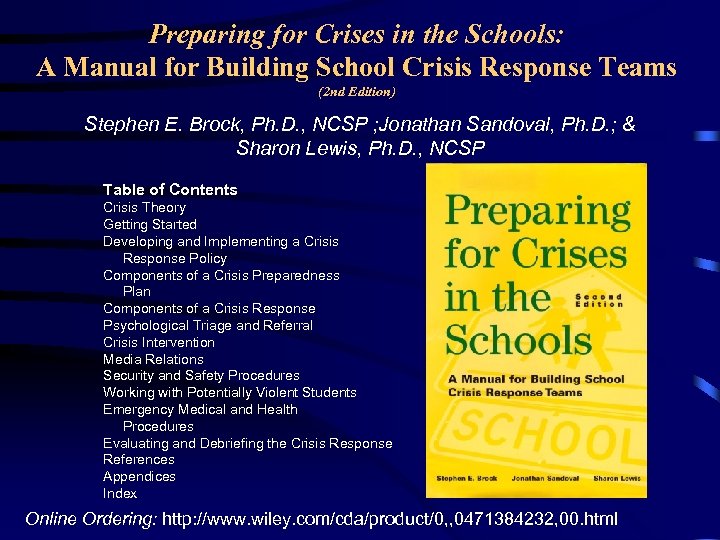 Preparing for Crises in the Schools: A Manual for Building School Crisis Response Teams (2 nd Edition) Stephen E. Brock, Ph. D. , NCSP ; Jonathan Sandoval, Ph. D. ; & Sharon Lewis, Ph. D. , NCSP Table of Contents Crisis Theory Getting Started Developing and Implementing a Crisis Response Policy Components of a Crisis Preparedness Plan Components of a Crisis Response Psychological Triage and Referral Crisis Intervention Media Relations Security and Safety Procedures Working with Potentially Violent Students Emergency Medical and Health Procedures Evaluating and Debriefing the Crisis Response References Appendices Index Online Ordering: http: //www. wiley. com/cda/product/0, , 0471384232, 00. html
 Training Resources • NOVA – 202 -232 -6682 – http: //www. try-nova. org/ • Applied Suicide Intervention Skills Training – Living. Works Education, Inc. – 1 -403 -309 -0242 – Living@nucleus. com • Nonviolent Crisis Intervention – National Crisis Prevention Institute – 1 -800 -588 -8976 – http: //www. crisisprevention. com
 The Importance of Local Experts Beth Doll, reflecting on the response to the Columbine High School Tragedy, in Littleton Colorado, stated: While our thanks go out to the national leaders and experts who came to Littleton to help, it was the local ‘insiders’ who led the community’s response who were most valued by the Columbine students, staff, and their families. Many of these leaders had participated in national training on crisis intervention in the recent past. They were insider experts, familiar and trusted faces, who knew the history of the school and the community, were part of a shared culture and shared the loss. We especially appreciated the fact that these local leaders were here, in the community, and prepared to intervene. (pp. 66, 97) Doll, B. (1999). Reflections from Littleton. The School Psychologist, 53, 66, 97.
 Anticipated or Experienced Reactions to Crisis Intervention Discuss the kind of reactions to crisis intervention that you have had, or anticipate that you might have following such work.
 Warning Signs of an Overextended Crisis Intervenor § § § § § Excessive worry about crisis victims. Intense irritability. Obsessive thinking. Constant replays of the incident. Unfounded anger. Loss of interest in own work. Chronic feelings of fatigue. Doing to much for crisis victims. Maintaining an unnecessary degree of follow-up. Adapted from Critical Incident Stress Debriefing (pp. 257 -258), by J. T. Mitchell and G. S. Everly (1996), Ellicott City, MD: Chevron.
 Warning Signs of an Overextended Crisis Intervenor § § § § Attempts to work independently. Frequent and unexplained loss of emotional control. Sleeplessness, agitation, and restlessness. Excessive withdrawal. Excessive volunteering for crisis intervention. Feeling upset/jealous when others do an intervention. Believe that no one else could provide an intervention. Adapted from Critical Incident Stress Debriefing (pp. 257 -258), by J. T. Mitchell and G. S. Everly (1996), Ellicott City, MD: Chevron.
 Care for the Caregiver § Exercise. § Rest. § Avoid drugs and alcohol. § Maintain a normal schedule. § Spend time with other intervenors. § Help your fellow crisis intervenors. § Do things that feel good. § Realize those around you are stressed. § Eat well-balanced and regular meals. Adapted from Critical Incident Stress Management: The Basic Course Workbook (p. 77), by J. T. Mitchell and G. S. Everly (1996), Ellicott City, MD: International Critical Incident Stress Foundation.
 Care for the Caregiver Discuss the elements of your personal self care plan.
 Team Development • Institutionalizing Crisis Response – Governing Board Policy • Levels of Response – – No Response School Level Response District Level Response Mutual Aid Response • Specific Roles & Responsibilities of the Crisis Response Team According to the Standardized Emergency Management System • Planning Checklist
 Crisis Response Policy The governing board recognizes the need to provide support to students and staff in the event of a crisis. A crisis is defined as a sudden, unexpected, and accidental event. These events will have an emergency quality to them and will have the potential to impact the entire school community. Examples of such "situational crises" include physical illness and injury, unexpected/untimely deaths, being the victim of a crime, natural and man-made disasters, and war and related acts. These events may cause entry into a "crisis state. " This is a temporary state of distress, characterized chiefly by the inability to cope with the situation using customary methods of problem solving, and by the potential for a radically positive or negative outcome. This crisis state is more than simple stress and not necessarily a sign of mental illness. The crisis state is a normal reaction to abnormal circumstances. It is the intent of the governing board that the administration shall develop procedures to identify and assist students and staff who enter into a "crisis state" as the result of a "situational crisis. " It is the policy of the governing board that the district have a plan in place for the provision of immediate crisis response and crisis intervention, as well as for follow-up support.
 Crisis Response Rules Crisis Preparedness 1. At least annually, school administration will review Administrative Guidelines for Crisis Intervention with site staff. 2. A current copy of the Planning Check List (from Administrative Guidelines for Crisis Intervention) must be on file in the superintendent's office by October 1 of each school year. 3. Annually, district administration will select a sample of school sites that will have their crisis preparedness evaluated through a readiness check or drill. Supervision and evaluation of this drill will be facilitated by districtlevel administration. Crisis Response 4. Once a crisis situation has stabilized, school administration must make efforts to determine facts surrounding the crisis. Assess degree of impact on the school and begin to determine the level of response required. 5. The superintendent's office must be notified immediately following a crisis that occurs at school. District Crisis Response Team assistance (if needed) is requested through the district office. 6. Implement procedures for crisis intervention as specified in Administrative Guidelines for Crisis Intervention.
 Comprehensive Safety Plan Policy • The Governing Board recognizes that students and staff have the right to a safe and secure campus where they are free from physical and psychological harm. The Board is fully committed to maximizing school safety and to creating a positive learning environment that teaches strategies for violence prevention and emphasizes high expectations for student conduct, responsible behavior and respect for others. • The Superintendent or designee shall oversee the development of a comprehensive districtwide safety plan that identifies major safety concerns as well as the district’s goals and priorities for safe schools. The plan shall include violence prevention strategies and actions to be taken in the event of a crisis or emergency. • The Governing Board also recognizes the need to provide support to students in the event of a crisis. A crisis is defined as a traumatic event that affects the health, safety, or social-emotional well being of students. It is further the intent of the Governing Board that the Administration shall develop and maintain procedures to assist students, staff, and families in these instances. It is the policy of the Governing Board that the district have a plan in place for the provision of group crisis intervention and crisis management, as well as for follow-up support, and to provide training for administration and staff, as appropriate.
 Comprehensive Safety Plan Policy • Each principal or designee shall ensure the development of a site-level plan, in accordance with law, tailored to the specific concerns of each school. The plan shall take into account the school’s staff, available resources and building design, as well as other factors. • The school safety plan shall be reviewed and updated annually by March 1 of each year. • The superintendent or designee shall approve the comprehensive district wide and/or school safety plan(s) in order to ensure compliance with state law, board policies and administrative regulations. • Legal Reference: – Education Code – 231. 5 35291. 5 – 32260 -32262 3594 -3594. 9 – 35147 35294. 0 -35294. 15 – 35183 48900 -48926 – 35291 48950 Huntington Beach Union High School District, BP 0450
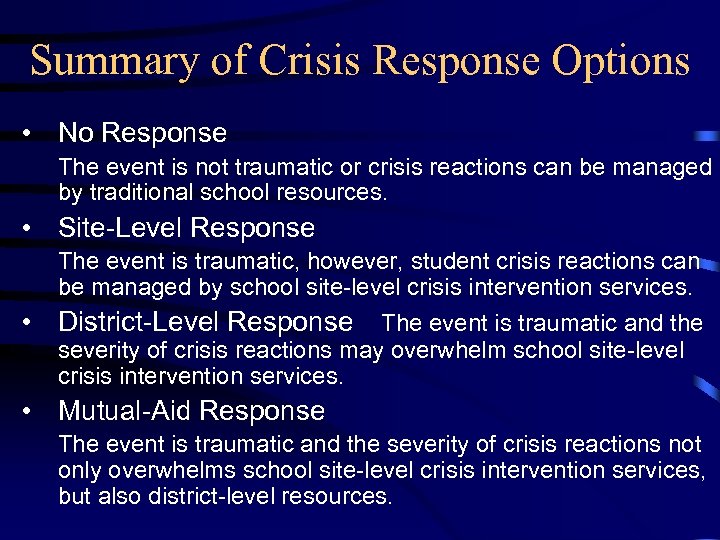 Summary of Crisis Response Options • No Response The event is not traumatic or crisis reactions can be managed by traditional school resources. • Site-Level Response The event is traumatic, however, student crisis reactions can be managed by school site-level crisis intervention services. • District-Level Response The event is traumatic and the severity of crisis reactions may overwhelm school site-level crisis intervention services. • Mutual-Aid Response The event is traumatic and the severity of crisis reactions not only overwhelms school site-level crisis intervention services, but also district-level resources.
 SCT membership and the Standardized Emergency Management System (SEMS) • SCT membership can be defined by making use of the SEMS and the organizational structure of the Incident Command System (ICS). • SEMS is traditionally used to centralize, organize, and coordinate the emergency response to a critical incident, but can also be used to structure other SCT activities (i. e. , prevention, preparedness, and recovery). • This is the same system used by most emergency responders (e. g. , fire departments, law enforcement, emergency medical technicians, disaster responders). • Thus, use of SEMS helps to ensure that the SCT and other emergency responders are speaking the same language.
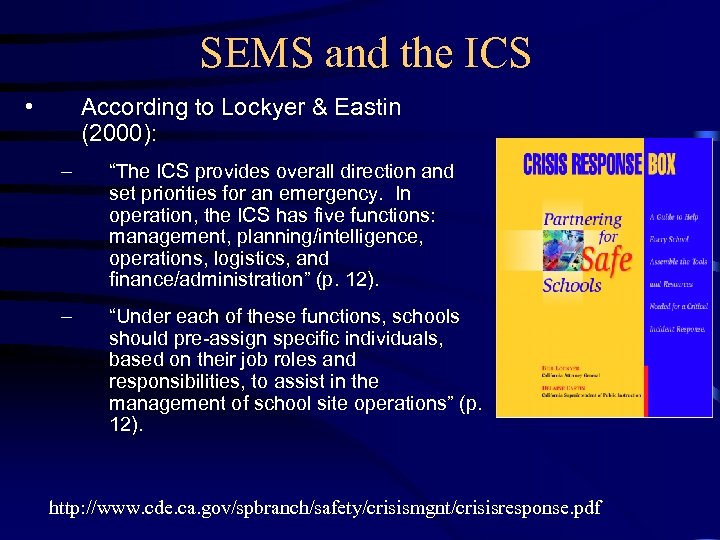 SEMS and the ICS • According to Lockyer & Eastin (2000): – “The ICS provides overall direction and set priorities for an emergency. In operation, the ICS has five functions: management, planning/intelligence, operations, logistics, and finance/administration” (p. 12). – “Under each of these functions, schools should pre-assign specific individuals, based on their job roles and responsibilities, to assist in the management of school site operations” (p. 12). http: //www. cde. ca. gov/spbranch/safety/crisismgnt/crisisresponse. pdf
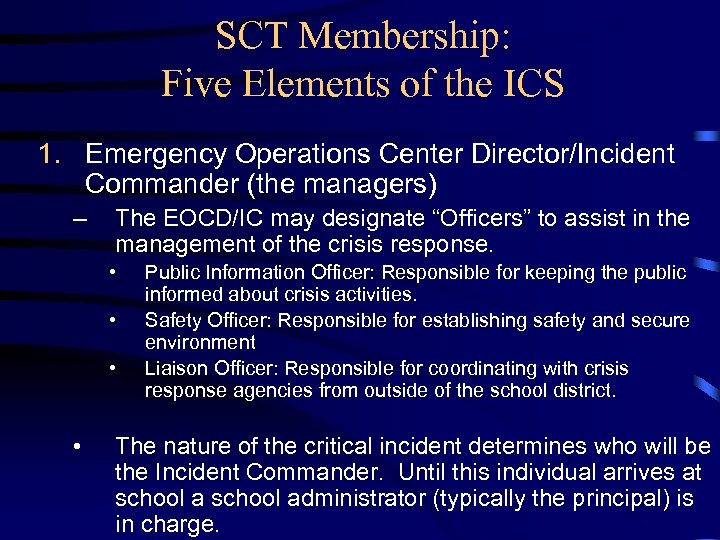 SCT Membership: Five Elements of the ICS 1. Emergency Operations Center Director/Incident Commander (the managers) – The EOCD/IC may designate “Officers” to assist in the management of the crisis response. • • Public Information Officer: Responsible for keeping the public informed about crisis activities. Safety Officer: Responsible for establishing safety and secure environment Liaison Officer: Responsible for coordinating with crisis response agencies from outside of the school district. The nature of the critical incident determines who will be the Incident Commander. Until this individual arrives at school administrator (typically the principal) is in charge.
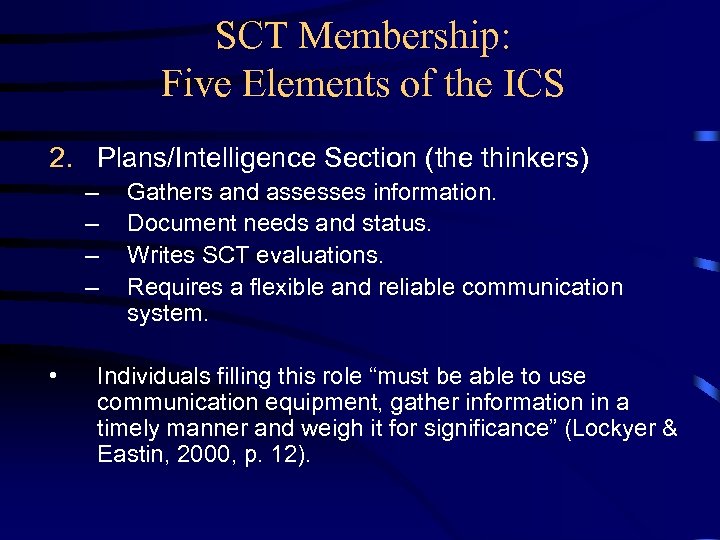 SCT Membership: Five Elements of the ICS 2. Plans/Intelligence Section (the thinkers) – – • Gathers and assesses information. Document needs and status. Writes SCT evaluations. Requires a flexible and reliable communication system. Individuals filling this role “must be able to use communication equipment, gather information in a timely manner and weigh it for significance” (Lockyer & Eastin, 2000, p. 12).
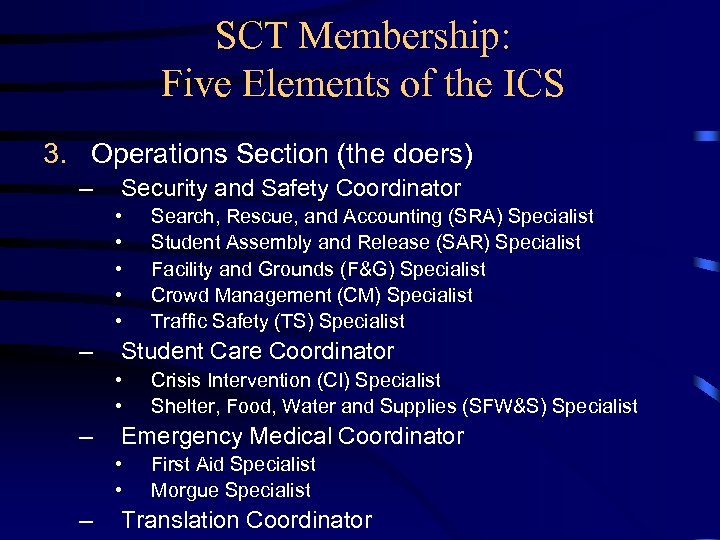 SCT Membership: Five Elements of the ICS 3. Operations Section (the doers) – Security and Safety Coordinator • • • – Student Care Coordinator • • – Crisis Intervention (CI) Specialist Shelter, Food, Water and Supplies (SFW&S) Specialist Emergency Medical Coordinator • • – Search, Rescue, and Accounting (SRA) Specialist Student Assembly and Release (SAR) Specialist Facility and Grounds (F&G) Specialist Crowd Management (CM) Specialist Traffic Safety (TS) Specialist First Aid Specialist Morgue Specialist Translation Coordinator
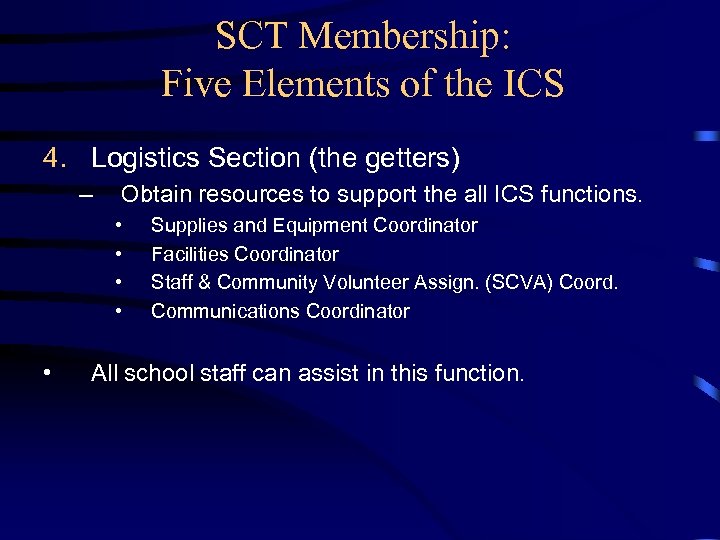 SCT Membership: Five Elements of the ICS 4. Logistics Section (the getters) – Obtain resources to support the all ICS functions. • • • Supplies and Equipment Coordinator Facilities Coordinator Staff & Community Volunteer Assign. (SCVA) Coord. Communications Coordinator All school staff can assist in this function.
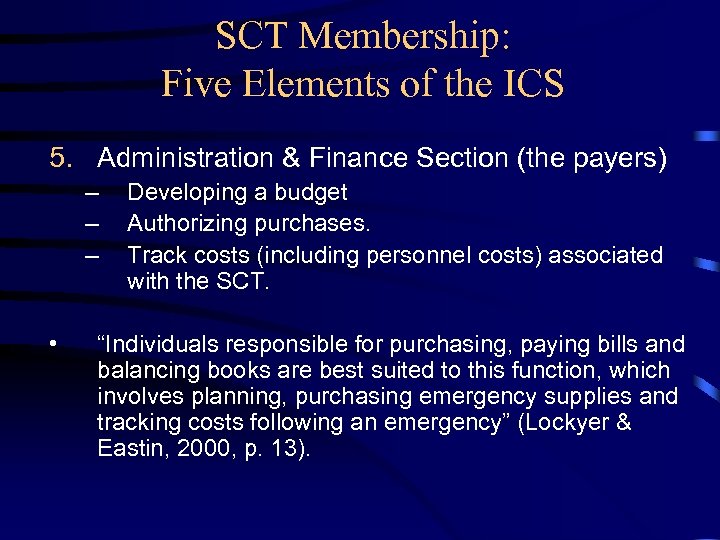 SCT Membership: Five Elements of the ICS 5. Administration & Finance Section (the payers) – – – • Developing a budget Authorizing purchases. Track costs (including personnel costs) associated with the SCT. “Individuals responsible for purchasing, paying bills and balancing books are best suited to this function, which involves planning, purchasing emergency supplies and tracking costs following an emergency” (Lockyer & Eastin, 2000, p. 13).
 SEMS and the SCT
 The Five SEMS Incident Command Structure Roles and the SCT • The specific responsibilities of SCT members during the different phases of a crisis. • We will now review those responsibilities specific to crisis preparedness.
 1. Crisis Management: Preparedness • Delegation, supervision, and evaluation of all crisis preparedness activities. • Assign SCT membership and maintain 24/7 contact information. • Public Information Officer – Foster media relationships, develop media policy, prepare press release templates, plan for an emergency media center. • Safety Officer – Develop disaster safety resources (e. g. , structural engineers, law enforcement). • Liaison Officer – Foster relationships with emergency response personnel, and identify and maintain emergence response listings (e. g. , Red Cross, FEMA).
 2. Intelligence: Preparedness • Acquire and maintain information gathering and reporting materials. – – – Weather radios (battery operated) Cell phones Computers (with Internet access) Two-way radios Maps and floor plans
 3. Operations: Preparedness • Security and Safety – Establish search, rescue, and student accounting procedures. – Establish student assembly and release (to parents) procedures. – Establish crowd and traffic management procedures. • Student Care – Develop the capacity to provide crisis intervention services. – Develop the capacity to meet student basic needs (e. g. , shelter, water, food). • Medical – Develop the capacity to meet emergency medical needs. • Translation – Maintain a listing of translators who speak all languages represented in the school community.
 3. Operations Section Specialists • Search, Rescue, and Accounting Specialist: – • Looks for, rescues, and accounts for students and staff. Student Assembly and Release Specialist : – • Oversees location where students assemble and supervises parent/child reunification. Facility and Grounds Specialist: – • Along with the Safety Officer, ensures that school facilities and grounds are safe. Crowd Management Specialist: – • Implements procedures designed to manage large crowds (e. g. , parents looking for children). Traffic Safety Specialist: – Manages all traffic including emergency response vehicles.
 3. Operations Section Specialists • Crisis Intervention Specialist: – • Addresses mental health needs. Shelter, Food, Water, and Supplies Specialist: – • Maintains and distributes basic needs facilities and supplies. First Aid Specialist: – • Maintains and distributes first aid supplies, oversees first aid prior to emergency response personnel arrival, and works with paramedics. Morgue Specialist – Maintains facilities and supplies to be used to house the deceased until they can be removed.
 4. Logistics: Preparedness • Supplies and Equipment – Obtain and store all crisis response supplies and equipment. • Facilities – Identify and designate crisis response facilities. • Assignments – Identify individuals to fill various crisis response roles. • Communications – Ensure reliable/redundant communications systems (within, to, and from school and to and from all staff) are available.
 5. Finance: Preparedness • Budget for and authorize all crisis preparedness related expenditures
 Primary Elements of a Preparedness Protocol • Identify specific individuals to fill specific crisis response roles • Complete the crisis response box.
 District Level Planning Checklist
 District Level SCT Flowchart
 School Level Planning Checklist
 School Level SCT Flowchart
 Crisis Response Box Elements
 Crisis Response Box Elements
 Crisis Response Box Elements
 Responding to Crisis
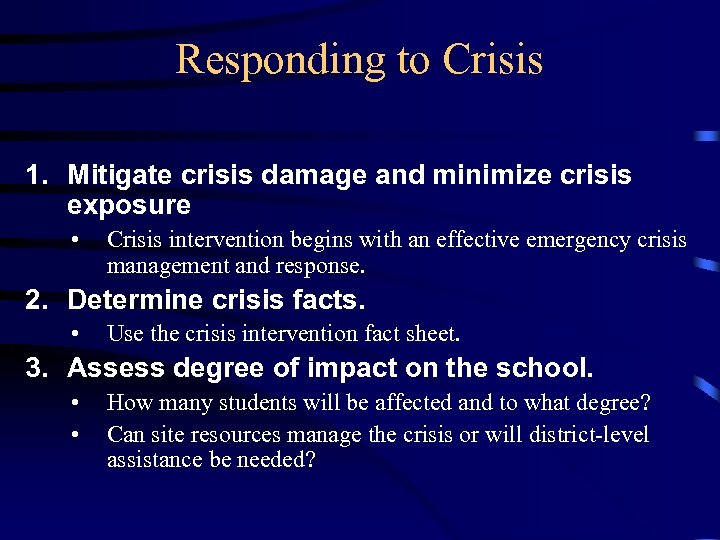 Responding to Crisis 1. Mitigate crisis damage and minimize crisis exposure • Crisis intervention begins with an effective emergency crisis management and response. 2. Determine crisis facts. • Use the crisis intervention fact sheet. 3. Assess degree of impact on the school. • • How many students will be affected and to what degree? Can site resources manage the crisis or will district-level assistance be needed?
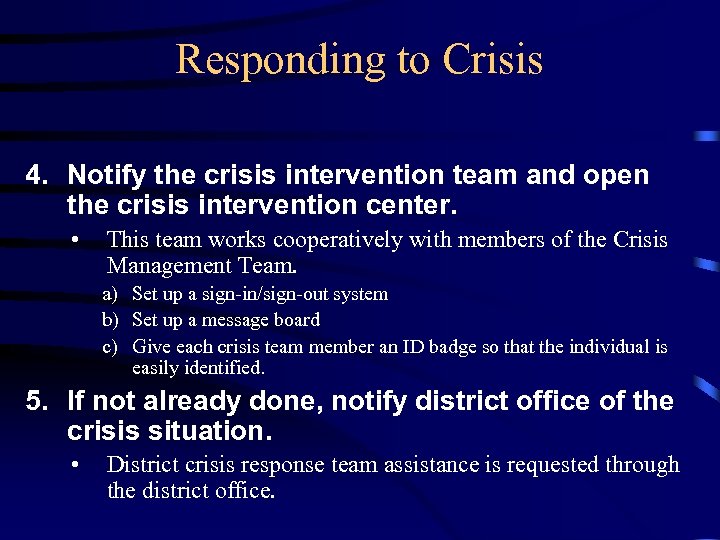 Responding to Crisis 4. Notify the crisis intervention team and open the crisis intervention center. • This team works cooperatively with members of the Crisis Management Team. a) Set up a sign-in/sign-out system b) Set up a message board c) Give each crisis team member an ID badge so that the individual is easily identified. 5. If not already done, notify district office of the crisis situation. • District crisis response team assistance is requested through the district office.
 Responding to Crisis 6. Notify other school sites that could be affected by the crisis. 7. Contact the family(ies) of the crisis victim(s). 8. Determine what information is to be shared with • • • Students Parents/Community Staff Media Remember to keep in mind parental rights to confidentiality.
 Responding to Crisis 9. Determine how the information is to be shared. • • • Written bulletins and/or letters Assemblies Phone calls Parent/Community meetings Classroom presentations/discussions 10. If a crime has occurred, isolate victims/witnesses until law enforcement interviews are completed.
 Responding to Crisis 11. Initiate the psychological triage and referral process. • • • Make referral forms available to staff Designate who will maintain the referral list and where it will be kept Designate interview/counseling locations Distribute a summary of referrals to support staff Establish a procedure for self-referral 12. Identify high-risk students and plan interventions. • • Designate who will maintain the high-risk list and where it will be kept. Decide upon interventions (i. e. , individual, small group, classroom). 13. Hold a staff meeting.
 Responding to Crisis 13. Computers, attendance registers and lockers. • • • 14. • • • Following a student's death, delete the name from computers and attendance registers. Be sure that no one calls reporting the student absent. Debriefing held at the end of each day. Review the intervention process Plan follow-up actions Review the status of the referrals Provide mutual support Prioritize needs 15. Schedule a morning planning session. 16. Plan memorials. 17. Debrief and evaluate the crisis response.