 Скачать презентацию Preparing for the Landscape Design Problem on the
a4ac050e1dbacc0efcaabaec2b283dae.ppt
- Количество слайдов: 18




Preparing for the Landscape Design Problem on the Colorado Certified Nursery Professional Exam. Ray Daugherty Front Range Community College Westminster, CO & Keith Williamson Little Valley Wholesale Nursery Brighton, CO
Why Is There A Landscape Design Problem On The CCNP Exam? • Nursery Professionals advise their customers about landscape design daily – whether it is through a formal “landscape design department” or “on the fly. ” So, you should be able to draw a landscape to scale and present it appropriately. • Nursery Professionals must be able to describe the cultural requirements for the plants they suggest, or understand those cultural requirements well enough to suggest the right plant for the right place. • The best way for the Certification Committee to assess your understanding of these two skills is through a landscape design problem. Keep this in mind as you go through this presentation.
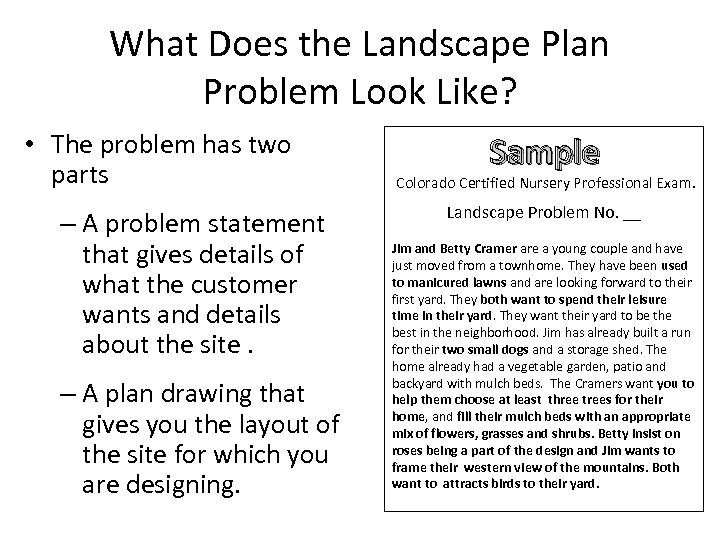
What Does the Landscape Plan Problem Look Like? • The problem has two parts – A problem statement that gives details of what the customer wants and details about the site. – A plan drawing that gives you the layout of the site for which you are designing. Sample Colorado Certified Nursery Professional Exam. Landscape Problem No. __ Jim and Betty Cramer are a young couple and have just moved from a townhome. They have been used to manicured lawns and are looking forward to their first yard. They both want to spend their leisure time in their yard. They want their yard to be the best in the neighborhood. Jim has already built a run for their two small dogs and a storage shed. The home already had a vegetable garden, patio and backyard with mulch beds. The Cramers want you to help them choose at least three trees for their home, and fill their mulch beds with an appropriate mix of flowers, grasses and shrubs. Betty insist on roses being a part of the design and Jim wants to frame their western view of the mountains. Both want to attracts birds to their yard.
Important Notes About The Problem Statement: • The CCNP Exam allows you to design for the stated client as if they reside in your home town. • Assume that the lot is “flat” (with only enough slope away from the home to allow for adequate drainage) unless otherwise stated. • Home color is usually unimportant, though it may be mentioned. • Assume that all windows are “normal windows” unless otherwise stated. Meaning that unless you are told otherwise, you can assume that the bottom of the window sill is 3 -4 ft. above ground level. • Assume that flower beds will be irrigated separately from turf and from each other.
Important To Note About The Problem: Pay close attention to the customers needs as stated in the problem statement. For example - If “money is no object” assume they want you to use sizeable materials. - If “they plan to install everything themselves” consider using only smaller plant material. - The finished plan should not show a tree and grass in the front yard if it states “they want a colorful front yard. ” How well you meet the customer’s needs is a part of your final score on this part of the CCNP exam.
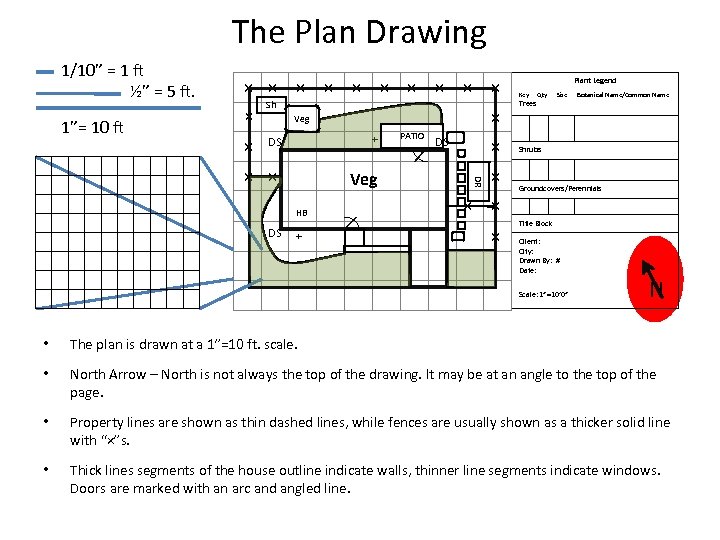
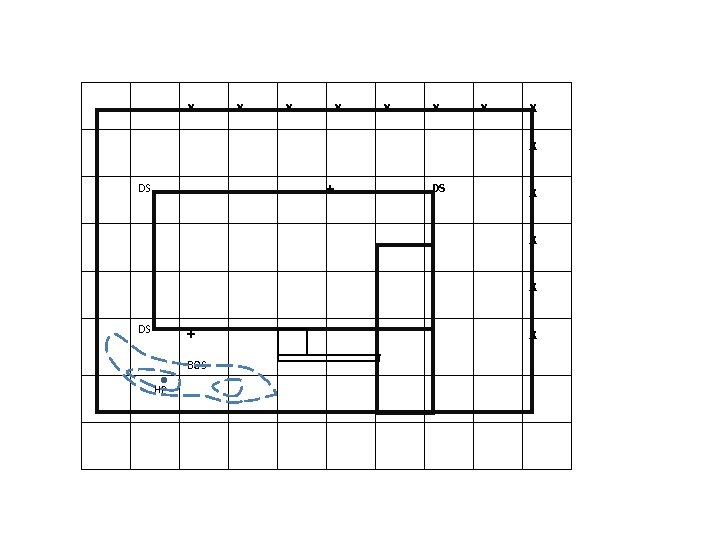
The Plan Drawing 1/10” = 1 ft ½” = 5 ft. 1”= 10 ft × × × Sh × Veg + DS × × × DS + DR Veg HB DS PATIO × × Plant Legend Key Trees Qty Size Botanical Name/Common Name Shrubs Groundcovers/Perennials × × Title Block Client: City: Drawn By: # Date: Scale: 1”=10’ 0” N • The plan is drawn at a 1”=10 ft. scale. • North Arrow – North is not always the top of the drawing. It may be at an angle to the top of the page. • Property lines are shown as thin dashed lines, while fences are usually shown as a thicker solid line with “×”s. • Thick lines segments of the house outline indicate walls, thinner line segments indicate windows. Doors are marked with an arc and angled line.
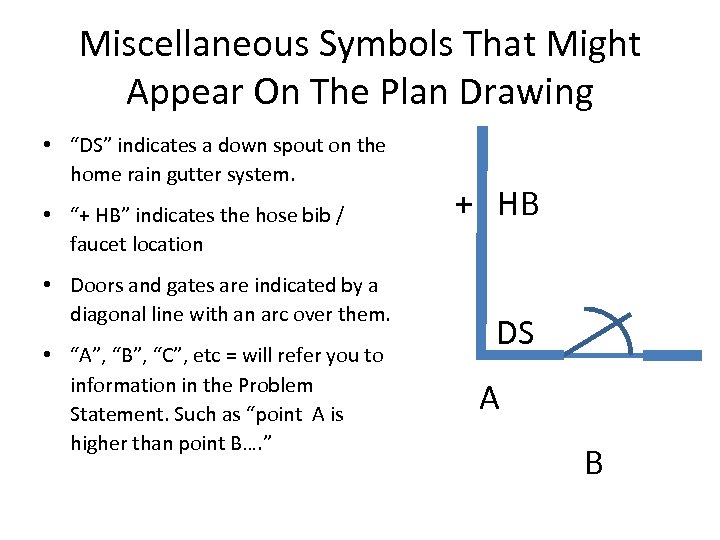
Miscellaneous Symbols That Might Appear On The Plan Drawing • “DS” indicates a down spout on the home rain gutter system. • “+ HB” indicates the hose bib / faucet location • Doors and gates are indicated by a diagonal line with an arc over them. • “A”, “B”, “C”, etc = will refer you to information in the Problem Statement. Such as “point A is higher than point B…. ” + HB DS A B
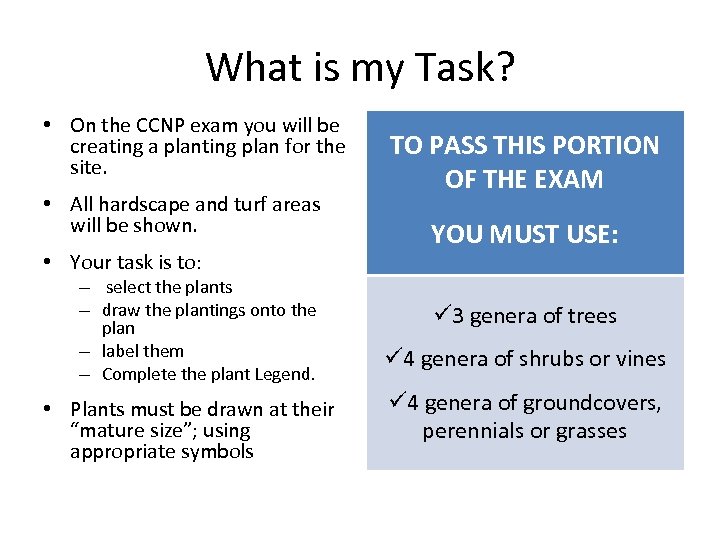
What is my Task? • On the CCNP exam you will be creating a planting plan for the site. • All hardscape and turf areas will be shown. • Your task is to: – select the plants – draw the plantings onto the plan – label them – Complete the plant Legend. • Plants must be drawn at their “mature size”; using appropriate symbols TO PASS THIS PORTION OF THE EXAM YOU MUST USE: ü 3 genera of trees ü 4 genera of shrubs or vines ü 4 genera of groundcovers, perennials or grasses
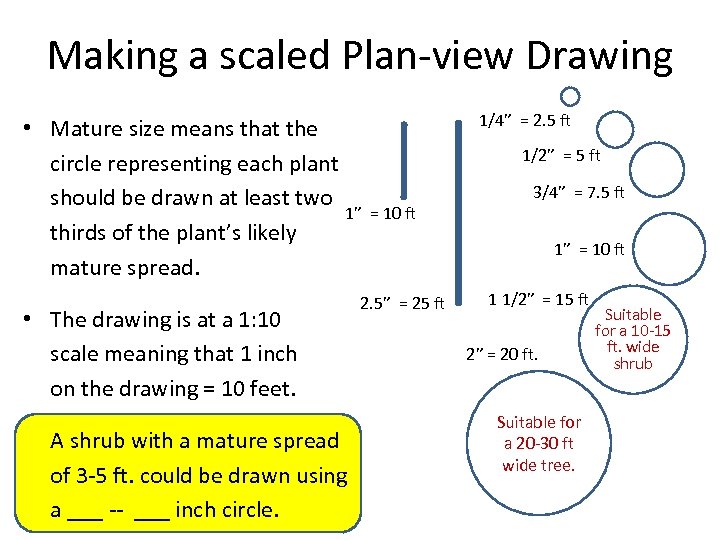
Making a scaled Plan-view Drawing • Mature size means that the circle representing each plant should be drawn at least two 1” thirds of the plant’s likely mature spread. • The drawing is at a 1: 10 scale meaning that 1 inch on the drawing = 10 feet. A shrub with a mature spread of 3 -5 ft. could be drawn using a ___ -- ___ inch circle. 1/4” = 2. 5 ft 1/2” = 5 ft = 10 ft 2. 5” = 25 ft 3/4” = 7. 5 ft 1” = 10 ft 1 1/2” = 15 ft 2” = 20 ft. Suitable for a 20 -30 ft wide tree. Suitable for a 10 -15 ft. wide shrub
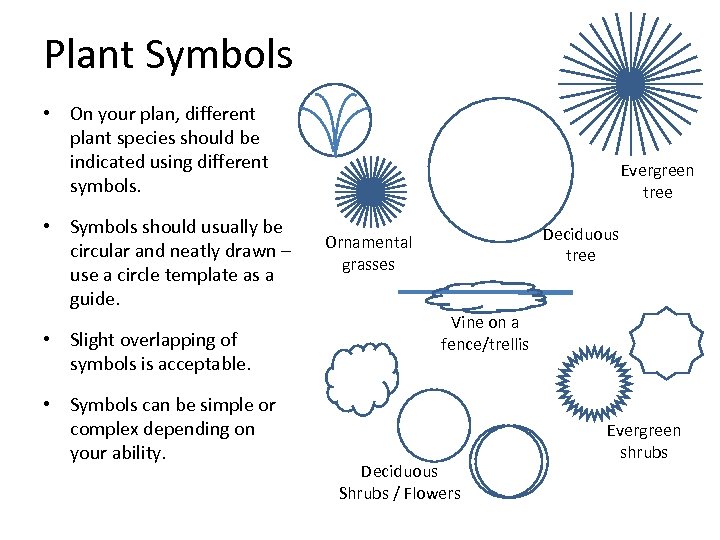
Plant Symbols • On your plan, different plant species should be indicated using different symbols. • Symbols should usually be circular and neatly drawn – use a circle template as a guide. • Slight overlapping of symbols is acceptable. • Symbols can be simple or complex depending on your ability. Evergreen tree Deciduous tree Ornamental grasses Vine on a fence/trellis Deciduous Shrubs / Flowers Evergreen shrubs
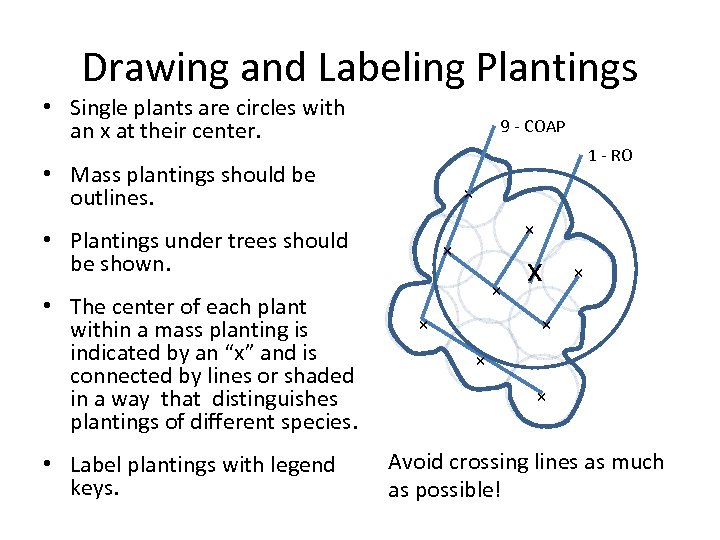
Drawing and Labeling Plantings • Single plants are circles with an x at their center. 9 - COAP 1 - RO • Mass plantings should be outlines. × • Plantings under trees should be shown. • The center of each plant within a mass planting is indicated by an “x” and is connected by lines or shaded in a way that distinguishes plantings of different species. • Label plantings with legend keys. × × x × × Avoid crossing lines as much as possible!
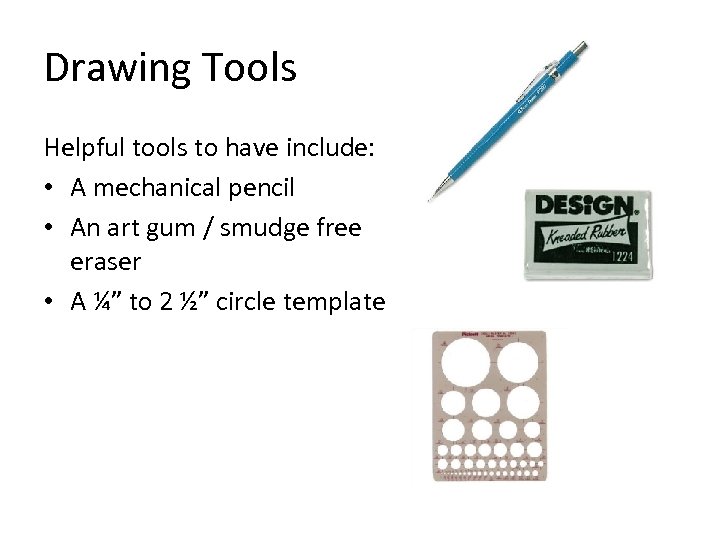
Drawing Tools Helpful tools to have include: • A mechanical pencil • An art gum / smudge free eraser • A ¼” to 2 ½” circle template
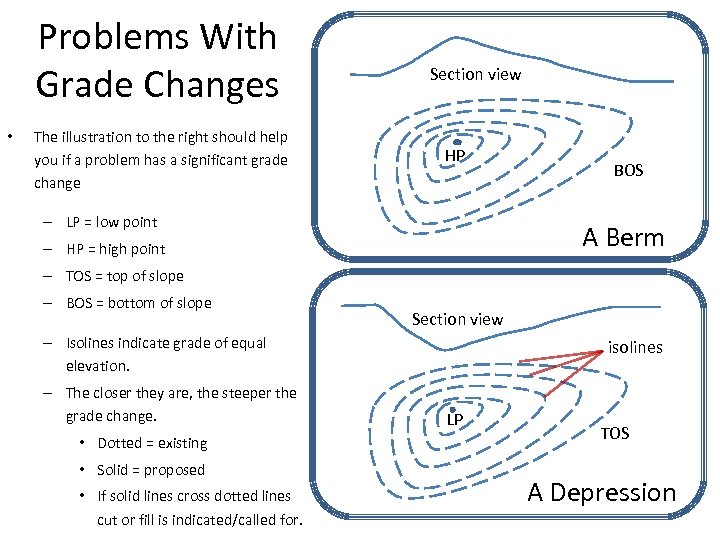
Problems With Grade Changes • The illustration to the right should help you if a problem has a significant grade change Section view HP – LP = low point BOS A Berm – HP = high point – TOS = top of slope – BOS = bottom of slope Section view – Isolines indicate grade of equal elevation. – The closer they are, the steeper the grade change. • Dotted = existing • Solid = proposed • If solid lines cross dotted lines cut or fill is indicated/called for. isolines LP TOS A Depression
x x x x x + DS DS x x x + DS BOS HP x
Drawing outside the lines • Can trees cross the plane of the property line?
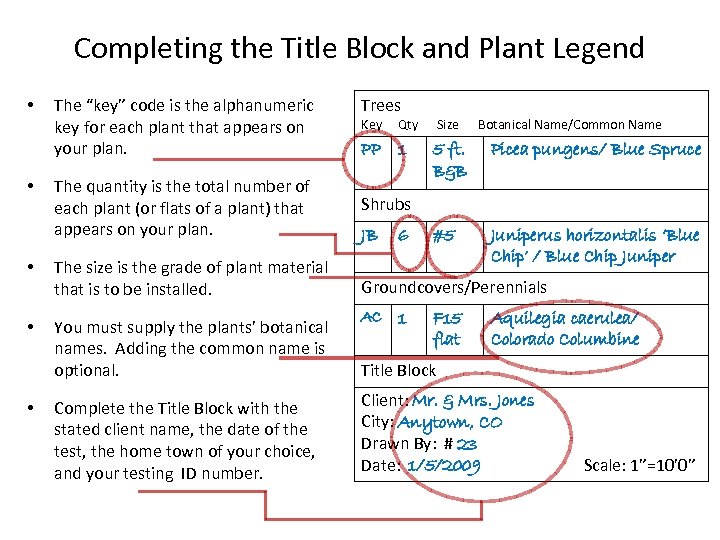
Completing the Title Block and Plant Legend • • The “key” code is the alphanumeric key for each plant that appears on your plan. The quantity is the total number of each plant (or flats of a plant) that appears on your plan. • The size is the grade of plant material that is to be installed. • You must supply the plants’ botanical names. Adding the common name is optional. • Complete the Title Block with the stated client name, the date of the test, the home town of your choice, and your testing ID number. Trees Key Qty PP 1 Size Botanical Name/Common Name 5 ft. B&B Picea pungens/ Blue Spruce #5 Juniperus horizontalis ‘Blue Chip’ / Blue Chip Juniper Shrubs JB 6 Groundcovers/Perennials AC 1 F 15 flat Aquilegia caerulea/ Colorado Columbine Title Block Client: Mr. & Mrs. Jones City: Anytown, CO Drawn By: # 23 Date: 1/5/2009 Scale: 1”=10’ 0”
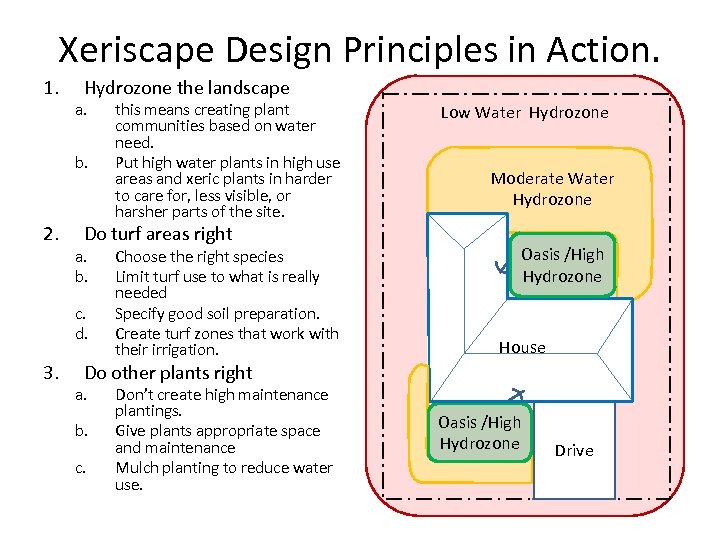
Xeriscape Design Principles in Action. 1. Hydrozone the landscape a. b. 2. Low Water Hydrozone Choose the right species Limit turf use to what is really needed Specify good soil preparation. Create turf zones that work with their irrigation. Oasis /High Hydrozone Do turf areas right a. b. c. d. 3. this means creating plant communities based on water need. Put high water plants in high use areas and xeric plants in harder to care for, less visible, or harsher parts of the site. Moderate Water Hydrozone House Do other plants right a. b. c. Don’t create high maintenance plantings. Give plants appropriate space and maintenance Mulch planting to reduce water use. Oasis /High Hydrozone Drive
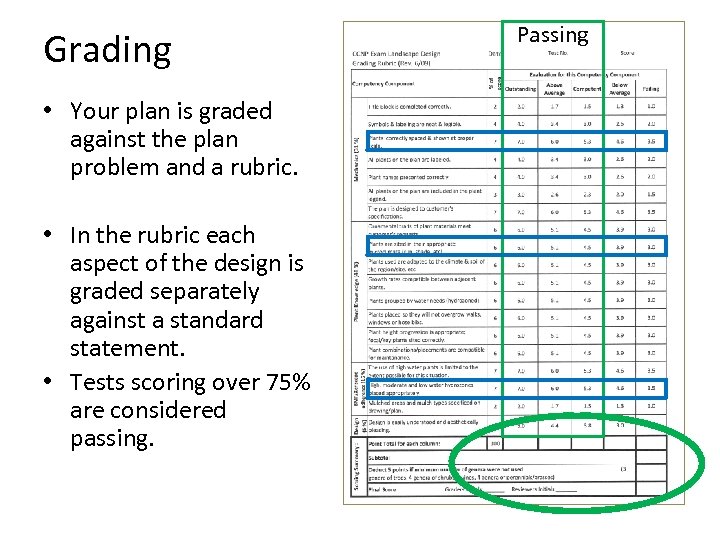
Grading • Your plan is graded against the plan problem and a rubric. • In the rubric each aspect of the design is graded separately against a standard statement. • Tests scoring over 75% are considered passing. Passing
Скачать презентацию Preparing for the Landscape Design Problem on the
a4ac050e1dbacc0efcaabaec2b283dae.ppt