


 Скачать презентацию Preparing for Promotion 21 March 2014 1
34afde798f521fd40761868791c65b6d.ppt
- Количество слайдов: 49
 Preparing for Promotion 21 March 2014 1
 Welcome Professor Robyn Dowling Learning and Teaching Centre 2
 Overview Professor Janet Greeley Executive Dean 3
 Policy To be promoted, a staff member must demonstrate how they meet the criteria of the level to which they seek promotion in the three elements of academic endeavour: • • • Teaching Research Community engagement 4
 Important Dates • • • 1 st February 1 st June 1 st October (NOTE: If the due date falls on a weekend or public holiday, completed applications must be received by Human Resources by close of business on the last working day preceding the weekend or public holiday. ) There are three opportunities to apply for promotion in any one year. 5
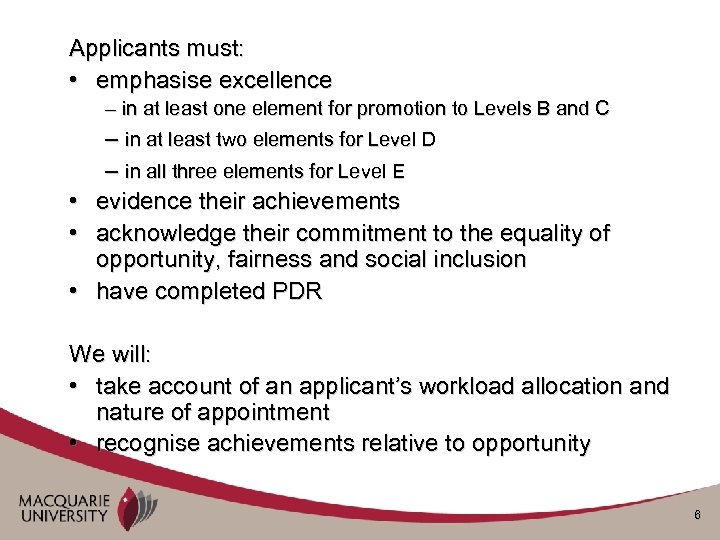 Applicants must: • emphasise excellence – in at least one element for promotion to Levels B and C – in at least two elements for Level D – in all three elements for Level E • evidence their achievements • acknowledge their commitment to the equality of opportunity, fairness and social inclusion • have completed PDR We will: • take account of an applicant’s workload allocation and nature of appointment • recognise achievements relative to opportunity 6
 Promotion & Selection Criteria Indicative Subject to opportunity Acknowledge discipline standards Teaching • Teaching performance – What areas? * – – – Undergraduate, postgraduate, honours, HDR supervision Quality of materials and delivery; modes of delivery Teaching philosophy Student evaluations, peer review, supervisor feedback 7
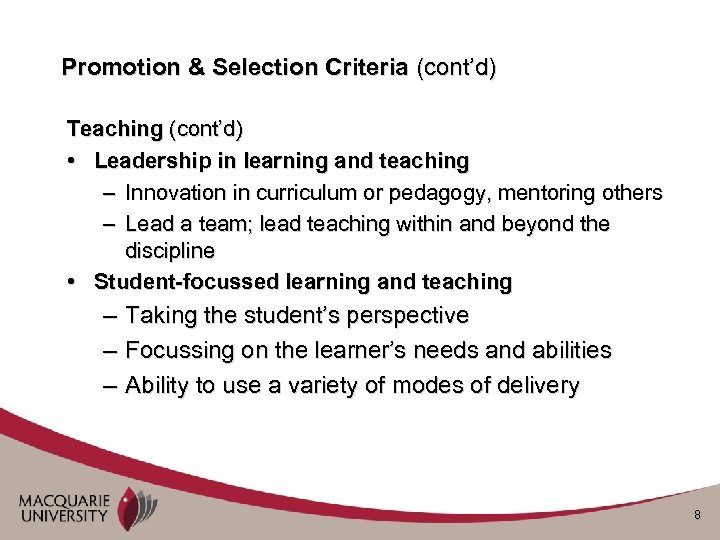 Promotion & Selection Criteria (cont’d) Teaching (cont’d) • Leadership in learning and teaching – Innovation in curriculum or pedagogy, mentoring others – Lead a team; lead teaching within and beyond the discipline • Student-focussed learning and teaching – – – Taking the student’s perspective Focussing on the learner’s needs and abilities Ability to use a variety of modes of delivery 8
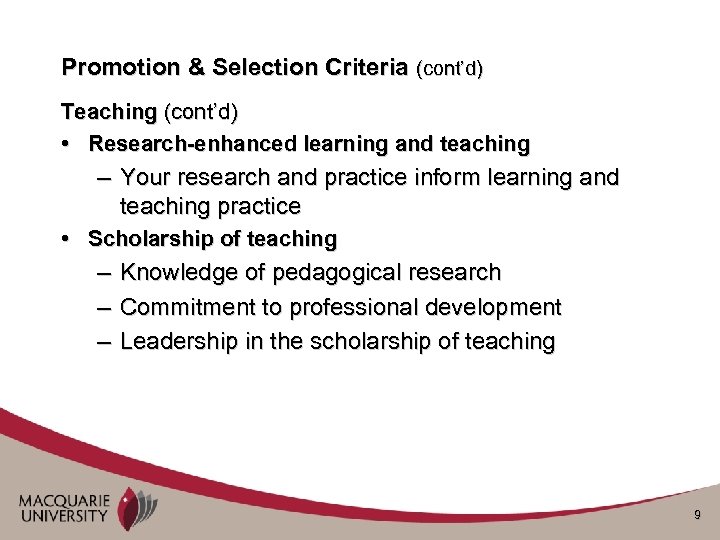 Promotion & Selection Criteria (cont’d) Teaching (cont’d) • Research-enhanced learning and teaching – Your research and practice inform learning and teaching practice • Scholarship of teaching – Knowledge of pedagogical research – Commitment to professional development – Leadership in the scholarship of teaching 9
 Promotion & Selection Criteria (cont’d) Teaching (cont’d) Evidence – Objective – demonstrable – concise – well-organised 10
 Promotion & Selection Criteria (cont’d) Research • Research performance • Leadership in research • Research mentoring and training • Research collaborations and partnerships 11
 Promotion & Selection Criteria (cont’d) Community Engagement • Contributions to the University, faculty and/or department community • Contributions to community and professional organisations, government agencies, NGOs, public intellectual discussion and the general community 12
 Planning • Time to put application together – one month, one year, two years etc • Profile for application – criteria, profile myths • Comfort level: risk taking – 10%, 50%, too early, too late, just right 13
 Appraising • Aren’t you simply good at your current level? • Why is now the right time? – Rather than last year or next year? • Am I ramping or stepping? – Qualitative or quantitative – Not time served • What will I do if I am unsuccessful? 14
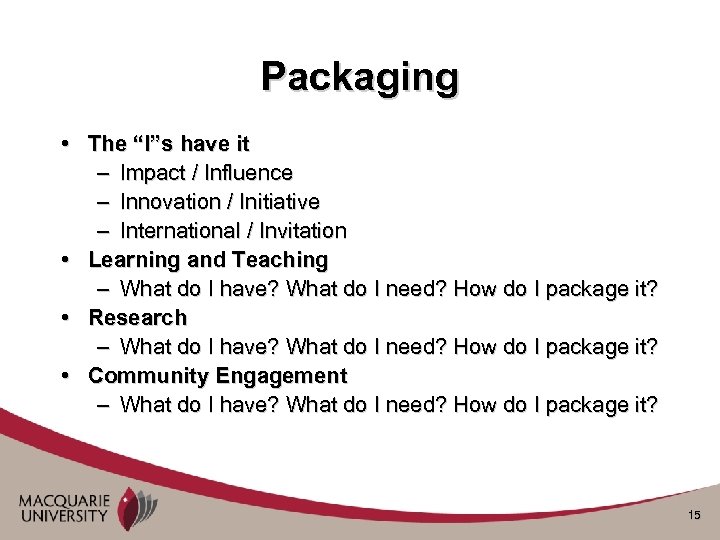 Packaging • The “I”s have it – Impact / Influence – Innovation / Initiative – International / Invitation • Learning and Teaching – What do I have? What do I need? How do I package it? • Research – What do I have? What do I need? How do I package it? • Community Engagement – What do I have? What do I need? How do I package it? 15
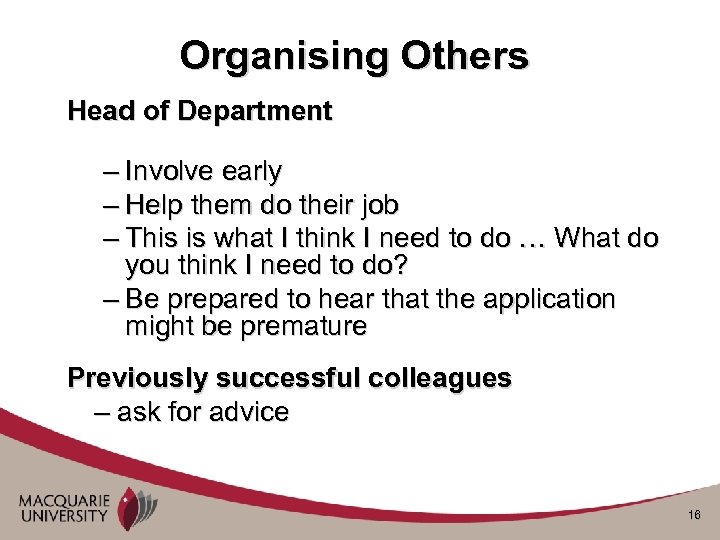 Organising Others Head of Department – Involve early – Help them do their job – This is what I think I need to do … What do you think I need to do? – Be prepared to hear that the application might be premature Previously successful colleagues – ask for advice 16
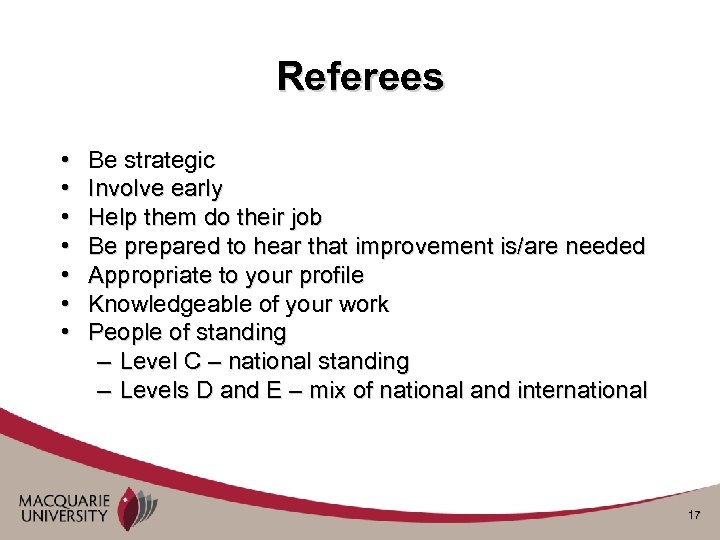 Referees • • Be strategic Involve early Help them do their job Be prepared to hear that improvement is/are needed Appropriate to your profile Knowledgeable of your work People of standing – Level C – national standing – Levels D and E – mix of national and international 17
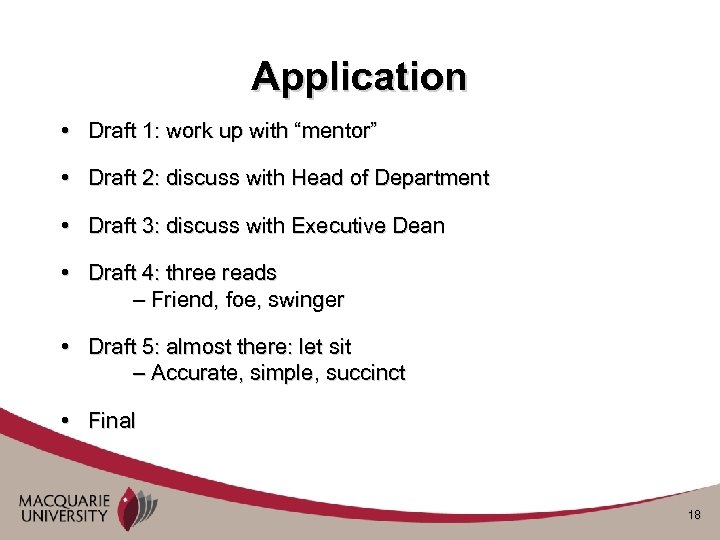 Application • Draft 1: work up with “mentor” • Draft 2: discuss with Head of Department • Draft 3: discuss with Executive Dean • Draft 4: three reads – Friend, foe, swinger • Draft 5: almost there: let sit – Accurate, simple, succinct • Final 18
 Discipline Report A factual report that has two specific purposes: 1. To provide details on the nature of an applicant’s discipline 2. To allow Promotion Committee members to interpret the significance of the applicant’s achievements in relation to the discipline standards and the area of the applicant’s work Not a reference Prepared by Head of Department 19
 Interviews • Head of Department: discuss, rehearse possible Q and A • Candidate nominee (friend): another academic who has expertise and in-depth knowledge of work • Not all candidates interviewed 20
 Preparing for the interview • No surprises • Make it a positive experience; interview should value add • Rehearse – accurate, simple, succinct, display discipline knowledge but don’t retreat into jargon • Be confident, competent and communicate clearly 21
 Research elements of promotion Professor Sakkie Pretorius Deputy Vice-Chancellor (Research) 22
 Research Applicants required to address: • Research performance – Publications – Research income • Leadership in research • Research mentoring and research training (eg HDR supervision) 23
 Research (cont’d) • Research collaborations and partnerships For example: Engagement with industry, community, governments National and/or international academic partners Collaboration with international stakeholders 24
 Research (cont’d) • Important to demonstrate evidence • Esteem Factors • Citations (or equivalent recognition in their field) 25
 Academic Promotion: Nuts and Bolts! Tim Sprague Director, Human Resources 26
 Benefits • Regular opportunities to reward and recognise academic staff for their achievements. • There is increased application support with 4 templates (compulsory). • 3 rounds per year instead of 1. Level E can be applied for in 2 of the 3 rounds, i. e. February and October. • Applicant can add comments to Discipline Report after the Executive Dean has commented and signed off. • Applicants are notified early – normally within 24 hours following last meeting at each academic level. • Promotion is effective just 1 month after final notification date. 27
 Responsibilities of Applicant • Late applications will not be accepted – must submit completed application by 5 pm EST on the deadline date. • Academic Promotion Policy and Procedure must be read prior to compiling an application. • Must ensure referees submit their references directly to academicpromotions@mq. edu. au in HR by the deadline. • Must ensure that the Discipline Report is completed by the HOD, signed off by the Executive Dean and submitted with application by the deadline. 28
 Applicant Eligibility Requirements • Must have 12 months service in an Academic position (can be in broken periods). • Must have completed the previous year’s PDR 29
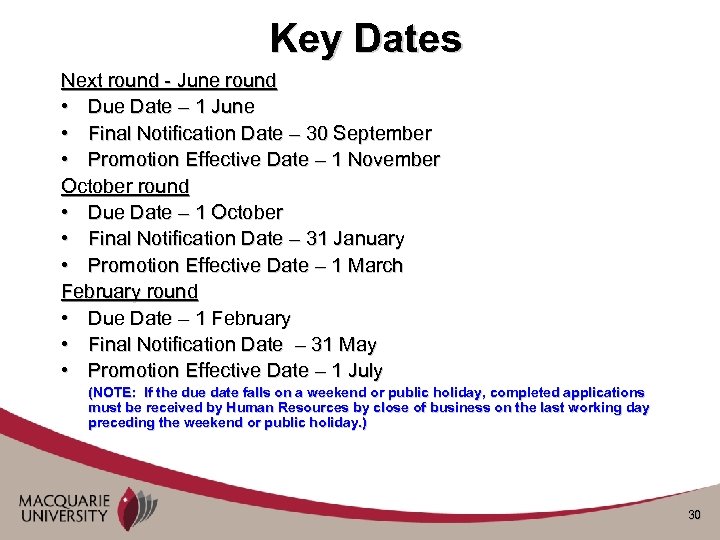 Key Dates Next round - June round • Due Date – 1 June • Final Notification Date – 30 September • Promotion Effective Date – 1 November October round • Due Date – 1 October • Final Notification Date – 31 January • Promotion Effective Date – 1 March February round • Due Date – 1 February • Final Notification Date – 31 May • Promotion Effective Date – 1 July (NOTE: If the due date falls on a weekend or public holiday, completed applications must be received by Human Resources by close of business on the last working day preceding the weekend or public holiday. ) 30
 Information and Resources • Policy and Procedure, Key Dates, Evaluation Criteria and FAQs, on the HR Academic Promotion web page http: //staff. mq. edu. au/human_resources/development _opportunities/academic_staff_development_opportu nities/promotion/ • Examples and advice re: compiling an application http: //www. mq. edu. au/ltc/rewards/index. htm 31
 How to submit your application in 2014 Sally Matthey Manager, Strategic Resourcing and Talent 32
 This year for June and October rounds • Email your application to: academicpromotions@mq. edu. au • Deliver a hard copy of your Sources of Evidence folder to: Building C 5 C Level 4 Reception (entry is via stairs/lift on the western side of the building) by 5 pm EST by the due date. 33
 For next year • Academic Promotion Review in 2014. • More about this in July 2014. 34
 Questions? 35
 Equity considerations Kate Wilson Director, Equity & Diversity 36
 Library support Heather Cooper Library Services Manager 37
 How does the Library support Academic Promotion? Assists with tracking your research/identifying your research data 1. Research consultations with Librarians http: //www. mq. edu. au/on_campus/library/help/research_librarians/ 2. Online support – Lib. Guide 3. Training sessions Applying Made Easy: Research Impact Data Dates 2014: Wednesday 7 th May 2014 1 – 2 pm Wednesday 10 th September 2014 1 – 2 pm Location: Library Level 4 Room M 4. 02 38
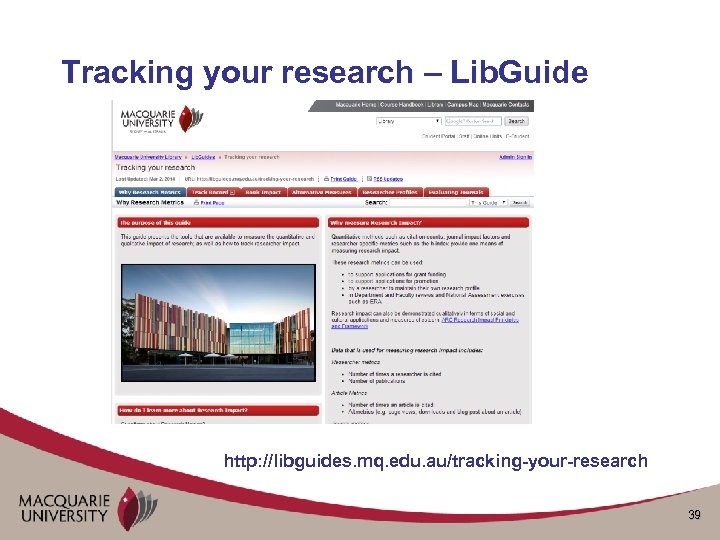 Tracking your research – Lib. Guide http: //libguides. mq. edu. au/tracking-your-research 39
 Applying Made Easy: Research Impact Data Training Session Outcomes • Locate and explore information on the “Tracking Your Research” Lib. Guide • Use Scopus, Web of Science and Google Scholar, to locate research impact data • Interpret research impact data from Scopus, Web of Science and Google Scholar • Discuss where to record personal research impact data • Discuss information sources for alternative metrics 40
 Library Collaborate with partners to deliver services that build the University’s capacity, opportunities and excellence Research. Online www. researchonline. mq. edu. au Ø Our digital repository = open, world wide access to your research outputs Ø Increased visibility of your research - harvested by major search engines such as Google, Google Scholar Ø We will enter your research publications into the University systems for YOU! ü Support you in meeting HERDC & ERA reporting and NHMRC & ARC open access mandates ü Record Research activity for Research Active Survey HOW? Send your CV to the LIBRARY For more information, email: researchonline@mq. edu. au 41
 Scopus • Largest abstract and citation database in the world. • Coverage is mainly in sciences, but social sciences content is increasing. • Provides citation and impact data about journals and publications. 42
 Web of Science • Large abstract and citation database, with strong coverage of the sciences. • Now includes Book Citation Index, so coverage of social sciences/arts and humanities has improved. • Can determine citation counts for articles as well as Impact Factor of journals. 43
 Impact Factor • Impact Factor is a measure of how often articles from a particular journal are cited. • Can be used to compare journals within the same discipline. 44
 Google Scholar • Google Scholar also tracks citations to articles. • Works best if you set up a profile and add your publications to it. 45
 Profile management Google Scholar • Can set up profile and bring publications together. Can find out times cited counts. Researcher. ID • Produced by Thomson Reuters and attempts to overcome problem of author name ambiguity by assigning a unique identifier to each author. ORCID • Open access research identification tool. Can link ORCID and Researcher. ID. 46
 Alternative metrics Increasing recent focus on social media impact of articles. Altmetric • Can download a bookmarklet from altmetrics. com which will display altmetrics for an article. Impact Story • Allows you to enter details of publications and displays their social media impact. 47
 Experience of successfully applying for promotion Professor Robyn Dowling Learning and Teaching Centre 48
 Questions? 49