


 Скачать презентацию Preparing for Pandemic Influenza The Hospital and Community
8cbedd625445a23667a0606327889418.ppt
- Количество слайдов: 89
 Preparing for Pandemic Influenza: The Hospital and Community Perspective 2007 Great Lakes Homeland Security Training Conference & Expo Grand Rapids, MI May 10, 2007 Stephen V. Cantrill, MD Associate Director Department of Emergency Medicine Denver Health Medical Center
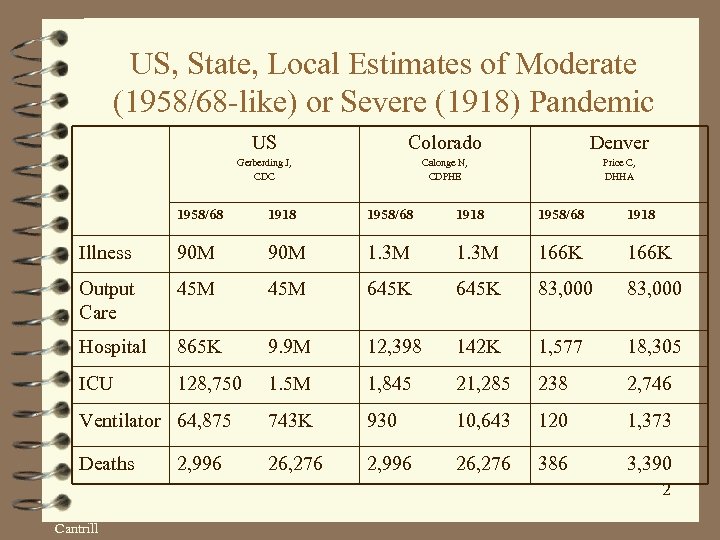 US, State, Local Estimates of Moderate (1958/68 -like) or Severe (1918) Pandemic US Colorado Denver Gerberding J, CDC Calonge N, CDPHE Price C, DHHA 1958/68 1918 Illness 90 M 1. 3 M 166 K Output Care 45 M 645 K 83, 000 Hospital 865 K 9. 9 M 12, 398 142 K 1, 577 18, 305 ICU 128, 750 1. 5 M 1, 845 21, 285 238 2, 746 Ventilator 64, 875 743 K 930 10, 643 120 1, 373 Deaths 26, 276 2, 996 26, 276 386 3, 390 2, 996 2 Cantrill
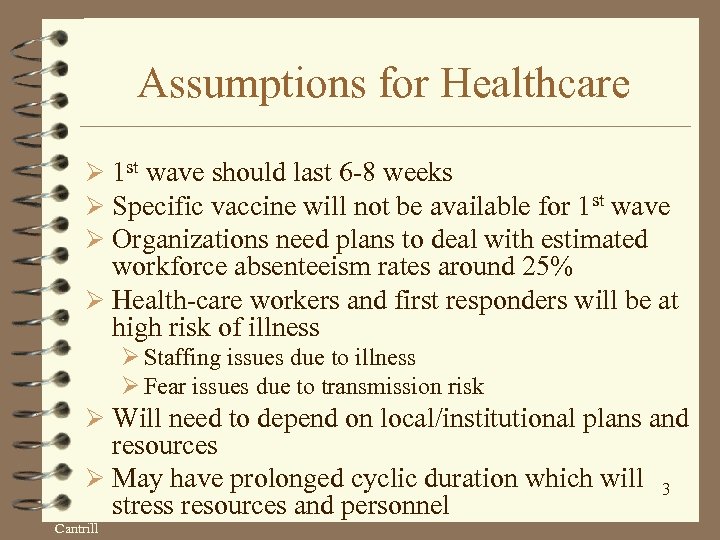 Assumptions for Healthcare Ø 1 st wave should last 6 -8 weeks Ø Specific vaccine will not be available for 1 st wave Ø Organizations need plans to deal with estimated workforce absenteeism rates around 25% Ø Health-care workers and first responders will be at high risk of illness Ø Staffing issues due to illness Ø Fear issues due to transmission risk Ø Will need to depend on local/institutional plans and resources Ø May have prolonged cyclic duration which will stress resources and personnel Cantrill 3
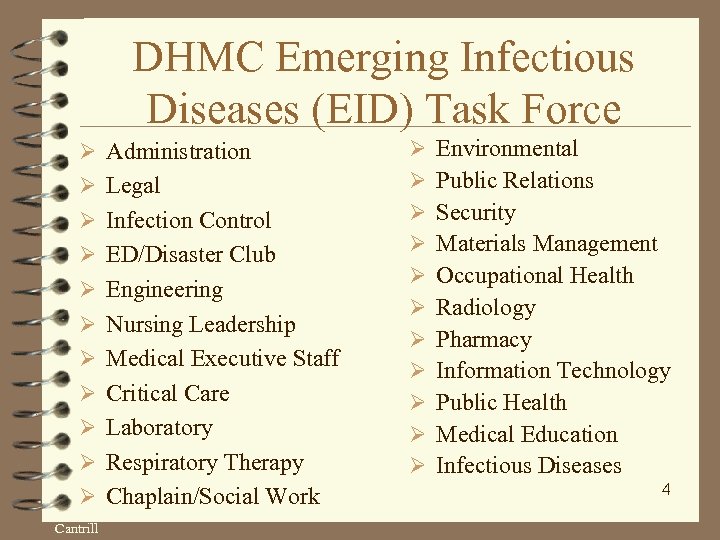 DHMC Emerging Infectious Diseases (EID) Task Force Ø Administration Ø Legal Ø Infection Control Ø ED/Disaster Club Ø Engineering Ø Nursing Leadership Ø Medical Executive Staff Ø Critical Care Ø Laboratory Ø Respiratory Therapy Ø Chaplain/Social Work Cantrill Ø Ø Ø Environmental Public Relations Security Materials Management Occupational Health Radiology Pharmacy Information Technology Public Health Medical Education Infectious Diseases 4
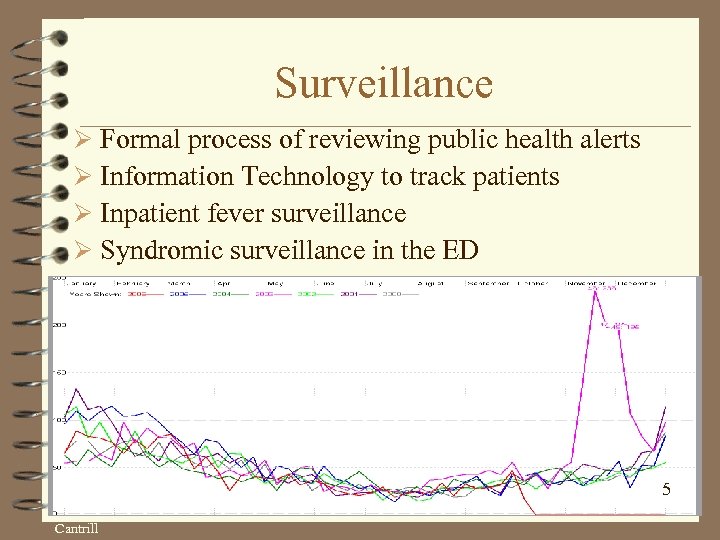 Surveillance Ø Formal process of reviewing public health alerts Ø Information Technology to track patients Ø Inpatient fever surveillance Ø Syndromic surveillance in the ED 5 Cantrill
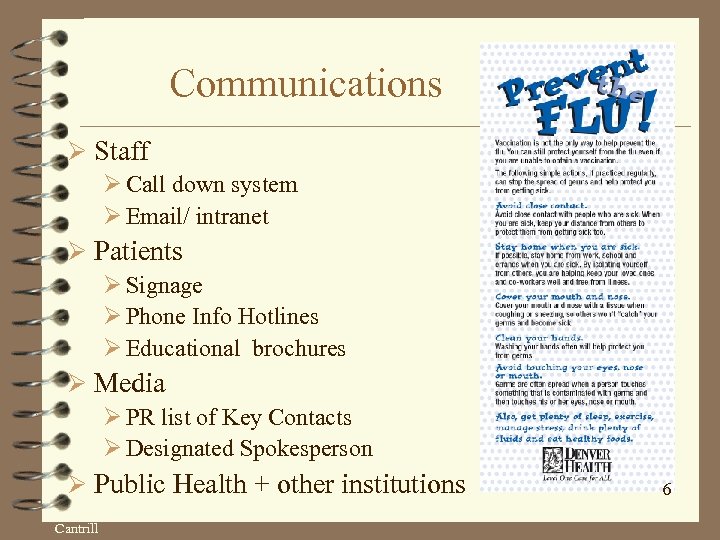 Communications Ø Staff Ø Call down system Ø Email/ intranet Ø Patients Ø Signage Ø Phone Info Hotlines Ø Educational brochures Ø Media Ø PR list of Key Contacts Ø Designated Spokesperson Ø Public Health + other institutions Cantrill 6
 Education and Training Ø Current healthcare provider web based training allows for rapid training and tracking compliance Ø Library of educational materials and website Ø H(E)ICS training Ø Administration Ø Clinical providers Ø Support personnel Ø Public health Ø Just-in-time training in respiratory care 7 Cantrill
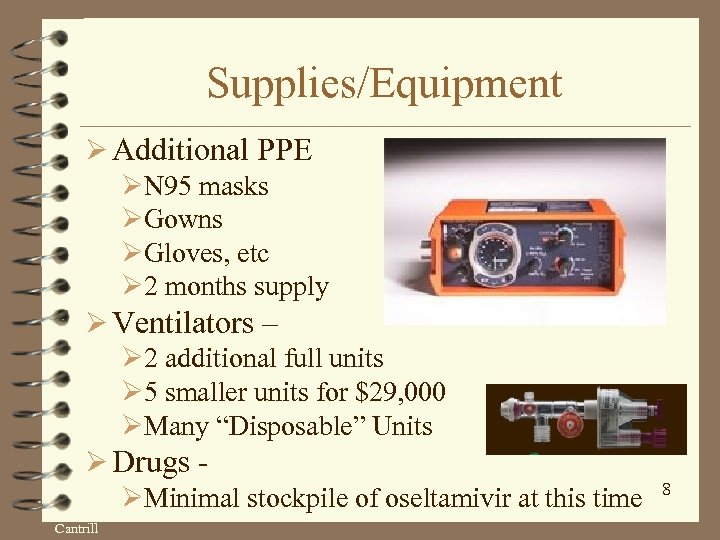 Supplies/Equipment Ø Additional PPE ØN 95 masks ØGowns ØGloves, etc Ø 2 months supply Ø Ventilators – Ø 2 additional full units Ø 5 smaller units for $29, 000 ØMany “Disposable” Units Ø Drugs ØMinimal stockpile of oseltamivir at this time Cantrill 8
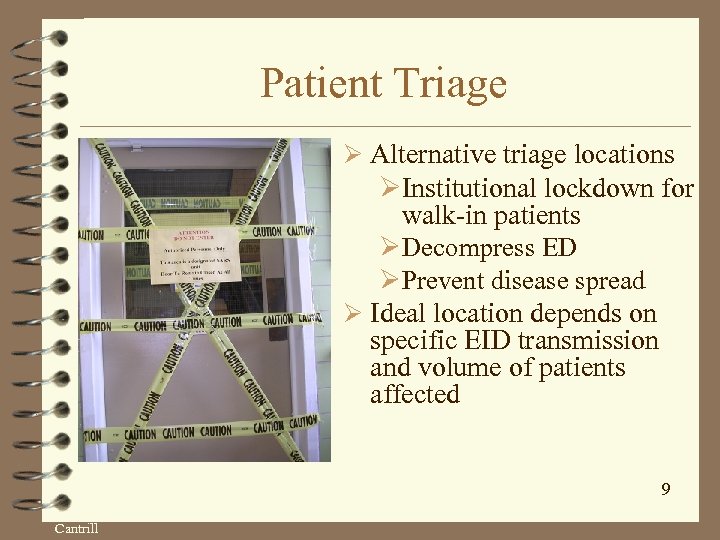 Patient Triage Ø Alternative triage locations ØInstitutional lockdown for walk-in patients ØDecompress ED ØPrevent disease spread Ø Ideal location depends on specific EID transmission and volume of patients affected 9 Cantrill
 Patient Triage and Admission Ø Use of automobiles as a social distancing mechanism Ø Nurse Advice Line to avoid hospital visits Ø Specific criteria for admission Ø Inpatient fever surveillance Cantrill 10
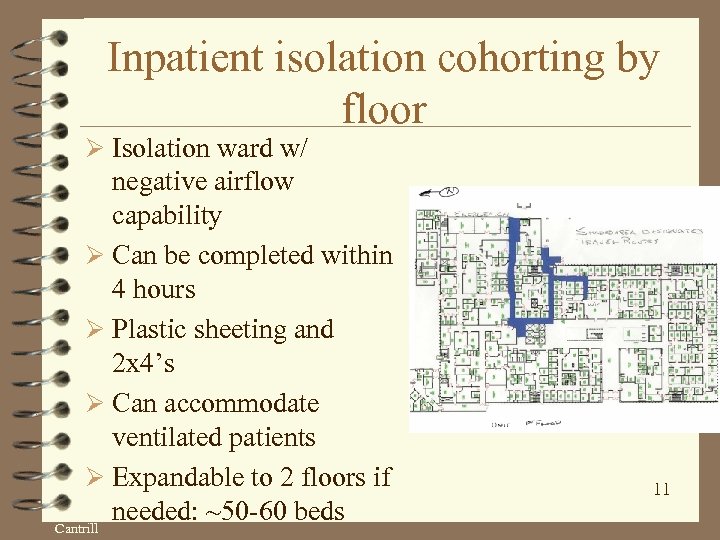 Inpatient isolation cohorting by floor Ø Isolation ward w/ negative airflow capability Ø Can be completed within 4 hours Ø Plastic sheeting and 2 x 4’s Ø Can accommodate ventilated patients Ø Expandable to 2 floors if needed: ~50 -60 beds Cantrill 11
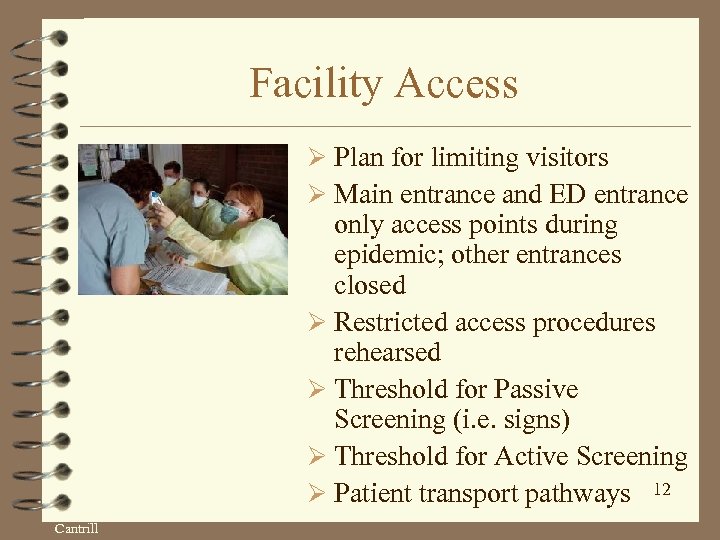 Facility Access Ø Plan for limiting visitors Ø Main entrance and ED entrance only access points during epidemic; other entrances closed Ø Restricted access procedures rehearsed Ø Threshold for Passive Screening (i. e. signs) Ø Threshold for Active Screening Ø Patient transport pathways 12 Cantrill
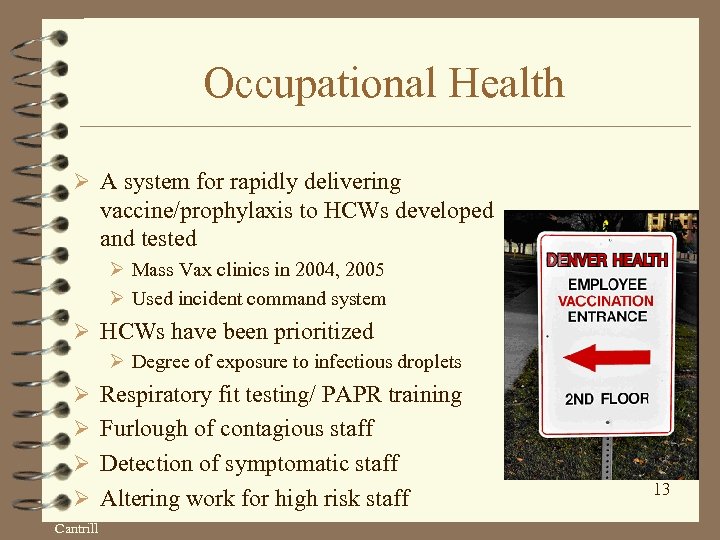 Occupational Health Ø A system for rapidly delivering vaccine/prophylaxis to HCWs developed and tested Ø Mass Vax clinics in 2004, 2005 Ø Used incident command system Ø HCWs have been prioritized Ø Degree of exposure to infectious droplets Ø Respiratory fit testing/ PAPR training Ø Furlough of contagious staff Ø Detection of symptomatic staff Ø Altering work for high risk staff Cantrill 13
 Surge Capacity Plan: Surging with Limited Staff Ø Database of retired healthcare personnel and former trainees Ø Legal issues (e. g. licensing) being reviewed Ø Limit non-essential patient care Ø Use of phone triage to free up providers Ø Restructuring/reassigning HCW tasks daily through incident command Ø Just-in Time training, LEAN Ø Use of family members (bathing, bathroom, vital signs, meals) Ø Maximize protection of current personnel: vaccines, prophylaxis, infection control Ø Day care center for employee families? Cantrill 14
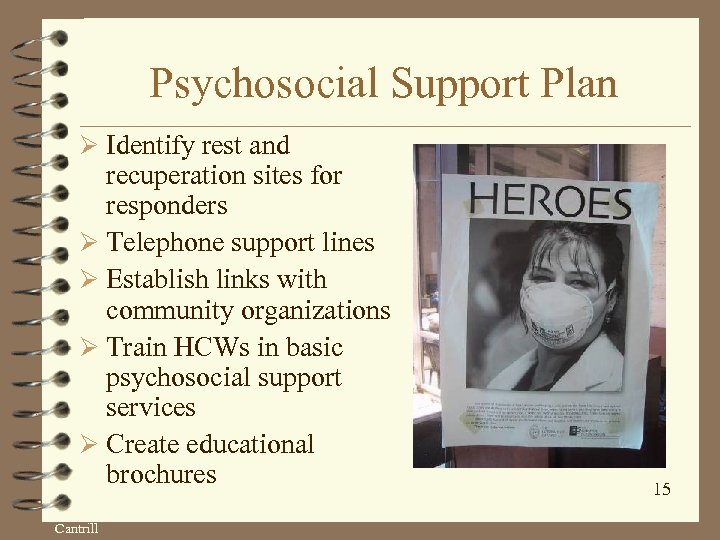 Psychosocial Support Plan Ø Identify rest and recuperation sites for responders Ø Telephone support lines Ø Establish links with community organizations Ø Train HCWs in basic psychosocial support services Ø Create educational brochures Cantrill 15
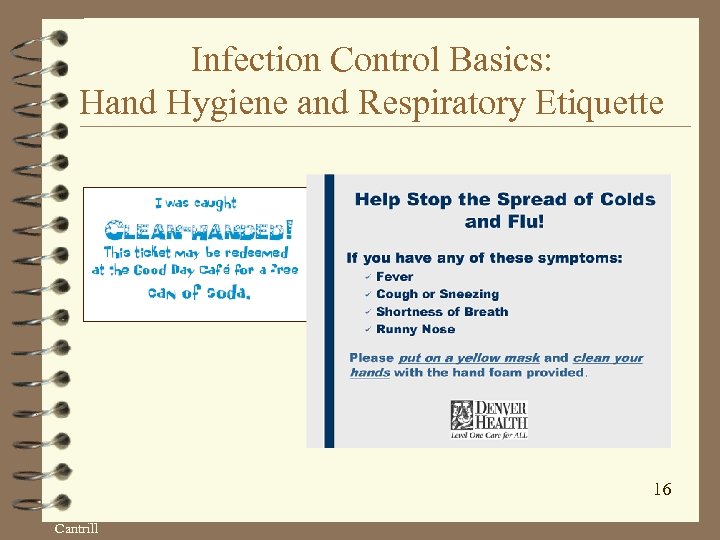 Infection Control Basics: Hand Hygiene and Respiratory Etiquette 16 Cantrill
 Facility Based Surge Capacity Ø Expedited discharges Ø Adaptation of existing capacity ØSingle rooms become doubles ØTake over areas of the hospital for acute care (Internal “Alternative Care Sites”) ØClassrooms ØOffices ØLobbies ØHallways 17 Cantrill
 Surge Capacity Issues Ø Physical space Ø Organizational structure Ø Medical staff Ø Ancillary staff Ø Support (nutrition, mental health, etc) Ø Supply Ø Pharmaceuticals Ø Other resources 18 Cantrill
 Part of the Problem: Ø ED overcrowding Ø Inpatient bed loss: 38, 000 (4. 4%) between 1996 and 2000 Ø ICU capacity loss: 20% between 1995 and 2001 Ø Most health care is in the private sector not under governmental or municipal authority 19 Cantrill
 DHMC Disaster Contingency Discharge Drill – 1/05 Ø Services participating: Internal Medicine, Surgery, Pediatrics Ø 26% of patients could be transferred off-site to lower care facility (alternative care site) Ø 28% of patients could be discharged home Ø 14% could be transferred from ICU to ward Ø Patients transferred with Problem List and Kardex 20 Cantrill
 Community Based Surge Capacity: Alternative Care Sites Ø Requires close planning and cooperation amongst diverse groups who have traditionally not played together ØHospitals ØOffices of Emergency Management ØRegional planners ØState Department of Health Ø MMRS may be a good organizing force 21 Cantrill
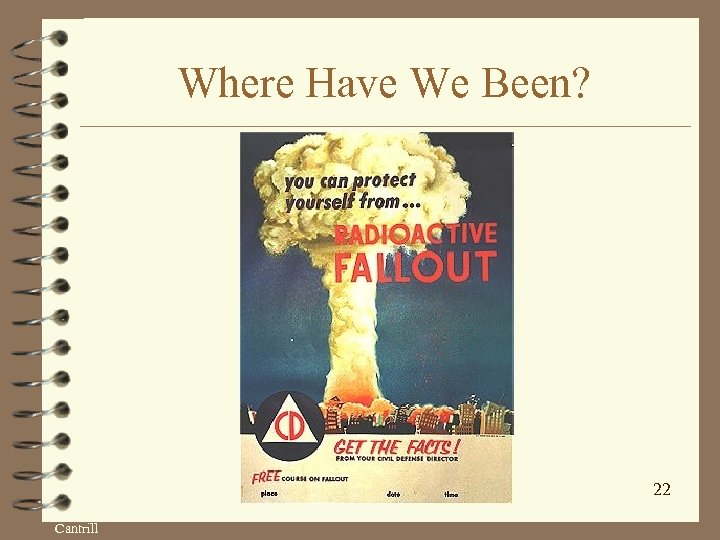 Where Have We Been? 22 Cantrill
 Hospital Reserve Disaster Inventory Ø Developed in 1950’s-1960’s Ø Designed to deal with trauma/nuclear victims Ø Developed by US Dept of HEW Ø Hospital-based storage Ø Included rotated pharmacy stock items 23 Cantrill
 Packaged Disaster Hospitals Ø Developed in 1950’s-1960’s Ø Designed to deal with trauma/nuclear victims Ø Developed by US Civil Defense Agency & Dept of HEW Ø 2500 deployed Ø Modularized for 50, 100, 200 bed units Ø 45, 000 pounds; 7500 cubic feet 24 Cantrill
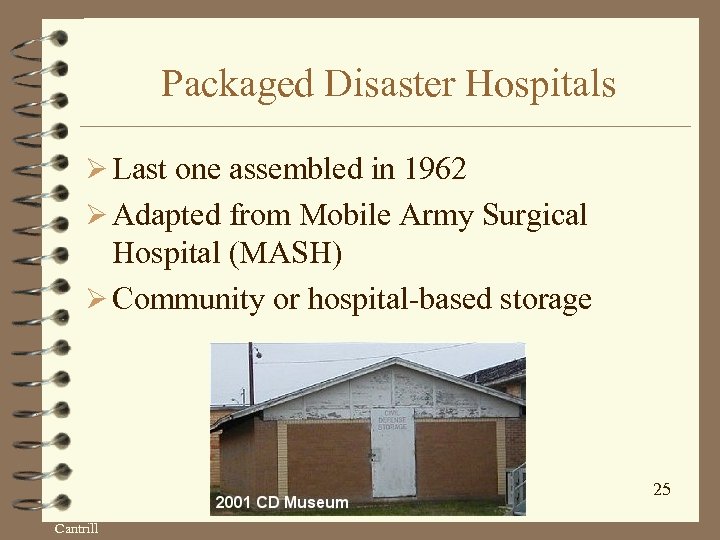 Packaged Disaster Hospitals Ø Last one assembled in 1962 Ø Adapted from Mobile Army Surgical Hospital (MASH) Ø Community or hospital-based storage 25 Cantrill
 Packaged Disaster Hospital: Multiple Units Ø Pharmacy Ø Records/office Ø Hospital supplies / supplies Ø Water supplies Ø Electrical supplies/equipment Ø Maintenance / housekeeping supplies Ø Limited oxygen support equipment Ø Surgical supplies / equipment Ø IV solutions / supplies Ø Dental supplies Ø X-ray 26 Cantrill
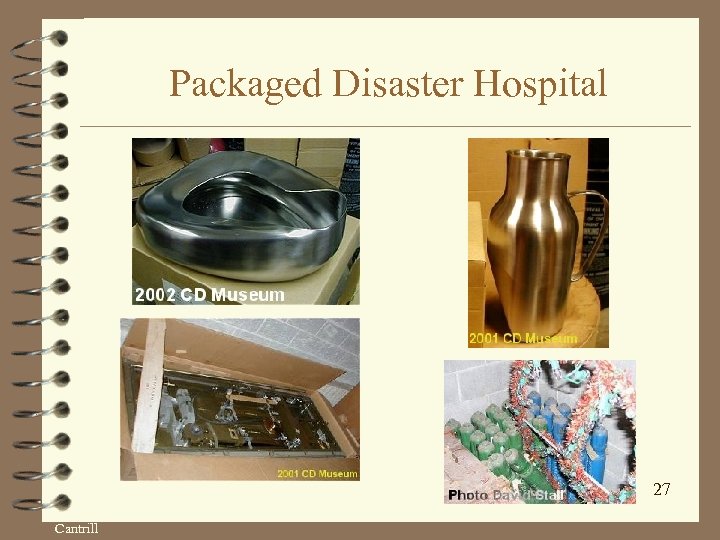 Packaged Disaster Hospital 27 Cantrill
 Packaged Disaster Hospitals Ø Congress refused to supply funds needed to maintain them in 1972 Ø Declared surplus in 1973 Ø Dismantled over the 1970’s-1980’s Ø Many sold for $1 28 Cantrill
 The Re-Emergence of a Concept Ø Medical Armory (Medical Cache) ØThink of the National Guard Armory Ø Driving Forces: ØLoss of institutional flexibility Ø“Just-In-Time” Everything ØLoss of physical surge capacity ØDenver has 1000 fewer physical beds that it did 10 years ago 29 Cantrill
 The Re-Emergence of a Concept: The Medical Cache Ø Issues: ØAugmentation vs Alternative Site? ØInclusion of actual structure? ØCost? ØStorage? ØOwnership? ØPharmaceuticals? ØLevel of care provided? 30 Cantrill
 Level I Cache: Hospital Augmentation Ø Bare-bones approach Ø Physical increase of 50 beds: may be an “Internal Alternative Care Site” Ø Would rely heavily on hospital supplies Ø Stored in a single trailer Ø About $20, 000 Ø Within the realm of institutional ownership Ø Readily mobile - but needs vehicle 31 Cantrill
 Level I Cache: Hospital Augmentation Ø Trailer Ø Cots Ø Linens Ø IV polls Ø Glove, gowns, masks Ø BP cuffs Ø Stethoscopes 32 Cantrill
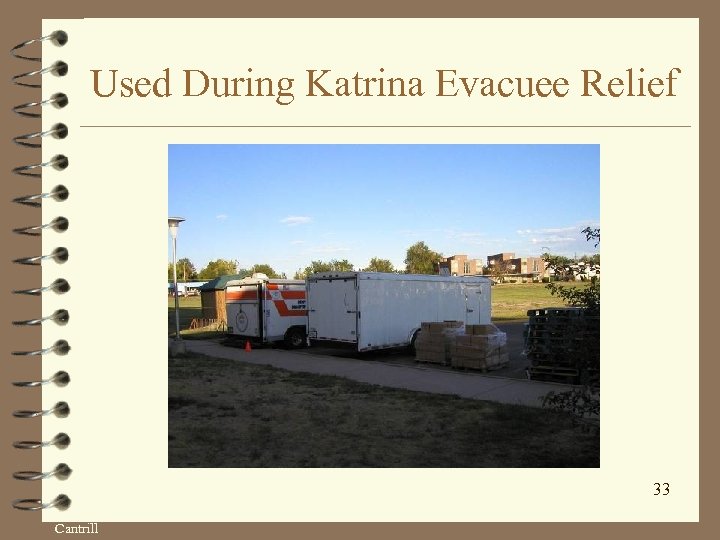 Used During Katrina Evacuee Relief 33 Cantrill
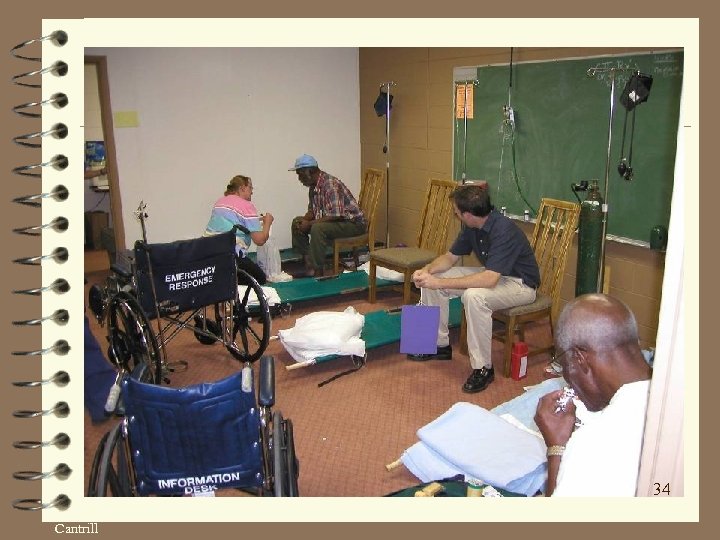 34 Cantrill
 Level II Cache: Regional Alternative Site Ø Significantly more robust in terms of supplies Ø Designed by one of our partners, Colorado Department of Public Health and Environment 35 Cantrill
 Level II Cache: Regional Alternative Site Ø Designed for initial support of 500 patients Ø Per HRSA recommendations of 500 patient surge per 1, 000 population Ø Modular packaging for units of 50 -100 pts Ø Regionally located and stored Ø Trailer-based for mobility Ø Has been implemented Ø Approximate price less than $100, 000 per copy 36 Cantrill
 Level III Cache: Comprehensive Alternative Care Site Ø Adapted from work done by US Army Soldier and Biological Chemical Command Ø 50 Patient modules Ø Most robust model Ø Closest to supporting non-disaster level of care, but still limited Ø More extensive equipment support 37 Cantrill
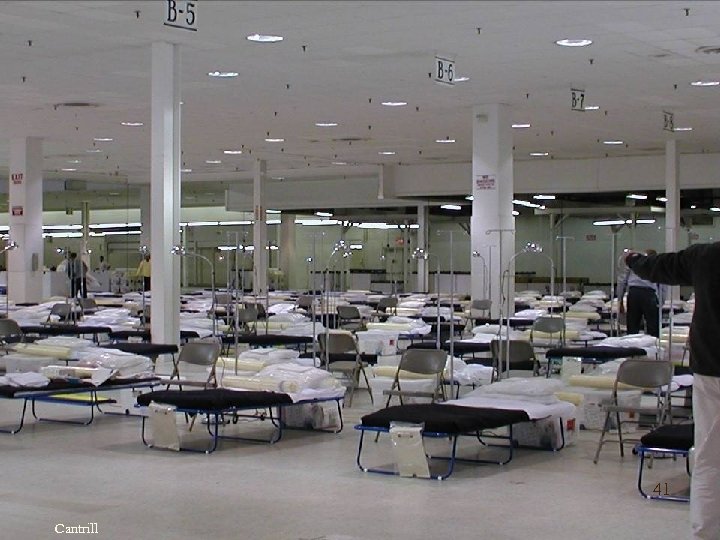
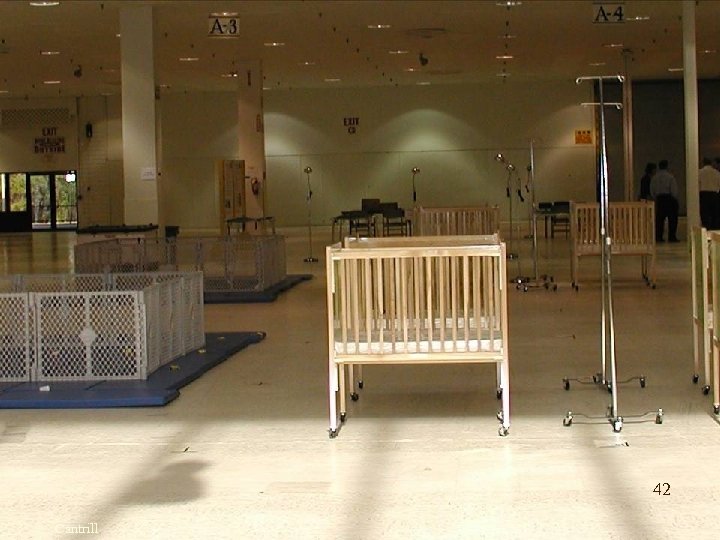
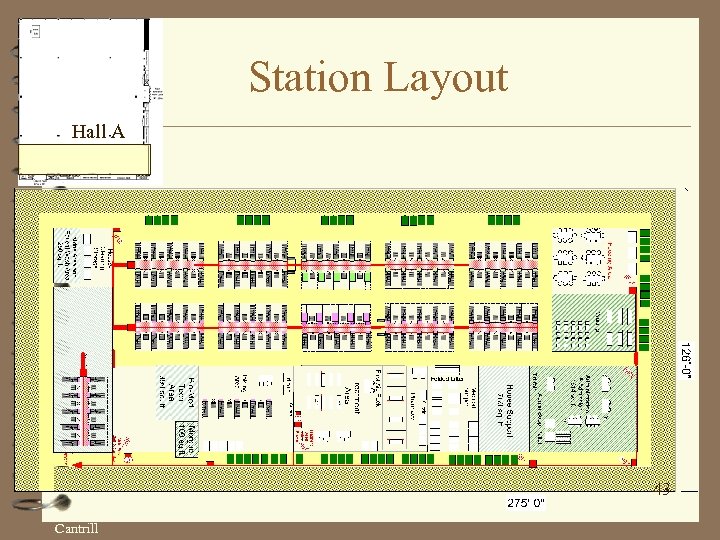
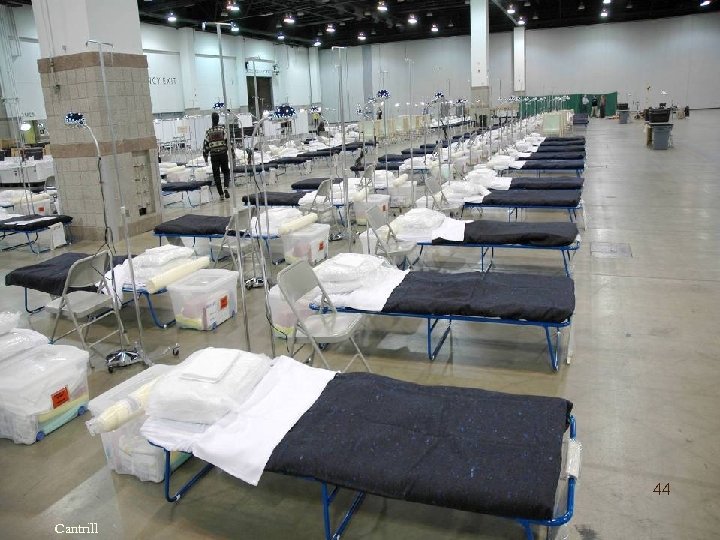
 Work at the Federal Level Ø DHHS: Public Health System Contingency Station ØSpecified and demonstrated Ø 250 beds in 50 bed units ØQuarantine or lower level of care ØFor use in existing structures ØMultiple copies to be strategically placed ØOwned and operated by the federal government 38 Cantrill
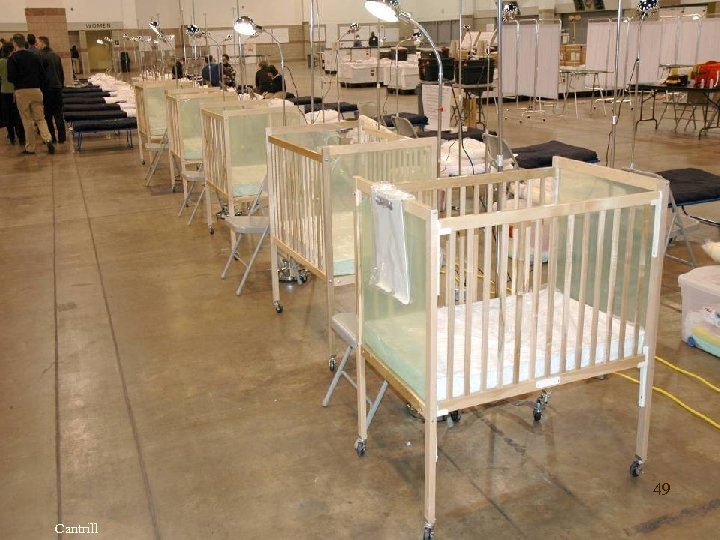
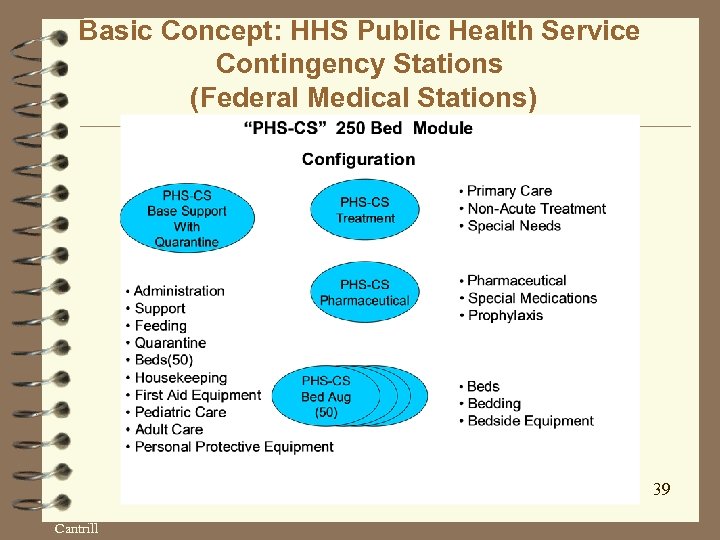 Basic Concept: HHS Public Health Service Contingency Stations (Federal Medical Stations) 39 Cantrill
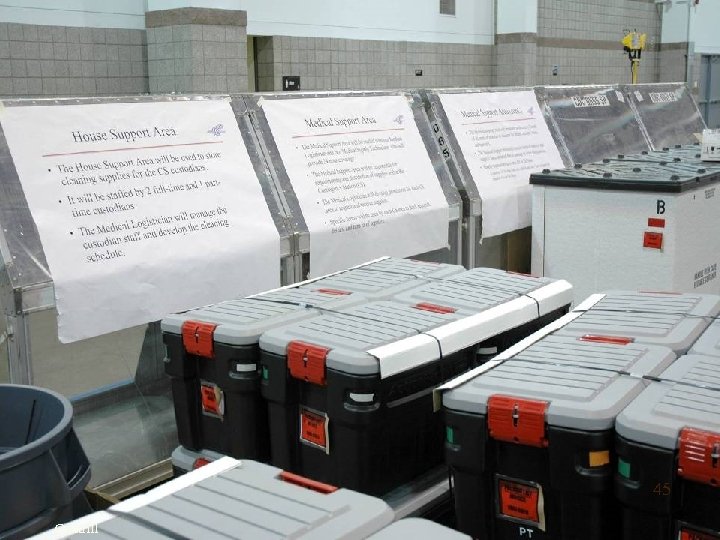
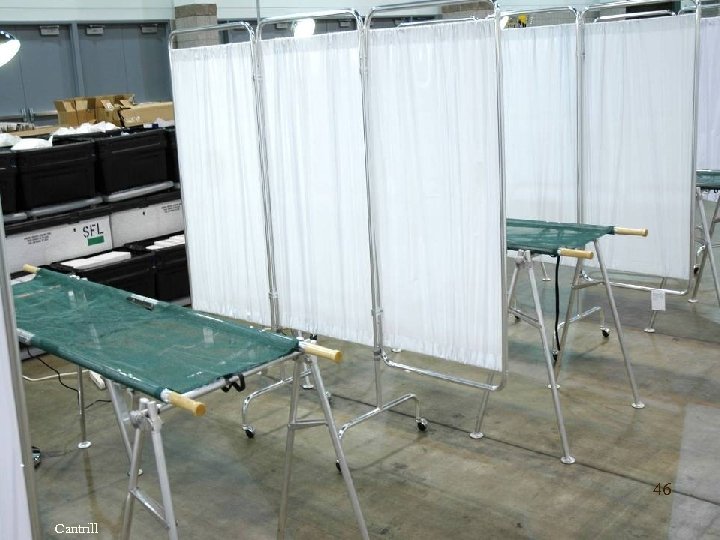
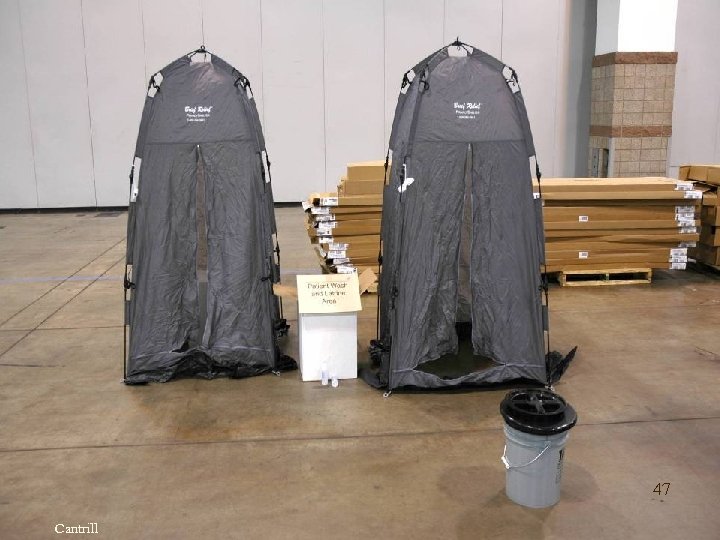
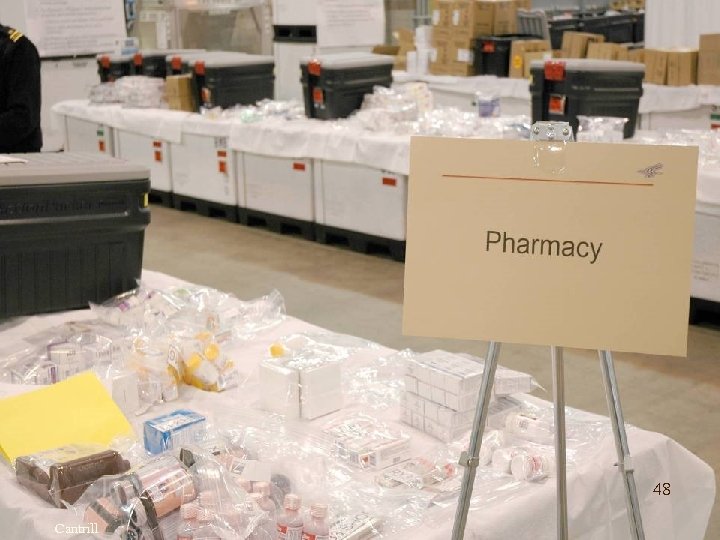
 Demo Scenario Ø Denver (notionally) experiences an event that demands 100 beds of surge relief. Ø OPHEP initiates set up of a PHS Contingency Station Ø The Denver Convention Center serves as the building of opportunity Ø Denver Health Medical Center decides which patients transfer to the Station, and then makes these transfers Ø Federal manpower operates the Station Ø PHS and/or Medical Reserve Corps provide professional services Ø Federal Logistics Manager operates Station logistics Ø Colorado and Denver PH/EMS provide service support (notionally)—food, water, utilities, etc Cantrill 40
 41 Cantrill
 42 Cantrill
 Station Layout Hall A 43 Cantrill
 44 Cantrill
 45 Cantrill
 46 Cantrill
 47 Cantrill
 48 Cantrill
 49 Cantrill
 Work at the Federal Level Ø DHS: Critical care unit ØSpecified, not yet implemented ØICU level of care Ø Specialty care units 50 Cantrill
 Problem ü Disaster event overwhelms current hospital capacity ü An “Alternative Care Site” must be opened to treat victims What is the best existing infrastructure/site in the region for delivering care? 51 Cantrill
 Concept of Alternative Care Site • It is not a miniature hospital • Level of care will decrease • Need to decide in advance: What types of patients will be treated at the site? • Disaster victims? • Low-level of care patients from overwhelmed hospitals? 52 Cantrill
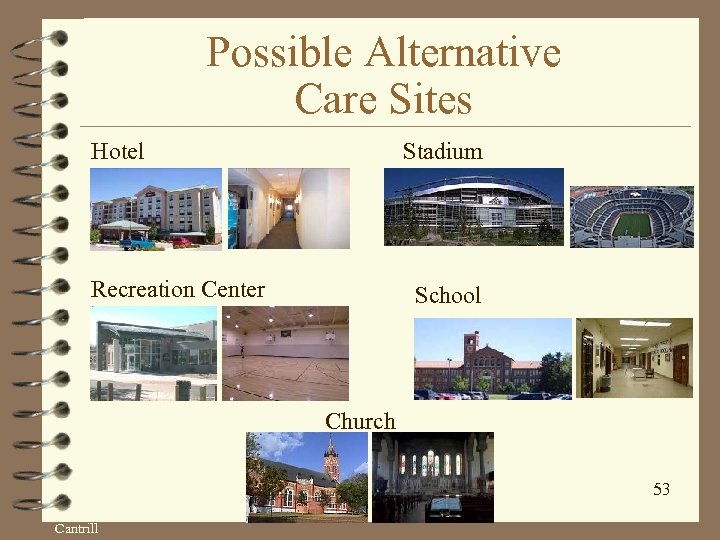 Possible Alternative Care Sites Hotel Stadium Recreation Center School Church 53 Cantrill
 Potential Non-Hospital Sites ü Aircraft hangers ü Churches ü Community/recreation ü ü ü centers Convalescent care facilities Fairgrounds Government buildings Hotels/motels Meeting Halls Military facilities ü National Guard armories ü Same day surgical ü ü ü centers/clinics Schools Sports Facilities/stadiums Trailers/tents (military/other) Shuttered Hospitals Detention Facilities 54 Cantrill
 Some Issues: Ø Private sites vs Public sites Ø Who can grant permission to use? Ø Need for decontamination after use to restore to original function 55 Cantrill
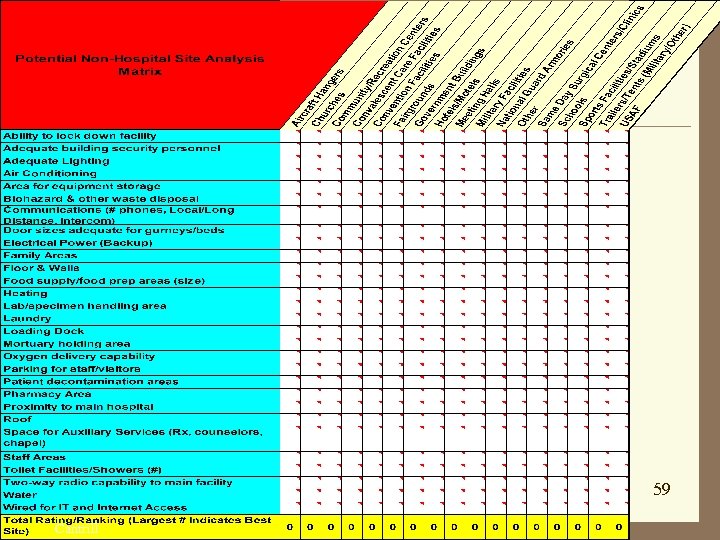
 Infrastructure Requirements ü Infrastructure factors listed on axis of a matrix. ü Additional relevant factors can be added/deleted based on your area or the type of event. ü Relative weight scale created on 5 -point scale comparing factor to that of a hospital 56 Cantrill
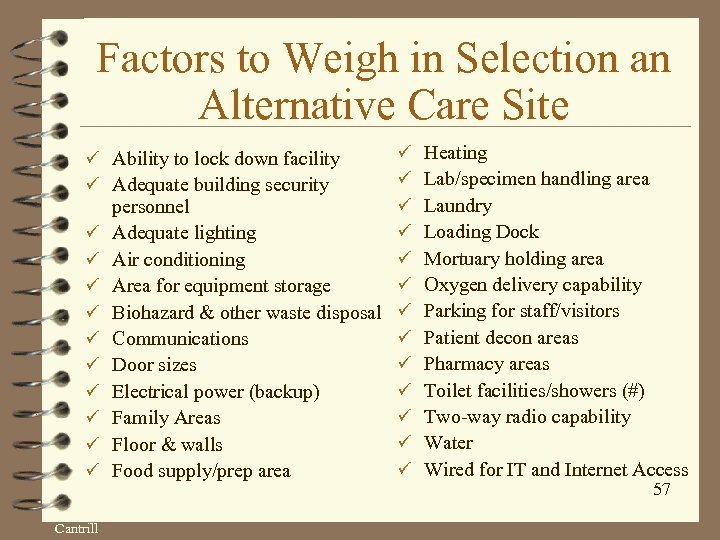 Factors to Weigh in Selection an Alternative Care Site ü ü ü personnel ü Adequate lighting ü Air conditioning ü Area for equipment storage Biohazard & other waste disposal ü ü Communications ü Door sizes ü Electrical power (backup) ü Family Areas ü Floor & walls ü Food supply/prep area ü Ability to lock down facility ü Adequate building security ü ü ü ü ü Cantrill Heating Lab/specimen handling area Laundry Loading Dock Mortuary holding area Oxygen delivery capability Parking for staff/visitors Patient decon areas Pharmacy areas Toilet facilities/showers (#) Two-way radio capability Water Wired for IT and Internet Access 57
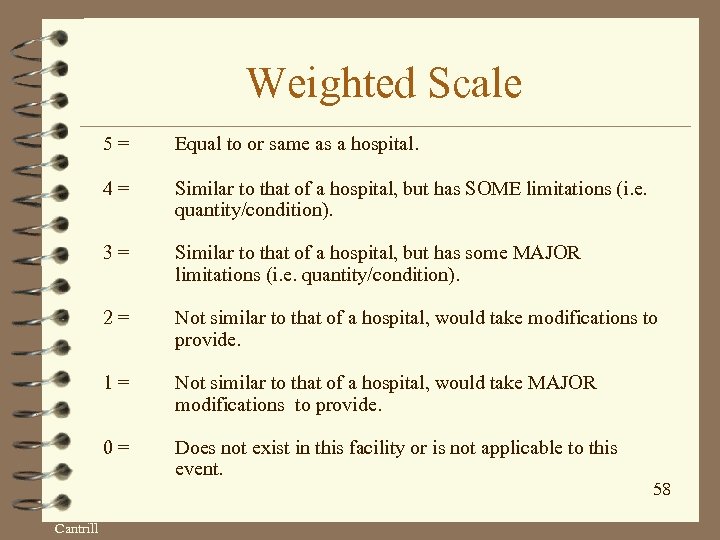 Weighted Scale 5= 4= Similar to that of a hospital, but has SOME limitations (i. e. quantity/condition). 3= Similar to that of a hospital, but has some MAJOR limitations (i. e. quantity/condition). 2= Not similar to that of a hospital, would take modifications to provide. 1= Not similar to that of a hospital, would take MAJOR modifications to provide. 0= Cantrill Equal to or same as a hospital. Does not exist in this facility or is not applicable to this event. 58
 59 Cantrill
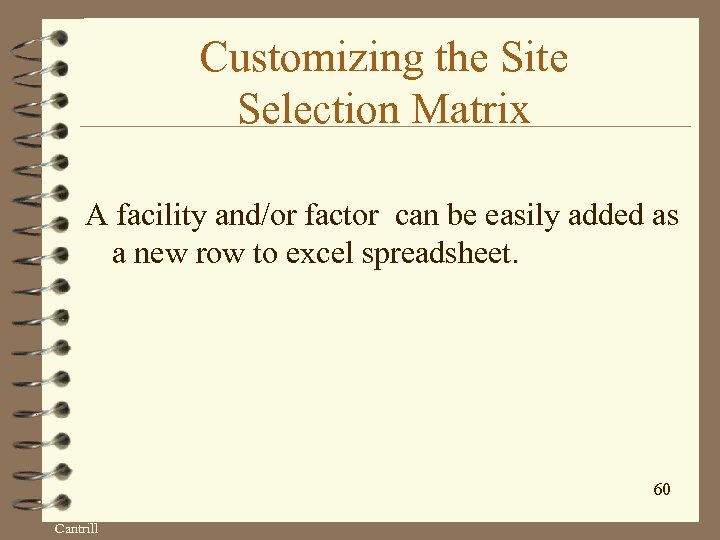 Customizing the Site Selection Matrix A facility and/or factor can be easily added as a new row to excel spreadsheet. 60 Cantrill
 Issues to Consider ü Is each factor of equal weight? ü What if another use is already stated for the building in a disaster situation? • (i. e. a church may have a valuable community role) ü Are missing, critical elements able to be brought in easily to site? 61 Cantrill
 WHO needs this tool? ü Incident commanders ü Regional planners ü Planning teams including: fire, law, Red Cross, security, emergency managers, hospital personnel ü Public works / hospital engineering should be involved to know what modifications are needed. 62 Cantrill
 WHEN should you use this tool? ü Before an actual event. ü Choose best site for different scenarios so have a site in mind for each “type”. www. denverhealth. org/bioterror/tools. htm 63 Cantrill
 The Supplemental Oxygen Dilemma Ø Supplemental oxygen need highly likely in a pan flu / bioterrorism incident Ø Has been carefully researched by the Armed Forces Ø Most options are quite expensive Ø Most require training/maintenance Ø All present logistical challenges Ø Remains an unresolved issue Ø Most have high cost/patient Ø Many have very high power requirements 64 Cantrill
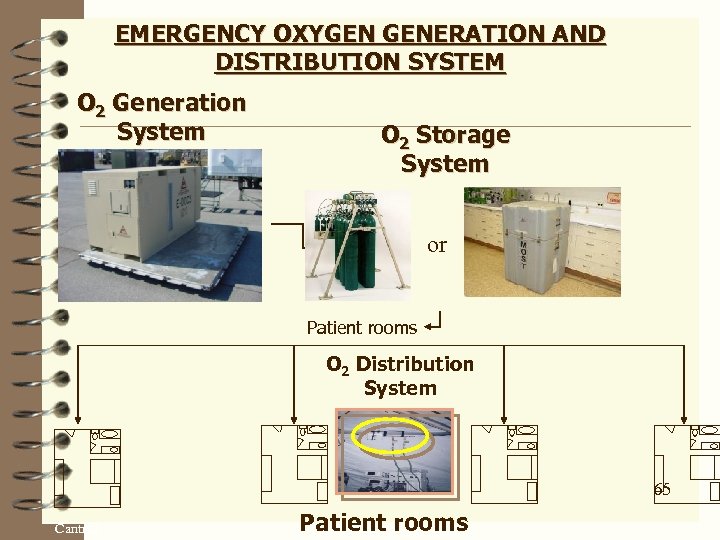 EMERGENCY OXYGEN GENERATION AND DISTRIBUTION SYSTEM O 2 Generation System O 2 Storage System or Patient rooms O 2 Distribution System 65 Cantrill Patient rooms
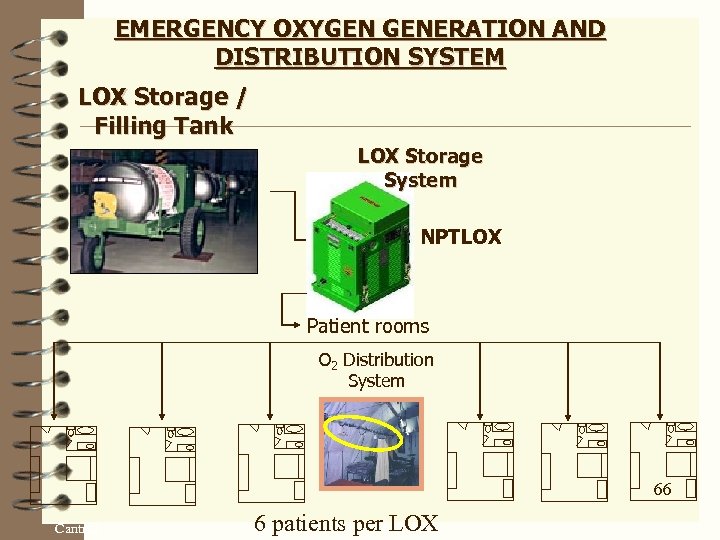 EMERGENCY OXYGEN GENERATION AND DISTRIBUTION SYSTEM LOX Storage / Filling Tank LOX Storage System NPTLOX Patient rooms O 2 Distribution System 66 Cantrill 6 patients per LOX
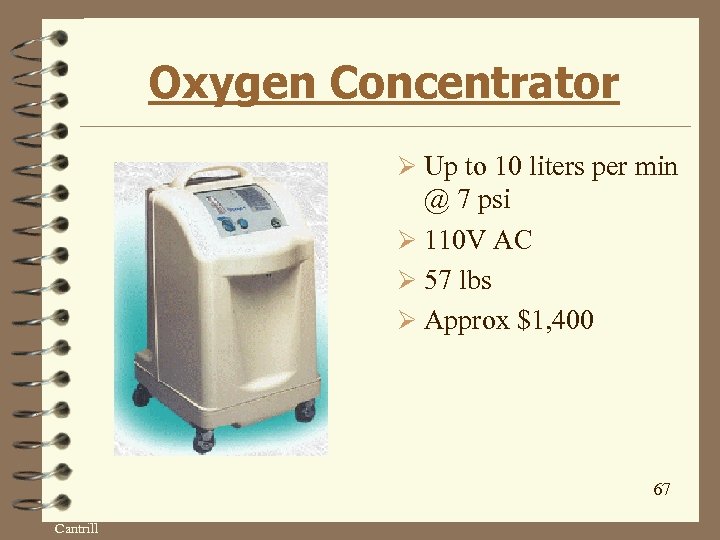 Oxygen Concentrator Ø Up to 10 liters per min @ 7 psi Ø 110 V AC Ø 57 lbs Ø Approx $1, 400 67 Cantrill
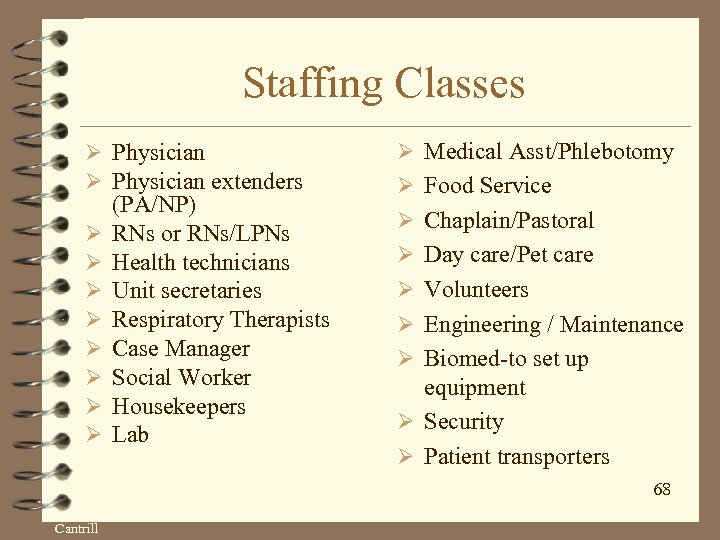 Staffing Classes Ø Physician extenders Ø Ø Ø Ø (PA/NP) RNs or RNs/LPNs Health technicians Unit secretaries Respiratory Therapists Case Manager Social Worker Housekeepers Lab Ø Medical Asst/Phlebotomy Ø Food Service Ø Chaplain/Pastoral Ø Day care/Pet care Ø Volunteers Ø Engineering / Maintenance Ø Biomed-to set up equipment Ø Security Ø Patient transporters 68 Cantrill
![Per 12 Hour Shift: 33 Ø Physician [1] Ø Physician extenders Ø Ø Ø](https://present5.com/presentation/8cbedd625445a23667a0606327889418/image-69.jpg "Per 12 Hour Shift: 33 Ø Physician [1] Ø Physician extenders Ø Ø Ø") Per 12 Hour Shift: 33 Ø Physician [1] Ø Physician extenders Ø Ø Ø Ø (PA/NP) [1] RNs or RNs/LPNs [6] Health technicians [4] Unit secretaries [2] Respiratory Therapists [1] Case Manager [1] Social Worker [1] Housekeepers [2] Lab [1] Ø Medical Asst/Phlebotomy [1] Ø Food Service Ø Ø Ø Ø [2] Chaplain/Pastoral [1] Day care/Pet care Volunteers [4] Engineering/Maintenance [. 25] Biomed [. 25] Security [2] Patient transporters [2] 69 Cantrill
Per 12 Hour Shift: 33 Ø Physician [1] Ø Physician extenders Ø Ø Ø Ø (PA/NP) [1] RNs or RNs/LPNs [6] Health technicians [4] Unit secretaries [2] Respiratory Therapists [1] Case Manager [1] Social Worker [1] Housekeepers [2] Lab [1] Ø Medical Asst/Phlebotomy [1] Ø Food Service Ø Ø Ø Ø [2] Chaplain/Pastoral [1] Day care/Pet care Volunteers [4] Engineering/Maintenance [. 25] Biomed [. 25] Security [2] Patient transporters [2] 69 Cantrill
 Staffing Considerations Ø Requires significant pre-planning ØState {S} ØLocal {L} ØInstitutional {I} Ø Unclear who would volunteer Ø Contained vs Population-based Surge event 70 Cantrill
 Facilitation of Emergency Staffing Ø Establish legal authority to utilize out-of-state licensed personnel {S} Ø Establish supervision criteria for volunteer and out -of-state licensed personnel {S} Ø Establish/maintain list of retired individuals who could be called upon to staff {S L I} Ø Availability of prophylaxis for employees and volunteers (? and their families) to guarantee workforce availability {S L I} 71 Cantrill
 Facilitation of Emergency Staffing Ø Communication of institutional workforce plan in advance to employees {I} Ø Develop, test and maintain emergency call-in protocol {L I} Ø Expectation and capacity for flexibility in roles {S L I} Ø Establish linkages with community resources (ie. hotel housekeeping) {L I} 72 Cantrill
 Facilitation of Emergency Staffing Ø Address specific needs of employees (transportation, single mother, pets) {I} Ø Implement a reverse 911 or notification system for all employees {S L I} Ø Establishment of institutional policies for credentialing of non-employees {S L I} 73 Cantrill
 Emergency System for Advanced Registration of Volunteer Health Professionals: ESAR-VHP Ø State-based registration, verification and credentialing of medical volunteers Ø Should allow easier sharing of volunteers across states Ø Still missing: ØLiability coverage ØCommand control 74 Cantrill
 Medical Reserve Corps Ø Local medical volunteers Ø No corps unit uniform structure Ø 330 units of 55, 000 volunteers Ø Deployments do not qualify for FEMA reimbursement Ø Liability concerns are still an issue Ø ESAR-VHP may help with credentialing 75 Cantrill
 Development of Gubernatorial Draft Executive Orders Ø Developed by the Colorado Governor’s Expert Emergency Epidemic Response Committee (GEEERC) Ø Multi-disciplinary Ø 20 different specialties/fields (from attorney general to vets) Ø To address pandemics or BT incidents Ø Work started in 2000 76 Cantrill
 Development of Gubernatorial Draft Executive Orders Ø Declaration of Bioterrorism Disaster Ø Suspension of Federal Emergency Medical Treatment and Active Labor Act (EMTALA) Ø Allowing seizure of specific drugs from private sources Ø Suspension of certain Board of Pharmacy regulations regarding dispensing of medication 77 Cantrill
 Development of Gubernatorial Draft Executive Orders Ø Suspension of certain physician and nurse licensure statutes Ø Allows out-of-state or inactive license holders to provide care under proper supervision Ø Allowing physician assistants and EMTs to provide care under the supervision of any licensed physician Ø Allowing isolation and quarantine Ø Suspension of certain death and burial statutes 78 Cantrill
 Other Issues and Decision Points Ø “Ownership”, command control ØHICS is a good starting structure Ø Who decides to open an ACS? Ø Scope of care to be delivered? ØOffloaded hospital patients ØPrimary victim care ØNursing home replacement ØAmbulatory chronic care / shelter 79 Cantrill
 Other Issues and Decision Points Ø Operational support ØMeals ØSanitary needs ØInfrastructure Ø Documentation of care Ø Security 80 Cantrill
 Other Issues and Decision Points Ø Communications Ø Relations with EMS Ø Rules/policies for operation Ø Exit strategy Ø Exercising the plan 81 Cantrill
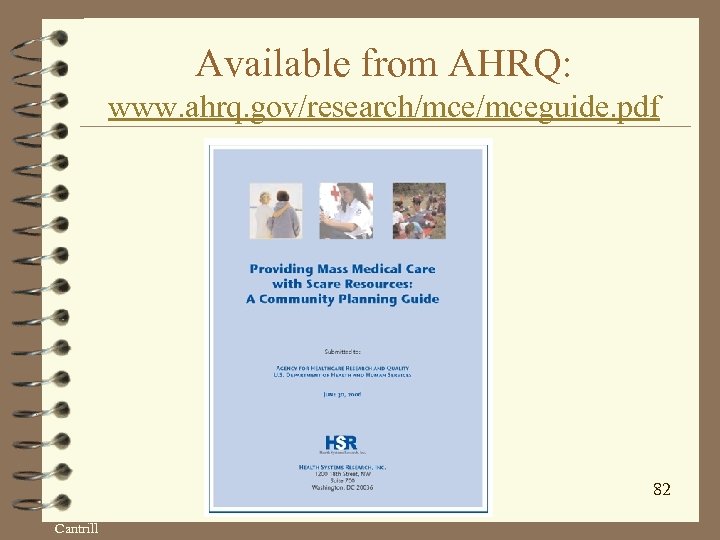 Available from AHRQ: www. ahrq. gov/research/mceguide. pdf 82 Cantrill
 Also Available: Altered Standards of Care in Mass Casualty Events: Bioterrorism and Other Public Health Emergencies. AHRQ Publication No. 05 -0043, April 2005. Agency for Healthcare Research and Quality, Rockville, MD. www. ahrq. gov/research/altstand/ 83 Cantrill
 Katrina: ACS Issues Ø Importance of regional planning Ø Importance of security Ø Advantages of manpower proximity Ø Segregating special needs populations Ø Organized facility layout Ø Importance of ICS 84 Cantrill
 Katrina: ACS Issues Ø The need for “House Rules” Ø Importance of public health issues ØSafe food ØClean water ØLatrine resources ØSanitation supplies 85 Cantrill
 Tiered Response Plan: Based on Epidemiology Ø Category 0: No cases of EID at DHMC q EID elsewhere in the world q EID transmission in the region q Passive/active surveillance; Just-in-time training Ø Category 1: A few cases at DHMC but all cases are imported Ø Cohort patients; limit visitors to infectious patients; institute patient transport routes Cantrill 86
 Tiered Response Plan: Based on Epidemiology Ø Category 2: A larger number of EID cases at DHMC (e. g. more than 5 -10) OR nosocomial transmission has occurred, but source clear. Ø Limit visitors to all patients; limit elective procedures; fever screen at entry; fever surveillance on wards Ø Category 3: Nosocomial transmission has occurred and the nosocomial cases have NO clear source Ø No visitors; facility closed to elective or non-life/limb threat admits 87 Cantrill
 Summary Ø Institutional preparedness is a challenge Ø We are rediscovering some old concepts Ø Supplemental oxygen and respiratory support remain problems for an ACS Ø Surge staffing facilitation requires advance planning at multiple levels and may still fail 88 Cantrill
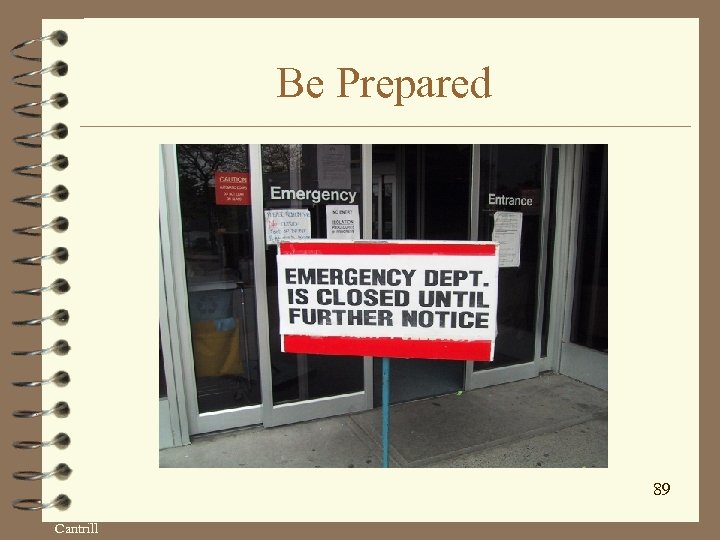 Be Prepared 89 Cantrill