Скачать презентацию Preparing for IELTS First Certificate Some useful
Preparing-for-IELTS-First-Certificate.pptx
- Количество слайдов: 21
 Preparing for IELTS & First Certificate. Some useful hints and tips
 IELTS • For people who want to study or work where English is used as the language of communication. • Over 2. 5 million tests taken each year.
 IELTS • IELTS enables you to: • work or study in another country • decide on a module to match your goal – Academic or General Training. • Results are available in 13 calendar days. • Over 9, 000 organisations worldwide accept IELTS as proof of language ability.
 IELTS • IELTS test assesses your abilities in listening, reading, writing and speaking. • Two types of IELTS test: IELTS Academic and IELTS General Training. Listening and Speaking are the same for both tests, but the subject matter of the Reading and Writing components differs depending on which test you take. • Total test time: 2 hours and 45 minutes.
 IELTS • IELTS tests the language ability of people who want to study or work where English is used as the language of communication. Over 2. 5 million tests are taken each year. • Valid for 2 years
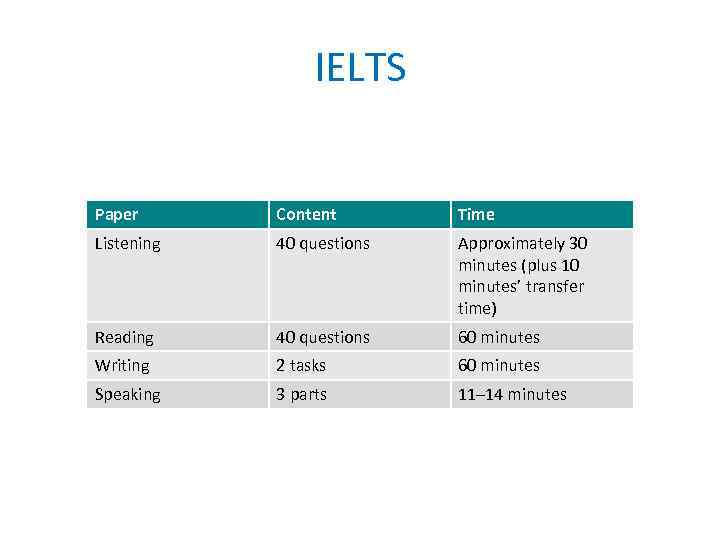 IELTS Paper Content Time Listening 40 questions Approximately 30 minutes (plus 10 minutes’ transfer time) Reading 40 questions 60 minutes Writing 2 tasks 60 minutes Speaking 3 parts 11– 14 minutes
 First Certificate CEFR level: B 2 Cambridge English: First (FCE) qualification proves you have the language skills to live and work independently in an English-speaking country or study on courses taught in English. Cambridge First Certificate is valid for life.
 FIRST • communicate effectively face-to-face, expressing opinions and presenting arguments • follow the news • write clear, detailed English, expressing opinions and explaining the advantages and disadvantages of different points of view • write letters, reports, stories and other types of text.
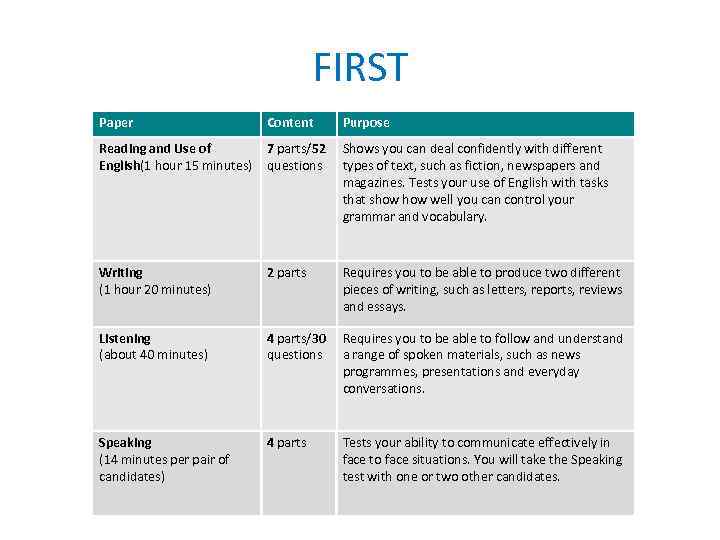 FIRST Paper Content Purpose Reading and Use of 7 parts/52 Shows you can deal confidently with different English(1 hour 15 minutes) questions types of text, such as fiction, newspapers and magazines. Tests your use of English with tasks that show well you can control your grammar and vocabulary. Writing (1 hour 20 minutes) 2 parts Requires you to be able to produce two different pieces of writing, such as letters, reports, reviews and essays. Listening (about 40 minutes) 4 parts/30 Requires you to be able to follow and understand questions a range of spoken materials, such as news programmes, presentations and everyday conversations. Speaking (14 minutes per pair of candidates) 4 parts Tests your ability to communicate effectively in face to face situations. You will take the Speaking test with one or two other candidates.
 READING Ways of reading Reading for pleasure
 READING Ways of reading Skimming
 READING Ways of reading Scanning
 Skimming • Read the text quickly • Ignore words you don’t understand • Look for the general meaning and message of the text.
 Scanning • Find specific information in the text. • Do NOT read the whole text again.
 Listening • Listening for general information • Listening for specific information.
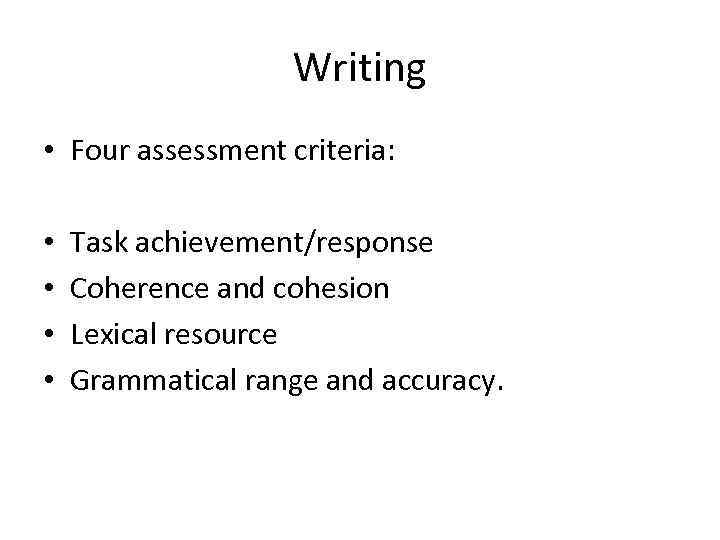 Writing • Four assessment criteria: • • Task achievement/response Coherence and cohesion Lexical resource Grammatical range and accuracy.
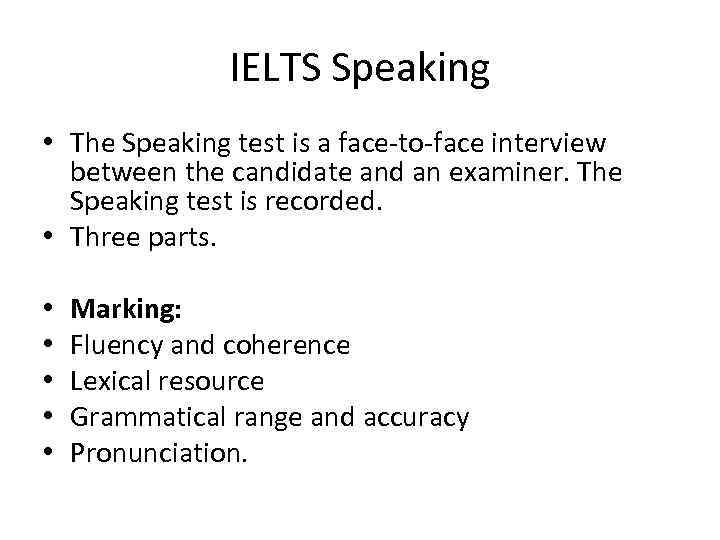 IELTS Speaking • The Speaking test is a face-to-face interview between the candidate and an examiner. The Speaking test is recorded. • Three parts. • • • Marking: Fluency and coherence Lexical resource Grammatical range and accuracy Pronunciation.
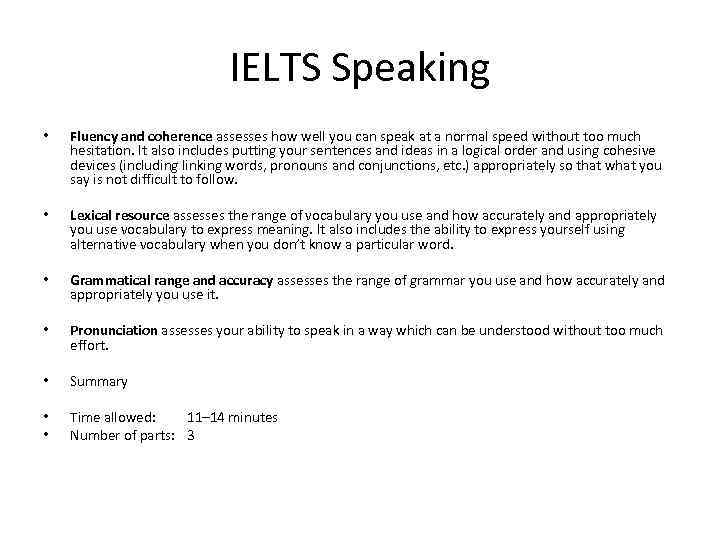 IELTS Speaking • Fluency and coherence assesses how well you can speak at a normal speed without too much hesitation. It also includes putting your sentences and ideas in a logical order and using cohesive devices (including linking words, pronouns and conjunctions, etc. ) appropriately so that what you say is not difficult to follow. • Lexical resource assesses the range of vocabulary you use and how accurately and appropriately you use vocabulary to express meaning. It also includes the ability to express yourself using alternative vocabulary when you don’t know a particular word. • Grammatical range and accuracy assesses the range of grammar you use and how accurately and appropriately you use it. • Pronunciation assesses your ability to speak in a way which can be understood without too much effort. • Summary • • Time allowed: 11– 14 minutes Number of parts: 3
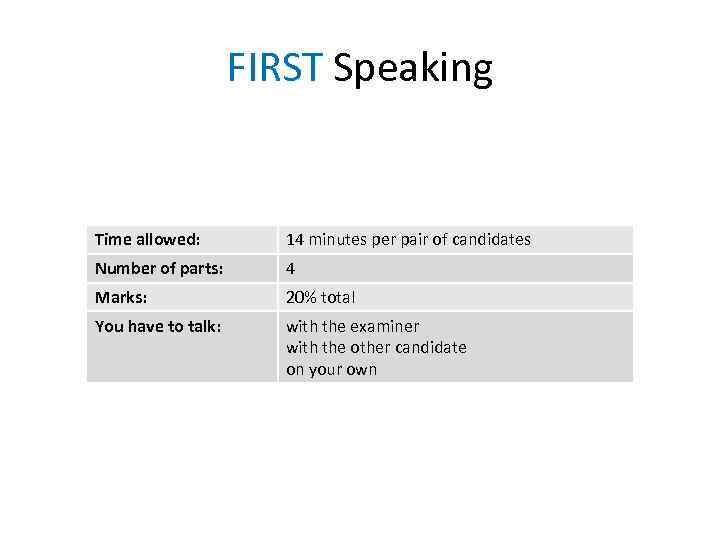 FIRST Speaking Time allowed: 14 minutes per pair of candidates Number of parts: 4 Marks: 20% total You have to talk: with the examiner with the other candidate on your own