


 Скачать презентацию Preparing for first physics at the LHC the
c7017691824053bd4c7db30dd0c1d6a1.ppt
- Количество слайдов: 62
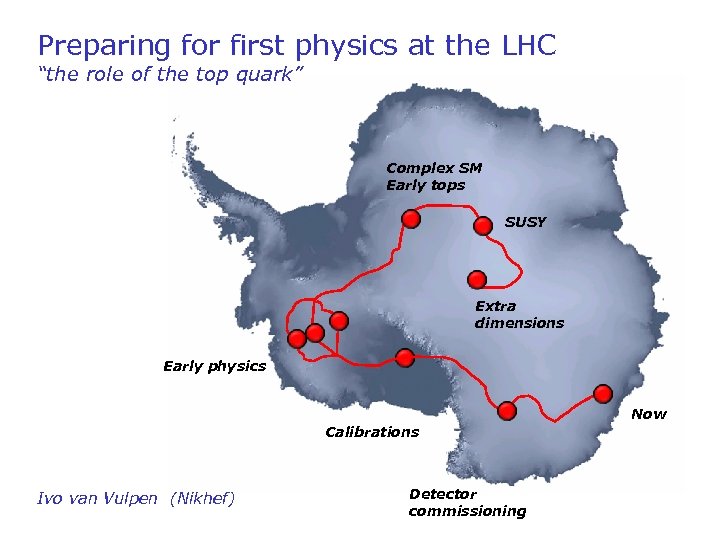 Preparing for first physics at the LHC “the role of the top quark” Complex SM Early tops SUSY Extra dimensions Early physics Now Calibrations Ivo van Vulpen (Nikhef) Detector commissioning
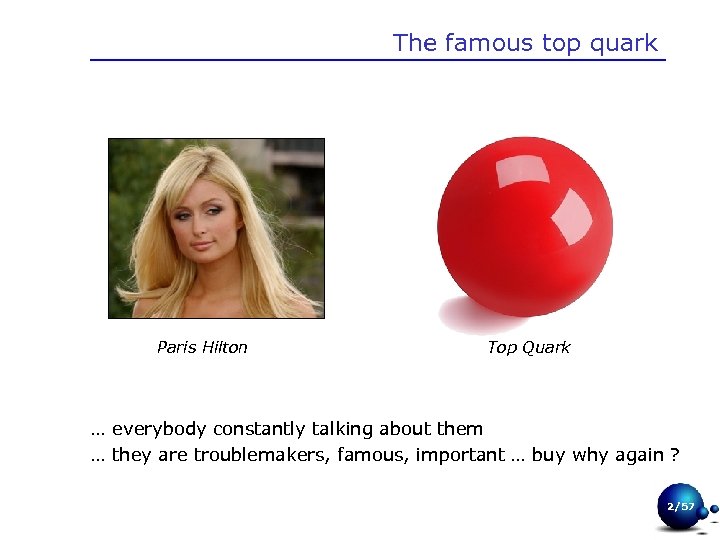 The famous top quark Paris Hilton Top Quark … everybody constantly talking about them … they are troublemakers, famous, important … buy why again ? 2/57
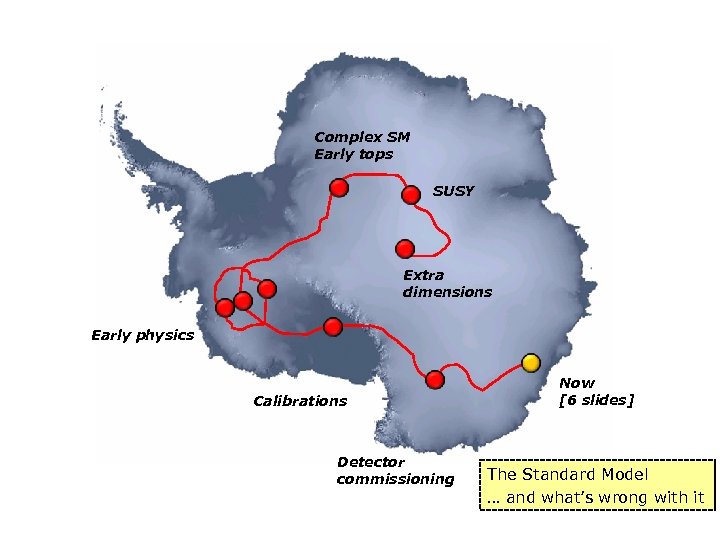 Complex SM Early tops SUSY Extra dimensions Early physics Calibrations Detector commissioning Now [6 slides] The Standard Model … and what’s wrong with it
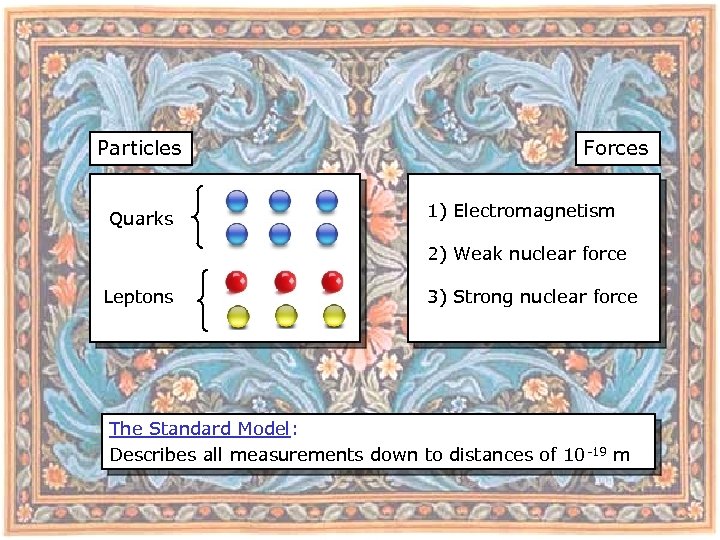 Particles Quarks Forces 1) Electromagnetism 2) Weak nuclear force Leptons 3) Strong nuclear force The Standard Model: Describes all measurements down to distances of 10 -19 m 4/57 4/52
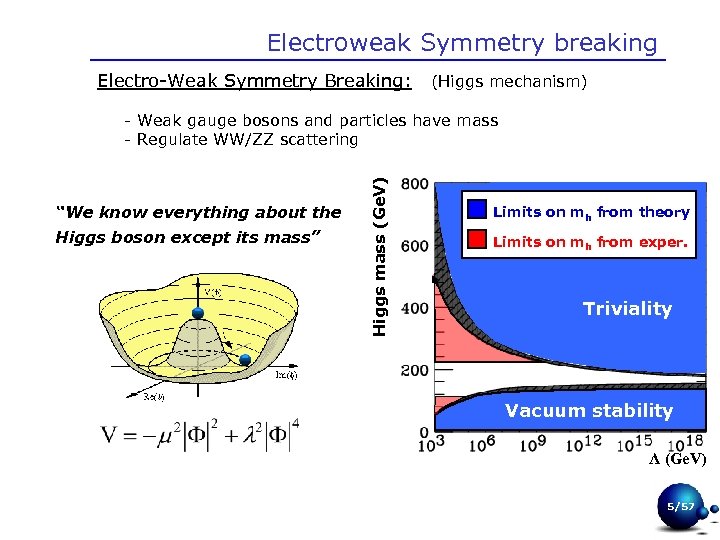 Electroweak Symmetry breaking Electro-Weak Symmetry Breaking: (Higgs mechanism) “We know everything about the Higgs boson except its mass” Higgs mass (Ge. V) - Weak gauge bosons and particles have mass - Regulate WW/ZZ scattering Limits on mh from theory Limits on mh from exper. Triviality Vacuum stability Λ (Ge. V) 5/57
 The standard model … boring ? “All measurements in HEP can be explained using the SM” “The Higgs boson will be discovered at the LHC at ~ 140 Ge. V” No. … there are many mysteries left! 6/57
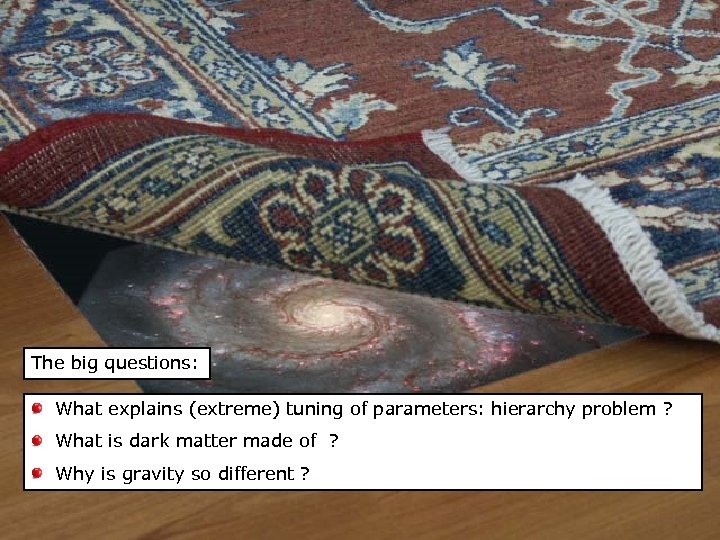 The big questions: What explains (extreme) tuning of parameters: hierarchy problem ? What is dark matter made of ? Why is gravity so different ?
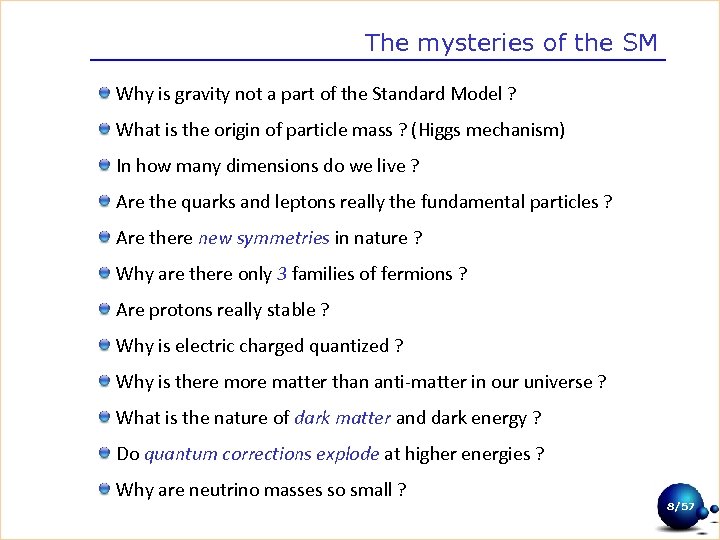 The mysteries of the SM Why is gravity not a part of the Standard Model ? What is the origin of particle mass ? (Higgs mechanism) In how many dimensions do we live ? Are the quarks and leptons really the fundamental particles ? Are there new symmetries in nature ? Why are there only 3 families of fermions ? Are protons really stable ? Why is electric charged quantized ? Why is there more matter than anti-matter in our universe ? What is the nature of dark matter and dark energy ? Do quantum corrections explode at higher energies ? Why are neutrino masses so small ? 8/57
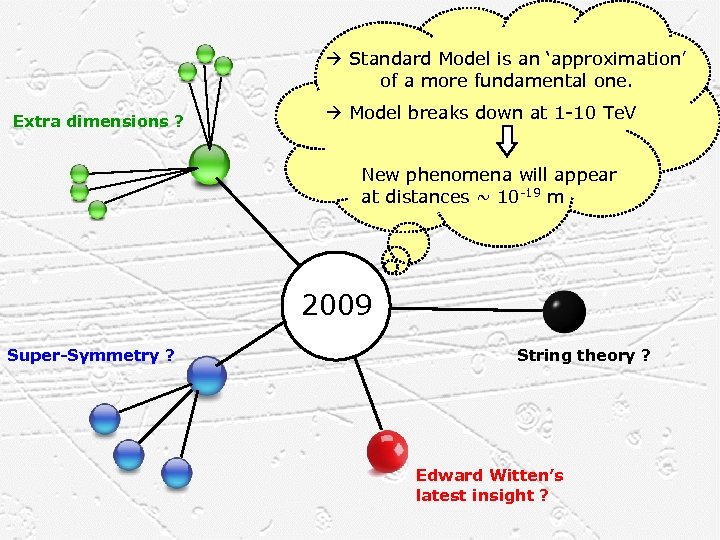 Standard Model is an ‘approximation’ of a more fundamental one. Extra dimensions ? Model breaks down at 1 -10 Te. V New phenomena will appear at distances ~ 10 -19 m 2009 Super-Symmetry ? String theory ? Edward Witten’s latest insight ?
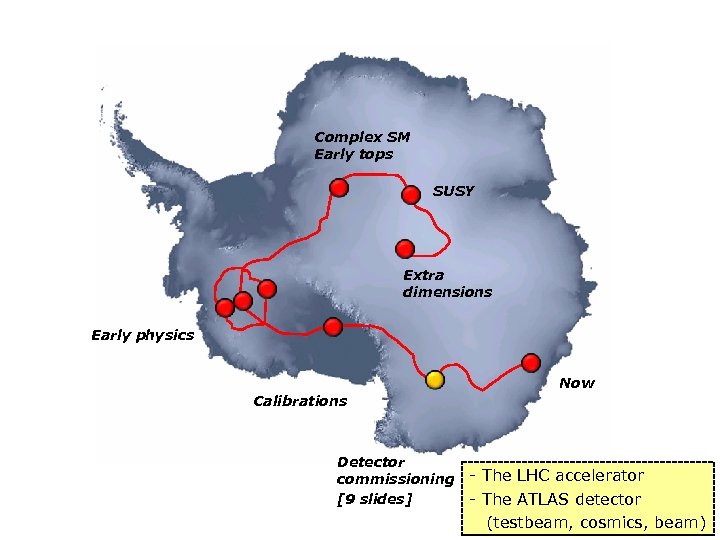 Complex SM Early tops SUSY Extra dimensions Early physics Now Calibrations Detector commissioning [9 slides] - The LHC accelerator - The ATLAS detector (testbeam, cosmics, beam)
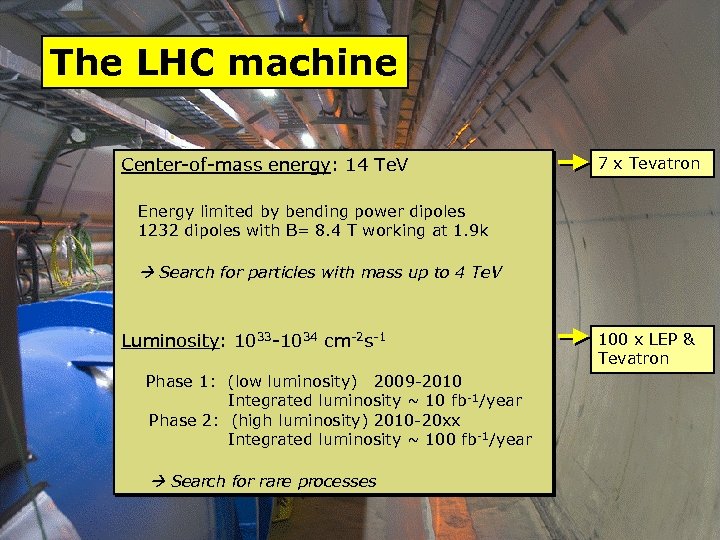 The LHC machine Center-of-mass energy: 14 Te. V 7 x Tevatron Energy limited by bending power dipoles 1232 dipoles with B= 8. 4 T working at 1. 9 k Search for particles with mass up to 4 Te. V Luminosity: 1033 -1034 cm-2 s-1 100 x LEP & Tevatron Phase 1: (low luminosity) 2009 -2010 Integrated luminosity ~ 10 fb-1/year Phase 2: (high luminosity) 2010 -20 xx Integrated luminosity ~ 100 fb-1/year Search for rare processes 11/57 11/52
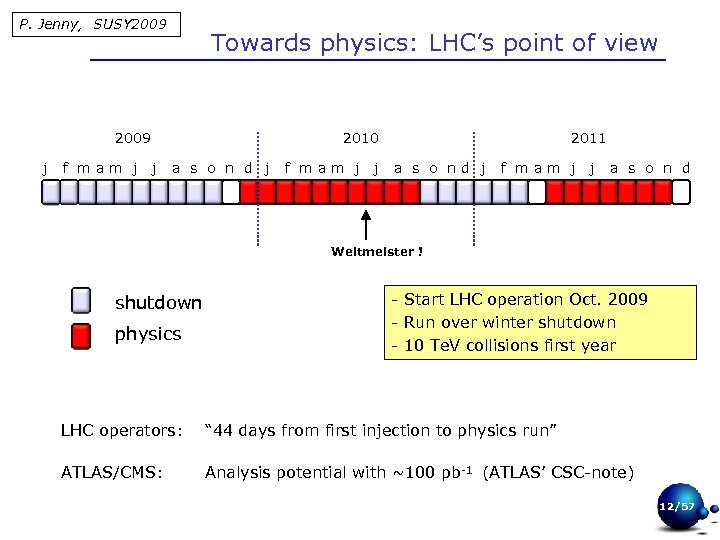 P. Jenny, SUSY 2009 Towards physics: LHC’s point of view 2009 j f mam j 2010 j a s o n d j f mam j j 2011 a s o nd j f mam j j a s o n d Weltmeister ! shutdown physics - Start LHC operation Oct. 2009 - Run over winter shutdown - 10 Te. V collisions first year LHC operators: “ 44 days from first injection to physics run” ATLAS/CMS: Analysis potential with ~100 pb-1 (ATLAS’ CSC-note) 12/57
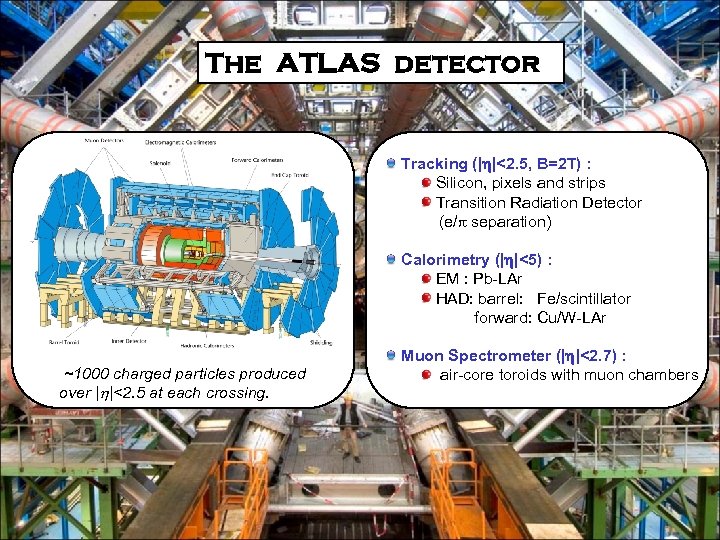 The ATLAS detector Tracking (| |<2. 5, B=2 T) : Silicon, pixels and strips Transition Radiation Detector (e/ separation) Calorimetry (| |<5) : EM : Pb-LAr HAD: barrel: Fe/scintillator forward: Cu/W-LAr ~1000 charged particles produced over | |<2. 5 at each crossing. Muon Spectrometer (| |<2. 7) : air-core toroids with muon chambers
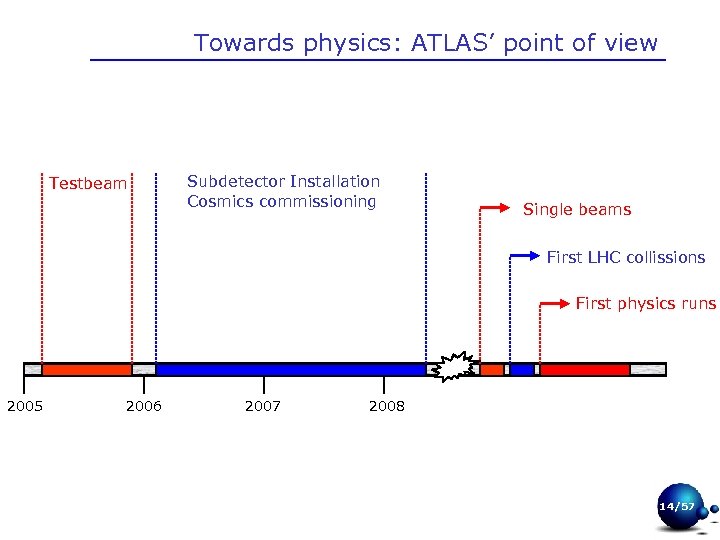 Towards physics: ATLAS’ point of view Testbeam Subdetector Installation Cosmics commissioning Single beams First LHC collissions First physics runs 2005 2006 2007 2008 14/57
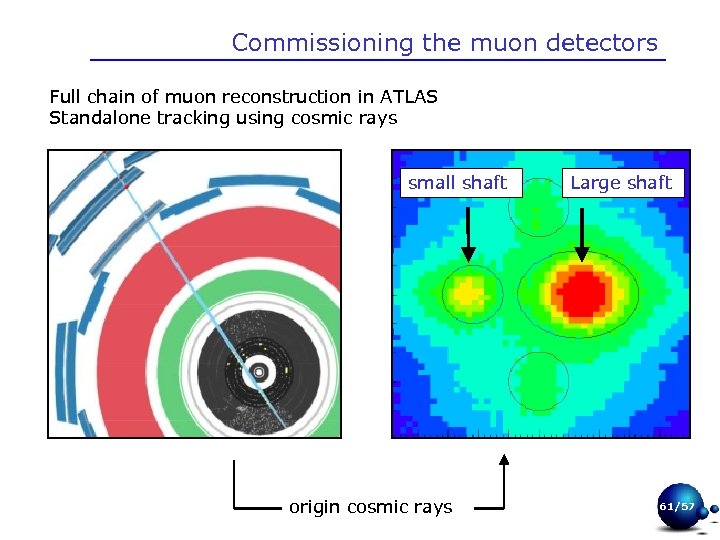
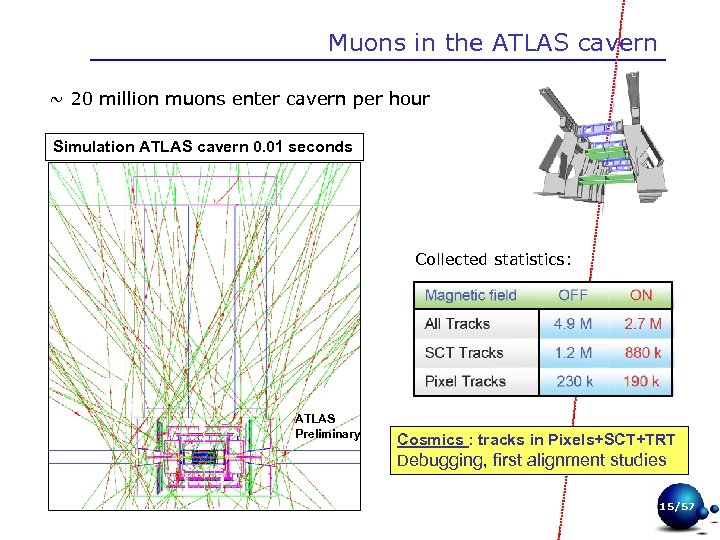 Muons in the ATLAS cavern ~ 20 million muons enter cavern per hour Simulation ATLAS cavern 0. 01 seconds Collected statistics: ATLAS Preliminary Cosmics : tracks in Pixels+SCT+TRT Debugging, first alignment studies 15/57
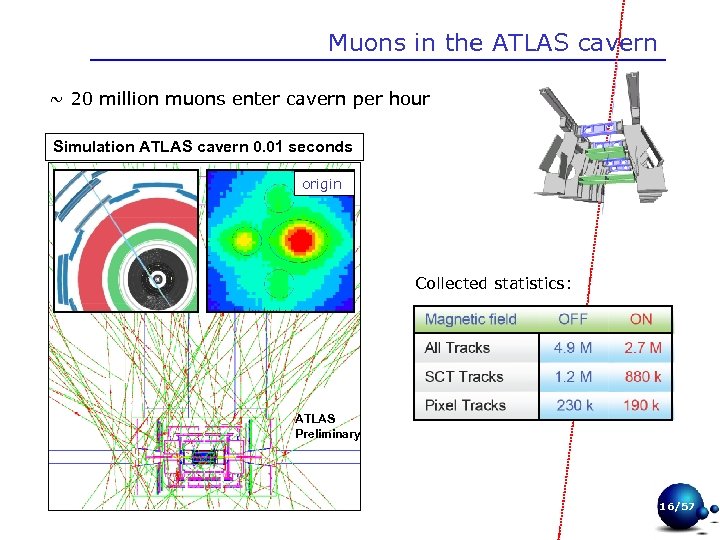 Muons in the ATLAS cavern ~ 20 million muons enter cavern per hour Simulation ATLAS cavern 0. 01 seconds origin Collected statistics: ATLAS Preliminary 16/57
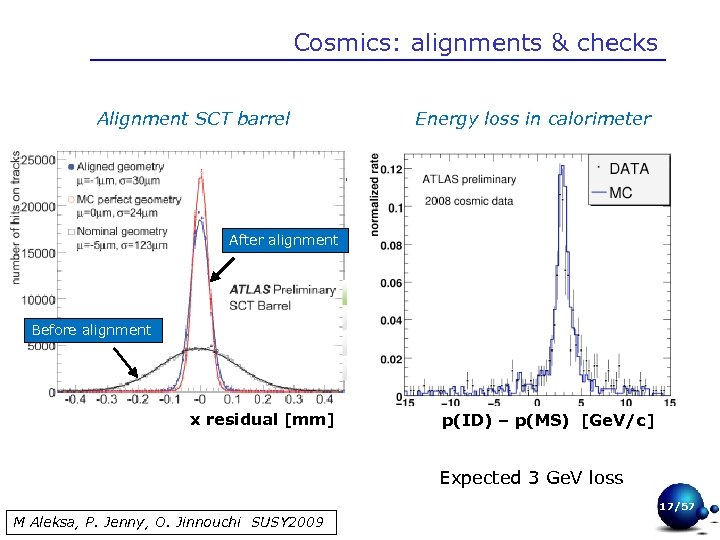 Cosmics: alignments & checks Alignment SCT barrel Energy loss in calorimeter After alignment Before alignment x residual [mm] p(ID) – p(MS) [Ge. V/c] Expected 3 Ge. V loss 17/57 M Aleksa, P. Jenny, O. Jinnouchi SUSY 2009
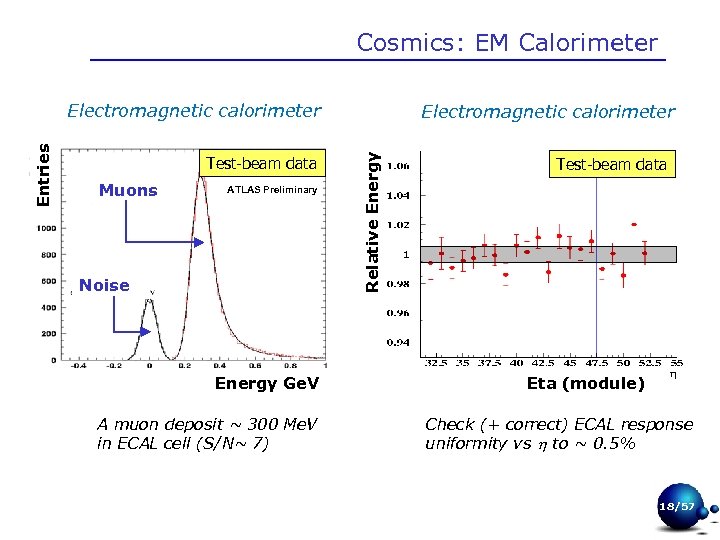 Cosmics: EM Calorimeter Test-beam data Muons ATLAS Preliminary Noise Energy Ge. V A muon deposit ~ 300 Me. V in ECAL cell (S/N~ 7) Electromagnetic calorimeter Relative Energy Entries Electromagnetic calorimeter Test-beam data Eta (module) Check (+ correct) ECAL response uniformity vs to ~ 0. 5% 18/57
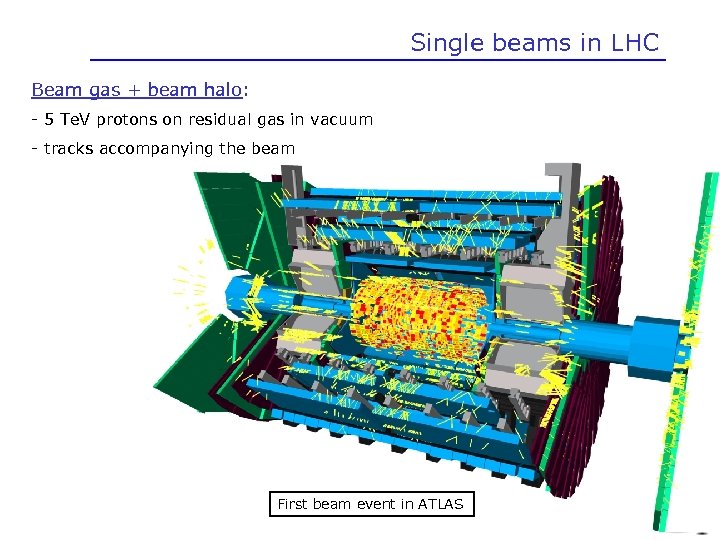 Single beams in LHC Beam gas + beam halo: - 5 Te. V protons on residual gas in vacuum - tracks accompanying the beam First beam event in ATLAS 19/57
![Complex SM Early tops SUSY Extra dimensions Early physics Now [4 slides] Calibrations -](https://present5.com/presentation/c7017691824053bd4c7db30dd0c1d6a1/image-20.jpg "Complex SM Early tops SUSY Extra dimensions Early physics Now [4 slides] Calibrations -") Complex SM Early tops SUSY Extra dimensions Early physics Now [4 slides] Calibrations - Planning road to new physics - Simple SM topologies (collecting pieces of the puzzle) Detector commissioning
Complex SM Early tops SUSY Extra dimensions Early physics Now [4 slides] Calibrations - Planning road to new physics - Simple SM topologies (collecting pieces of the puzzle) Detector commissioning
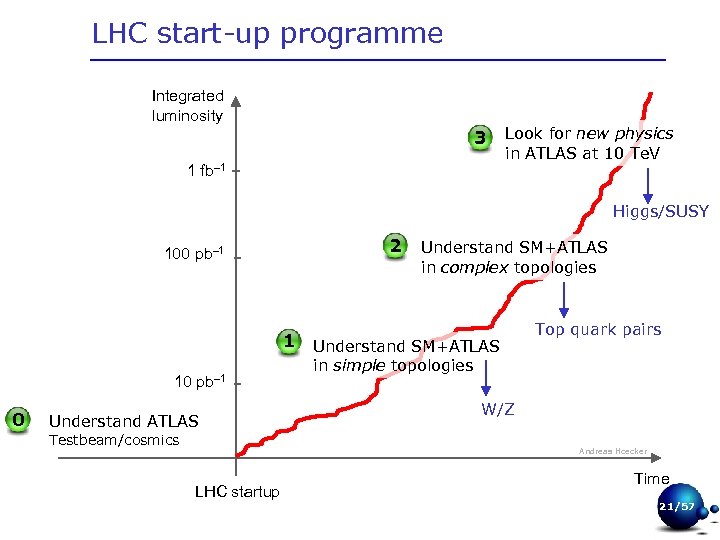 LHC start-up programme Integrated luminosity 3 1 fb– 1 Look for new physics in ATLAS at 10 Te. V Higgs/SUSY 100 pb– 1 2 Understand SM+ATLAS in complex topologies 1 Understand SM+ATLAS 10 0 pb– 1 Understand ATLAS Testbeam/cosmics Top quark pairs in simple topologies W/Z Andreas Hoecker LHC startup Time 21/57
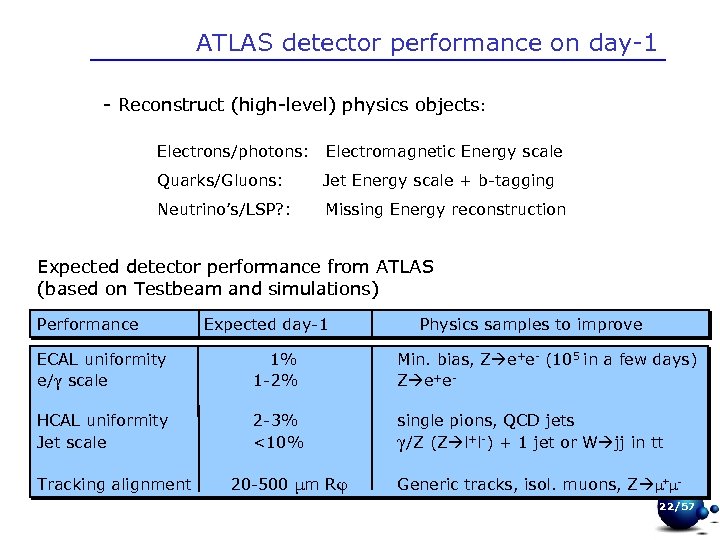 ATLAS detector performance on day-1 - Reconstruct (high-level) physics objects: Electrons/photons: Electromagnetic Energy scale Quarks/Gluons: Jet Energy scale + b-tagging Neutrino’s/LSP? : Missing Energy reconstruction Expected detector performance from ATLAS (based on Testbeam and simulations) Performance Expected day-1 Physics samples to improve ECAL uniformity e/γ scale 1% 1 -2% Min. bias, Z e+e- (105 in a few days) Z e+e- HCAL uniformity Jet scale 2 -3% <10% single pions, QCD jets γ/Z (Z l+l-) + 1 jet or W jj in tt Tracking alignment 20 -500 μm Rφ Generic tracks, isol. muons, Z μ+μ 22/57
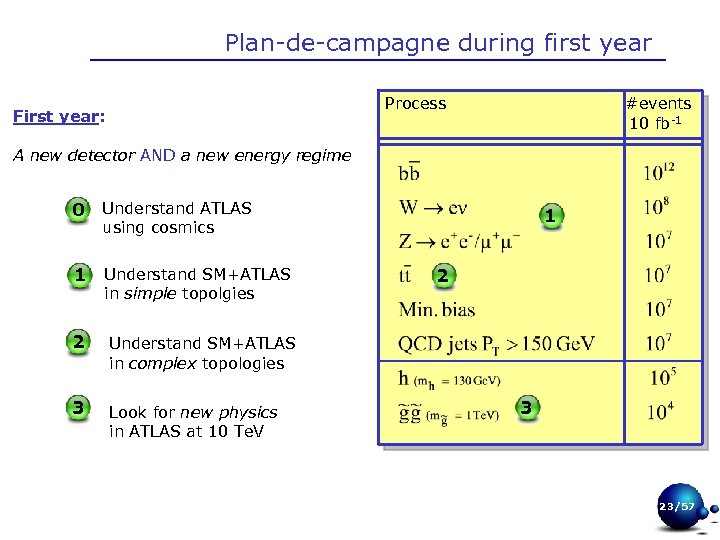 Plan-de-campagne during first year Process First year: #events 10 fb-1 A new detector AND a new energy regime 0 Understand ATLAS 1 using cosmics 1 Understand SM+ATLAS in simple topolgies 2 Understand SM+ATLAS in complex topologies 3 Look for new physics in ATLAS at 10 Te. V 2 3 23/57
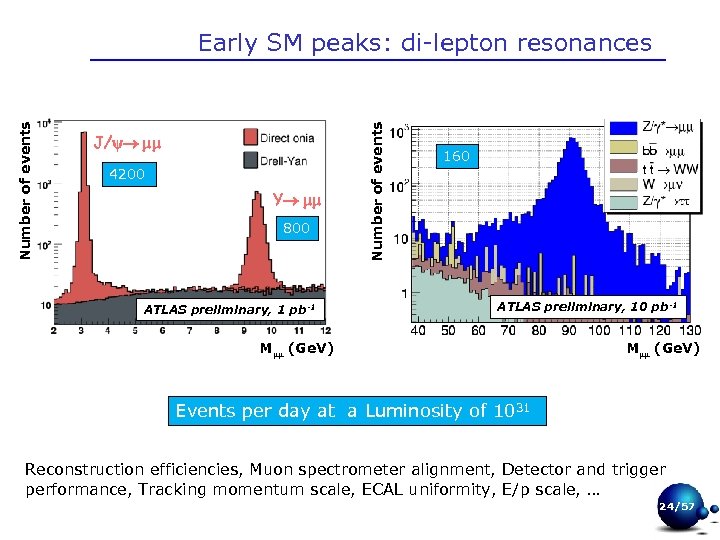 J/ 4200 Y 800 ATLAS preliminary, 1 pb-1 Number of events Early SM peaks: di-lepton resonances 160 ATLAS preliminary, 10 pb-1 Mμμ (Ge. V) Events per day at a Luminosity of 1031 Reconstruction efficiencies, Muon spectrometer alignment, Detector and trigger performance, Tracking momentum scale, ECAL uniformity, E/p scale, … 24/57
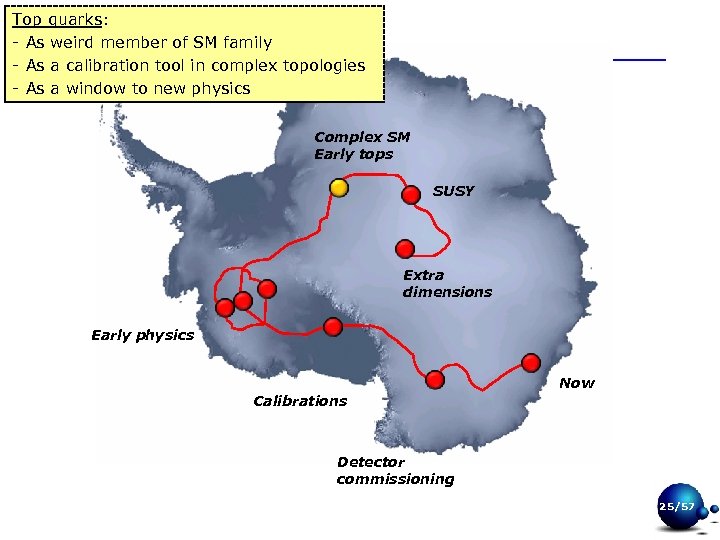 Top quarks: - As weird member of SM family - As a calibration tool in complex topologies - As a window to new physics Complex SM Early tops SUSY Extra dimensions Early physics Now Calibrations Detector commissioning 25/57
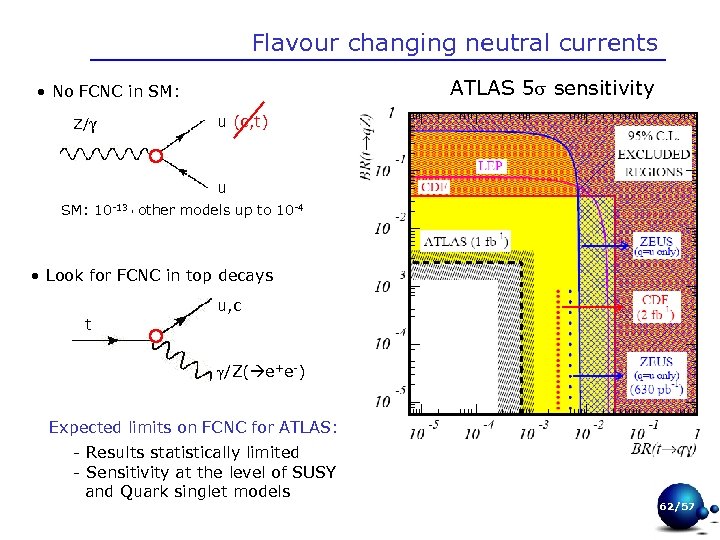
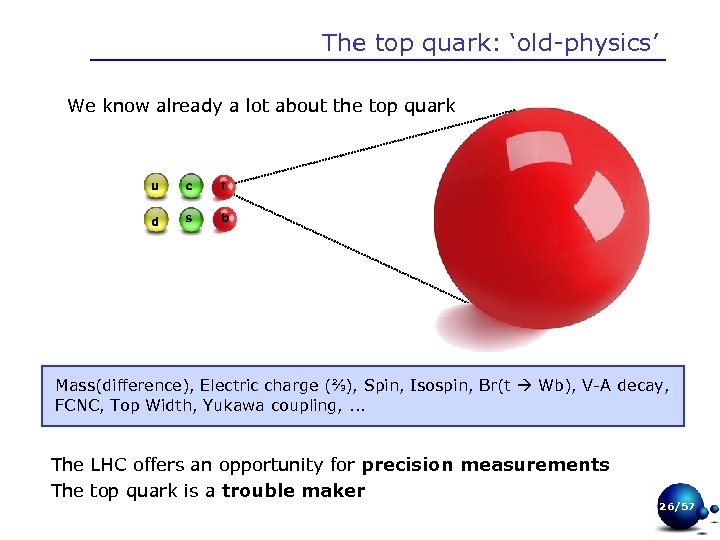 The top quark: ‘old-physics’ We know already a lot about the top quark u c t d s b Mass(difference), Electric charge (⅔), Spin, Isospin, Br(t Wb), V-A decay, FCNC, Top Width, Yukawa coupling, . . . The LHC offers an opportunity for precision measurements The top quark is a trouble maker 26/57
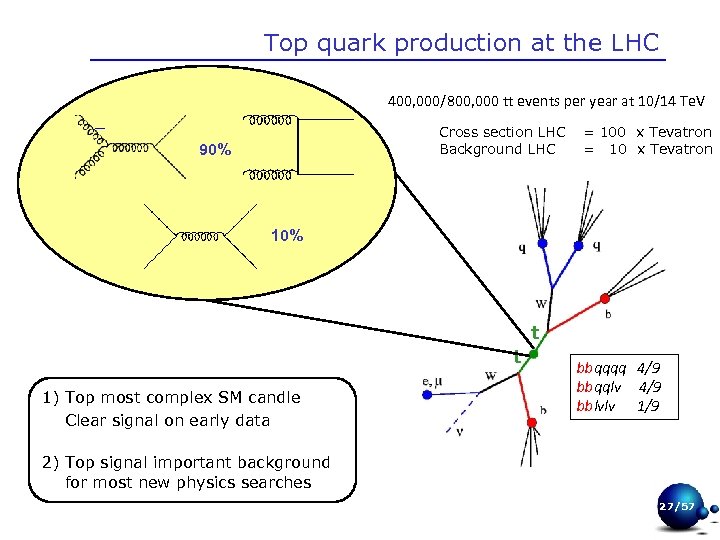 Top quark production at the LHC 400, 000/800, 000 tt events per year at 10/14 Te. V Cross section LHC Background LHC 90% = 100 x Tevatron = 10 x Tevatron 10% t t 1) Top most complex SM candle Clear signal on early data bbqqqq 4/9 bbqqlv 4/9 bblvlv 1/9 2) Top signal important background for most new physics searches 27/57
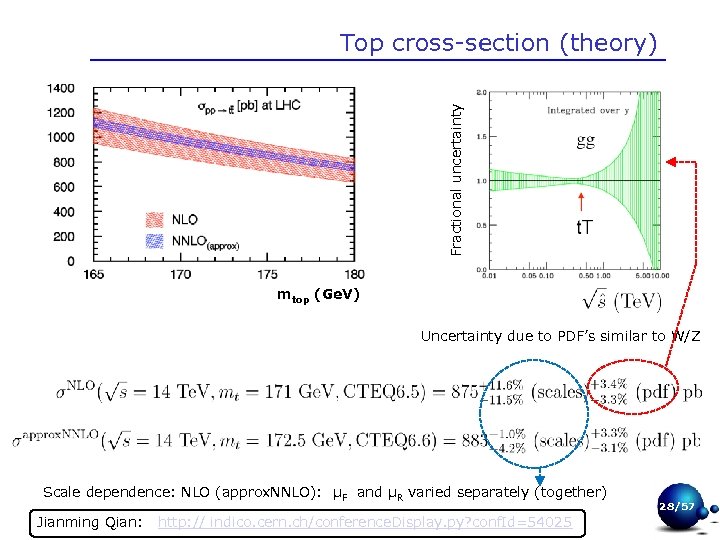 Fractional uncertainty Top cross-section (theory) mtop (Ge. V) Uncertainty due to PDF’s similar to W/Z Scale dependence: NLO (approx. NNLO): μF and μR varied separately (together) Jianming Qian: http: // indico. cern. ch/conference. Display. py? conf. Id=54025 28/57
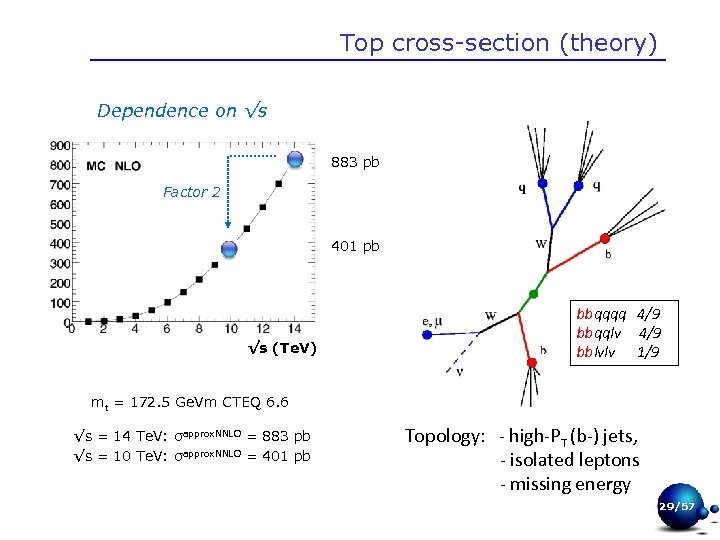 Top cross-section (theory) Dependence on √s 883 pb Factor 2 401 pb √s (Te. V) bbqqqq 4/9 bbqqlv 4/9 bblvlv 1/9 mt = 172. 5 Ge. Vm CTEQ 6. 6 √s = 14 Te. V: σapprox. NNLO = 883 pb √s = 10 Te. V: σapprox. NNLO = 401 pb Topology: - high-PT (b-) jets, - isolated leptons - missing energy 29/57
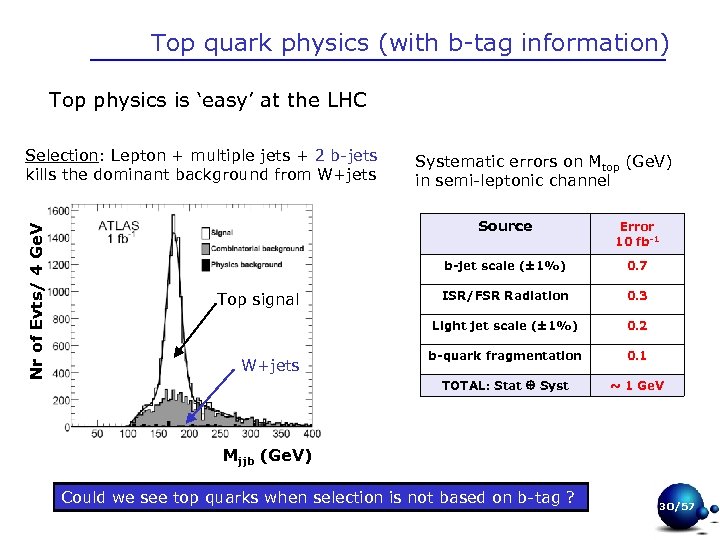 Top quark physics (with b-tag information) Top physics is ‘easy’ at the LHC Nr of Evts/ 4 Ge. V Selection: Lepton + multiple jets + 2 b-jets kills the dominant background from W+jets Systematic errors on Mtop (Ge. V) in semi-leptonic channel Source b-jet scale (± 1%) ISR/FSR Radiation 0. 3 0. 2 b-quark fragmentation 0. 1 TOTAL: Stat Syst W+jets 0. 7 Light jet scale (± 1%) Top signal Error 10 fb-1 ~ 1 Ge. V Mjjb (Ge. V) Could we see top quarks when selection is not based on b-tag ? 30/57
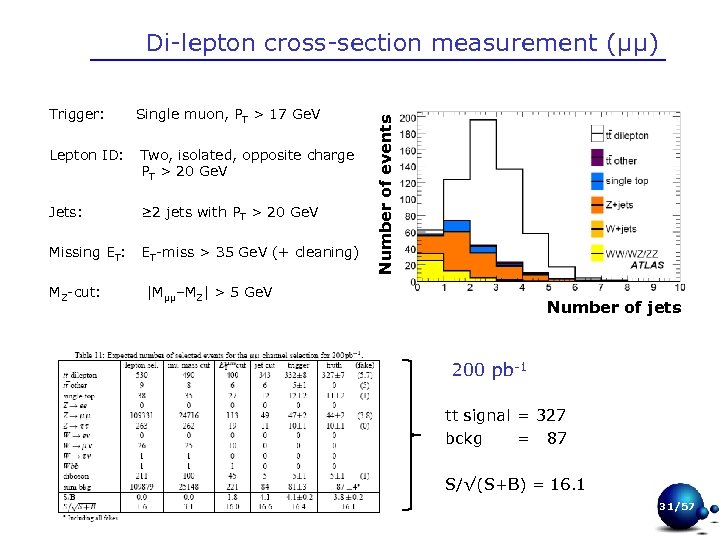 Trigger: Single muon, PT > 17 Ge. V Lepton ID: Two, isolated, opposite charge PT > 20 Ge. V Jets: ≥ 2 jets with PT > 20 Ge. V Missing ET: ET-miss > 35 Ge. V (+ cleaning) MZ-cut: Number of events Di-lepton cross-section measurement (μμ) |Mμμ–MZ| > 5 Ge. V Number of jets 200 pb-1 tt signal = 327 bckg = 87 S/√(S+B) = 16. 1 31/57
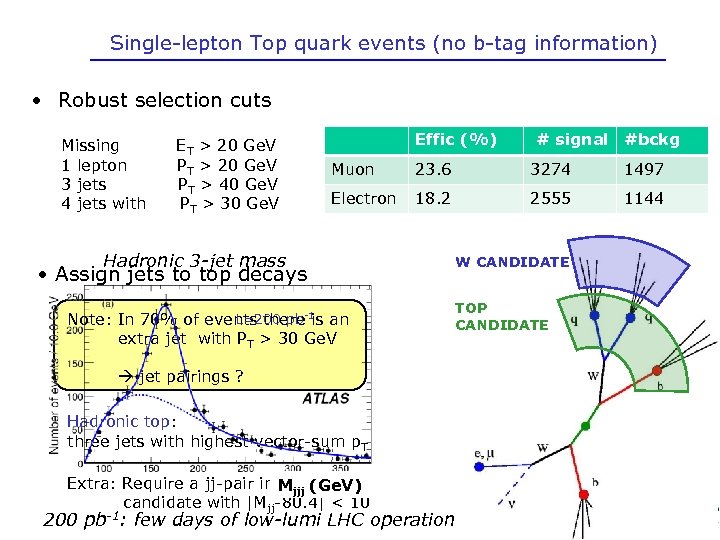 Single-lepton Top quark events (no b-tag information) • Robust selection cuts Missing 1 lepton 3 jets 4 jets with ET > 20 Ge. V PT > 40 Ge. V PT > 30 Ge. V Effic (%) # signal #bckg Muon 23. 6 3274 1497 Electron 18. 2 2555 1144 Hadronic 3 -jet mass • Assign jets to top decays L=200 pb Note: In 70% of events there-1 is an extra jet with PT > 30 Ge. V W CANDIDATE TOP CANDIDATE jet pairings ? Hadronic top: three jets with highest vector-sum p. T Extra: Require a jj-pair in Mjjj (Ge. V) top quark candidate with |Mjj-80. 4| < 10 200 pb-1: few days of low-lumi LHC operation 32/57
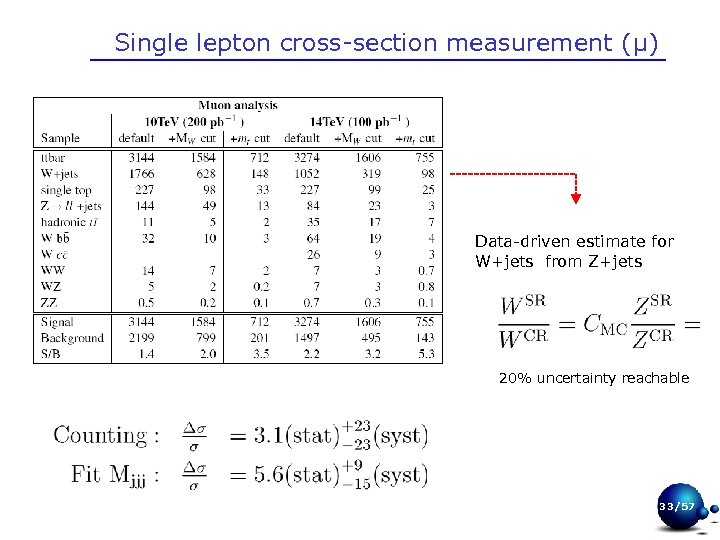 Single lepton cross-section measurement (μ) Data-driven estimate for W+jets from Z+jets 20% uncertainty reachable 33/57
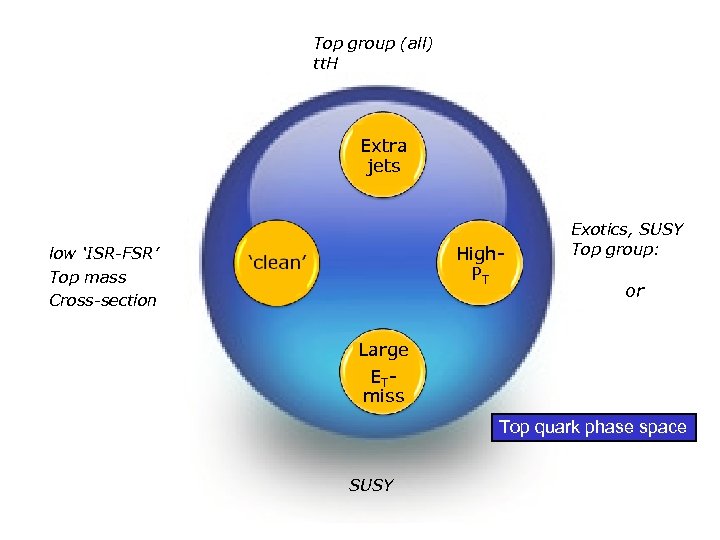
 Top phase space Top quark phase space Top precision measurements Calibrating ATLAS in multi-jet events 34/57
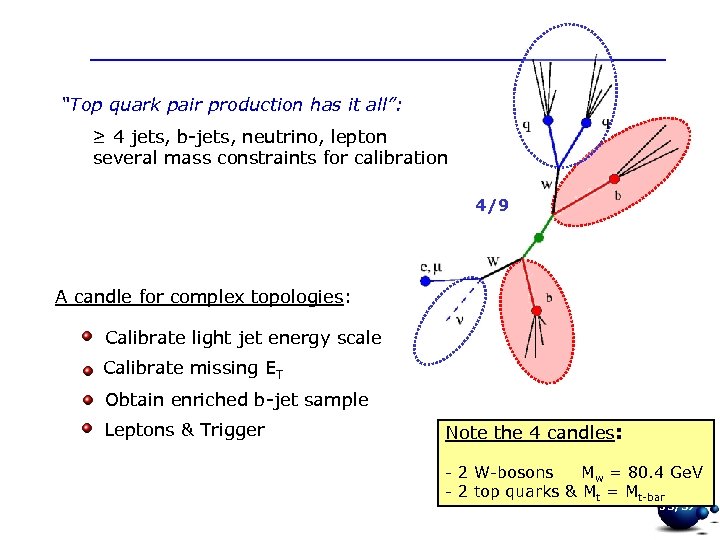 Top physics at the LHC “Top quark pair production has it all”: ≥ 4 jets, b-jets, neutrino, lepton several mass constraints for calibration 4/9 A candle for complex topologies: Calibrate light jet energy scale Calibrate missing ET Obtain enriched b-jet sample Leptons & Trigger Note the 4 candles: - 2 W-bosons Mw = 80. 4 Ge. V - 2 top quarks & Mt = Mt-bar 35/57
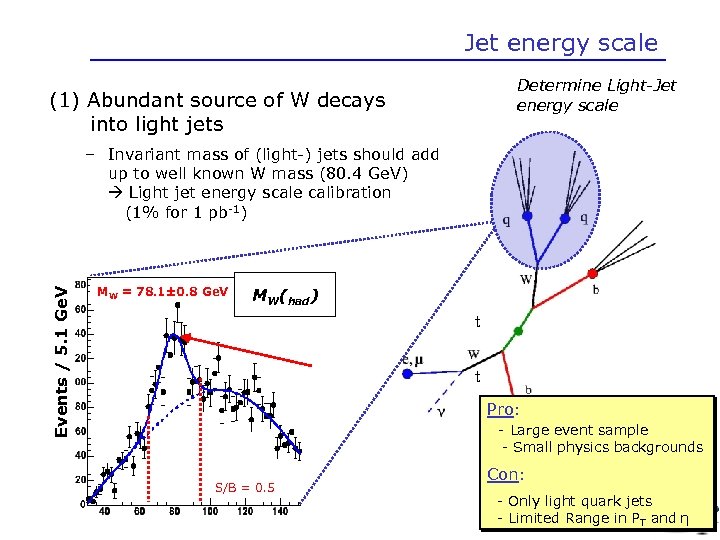 Jet energy scale Determine Light-Jet energy scale (1) Abundant source of W decays into light jets Events / 5. 1 Ge. V – Invariant mass of (light-) jets should add up to well known W mass (80. 4 Ge. V) Light jet energy scale calibration (1% for 1 pb-1) MW = 78. 1± 0. 8 Ge. V MW(had) t t Pro: - Large event sample - Small physics backgrounds S/B = 0. 5 Con: - Only light quark jets 36/57 - Limited Range in PT and η
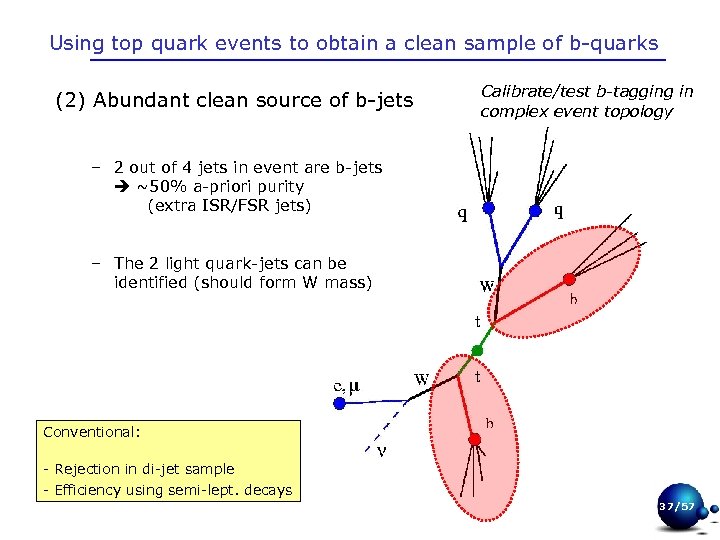 Using top quark events to obtain a clean sample of b-quarks Calibrate/test b-tagging in complex event topology (2) Abundant clean source of b-jets – 2 out of 4 jets in event are b-jets ~50% a-priori purity (extra ISR/FSR jets) – The 2 light quark-jets can be identified (should form W mass) t t Conventional: - Rejection in di-jet sample - Efficiency using semi-lept. decays 37/57
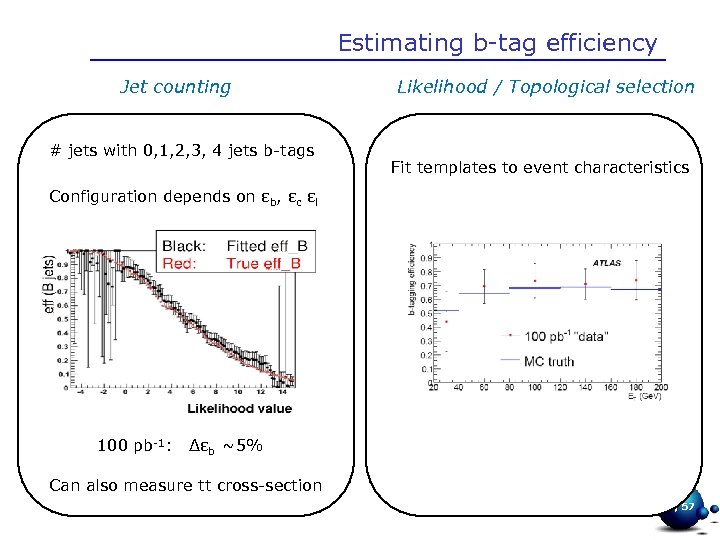 Estimating b-tag efficiency Jet counting # jets with 0, 1, 2, 3, 4 jets b-tags Likelihood / Topological selection Fit templates to event characteristics Configuration depends on εb, εc εl 100 pb-1: Δεb ~5% Can also measure tt cross-section 38/57
 Top group (all) tt. H Extra jets High. PT low ‘ISR-FSR’ Top mass Cross-section Exotics, SUSY Top group: or Large ET miss Top quark phase space SUSY
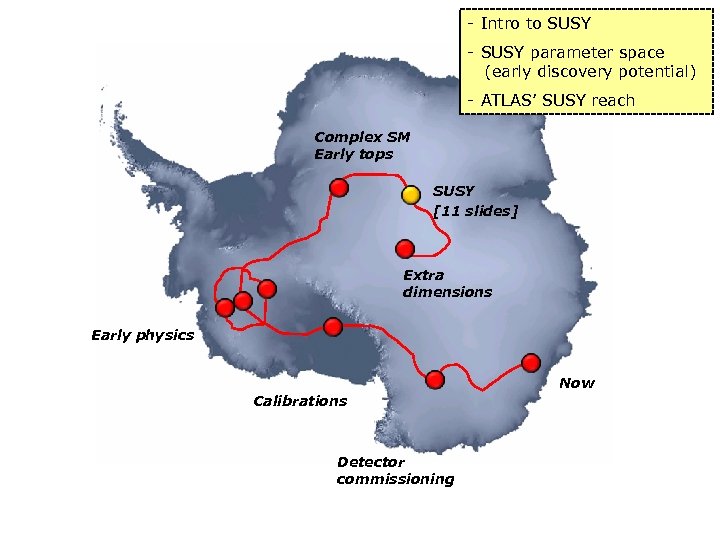 - Intro to SUSY - SUSY parameter space (early discovery potential) - ATLAS’ SUSY reach Complex SM Early tops SUSY [11 slides] Extra dimensions Early physics Now Calibrations Detector commissioning
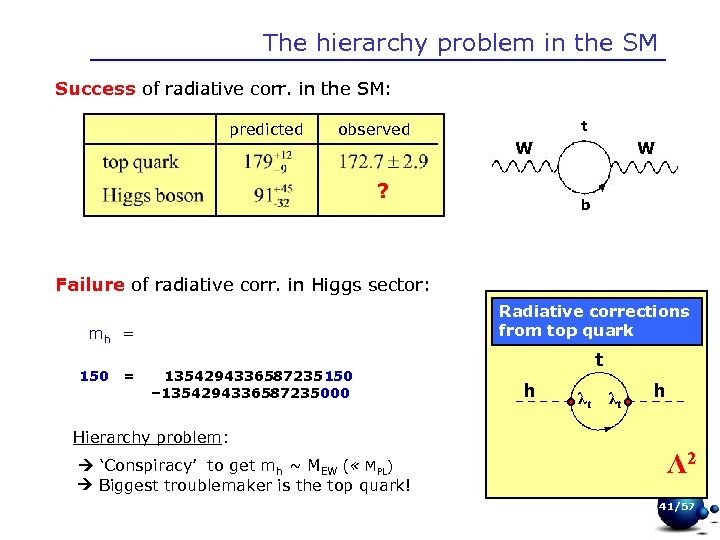 The hierarchyin the SM The problem Success of radiative corr. in the SM: predicted observed t W ? W b Failure of radiative corr. in Higgs sector: Radiative corrections from top quark mh = 150 = 1354294336587235150 – 1354294336587235000 t h λt λt h Hierarchy problem: ‘Conspiracy’ to get mh ~ MEW ( « MPL) Biggest troublemaker is the top quark! Λ 2 41/57
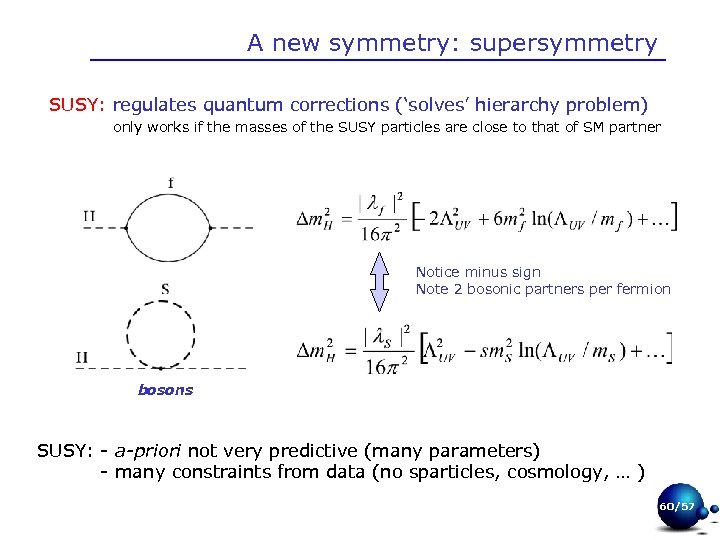
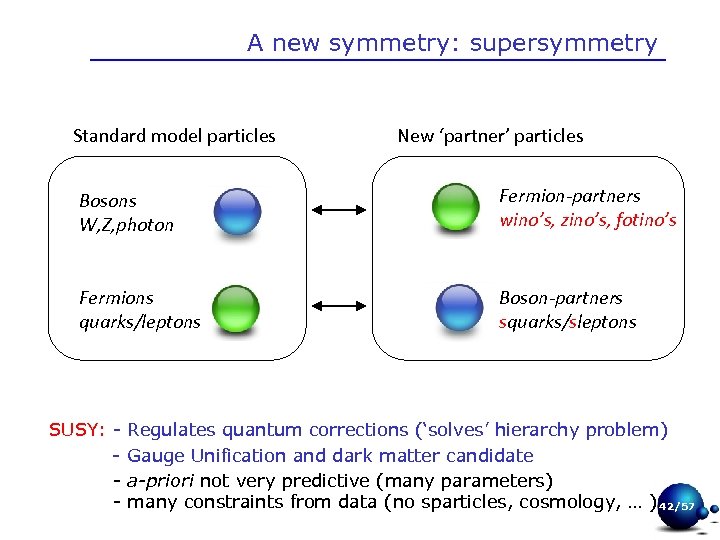 A new symmetry: supersymmetry Standard model particles New ‘partner’ particles Bosons W, Z, photon Fermion-partners wino’s, zino’s, fotino’s Fermions quarks/leptons Boson-partners squarks/sleptons SUSY: - Regulates quantum corrections (‘solves’ hierarchy problem) Gauge Unification and dark matter candidate a-priori not very predictive (many parameters) many constraints from data (no sparticles, cosmology, … ) 42/57
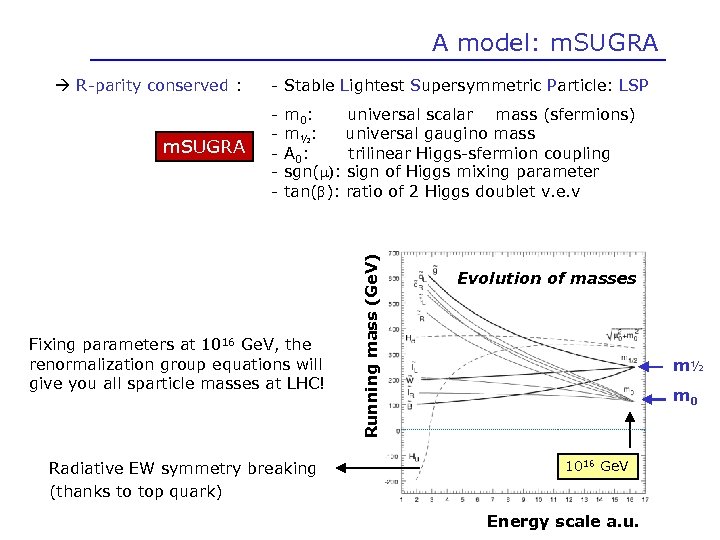 A model: m. SUGRA - Stable Lightest Supersymmetric Particle: LSP - m 0 : universal scalar mass (sfermions) m½: universal gaugino mass A 0 : trilinear Higgs-sfermion coupling sgn(μ): sign of Higgs mixing parameter tan(β): ratio of 2 Higgs doublet v. e. v Fixing parameters at 1016 Ge. V, the renormalization group equations will give you all sparticle masses at LHC! Radiative EW symmetry breaking (thanks to top quark) Running mass (Ge. V) R-parity conserved : Evolution of masses m½ m 0 1016 Ge. V Energy scale a. u. 43/57
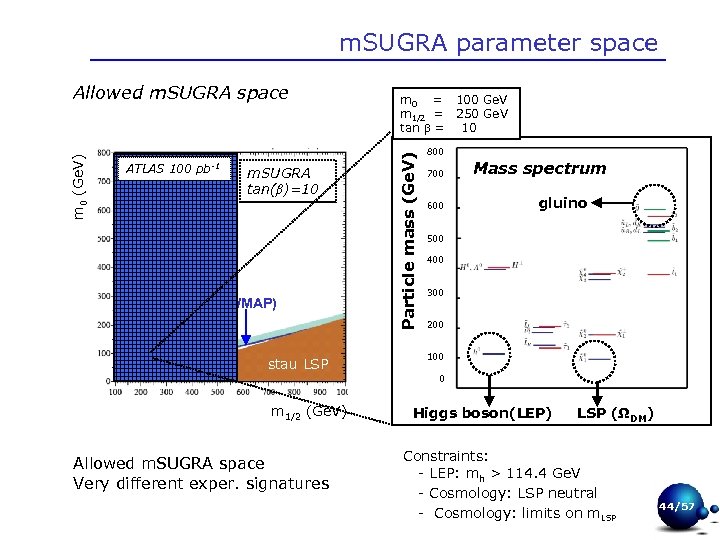 m. SUGRA parameter space ATLAS 100 pb-1 m. SUGRA tan(β)=10 g-2 (WMAP) stau LSP m 0 = 100 Ge. V m 1/2 = 250 Ge. V tan = 10 Particle mass (Ge. V) m 0 (Ge. V) Allowed m. SUGRA space 800 700 600 Mass spectrum gluino 500 400 300 200 100 0 m 1/2 (Ge. V) Allowed m. SUGRA space Very different exper. signatures Higgs boson(LEP) LSP (ΩDM) Constraints: - LEP: mh > 114. 4 Ge. V - Cosmology: LSP neutral - Cosmology: limits on m. LSP 44/57
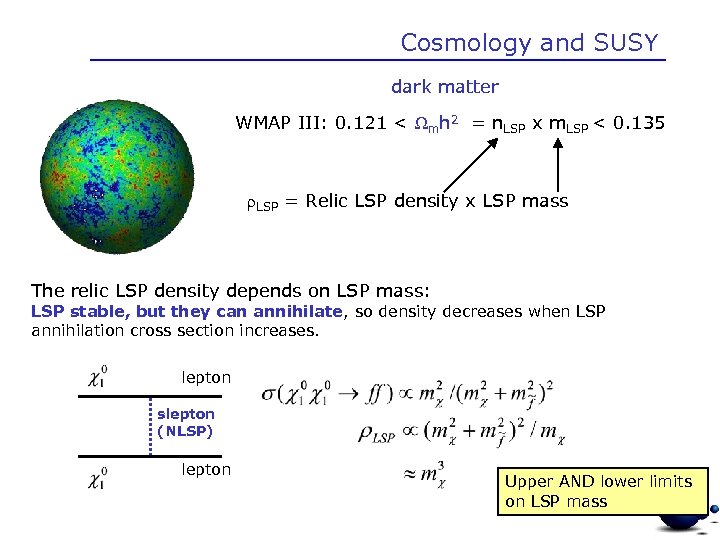 Cosmology and SUSY dark matter WMAP III: 0. 121 < Ωmh 2 = n. LSP x m. LSP < 0. 135 ρLSP = Relic LSP density x LSP mass The relic LSP density depends on LSP mass: LSP stable, but they can annihilate, so density decreases when LSP annihilation cross section increases. lepton slepton (NLSP) lepton Upper AND lower limits on LSP mass 45/57
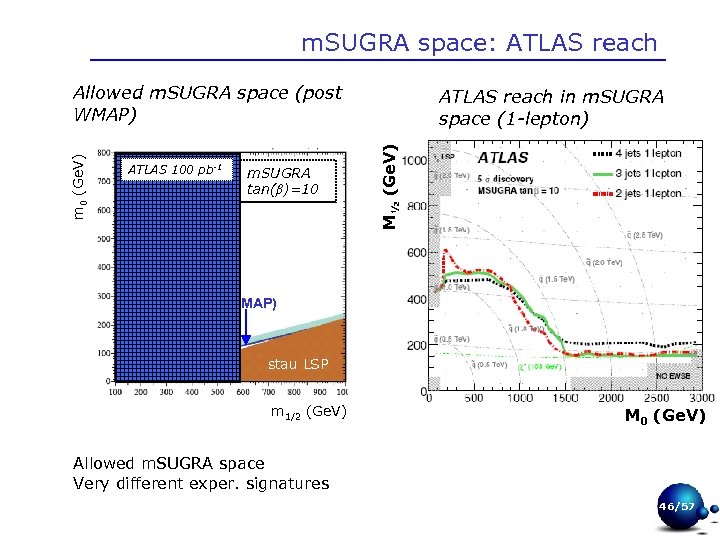 m. SUGRA space: ATLAS reach ATLAS 100 pb-1 m. SUGRA tan(β)=10 ATLAS reach in m. SUGRA space (1 -lepton) M½ (Ge. V) m 0 (Ge. V) Allowed m. SUGRA space (post WMAP) g-2 (WMAP) stau LSP m 1/2 (Ge. V) M 0 (Ge. V) Allowed m. SUGRA space Very different exper. signatures 46/57
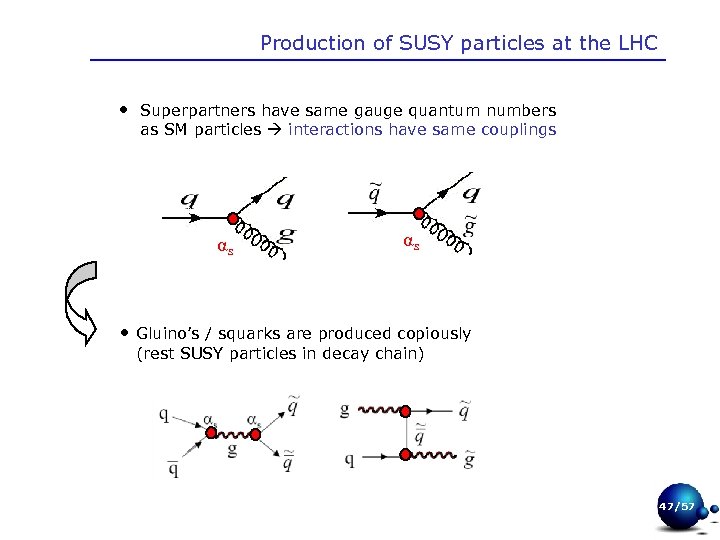 Production of SUSY particles at the LHC • Superpartners have same gauge quantum numbers as SM particles interactions have same couplings αS αS • Gluino’s / squarks are produced copiously (rest SUSY particles in decay chain) 47/57
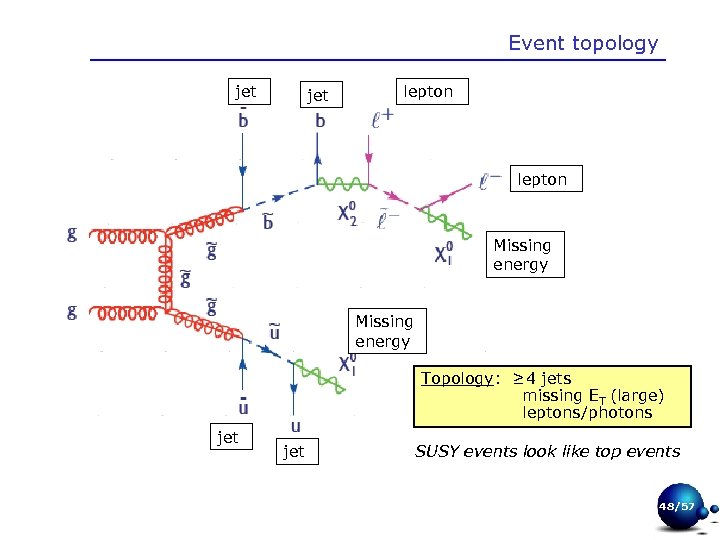 Event topology jet lepton Missing energy Topology: ≥ 4 jets missing ET (large) leptons/photons jet SUSY events look like top events 48/57
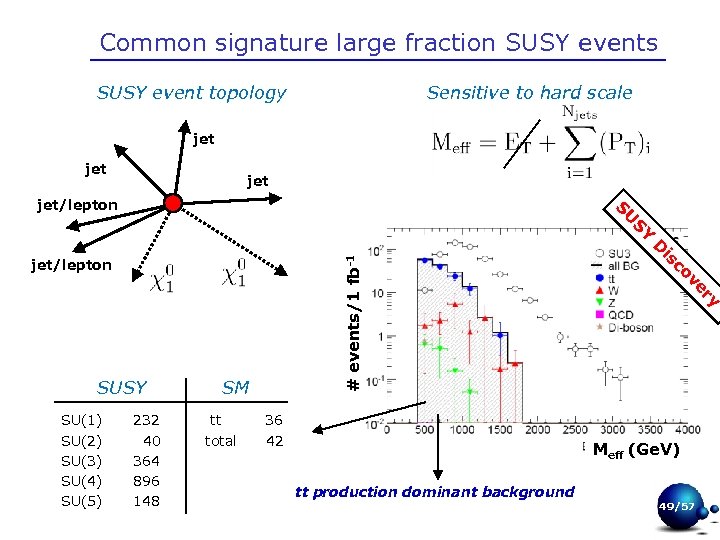 Common signature large First to discover SUSY LHC day 2: fraction SUSY events SUSY event topology Sensitive to hard scale jet jet U S jet/lepton 36 42 ry tt total ve 232 40 364 896 148 co SU(1) SU(2) SU(3) SU(4) SU(5) SM is SUSY D # events/1 fb-1 Y S jet/lepton Meff (Ge. V) tt production dominant background 49/57
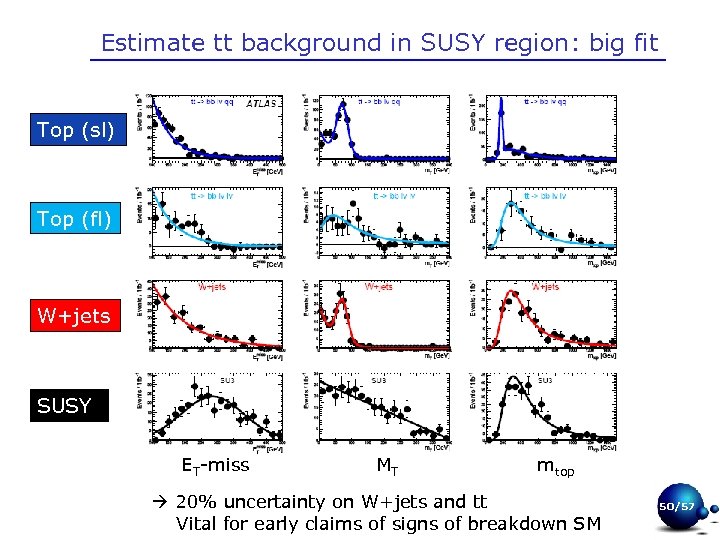 Estimate tt background in SUSY region: big fit Top (sl) Top (fl) W+jets SUSY ET-miss MT mtop 20% uncertainty on W+jets and tt Vital for early claims of signs of breakdown SM 50/57
![Complex SM Early tops SUSY Extra dimensions [6 slides] Early physics Now Calibrations -](https://present5.com/presentation/c7017691824053bd4c7db30dd0c1d6a1/image-51.jpg "Complex SM Early tops SUSY Extra dimensions [6 slides] Early physics Now Calibrations -") Complex SM Early tops SUSY Extra dimensions [6 slides] Early physics Now Calibrations - New physics in the top sample (focus on resonances/high-PT) - 2 -slide intro to extra dimensions Detector commissioning
Complex SM Early tops SUSY Extra dimensions [6 slides] Early physics Now Calibrations - New physics in the top sample (focus on resonances/high-PT) - 2 -slide intro to extra dimensions Detector commissioning
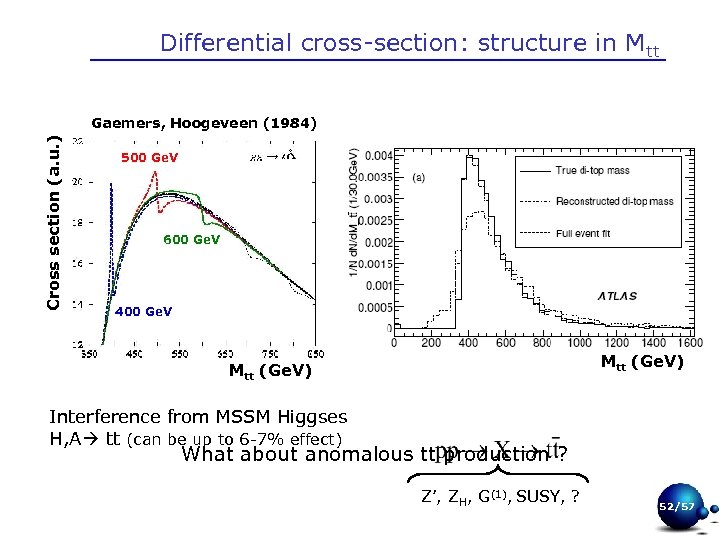 Differential cross-section: structure in Mtt Cross section (a. u. ) Gaemers, Hoogeveen (1984) 500 Ge. V 600 Ge. V 400 Ge. V Mtt (Ge. V) Interference from MSSM Higgses H, A tt (can be up to 6 -7% effect) What about anomalous tt production ? Z’, ZH, G(1), SUSY, ? 52/57
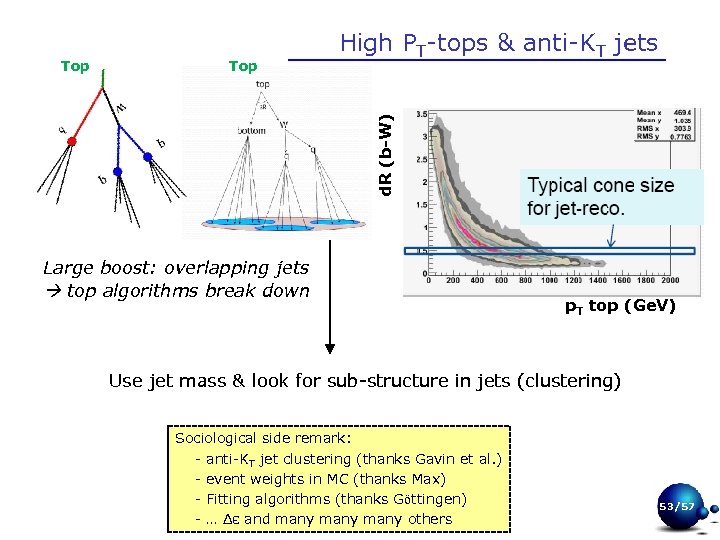 Top d. R (b-W) Top High PT-tops & anti-KT jets Large boost: overlapping jets top algorithms break down p. T top (Ge. V) Use jet mass & look for sub-structure in jets (clustering) Sociological side remark: - anti-KT jet clustering (thanks Gavin et al. ) - event weights in MC (thanks Max) - Fitting algorithms (thanks Göttingen) - … Δε and many others 53/57
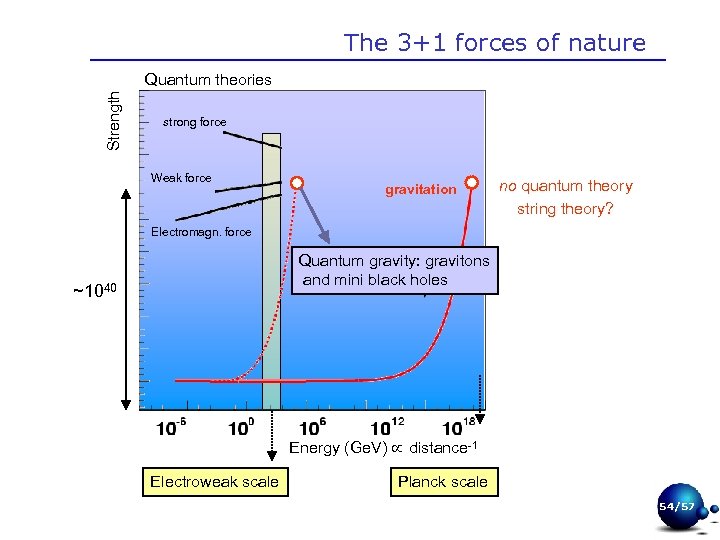 The 3+1 forces of nature Strength Quantum theories strong force Weak force gravitation no quantum theory string theory? Electromagn. force Quantum gravity: gravitons and mini black holes ~1040 Energy (Ge. V) distance-1 Electroweak scale Planck scale 54/57
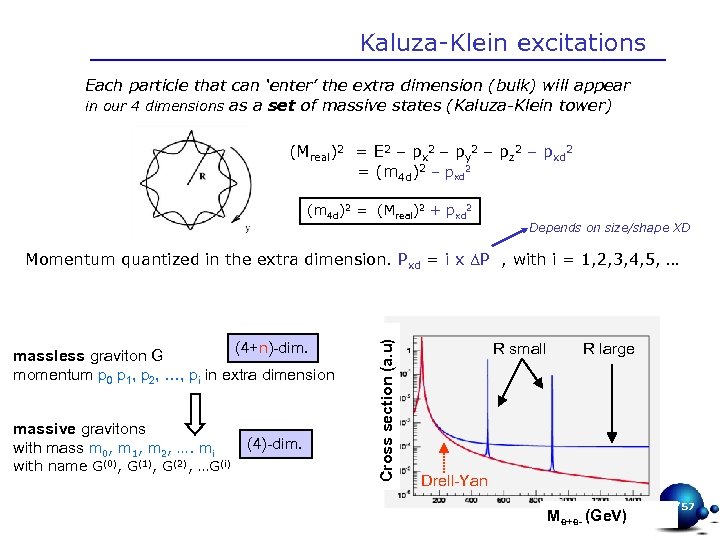 Kaluza-Klein excitations Each particle that can ‘enter’ the extra dimension (bulk) will appear in our 4 dimensions as a set of massive states (Kaluza-Klein tower) (Mreal)2 = E 2 – px 2 – py 2 – pz 2 – pxd 2 = (m 4 d)2 – pxd 2 (m 4 d)2 = (Mreal)2 + pxd 2 Depends on size/shape XD (4+n)-dim. massless graviton G momentum p 0 p 1, p 2, …, pi in extra dimension massive gravitons with mass m 0, m 1, m 2, …. mi with name G(0), G(1), G(2), …G(i) (4)-dim. Cross section (a. u) Momentum quantized in the extra dimension. Pxd = i x ΔP , with i = 1, 2, 3, 4, 5, … R small R large Drell-Yan Me+e- (Ge. V) 55/57
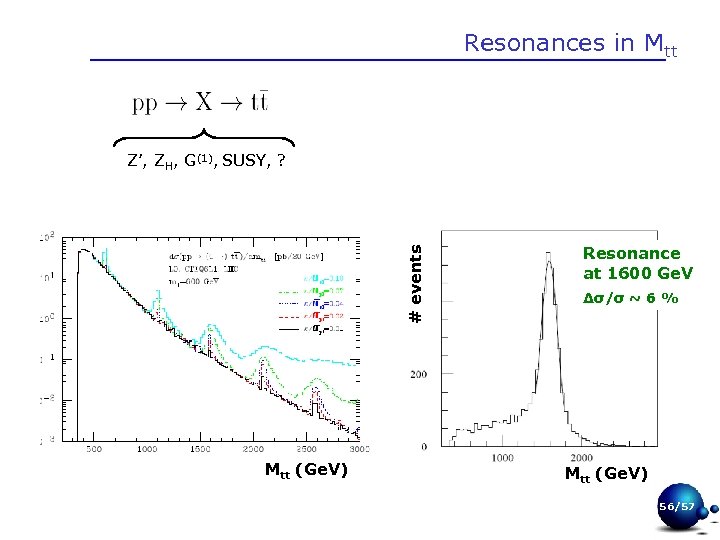 Resonances in Mtt # events Z’, ZH, G(1), SUSY, ? Resonances in Mtt (Ge. V) Resonance at 1600 Ge. V Δσ/σ ~ 6 % Mtt (Ge. V) 56/57
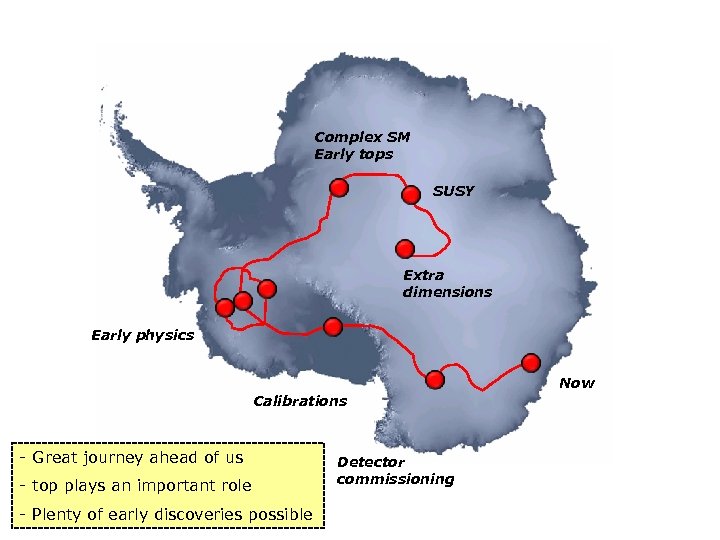 Complex SM Early tops SUSY Extra dimensions Early physics Now Calibrations - Great journey ahead of us - top plays an important role - Plenty of early discoveries possible Detector commissioning
 Backup slides
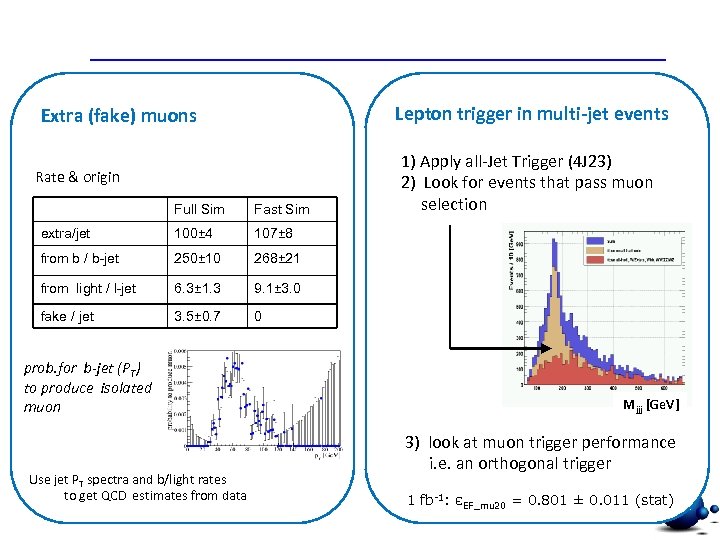 Lepton trigger in multi-jet events Extra (fake) muons Rate & origin Full Sim Fast Sim extra/jet 100± 4 107± 8 from b / b-jet 250± 10 268± 21 from light / l-jet 6. 3± 1. 3 • v 3. 5± 0. 7 1) Apply all-Jet Trigger (4 J 23) 2) Look for events that pass muon selection 9. 1± 3. 0 fake / jet prob. for b-jet (PT) to produce isolated muon Use jet PT spectra and b/light rates to get QCD estimates from data 0 Mjjj [Ge. V] 3) look at muon trigger performance i. e. an orthogonal trigger 1 fb-1: εEF_mu 20 = 0. 801 ± 0. 011 (stat) 59/57
 A new symmetry: supersymmetry SUSY: regulates quantum corrections (‘solves’ hierarchy problem) only works if the masses of the SUSY particles are close to that of SM partner Notice minus sign Note 2 bosonic partners per fermion bosons SUSY: - a-priori not very predictive (many parameters) - many constraints from data (no sparticles, cosmology, … ) 60/57
 Commissioning the muon detectors Full chain of muon reconstruction in ATLAS Standalone tracking using cosmic rays small shaft origin cosmic rays Large shaft 61/57
 Flavour changing neutral currents ATLAS 5 s sensitivity • No FCNC in SM: Z/γ u (c, t) u SM: 10 -13 , other models up to 10 -4 • Look for FCNC in top decays t u, c γ/Z( e+e-) Expected limits on FCNC for ATLAS: - Results statistically limited - Sensitivity at the level of SUSY and Quark singlet models 62/57