


 Скачать презентацию Preparing for first physics at the LHC Ivo
2d26551910cef17f4256a914be04b871.ppt
- Количество слайдов: 64
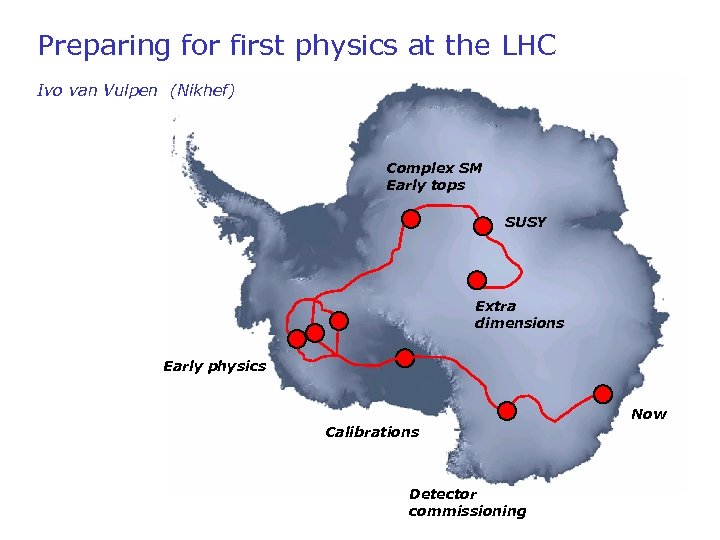 Preparing for first physics at the LHC Ivo van Vulpen (Nikhef) Complex SM Early tops SUSY Extra dimensions Early physics Now Calibrations Detector commissioning
 Athens: ‘the place where I bought my first house’ New house
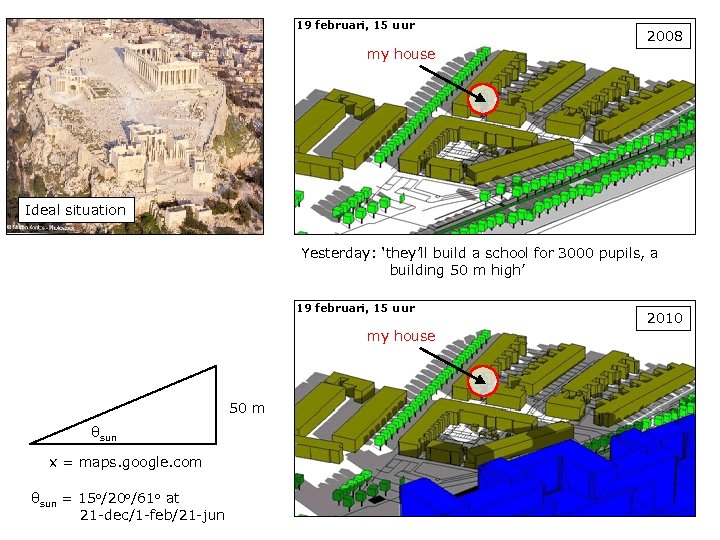 2008 my house Ideal situation Yesterday: ‘they’ll build a school for 3000 pupils, a building 50 m high’ 2010 my house 50 m θsun x = maps. google. com θsun = 15 o/20 o/61 o at 21 -dec/1 -feb/21 -jun
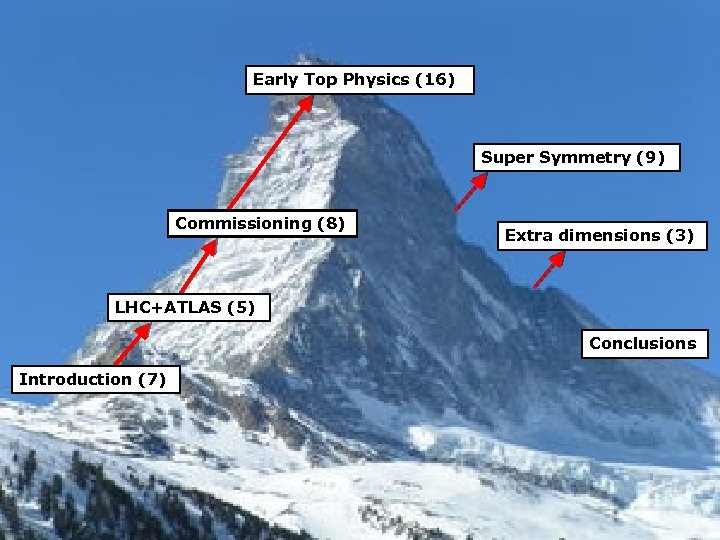 Early Top Physics (16) Super Symmetry (9) Commissioning (8) Extra dimensions (3) LHC+ATLAS (5) Conclusions Introduction (7)
 Early Top Physics (16) Super Symmetry (9) Commissioning (8) Extra dimensions (3) LHC+ATLAS (5) Conclusions Introduction (7) - The SM -. . . and what’s wrong it
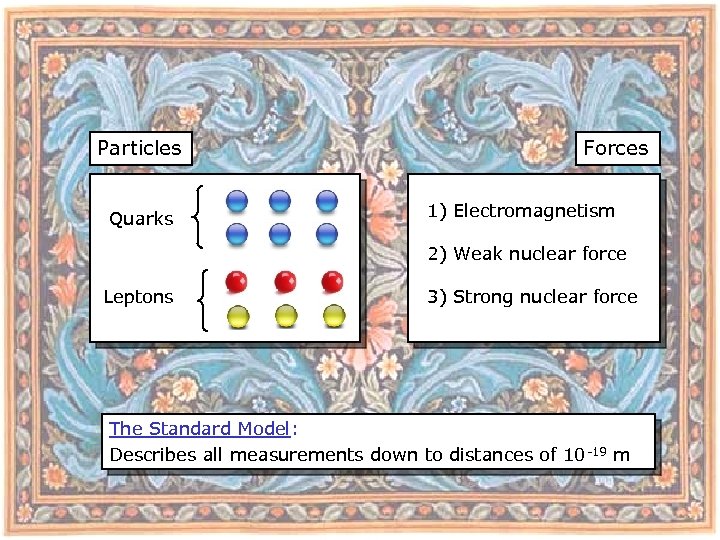 Particles Quarks Forces 1) Electromagnetism 2) Weak nuclear force Leptons 3) Strong nuclear force The Standard Model: Describes all measurements down to distances of 10 -19 m 6/60 6/52
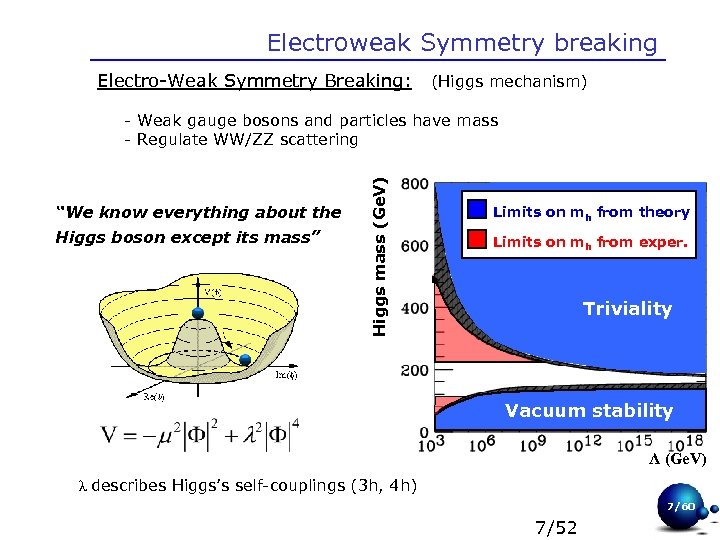 Electroweak Symmetry breaking Electro-Weak Symmetry Breaking: (Higgs mechanism) “We know everything about the Higgs boson except its mass” Higgs mass (Ge. V) - Weak gauge bosons and particles have mass - Regulate WW/ZZ scattering Limits on mh from theory Limits on mh from exper. Triviality Vacuum stability Λ (Ge. V) λ describes Higgs’s self-couplings (3 h, 4 h) 7/60 7/52
 The standard model … boring ? “All measurements in HEP can be explained using the SM” “The Higgs boson will be discovered at the LHC at ~ 150 Ge. V” No. … there are many mysteries left! 8/60 8/52
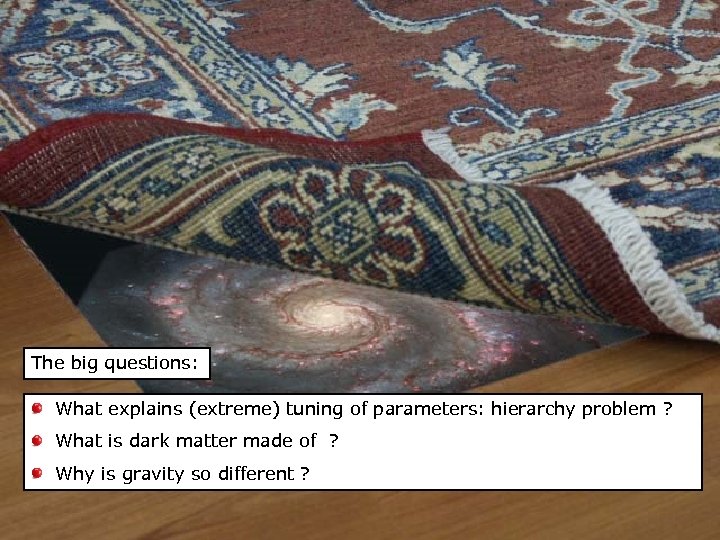 The big questions: What explains (extreme) tuning of parameters: hierarchy problem ? What is dark matter made of ? Why is gravity so different ?
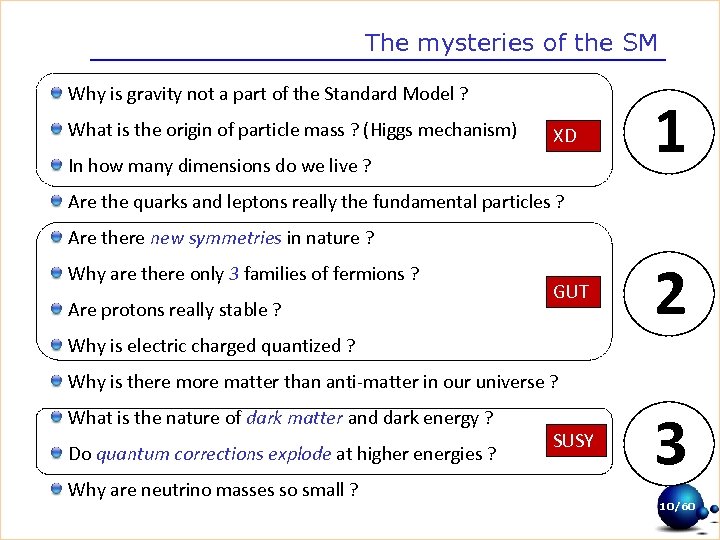 The mysteries of the SM Why is gravity not a part of the Standard Model ? What is the origin of particle mass ? (Higgs mechanism) XD In how many dimensions do we live ? 1 Are the quarks and leptons really the fundamental particles ? Are there new symmetries in nature ? Why are there only 3 families of fermions ? Are protons really stable ? GUT 2 Why is electric charged quantized ? Why is there more matter than anti-matter in our universe ? What is the nature of dark matter and dark energy ? Do quantum corrections explode at higher energies ? Why are neutrino masses so small ? SUSY 3 10/60
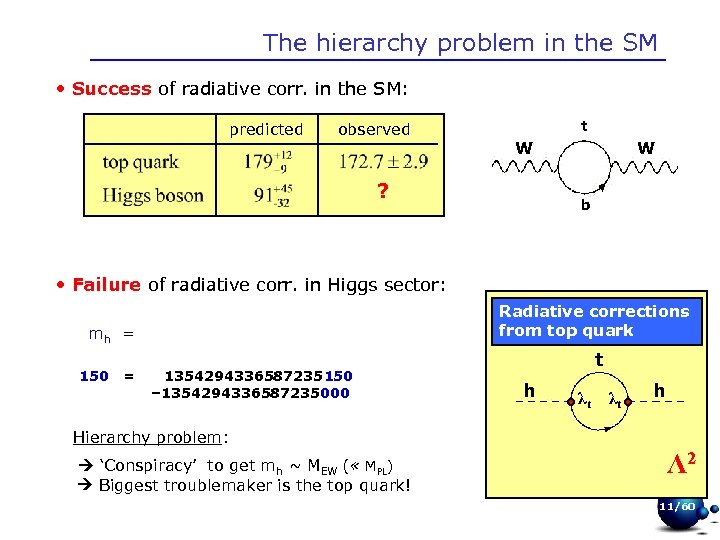 The hierarchy problem in the SM The hierarchy problem • Success of radiative corr. in the SM: predicted observed t W ? W b • Failure of radiative corr. in Higgs sector: Radiative corrections from top quark mh = 150 = 1354294336587235150 – 1354294336587235000 t h λt λt h Hierarchy problem: ‘Conspiracy’ to get mh ~ MEW ( « MPL) Biggest troublemaker is the top quark! Λ 2 11/60
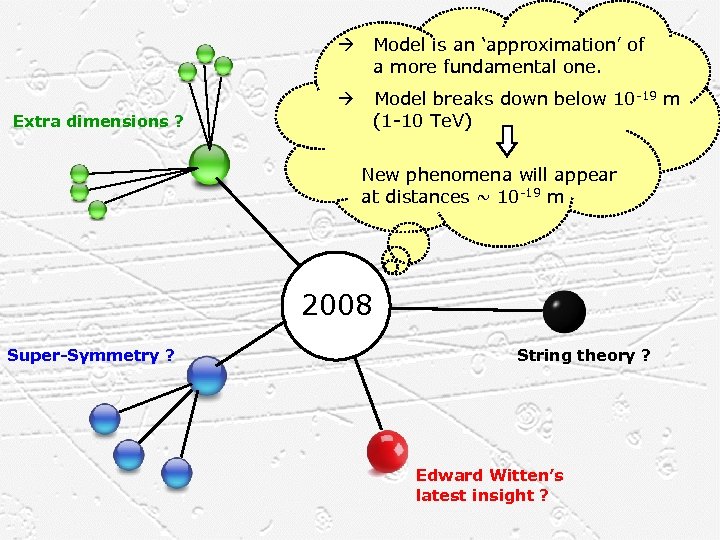 Model is an ‘approximation’ of a more fundamental one. Extra dimensions ? Model breaks down below 10 -19 m (1 -10 Te. V) New phenomena will appear at distances ~ 10 -19 m 2008 Super-Symmetry ? String theory ? Edward Witten’s latest insight ?
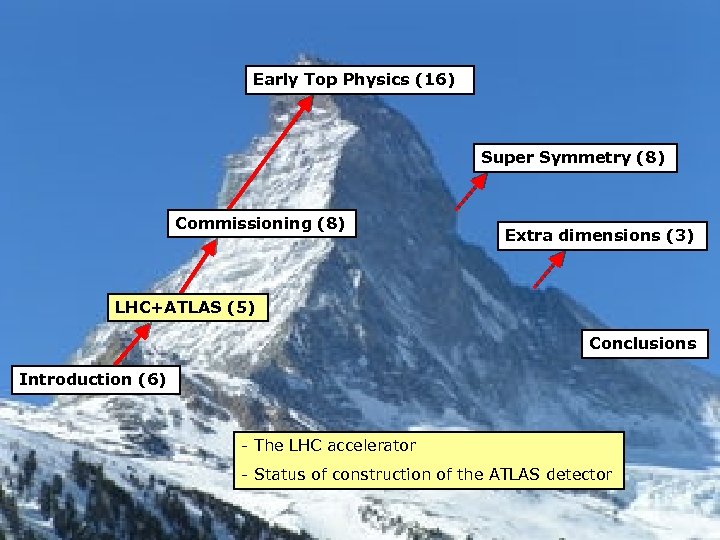 Early Top Physics (16) Super Symmetry (8) Commissioning (8) Extra dimensions (3) LHC+ATLAS (5) Conclusions Introduction (6) - The LHC accelerator - Status of construction of the ATLAS detector
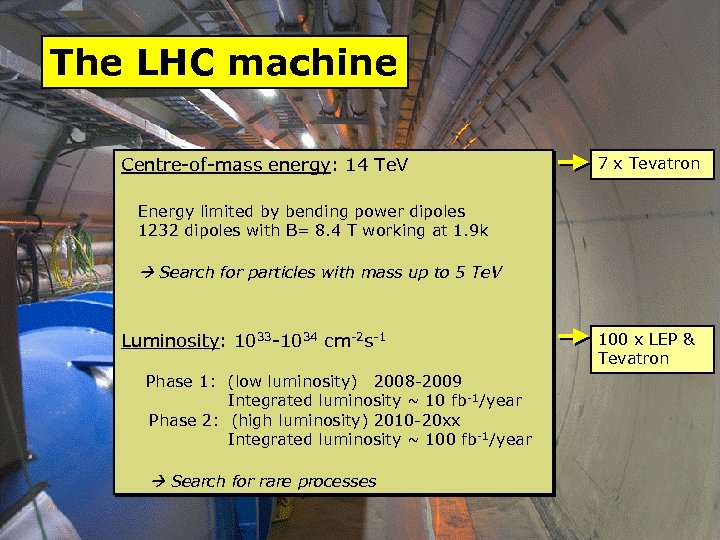 The LHC machine Centre-of-mass energy: 14 Te. V 7 x Tevatron Energy limited by bending power dipoles 1232 dipoles with B= 8. 4 T working at 1. 9 k Search for particles with mass up to 5 Te. V Luminosity: 1033 -1034 cm-2 s-1 100 x LEP & Tevatron Phase 1: (low luminosity) 2008 -2009 Integrated luminosity ~ 10 fb-1/year Phase 2: (high luminosity) 2010 -20 xx Integrated luminosity ~ 100 fb-1/year Search for rare processes 14/60 14/52
![R. Bailey Top 2008 Strategy for 2008 and 2009 [A] pilot run: - first](https://present5.com/presentation/2d26551910cef17f4256a914be04b871/image-15.jpg "R. Bailey Top 2008 Strategy for 2008 and 2009 [A] pilot run: - first") R. Bailey Top 2008 Strategy for 2008 and 2009 [A] pilot run: - first collissions - 43 bunches - few times 1031 5 Te. V 7 Te. V [B] - 75 ns [C] 25 ns operation - Squeeze beam 50% nominal operation - few times 1033 15/60
R. Bailey Top 2008 Strategy for 2008 and 2009 [A] pilot run: - first collissions - 43 bunches - few times 1031 5 Te. V 7 Te. V [B] - 75 ns [C] 25 ns operation - Squeeze beam 50% nominal operation - few times 1033 15/60
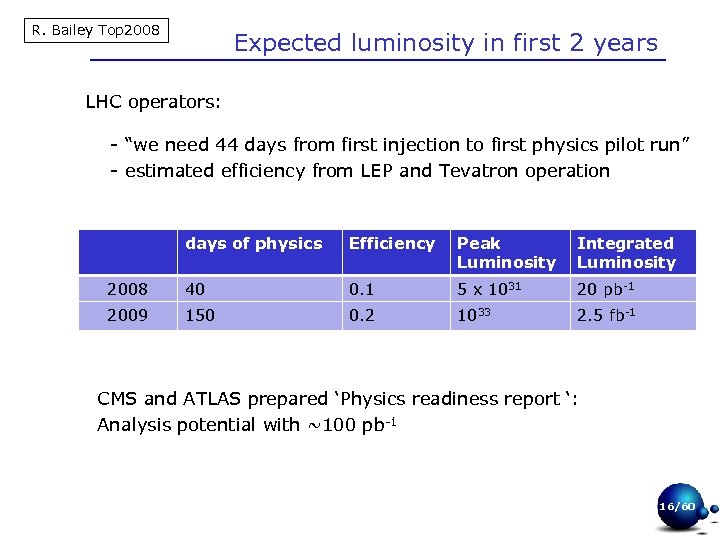 R. Bailey Top 2008 Expected luminosity in first 2 years LHC operators: - “we need 44 days from first injection to first physics pilot run” - estimated efficiency from LEP and Tevatron operation days of physics Efficiency Peak Luminosity Integrated Luminosity 2008 40 0. 1 5 x 1031 20 pb-1 2009 150 0. 2 1033 2. 5 fb-1 CMS and ATLAS prepared ‘Physics readiness report ‘: Analysis potential with ~100 pb-1 16/60
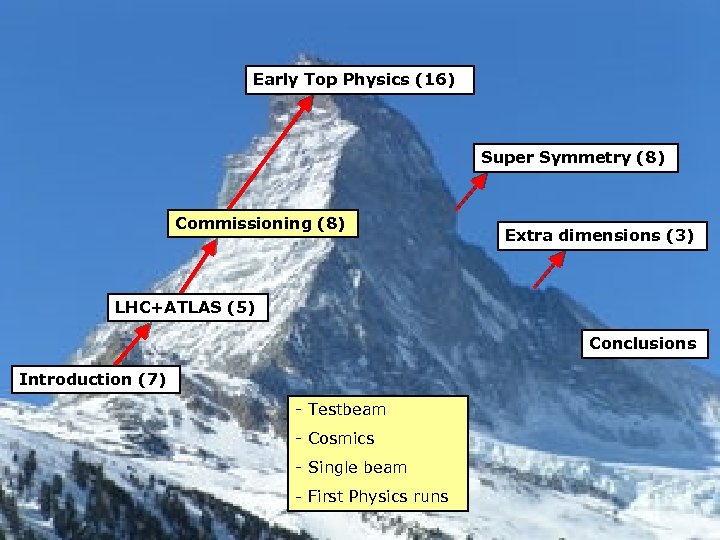
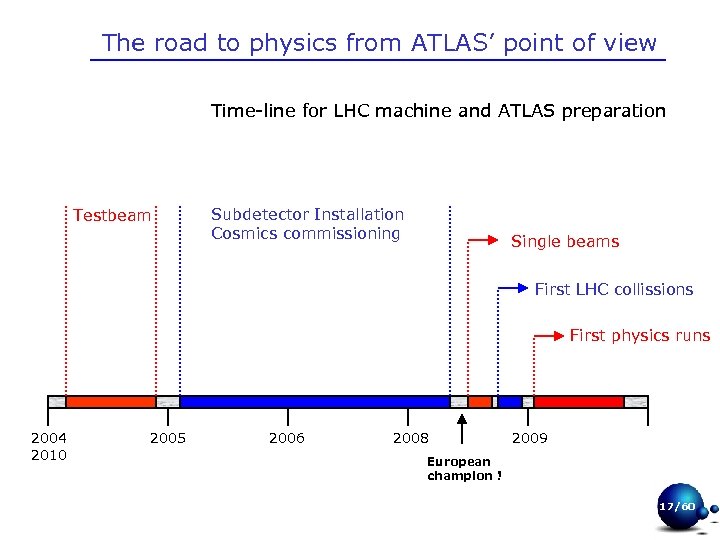 The road to physics from ATLAS’ point of view Time-line for LHC machine and ATLAS preparation Testbeam Subdetector Installation Cosmics commissioning Single beams First LHC collissions First physics runs 2004 2005 2006 2008 2009 2010 European champion ! 17/60
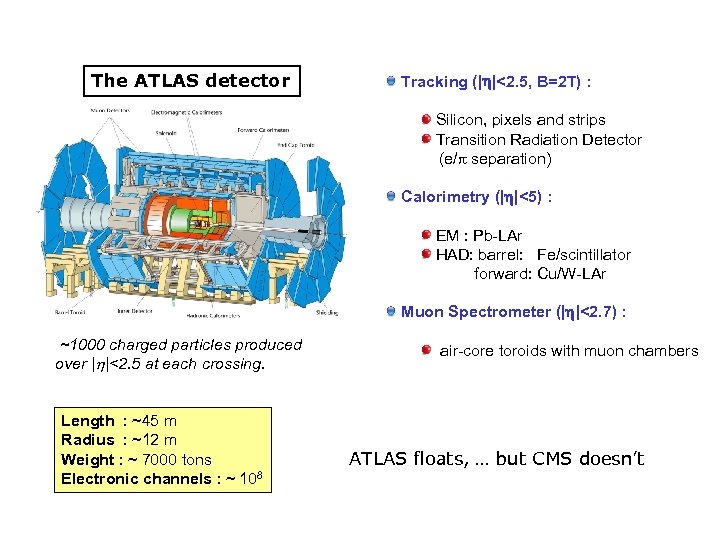 The ATLAS detector Tracking (| |<2. 5, B=2 T) : Silicon, pixels and strips Transition Radiation Detector (e/ separation) Calorimetry (| |<5) : EM : Pb-LAr HAD: barrel: Fe/scintillator forward: Cu/W-LAr Muon Spectrometer (| |<2. 7) : ~1000 charged particles produced over | |<2. 5 at each crossing. Length : ~45 m Radius : ~12 m Weight : ~ 7000 tons Electronic channels : ~ 108 air-core toroids with muon chambers ATLAS floats, … but CMS doesn’t
 Early Top Physics (16) Super Symmetry (8) Commissioning (8) Extra dimensions (3) LHC+ATLAS (5) Conclusions Introduction (7) - Testbeam - Cosmics - Single beam - First Physics runs
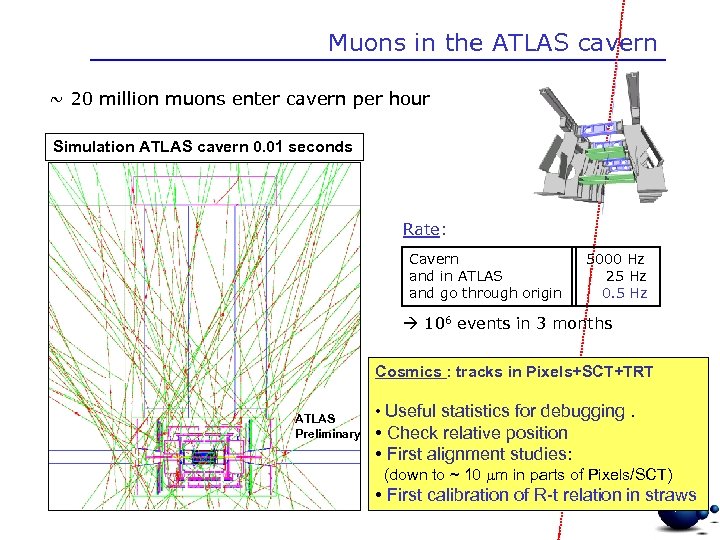 Muons in the ATLAS cavern ~ 20 million muons enter cavern per hour Simulation ATLAS cavern 0. 01 seconds Rate: Cavern 5000 Hz and in ATLAS 25 Hz and go through origin 0. 5 Hz 106 events in 3 months Cosmics : tracks in Pixels+SCT+TRT ATLAS Preliminary • Useful statistics for debugging. • Check relative position • First alignment studies: (down to ~ 10 m in parts of Pixels/SCT) • First calibration of R-t relation in straws 20/60
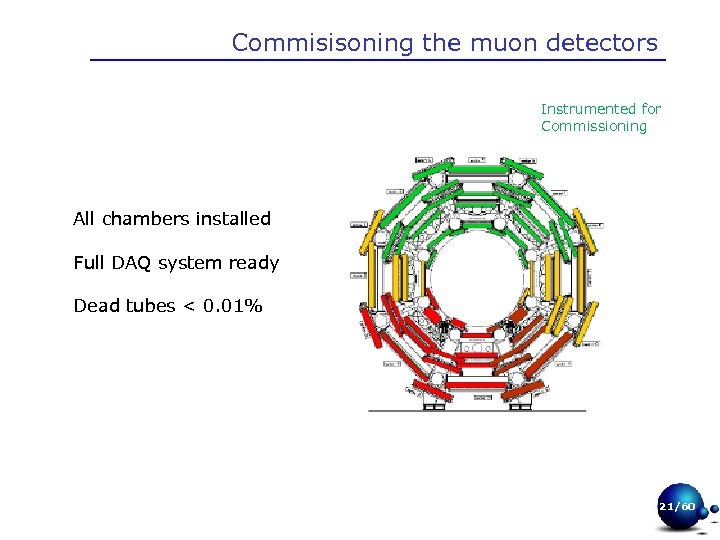 Commisisoning the muon detectors Instrumented for Commissioning All chambers installed Full DAQ system ready Dead tubes < 0. 01% 21/60
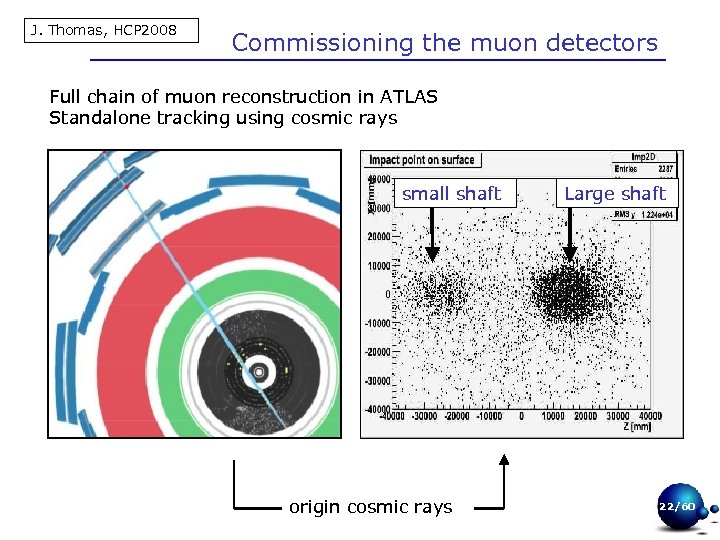 J. Thomas, HCP 2008 Commissioning the muon detectors Full chain of muon reconstruction in ATLAS Standalone tracking using cosmic rays small shaft origin cosmic rays Large shaft 22/60
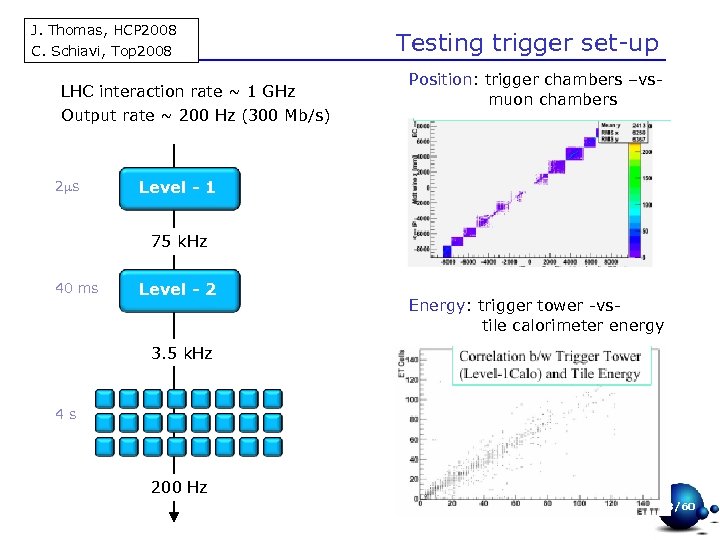 J. Thomas, HCP 2008 C. Schiavi, Top 2008 LHC interaction rate ~ 1 GHz Output rate ~ 200 Hz (300 Mb/s) 2μs Testing trigger set-up Position: trigger chambers –vs muon chambers Level - 1 75 k. Hz 40 ms Level - 2 Energy: trigger tower -vs tile calorimeter energy 3. 5 k. Hz 4 s 200 Hz 23/60
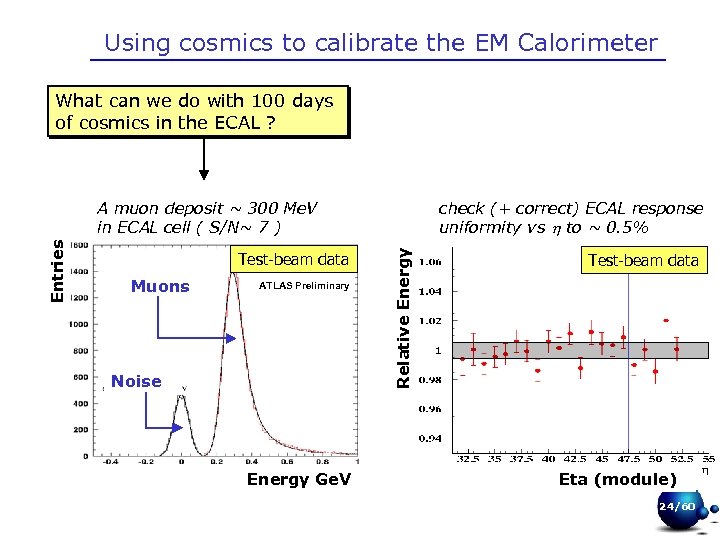 Using cosmics to calibrate the EM Calorimeter What can we do with 100 days of cosmics in the ECAL ? Test-beam data Muons ATLAS Preliminary Noise Energy Ge. V check (+ correct) ECAL response uniformity vs to ~ 0. 5% Relative Energy Entries A muon deposit ~ 300 Me. V in ECAL cell ( S/N~ 7 ) Test-beam data Eta (module) 24/60
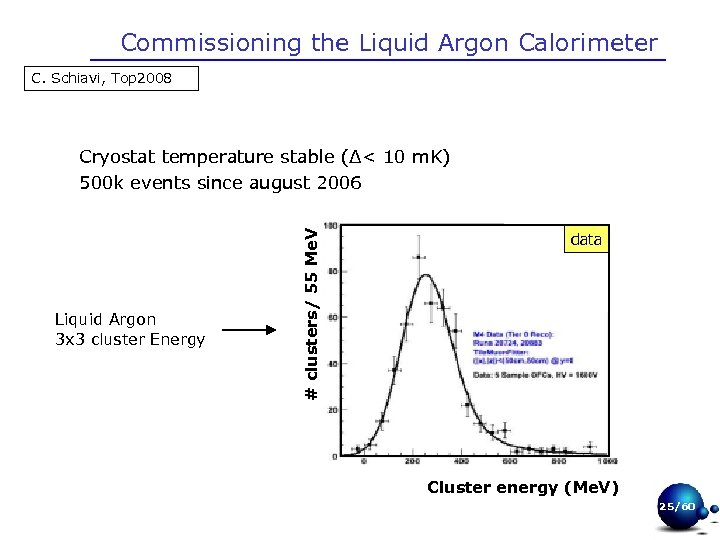 Commissioning the Liquid Argon Calorimeter C. Schiavi, Top 2008 Liquid Argon 3 x 3 cluster Energy # clusters/ 55 Me. V Cryostat temperature stable (Δ< 10 m. K) 500 k events since august 2006 data Cluster energy (Me. V) 25/60
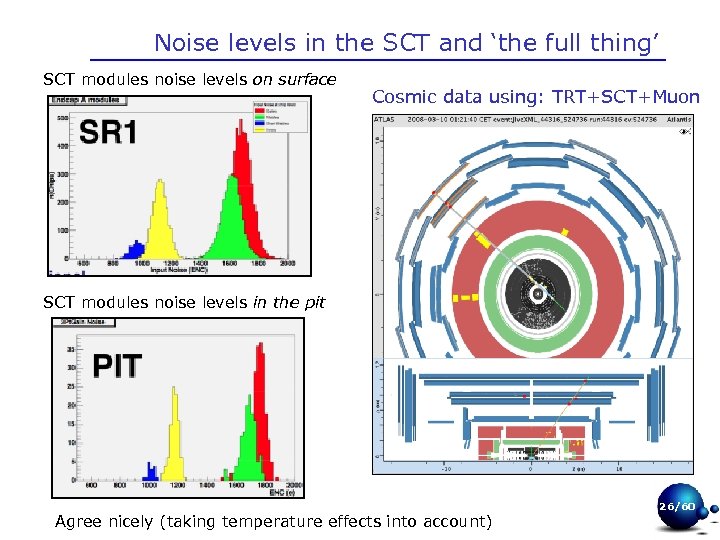 Noise levels in the SCT and ‘the full thing’ SCT modules noise levels on surface Cosmic data using: TRT+SCT+Muon SCT modules noise levels in the pit Agree nicely (taking temperature effects into account) 26/60
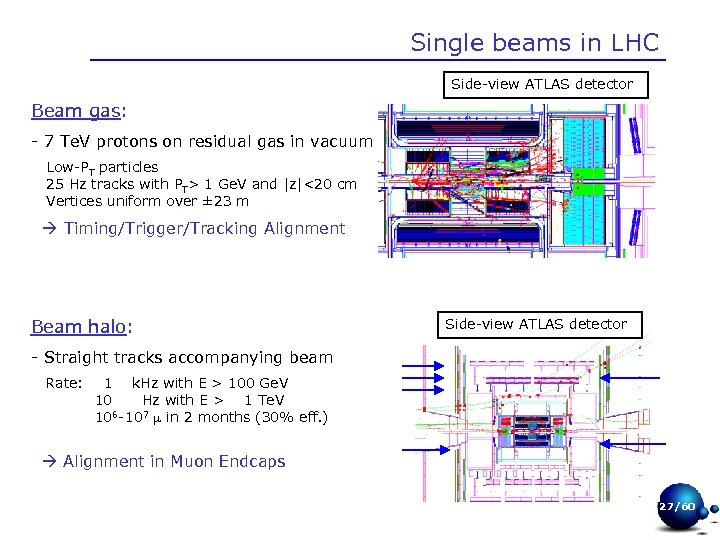 Single beams in LHC Side-view ATLAS detector Beam gas: - 7 Te. V protons on residual gas in vacuum Low-PT particles 25 Hz tracks with PT> 1 Ge. V and |z|<20 cm Vertices uniform over ± 23 m Timing/Trigger/Tracking Alignment Beam halo: Side-view ATLAS detector - Straight tracks accompanying beam Rate: 1 k. Hz with E > 100 Ge. V 10 Hz with E > 1 Te. V 106 -107 in 2 months (30% eff. ) Alignment in Muon Endcaps 27/60
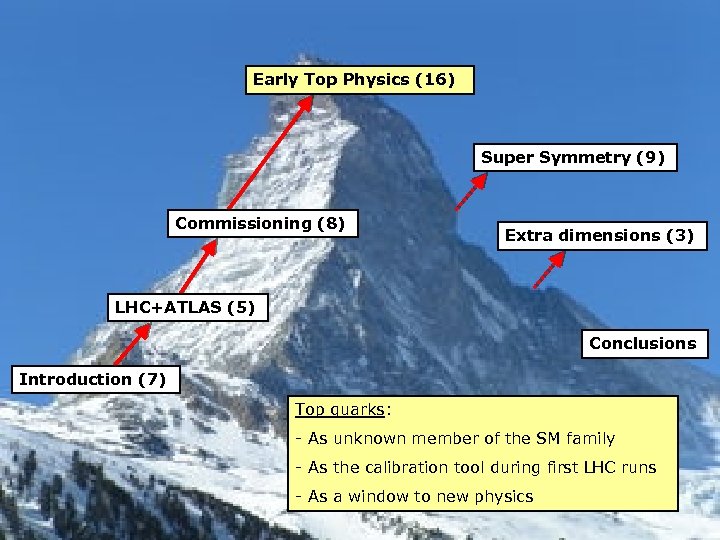 Early Top Physics (16) Super Symmetry (9) Commissioning (8) Extra dimensions (3) LHC+ATLAS (5) Conclusions Introduction (7) Top quarks: - As unknown member of the SM family - As the calibration tool during first LHC runs - As a window to new physics
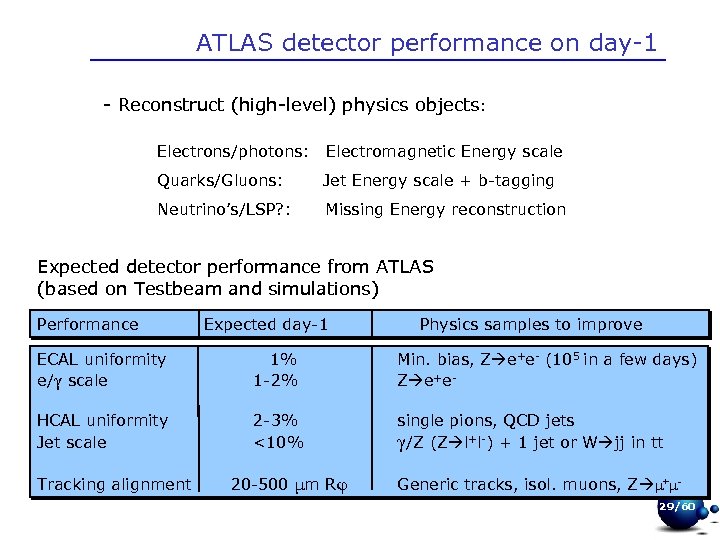 ATLAS detector performance on day-1 - Reconstruct (high-level) physics objects: Electrons/photons: Electromagnetic Energy scale Quarks/Gluons: Jet Energy scale + b-tagging Neutrino’s/LSP? : Missing Energy reconstruction Expected detector performance from ATLAS (based on Testbeam and simulations) Performance Expected day-1 ECAL uniformity e/γ scale 1% 1 -2% HCAL uniformity Jet scale 2 -3% <10% Tracking alignment 20 -500 μm Rφ Physics samples to improve Min. bias, Z e+e- (105 in a few days) Z e+esingle pions, QCD jets γ/Z (Z l+l-) + 1 jet or W jj in tt Generic tracks, isol. muons, Z μ+μ 29/60
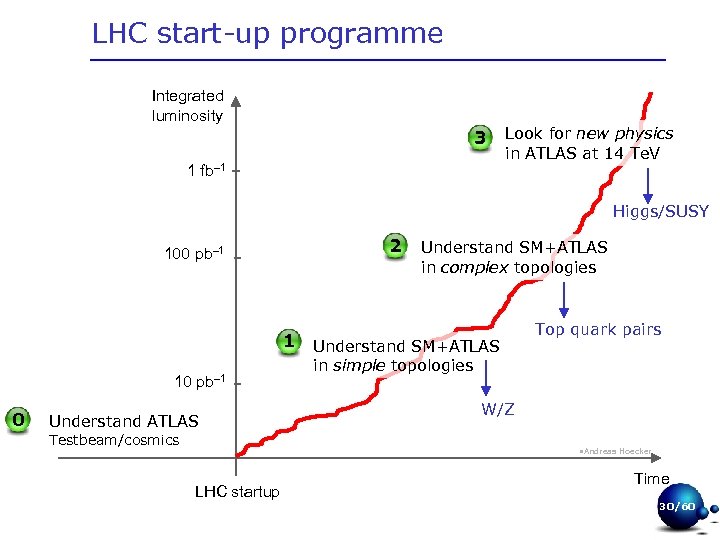 LHC start-up programme Integrated luminosity 3 1 fb– 1 Look for new physics in ATLAS at 14 Te. V Higgs/SUSY 100 pb– 1 2 Understand SM+ATLAS in complex topologies 1 Understand SM+ATLAS 10 0 pb– 1 Understand ATLAS Testbeam/cosmics Top quark pairs in simple topologies W/Z • Andreas Hoecker LHC startup Time 30/60
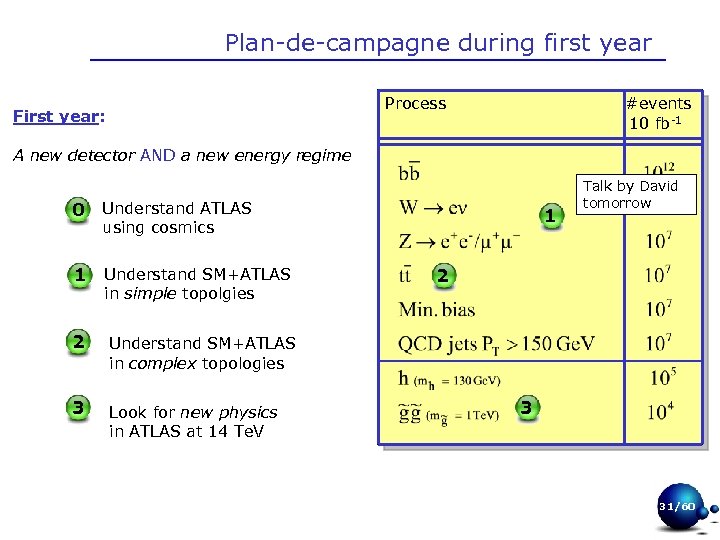 Plan-de-campagne during first year Process #events 10 fb-1 First year: A new detector AND a new energy regime 0 Understand ATLAS 1 using cosmics 1 Understand SM+ATLAS in simple topolgies 2 Look for new physics in ATLAS at 14 Te. V 2 Understand SM+ATLAS in complex topologies 3 Talk by David tomorrow 3 31/60
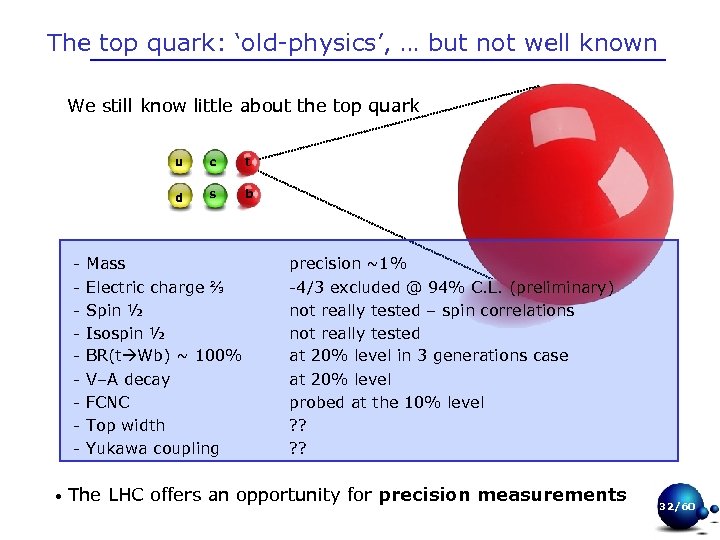 The top quark: ‘old-physics’, … but not well known We still know little about the top quark u c t d s b - Mass - Electric charge ⅔ - Spin ½ - Isospin ½ - BR(t Wb) ~ 100% - V–A decay - FCNC - Top width - Yukawa coupling precision ~1% -4/3 excluded @ 94% C. L. (preliminary) not really tested – spin correlations not really tested at 20% level in 3 generations case at 20% level probed at the 10% level ? ? • The LHC offers an opportunity for precision measurements 32/60
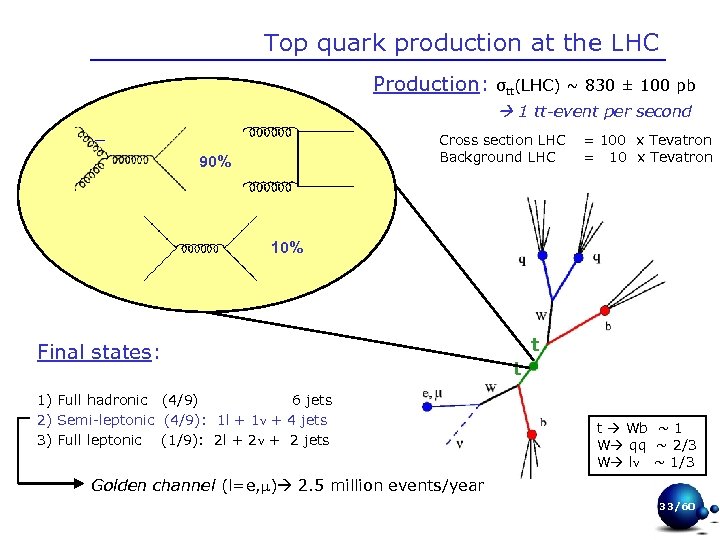 Top quark production at the LHC Production: σtt(LHC) ~ 830 ± 100 pb 1 tt-event per second Cross section LHC = 100 x Tevatron Background LHC = 10 x Tevatron 90% 10% Final states: 1) Full hadronic (4/9) 6 jets 2) Semi-leptonic (4/9): 1 l + 1ν + 4 jets 3) Full leptonic (1/9): 2 l + 2ν + 2 jets t t t Wb ~ 1 W qq ~ 2/3 W lν ~ 1/3 Golden channel (l=e, μ) 2. 5 million events/year 33/60
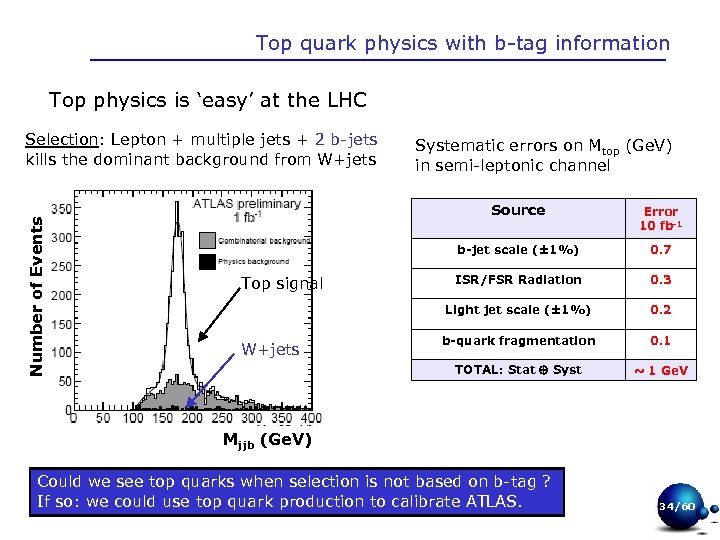 Top quark physics with b-tag information Top physics is ‘easy’ at the LHC Number of Events Selection: Lepton + multiple jets + 2 b-jets kills the dominant background from W+jets Systematic errors on Mtop (Ge. V) in semi-leptonic channel Source b-jet scale (± 1%) ISR/FSR Radiation 0. 3 0. 2 b-quark fragmentation 0. 1 TOTAL: Stat Syst W+jets 0. 7 Light jet scale (± 1%) Top signal Error 10 fb-1 ~ 1 Ge. V Mjjb (Ge. V) Could we see top quarks when selection is not based on b-tag ? If so: we could use top quark production to calibrate ATLAS. 34/60
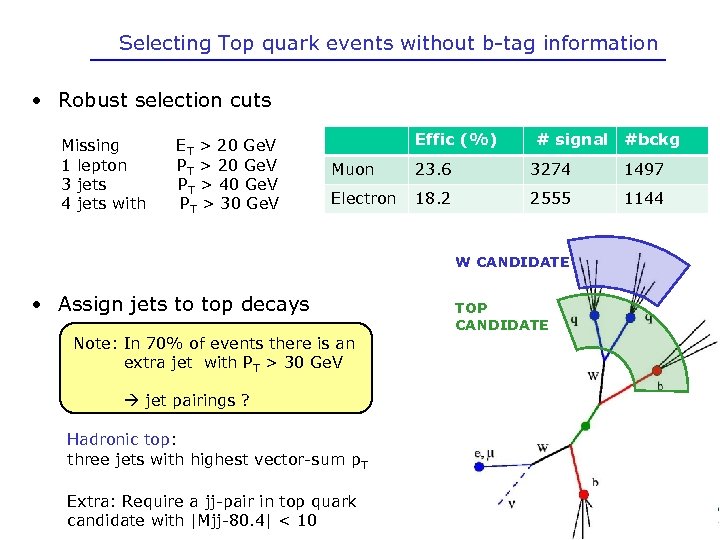 Selecting Top quark events without b-tag information • Robust selection cuts Missing ET > 20 Ge. V 1 lepton PT > 20 Ge. V 3 jets PT > 40 Ge. V 4 jets with PT > 30 Ge. V Effic (%) # signal #bckg Muon 23. 6 3274 1497 Electron 18. 2 2555 1144 W CANDIDATE • Assign jets to top decays TOP CANDIDATE Note: In 70% of events there is an extra jet with PT > 30 Ge. V jet pairings ? Hadronic top: three jets with highest vector-sum p. T Extra: Require a jj-pair in top quark candidate with |Mjj-80. 4| < 10 35/60
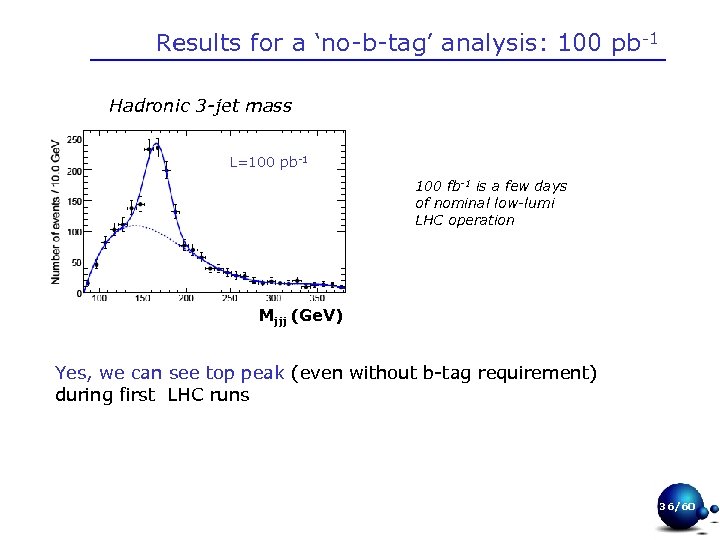 Results for a ‘no-b-tag’ analysis: 100 pb-1 Hadronic 3 -jet mass L=100 pb-1 100 fb-1 is a few days of nominal low-lumi LHC operation Mjjj (Ge. V) Yes, we can see top peak (even without b-tag requirement) during first LHC runs 36/60
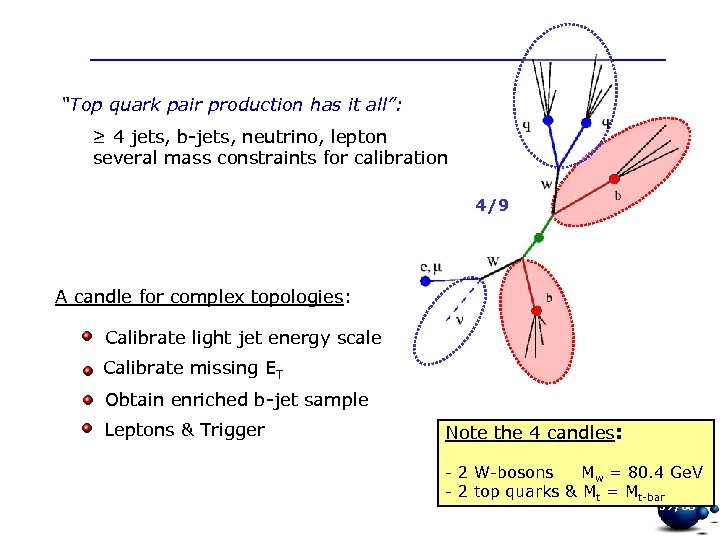 Top physics at the LHC “Top quark pair production has it all”: ≥ 4 jets, b-jets, neutrino, lepton several mass constraints for calibration 4/9 A candle for complex topologies: Calibrate light jet energy scale Calibrate missing ET Obtain enriched b-jet sample Leptons & Trigger Note the 4 candles: - 2 W-bosons Mw = 80. 4 Ge. V - 2 top quarks & Mt = Mt-bar 37/60
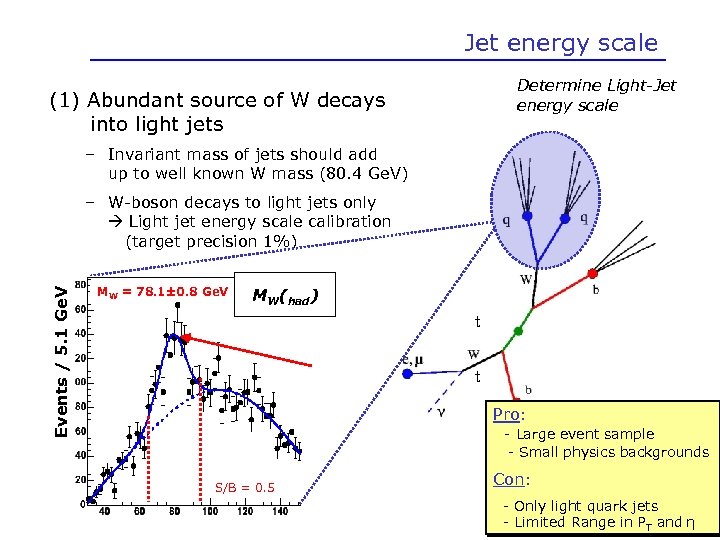 Jet energy scale Determine Light-Jet energy scale (1) Abundant source of W decays into light jets – Invariant mass of jets should add up to well known W mass (80. 4 Ge. V) Events / 5. 1 Ge. V – W-boson decays to light jets only Light jet energy scale calibration (target precision 1%) MW = 78. 1± 0. 8 Ge. V MW(had) t t Pro: - Large event sample - Small physics backgrounds S/B = 0. 5 Con: - Only light quark jets 38/60 - Limited Range in PT and η
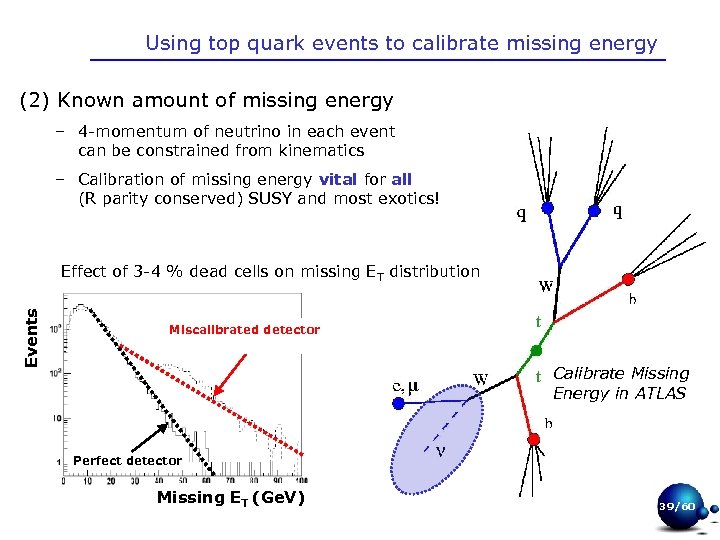 Using top quark events to calibrate missing energy (2) Known amount of missing energy – 4 -momentum of neutrino in each event can be constrained from kinematics – Calibration of missing energy vital for all (R parity conserved) SUSY and most exotics! Events Effect of 3 -4 % dead cells on missing ET distribution Miscalibrated detector or escaping ‘new’ particle t t Calibrate Missing Energy in ATLAS Perfect detector Missing ET (Ge. V) 39/60
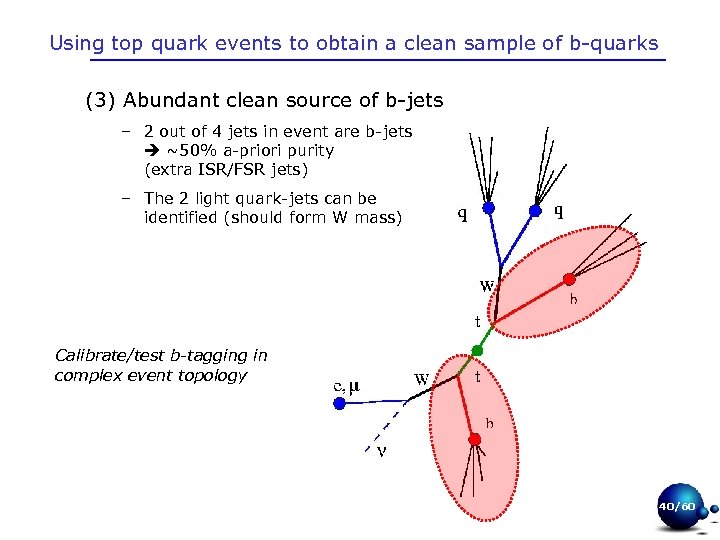 Using top quark events to obtain a clean sample of b-quarks (3) Abundant clean source of b-jets – 2 out of 4 jets in event are b-jets ~50% a-priori purity (extra ISR/FSR jets) – The 2 light quark-jets can be identified (should form W mass) t Calibrate/test b-tagging in complex event topology t 40/60
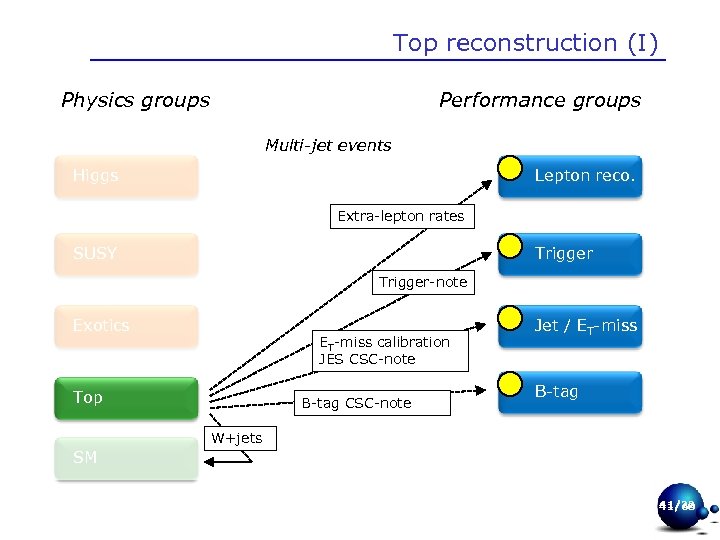 Top reconstruction (I) Physics groups Performance groups Multi-jet events Higgs Lepton reco. Extra-lepton rates SUSY Trigger-note Exotics ET-miss calibration JES CSC-note Top B-tag CSC-note Jet / ET-miss B-tag W+jets SM 41/22 41/60
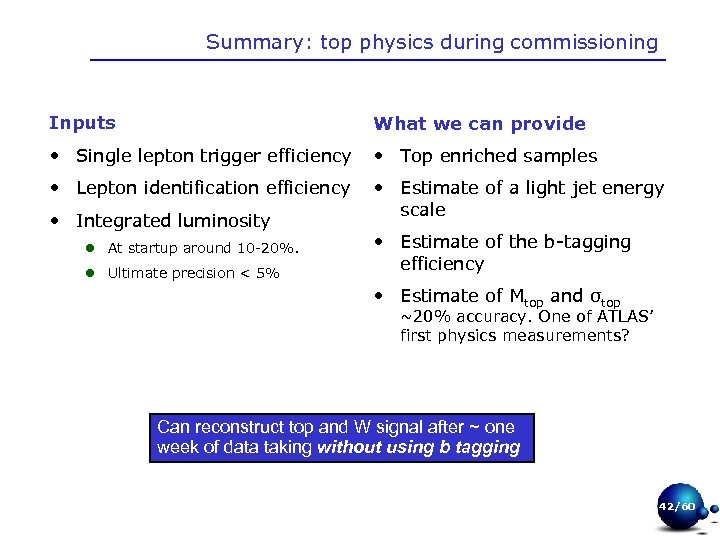 Summary: top physics during commissioning Inputs What we can provide • Single lepton trigger efficiency • Top enriched samples • Lepton identification efficiency • Estimate of a light jet energy scale • Integrated luminosity l At startup around 10 -20%. l Ultimate precision < 5% • Estimate of the b-tagging efficiency • Estimate of Mtop and σtop ~20% accuracy. One of ATLAS’ first physics measurements? Can reconstruct top and W signal after ~ one week of data taking without using b tagging 42/60
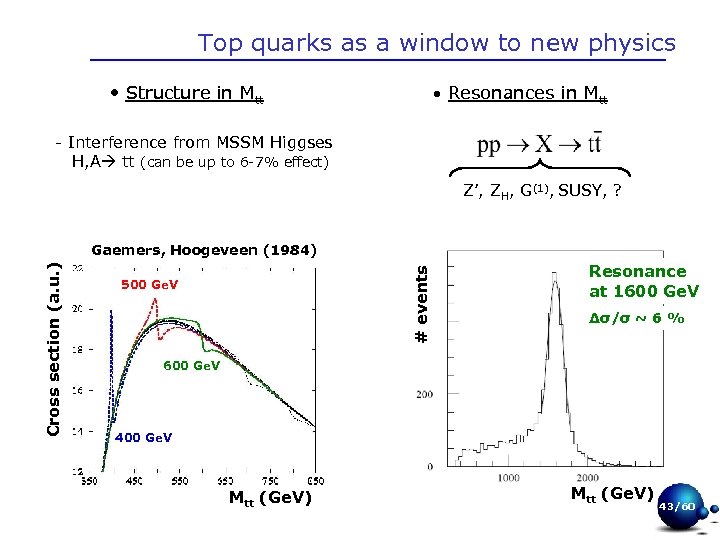 Top quarks as a window to new physics • Structure in Mtt • Resonances in Mtt - Interference from MSSM Higgses H, A tt (can be up to 6 -7% effect) Z’, ZH, G(1), SUSY, ? # events Cross section (a. u. ) Gaemers, Hoogeveen (1984) 500 Ge. V Resonance at 1600 Ge. V Δσ/σ ~ 6 % 600 Ge. V 400 Ge. V Mtt (Ge. V) 43/60
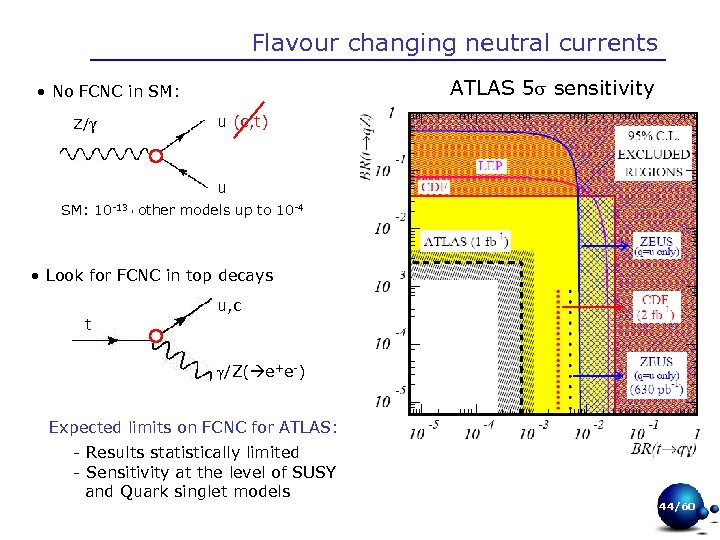 Flavour changing neutral currents ATLAS 5 s sensitivity • No FCNC in SM: Z/γ u (c, t) u SM: 10 -13 , other models up to 10 -4 • Look for FCNC in top decays t u, c γ/Z( e+e-) Expected limits on FCNC for ATLAS: - Results statistically limited - Sensitivity at the level of SUSY and Quark singlet models 44/60
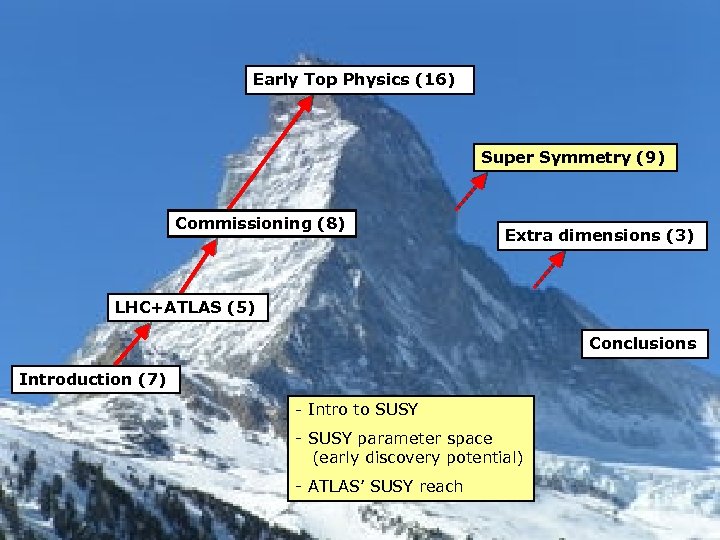 Early Top Physics (16) Super Symmetry (9) Commissioning (8) Extra dimensions (3) LHC+ATLAS (5) Conclusions Introduction (7) - Intro to SUSY - SUSY parameter space (early discovery potential) - ATLAS’ SUSY reach
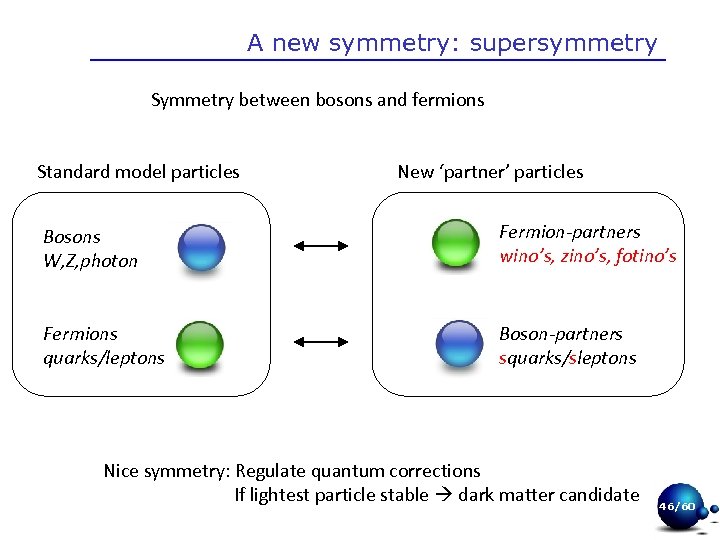 A new symmetry: supersymmetry Symmetry between bosons and fermions Standard model particles New ‘partner’ particles Bosons W, Z, photon Fermion-partners wino’s, zino’s, fotino’s Fermions quarks/leptons Boson-partners squarks/sleptons Nice symmetry: Regulate quantum corrections If lightest particle stable dark matter candidate 46/60
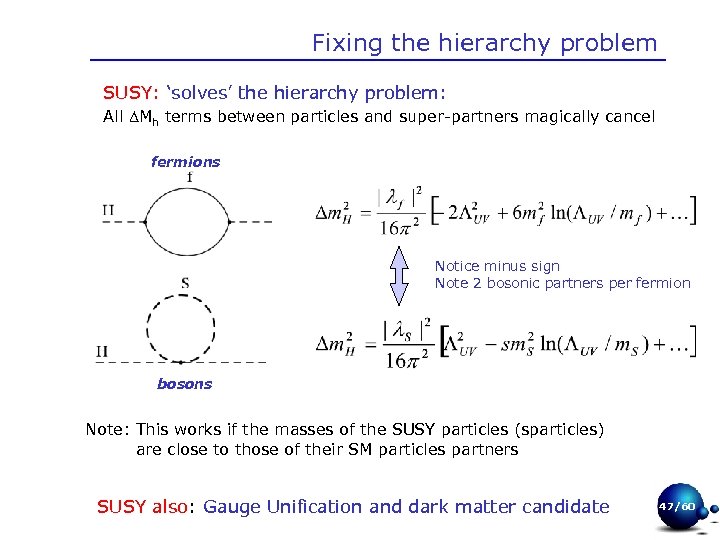 Fixing the hierarchy problem SUSY: ‘solves’ the hierarchy problem: All ΔMh terms between particles and super-partners magically cancel fermions Notice minus sign Note 2 bosonic partners per fermion bosons Note: This works if the masses of the SUSY particles (sparticles) are close to those of their SM particles partners SUSY also: Gauge Unification and dark matter candidate 47/60
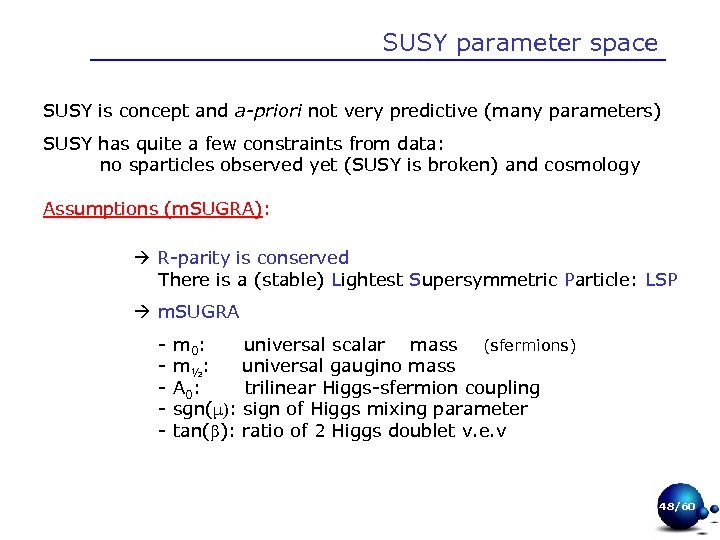 SUSY parameter space SUSY is concept and a-priori not very predictive (many parameters) SUSY has quite a few constraints from data: no sparticles observed yet (SUSY is broken) and cosmology Assumptions (m. SUGRA): R-parity is conserved There is a (stable) Lightest Supersymmetric Particle: LSP m. SUGRA - m 0: universal scalar mass (sfermions) - m½: universal gaugino mass - A 0: trilinear Higgs-sfermion coupling - sgn(μ): sign of Higgs mixing parameter - tan(β): ratio of 2 Higgs doublet v. e. v 48/60
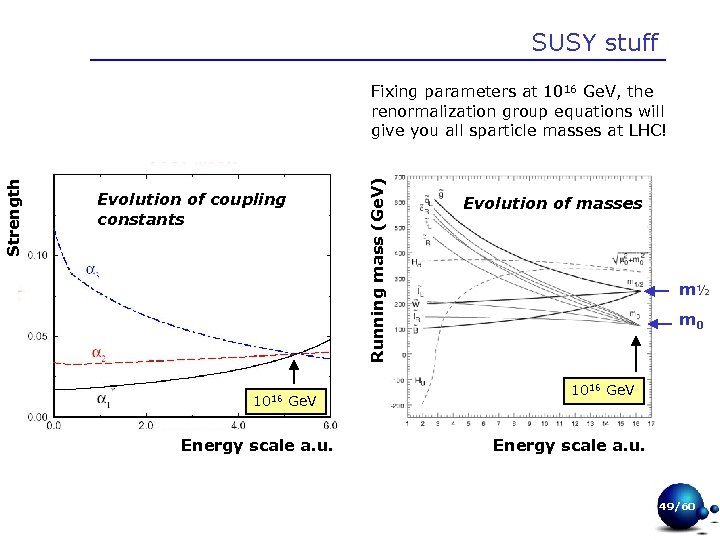 SUSY stuff Evolution of coupling constants 1016 Ge. V Energy scale a. u. Running mass (Ge. V) Strength Fixing parameters at 1016 Ge. V, the renormalization group equations will give you all sparticle masses at LHC! Evolution of masses m½ m 0 1016 Ge. V Energy scale a. u. 49/60
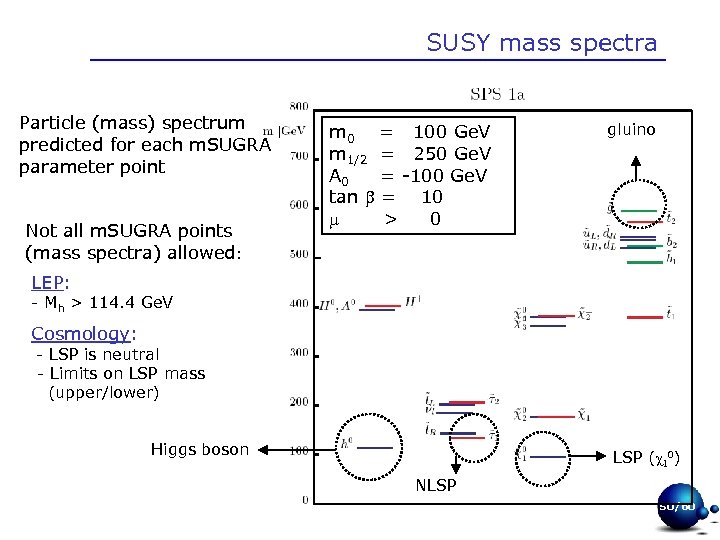 SUSY mass spectra Particle (mass) spectrum predicted for each m. SUGRA parameter point Not all m. SUGRA points (mass spectra) allowed: m 0 = 100 Ge. V m 1/2 = 250 Ge. V A 0 = -100 Ge. V tan = 10 > 0 gluino LEP: - Mh > 114. 4 Ge. V Cosmology: - LSP is neutral - Limits on LSP mass (upper/lower) Higgs boson LSP (χ10) NLSP 50/60
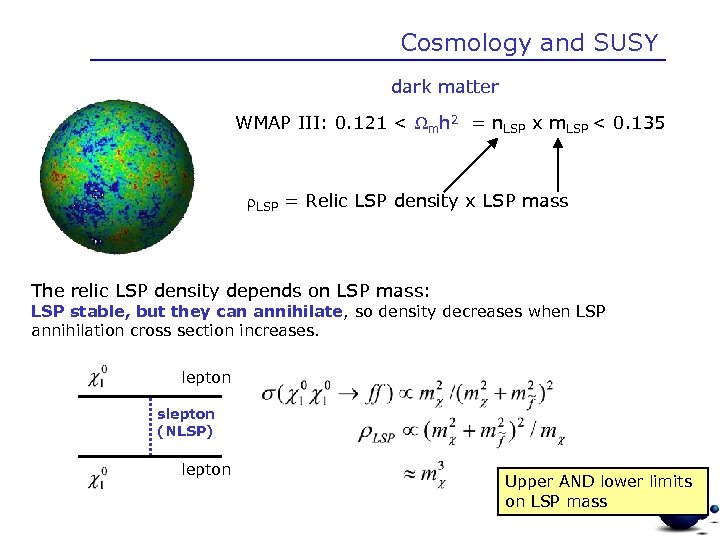 Cosmology and SUSY dark matter WMAP III: 0. 121 < Ωmh 2 = n. LSP x m. LSP < 0. 135 ρLSP = Relic LSP density x LSP mass The relic LSP density depends on LSP mass: LSP stable, but they can annihilate, so density decreases when LSP annihilation cross section increases. lepton slepton (NLSP) lepton Upper AND lower limits on LSP mass 51/60
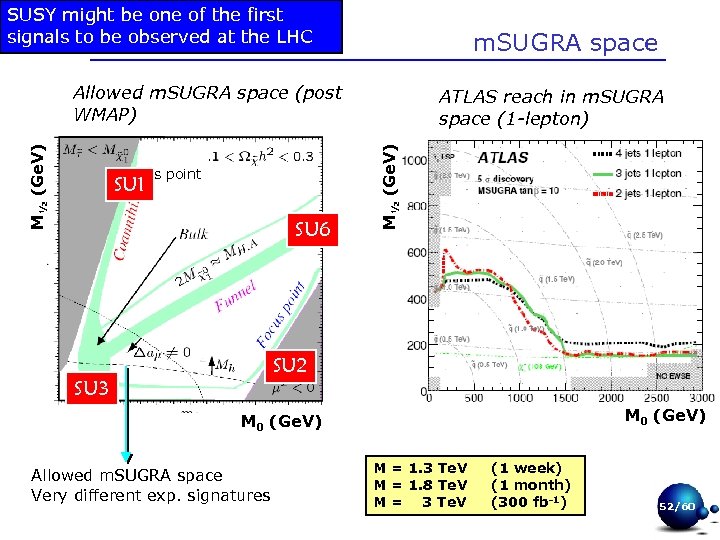 SUSY might be one of the first signals to be observed at the LHC m. SUGRA space Focus point SU 1 SU 6 ATLAS reach in m. SUGRA space (1 -lepton) M½ (Ge. V) Allowed m. SUGRA space (post WMAP) SU 2 SU 3 M 0 (Ge. V) Allowed m. SUGRA space Very different exp. signatures M = 1. 3 Te. V M = 1. 8 Te. V M = 3 Te. V (1 week) (1 month) (300 fb-1) 52/60
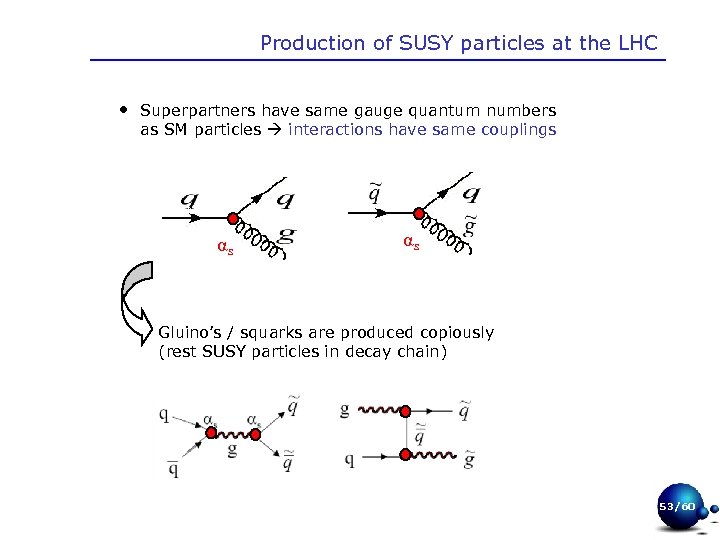 Production of SUSY particles at the LHC • Superpartners have same gauge quantum numbers as SM particles interactions have same couplings αS αS • Gluino’s / squarks are produced copiously (rest SUSY particles in decay chain) 53/60
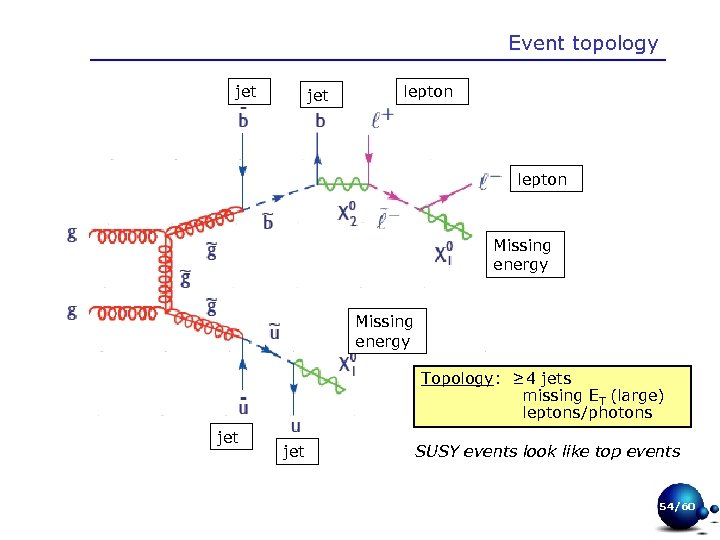 Event topology jet lepton Missing energy Topology: ≥ 4 jets missing ET (large) leptons/photons jet SUSY events look like top events 54/60
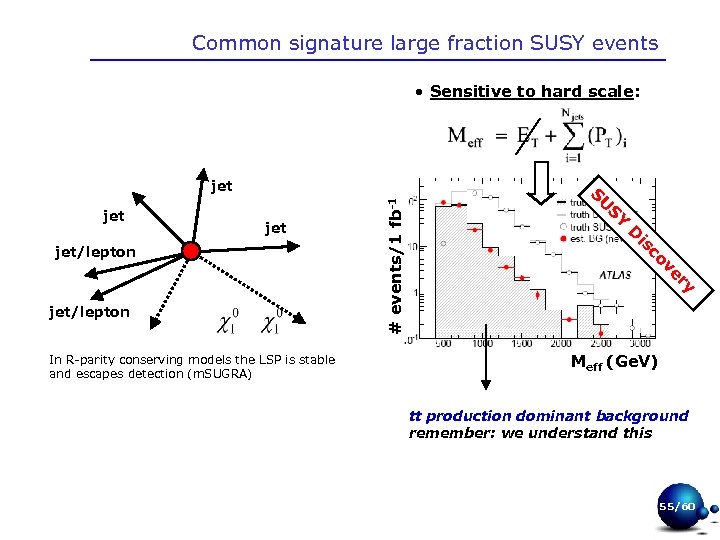 Common signature large fraction SUSY events LHC day 2: First to discover SUSY • Sensitive to hard scale: is D er v co y In R-parity conserving models the LSP is stable and escapes detection (m. SUGRA) Y jet/lepton S jet/lepton U jet S jet # events/1 fb-1 jet Meff (Ge. V) tt production dominant background remember: we understand this 55/60
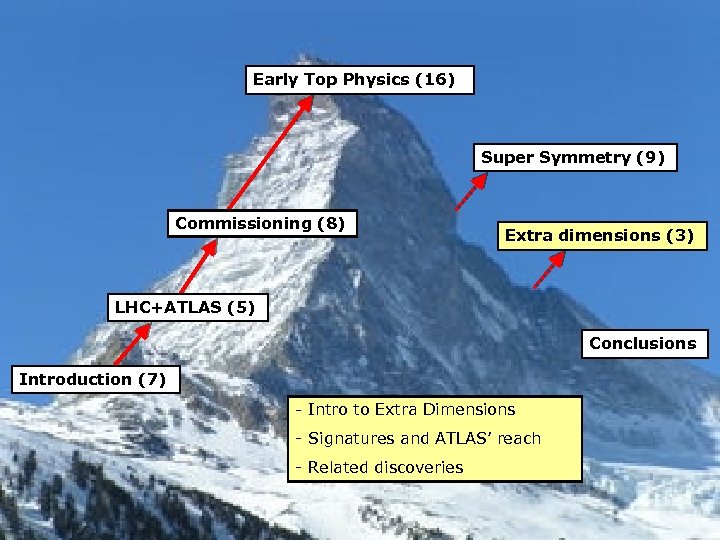 Early Top Physics (16) Super Symmetry (9) Commissioning (8) Extra dimensions (3) LHC+ATLAS (5) Conclusions Introduction (7) - Intro to Extra Dimensions - Signatures and ATLAS’ reach - Related discoveries
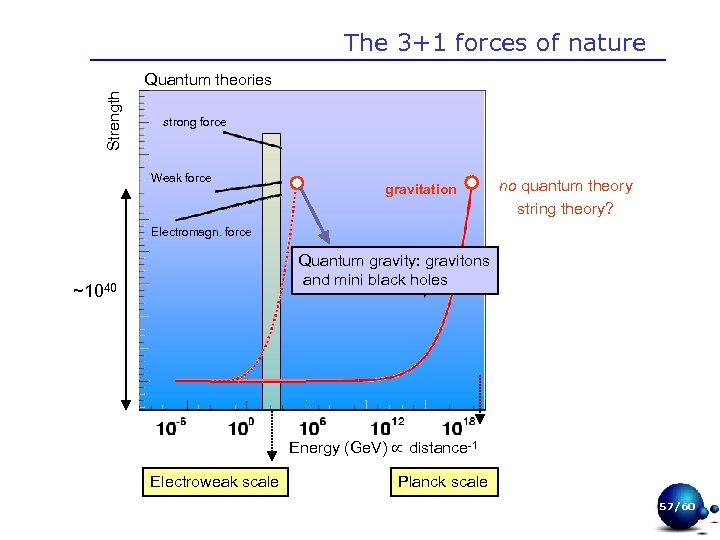 The 3+1 forces of nature Strength Quantum theories strong force Weak force gravitation no quantum theory string theory? Electromagn. force Quantum gravity: gravitons and mini black holes ~1040 Energy (Ge. V) distance-1 Electroweak scale Planck scale 57/60
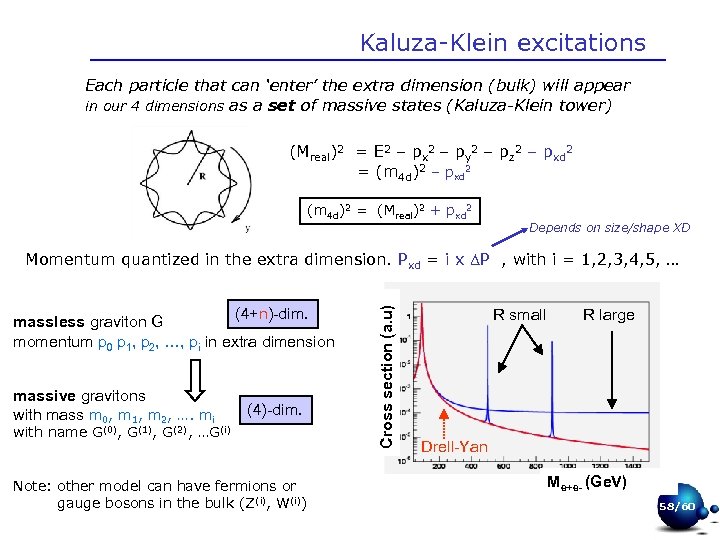 Kaluza-Klein excitations Each particle that can ‘enter’ the extra dimension (bulk) will appear in our 4 dimensions as a set of massive states (Kaluza-Klein tower) (Mreal)2 = E 2 – px 2 – py 2 – pz 2 – pxd 2 = (m 4 d)2 – pxd 2 (m 4 d)2 = (Mreal)2 + pxd 2 Depends on size/shape XD (4+n)-dim. massless graviton G momentum p 0 p 1, p 2, …, pi in extra dimension massive gravitons with mass m 0, m 1, m 2, …. mi (4)-dim. with name G(0), G(1), G(2), …G(i) Note: other model can have fermions or gauge bosons in the bulk (Z(i), W(i)) Cross section (a. u) Momentum quantized in the extra dimension. Pxd = i x ΔP , with i = 1, 2, 3, 4, 5, … R small R large Drell-Yan Me+e- (Ge. V) 58/60
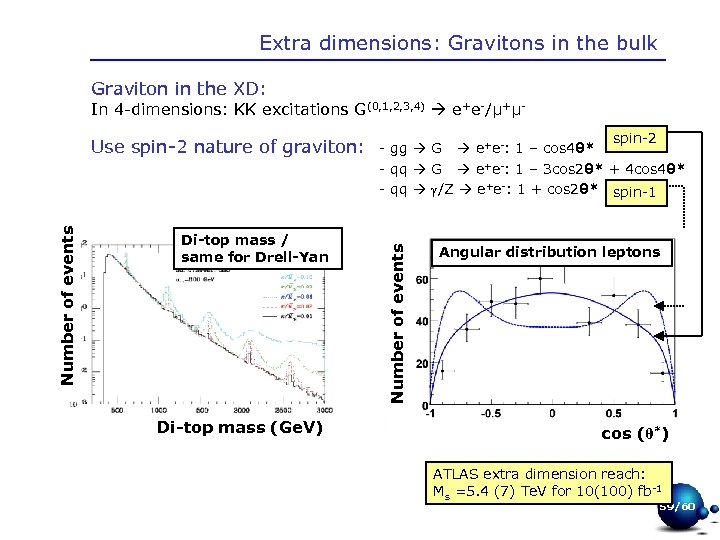 Extra dimensions: Gravitons in the bulk Graviton in the XD: In 4 -dimensions: KK excitations G(0, 1, 2, 3, 4) e+e-/μ+μ- Number of events Di-top mass / same for Drell-Yan Di-top mass (Ge. V) spin-2 - gg G e+e-: 1 – cos 4θ* - qq G e+e-: 1 – 3 cos 2θ* + 4 cos 4θ* - qq γ/Z e+e-: 1 + cos 2θ* spin-1 Number of events Use spin-2 nature of graviton: Angular distribution leptons cos (θ*) ATLAS extra dimension reach: Ms =5. 4 (7) Te. V for 10(100) fb-1 59/60
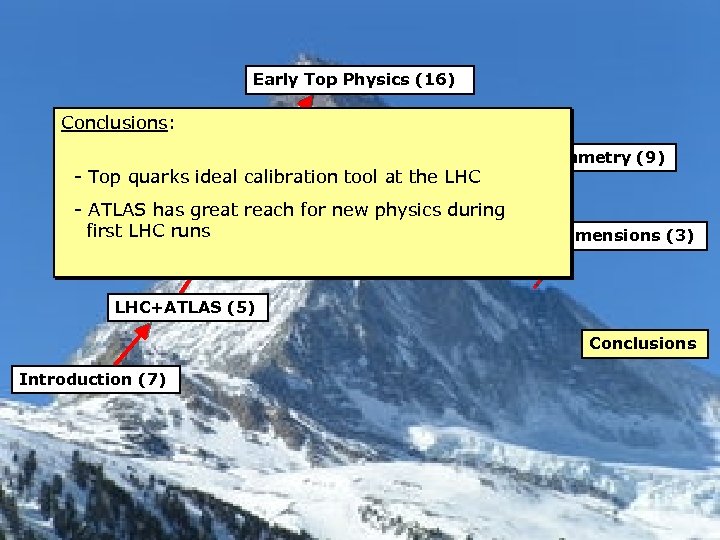 Early Top Physics (16) Conclusions: - Top quarks ideal calibration tool at the LHC Super Symmetry (9) - ATLAS has great reach for new physics during Commissioning (8) first LHC runs Extra dimensions (3) LHC+ATLAS (5) Conclusions Introduction (7)
 Backup slides
 Top reconstruction (I) Physics groups Performance groups Higgs Lepton reco. SUSY Trigger Exotics Jet / ET-miss Top B-tag SM 62/22 62/60
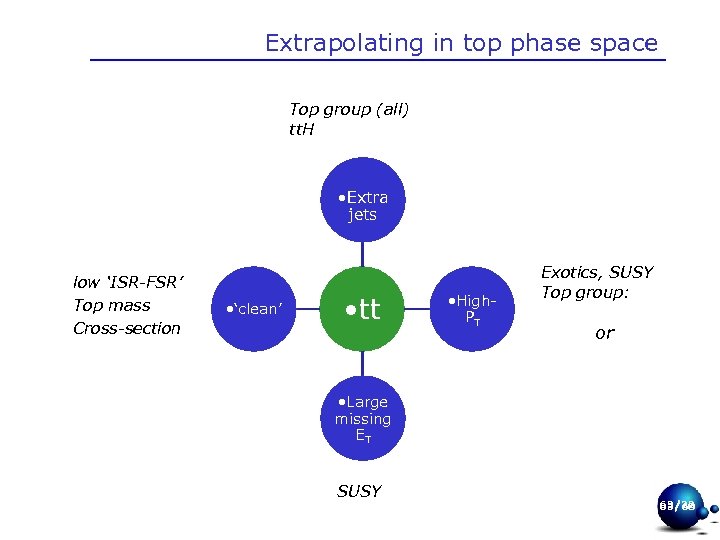 Extrapolating in top phase space Top group (all) tt. H • Extra jets low ‘ISR-FSR’ Top mass Cross-section • ‘clean’ • tt • High. PT Exotics, SUSY Top group: or • Large missing ET SUSY 63/22 63/60
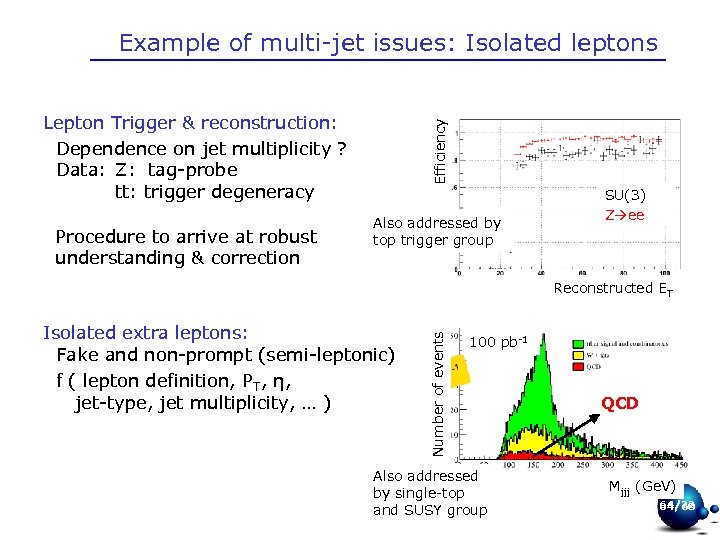 Example of multi-jet issues: Isolated leptons Procedure to arrive at robust understanding & correction Efficiency Lepton Trigger & reconstruction: Dependence on jet multiplicity ? Data: Z: tag-probe tt: trigger degeneracy Also addressed by top trigger group SU(3) Z ee Isolated extra leptons: Fake and non-prompt (semi-leptonic) f ( lepton definition, PT, η, jet-type, jet multiplicity, … ) Number of events Reconstructed ET 100 pb-1 Also addressed by single-top and SUSY group Tokyo, Nikhef QCD Mjjj (Ge. V) 64/22 64/60