Prepared by: Matina L. E. Cheched by: Iskaliev B. I.
Plan: 1. 2. 3. 4. 5. 6. 7. THE UNIVERSITY OF OXFORD HISTORY ORGANISATION CENTRAL GOVERNANCE COLLEGES TEACHING AND DEGREES ACADEMIC YEAR
The University of Oxford • The University of Oxford (informally Oxford University, or simply Oxford), located in the English city of Oxford, is the oldest surviving university in the English-speaking world[5] and is regarded as one of the world's leading academic institutions. Although the exact date of foundation remains unclear, there is evidence of teaching there as far back as the 11 th century. The University grew rapidly from 1167 when Henry II banned English students from attending the University of Paris.
• After disputes between students and Oxford townsfolk in 1209, some academics fled northeast to Cambridge, where they established what became the University of Cambridge. The two "ancient universities" have many common features and are nowadays known as Oxbridge. In post-nominals the University of Oxford is typically abbreviated as Oxon. (from the Latin Oxoniensis), although Oxf is sometimes used in official publications.
The University of Oxford Most undergraduate teaching at Oxford is organised around weekly essay-based tutorials at self-governing colleges and halls, supported by lectures and laboratory classes organised by University faculties and departments. League tables consistently list Oxford as one of the UK's best universities, and Oxford consistently ranks in the world's top 10. The University is a member of the Russell Group of research-led British universities, the Coimbra Group, the League of European Research Universities, International Alliance of Research Universities and is also a core member of the Europaeum. For more than a century, it has served as the home of the Rhodes Scholarship, which brings students from a number of countries to study at Oxford as postgraduates.
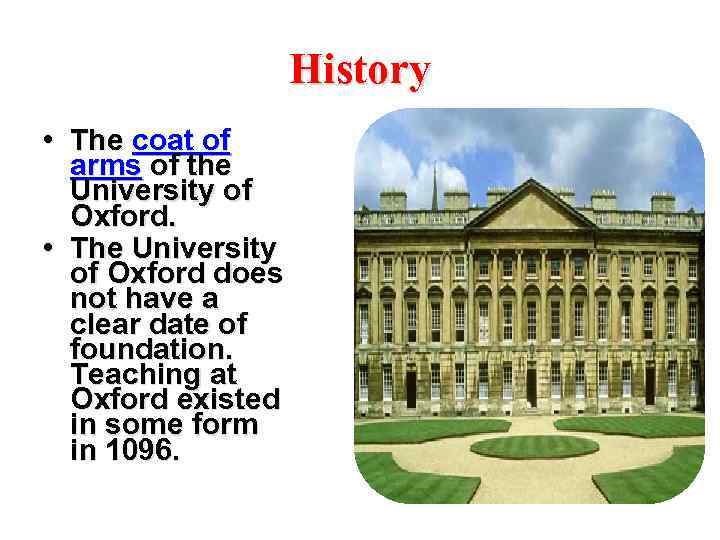
History • The coat of arms of the University of Oxford. • The University of Oxford does not have a clear date of foundation. Teaching at Oxford existed in some form in 1096.
The expulsion of foreigners from the University of Paris in 1167 caused many English scholars to return from France and settle in Oxford. The historian Gerald of Wales lectured to the scholars in 1188, and the first known foreign scholar, Emo of Friesland, arrived in 1190. The head of the University was named a chancellor from 1201, and the masters were recognised as a universitas or corporation in 1231. The students associated together, on the basis of geographical origins, into two “nations”, representing the North (including the Scots) and the South (including the Irish and the Welsh). In later centuries, geographical origins continued to influence many students' affiliations when membership of a college or hall became customary in Oxford. Members of many religious orders, including Dominicans, Franciscans, Carmelites, and Augustinians, settled in Oxford in the mid-13 th century, gained influence, and maintained houses for students. At about the same time, private benefactors established colleges to serve as self-contained scholarly communities. Among the earliest were John I de Balliol, father of the future King of Scots; Balliol College bears his name. Another founder, Walter de Merton, a chancellor of England afterwards Bishop of Rochester, devised a series of regulations for college life; Merton College thereby became the model for such establishments at Oxford as well as at the University of Cambridge. Thereafter, an increasing number of students forsook living in halls and religious houses in favour of living at colleges.
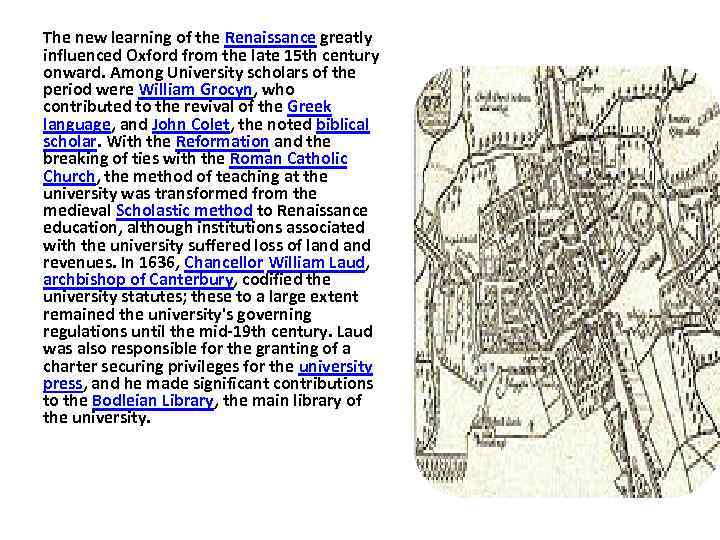
The new learning of the Renaissance greatly influenced Oxford from the late 15 th century onward. Among University scholars of the period were William Grocyn, who contributed to the revival of the Greek language, and John Colet, the noted biblical scholar. With the Reformation and the breaking of ties with the Roman Catholic Church, the method of teaching at the university was transformed from the medieval Scholastic method to Renaissance education, although institutions associated with the university suffered loss of land revenues. In 1636, Chancellor William Laud, archbishop of Canterbury, codified the university statutes; these to a large extent remained the university's governing regulations until the mid-19 th century. Laud was also responsible for the granting of a charter securing privileges for the university press, and he made significant contributions to the Bodleian Library, the main library of the university.
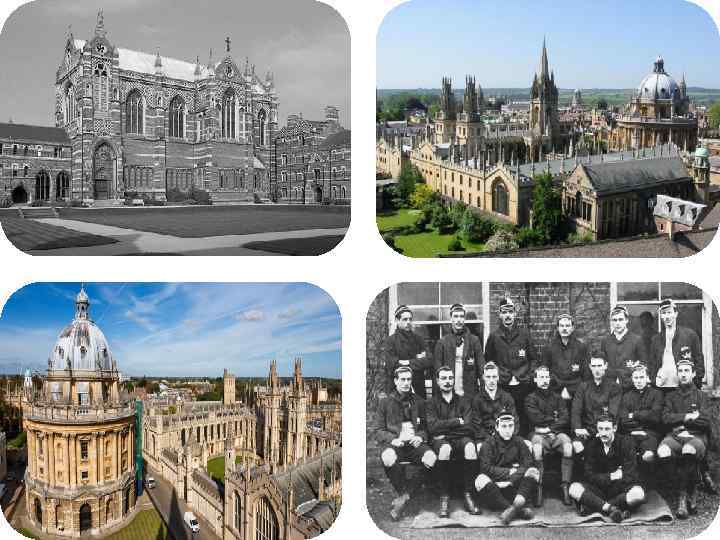
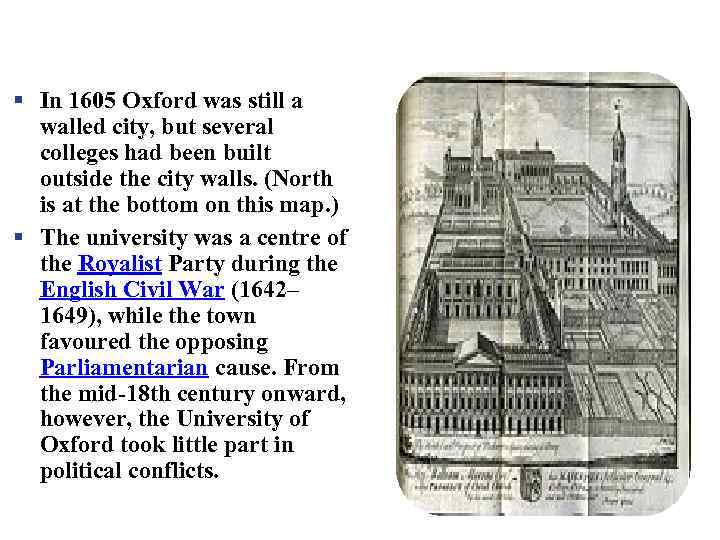
In 1605 Oxford was still a walled city, but several colleges had been built outside the city walls. (North is at the bottom on this map. ) The university was a centre of the Royalist Party during the English Civil War (1642– 1649), while the town favoured the opposing Parliamentarian cause. From the mid-18 th century onward, however, the University of Oxford took little part in political conflicts.
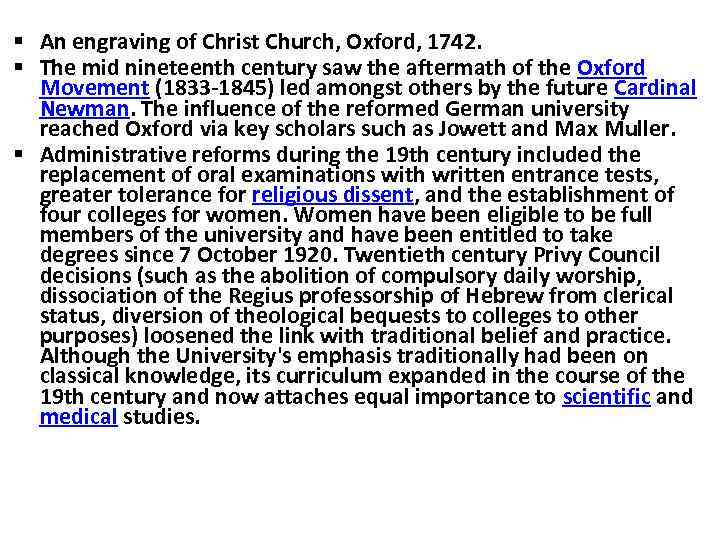
An engraving of Christ Church, Oxford, 1742. The mid nineteenth century saw the aftermath of the Oxford Movement (1833 -1845) led amongst others by the future Cardinal Newman. The influence of the reformed German university reached Oxford via key scholars such as Jowett and Max Muller. Administrative reforms during the 19 th century included the replacement of oral examinations with written entrance tests, greater tolerance for religious dissent, and the establishment of four colleges for women. Women have been eligible to be full members of the university and have been entitled to take degrees since 7 October 1920. Twentieth century Privy Council decisions (such as the abolition of compulsory daily worship, dissociation of the Regius professorship of Hebrew from clerical status, diversion of theological bequests to colleges to other purposes) loosened the link with traditional belief and practice. Although the University's emphasis traditionally had been on classical knowledge, its curriculum expanded in the course of the 19 th century and now attaches equal importance to scientific and medical studies.
• The mid twentieth century saw many distinguished continental scholars displaced by Nazism and Communism who were to find academic fulfilment in Oxford. • The list of distinguished scholars at the University of Oxford is long and includes many who have made major contributions to British politics, the sciences, medicine, and literature. More than forty Nobel laureates and more than fifty world leaders have been affiliated with the University of Oxford.
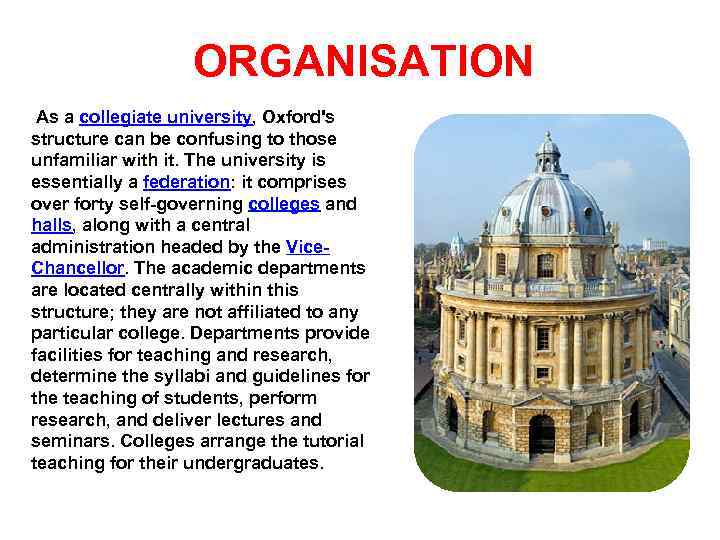
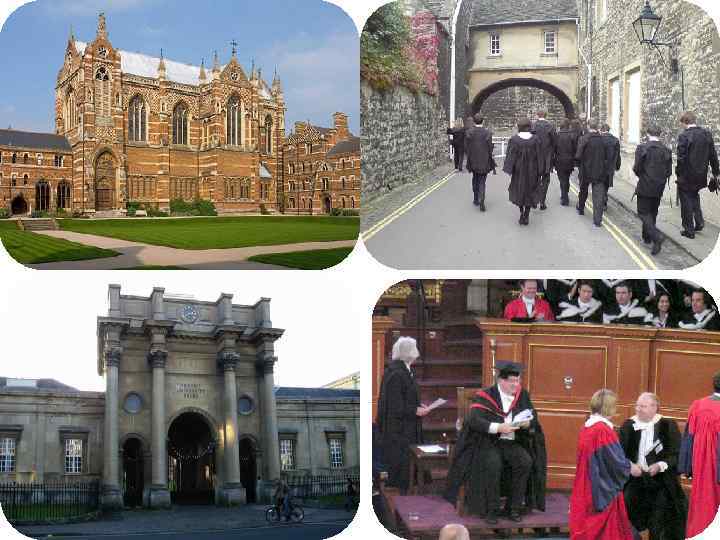
ORGANISATION As a collegiate university, Oxford's structure can be confusing to those unfamiliar with it. The university is essentially a federation: it comprises over forty self-governing colleges and halls, along with a central administration headed by the Vice. Chancellor. The academic departments are located centrally within this structure; they are not affiliated to any particular college. Departments provide facilities for teaching and research, determine the syllabi and guidelines for the teaching of students, perform research, and deliver lectures and seminars. Colleges arrange the tutorial teaching for their undergraduates.
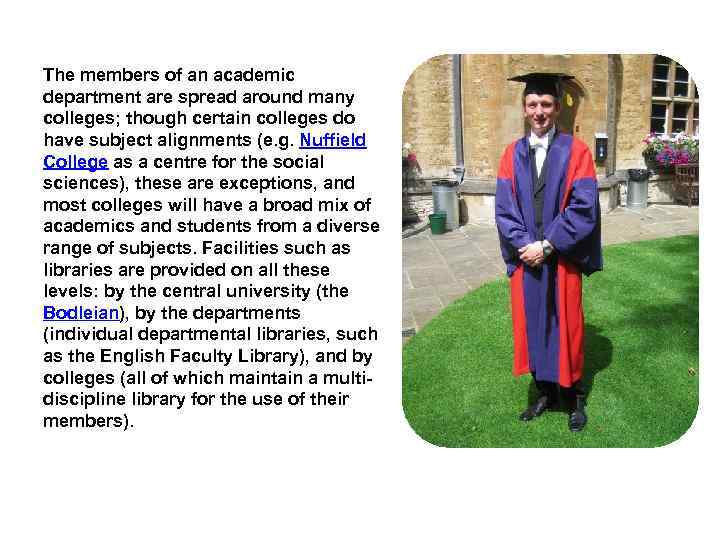
The members of an academic department are spread around many colleges; though certain colleges do have subject alignments (e. g. Nuffield College as a centre for the social sciences), these are exceptions, and most colleges will have a broad mix of academics and students from a diverse range of subjects. Facilities such as libraries are provided on all these levels: by the central university (the Bodleian), by the departments (individual departmental libraries, such as the English Faculty Library), and by colleges (all of which maintain a multidiscipline library for the use of their members).
CENTRAL GOVERNANCE The university's formal head is the Chancellor (currently Lord Patten of Barnes), though as with most British universities, the Chancellor is a titular figure, rather than someone involved with the day-to-day running of the university. The Chancellor is elected by the members of Convocation, a body comprising all graduates of the university, and holds office until death.
• The Vice-Chancellor, currently Andrew Hamilton, is the "de facto" head of the University. Five Pro-Vice. Chancellors have specific responsibilities for Education; Research; Planning and Resources; Development and External Affairs; and Personnel and Equal Opportunities. The University Council is the executive policy-forming body, which consists of the Vice-Chancellor as well as heads of departments and other members elected by Congregation, in addition to observers from the Student Union. Congregation, the "parliament of the dons", comprises over 3, 700 members of the University’s academic and administrative staff, and has ultimate responsibility for legislative matters: it discusses and pronounces on policies proposed by the University Council. Oxford and Cambridge (which is similarly structured) are unique for this democratic form of governance.
Two university proctors, who are elected annually on a rotating basis from two of the colleges, are the internal ombudsmen who make sure that the university and its members adhere to its statutes. This role incorporates student welfare and discipline, as well as oversight of the university's proceedings. The collection of University Professors is called the Statutory Professors of the University of Oxford. They are particularly influential in the running of the graduate programmes within the University. Examples of Statutory Professors are the Chichele Professorships and the Drummond Professor of Political Economy. The various academic faculties, departments, and institutes are organised into four divisions, each with their own Head and elected board. They are the Humanities Division; the Social Sciences Division; the Mathematical, Physical and Life Sciences Division; and the Medical Sciences Division
COLLEGES There are 38 colleges of the University of Oxford and 6 Permanent Private Halls, each with its own internal structure and activities. All resident students, and most academic staff, must be members both of a college or hall, and of the university. The heads of Oxford colleges are known by various titles, according to the college, including warden, provost, principal, president, rector, master or dean. The colleges join together as the Conference of Colleges to discuss policy and to deal with the central University administration. Teaching members of the colleges (fellows and tutors) are collectively and familiarly known as dons (though the term is rarely used by members of the university itself). In addition to residential and dining facilities, the colleges provide social, cultural, and recreational activities for their members. Colleges have responsibility for admitting undergraduates and organising their tuition; for graduates, this responsibility falls upon the departments.
TEACHING AND DEGREES Undergraduate teaching is centred upon the tutorial, where 1 -4 students spend an hour with an academic discussing their week’s work, usually an essay (arts) or problem sheet (sciences). Students usually have around two tutorials a week, and can be taught by academics at any other college - not just their own - as expertise and personnel requires. These tutorials are complemented by lectures, classes and seminars, which are organised on a departmental basis. Graduate students undertaking taught degrees are usually instructed through classes and seminars, though naturally there is more focus upon individual research.
• The university itself is responsible for conducting examinations and conferring degrees. The passing of two sets of examinations is a prerequisite for a first degree. The first set of examinations, called either Honour Moderations ("Mods" and "Honour Mods") or Preliminary Examinations ("Prelims"), are usually held at the end of the first year (after two terms for those studying Law, Theology, Philosophy and Theology, Experimental Psychology or Psychology, Philosophy and Physiology or after five terms in the case of Classics). The second set of examinations, the Final Honour School ("Finals"), is held at the end of the undergraduate course. Successful candidates receive first-, upper or lower second-, or third-class honours based on their performance in Finals. An upper second is the most usual result, and a first is generally prerequisite for graduate study. A "double first" reflects first class results in both Honour Mods. and Finals. Research degrees at the master's and doctoral level are conferred in all subjects studied at graduate level at the university. First degree graduates are eligible, after seven years from matriculation and without additional study, to apply for an upgrade of their bachelors level degree to a Masters level degree
ACADEMIC YEAR The academic year is divided into three terms, determined by Regulations. Michaelmas Term lasts from October to December; Hilary Term from January to March; and Trinity Term from April to June. Within these terms, Council determines for each year eight-week periods called Full Terms, during which undergraduate teaching takes place. These terms are shorter than those of many other British universities. Undergraduates are also expected to prepare heavily in the three holidays (known as the Christmas, Easter and Long Vacations).
Internally at least, the dates in the term are often referred to by a number in reference to the start of each full term, thus the first week of any full term is called "1 st week" and the last is "8 th week". The numbering of the weeks continues up to the end of the term, and begins again with negative numbering from the beginning of the succeeding term, through "minus first week" and "noughth week", which precedes "1 st week". Weeks begin on a Sunday. Undergraduates must be in residence from Thursday of 0 th week