


 Скачать презентацию Preparation of Fine Particulate Emissions Inventories Chapter 9
a26c661c0e7fc92388dcc797d056670e.ppt
- Количество слайдов: 114
 Preparation of Fine Particulate Emissions Inventories Chapter 9 – Combustion Nonpoint Sources
 What We Will Cover § § § Residential Wood Combustion Residential Open Burning Land Clearing Debris Burning Agricultural Burning Wildland Fire Emissions Preparation of Fine Particulate Emissions Inventories 2
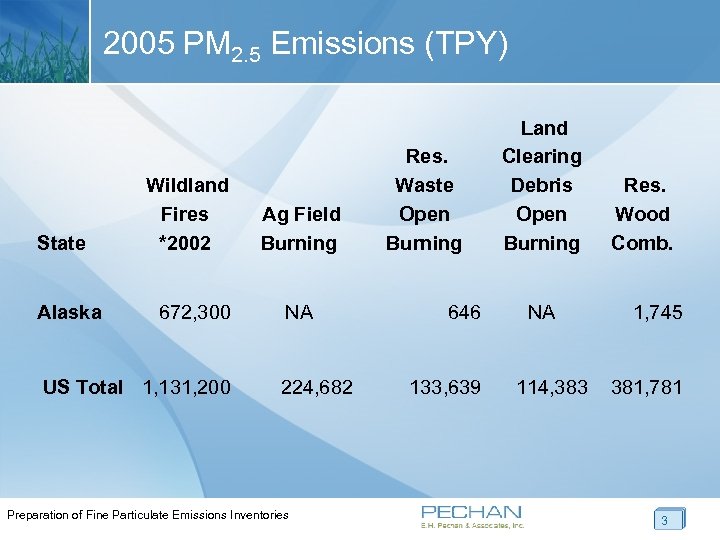 2005 PM 2. 5 Emissions (TPY) State Alaska Wildland Fires *2002 672, 300 US Total 1, 131, 200 Ag Field Burning NA 224, 682 Preparation of Fine Particulate Emissions Inventories Res. Waste Open Burning 646 133, 639 Land Clearing Debris Open Burning NA Res. Wood Comb. 1, 745 114, 383 381, 781 3
 Residential Wood Combustion § What you will Learn: – Basis of the NEI estimates – Suggestions for making improvements in your airshed Preparation of Fine Particulate Emissions Inventories 4
 MANE-VU 2002 RWC Emission Inventory § Objective – Prepare 2002 EI based on survey of household equipment usage and wood consumption patterns § Survey Method – stratified, random-sampling § Data Collected for Each Household – Wood consumption at equipment level (both real wood and artificial logs) – Wood type for real wood – Temporal activity to calculate monthly, weekly, and daily emissions Preparation of Fine Particulate Emissions Inventories 5
 Sample Frame Construction § Sampling designed to address major sources of variability in activity (i. e. , wood consumption) § Sources of variability include: – Location and type of housing – Heating demand (expressed as heating degree days (HDDs)) – Availability of wood Preparation of Fine Particulate Emissions Inventories 6
 Sample Frame Construction (cont'd) § Sample Stratification – Housing Data – 2000 Census tract data used to stratify sample by: • Urban, suburban, and rural single-family and “other” homes (other homes = multi-family units such as apartments, condos, mobile homes) • Rural category stratified by forested and non-forested areas using USGS GIS data (i. e. , Forest Fragmentation Index Map of North America) – Heating Demand – Total annual HDDs used to stratify sample into 3 zones Preparation of Fine Particulate Emissions Inventories 7
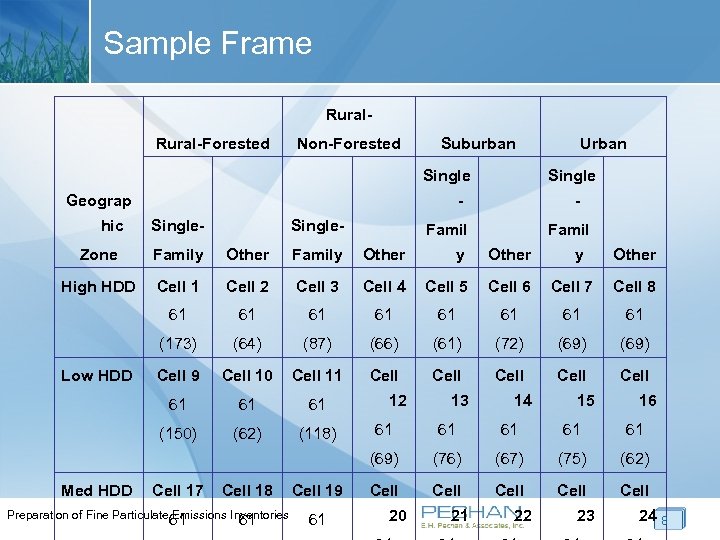 Sample Frame Rural-Forested Non-Forested Suburban Single Geograp hic Single- Urban - Famil Zone Family Other High HDD Cell 1 Cell 2 Cell 3 Cell 4 Cell 5 Cell 6 Cell 7 Cell 8 61 61 (173) (64) (87) (66) (61) (72) (69) Cell 9 Cell 10 Cell 11 Cell Cell 61 61 61 (150) (62) (118) Low HDD 12 13 14 y 15 Other 16 Cell 17 Cell 18 Cell 19 Preparation of Fine Particulate Emissions Inventories 61 61 (69) Med HDD 61 (76) (67) (75) (62) Cell Cell 20 21 22 23 24 8
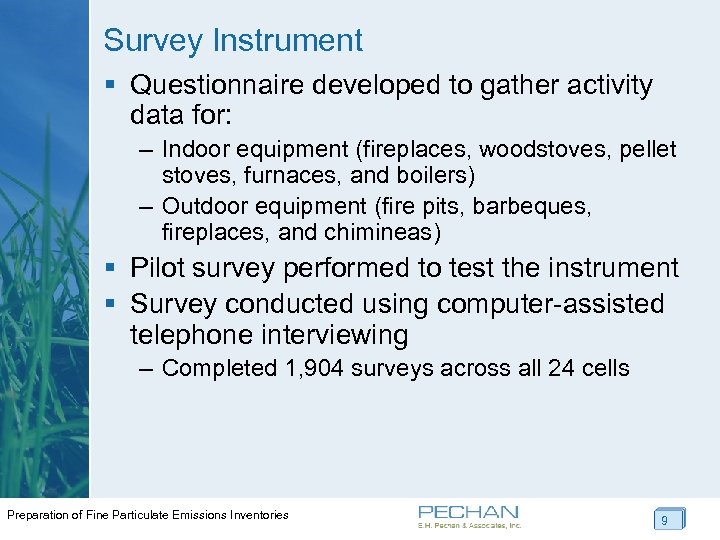 Survey Instrument § Questionnaire developed to gather activity data for: – Indoor equipment (fireplaces, woodstoves, pellet stoves, furnaces, and boilers) – Outdoor equipment (fire pits, barbeques, fireplaces, and chimineas) § Pilot survey performed to test the instrument § Survey conducted using computer-assisted telephone interviewing – Completed 1, 904 surveys across all 24 cells Preparation of Fine Particulate Emissions Inventories 9
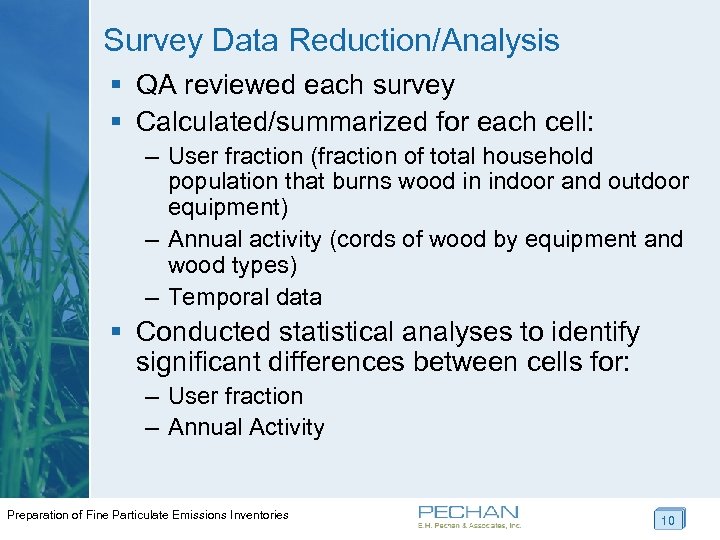 Survey Data Reduction/Analysis § QA reviewed each survey § Calculated/summarized for each cell: – User fraction (fraction of total household population that burns wood in indoor and outdoor equipment) – Annual activity (cords of wood by equipment and wood types) – Temporal data § Conducted statistical analyses to identify significant differences between cells for: – User fraction – Annual Activity Preparation of Fine Particulate Emissions Inventories 10
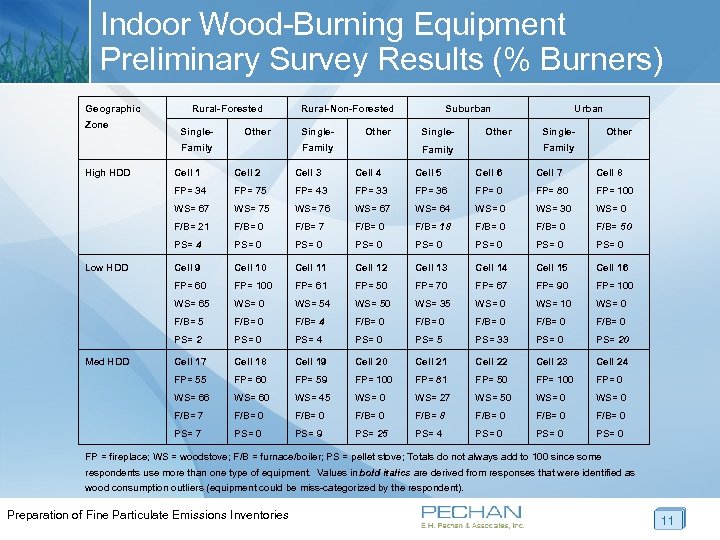 Indoor Wood-Burning Equipment Preliminary Survey Results (% Burners) Geographic Zone Rural-Forested Single- Other Family High HDD Rural-Non-Forested Single- Other Family Suburban Single- Other Urban Single- Other Family Cell 3 Cell 4 Cell 5 Cell 6 Cell 7 Cell 8 FP= 75 FP= 43 FP= 36 FP= 0 FP= 80 FP= 100 WS= 67 WS= 75 WS= 76 WS= 67 WS= 64 WS= 0 WS= 30 WS= 0 F/B= 21 F/B= 0 F/B= 7 F/B= 0 F/B= 18 F/B= 0 F/B= 50 PS= 4 PS= 0 PS= 0 Cell 9 Cell 10 Cell 11 Cell 12 Cell 13 Cell 14 Cell 15 Cell 16 FP= 60 FP= 100 FP= 61 FP= 50 FP= 70 FP= 67 FP= 90 FP= 100 WS= 65 WS= 0 WS= 54 WS= 50 WS= 35 WS= 0 WS= 10 WS= 0 F/B= 5 F/B= 0 F/B= 4 F/B= 0 F/B= 0 PS= 2 PS= 0 PS= 4 PS= 0 PS= 5 PS= 33 PS= 0 PS= 20 Cell 17 Cell 18 Cell 19 Cell 20 Cell 21 Cell 22 Cell 23 Cell 24 FP= 55 FP= 60 FP= 59 FP= 100 FP= 81 FP= 50 FP= 100 FP= 0 WS= 66 WS= 60 WS= 45 WS= 0 WS= 27 WS= 50 WS= 0 F/B= 7 F/B= 0 F/B= 8 F/B= 0 PS= 7 Med HDD Cell 2 FP= 34 Low HDD Cell 1 PS= 0 PS= 9 PS= 25 PS= 4 PS= 0 FP = fireplace; WS = woodstove; F/B = furnace/boiler; PS = pellet stove; Totals do not always add to 100 since some respondents use more than one type of equipment. Values in bold italics are derived from responses that were identified as wood consumption outliers (equipment could be miss-categorized by the respondent). Preparation of Fine Particulate Emissions Inventories 11
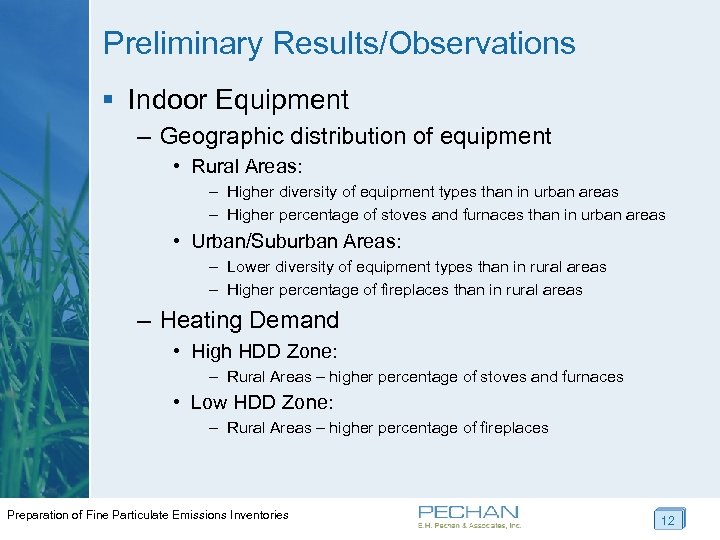 Preliminary Results/Observations § Indoor Equipment – Geographic distribution of equipment • Rural Areas: – Higher diversity of equipment types than in urban areas – Higher percentage of stoves and furnaces than in urban areas • Urban/Suburban Areas: – Lower diversity of equipment types than in rural areas – Higher percentage of fireplaces than in rural areas – Heating Demand • High HDD Zone: – Rural Areas – higher percentage of stoves and furnaces • Low HDD Zone: – Rural Areas – higher percentage of fireplaces Preparation of Fine Particulate Emissions Inventories 12
 Preliminary Results/Observations (cont'd) § Indoor Equipment – For urban areas, it was difficult to find households that burned wood for the sample size taken – The urban sample size was not increased because of budget constraints and priorities for obtaining a representative sample for three instead of two HDD zones – The equipment- and fuel-based survey results were used to estimate emissions (e. g. , lbs PM 2. 5/household-yr) for each household surveyed – A household-based statistical model is being developed to estimate emissions for each cell Preparation of Fine Particulate Emissions Inventories 13
 Preliminary Results/Observations (cont'd) § Outdoor Equipment – Equipment-based emissions will be estimated using survey results Annual Emissions = Fraction of outdoor equipment users per cell x annual activity x emission factor Preparation of Fine Particulate Emissions Inventories 14
 Emission Inventory Development § Emissions were: – Estimated for all criteria pollutants/precursors and several dozen toxic air pollutants – Estimated at the census tract level (summed to county, state, region) – Temporally allocated to support modeling using profiles developed from the survey Preparation of Fine Particulate Emissions Inventories 15
 Lessons Learned § Survey Instrument: for regional surveys, tailor it to suit the usage patterns in rural, suburban, urban areas § Difficult to find wood burners in urban areas – minimum sample sizes need to reflect this Preparation of Fine Particulate Emissions Inventories 16
 Lessons Learned (cont'd) § For indoor equipment, to keep resources manageable: – Consider the use of a statistically-derived emissions-based model (household level) instead of an equipment-specific method – Concern: Approach aggregates emissions for different types of wood burning equipment needed to support control measure analysis Preparation of Fine Particulate Emissions Inventories 17
 Documentation for MANE-VU EI Final Report: MANE-VU Residential Wood Combustion Emission Inventory (June 22, 2004) http: //www. marama. org/visibility/Res. Wood. Com bustion/Final_report. pdf Preparation of Fine Particulate Emissions Inventories 18
 How are RWC Emissions Estimated in the 2005 and 2008 NEI? § Uses new RWC emissions tool § MS Access tool § Uses available activity and emission factor data § Users can update values for their states/counties § Produces county-level emission estimates Preparation of Fine Particulate Emissions Inventories 19
 How are RWC Emissions Estimated in the 2005 and 2008 NEI? (cont'd) § Pollutants – PM 10 -PRI, PM 2. 5 -PRI, NOx, CO, VOC, SOx – HAPs (number of pollutants) Preparation of Fine Particulate Emissions Inventories 20
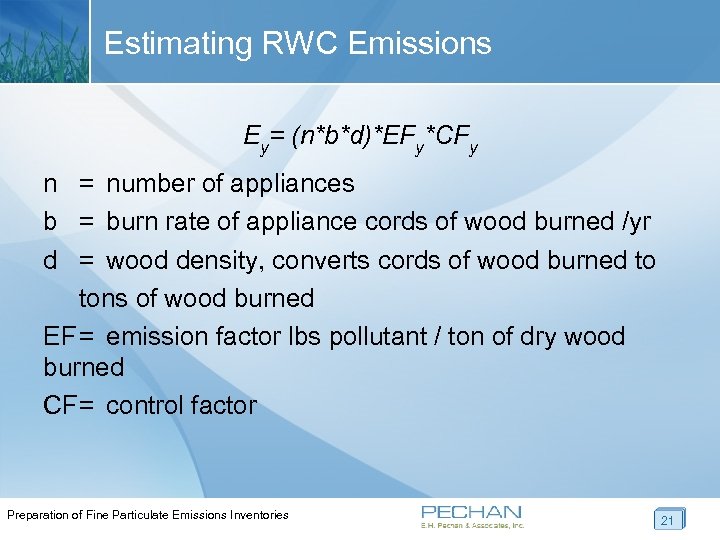 Estimating RWC Emissions Ey= (n*b*d)*EFy*CFy n = number of appliances b = burn rate of appliance cords of wood burned /yr d = wood density, converts cords of wood burned to tons of wood burned EF = emission factor lbs pollutant / ton of dry wood burned CF= control factor Preparation of Fine Particulate Emissions Inventories 21
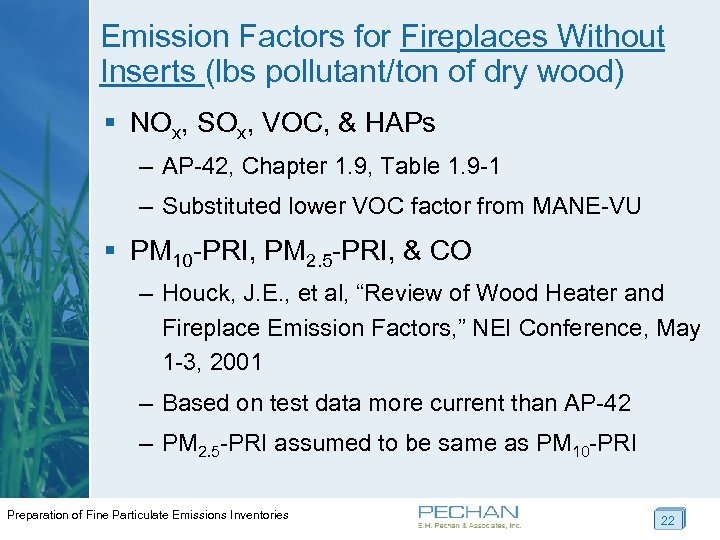 Emission Factors for Fireplaces Without Inserts (lbs pollutant/ton of dry wood) § NOx, SOx, VOC, & HAPs – AP-42, Chapter 1. 9, Table 1. 9 -1 – Substituted lower VOC factor from MANE-VU § PM 10 -PRI, PM 2. 5 -PRI, & CO – Houck, J. E. , et al, “Review of Wood Heater and Fireplace Emission Factors, ” NEI Conference, May 1 -3, 2001 – Based on test data more current than AP-42 – PM 2. 5 -PRI assumed to be same as PM 10 -PRI Preparation of Fine Particulate Emissions Inventories 22
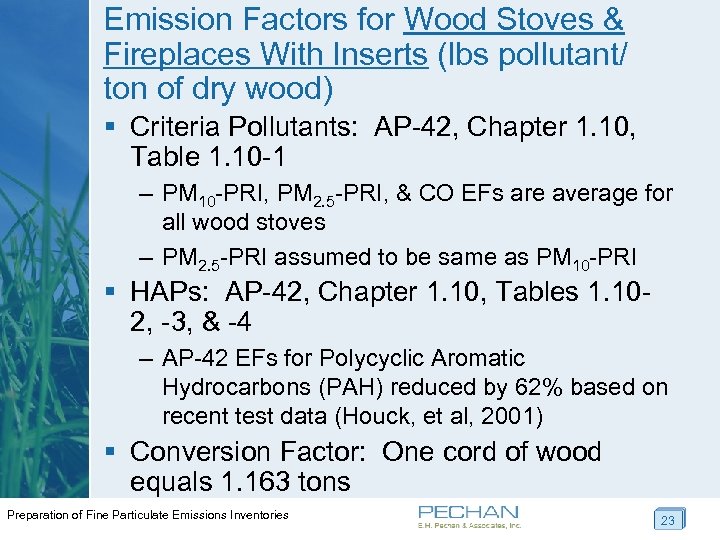 Emission Factors for Wood Stoves & Fireplaces With Inserts (lbs pollutant/ ton of dry wood) § Criteria Pollutants: AP-42, Chapter 1. 10, Table 1. 10 -1 – PM 10 -PRI, PM 2. 5 -PRI, & CO EFs are average for all wood stoves – PM 2. 5 -PRI assumed to be same as PM 10 -PRI § HAPs: AP-42, Chapter 1. 10, Tables 1. 102, -3, & -4 – AP-42 EFs for Polycyclic Aromatic Hydrocarbons (PAH) reduced by 62% based on recent test data (Houck, et al, 2001) § Conversion Factor: One cord of wood equals 1. 163 tons Preparation of Fine Particulate Emissions Inventories 23
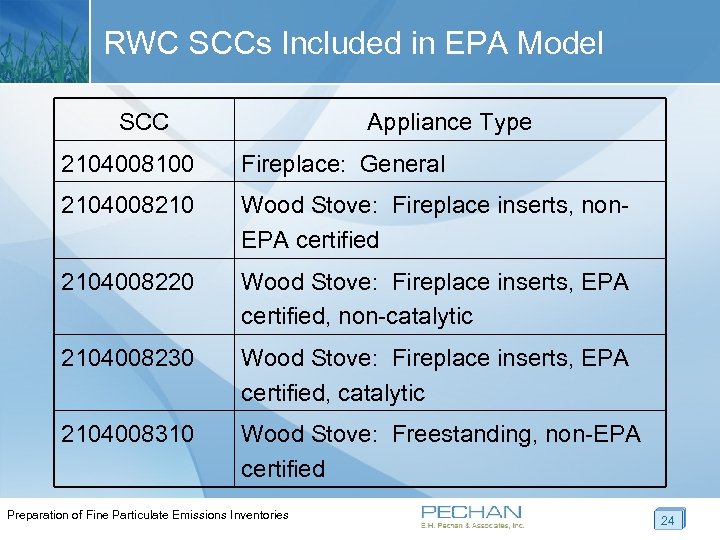 RWC SCCs Included in EPA Model SCC Appliance Type 2104008100 Fireplace: General 2104008210 Wood Stove: Fireplace inserts, non. EPA certified 2104008220 Wood Stove: Fireplace inserts, EPA certified, non-catalytic 2104008230 Wood Stove: Fireplace inserts, EPA certified, catalytic 2104008310 Wood Stove: Freestanding, non-EPA certified Preparation of Fine Particulate Emissions Inventories 24
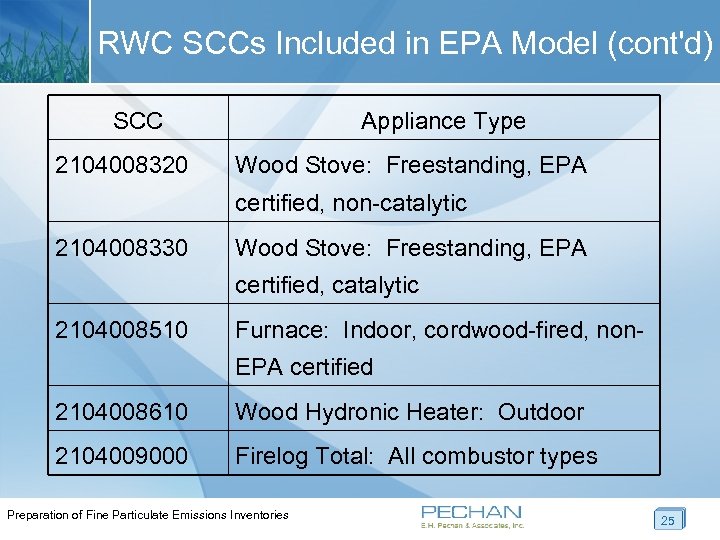 RWC SCCs Included in EPA Model (cont'd) SCC 2104008320 Appliance Type Wood Stove: Freestanding, EPA certified, non-catalytic 2104008330 Wood Stove: Freestanding, EPA certified, catalytic 2104008510 Furnace: Indoor, cordwood-fired, non. EPA certified 2104008610 Wood Hydronic Heater: Outdoor 2104009000 Firelog Total: All combustor types Preparation of Fine Particulate Emissions Inventories 25
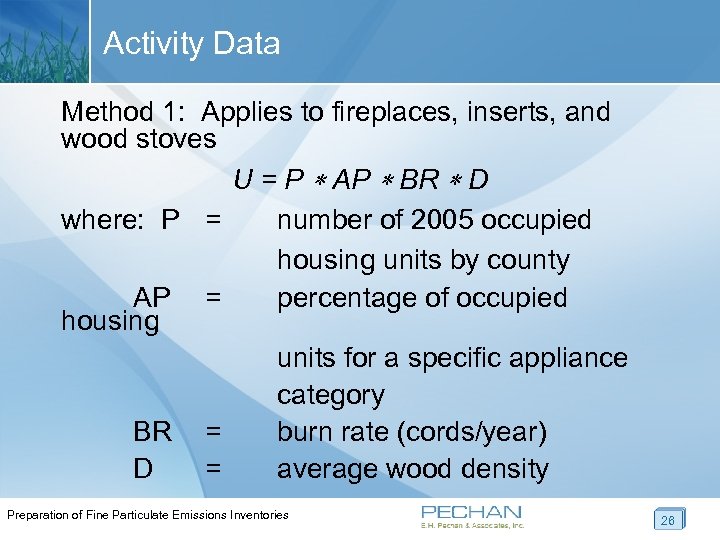 Activity Data Method 1: Applies to fireplaces, inserts, and wood stoves U = P AP BR D where: P = number of 2005 occupied housing units by county AP = percentage of occupied housing units for a specific appliance category BR = burn rate (cords/year) D = average wood density Preparation of Fine Particulate Emissions Inventories 26
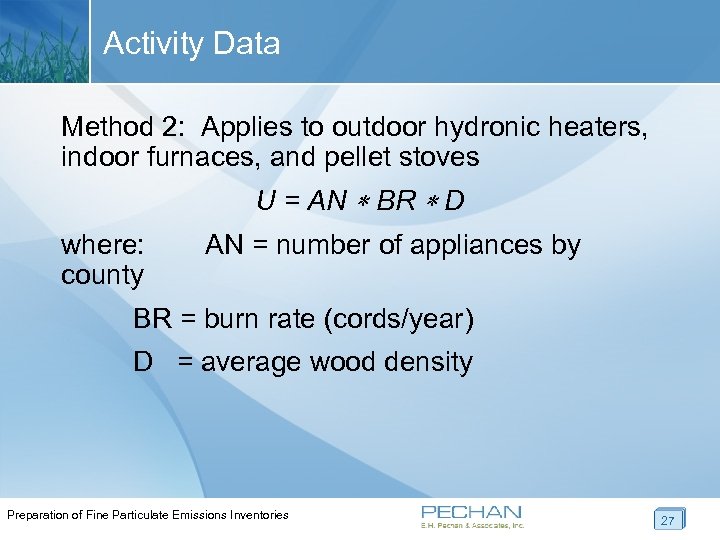 Activity Data Method 2: Applies to outdoor hydronic heaters, indoor furnaces, and pellet stoves U = AN BR D where: county AN = number of appliances by BR = burn rate (cords/year) D = average wood density Preparation of Fine Particulate Emissions Inventories 27
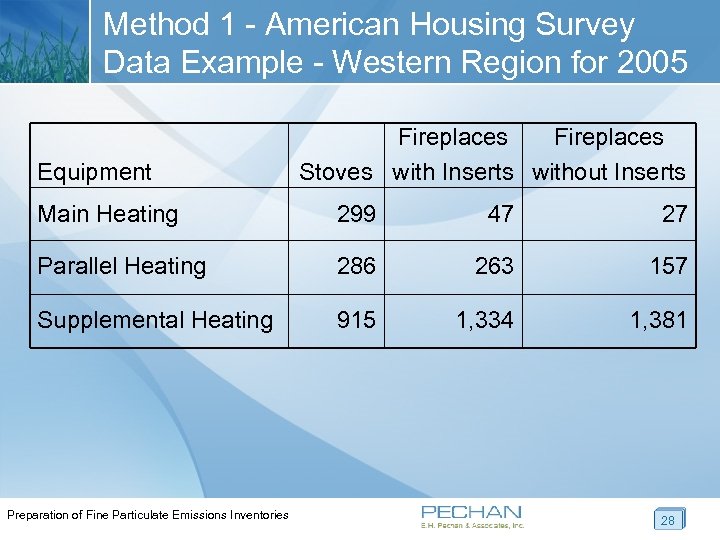 Method 1 - American Housing Survey Data Example - Western Region for 2005 Equipment Fireplaces Stoves with Inserts without Inserts Main Heating 299 47 27 Parallel Heating 286 263 157 Supplemental Heating 915 1, 334 1, 381 Preparation of Fine Particulate Emissions Inventories 28
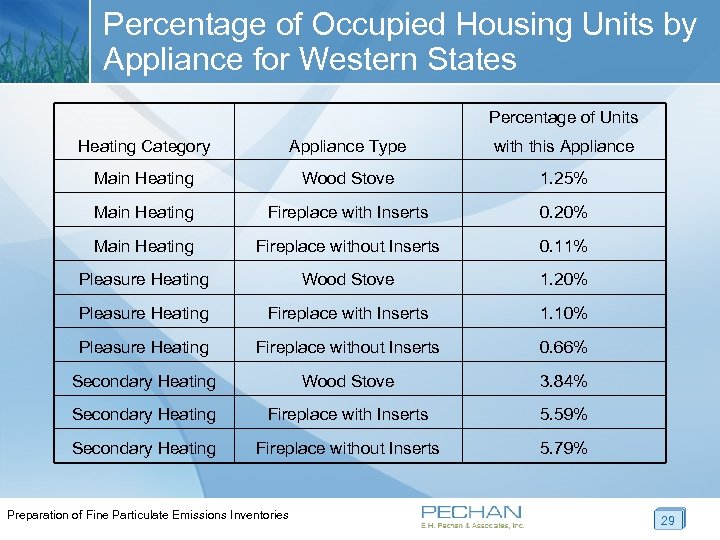 Percentage of Occupied Housing Units by Appliance for Western States Percentage of Units Heating Category Appliance Type with this Appliance Main Heating Wood Stove 1. 25% Main Heating Fireplace with Inserts 0. 20% Main Heating Fireplace without Inserts 0. 11% Pleasure Heating Wood Stove 1. 20% Pleasure Heating Fireplace with Inserts 1. 10% Pleasure Heating Fireplace without Inserts 0. 66% Secondary Heating Wood Stove 3. 84% Secondary Heating Fireplace with Inserts 5. 59% Secondary Heating Fireplace without Inserts 5. 79% Preparation of Fine Particulate Emissions Inventories 29
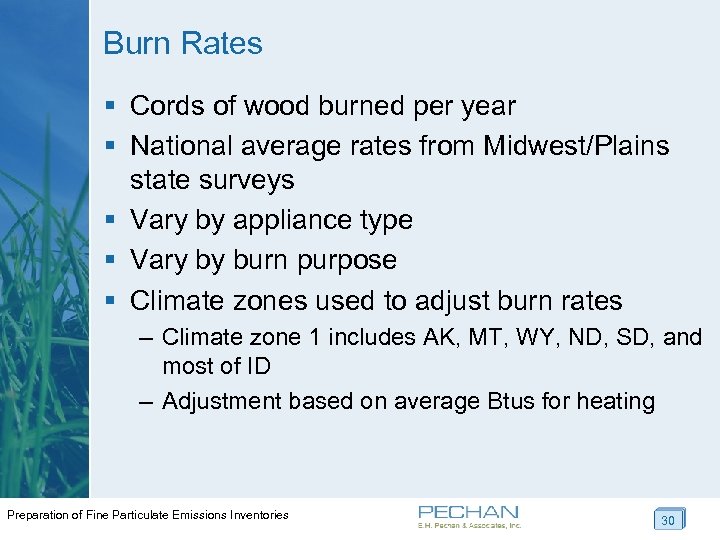 Burn Rates § Cords of wood burned per year § National average rates from Midwest/Plains state surveys § Vary by appliance type § Vary by burn purpose § Climate zones used to adjust burn rates – Climate zone 1 includes AK, MT, WY, ND, SD, and most of ID – Adjustment based on average Btus for heating Preparation of Fine Particulate Emissions Inventories 30
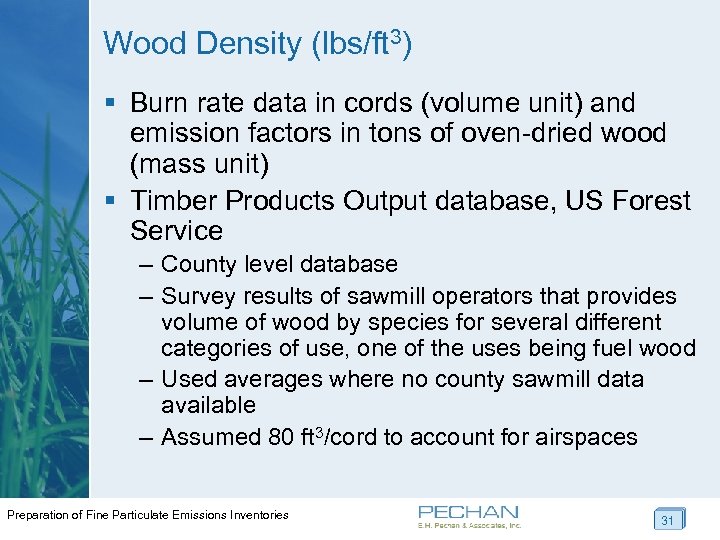 Wood Density (lbs/ft 3) § Burn rate data in cords (volume unit) and emission factors in tons of oven-dried wood (mass unit) § Timber Products Output database, US Forest Service – County level database – Survey results of sawmill operators that provides volume of wood by species for several different categories of use, one of the uses being fuel wood – Used averages where no county sawmill data available – Assumed 80 ft 3/cord to account for airspaces Preparation of Fine Particulate Emissions Inventories 31
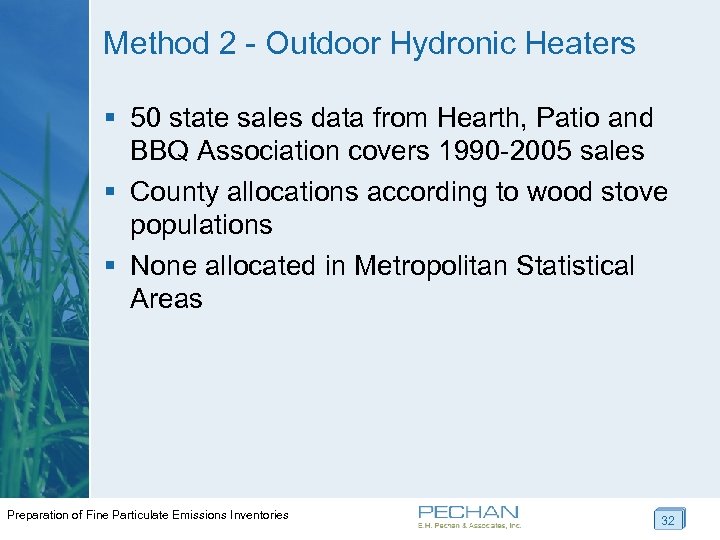 Method 2 - Outdoor Hydronic Heaters § 50 state sales data from Hearth, Patio and BBQ Association covers 1990 -2005 sales § County allocations according to wood stove populations § None allocated in Metropolitan Statistical Areas Preparation of Fine Particulate Emissions Inventories 32
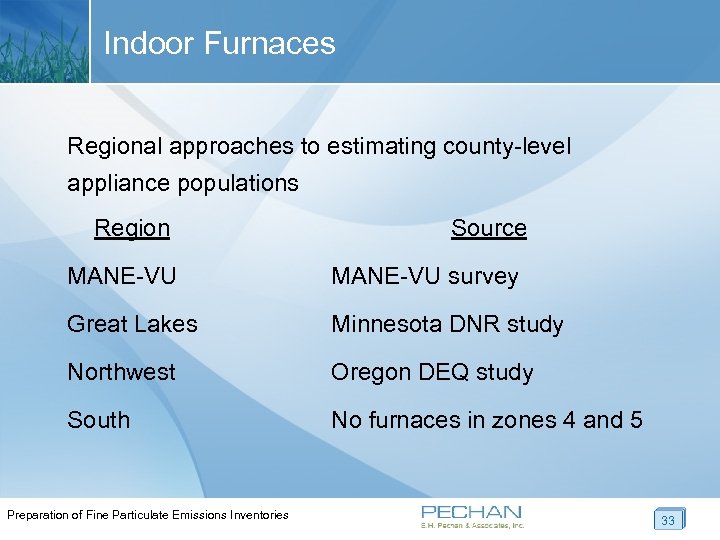 Indoor Furnaces Regional approaches to estimating county-level appliance populations Region Source MANE-VU survey Great Lakes Minnesota DNR study Northwest Oregon DEQ study South No furnaces in zones 4 and 5 Preparation of Fine Particulate Emissions Inventories 33
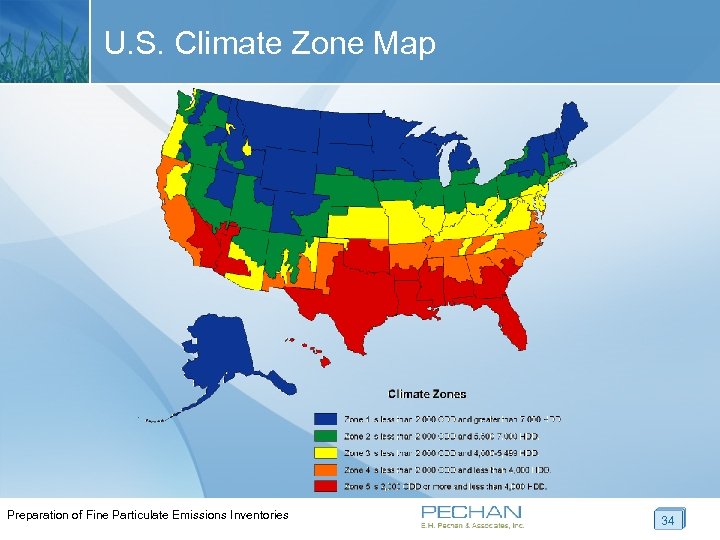 U. S. Climate Zone Map Preparation of Fine Particulate Emissions Inventories 34
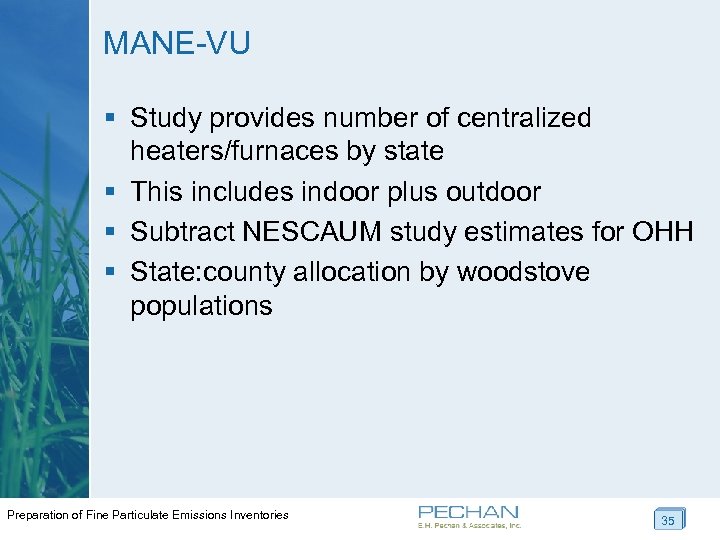 MANE-VU § Study provides number of centralized heaters/furnaces by state § This includes indoor plus outdoor § Subtract NESCAUM study estimates for OHH § State: county allocation by woodstove populations Preparation of Fine Particulate Emissions Inventories 35
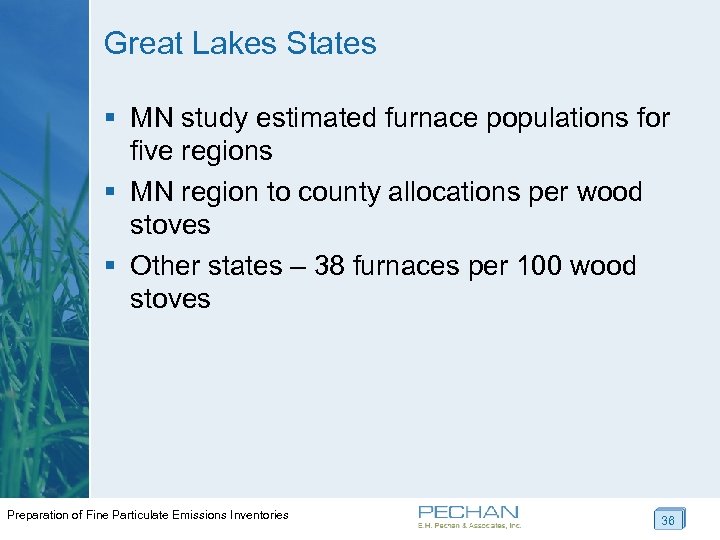 Great Lakes States § MN study estimated furnace populations for five regions § MN region to county allocations per wood stoves § Other states – 38 furnaces per 100 wood stoves Preparation of Fine Particulate Emissions Inventories 36
 Northwest § Oregon DEQ study (2000) § This yielded a ratio of furnaces to wood stoves § Applied in other NW states to determine furnace populations § 5. 3 indoor furnaces to 100 wood stoves Preparation of Fine Particulate Emissions Inventories 37
 Burn Rates § Entries contain: – – burn profile SCC burn purpose cords burned per year per appliance Preparation of Fine Particulate Emissions Inventories 38
 County Populations § Entries contain: – – – county number of occupied housing units in 2005 appliance profile burn profile climate zone Preparation of Fine Particulate Emissions Inventories 39
 Appliance Profiles § Entries contain: – – appliance profile SCC burn purpose (main, secondary, or pleasure) percentage of households with an appliance of the type corresponding to the SCC Preparation of Fine Particulate Emissions Inventories 40
 Density by County § Entries contain: – – county density in lbs/ft 3 density in tons/cord data source Preparation of Fine Particulate Emissions Inventories 41
 Other Appliance Populations § Entries contain: – – county SCC burn purpose number of appliances in the county with an appliance of the type corresponding to the SCC Preparation of Fine Particulate Emissions Inventories 42
 Emission Factor by SCC § Entries contain: – – SCC pollutant emission factor with units emission factor converted to tons pollutant/tons of wood combusted – data source for the emission factor Preparation of Fine Particulate Emissions Inventories 43
 How Can You Improve the NEI for Your Area? § Preferred Method: Residential Wood Survey – Obtain locally representative information on the amount of wood fuel use specifically for wood stoves & fireplaces (with and without inserts) – This will require a local survey, or activity data generated by state & local governments – Reduces uncertainties in estimates associated with allocating national activity to counties Preparation of Fine Particulate Emissions Inventories 44
 How Can You Improve the NEI for Your Area? (cont'd) § Rule Effectiveness/Rule Penetration – Incorporate effects of S/L/T rules and level of compliance – NEI methodology does not account for S/L/T rules Preparation of Fine Particulate Emissions Inventories 45
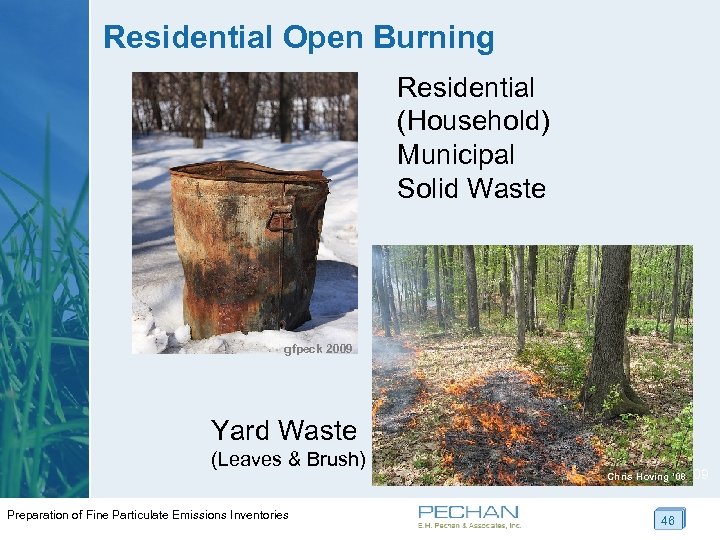 Residential Open Burning Residential (Household) Municipal Solid Waste gfpeck 2009 Yard Waste (Leaves & Brush) Preparation of Fine Particulate Emissions Inventories thievingjoker 2009 Chris Hoving ‘ 08 46
 Residential Open Burning - What Sources are Included? SCCs: 2610030000 - Residential Municipal Solid Waste (MSW) Burning Pollutants: PM 10, PM 2. 5, CO, NOx, VOC, SO 2, 32 HAPs 2610000100 - Residential Leaf Burning 2610000400 - Residential Brush Burning Pollutants: PM 10, PM 2. 5, CO, VOC, 6 HAPs Details: http: //www. epa. gov/ttn/chief/net/2002 inventory. html#documentation Preparation of Fine Particulate Emissions Inventories 47
 Residential Open Burning - NEI Methods for Residential MSW § Activity Data (tons of waste burned) § Step 1 - Estimate 2002 rural population by county – County-level rural population estimated by applying rural/urban percentages from 2000 Census data to 2002 population § Step 2 - Multiply per capita waste factor by rural population – Used national average per capita waste generation factor of 3. 37 lbs/person/day (noncombustibles and yard waste subtracted out) Preparation of Fine Particulate Emissions Inventories 48
 Residential Open Burning - NEI Methods for Residential MSW (cont'd) § Step 3 - Estimate amount of waste burned – Assume 28% of total waste generated is burned (default) § Step 4 - Account for burning bans – For counties where urban population exceeds 80 percent of the total population, the amount of waste burned was assumed to be zero, therefore zero open burning assigned to these counties Preparation of Fine Particulate Emissions Inventories 49
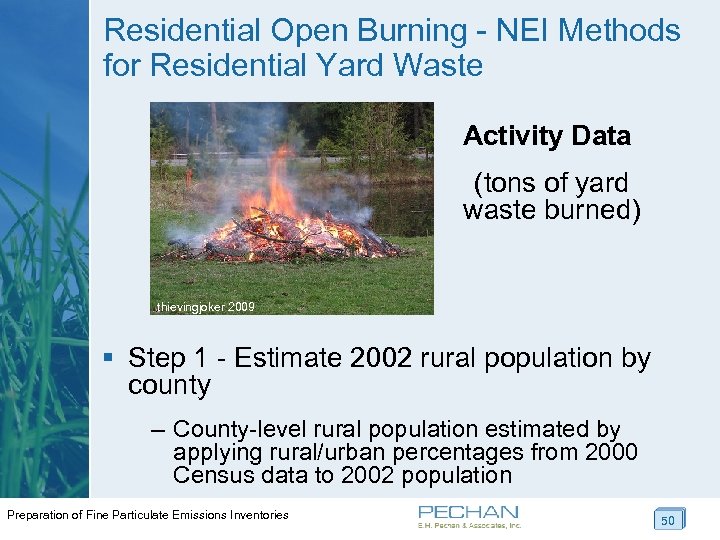 Residential Open Burning - NEI Methods for Residential Yard Waste Activity Data (tons of yard waste burned) thievingjoker 2009 § Step 1 - Estimate 2002 rural population by county – County-level rural population estimated by applying rural/urban percentages from 2000 Census data to 2002 population Preparation of Fine Particulate Emissions Inventories 50
 Residential Open Burning - NEI Methods for Residential Yard Waste (cont'd) § Step 2 - Multiply per capita waste factor by rural population – Used national average per capita yard waste generation factor of 0. 54 lbs/person/day § Step 3 - Estimate amount of leaf, brush and grass yard waste – Multiply total yard waste mass by 25% to estimate leaf waste, 25% for brush waste, and 50% for grass waste § Step 4 - Estimate amount of waste burned – Assume 28% of total leaf and brush waste generated is burned; assume 0% of grass is burned Preparation of Fine Particulate Emissions Inventories 51
 Residential Open Burning - NEI Methods for Residential Yard Waste (cont'd) § Step 5 - Adjust for variations in vegetation – Used the following ranges to make adjustments to the amount of yard waste generated per county: Percent forested acres per county Adjustment for yard waste generated < 10% Zero out >=10%, and <50% Multiply by 50% >=50% Assume 100% Preparation of Fine Particulate Emissions Inventories 52
 Residential Open Burning - NEI Methods for Residential Yard Waste (cont'd) § Step 6 - Account for burning bans – For counties where urban population exceeds 80 percent of the total population, the amount of waste burned was assumed to be zero, therefore zero open burning assigned to these counties Preparation of Fine Particulate Emissions Inventories 53
 Residential Open Burning - NEI Methods for Residential MSW and Yard Waste E = A * EF * (1 – CE * RP * RE) where: E year = A leaves/brush burned per year EF burned CE RP = RE = Controlled Emissions, lbs pollutant per = Activity, tons of MSW or = Emission Factor, lbs per ton = % Control Efficiency/100 % Rule Penetration/100 % Rule Effectiveness/100 100% CE assumed for counties where urban population exceeds 80% of the total population Assumed 100% RE and RP All other counties, assumed 0% CE, RE, and RP Note: Emission factors are found in Appendix A of Preparation of Fine Particulate Emissions Inventories http: //www. epa. gov/ttnchie 1/net/2002 inventory. html 54
 Residential Open Burning - EIIP Alternative for Yard Waste § Identify records of burning permits or violations, coupled with data (or assumptions) on typical volumes and material composition Preparation of Fine Particulate Emissions Inventories 55
 Residential Open Burning - Improvements to NEI Methods § Review EIIP Volume III, Ch. 16 Open Burning § Obtain state/local estimates of per-capita waste generation § Use state/local estimates for amount or percentage of waste burned § Obtain state/local estimates of months when yard wastes are burned Preparation of Fine Particulate Emissions Inventories 56
 Residential Open Burning - Improvements to NEI Methods (cont'd) § Data Sources – – Local or State Solid Waste Agency Air Agency County Health Department State or National Solid Waste Management Organizations – Local Survey Preparation of Fine Particulate Emissions Inventories 57
 Residential Open Burning - Improvements to NEI Methods (cont'd) § Identify rules prohibiting or limiting open burning, and the organization that enforces those rules § For areas that have burning prohibitions, consider performing rule effectiveness (RE) surveys § Level of enforcement/compliance can be a significant variable in calculating controlled emissions § Rule penetration (RP) to reflect duration of seasonal bans relative to annual activity profile, exempt activities Preparation of Fine Particulate Emissions Inventories 58
 Residential Open Burning - MANE-VU Example § Development of 2002 residential open burning inventory for MANE-VU states § Multi-state RPO developed inventory following EIIP procedures Preparation of Fine Particulate Emissions Inventories 59
 Residential Open Burning - MANE-VU Example (cont'd) § Developed survey instrument to collect: – Number/percentage of households that burn waste – Burn frequency – Amount per burn – Seasonal Activity § 3 separate surveys for: – Residential MSW – Brush – Leaf Preparation of Fine Particulate Emissions Inventories 60
 Residential Open Burning - MANE-VU Example (cont'd) § Survey results were used to estimate emissions for each survey jurisdiction § For non-surveyed areas, default activity data derived from survey responses were applied Preparation of Fine Particulate Emissions Inventories 61
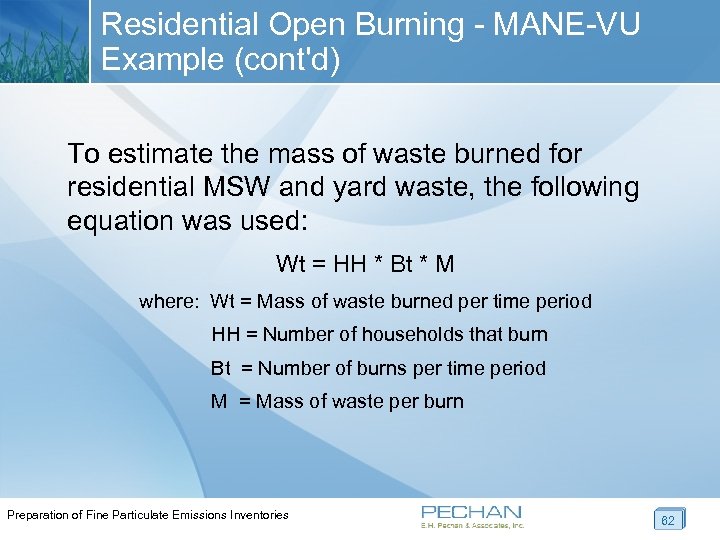 Residential Open Burning - MANE-VU Example (cont'd) To estimate the mass of waste burned for residential MSW and yard waste, the following equation was used: Wt = HH * Bt * M where: Wt = Mass of waste burned per time period HH = Number of households that burn Bt = Number of burns per time period M = Mass of waste per burn Preparation of Fine Particulate Emissions Inventories 62
 Residential Open Burning - MANE-VU Example (cont'd) § Developed database of area-specific control efficiency (CE), rule penetration (RP) and rule effectiveness (RE) § Performed rule effectiveness (RE) survey to determine level of compliance with state or local open burning prohibitions § To estimate default RE values, the survey data was statistically analyzed resulting in one value for all non-surveyed areas Preparation of Fine Particulate Emissions Inventories 63
 Residential Open Burning - MANE-VU Example (cont'd) § Emissions estimated for all criteria pollutants/precursors and several toxic air pollutants § Emissions estimated at the census tract level (summed to county, state, region) § Emissions temporally allocated to support modeling using profiles developed from the survey Preparation of Fine Particulate Emissions Inventories 64
 Lessons Learned § If leaf burning is significant, perform separate surveys in targeted areas for leaf waste and brush waste burning § Perform MSW surveys separate from yard waste surveys, instead of combined to reduce survey length § A larger sample may have allowed for greater geographic distinction Preparation of Fine Particulate Emissions Inventories 65
 Lessons Learned (cont'd) § Sub-county emissions estimates serve as the basis for a more spatially refined inventory § Regional survey provides greater consistency § Better accounting of controls results in decreased emissions relative to NEI Preparation of Fine Particulate Emissions Inventories 66
 Questions? HERVAL 2005 Preparation of Fine Particulate Emissions Inventories tsuacctnt 2009 67
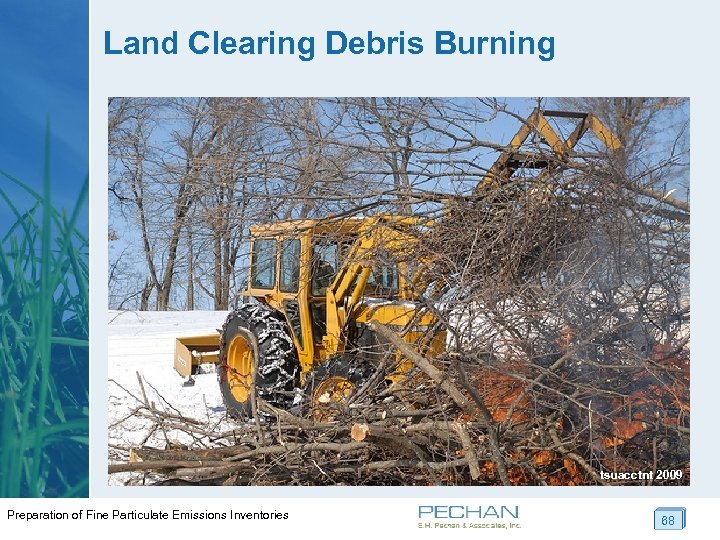 Land Clearing Debris Burning tsuacctnt 2009 Preparation of Fine Particulate Emissions Inventories 68
 Land Clearing Debris Burning - What Sources are Included? SCCs: 2610000500 - Land Clearing Debris Burning Pollutants: PM 10, PM 2. 5, CO, VOC, 6* HAPs *There are multiple HAPs likely emitted from debris burning which have not been fully assessed and will likely vary depending on debris content. The key HAPs used by EPA for risk assessment are identified as top priority for reporting. Preparation of Fine Particulate Emissions Inventories 69
 Land Clearing Debris Burning – NEI Method Activity Data § Estimate the county-level total number of acres disturbed by residential, non-residential, and roadway construction –same fundamental approach for each – Use number of acres disturbed from fugitive dust construction emissions activity calculations § Apply loading factor to number of acres to estimate the amount of material or fuel subject to burning Preparation of Fine Particulate Emissions Inventories 70
 Land Clearing Debris Burning – NEI Method (cont'd) § Weighted, county-specific loading factors developed based on acres of hardwoods, softwoods, and grasses (BELD 2 database in BEIS) http: //www. epa. gov/asmdnerl/biogen. html § Multiply average loading factors by percent contribution of each type of vegetation class to the total county land area Preparation of Fine Particulate Emissions Inventories 71
 Land Clearing Debris Burning – NEI Method (cont'd) Average loading factors for hardwood and softwood are then further adjusted by 1. 5 x to account for mass of tree below the surface Fuel Loading Fuel Type (tons/acre) Hardwood 99 Softwood 57 Grass 4. 5 Preparation of Fine Particulate Emissions Inventories 72
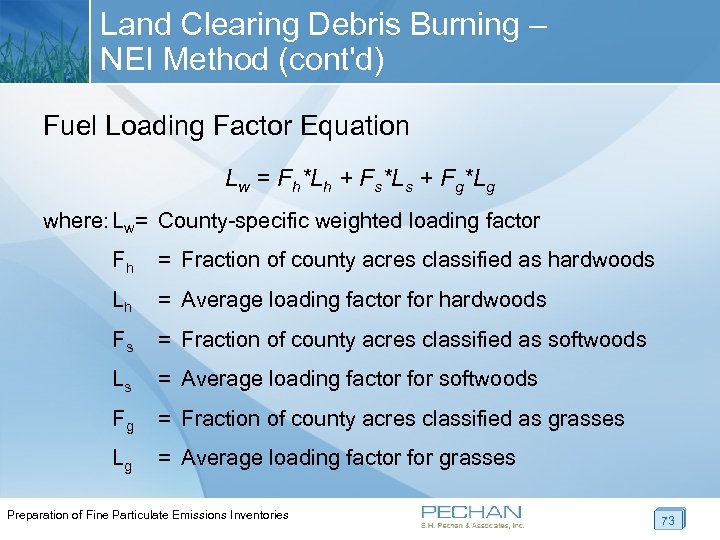 Land Clearing Debris Burning – NEI Method (cont'd) Fuel Loading Factor Equation Lw = Fh*Lh + Fs*Ls + Fg*Lg where: Lw= County-specific weighted loading factor Fh = Fraction of county acres classified as hardwoods Lh = Average loading factor for hardwoods Fs = Fraction of county acres classified as softwoods Ls = Average loading factor for softwoods Fg = Fraction of county acres classified as grasses Lg = Average loading factor for grasses Preparation of Fine Particulate Emissions Inventories 73
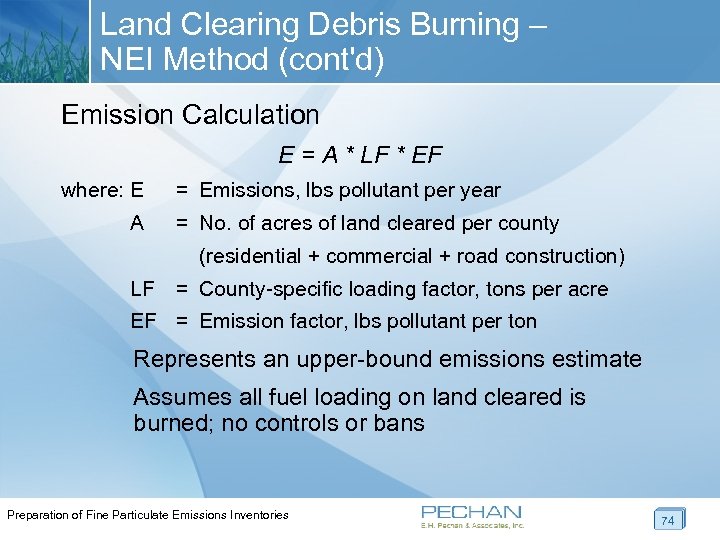 Land Clearing Debris Burning – NEI Method (cont'd) Emission Calculation E = A * LF * EF where: E A = Emissions, lbs pollutant per year = No. of acres of land cleared per county (residential + commercial + road construction) LF = County-specific loading factor, tons per acre EF = Emission factor, lbs pollutant per ton Represents an upper-bound emissions estimate Assumes all fuel loading on land cleared is burned; no controls or bans Preparation of Fine Particulate Emissions Inventories 74
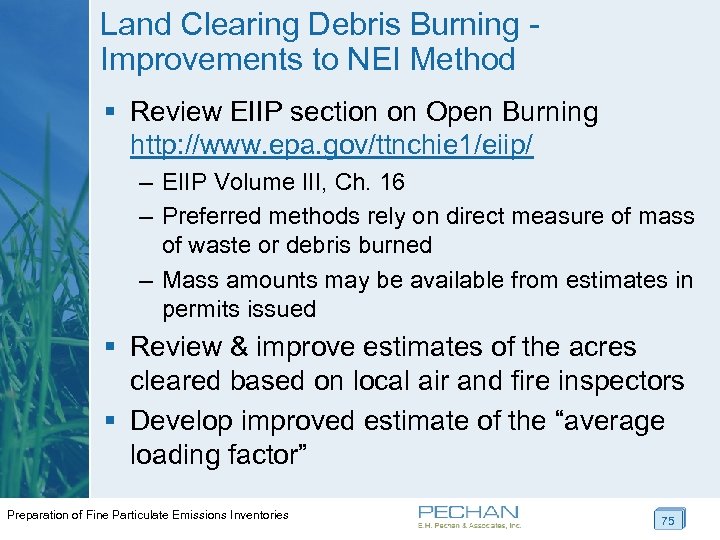 Land Clearing Debris Burning - Improvements to NEI Method § Review EIIP section on Open Burning http: //www. epa. gov/ttnchie 1/eiip/ – EIIP Volume III, Ch. 16 – Preferred methods rely on direct measure of mass of waste or debris burned – Mass amounts may be available from estimates in permits issued § Review & improve estimates of the acres cleared based on local air and fire inspectors § Develop improved estimate of the “average loading factor” Preparation of Fine Particulate Emissions Inventories 75
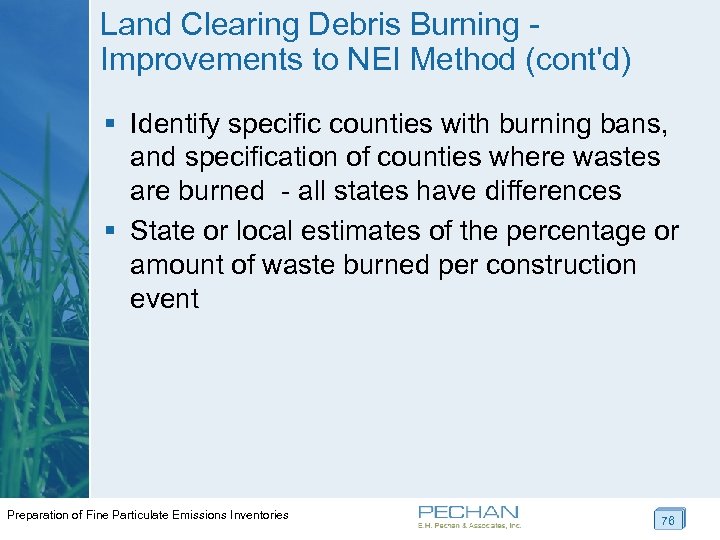 Land Clearing Debris Burning - Improvements to NEI Method (cont'd) § Identify specific counties with burning bans, and specification of counties where wastes are burned - all states have differences § State or local estimates of the percentage or amount of waste burned per construction event Preparation of Fine Particulate Emissions Inventories 76
 Land Clearing Debris Burning - Northern Virginia Example § Performed Rule Effectiveness (RE) survey to determine the level of compliance for: – Land clearing/debris burning – Residential waste burning § Developed RE to apply to ozone season open burning emission estimates for the Virginia portion of the Washington DC-MD-VA Ozone Nonattainment Area Preparation of Fine Particulate Emissions Inventories 77
 Land Clearing Debris Burning - Northern Virginia Example (cont'd) § Reviewed conditions of existing open burning rules – Time period of ban(s) – Exemptions and special provisions § Surveyed local open burning officials responsible for tracking and enforcing open burning rules Preparation of Fine Particulate Emissions Inventories 78
 Land Clearing Debris Burning - Northern Virginia Example (cont'd) § Started with EPA questionnaire from RE guidance, modified for open burning § Responses to questions are assigned specific point values that add up to a maximum of 100 points, considered equivalent to a RE percentage value Preparation of Fine Particulate Emissions Inventories 79
 Land Clearing Debris Burning - Northern Virginia Example (cont'd) § RE values analyzed by county and for 5 county region – Estimated regional RE of 93 percent § If area comprised of counties and jurisdictions with significantly different population densities, one should analyze responses by urban and rural areas Preparation of Fine Particulate Emissions Inventories 80
 Lessons Learned § Local officials may defer to higher officials (e. g. , county or state-level) for enforcing open burning rules § RE may be high for time period that ban is in effect, but need to account for duration of ban (RP) if less than annual or seasonal § It is important to account for when the ban is taking place Preparation of Fine Particulate Emissions Inventories 81
 Questions thievingjoker 2009 Preparation of Fine Particulate Emissions Inventories 82
 Agricultural Burning Wesley Fryer Preparation of Fine Particulate Emissions Inventories 83
 Agricultural Burning ~ SCC 2801500000 - What We Will Cover § General methodology § Wheat Stubble Example § Potential Improvements to NEI Preparation of Fine Particulate Emissions Inventories 84
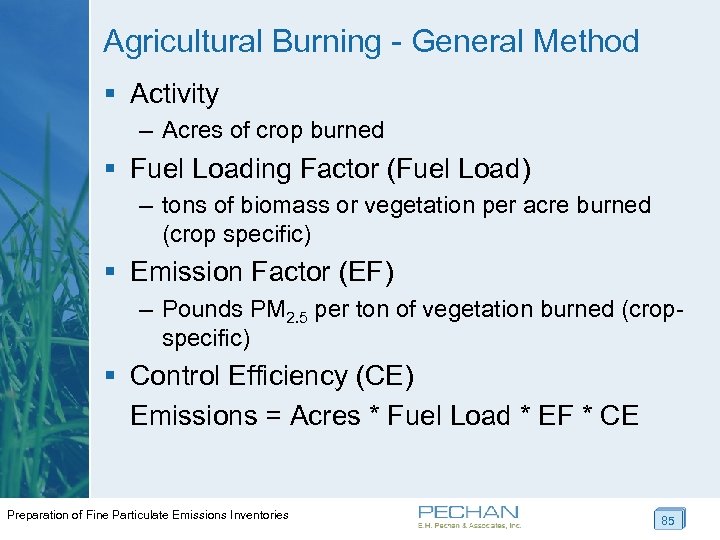 Agricultural Burning - General Method § Activity – Acres of crop burned § Fuel Loading Factor (Fuel Load) – tons of biomass or vegetation per acre burned (crop specific) § Emission Factor (EF) – Pounds PM 2. 5 per ton of vegetation burned (cropspecific) § Control Efficiency (CE) Emissions = Acres * Fuel Load * EF * CE Preparation of Fine Particulate Emissions Inventories 85
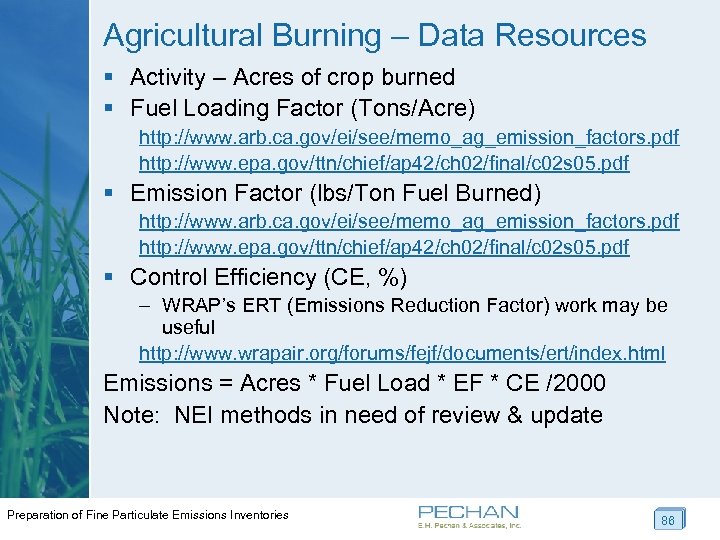 Agricultural Burning – Data Resources § Activity – Acres of crop burned § Fuel Loading Factor (Tons/Acre) http: //www. arb. ca. gov/ei/see/memo_ag_emission_factors. pdf http: //www. epa. gov/ttn/chief/ap 42/ch 02/final/c 02 s 05. pdf § Emission Factor (lbs/Ton Fuel Burned) http: //www. arb. ca. gov/ei/see/memo_ag_emission_factors. pdf http: //www. epa. gov/ttn/chief/ap 42/ch 02/final/c 02 s 05. pdf § Control Efficiency (CE, %) – WRAP’s ERT (Emissions Reduction Factor) work may be useful http: //www. wrapair. org/forums/fejf/documents/ert/index. html Emissions = Acres * Fuel Load * EF * CE /2000 Note: NEI methods in need of review & update Preparation of Fine Particulate Emissions Inventories 86
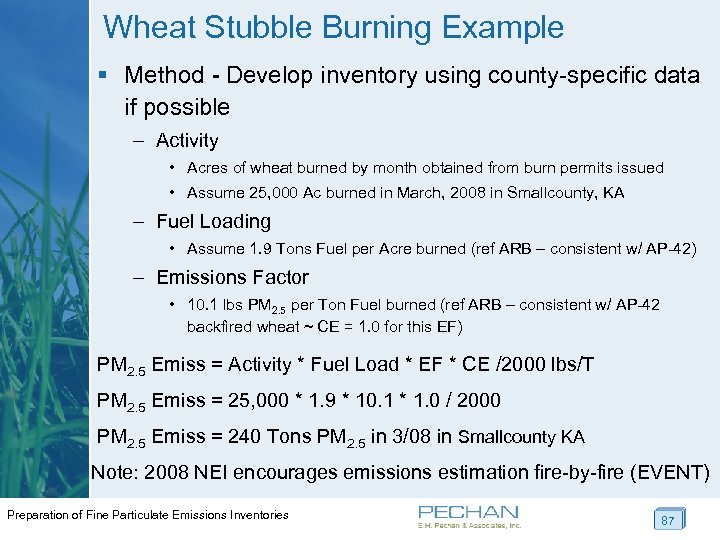 Wheat Stubble Burning Example § Method - Develop inventory using county-specific data if possible – Activity • Acres of wheat burned by month obtained from burn permits issued • Assume 25, 000 Ac burned in March, 2008 in Smallcounty, KA – Fuel Loading • Assume 1. 9 Tons Fuel per Acre burned (ref ARB – consistent w/ AP-42) – Emissions Factor • 10. 1 lbs PM 2. 5 per Ton Fuel burned (ref ARB – consistent w/ AP-42 backfired wheat ~ CE = 1. 0 for this EF) PM 2. 5 Emiss = Activity * Fuel Load * EF * CE /2000 lbs/T PM 2. 5 Emiss = 25, 000 * 1. 9 * 10. 1 * 1. 0 / 2000 PM 2. 5 Emiss = 240 Tons PM 2. 5 in 3/08 in Smallcounty KA Note: 2008 NEI encourages emissions estimation fire-by-fire (EVENT) Preparation of Fine Particulate Emissions Inventories 87
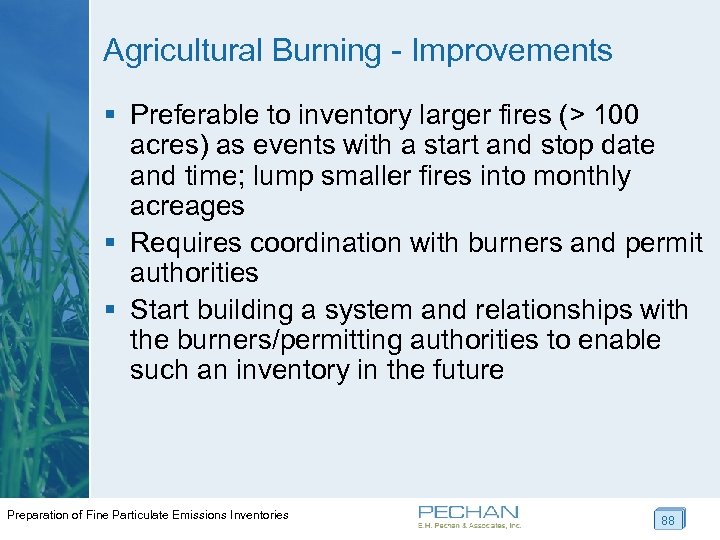 Agricultural Burning - Improvements § Preferable to inventory larger fires (> 100 acres) as events with a start and stop date and time; lump smaller fires into monthly acreages § Requires coordination with burners and permit authorities § Start building a system and relationships with the burners/permitting authorities to enable such an inventory in the future Preparation of Fine Particulate Emissions Inventories 88
 Agricultural Burning - Improvements (cont'd) § Obtain local acres of crops burned data from: – Burn permits – Survey of county agricultural extension offices – Note: some state/tribe recordkeeping “on paper” § Verify that burns actually occurred § Obtain fuel loading data – Local data preferred from county agricultural extension offices, local Natural Resources Conservation Service Center – National defaults available from Chapter 2. 5 in AP-42 (Needs review/update) Preparation of Fine Particulate Emissions Inventories 89
 Questions? SKATOOLAKI Preparation of Fine Particulate Emissions Inventories 90
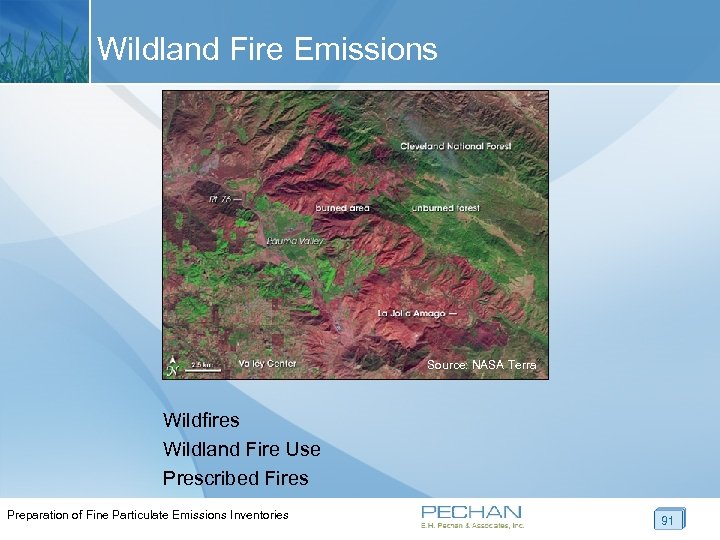 Wildland Fire Emissions Source: NASA Terra Wildfires Wildland Fire Use Prescribed Fires Preparation of Fine Particulate Emissions Inventories 91
 Overview of Wildland Fires § Wildland Burning – Types: Wildfires, Managed (Prescribed) Burns – Burners: • NPS, USFS, BLM, USFWS, State & Tribal Forests, Private Burners § Prescribed Burning – Intentionally ignited, based on met & fuel conditions – Used for: • Habitat improvement • Forest health • Managing undergrowth and understoring of the forest • Reducing risk of wildfires Preparation of Fine Particulate Emissions Inventories 92
 How were Wildfire Emissions Estimated in the ’ 99 – ’ 02 V 1 NEI? § Pollutants – PM 10, PM 2. 5, NOx, CO, VOC, SO 2, 30 HAPS § Emission Factors (AP-42) § State-specific Fuel Consumed per Acre Burned § Annual Activity Data ~ State (or regional) Level – USFS, BIA, BLM, NPS, FWS – Some states provide private / state burn data – Spatial allocation to counties using forested area § Emissions Processor ~ Allocates Diurnal & Monthly Preparation of Fine Particulate Emissions Inventories 93
 What We Will Discuss § Fire emissions in 2003 – 2006 – – – Fire impacts estimated by AQ modeling Evolving fire emissions estimation methods SMARTFire Blue. Sky Results § Future plans § EPA’s new Events Module for Fires in the NEI Preparation of Fine Particulate Emissions Inventories 94
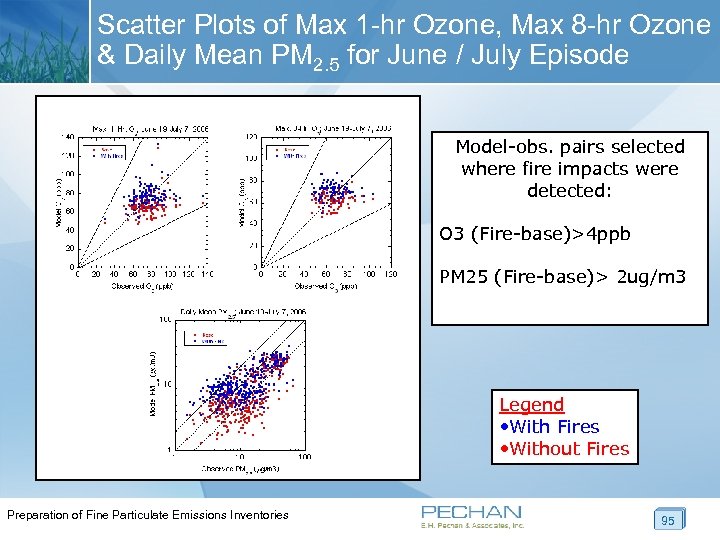 Scatter Plots of Max 1 -hr Ozone, Max 8 -hr Ozone & Daily Mean PM 2. 5 for June / July Episode Model-obs. pairs selected where fire impacts were detected: O 3 (Fire-base)>4 ppb PM 25 (Fire-base)> 2 ug/m 3 Legend • With Fires • Without Fires Preparation of Fine Particulate Emissions Inventories 95
 Improving the NEI’s Fire EI § Pre-2002 Fires treated as Non Point – Annual estimate, state/county geo-location § 2002 Fires treated as Point Sources – Average daily emissions & 1 st-day-of-fire location – Snapshot of 2002 – cost not sustainable § 2003 -2006 Fires treated as Point Sources – Fire emissions & daily geo-location – 1 st use of NOAA’s HMS & SMARTFIRE but… – Lacks SLT input – Alaska not yet included in SMARTFIRE Preparation of Fine Particulate Emissions Inventories 96
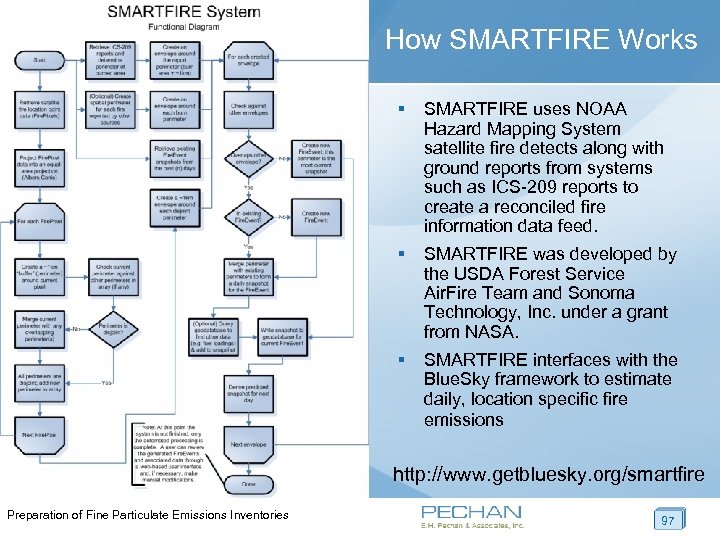 How SMARTFIRE Works § SMARTFIRE uses NOAA Hazard Mapping System satellite fire detects along with ground reports from systems such as ICS-209 reports to create a reconciled fire information data feed. § SMARTFIRE was developed by the USDA Forest Service Air. Fire Team and Sonoma Technology, Inc. under a grant from NASA. § SMARTFIRE interfaces with the Blue. Sky framework to estimate daily, location specific fire emissions http: //www. getbluesky. org/smartfire Preparation of Fine Particulate Emissions Inventories 97
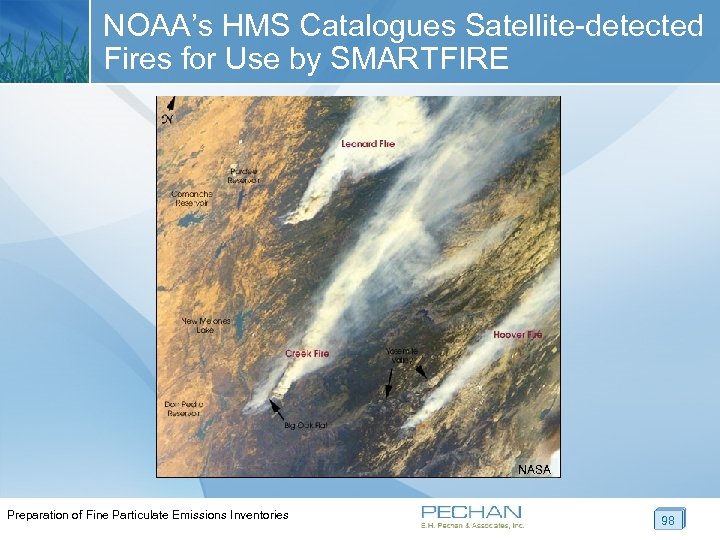 NOAA’s HMS Catalogues Satellite-detected Fires for Use by SMARTFIRE NASA Preparation of Fine Particulate Emissions Inventories 98
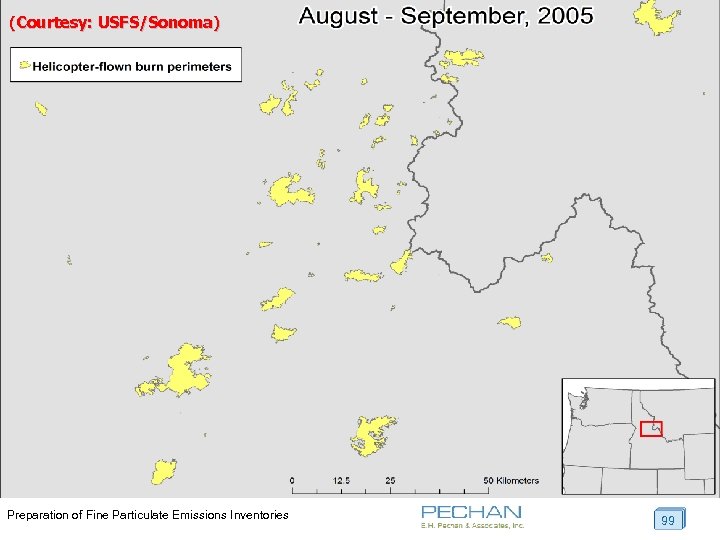 (Courtesy: USFS/Sonoma) Preparation of Fine Particulate Emissions Inventories 99
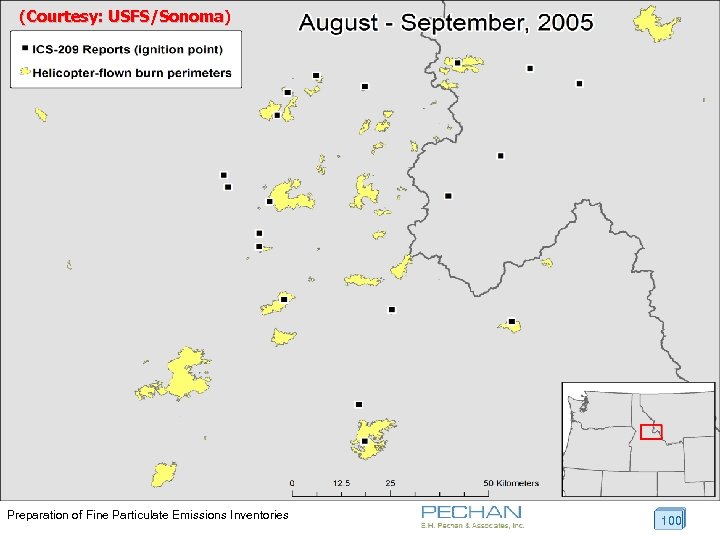 (Courtesy: USFS/Sonoma) Preparation of Fine Particulate Emissions Inventories 100
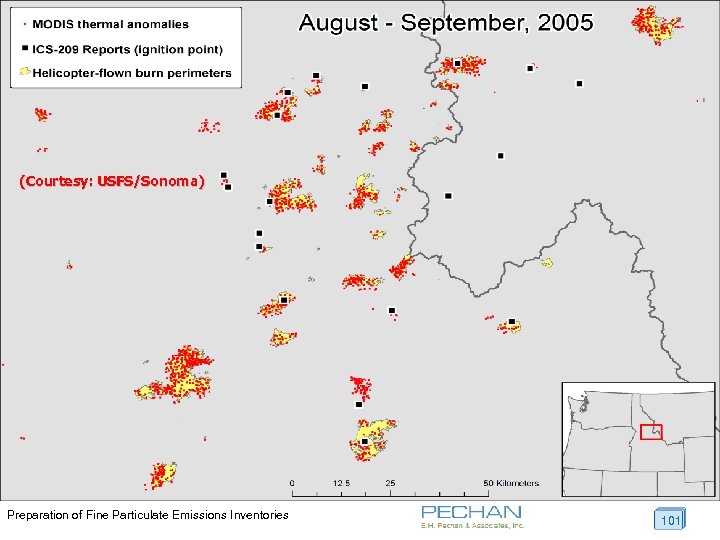 (Courtesy: USFS/Sonoma) Preparation of Fine Particulate Emissions Inventories 101
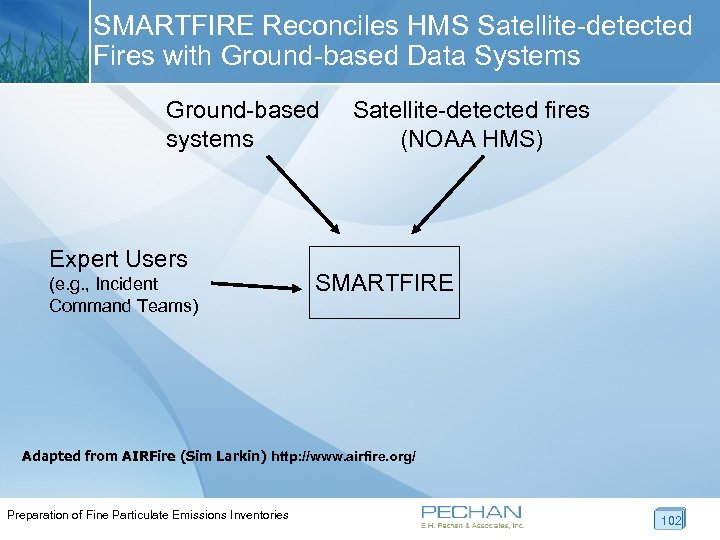 SMARTFIRE Reconciles HMS Satellite-detected Fires with Ground-based Data Systems Ground-based systems Expert Users (e. g. , Incident Command Teams) Satellite-detected fires (NOAA HMS) SMARTFIRE Adapted from AIRFire (Sim Larkin) http: //www. airfire. org/ Preparation of Fine Particulate Emissions Inventories 102
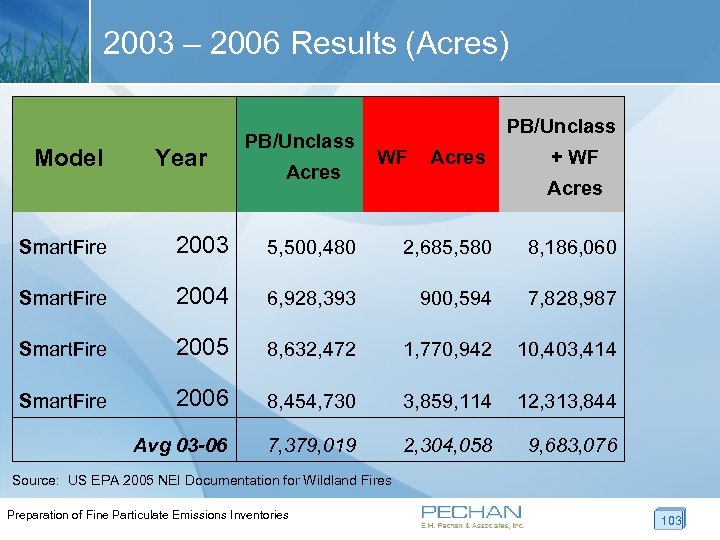 2003 – 2006 Results (Acres) Model Year PB/Unclass Acres PB/Unclass WF Acres + WF Acres Smart. Fire 2003 5, 500, 480 2, 685, 580 8, 186, 060 Smart. Fire 2004 6, 928, 393 900, 594 7, 828, 987 Smart. Fire 2005 8, 632, 472 1, 770, 942 10, 403, 414 Smart. Fire 2006 8, 454, 730 3, 859, 114 12, 313, 844 Avg 03 -06 7, 379, 019 2, 304, 058 9, 683, 076 Source: US EPA 2005 NEI Documentation for Wildland Fires Preparation of Fine Particulate Emissions Inventories 103
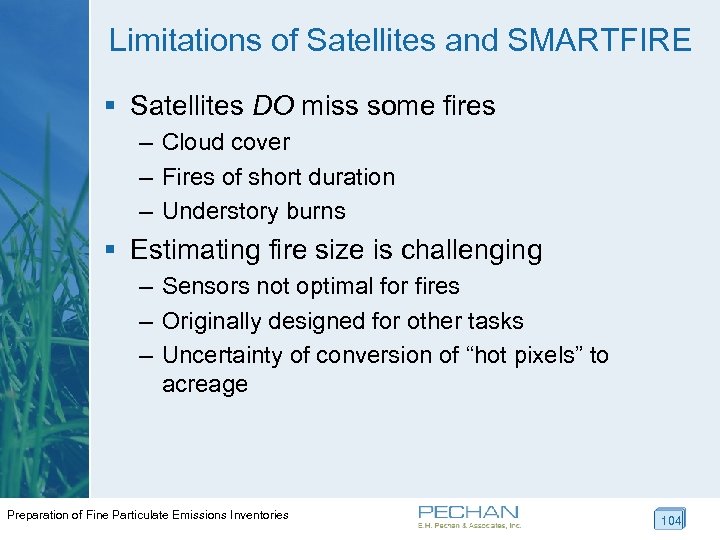 Limitations of Satellites and SMARTFIRE § Satellites DO miss some fires – Cloud cover – Fires of short duration – Understory burns § Estimating fire size is challenging – Sensors not optimal for fires – Originally designed for other tasks – Uncertainty of conversion of “hot pixels” to acreage Preparation of Fine Particulate Emissions Inventories 104
 Ground-based Data Bases are Incomplete & Inconsistent § Wildfire database for fires > 100 ac – Lacks consistency across US § Prescribed/Ag Burns – Paper records (if at all) – very little digital data – Permitted burns – often not accomplished, no confirmation § Other ground-based databases – FETS – participation by several western states – Handful of other states with digital datasets – SE and South Central have greatest need § Issue with “unclassified” fires – Mainly prescribed and agricultural burns (some are – Huge issue in SE & South Central Preparation of Fine Particulate Emissions Inventories 105
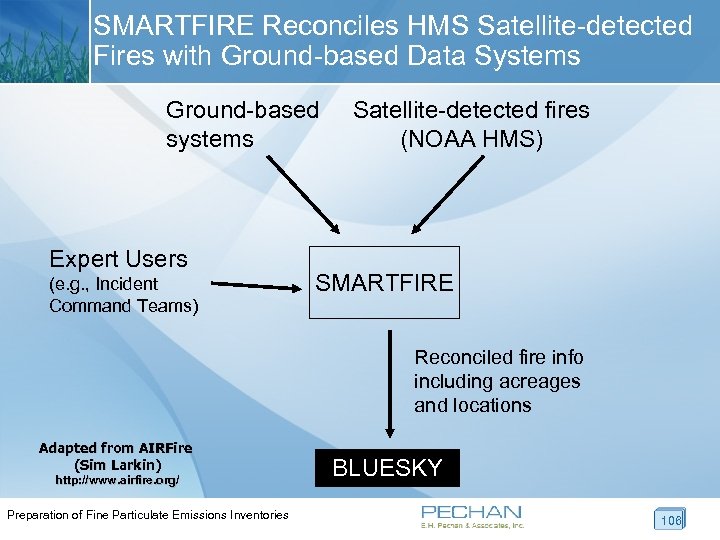 SMARTFIRE Reconciles HMS Satellite-detected Fires with Ground-based Data Systems Ground-based systems Expert Users (e. g. , Incident Command Teams) Satellite-detected fires (NOAA HMS) SMARTFIRE Reconciled fire info including acreages and locations Adapted from AIRFire (Sim Larkin) http: //www. airfire. org/ Preparation of Fine Particulate Emissions Inventories BLUESKY 106
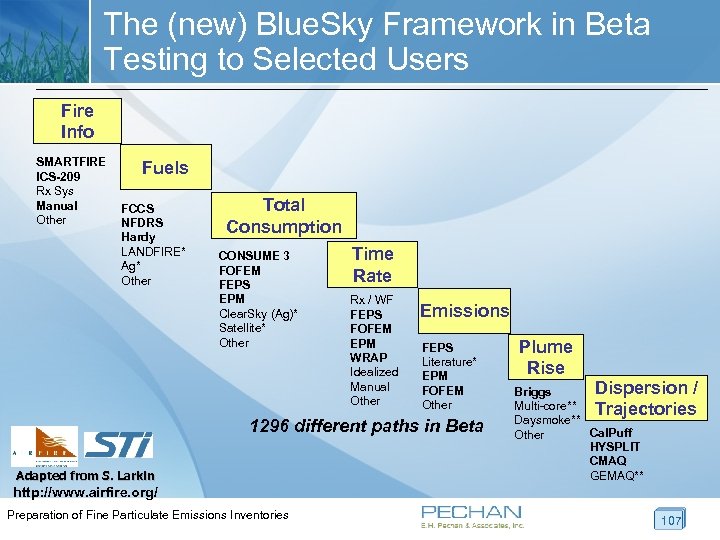 The (new) Blue. Sky Framework in Beta Testing to Selected Users Fire Info SMARTFIRE ICS-209 Rx Sys Manual Other Fuels FCCS NFDRS Hardy LANDFIRE* Ag* Other Total Consumption CONSUME 3 FOFEM FEPS EPM Clear. Sky (Ag)* Satellite* Other Time Rate Rx / WF FEPS FOFEM EPM WRAP Idealized Manual Other Emissions FEPS Literature* EPM FOFEM Other 1296 different paths in Beta Adapted from S. Larkin Plume Rise Dispersion / Briggs Multi-core** Trajectories Daysmoke** Cal. Puff Other HYSPLIT CMAQ GEMAQ** http: //www. airfire. org/ Preparation of Fine Particulate Emissions Inventories 107
 Post 2003 -8 Fire EI Development – New Generation of Hybrid Fire EI Methods § Fire Emissions Tracking System – FETS in WRAP States – partial participation – Other Fire Tracking Systems (e. g. , Florida) – SE & South Central ~ area with biggest need § More Refinement & Reliance on SMARTFire – Automated integration of Events databases & Satellite data § Ongoing Tools Development & Research – Blue. Sky Framework Enhancements – 3. 0 released – Improved fuels databases under development – Multi-chimney, plume rise – MISR, Calypso – Near real-time emissions modeling in beta (West) – Improved use of existing spectra data to estimate fuel consumption – Improved area burned data from satellite observations of burn scar Preparation of Fine Particulate Emissions Inventories 108
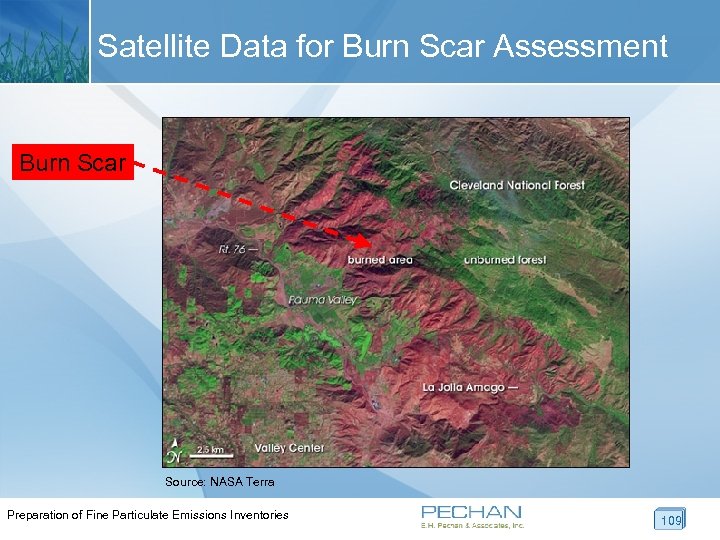 Satellite Data for Burn Scar Assessment Burn Scar Source: NASA Terra Preparation of Fine Particulate Emissions Inventories 109
 Improving the NEI’s Fire EI § Pre – 2002 Fires treated as Non Point – Annual estimate, state/county geo-location § 2002 Fires treated as Point Sources – Average daily emissions & 1 st-day-of-fire location – Snapshot of 2002 – cost not sustainable § 2003 -2006 Fires treated as Point Sources – Fire emissions & daily geo-location – 1 st use of NOAA’s HMS & SMARTFIRE but… – Lacks SLT input – Alaska not yet included in SMARTFIRE § 2008 – 1 st use of new NEI EVENTS module Preparation of Fine Particulate Emissions Inventories 110
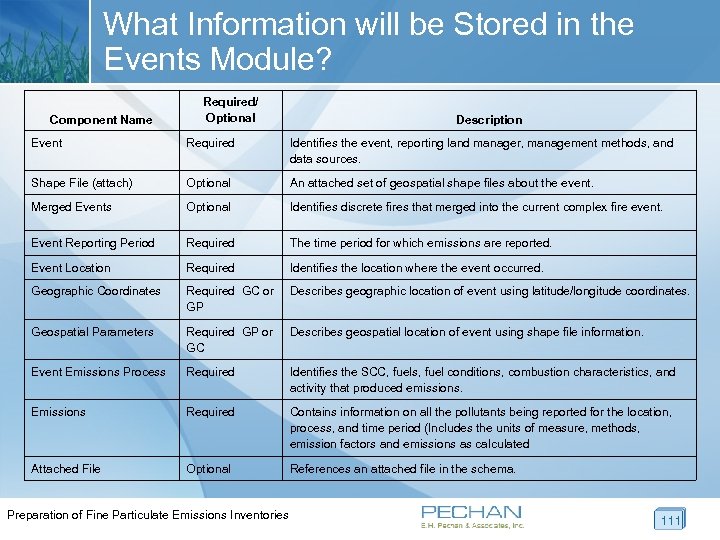 What Information will be Stored in the Events Module? Component Name Required/ Optional Description Event Required Identifies the event, reporting land manager, management methods, and data sources. Shape File (attach) Optional An attached set of geospatial shape files about the event. Merged Events Optional Identifies discrete fires that merged into the current complex fire event. Event Reporting Period Required The time period for which emissions are reported. Event Location Required Identifies the location where the event occurred. Geographic Coordinates Required GC or GP Describes geographic location of event using latitude/longitude coordinates. Geospatial Parameters Required GP or GC Describes geospatial location of event using shape file information. Event Emissions Process Required Identifies the SCC, fuels, fuel conditions, combustion characteristics, and activity that produced emissions. Emissions Required Contains information on all the pollutants being reported for the location, process, and time period (Includes the units of measure, methods, emission factors and emissions as calculated Attached File Optional References an attached file in the schema. Preparation of Fine Particulate Emissions Inventories 111
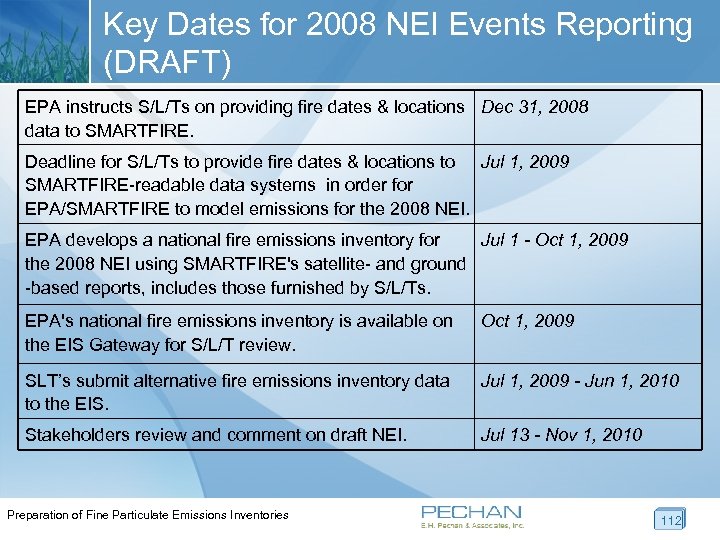 Key Dates for 2008 NEI Events Reporting (DRAFT) EPA instructs S/L/Ts on providing fire dates & locations Dec 31, 2008 data to SMARTFIRE. Deadline for S/L/Ts to provide fire dates & locations to Jul 1, 2009 SMARTFIRE-readable data systems in order for EPA/SMARTFIRE to model emissions for the 2008 NEI. EPA develops a national fire emissions inventory for Jul 1 - Oct 1, 2009 the 2008 NEI using SMARTFIRE's satellite- and ground -based reports, includes those furnished by S/L/Ts. EPA's national fire emissions inventory is available on the EIS Gateway for S/L/T review. Oct 1, 2009 SLT’s submit alternative fire emissions inventory data to the EIS. Jul 1, 2009 - Jun 1, 2010 Stakeholders review and comment on draft NEI. Jul 13 - Nov 1, 2010 Preparation of Fine Particulate Emissions Inventories 112
 Evolution of Fire Emissions Estimation ~Summary~ § Pre 2002 ~ simplified, top-down § 2002 ~ event-based, extensive “cleanup” § 2003 - 2008 ~ 1 st generation hybrid – Satellite / ground data integration § Future ~ 2 nd generation hybrid – Expanded events databases – Improved algorithms to interpret information from satellites – Improved fire perimeter & area burned • Post-fire burn scar analysis • Improved use of existing sensor spectra – Improved plume rise estimates Preparation of Fine Particulate Emissions Inventories 113
 Questions Wildfire Smoke – August 2009 JK Brooks 85 Preparation of Fine Particulate Emissions Inventories 114