


 Скачать презентацию Prenatal Care of Patients with Female Circumcision Planning
eda20332621fd1868af1da0ecf0f7640.ppt
- Количество слайдов: 33
 Prenatal Care of Patients with Female Circumcision: Planning for Labor and Delivery Grace Alfonsi MD Katherine Miller MD Department of Family Medicine University of Colorado Department of Community Health Denver Health Medical Center Grace. Alfonsi@dhha. org Katherine. Miller@dhha. org
 Learning Objectives • Define the anatomy • Formulate a plan for prenatal management • Describe intrapartum care including complications • Discuss special considerations when caring for circumcised women
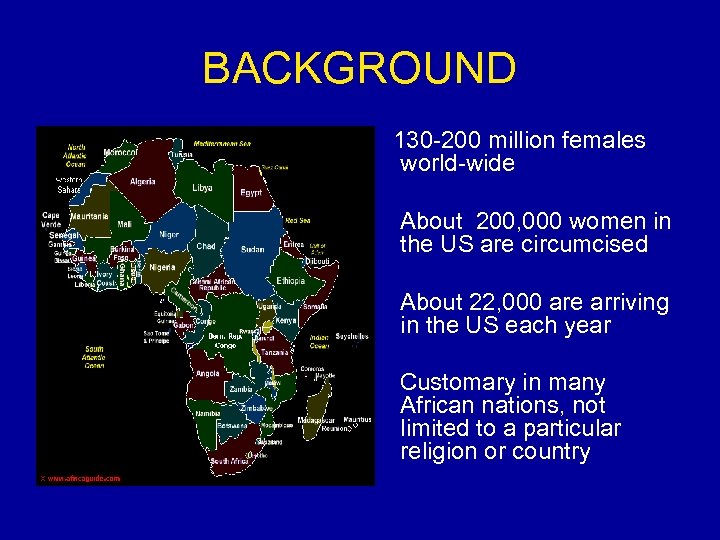 BACKGROUND 130 -200 million females world-wide About 200, 000 women in the US are circumcised About 22, 000 are arriving in the US each year Customary in many African nations, not limited to a particular religion or country
 Terminology • Female Genital Mutilation • Female Genital Cutting • Female Circumcision • Sunna
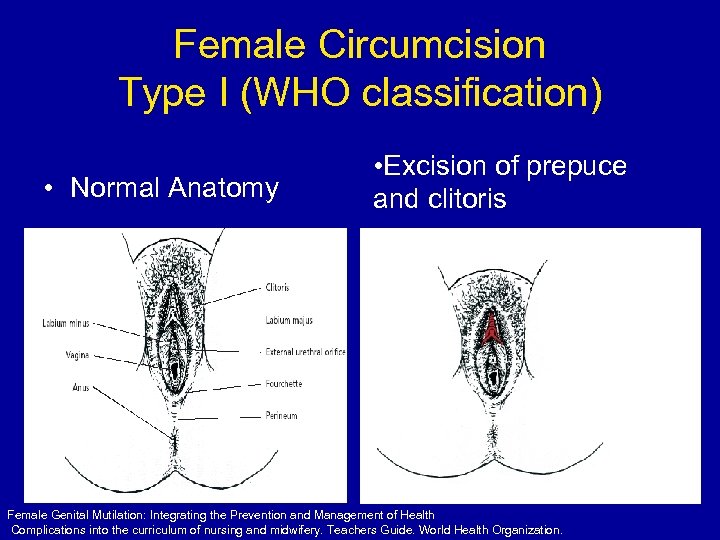 Female Circumcision Type I (WHO classification) • Normal Anatomy • Excision of prepuce and clitoris Female Genital Mutilation: Integrating the Prevention and Management of Health Complications into the curriculum of nursing and midwifery. Teachers Guide. World Health Organization.
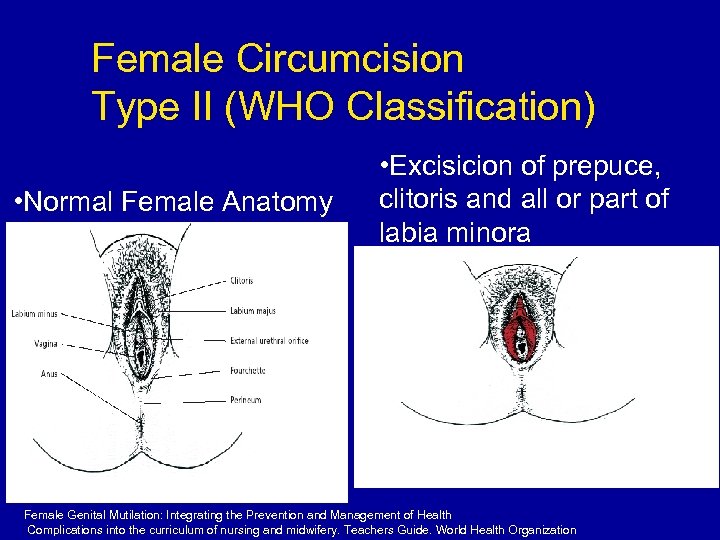 Female Circumcision Type II (WHO Classification) • Normal Female Anatomy • Excisicion of prepuce, clitoris and all or part of labia minora Female Genital Mutilation: Integrating the Prevention and Management of Health Complications into the curriculum of nursing and midwifery. Teachers Guide. World Health Organization
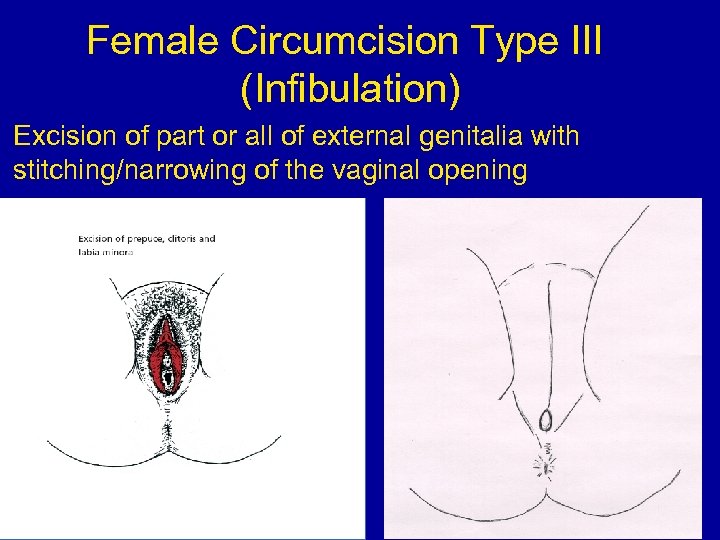 Female Circumcision Type III (Infibulation) Excision of part or all of external genitalia with stitching/narrowing of the vaginal opening
 Obstetric Complications • Difficult intrapartum vaginal exams and urinary catheterization • Second stage soft tissue dystocia • Need for anterior episiotomy • Increased risk of hemorrhage and infection • Risk of poor healing • Increased risk of maternal and neonatal morbidity and mortality • Increased C section rate
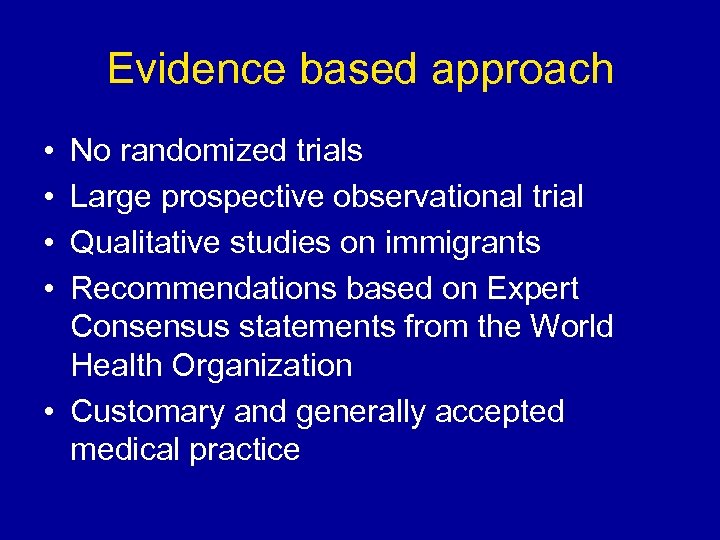 Evidence based approach • • No randomized trials Large prospective observational trial Qualitative studies on immigrants Recommendations based on Expert Consensus statements from the World Health Organization • Customary and generally accepted medical practice
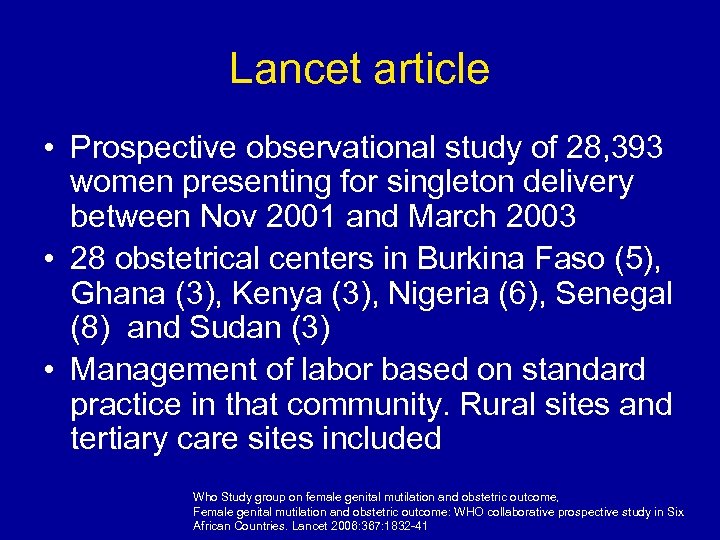 Lancet article • Prospective observational study of 28, 393 women presenting for singleton delivery between Nov 2001 and March 2003 • 28 obstetrical centers in Burkina Faso (5), Ghana (3), Kenya (3), Nigeria (6), Senegal (8) and Sudan (3) • Management of labor based on standard practice in that community. Rural sites and tertiary care sites included Who Study group on female genital mutilation and obstetric outcome, Female genital mutilation and obstetric outcome: WHO collaborative prospective study in Six African Countries. Lancet 2006: 367: 1832 -41
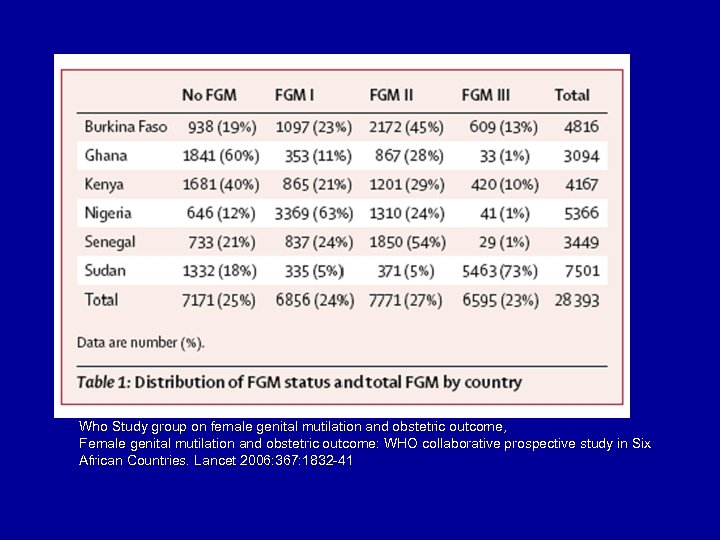 Who Study group on female genital mutilation and obstetric outcome, Female genital mutilation and obstetric outcome: WHO collaborative prospective study in Six African Countries. Lancet 2006: 367: 1832 -41
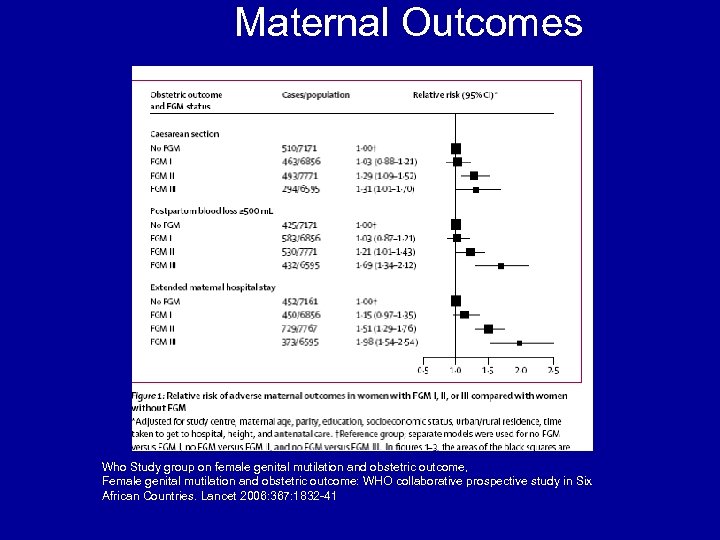 Maternal Outcomes Who Study group on female genital mutilation and obstetric outcome, Female genital mutilation and obstetric outcome: WHO collaborative prospective study in Six African Countries. Lancet 2006: 367: 1832 -41
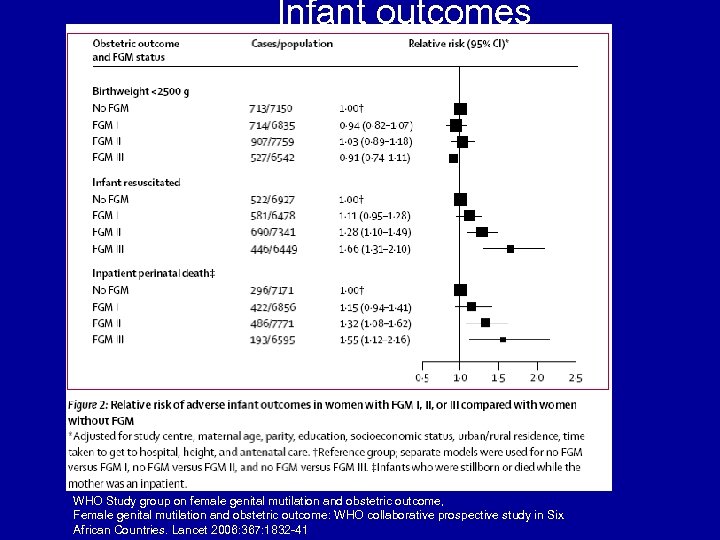 Infant outcomes WHO Study group on female genital mutilation and obstetric outcome, Female genital mutilation and obstetric outcome: WHO collaborative prospective study in Six African Countries. Lancet 2006: 367: 1832 -41
 Lancet Conclusions • Women with FGM are more likely to have adverse obstetric outcomes • Risks are greater with more extensive FGM • Parity did not affect these risks • Study done with high background rates of adverse maternal/infant outcomes • Limitation: Hospital based study WHO Study group on female genital mutilation and obstetric outcome, Female genital mutilation and obstetric outcome: WHO collaborative prospective study in Six African Countries. Lancet 2006: 367: 1832 -41
 Stangers in a Strange land • Qualitative study of Somali women in Norway. • Snowball sample of patients • Interviewed patients and providers about their prenatal and labor experiences • 23 Somali immigrants and 36 health professionals interviewed Vange S, Johanse RE, et al. Qualitative study of perinatal cae experiences among Somali women and local health care Professionals in Norway. Eur J Obstet Gynecol Reprod Biol. 2004 Jan 15: 112 (1): 29 -35
 The Patient “Childbirth is like going into a tunnel and you never know whether you are coming out alive. ” Vange S, Johanse RE, et al. Qualitative study of perinatal cae experiences among Somali women and local health care Professionals in Norway. Eur J Obstet Gynecol Reprod Biol. 2004 Jan 15: 112 (1): 29 -35
 Outpatient Provider “I didn’t study her genitals very carefully as I think that would have been intrusive and I don’t think it is necessary…it is the hospital’s job to take care of the delivery and they will do whatever they think is necessary” Vange S, Johanse RE, et al. Qualitative study of perinatal cae experiences among Somali women and local health care Professionals in Norway. Eur J Obstet Gynecol Reprod Biol. 2004 Jan 15: 112 (1): 29 -35
 Inpatient Midwife “The women come here to deliver their child and not to discuss circumcision…you can’t discuss with a woman when she is in labor pain. ” Vange S, Johanse RE, et al. Qualitative study of perinatal cae experiences among Somali women and local health care professionals in Norway. Eur J Obstet Gynecol Reprod Biol. 2004 Jan 15: 112 (1): 29 -35
 Physician on L and D “When you don’t recognize the anatomy, you are sort of taken aback. ” Vange S, Johanse RE, et al. Qualitative study of perinatal cae experiences among Somali women and local health care Professionals in Norway. Eur J Obstet Gynecol Reprod Biol. 2004 Jan 15: 112 (1): 29 -35
 Post Partum Patient “ I felt so lonely and lost…if I had stayed at home in Somalia, there would have been people around me, people who cared. Here I was alone, helpless…and then it ended in a C-section…I don’t think it was necessary. ” Vange S, Johanse RE, et al. Qualitative study of perinatal cae experiences among Somali women and local health care Professionals in Norway. Eur J Obstet Gynecol Reprod Biol. 2004 Jan 15: 112 (1): 29 -35
 WHO Guidelines • Prevention of FGM/FC and management of its complications should be included in antenatal care • Provide information to couples about timing of opening of the scar tissue of type III circumcisions and discuss complications • Develop rapport before attempting a PE • Carefully examine introitus and document anatomy
 WHO Guidelines • Establish local guidelines for opening up the type III introitus taking into account traveling distance and availability of anesthesia • Midwives and doctors should receive adequate training in safe techniques for opening the scar tissue of type III circ. • Couples should be offered education and counseling requarding the health consequences of female circumcision
 Antenatal Care Detailed physical exam noting anatomy including : - Visibility of Urethra - Extent of opening - Description of external genitalia
 Prenatal Assessment: Sample notes • Sample notes: Circumcised with the absence of clitoris, ant labia minora missing; no fusion of labia, urethral meatus visible, opening greater than 2 cm. • Circumcised with 2 cm vaginal opening; labia majora fused; no urethra visualized but can be palpated under fused labia; speculum exam difficult; os not seen; bimanual exam not attempted.
 Formulating a Birth Plan • Develop rapport with the patient and her family including language considerations • Discussion and exams over several visits • Expect need to call or consult with other family members • Diagrams are very helpful • Discuss provider preference and possibilities
 Formulating a Birth Plan • Discussion of anterior episiotomy and subsequent repair • Emphasize unpredictability of delivery and appearance of perineum post partum • Review risks of labor and delivery including poor healing, breakdown of repair, hemorrhage and infection
 Document and Discuss • Document discussions • Discuss with obstetrical back-up • Discuss with labor and delivery nursing • Don’t wait until the delivery room to make this plan
 Delivery Room Management • • Identify urethra Adequate anesthesia Anterior episiotomy: cut only to urethra. If unable to do digital vaginal checks may need to do anterior episiotomy prior to second stage. • Consider need for earlier episiotomy (scar tissue on perineum does not stretch in the usual way)
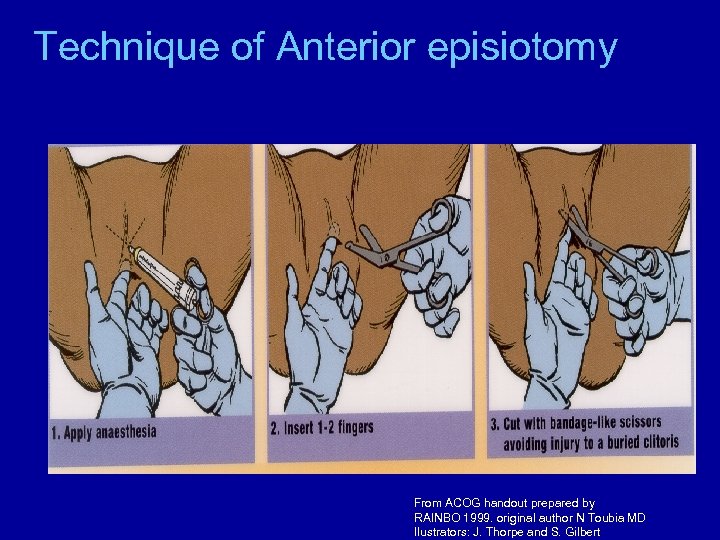 Technique of Anterior episiotomy From ACOG handout prepared by RAINBO 1999. original author N Toubia MD Ilustrators: J. Thorpe and S. Gilbert
 REPAIR OPTIONS • Repair anterior episiotomy by reapproximating labial edge ---as before ---more open than before • Complete open repair (Deinfibulation) • Both options have increased risk for infection and breakdown of suture line
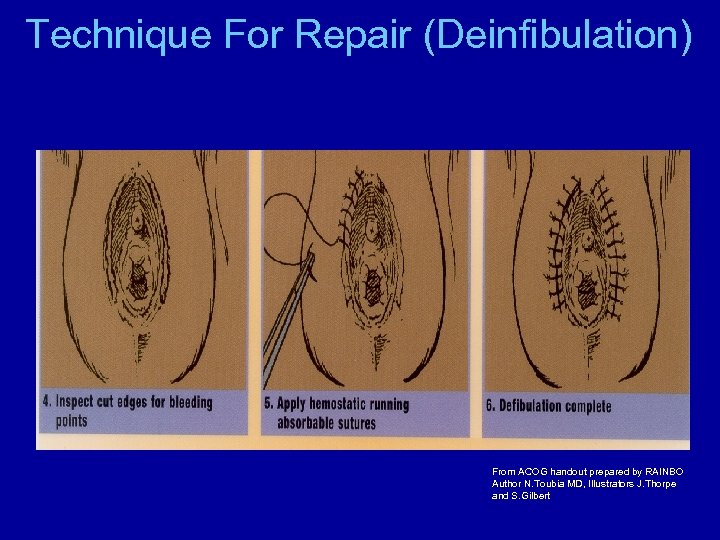 Technique For Repair (Deinfibulation) From ACOG handout prepared by RAINBO Author N. Toubia MD, Illustrators J. Thorpe and S. Gilbert
 SUMMARY • Female circumcision patients can present a challenge in the labor suite if encountered there for the first time • Good birth planning and documentation can help the patient , her family and the care provider effectively manage these physical and social issues. This starts in our family practice office. • Family doctors are well equipped to care for this immigrant population.
 Bibliography 1. Female Genital Mutilation: Integrating the Prevention and Management of Health Complications into the curriculum of nursing and midwifery. Teachers Guide. World Health Organization. Department of Gender and Women’s Health, Department of Reproductive Health and Research. World Health Organization. Geneva 2001 WHO/FCH/GWH/01. 3 2. Management of pregnancy, childbirth and the postpartum period in the presence of female genital mutilation. Report of the WHO Technical Consultation. October 1517, 1997, World Health Organization, Department of Gender and Womens Health, Department of Reproductive Health and Research. World Health Organization. Geneva 2001 WHO/FCH/GWH/01. 2 3. Rushwan H. Female genital mutilation(FGM) management during pregnancy, childbirth and the postpartum period. International Journal of Gynecology and Obstetrics 70(2000) 99 -104 4. Toubia, Nahid. Female Circumcision as a Public Health Issue. NEJM (1994) Volume 31: 712 -716 5 Vangen S, Johansen RE, Sundby J, Traeen B, Stray-Pedersen B. Qualitative study of perinatal care experiences among Somali women and local health care professionals in Norway. Eur J Obstet Gynecol Reprod Biol. 2004 Jan 15; 112(1): 29 -35. . 6. Who Study group on female genital mutilation and obstetric outcome, Female genital mutilation and obstetric outcome: WHO collaborative prospective study in Six African Countries. Lancet 2006: 367: 1832 -41