


 Скачать презентацию Premium Financing as a Tool for Life Insurance
193f71a8f835157f4aeaf349c4b73051.ppt
- Количество слайдов: 28
 Premium Financing as a Tool for Life Insurance Funding John A. Oliver Vice President Transamerica Insurance & Investment Group
 Premium Financing An arrangement in which an entity (a business or trust) borrows premiums from a third-party lender usually unrelated to the insurance company issuing the life insurance policy. 1
 Variety of Sources for Premium Financing n n n Insurer arrangements with third-party lender Banks & brokerage firms working with preferred clients Premium financing brokers working with multiple lenders 2
 Factors to Consider in Premium Financing General requirements n n Minimum loan size Minimum net worth 3
 Interest Component n n Variable or fixed rate If variable, what index? How often does it reset? If fixed, for how long? Caps and collars 4
 Payment of Interest n n n Pay interest annually Pay interest via a SPIA Accrue interest 5
 Terms of the Loan n n Term versus non-term loan Recourse versus non-recourse loan Right to call the loan Personal guarantee of the loan 6
 Loan Renewal n n Typically not guaranteed Renewal depends on: n n n Client’s financial condition Collateral situation Length of new term 7
 Collateral Requirements n n n May be a fully collateralized loan Policy cash value is primary source of collateral May require other forms of collateral 8
 Collateral Requirements Lender may limit forms of collateral n Cash n Certificates of deposit n Government-issued bonds n Non-financed life insurance policy cash values n Letter of credit – banks charge (0. 5 -1% of credit amount) n Securities 9
 Repayment of Loan Principal n n n At death of the insured, from insurance proceeds During life from policy cash values During life from other planning strategies n n n GRAT Sale to a defective trust Settlement 10
 Identifying Proper Use of Premium Financing n n Estate is typically greater than $5 million Traditional funding of a policy inside an ILIT will create gift taxes Individual or family wealth is illiquid but assets are available for collateral or a letter of credit can be obtained Trust grantor and trustee understand financial leverage and are comfortable with the financing concept 11
 Annuity & Insurance Arbitrage: Overstatement or Reality? Robert S. Held Harrison & Held, LLP
 Mortality and Pricing of Immediate Pay Annuities and Insurance Pricing – assume life expectancy of insured/annuitant is X years n Annuity: pay more now to annuitant if life expectancy is shorter than X years. n Insurance: insured pays less if life expectancy is longer than X years. For older insureds, these different assumptions can have a dramatic impact on price. (section 3, page 1) 13
 Why It Could Work n Premise: life insurance companies price the life expectancy (and surrender) components of annuities and life insurance policies differently. (Section 3, page 1. ) n Meaning that for an older insured I, the mortality assumptions for the annuity are too high annuity pays more; and the mortality assumptions for the insurance are too low insurance requires lower premiums. (Example 2, page 2) 14
 The Arbitrage n n n Assume we pay $X for an immediate pay annuity. We receive 1/10 th of $X each year, call it $Y. We buy an $X face universal policy that has premiums each year of $Z, and $Z < $Y. We can do this, but this is not arbitrage. This is sort of the easing starting point. (See example 1 on page 1) 15
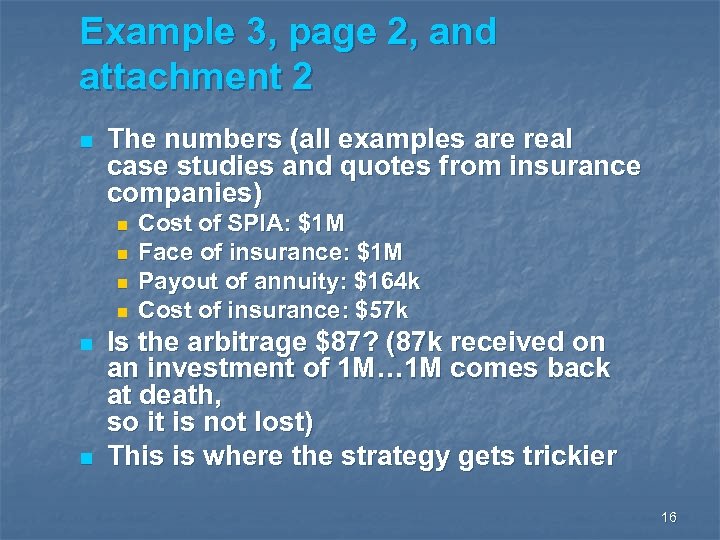 Example 3, page 2, and attachment 2 n The numbers (all examples are real case studies and quotes from insurance companies) n n n Cost of SPIA: $1 M Face of insurance: $1 M Payout of annuity: $164 k Cost of insurance: $57 k Is the arbitrage $87? (87 k received on an investment of 1 M… 1 M comes back at death, so it is not lost) This is where the strategy gets trickier 16
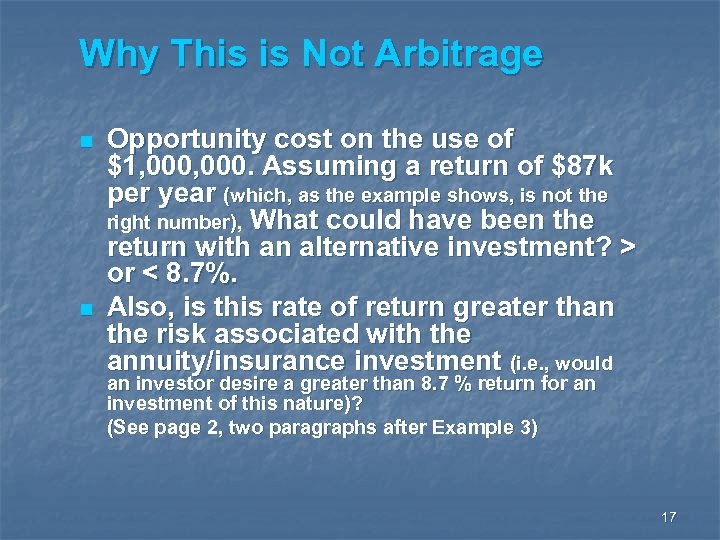 Why This is Not Arbitrage n n Opportunity cost on the use of $1, 000. Assuming a return of $87 k per year (which, as the example shows, is not the right number), What could have been the return with an alternative investment? > or < 8. 7%. Also, is this rate of return greater than the risk associated with the annuity/insurance investment (i. e. , would an investor desire a greater than 8. 7 % return for an investment of this nature)? (See page 2, two paragraphs after Example 3) 17
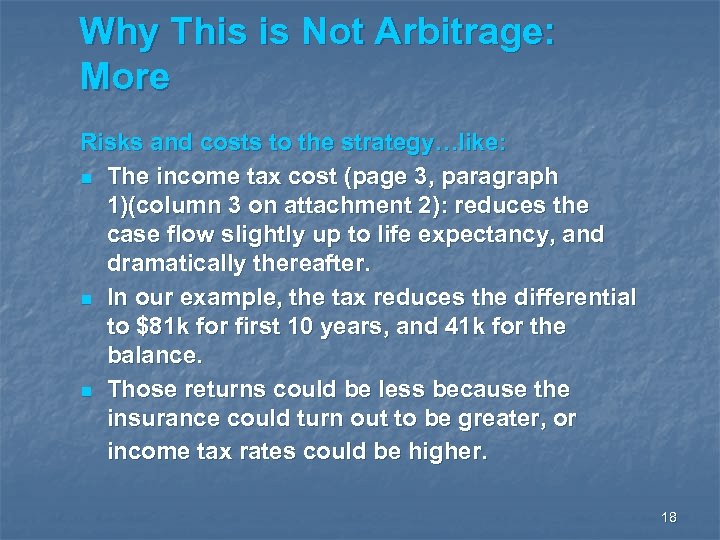 Why This is Not Arbitrage: More Risks and costs to the strategy…like: n The income tax cost (page 3, paragraph 1)(column 3 on attachment 2): reduces the case flow slightly up to life expectancy, and dramatically thereafter. n In our example, the tax reduces the differential to $81 k for first 10 years, and 41 k for the balance. n Those returns could be less because the insurance could turn out to be greater, or income tax rates could be higher. 18
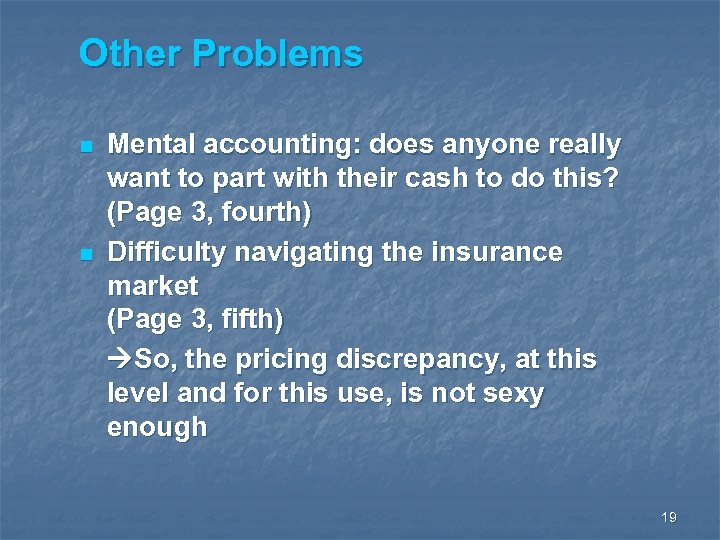 Other Problems n n Mental accounting: does anyone really want to part with their cash to do this? (Page 3, fourth) Difficulty navigating the insurance market (Page 3, fifth) So, the pricing discrepancy, at this level and for this use, is not sexy enough 19
 Adding the “Financing” Concepts Discussed by John to Really Achieve an Arbitrage n n (Review with example 1 and fns. 2 and 3) Use same assumptions as Example 3, but now add financing element to arrangement. Specifically, instead of insured coming up with $1 M for SPIA (thereby causing opp cost), have 3 rd party finance the 1 M, with interest only loans at 4% (per Don and Charlie). Results (Attachment 3), at 4% financing. Here we have pure arbitrage: for no money, annual rate of return is 4. 17% on $1 M up to life expectancy, and thereafter 0. 17% (but positive). 20
 Problems n n NONE IF there are no guarantees or collateral because if loan ever defaults, cannot go below zero. Pure arbitrage. BUT, financing requires usually guarantees and collateral, and hence arbitrage is subject to the risks identified before, including: n n n Interest rate risk on the loans (the interest rate increases, e. g. ) Costs of the insurance product increases or the insurance or annuity companies disappear. And income tax likely not deductible (Pages 3 and 4, example 4) 21
 Meaning Straight arbitrage will not be desirable and we need to float into one of two areas n n Incorporate an irrevocable insurance trust and go for a pure estate tax arbitrage (discussed now) Use third party to purchase the arbitrage opportunity (discussed at the end) 22
 Irrevocable Insurance Trust + Financing Elements n Insurance trust n Grantor trust as to the insured n Insured loans money: long term for interest only; to allow for the purchase of a SPIA n SPIA - purchase and insurance face are the same n Trust uses pricing differentials re annuity and insurance 23
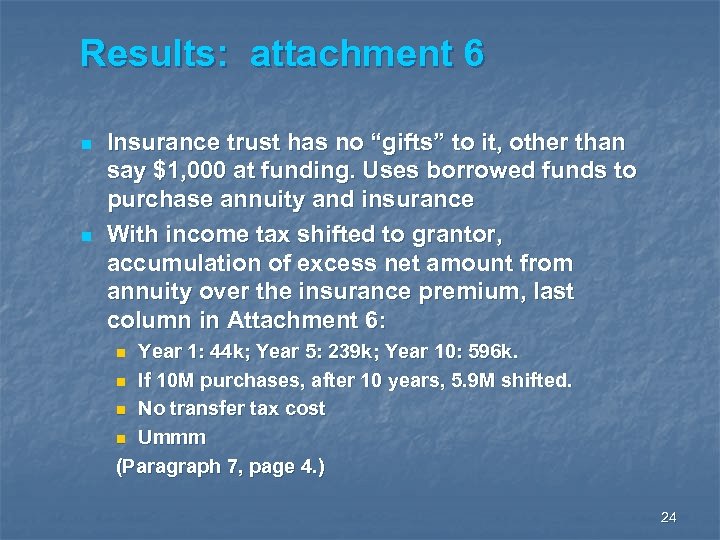 Results: attachment 6 n n Insurance trust has no “gifts” to it, other than say $1, 000 at funding. Uses borrowed funds to purchase annuity and insurance With income tax shifted to grantor, accumulation of excess net amount from annuity over the insurance premium, last column in Attachment 6: Year 1: 44 k; Year 5: 239 k; Year 10: 596 k. n If 10 M purchases, after 10 years, 5. 9 M shifted. n No transfer tax cost n Ummm (Paragraph 7, page 4. ) n 24
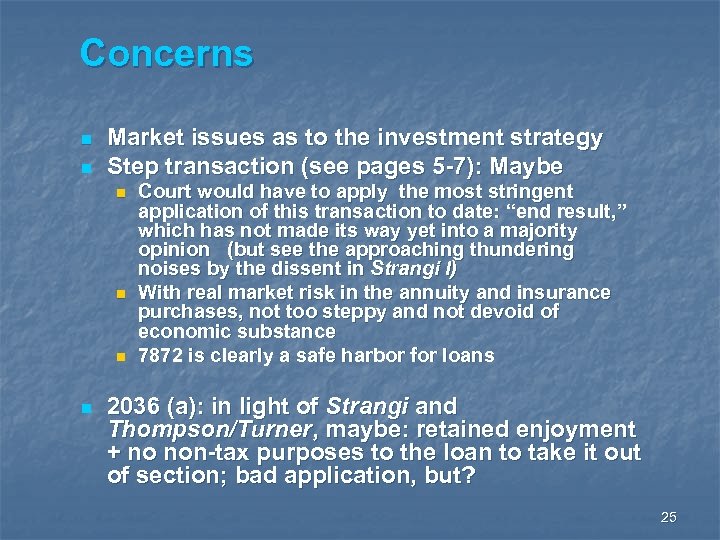 Concerns n n Market issues as to the investment strategy Step transaction (see pages 5 -7): Maybe n n Court would have to apply the most stringent application of this transaction to date: “end result, ” which has not made its way yet into a majority opinion (but see the approaching thundering noises by the dissent in Strangi I) With real market risk in the annuity and insurance purchases, not too steppy and not devoid of economic substance 7872 is clearly a safe harbor for loans 2036 (a): in light of Strangi and Thompson/Turner, maybe: retained enjoyment + no non-tax purposes to the loan to take it out of section; bad application, but? 25
 Alternative: Sell Transaction to Third Party 26
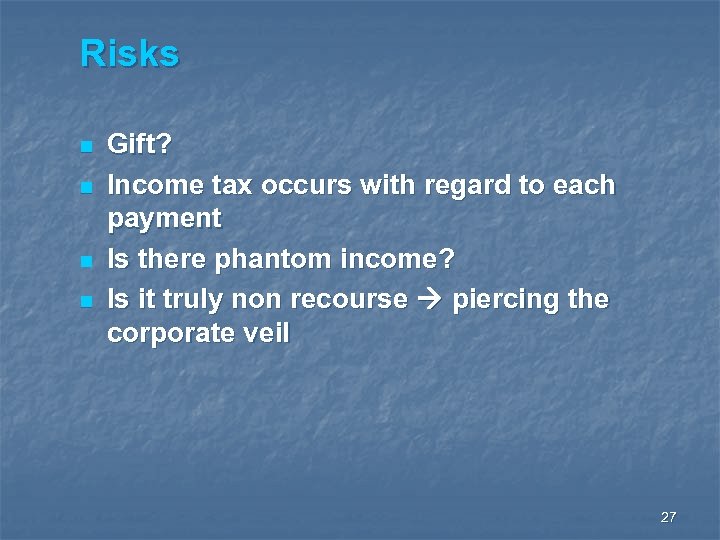 Risks n n Gift? Income tax occurs with regard to each payment Is there phantom income? Is it truly non recourse piercing the corporate veil 27