


 Скачать презентацию Preliminary intercomparison results for NARCCAP other RCMs and
d5def0eacfbb183e63456d9f11d025ec.ppt
- Количество слайдов: 21
 Preliminary intercomparison results for NARCCAP, other RCMs, and statistical downscaling over southern Quebec Philippe Gachon Research Scientist Adaptation & Impacts Research Division, Atmospheric Science and Technology Directorate Environment Canada @ Mc. Gill University 2009 NARCCAP Users’ Meeting September 10 -11, 2009 - NCAR Foothills Lab, EOL Atrium
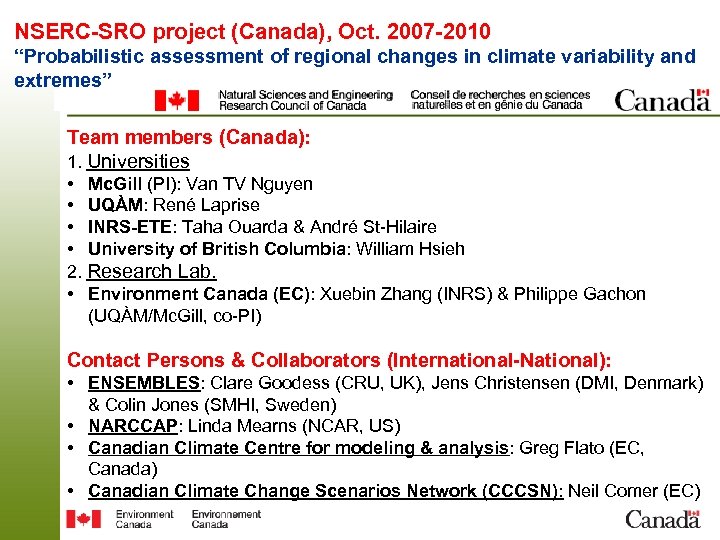 NSERC-SRO project (Canada), Oct. 2007 -2010 “Probabilistic assessment of regional changes in climate variability and extremes” Team members (Canada): 1. Universities • Mc. Gill (PI): Van TV Nguyen • UQÀM: René Laprise • INRS-ETE: Taha Ouarda & André St-Hilaire • University of British Columbia: William Hsieh 2. Research Lab. • Environment Canada (EC): Xuebin Zhang (INRS) & Philippe Gachon (UQÀM/Mc. Gill, co-PI) Contact Persons & Collaborators (International-National): • ENSEMBLES: Clare Goodess (CRU, UK), Jens Christensen (DMI, Denmark) & Colin Jones (SMHI, Sweden) • NARCCAP: Linda Mearns (NCAR, US) • Canadian Climate Centre for modeling & analysis: Greg Flato (EC, Canada) • Canadian Climate Change Scenarios Network (CCCSN): Neil Comer (EC)
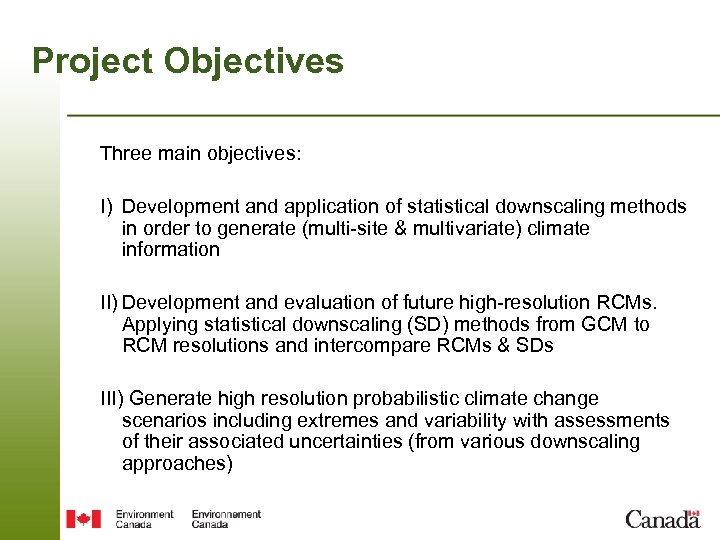 Project Objectives Three main objectives: I) Development and application of statistical downscaling methods in order to generate (multi-site & multivariate) climate information II) Development and evaluation of future high-resolution RCMs. Applying statistical downscaling (SD) methods from GCM to RCM resolutions and intercompare RCMs & SDs III) Generate high resolution probabilistic climate change scenarios including extremes and variability with assessments of their associated uncertainties (from various downscaling approaches)
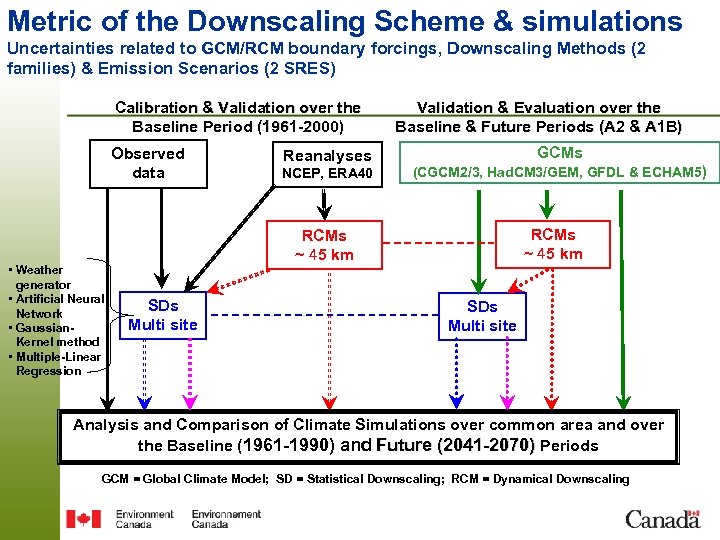 Metric of the Downscaling Scheme & simulations Uncertainties related to GCM/RCM boundary forcings, Downscaling Methods (2 families) & Emission Scenarios (2 SRES) Calibration & Validation over the Baseline Period (1961 -2000) Observed data • Weather generator • Artificial Neural Network • Gaussian. Kernel method • Multiple-Linear Regression Reanalyses NCEP, ERA 40 Validation & Evaluation over the Baseline & Future Periods (A 2 & A 1 B) GCMs (CGCM 2/3, Had. CM 3/GEM, GFDL & ECHAM 5) RCMs ~ 45 km SDs Multi site Analysis and Comparison of Climate Simulations over common area and over the Baseline (1961 -1990) and Future (2041 -2070) Periods GCM = Global Climate Model; SD = Statistical Downscaling; RCM = Dynamical Downscaling
 Research objectives from RCMs runs from NARCCAP (and others) 1. Inter-compare different RCMs (NCEP driven) to further reconstruct 2. 3. 4. observed extremes (precipitation, temperature) for the Quebec/Ontario/BC region; – Evaluate errors or added values due to RCM (NCEP vs GCMs driven conditions): low & high frequency variability; – Test and choice the appropriate methodology of interpolation to validate the RCM outputs with gridded observed data (e. g. , Cubic Spline method or other methods); Frequency analysis (occurrence & intensity) of the extremes as simulated by the RCMs; Develop and validate preditors from selected RCM runs to be used in Statistical Downscaling models; Inter-compare different RCMs vs Statistical Downscaling models and construct probabilistic scenarios (uncertainties with confidence interval information).
![Model Version Run Domain & Resolution[1] Driving atmospheric & oceanic data abf Time window](https://present5.com/presentation/d5def0eacfbb183e63456d9f11d025ec/image-6.jpg "Model Version Run Domain & Resolution[1] Driving atmospheric & oceanic data abf Time window") Model Version Run Domain & Resolution[1] Driving atmospheric & oceanic data abf Time window NCEP & AMIP 02 abg GHG+A evolution 1960 -dec - 1990 -dec ERA 40 & AMIP 02 - abi Canadian RCM. 3. 7. 1 AMNO 45 km & 29 L acu acw QC 45 km & 29 L Canadian RCM. 4. 1. 1 AMNO 45 km & 29 L ade adj adk Canadian RCM. 4. 2. 0 AMNO 45 km & 29 L ARPÈGE 4. 4 WINI 160 x 32 OGG & 31 L CGCM 2 3 rd member (6 h) Observed 1960 -dec - 1990 -dec CGCM 2 3 rd member (6 h) abj acy 1960 -dec - 1990 -dec SRES A 2 2040 -dec - 2070 -dec CGCM 3 4 th member (6 h) Obs + SRES A 2 1960 -dec - 2100 -nov ERA 40 & AMIP 02 1960 -dec - 2002 -jul ERA 40 (6 h) & AMIP 03 1960 -dec - 2002 -jul - NCEP & AMIP 05 (6 h) 1960 -dec - 2005 -may CGCM 3 4 th member (6 h) 1960 -dec - 1990 -dec SRES A 2 CGCM 3 4 th member (6 h) 2040 -dec - 2070 -dec ERA 40 (6 -hrs) abx acb Run Model Version LAM_NA_ER A 40_0. 5 deg GEMCLI M CRCM 5 LAM_NA_ER A 40_0. 25 deg - 1961 -jan - 2001 -dec ERA 40 (6 -hrs) & [ARPEGE. 3 coupled OPA A 2] SRES A 2 2041 -jan - 2081 -dec Domain & Resolution & No of grid Points Driving atmospheri c & oceanic data GHG+ A Evoluti on North America & 0. 5 deg & 150 lon x 138 lat pts ERA-40 at 0. 5 deg - North America & 0. 25 deg & 300 lon x 276 lat pts ERA-40 at 0. 25 deg Time Window 1957 -sep to 2002 -aug - (13 series) RCMs runs available from Ouranos, CRCMD & NARCCAP
Model Version Run Domain & Resolution[1] Driving atmospheric & oceanic data abf Time window NCEP & AMIP 02 abg GHG+A evolution 1960 -dec - 1990 -dec ERA 40 & AMIP 02 - abi Canadian RCM. 3. 7. 1 AMNO 45 km & 29 L acu acw QC 45 km & 29 L Canadian RCM. 4. 1. 1 AMNO 45 km & 29 L ade adj adk Canadian RCM. 4. 2. 0 AMNO 45 km & 29 L ARPÈGE 4. 4 WINI 160 x 32 OGG & 31 L CGCM 2 3 rd member (6 h) Observed 1960 -dec - 1990 -dec CGCM 2 3 rd member (6 h) abj acy 1960 -dec - 1990 -dec SRES A 2 2040 -dec - 2070 -dec CGCM 3 4 th member (6 h) Obs + SRES A 2 1960 -dec - 2100 -nov ERA 40 & AMIP 02 1960 -dec - 2002 -jul ERA 40 (6 h) & AMIP 03 1960 -dec - 2002 -jul - NCEP & AMIP 05 (6 h) 1960 -dec - 2005 -may CGCM 3 4 th member (6 h) 1960 -dec - 1990 -dec SRES A 2 CGCM 3 4 th member (6 h) 2040 -dec - 2070 -dec ERA 40 (6 -hrs) abx acb Run Model Version LAM_NA_ER A 40_0. 5 deg GEMCLI M CRCM 5 LAM_NA_ER A 40_0. 25 deg - 1961 -jan - 2001 -dec ERA 40 (6 -hrs) & [ARPEGE. 3 coupled OPA A 2] SRES A 2 2041 -jan - 2081 -dec Domain & Resolution & No of grid Points Driving atmospheri c & oceanic data GHG+ A Evoluti on North America & 0. 5 deg & 150 lon x 138 lat pts ERA-40 at 0. 5 deg - North America & 0. 25 deg & 300 lon x 276 lat pts ERA-40 at 0. 25 deg Time Window 1957 -sep to 2002 -aug - (13 series) RCMs runs available from Ouranos, CRCMD & NARCCAP
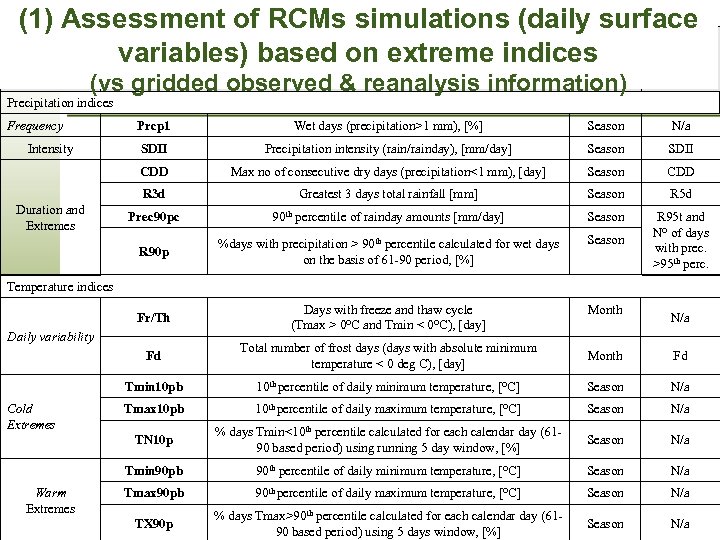 (1) Assessment of RCMs simulations (daily surface Time PCMDI variables) based on extreme indices Indices Abbreviation Description [unit] scale Similar (vs gridded observed & reanalysis information) indices Precipitation indices Frequency Season N/a SDII Precipitation intensity (rain/rainday), [mm/day] Season SDII Max no of consecutive dry days (precipitation<1 mm), [day] Season CDD R 3 d Greatest 3 days total rainfall [mm] Season R 5 d Prec 90 pc 90 th percentile of rainday amounts [mm/day] Season R 90 p %days with precipitation > 90 th percentile calculated for wet days on the basis of 61 -90 period, [%] Season R 95 t and N° of days with prec. >95 th perc. Fr/Th Days with freeze and thaw cycle (Tmax > 0°C and Tmin < 0°C), [day] Month Fd Total number of frost days (days with absolute minimum temperature < 0 deg C), [day] Month Fd Tmin 10 pb 10 th percentile of daily minimum temperature, [°C] Season N/a Tmax 10 pb 10 th percentile of daily maximum temperature, [°C] Season N/a TN 10 p % days Tmin<10 th percentile calculated for each calendar day (6190 based period) using running 5 day window, [%] Season N/a Tmin 90 pb Duration and Extremes Wet days (precipitation>1 mm), [%] CDD Intensity Prcp 1 90 th percentile of daily minimum temperature, [°C] Season N/a Tmax 90 pb 90 th percentile of daily maximum temperature, [°C] Season N/a TX 90 p % days Tmax>90 th percentile calculated for each calendar day (6190 based period) using 5 days window, [%] Season N/a Temperature indices Daily variability Cold Extremes Warm Extremes N/a
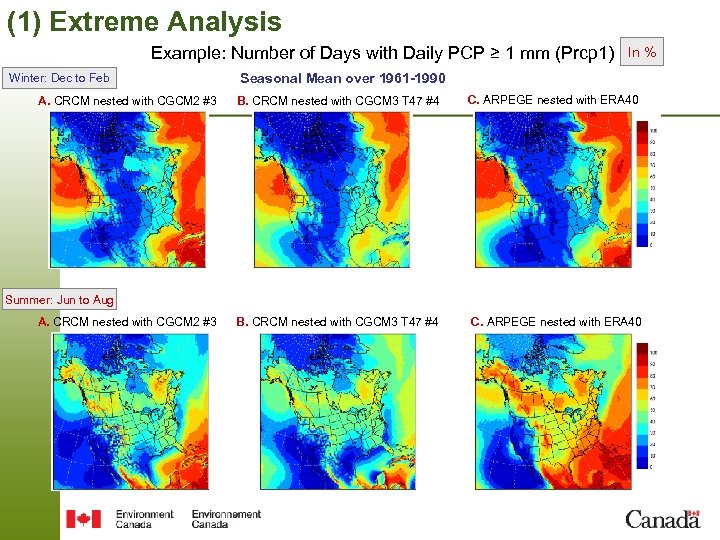 (1) Extreme Analysis Example: Number of Days with Daily PCP ≥ 1 mm (Prcp 1) Winter: Dec to Feb A. CRCM nested with CGCM 2 #3 In % Seasonal Mean over 1961 -1990 B. CRCM nested with CGCM 3 T 47 #4 C. ARPEGE nested with ERA 40 Summer: Jun to Aug A. CRCM nested with CGCM 2 #3
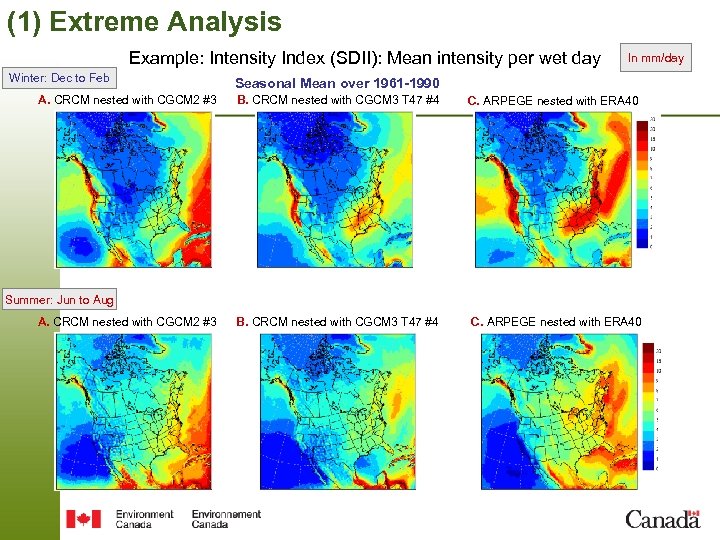 (1) Extreme Analysis Example: Intensity Index (SDII): Mean intensity per wet day Winter: Dec to Feb A. CRCM nested with CGCM 2 #3 In mm/day Seasonal Mean over 1961 -1990 B. CRCM nested with CGCM 3 T 47 #4 C. ARPEGE nested with ERA 40 Summer: Jun to Aug A. CRCM nested with CGCM 2 #3
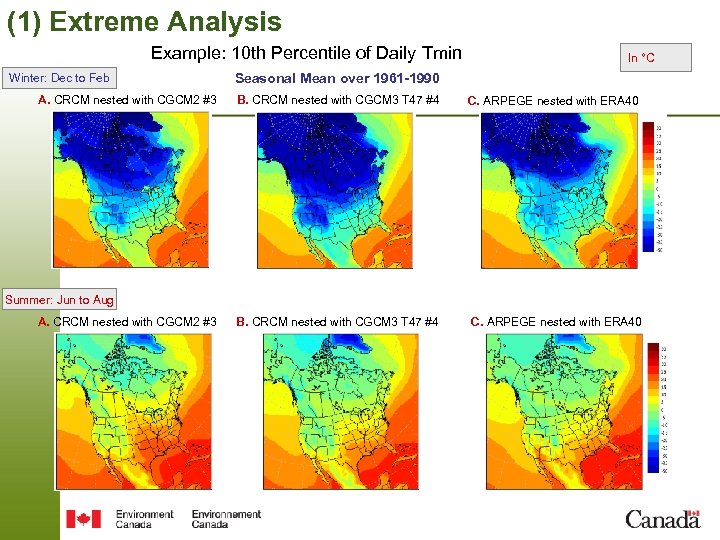 (1) Extreme Analysis Example: 10 th Percentile of Daily Tmin Winter: Dec to Feb A. CRCM nested with CGCM 2 #3 In °C Seasonal Mean over 1961 -1990 B. CRCM nested with CGCM 3 T 47 #4 C. ARPEGE nested with ERA 40 Summer: Jun to Aug A. CRCM nested with CGCM 2 #3
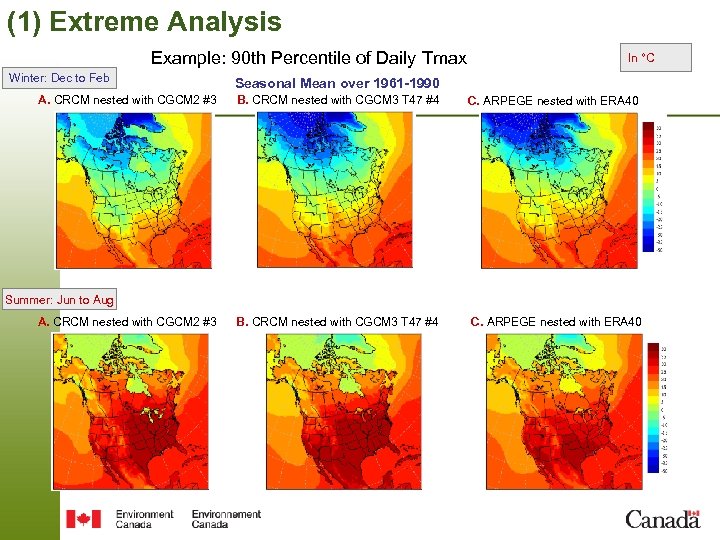 (1) Extreme Analysis Example: 90 th Percentile of Daily Tmax Winter: Dec to Feb A. CRCM nested with CGCM 2 #3 In °C Seasonal Mean over 1961 -1990 B. CRCM nested with CGCM 3 T 47 #4 C. ARPEGE nested with ERA 40 Summer: Jun to Aug A. CRCM nested with CGCM 2 #3
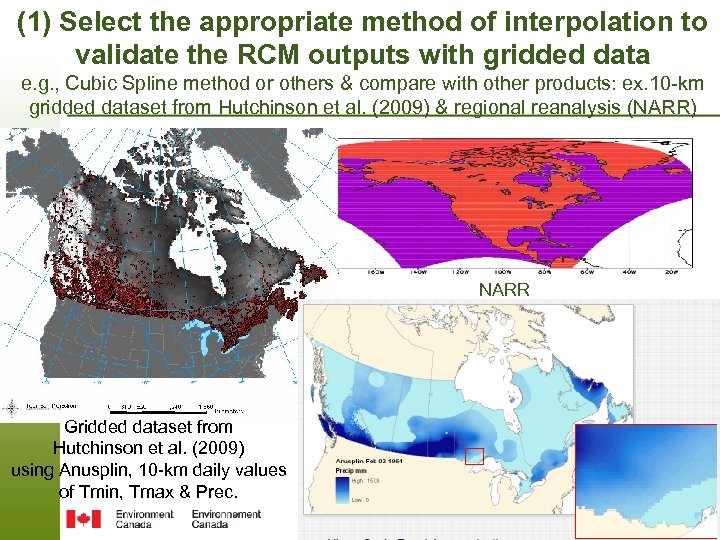 (1) Select the appropriate method of interpolation to validate the RCM outputs with gridded data e. g. , Cubic Spline method or others & compare with other products: ex. 10 -km gridded dataset from Hutchinson et al. (2009) & regional reanalysis (NARR) NARR Gridded dataset from Hutchinson et al. (2009) using Anusplin, 10 -km daily values of Tmin, Tmax & Prec.
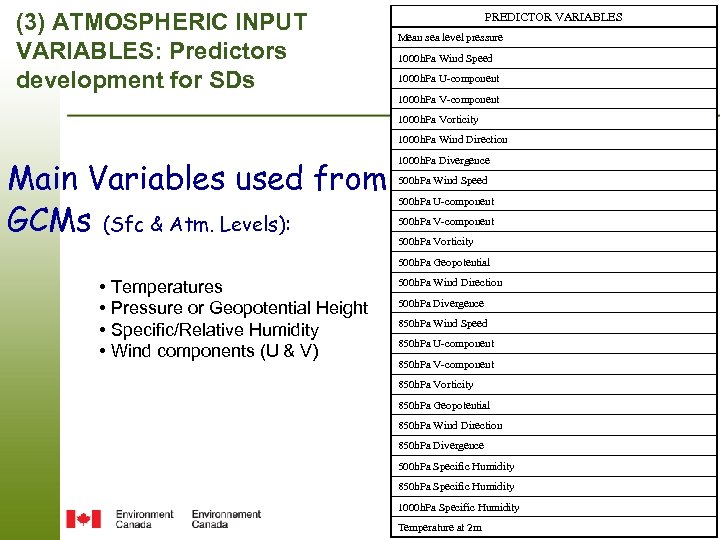 (3) ATMOSPHERIC INPUT VARIABLES: Predictors development for SDs PREDICTOR VARIABLES Mean sea level pressure 1000 h. Pa Wind Speed 1000 h. Pa U-component 1000 h. Pa Vorticity 1000 h. Pa Wind Direction Main Variables used from GCMs (Sfc & Atm. Levels): 1000 h. Pa Divergence 500 h. Pa Wind Speed 500 h. Pa U-component 500 h. Pa Vorticity 500 h. Pa Geopotential • Temperatures • Pressure or Geopotential Height • Specific/Relative Humidity • Wind components (U & V) 500 h. Pa Wind Direction 500 h. Pa Divergence 850 h. Pa Wind Speed 850 h. Pa U-component 850 h. Pa Vorticity 850 h. Pa Geopotential 850 h. Pa Wind Direction 850 h. Pa Divergence 500 h. Pa Specific Humidity 850 h. Pa Specific Humidity 1000 h. Pa Specific Humidity Temperature at 2 m
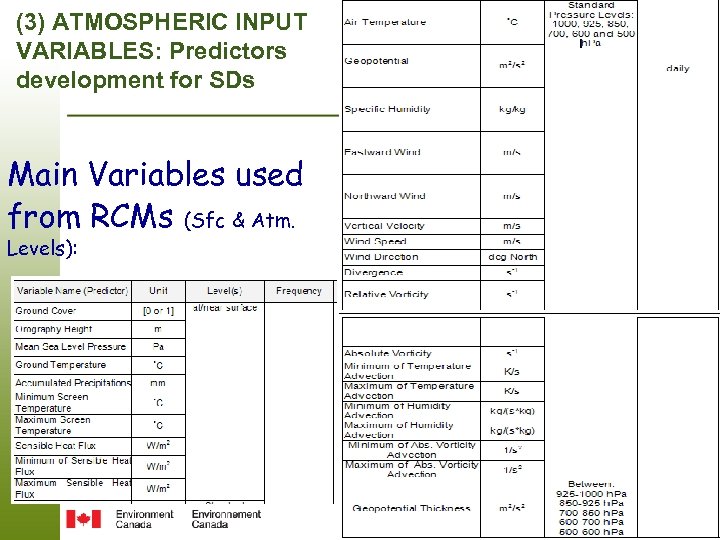 (3) ATMOSPHERIC INPUT VARIABLES: Predictors development for SDs Main Variables used from RCMs (Sfc & Atm. Levels):
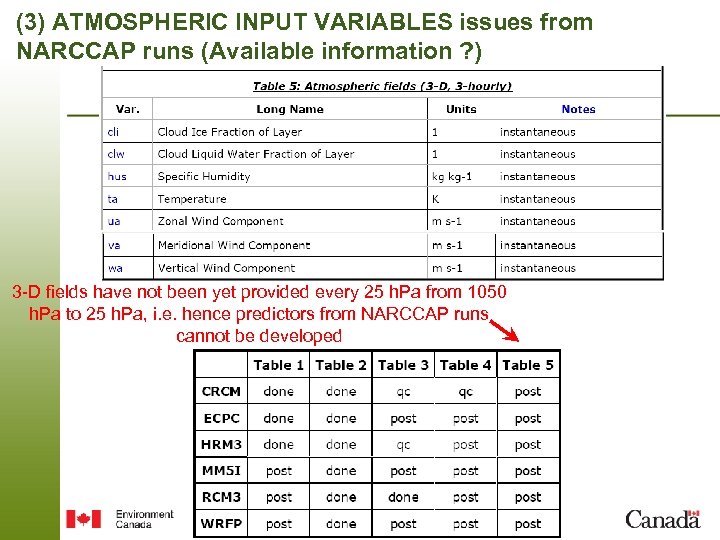 (3) ATMOSPHERIC INPUT VARIABLES issues from NARCCAP runs (Available information ? ) 3 -D fields have not been yet provided every 25 h. Pa from 1050 h. Pa to 25 h. Pa, i. e. hence predictors from NARCCAP runs cannot be developed
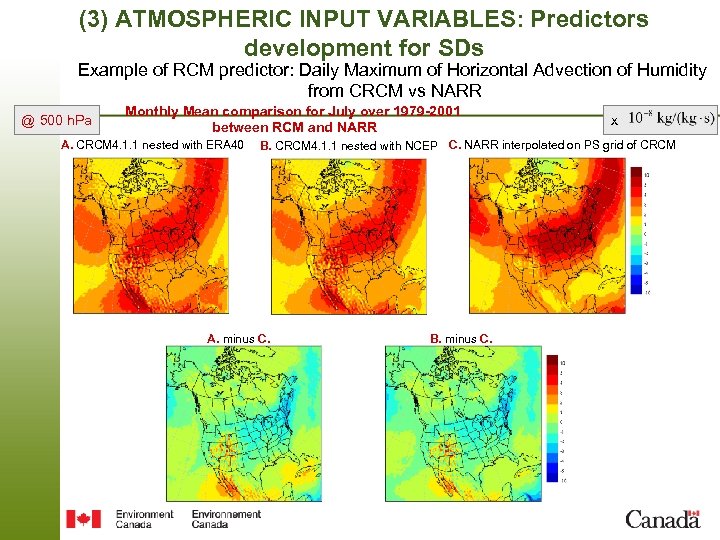 (3) ATMOSPHERIC INPUT VARIABLES: Predictors development for SDs Example of RCM predictor: Daily Maximum of Horizontal Advection of Humidity from CRCM vs NARR @ 500 h. Pa Monthly Mean comparison for July over 1979 -2001 between RCM and NARR A. CRCM 4. 1. 1 nested with ERA 40 x B. CRCM 4. 1. 1 nested with NCEP C. NARR interpolated on PS grid of CRCM A. minus C. B. minus C.
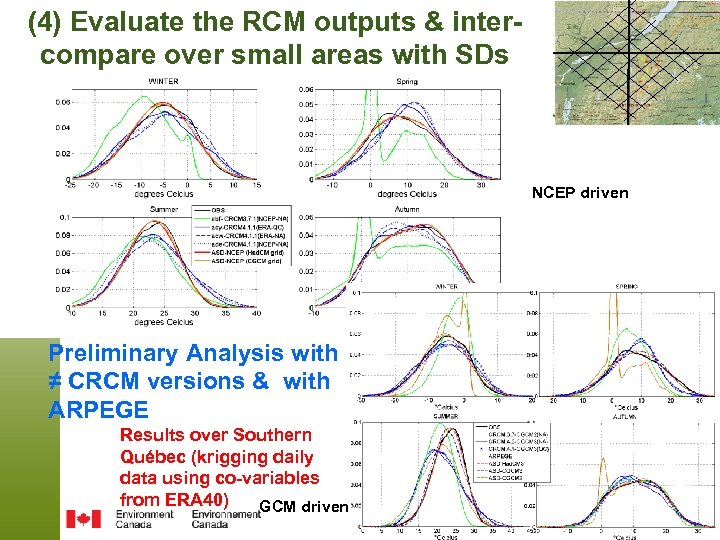 (4) Evaluate the RCM outputs & intercompare over small areas with SDs NCEP driven Preliminary Analysis with ≠ CRCM versions & with ARPEGE Results over Southern Québec (krigging daily data using co-variables from ERA 40) GCM driven (CRCM available runs from Ouranos)
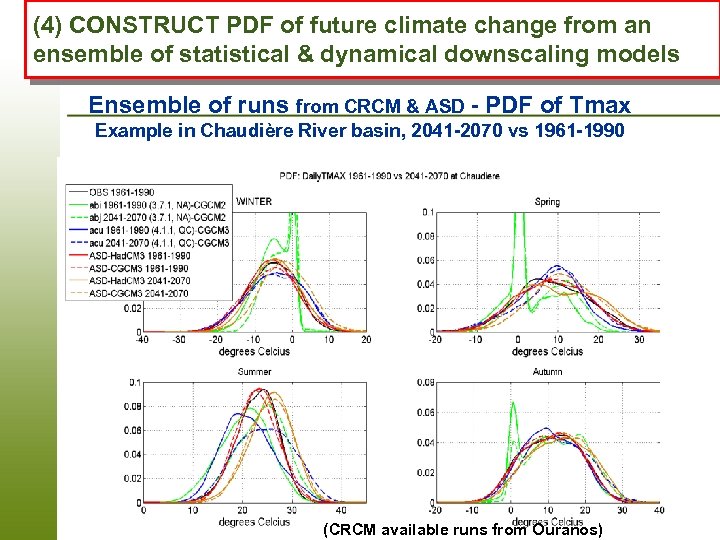 (4) CONSTRUCT PDF of future climate change from an ensemble of statistical & dynamical downscaling models Ensemble of runs from CRCM & ASD - PDF of Tmax Example in Chaudière River basin, 2041 -2070 vs 1961 -1990 (CRCM available runs from Ouranos)
 Next Steps for Statistical Downscaling Research, RCMs evaluation & climate scenarios • Improve the interannual variability of the multi-site MLR, i. e. link to atmospheric variables (downscaling) in modifying the parameters in the stochastic part & using Regional-scale predictors; • Develop multivariate statistical downscaling approaches (done for multisite & multivariate Tmin and Tmax); • Develop/Identify Links between predictand other regionalscale predictors from RCMs runs in extreme occurrences (from new predictors & test the stability of the statistical relationships); • Develop ensembles runs with various GCMs/RCMs SDs driven conditions & with RCMs (from Ouranos, CRCMD & NARCCAP runs, i. e. 13 independent RCM runs) and probabilistic scenarios. DRAFT – Page 19 – 16 March 2018
 Web sites links: Climate Analysis Group (Projects & Publications) : http: //quebec. ccsn. ca/GAC/ Data Access Integration : http: //quebec. ccsn. ca/local/data/DAI-e. html Canadian Climate Change Scenarios Network (CCCSN) : http: //www. cccsn. ca DRAFT – Page 20 – 16 March 2018
 Thank you for your attention!