


 Скачать презентацию Preliminary Findings of Study on Policy issues for
62fab8b11a5f591020d36bf284f1ae07.ppt
- Количество слайдов: 43
 Preliminary Findings of Study on “Policy issues for e-Health in Bangladesh” PREPARED BY ISTRATEGY LTD. WITH SUPPORT FROM BANGLADESH ENTERPRISE INSTITUTE (BEI) SPONSORED BY ROCKEFELLER FOUNDATION
 Background i. Strategy and BEI were given the task to conduct the following: Critical analysis of the current e-Health and HIS scenario in Bangladesh Identify policy-level issues that need prioritization This presentation is based on some results of that study
 Agenda Proposing realistic goals for HIS and e-Health in Bangladesh Policy issues that need to be addressed for attaining those goals in the context of local realities and global experiences A proposed phase-wise approach towards those goals
 Purpose Incite discussions and debates – not to suggest that there is only one way of looking at things Part of an on-going exercise to bring out the policy issues that need attention
 Setting Goals for Stronger HIS Moving gradually from “integrated” system thinking to “inter-operable” system thinking Moving gradually from aggregated data to individual -based data in electronic form Using open standards to avoid lock-in and keeping flexibility for customization as needed Focusing on “requirements specifications” and design before developing information systems
 1. Managing Identities
 Managing Identities The fundamental pre-requisite of a health system Issues for Mo. HFW: Health Service Provider Identity Organization Individual Service System user’s ID Patient ID Inter-ministerial issue: Geo Location Code: Address and location
 Managing IDs – Current Status Unique universally accepted IDs for: BMDC registration no for Physicians Drug License Hospital License Medical College License for nurses Issues that we don’t have unique IDs across systems for are: Service ID Health Indicators ID Diseases ID Patient ID System User’s ID Risk factors ID
 Potential Consequences of not having IDs Data from different systems cannot be aggregated Data can never be normalized in a single data dictionary Data exchange can be very expensive and time consuming Like developed countries, data can be locked in several silos and never being used across the systems, expensive adaptors are taking place for data interchange
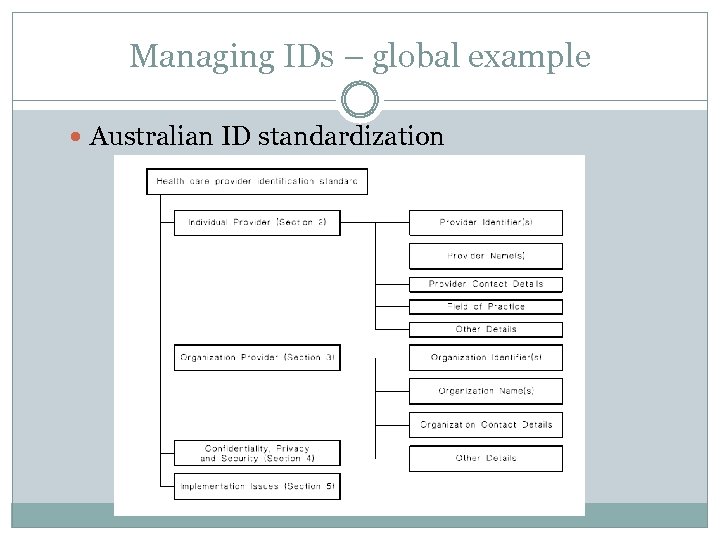 Managing IDs – global example Australian ID standardization
 Implementation Issues Unique ID system for every patient in the context of Bangladesh is a huge challenge and will take time to be developed However, many of the other IDs are more doable and can provide a basic platform for taking HIS to next level Short to medium term: IDs for health-service providers – individual and organizational, services, geo-locations Long term: Patient ID
 2. Privacy and Confidentiality
 Privacy and Confidentiality Setting rules for ‘governance of data’ is absolutely critical for designing an HIS Who owns data? Who has access to what data? Specially important for public-private collaborations and data sharing Consent of the patient regarding use of data
 Privacy and confidentiality – current status In practice, patient-doctor confidentiality is maintained by doctor himself Scope for improvement in the Privacy Act in Bangladesh being made more relevant for medical field No rules yet for ownership and access of data
 Potential consequences of not having privacy and confidentiality rules Critical to designing of health systems Defining the role of each user of the system Defining access control Designing security standards Without these, system development can be haphazard and adhoc – leading to expensive upgrades and changes later on Citizens will not be comfortable in letting their data to be digitized
 Privacy and Confidentiality: global scenario Every e-Health policy and guideline has privacy and confidentiality Example: HIPAA (Health Insurance Portability and Accountability Act) provides federal protections for personal health information held by different entities gives patients an array of rights with respect to that information.
 Privacy and Confidentiality - Implementation Issues We need to distinguish between individual and aggregated data since the former is much more sensitive We can start with issues around aggregated data first Short-to-Medium Term: Regulations may be passed by the government regarding: Ownership of health data Access rights of health data Security standards that need to be maintained by health systems Long Term: Deal with sharing of individual-level data Patient’s consent
 Reporting Standardization
 Reporting Standardization National Level Reporting Governmental organizations reporting to higher authority NGOs and private health-facilities reporting to the government International Level Reporting WHO Health-related donors
 Reporting Standardization – current status National-level reporting: Within Mo. HFW Inter-ministry Some standards such as those proposed by HMN, UN and Paris 21 declaration are used However, standards that can be used across systems are yet to be defined Collected manually, aggregated and sent through Excel spreadsheets Entered in DHIS from different districts Some of the comments that have come from the workshops: Duplication in report generation Aggregation across departments is often not possible For many organizations, there is no reporting software – it is done manually and the results entered in Excel formats Adhoc as needed NGO/private sector reporting to Mo. HFW Adhoc as needed International reporting: According to requirements of individual donors Varies from project to project Significant scope for standardization across projects
 Potential consequences of not standardizing reports Aggregation is not easily possible For instance: Very difficult to track MDG goals effectively at national level Costly and time consuming Expensive adapters and mapping mechanisms may be required for aggregation
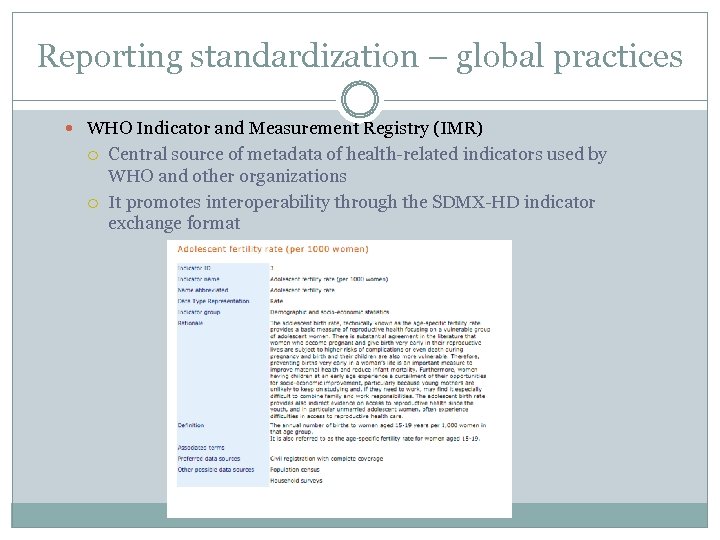 Reporting standardization – global practices WHO Indicator and Measurement Registry (IMR) Central source of metadata of health-related indicators used by WHO and other organizations It promotes interoperability through the SDMX-HD indicator exchange format
 4. Enabling Standardized Data Entry
 Enabling standardized data entry Standardized entry of diseases, signs and symptoms Standardized entry of patient data at: Facility-level Community-level
 Enabling standardized data entry – current status Public sector Facility-level: Aggregated data from record rooms at some hospitals are digitized and sent through Excel sheets or entered in DHIS indicators are not standardized across systems but it has provided a solid foundation for further work Community-level: Data collection is done manually and aggregated manually, which is digitized at district levels NGO sector Each NGO has their own way of inputting data – no standardization Private sector 2 or 3 top private hospitals are found to be using ICD-10
 Enabling standardized data entry: Implementation issues ICD 10 (International Classification of Diseases) Coding of diseases, signs and symptoms, abnormal findings, complaints, social circumstances and external causes of injury or diseases SNOMED (Systemized Nomenclature of Medicine) Wider coverage than just diseases, including findings, procedures, microorganisms, pharmaceuticals etc. Licensing involved Less uptake than ICD 10 Short term: Standardized digitization of aggregated data from record rooms at facilities Standardized digitization of aggregated data coming from community level Mid-term: EMR for community level intervention based on remote feedback from doctors Long term: EMR at hospitals
 Enabling standardized data exchange
 Enabling standardized data exchange Data may be entered in numerous ways and we cannot change those, we cannot change legacy systems already in place What we can do is have a standard for exchanging of data If the standards for data entry are not followed as discussed earlier, then aggregation will not be possible automatically
 Enabling standardized data exchange – current status Within Mo. HFW Different projects have their own MIS –no interchange of data between systems Between private sector and government Adhoc as needed Some comments from the workshops: Private sector is willing to send data if there is a specific format for exchange is given to them
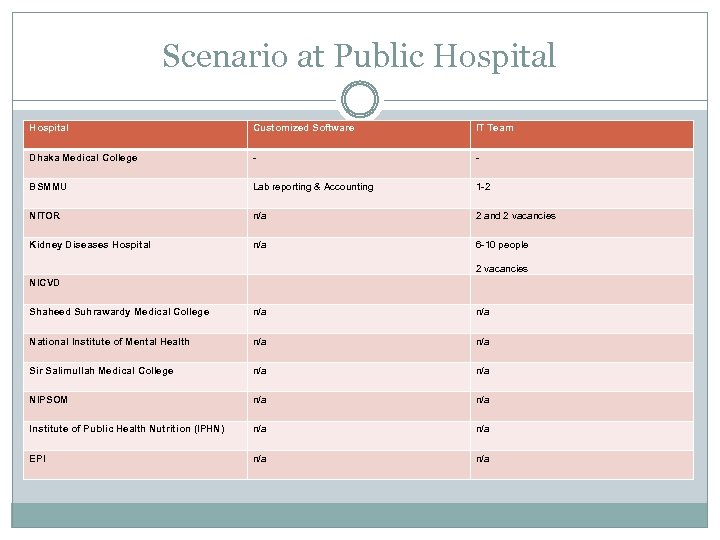 Scenario at Public Hospital Customized Software IT Team Dhaka Medical College - - BSMMU Lab reporting & Accounting 1 -2 NITOR n/a 2 and 2 vacancies Kidney Diseases Hospital n/a 6 -10 people 2 vacancies NICVD Shaheed Suhrawardy Medical College n/a National Institute of Mental Health n/a Sir Salimullah Medical College n/a NIPSOM n/a Institute of Public Health Nutrition (IPHN) n/a EPI n/a
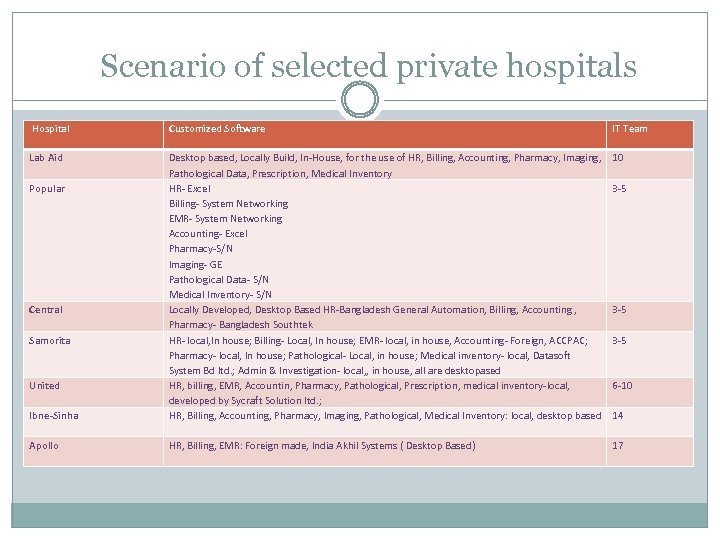 Scenario of selected private hospitals Hospital Customized Software IT Team Lab Aid 10 Ibne-Sinha Desktop based, Locally Build, In-House, for the use of HR, Billing, Accounting, Pharmacy, Imaging, Pathological Data, Prescription, Medical Inventory HR- Excel Billing- System Networking EMR- System Networking Accounting- Excel Pharmacy-S/N Imaging- GE Pathological Data- S/N Medical Inventory- S/N Locally Developed, Desktop Based HR-Bangladesh General Automation, Billing, Accounting , Pharmacy- Bangladesh Southtek HR- local, In house; Billing- Local, In house; EMR- local, in house, Accounting- Foreign, ACCPAC; Pharmacy- local, In house; Pathological- Local, in house; Medical inventory- local, Datasoft System Bd ltd. ; Admin & Investigation- local, , in house, all are desktopased HR, billing, EMR, Accountin, Pharmacy, Pathological, Prescription, medical inventory-local, developed by Sycraft Solution ltd. ; HR, Billing, Accounting, Pharmacy, Imaging, Pathological, Medical Inventory: local, desktop based Apollo HR, Billing, EMR: Foreign made, India Akhil Systems ( Desktop Based) 17 Popular Central Samorita United 3 -5 3 -5 6 -10 14
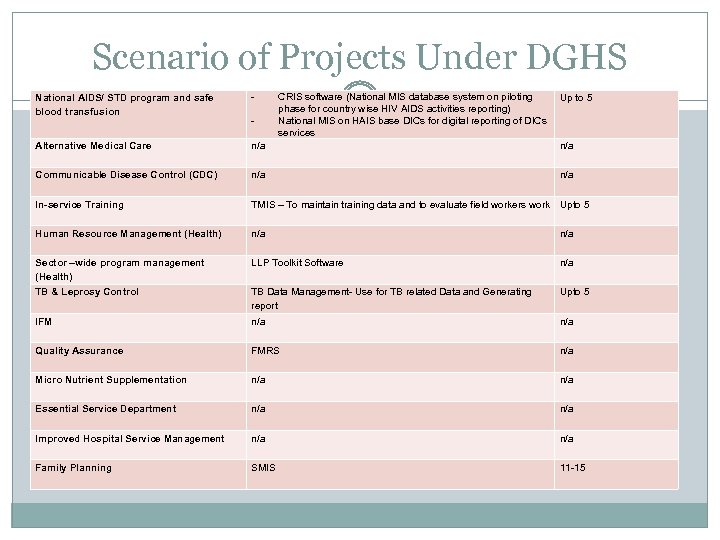 Scenario of Projects Under DGHS National AIDS/ STD program and safe blood transfusion - Alternative Medical Care n/a Communicable Disease Control (CDC) n/a In-service Training TMIS – To maintain training data and to evaluate field workers work Upto 5 Human Resource Management (Health) n/a Sector –wide program management (Health) LLP Toolkit Software n/a TB & Leprosy Control TB Data Management- Use for TB related Data and Generating report Upto 5 IFM n/a Quality Assurance FMRS n/a Micro Nutrient Supplementation n/a Essential Service Department n/a Improved Hospital Service Management n/a Family Planning SMIS 11 -15 - CRIS software (National MIS database system on piloting phase for country wise HIV AIDS activities reporting) National MIS on HAIS base DICs for digital reporting of DICs services Up to 5
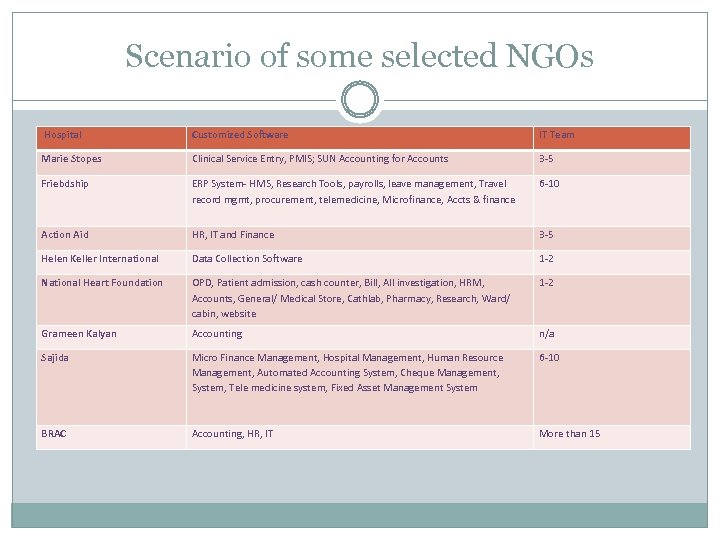 Scenario of some selected NGOs Hospital Customized Software IT Team Marie Stopes Clinical Service Entry, PMIS; SUN Accounting for Accounts 3 -5 Friebdship ERP System- HMS, Research Tools, payrolls, leave management, Travel record mgmt, procurement, telemedicine, Microfinance, Accts & finance 6 -10 Action Aid HR, IT and Finance 3 -5 Helen Keller International Data Collection Software 1 -2 National Heart Foundation OPD, Patient admission, cash counter, Bill, All investigation, HRM, Accounts, General/ Medical Store, Cathlab, Pharmacy, Research, Ward/ cabin, website 1 -2 Grameen Kalyan Accounting n/a Sajida Micro Finance Management, Hospital Management, Human Resource Management, Automated Accounting System, Cheque Management, System, Tele medicine system, Fixed Asset Management System 6 -10 BRAC Accounting, HR, IT More than 15
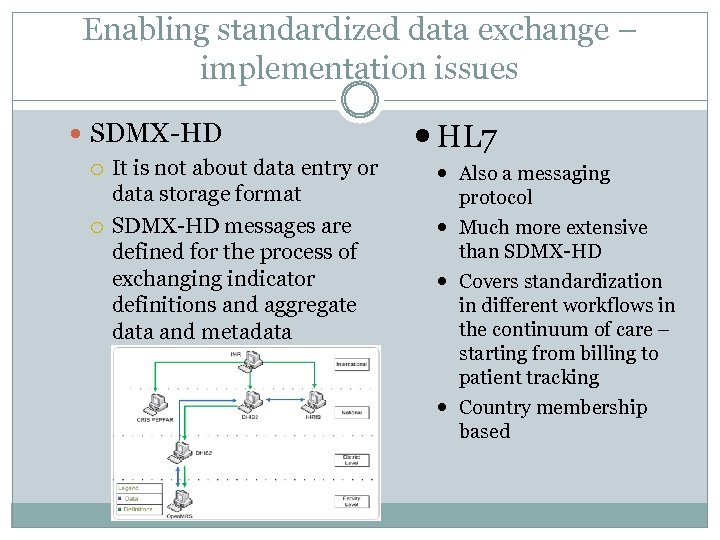 Enabling standardized data exchange – implementation issues SDMX-HD It is not about data entry or data storage format SDMX-HD messages are defined for the process of exchanging indicator definitions and aggregate data and metadata HL 7 Also a messaging protocol Much more extensive than SDMX-HD Covers standardization in different workflows in the continuum of care – starting from billing to patient tracking Country membership based
 Enabling standardized data exchange – implementation issues Short term: Standardizing the format for data exchange with respect to indicators and IDs Mid to long term: Standardizing data exchange and inter-operability Standardization for privacy and security during data exchange and inter-operability
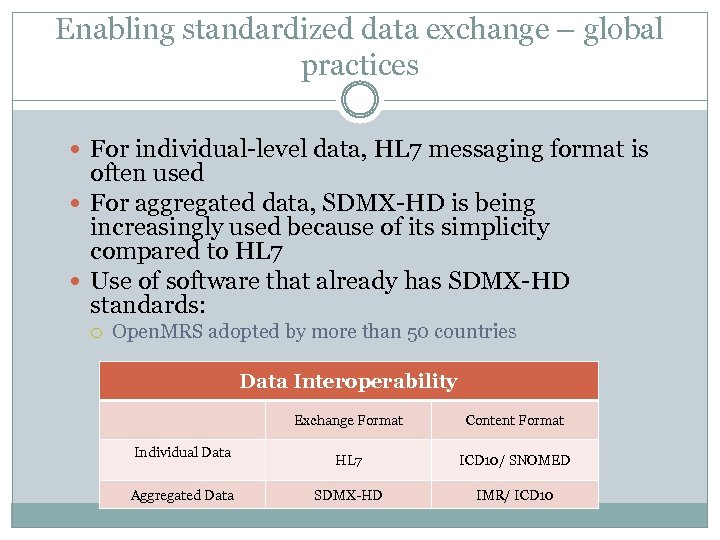 Enabling standardized data exchange – global practices For individual-level data, HL 7 messaging format is often used For aggregated data, SDMX-HD is being increasingly used because of its simplicity compared to HL 7 Use of software that already has SDMX-HD standards: Open. MRS adopted by more than 50 countries Data Interoperability Exchange Format Individual Data Aggregated Data Content Format HL 7 ICD 10/ SNOMED SDMX-HD IMR/ ICD 10
 Going beyond data exchange Getting data by querying into other information systems Service Oriented Architecture (SOA) approach
 Going beyond data exchange – current status In the government: SOA-based approach is not prevalent yet In the private sector: Sporadic instances Example: inter-operability within different systems of BRAC
 Potential consequences of sole dependence on data exchange It is not feasible for everybody to have every data. Systems cannot share functionality Redundant data storage Costly Data integrity Not taking advantage of “starting late”
 Proposed Implementation Phases Phase 1: Building on already developed foundation Phase 2: Basic Inter-operability Phase 3: Advanced Inter-operability
 Phase 1: Building on already developed foundation Form a high level steering committee for the following: Identity Management of Health Service Providers, Locations and Services. Role Based Privacy and Confidentiality Rules (like HIPAA). Use a terminology standard ICD 10/SNOMED during data entry before sending to the accumulation point Implement regulation for Data interchange Develop standardized formats for data interchange Enterprise service bus (developed by A 2 I)
 Phase 2: Basic Inter-operability Digitization of record room (aggregated data) Implementation of ICD 10, SDMX-HD Major private hospital and major NGOs involved in data interchange according to standardized formats Shared registry of National level health information (building on NPR) Implementation of privacy and security guideline (like HIPAA) First steps towards EMR at health-facilities
 Phase 3: Advanced Inter-operability Identity management of patients Roll out of EMR at health-facilities Interoperability in HIS SOA based- hub and spoke model ESB based