Скачать презентацию Preliminaries Federal Corps Planning Process PA Program Plan Formulation
918e69c96a9e9565c6dc4b2e2223b908.ppt
- Количество слайдов: 38
 Preliminaries Federal/Corps Planning Process PA Program Plan Formulation Supplement - FY 08
 Objective: This module will discuss the following: — What is Federal water resources planning? — What are the six steps of the planning process (and how are plans evaluated)?
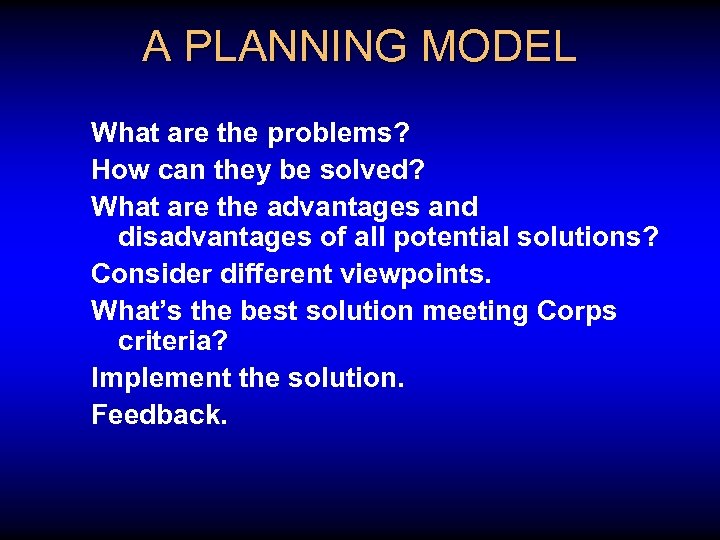 A PLANNING MODEL What are the problems? How can they be solved? What are the advantages and disadvantages of all potential solutions? Consider different viewpoints. What’s the best solution meeting Corps criteria? Implement the solution. Feedback.
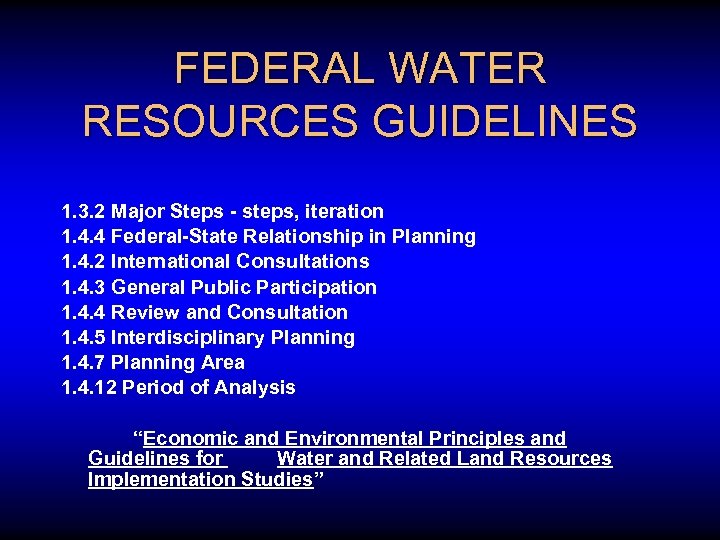 FEDERAL WATER RESOURCES GUIDELINES 1. 3. 2 Major Steps - steps, iteration 1. 4. 4 Federal-State Relationship in Planning 1. 4. 2 International Consultations 1. 4. 3 General Public Participation 1. 4. 4 Review and Consultation 1. 4. 5 Interdisciplinary Planning 1. 4. 7 Planning Area 1. 4. 12 Period of Analysis “Economic and Environmental Principles and Guidelines for Water and Related Land Resources Implementation Studies”
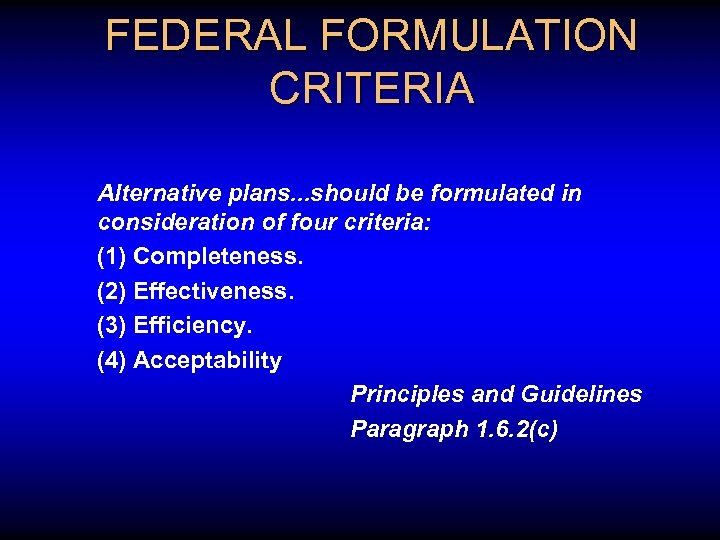 FEDERAL FORMULATION CRITERIA Alternative plans. . . should be formulated in consideration of four criteria: (1) Completeness. (2) Effectiveness. (3) Efficiency. (4) Acceptability Principles and Guidelines Paragraph 1. 6. 2(c)
 CORPS PLANNING REFERENCES ER 1105 -2 -100 - Chapter 2 Planning Manual - Chapters 5, 12, 13
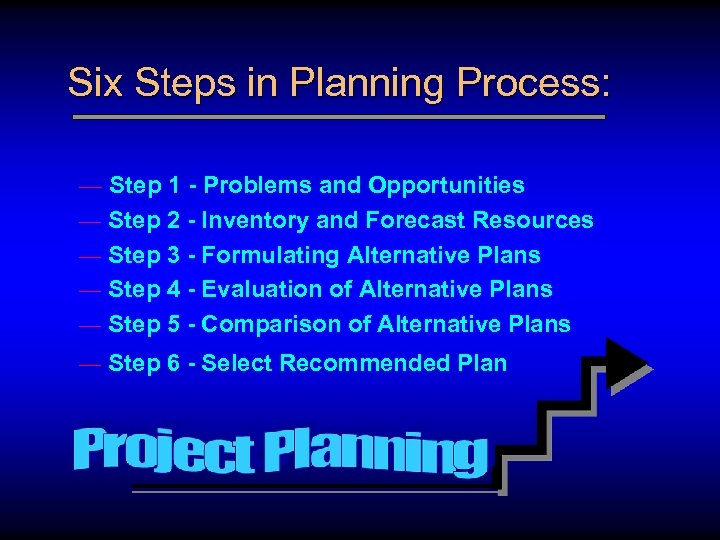 Six Steps in Planning Process: — Step 1 - Problems and Opportunities — Step 2 - Inventory and Forecast Resources — Step 3 - Formulating Alternative Plans — Step 4 - Evaluation of Alternative Plans — Step 5 - Comparison of Alternative Plans — Step 6 - Select Recommended Plan
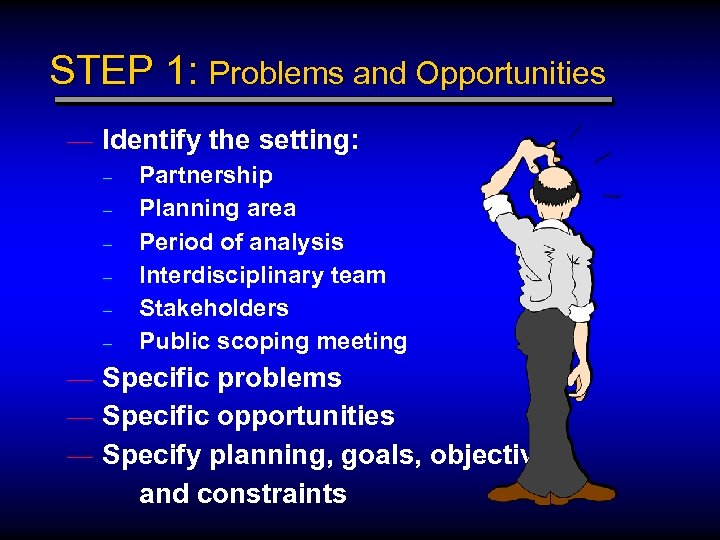 STEP 1: Problems and Opportunities — Identify the setting: – – – Partnership Planning area Period of analysis Interdisciplinary team Stakeholders Public scoping meeting — Specific problems — Specific opportunities — Specify planning, goals, objectives, and constraints
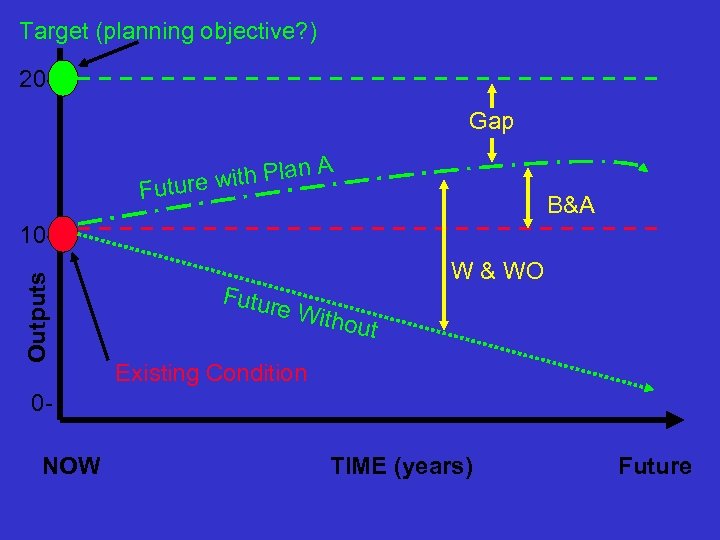
 STEP 2: Inventory and Forecast Resources — Planning requires information — External and internal factors influence the study environment — Determine existing conditions — Forecast future conditions and establish Without Project Condition(s)!!
 STEP 3: Formulation of Alternative Plans — Plan formulation is using systems of measures, strategies, or programs to fully or partially meet the identified planning objectives, subject to the planning constraints. — Generating “full” array of reasonable alternatives (NEPA) — The Principles and Guidelines (P&G) is the standard to formulate alternative plans — Effective — Efficient — Complete — Acceptable
 Feasibility Scoping Meeting (FSM) — Reference ER 1105 -2 -100 Appendix G, Amendment 1 — Mandatory meeting with the Corps Vertical Team, sponsors, agencies, and stakeholders — Establish buy-in for Without Project Condition(s) — Review/Update analysis yet to be done — Present preliminary measures and alternatives array
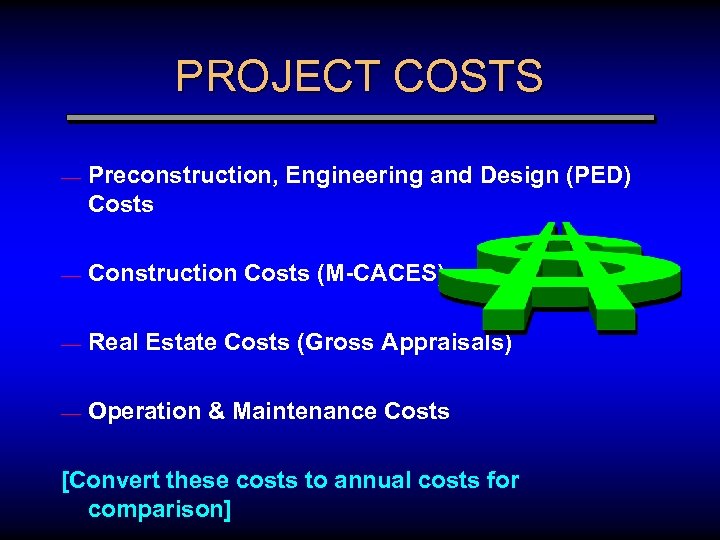
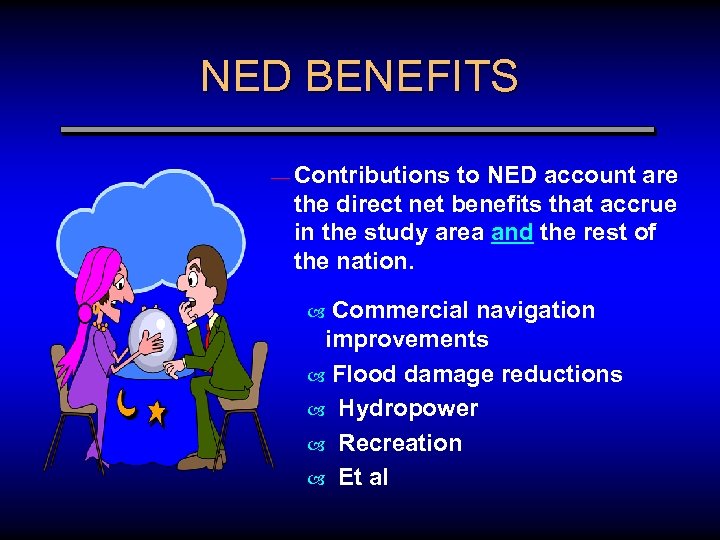
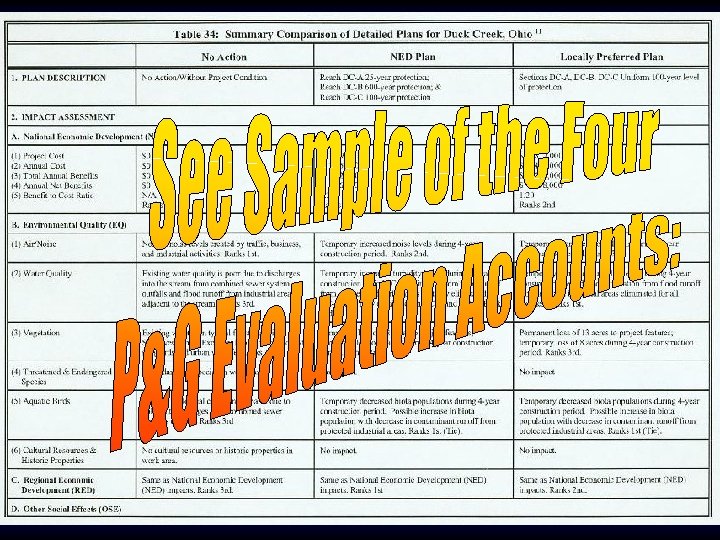
 STEP 4: Evaluation of Alternative Plans Compare with and without project conditions — Screen alternatives — Evaluate alternatives and present results of: — — Costs and Mitigation Requirements — Benefits (monetary and non-monetary) — P&G Accounts Impacts — NED – National Economic Development — RED – Regional Economic Development — EQ – Environmental Quality
 Target (planning objective? ) 20 Gap lan re with P Futu A B&A Outputs 10 W & WO Futur e Wit hout Existing Condition 0 NOW TIME (years) Future
 PROJECT COSTS — Preconstruction, Engineering and Design (PED) Costs — Construction Costs (M-CACES) — Real Estate Costs (Gross Appraisals) — Operation & Maintenance Costs [Convert these costs to annual costs for comparison]
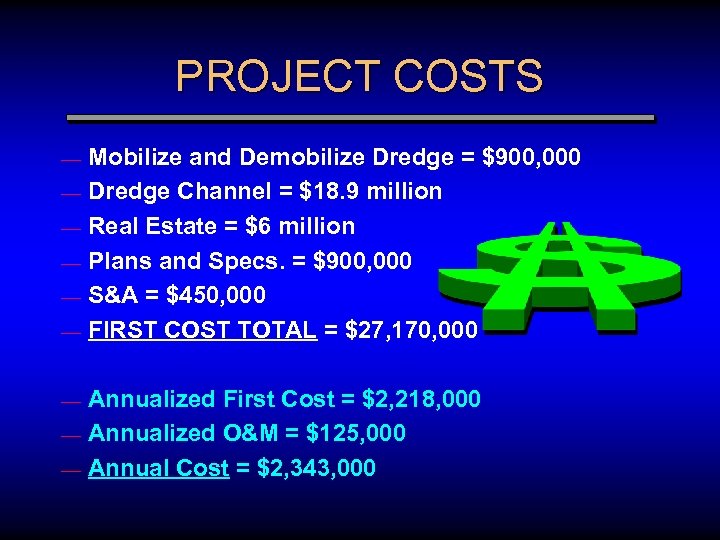 PROJECT COSTS — — — Mobilize and Demobilize Dredge = $900, 000 Dredge Channel = $18. 9 million Real Estate = $6 million Plans and Specs. = $900, 000 S&A = $450, 000 FIRST COST TOTAL = $27, 170, 000 Annualized First Cost = $2, 218, 000 — Annualized O&M = $125, 000 — Annual Cost = $2, 343, 000 —
 NED BENEFITS — Contributions to NED account are the direct net benefits that accrue in the study area and the rest of the nation. Commercial navigation improvements Flood damage reductions Hydropower Recreation Et al
 EVALUATE PLANS ECONOMICALLY Determine period of evaluation (typ. 50 or 100 years) — Determine benefits (NED and/or NER) and costs of the project —
 NED ANALYSIS PROCESS —Calculate NED benefits and costs at a common point in time - such as the end of the installation period —Convert this value to an average annual value —Benefits are quantified for each alternative being
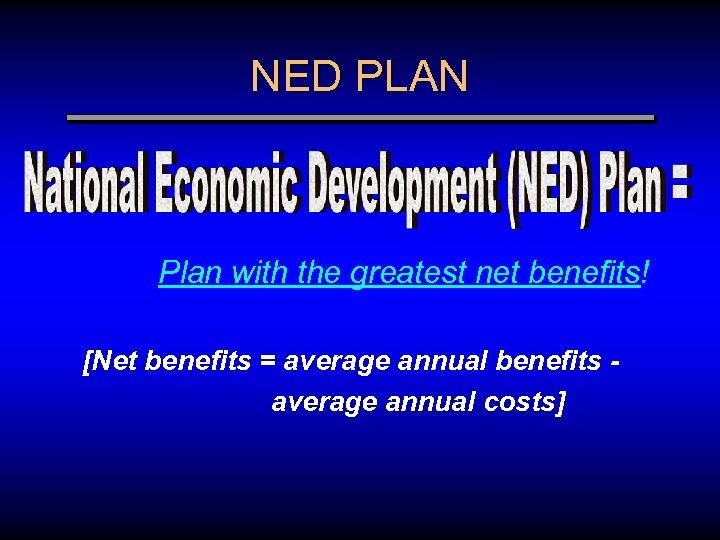 NED PLAN Plan with the greatest net benefits! [Net benefits = average annual benefits average annual costs]
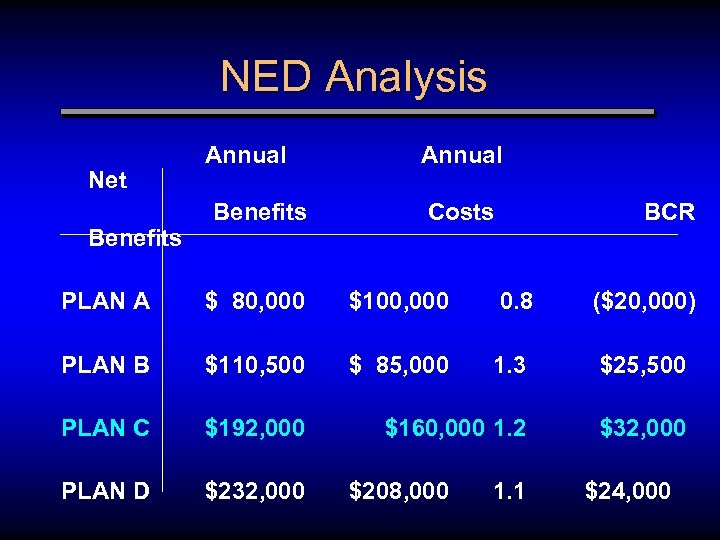 NED Analysis Net Benefits Annual Costs BCR PLAN A $ 80, 000 $100, 000 0. 8 ($20, 000) PLAN B $110, 500 $ 85, 000 1. 3 $25, 500 PLAN C $192, 000 $160, 000 1. 2 $32, 000 PLAN D $232, 000 $208, 000 1. 1 $24, 000
 NER BENEFITS – ECOSYSTEM RESTORATION — Non-monetary project benefits or outputs — Significance of resource must be explained — Ecosystem outputs must be measurable and quantifiable
 NER EVALUATION PROCESS — Identify relationship between changes in outputs and changes in costs. Completed through Cost Effectiveness and Incremental Cost Analysis — No monetary net benefits or Benefit-to-Cost Ratio
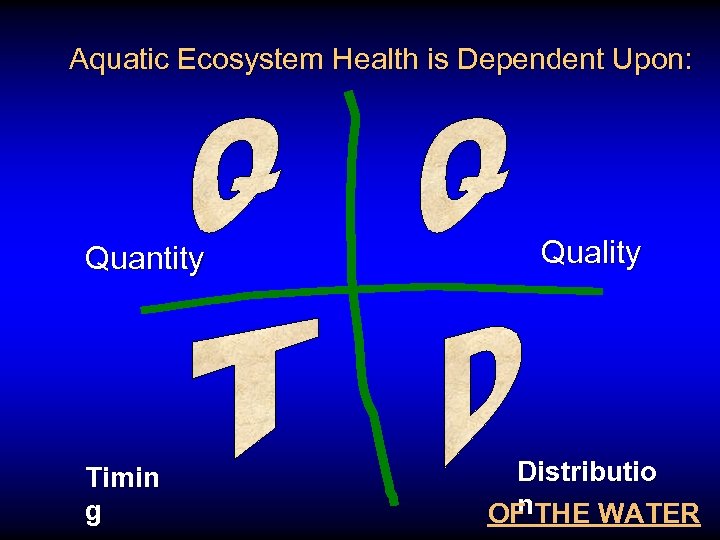 Aquatic Ecosystem Health is Dependent Upon: Quantity Timin g Quality Distributio n OF THE WATER
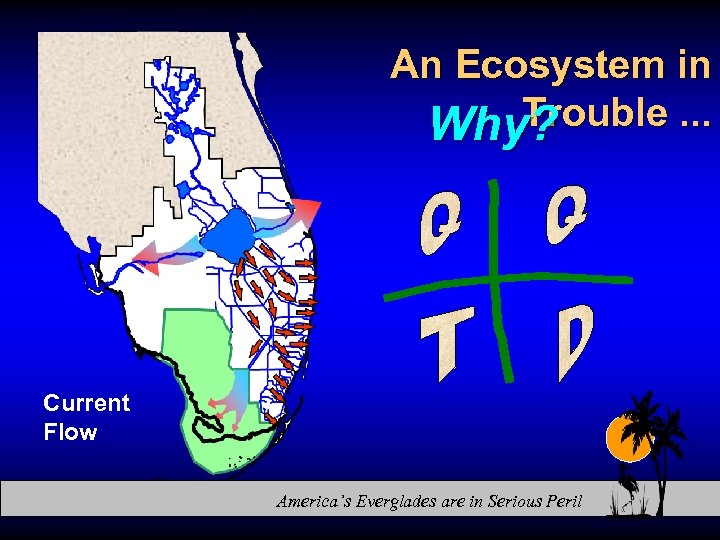 An Ecosystem in Trouble. . . Why? Current Flow America’s Everglades are in Serious Peril
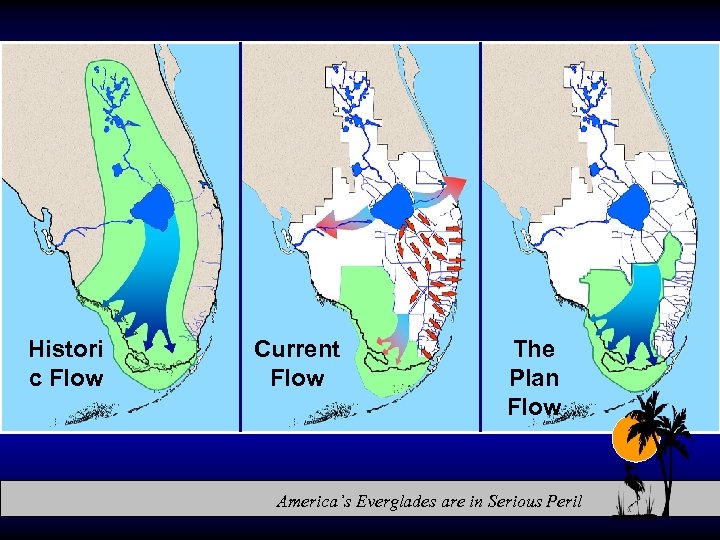 Histori c Flow Current Flow The Plan Flow America’s Everglades are in Serious Peril
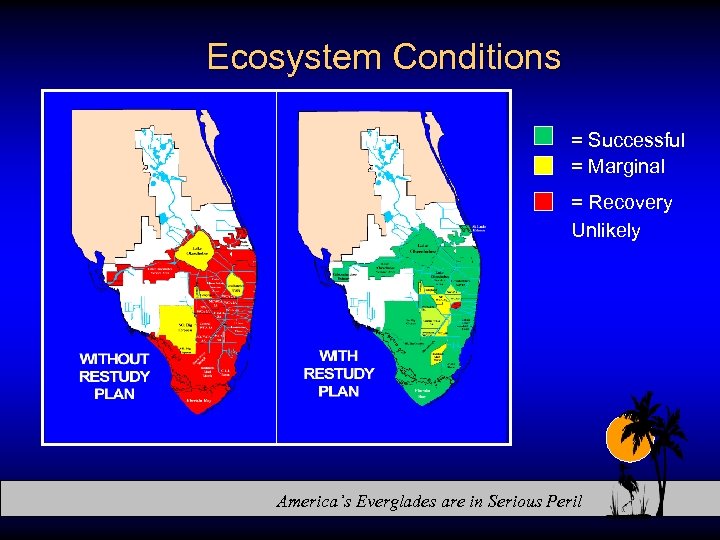 Ecosystem Conditions = Successful = Marginal = Recovery Unlikely America’s Everglades are in Serious Peril
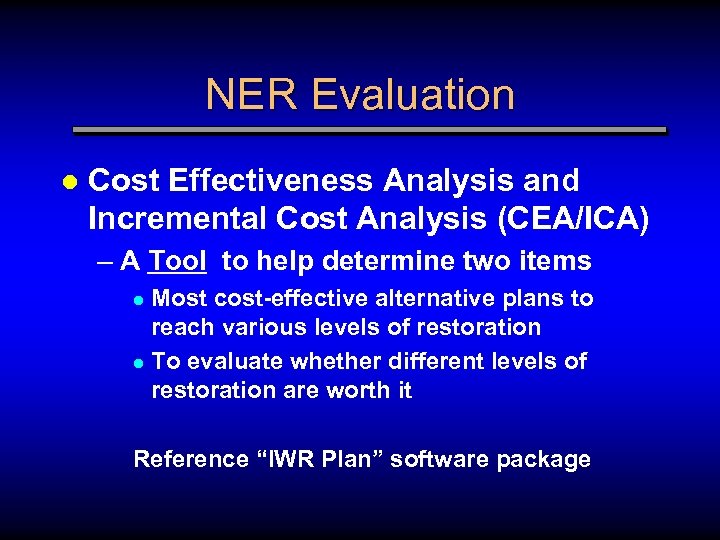 NER Evaluation l Cost Effectiveness Analysis and Incremental Cost Analysis (CEA/ICA) – A Tool to help determine two items Most cost-effective alternative plans to reach various levels of restoration l To evaluate whether different levels of restoration are worth it l Reference “IWR Plan” software package
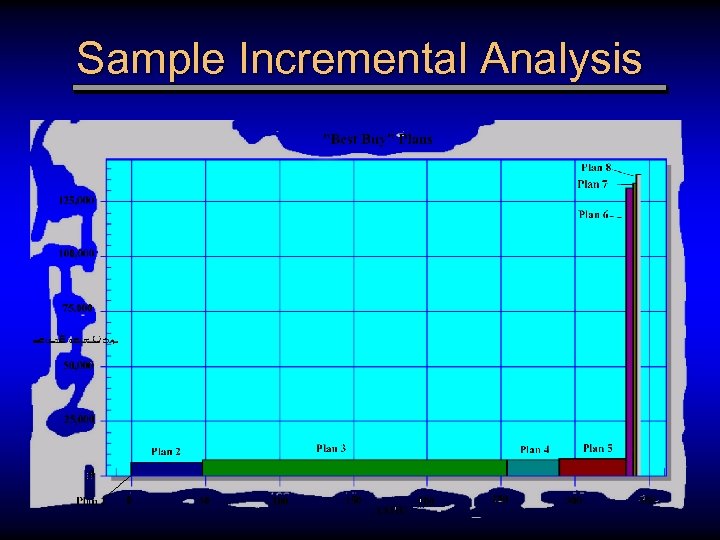 Sample Incremental Analysis
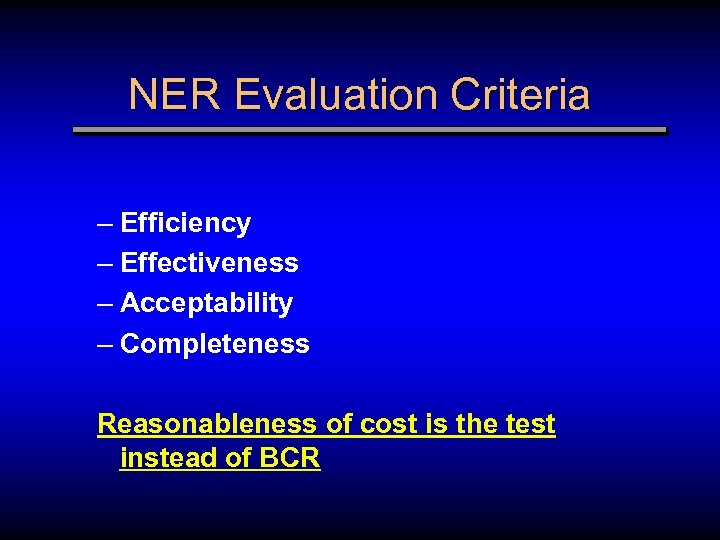 NER Evaluation Criteria – Efficiency – Effectiveness – Acceptability – Completeness Reasonableness of cost is the test instead of BCR
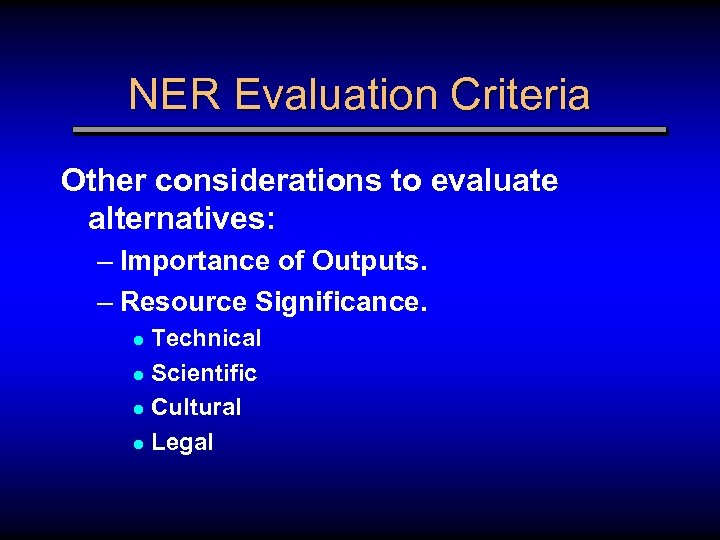 NER Evaluation Criteria Other considerations to evaluate alternatives: – Importance of Outputs. – Resource Significance. Technical l Scientific l Cultural l Legal l
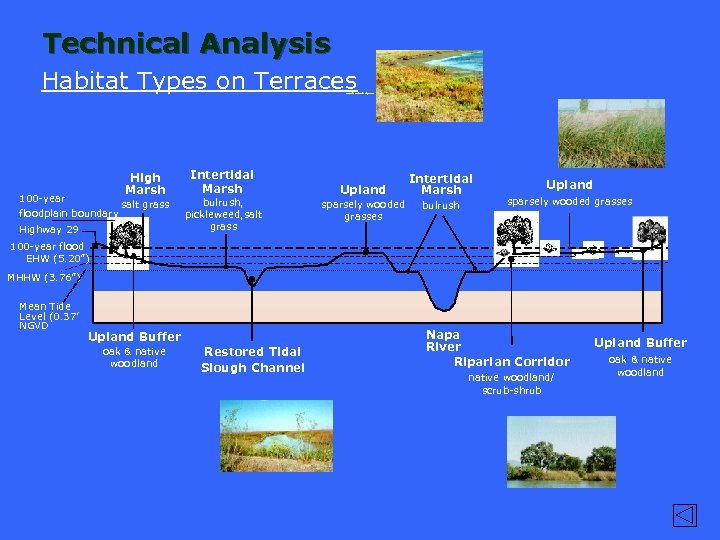 Technical Analysis Habitat Types on Terraces Wetlands restoration w/pictures High Marsh 100 -year floodplain boundary salt grass Highway 29 Intertidal Marsh bulrush, pickleweed, salt grass Upland Intertidal Marsh sparsely wooded grasses bulrush Upland sparsely wooded grasses 100 -year flood EHW (5. 20”) MHHW (3. 76”) Mean Tide Level (0. 37’ NGVD Upland Buffer oak & native woodland Restored Tidal Slough Channel Napa River Riparian Corridor native woodland/ scrub-shrub Upland Buffer oak & native woodland
 Evaluate Plans Environmentally — Determine environmental impacts caused by the alternative plans — Prepare NEPA (National Environmental Policy Act) documentation [EIS, EA/FONSI] and other environmental compliance requirements More to come in Module 15
 What is Mitigation ? Mitigation addresses adverse environmental effects of new project construction and operation and should be planned and implemented concurrently (if not before).
 STEP 5: Comparison of Alternative Plans — There are different methods for comparing alternatives and their effects: – – – Monetary evaluation methods Multi-criteria evaluation methods Trade-off analysis Goal achievement method Incremental cost/cost effectiveness analysis Non-monetary criteria (i. e. loss of life)
 STEP 6: Select Recommended Plan — Cost Effective: – Current guidance calls for recommending the – – NED or NER Plan unless there is a locally preferred plan (LPP) LPP recommendation requires ASA(CW) concurrence Sponsors typically pay any increased cost above NED or NER Plan — Environmentally sound — Technically feasible — Socially & Politically Acceptable
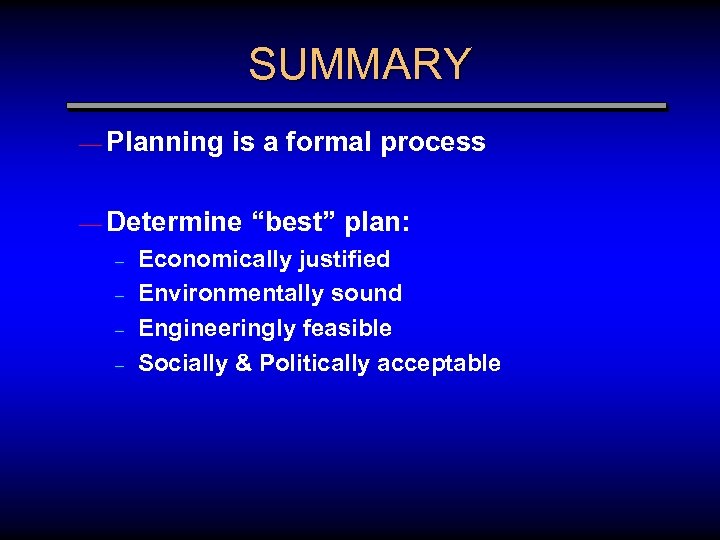 SUMMARY — Planning is a formal process — Determine – – “best” plan: Economically justified Environmentally sound Engineeringly feasible Socially & Politically acceptable