Скачать презентацию Prehospital Trauma Life Support Lesson 6 Shock
dfd7cc781732f1d4ac90c3d6b6cf7516.ppt
- Количество слайдов: 40

 Prehospital Trauma Life Support Lesson 6 Shock & Fluid Resuscitation
 Developed by the National Association of Emergency Medical In cooperation with Technicians The Committee on Trauma, American College of Surgeons This slide presentation is intended for use only in approved PHTLS courses. 6 -1 B
 Lesson 6 Objectives Correlate perfusion, hypoxia, hypovolemia and hypotension to the signs and symptoms of shock. Differentiate between early and late signs of shock. Describe the pathophysiological changes of shock. 6 -2
 Shock: A rude unhinging of the Samuel machinery of Gross, 1852 6 -3
 Shock Redefined: Lack of end-tissue perfusion. Pitfall: Defining shock as decreased blood pressure. 6 -4
 Scenario You are caring for the sole victim of a motorcycle crash. He is lying on the ground next to his motorcycle. The scene appears safe. 6 -5
 Findings Q A - Open, clear. Q B - RR fast. BS clear. Bruising noted over sternum; no other chest deformity. Q C - Radial pulse weak & rapid. Q D - PEARL. Anxious & confused. Normal movement & sensation. Q E - No deformity noted. Skin cool & diaphoretic. 6 -6
 Discussion ç Is this patient in shock? ç Why? ç What is the patient’s real problem? 6 -7
 Cell Perfusion ç Aerobic metabolism requires adequate oxygenation. ç Cells require oxygen and sugar to produce energy and carbon dioxide. Is the patient in this scenario adequately perfusing his cells? 6 -8
 Anaerobic Metabolism Inadequate oxygenation for metabolism. Q By-products: 4 Less energy. 4 More acid. 4 Potassium. 6 -9
 Leads to Acidosis • Inadequate oxygen delivery, cellular extraction, and consumption result in cellular conversion to anaerobic metabolism for energy substrate production (ATP production) • Increased production and release of lactate
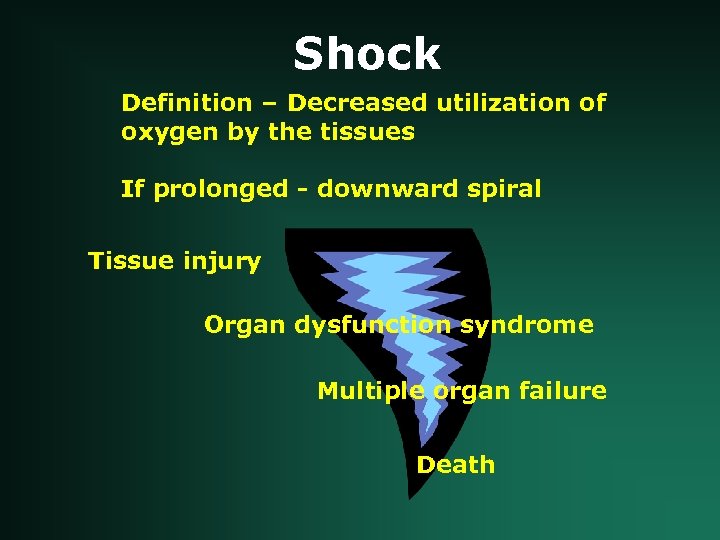 Shock Definition – Decreased utilization of oxygen by the tissues If prolonged - downward spiral Tissue injury Organ dysfunction syndrome Multiple organ failure Death
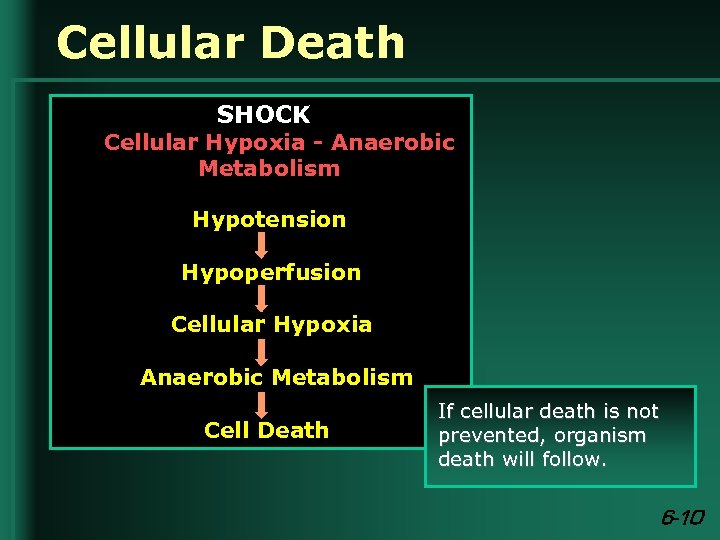 Cellular Death SHOCK Cellular Hypoxia - Anaerobic Metabolism Hypotension Hypoperfusion Cellular Hypoxia Anaerobic Metabolism Cell Death If cellular death is not prevented, organism death will follow. 6 -10
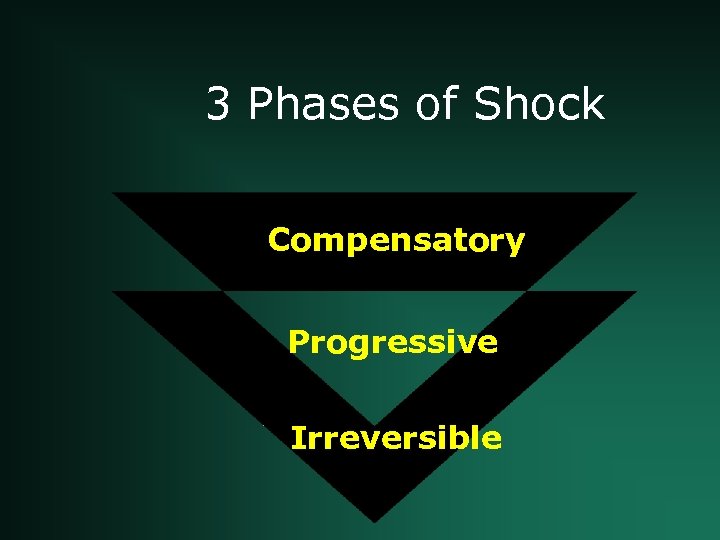
 Staged Death ç Organism death: 4 May be quick - prior to EMS. 4 May be prolonged - 2 to 3 weeks later. ç Occurs in stages: 4 Stages occur as the body tries to compensate. 4 We see the stages through signs & symptoms. 6 -11
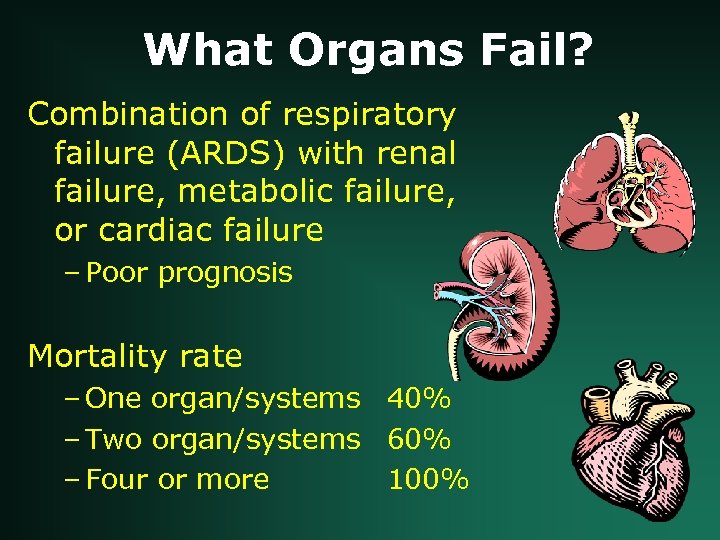 What Organs Fail? Combination of respiratory failure (ARDS) with renal failure, metabolic failure, or cardiac failure – Poor prognosis Mortality rate – One organ/systems 40% – Two organ/systems 60% – Four or more 100%
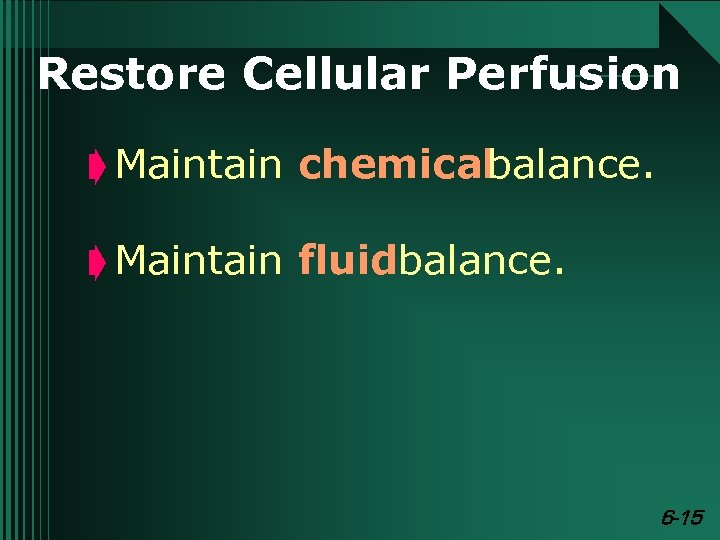
 Prevent Cellular Death ç Recognize shock early. ç Restore cellular perfusion. ç Restore aerobic metabolism. Pitfall: Waiting until it is too late to restore perfusion to cells. 6 -12
 3 Phases of Shock Compensatory Progressive Irreversible
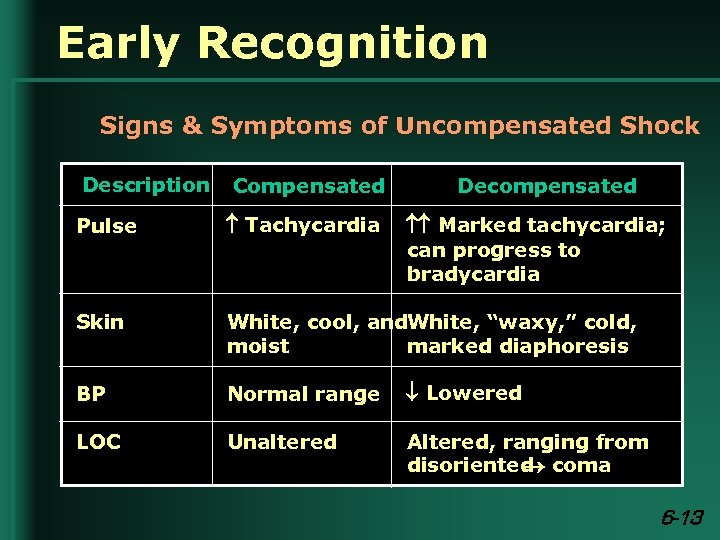 Early Recognition Signs & Symptoms of Uncompensated Shock Description Compensated Decompensated Pulse Tachycardia Marked tachycardia; can progress to bradycardia Skin White, cool, and. White, “waxy, ” cold, moist marked diaphoresis BP Normal range Lowered LOC Unaltered Altered, ranging from disoriented coma 6 -13
 Early vs. Late ç What are the earliest signs of shock? ç What is a late sign of shock? 6 -14
 Restore Cellular Perfusion ç Maintain chemical balance. ç Maintain fluidbalance. 6 -15
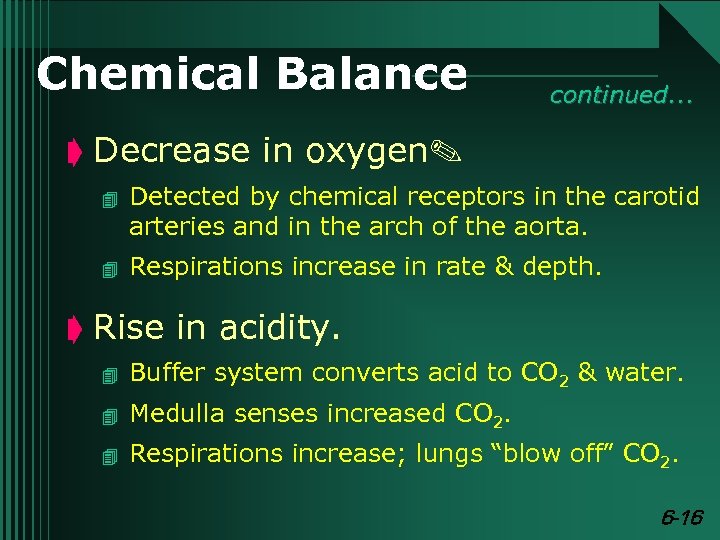 Chemical Balance continued. . . ç Decrease in oxygen. 4 Detected by chemical receptors in the carotid arteries and in the arch of the aorta. 4 Respirations increase in rate & depth. ç Rise in acidity. 4 Buffer system converts acid to CO 2 & water. 4 Medulla senses increased CO 2. 4 Respirations increase; lungs “blow off” CO 2. 6 -16
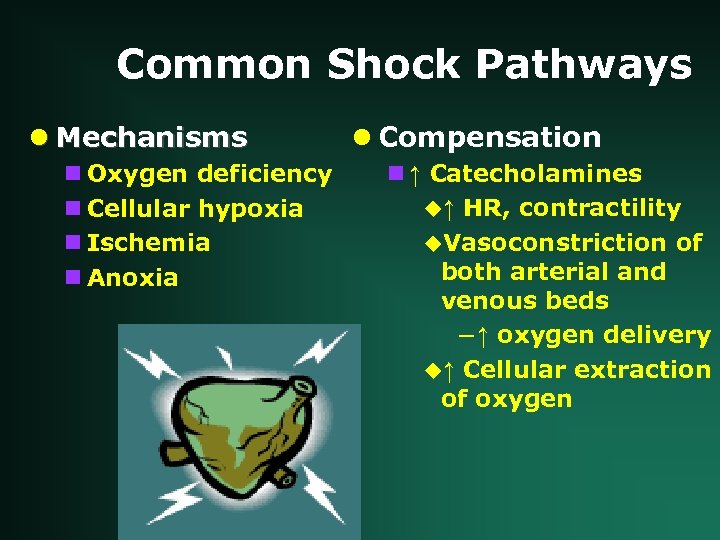 Common Shock Pathways l Mechanisms n Oxygen deficiency n Cellular hypoxia n Ischemia n Anoxia l Compensation n ↑ Catecholamines u↑ HR, contractility u. Vasoconstriction of both arterial and venous beds – ↑ oxygen delivery u↑ Cellular extraction of oxygen
 Chemical Balance cont’d. ç Key: increase in respiratory rate is an early sign of shock. ç What signs or symptoms indicate that the patient’s body is trying to restore its chemical balance? ç What steps could you take to help the body restore balance and aerobic metabolism? 6 -17
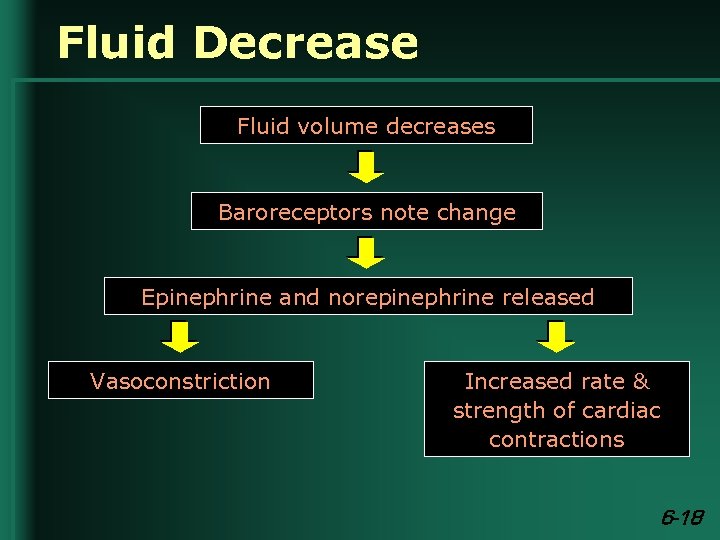 Fluid Decrease Fluid volume decreases Baroreceptors note change Epinephrine and norepinephrine released Vasoconstriction Increased rate & strength of cardiac contractions 6 -18
 Fluid Decrease continued. . . ç Hormonal response: 4 Various hormones are released, causing vasoconstriction and fluid retention. ç Compensation: 4 Blood vessels constrict. 4 Heart increases strength & rate. 4 Fluid is retained. 6 -19
 Fluid Decrease cont’d. ç In the scenario, which signs suggest that the patient’s body is trying to restore its fluid balance? ç Is the patient compensating well? Why? ç What steps could you take to help the body restore balance? 6 -20
 The Fick Principle ç Defines what is necessary to achieve end-tissue perfusion: 4 4 4 On-loading oxygen to the RBCs. Delivering the RBCs to the tissue. Off-loading oxygen to the tissue. ç As part of the process, patient must have an adequate number of RBCs to transport oxygen. 6 -21
 Scenario You are responding to a patient that has fallen from a 40 -foot cliff while rock climbing. He is awake. He tells you that he can’t move his legs, and has no feeling below his waist. Pulse 119, RR 20, and BP 104/72. How does the Fick Principle apply here? How well is this patient compensating? 6 -22
 Scenario You are called to the scene of a house fire, where firefighters have just removed one patient. He is unresponsive. Pulse 102, RR 6, and BP 104/76. How does the Fick Principle apply here? How well is this patient compensating? 6 -23
 Scenario You respond to a scene where a skier has struck a tree at high speed. Exam reveals pain on palpation of the right lateral chest, absent breath sounds on the right and labored breathing. Pulse 142, RR 40, and BP 88/70. How does the Fick Principle apply here? How well is this patient compensating? 6 -24
 Scenario You are dispatched to an MVC. On arrival, you find a 47 -year-old male driver still in the vehicle. There are 10 -15 inches of intrusion to the front of the vehicle. The patient is unresponsive as you approach. 6 -25
 Findings Q A - Blood & vomitus in airway. Q B - Slow & labored. BS absent on left. Q C - No palpable radial pulse. Cool, wet skin. No external bleeding. Q D - Pupils equal but reacting slowly. Q E - Obvious fracture of left femur. How does the Fick Principle apply here? 6 -26
 Shock Summary Shock is staged death. . . …catch it in the first act! 6 -27