


 Скачать презентацию Pregnancy among unmarried women in a tertiary centre
a032d9cbd82c8767ad055d83ca3fcf2b.ppt
- Количество слайдов: 1
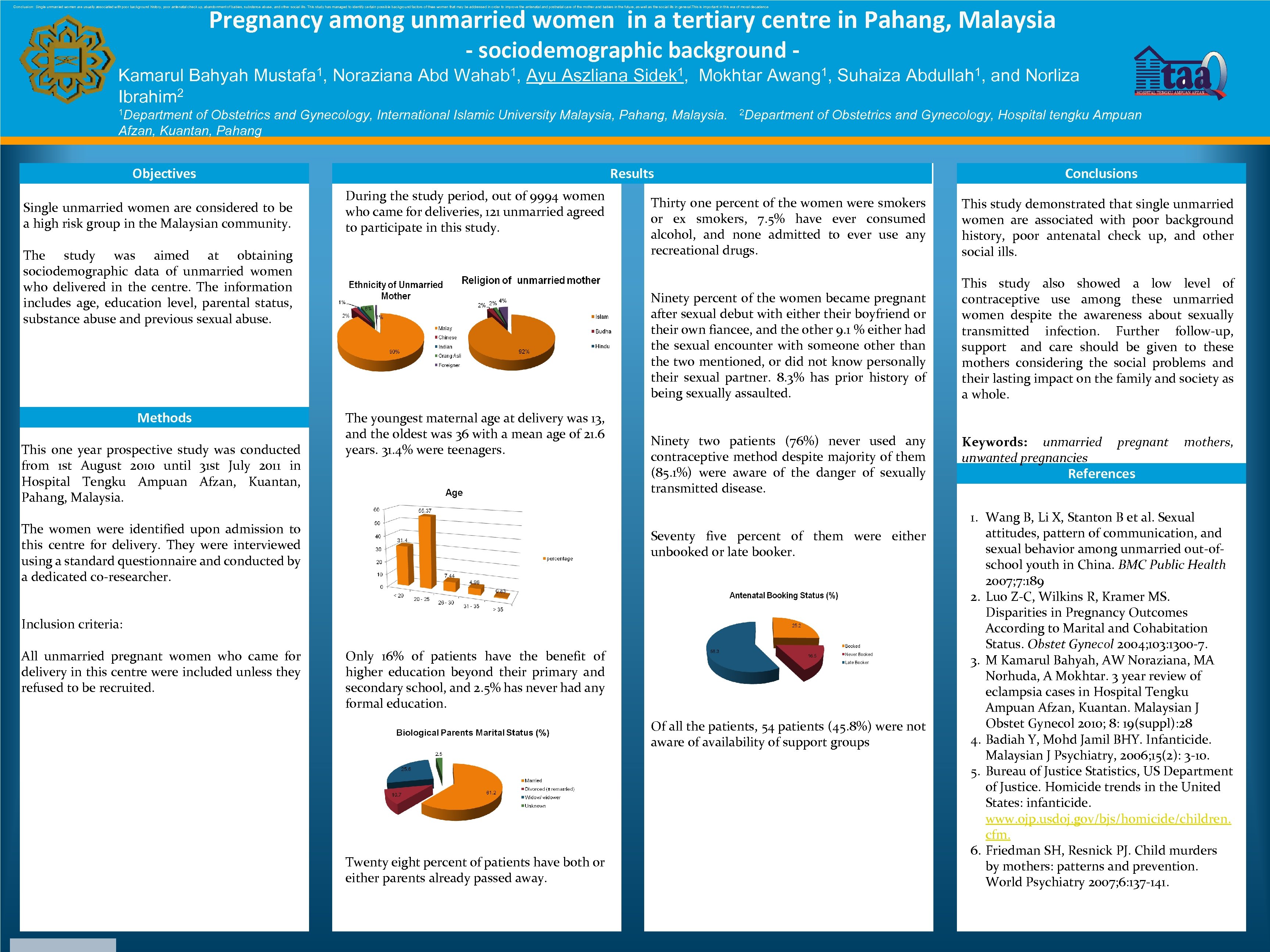 Pregnancy among unmarried women in a tertiary centre in Pahang, Malaysia Conclusion: Single unmarried women are usually associated with poor background history, poor antenatal check up, abandonment of babies, substance abuse, and other social ills. This study has managed to identify certain possible background factors of the women that may be addressed in order to improve the antenatal and postnatal care of the mother and babies in the future, as well as the social ills in general. This is important in this era of moral decadence se - sociodemographic background - Kamarul Bahyah Ibrahim 2 1, Mustafa Noraziana Abd 1, Wahab Ayu Aszliana 1, Sidek 1 Department Mokhtar of Obstetrics and Gynecology, International Islamic University Malaysia, Pahang, Malaysia. Afzan, Kuantan, Pahang Objectives Single unmarried women are considered to be a high risk group in the Malaysian community. This one year prospective study was conducted from 1 st August 2010 until 31 st July 2011 in Hospital Tengku Ampuan Afzan, Kuantan, Pahang, Malaysia. 2 Department Suhaiza 1, Abdullah During the study period, out of 9994 women who came for deliveries, 121 unmarried agreed to participate in this study. The youngest maternal age at delivery was 13, and the oldest was 36 with a mean age of 21. 6 years. 31. 4% were teenagers. Thirty one percent of the women were smokers or ex smokers, 7. 5% have ever consumed alcohol, and none admitted to ever use any recreational drugs. This study demonstrated that single unmarried women are associated with poor background history, poor antenatal check up, and other social ills. This study also showed a low level of contraceptive use among these unmarried women despite the awareness about sexually transmitted infection. Further follow-up, support and care should be given to these mothers considering the social problems and their lasting impact on the family and society as a whole. Ninety two patients (76%) never used any contraceptive method despite majority of them (85. 1%) were aware of the danger of sexually transmitted disease. Seventy five percent of them were either unbooked or late booker. Inclusion criteria: Only 16% of patients have the benefit of higher education beyond their primary and secondary school, and 2. 5% has never had any formal education. Of all the patients, 54 patients (45. 8%) were not aware of availability of support groups Twenty eight percent of patients have both or either parents already passed away. TEMPLATE DESIGN © 2008 www. Poster. Presentations. com Conclusions Ninety percent of the women became pregnant after sexual debut with either their boyfriend or their own fiancee, and the other 9. 1 % either had the sexual encounter with someone other than the two mentioned, or did not know personally their sexual partner. 8. 3% has prior history of being sexually assaulted. The women were identified upon admission to this centre for delivery. They were interviewed using a standard questionnaire and conducted by a dedicated co-researcher. All unmarried pregnant women who came for delivery in this centre were included unless they refused to be recruited. and Norliza of Obstetrics and Gynecology, Hospital tengku Ampuan Results The study was aimed at obtaining sociodemographic data of unmarried women who delivered in the centre. The information includes age, education level, parental status, substance abuse and previous sexual abuse. Methods 1, Awang Keywords: unmarried unwanted pregnancies pregnant mothers, References 1. Wang B, Li X, Stanton B et al. Sexual attitudes, pattern of communication, and sexual behavior among unmarried out-ofschool youth in China. BMC Public Health 2007; 7: 189 2. Luo Z-C, Wilkins R, Kramer MS. Disparities in Pregnancy Outcomes According to Marital and Cohabitation Status. Obstet Gynecol 2004; 103: 1300 -7. 3. M Kamarul Bahyah, AW Noraziana, MA Norhuda, A Mokhtar. 3 year review of eclampsia cases in Hospital Tengku Ampuan Afzan, Kuantan. Malaysian J Obstet Gynecol 2010; 8: 19(suppl): 28 4. Badiah Y, Mohd Jamil BHY. Infanticide. Malaysian J Psychiatry, 2006; 15(2): 3 -10. 5. Bureau of Justice Statistics, US Department of Justice. Homicide trends in the United States: infanticide. www. ojp. usdoj. gov/bjs/homicide/children. cfm. 6. Friedman SH, Resnick PJ. Child murders by mothers: patterns and prevention. World Psychiatry 2007; 6: 137 -141.