


 Скачать презентацию Predictive Learning from Data LECTURE SET 8 Methods
403d18bda099055a2dc0f074c6571388.ppt
- Количество слайдов: 74
 Predictive Learning from Data LECTURE SET 8 Methods for Classification Electrical and Computer Engineering 1
 OUTLINE • • • Problem statement and approaches - Risk minimization (SLT) approach - Statistical Decision Theory Methods’s taxonomy Representative methods for classification Practical aspects and examples Combining methods and Boosting Summary 2
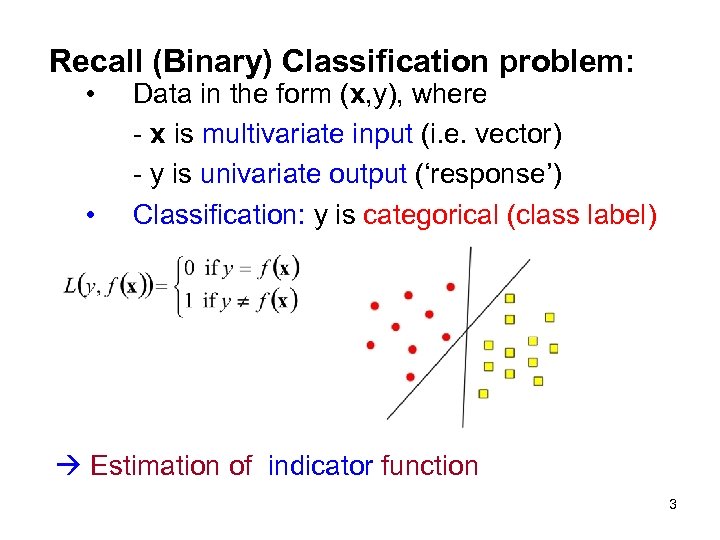 Recall (Binary) Classification problem: • • Data in the form (x, y), where - x is multivariate input (i. e. vector) - y is univariate output (‘response’) Classification: y is categorical (class label) Estimation of indicator function 3
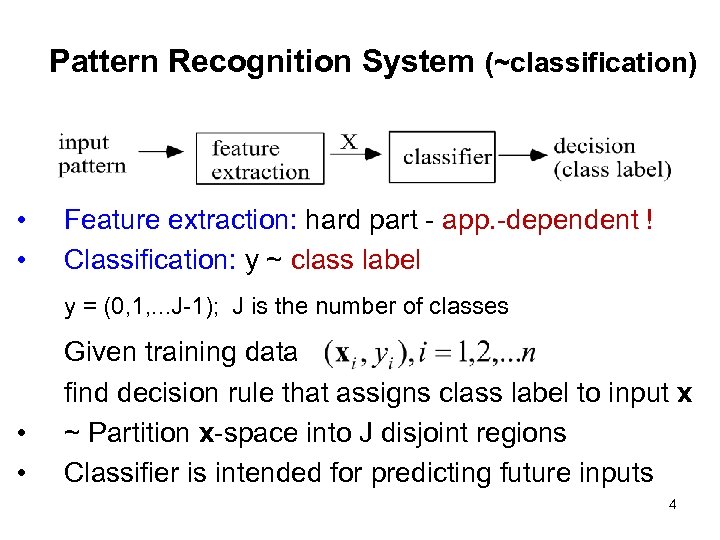 Pattern Recognition System (~classification) • • Feature extraction: hard part - app. -dependent ! Classification: y ~ class label y = (0, 1, . . . J-1); J is the number of classes • • Given training data find decision rule that assigns class label to input x ~ Partition x-space into J disjoint regions Classifier is intended for predicting future inputs 4
 Classification vs Discrimination • In some apps, the goal is not prediction, but capturing the essential differences between the classes in the training data ~ discrimination • Example: Diagnosis of the causes of plane crash Discrimination is related to explanation of past data • In this course, we are mainly interested in predictive classification • It is important to distinguish between: - conceptual approaches (for classification) and - constructive learning algorithms 5
 Two Approaches to Classification • Risk Minimization vs. Generative approach • Risk Minimization (VC-theoretical) approach - specify a set of models (decision boundaries) of increasing complexity (i. e. , structure) - minimize training error for each element of a structure (usually loss function ~ training error) - choose model of opt. complexity, i. e. via resampling or analytic bounds • Loss function: should be specified a priori • Technical problem: non-convex loss function 6
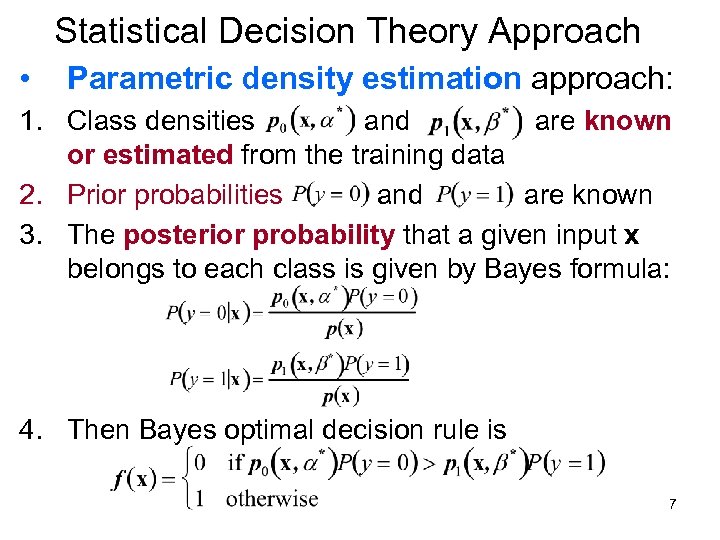 Statistical Decision Theory Approach • Parametric density estimation approach: 1. Class densities and are known or estimated from the training data 2. Prior probabilities and are known 3. The posterior probability that a given input x belongs to each class is given by Bayes formula: 4. Then Bayes optimal decision rule is 7
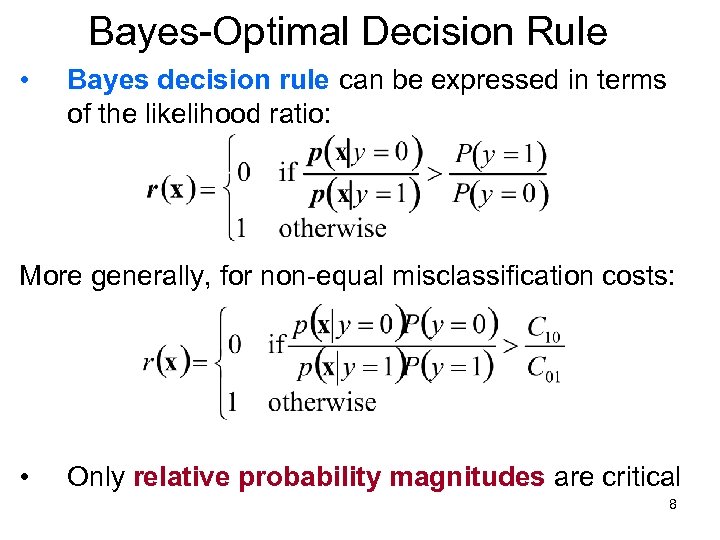 Bayes-Optimal Decision Rule • Bayes decision rule can be expressed in terms of the likelihood ratio: More generally, for non-equal misclassification costs: • Only relative probability magnitudes are critical 8
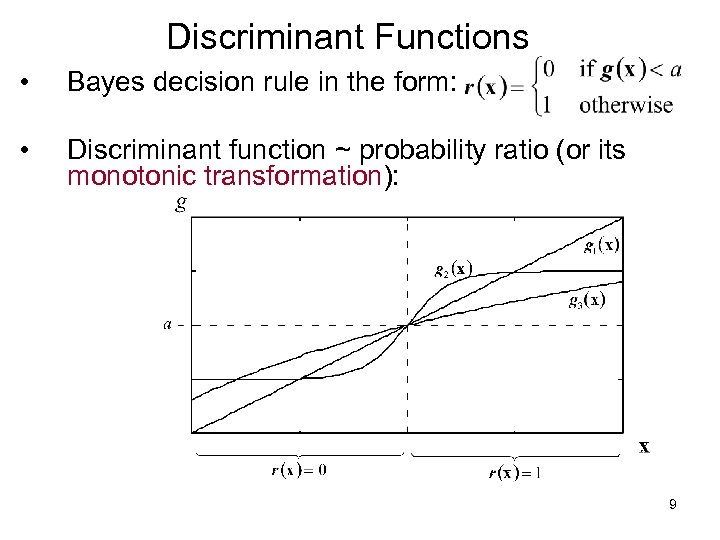 Discriminant Functions • Bayes decision rule in the form: • Discriminant function ~ probability ratio (or its monotonic transformation): 9
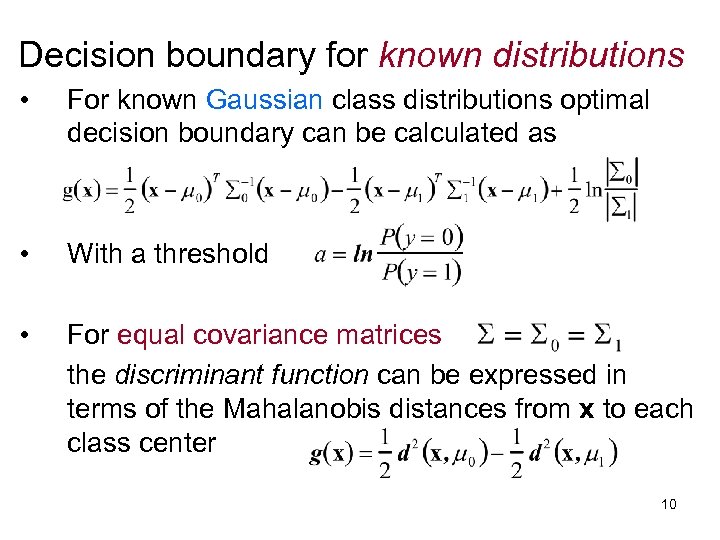 Decision boundary for known distributions • For known Gaussian class distributions optimal decision boundary can be calculated as • With a threshold • For equal covariance matrices the discriminant function can be expressed in terms of the Mahalanobis distances from x to each class center 10
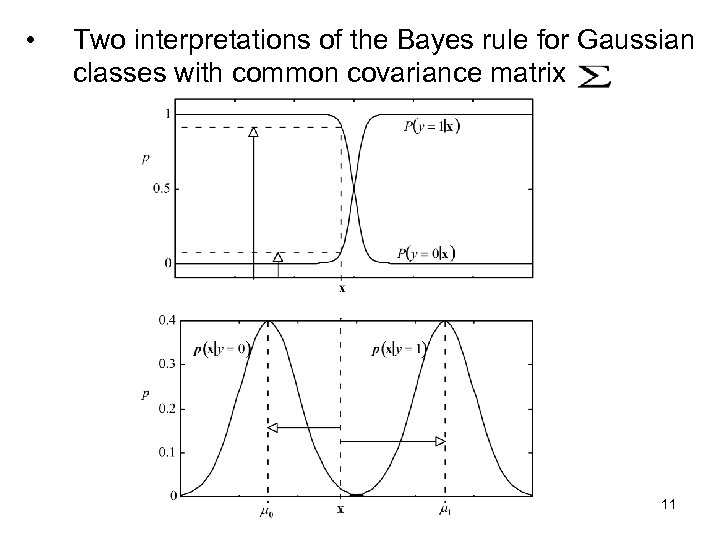 • Two interpretations of the Bayes rule for Gaussian classes with common covariance matrix 11
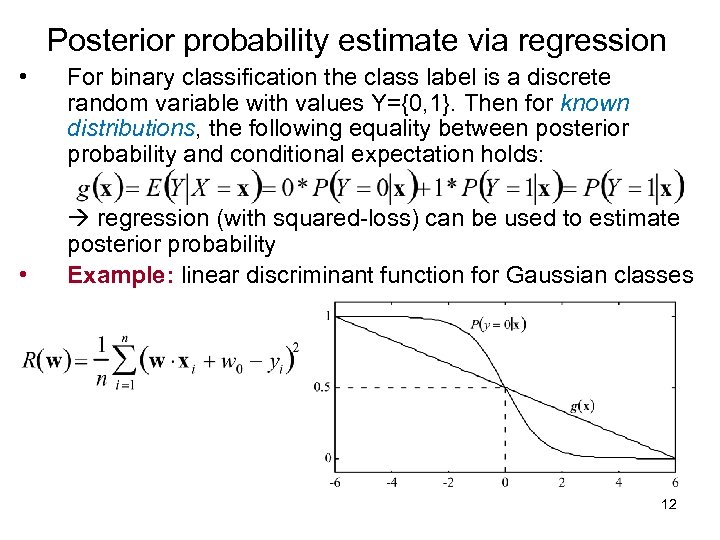 Posterior probability estimate via regression • • For binary classification the class label is a discrete random variable with values Y={0, 1}. Then for known distributions, the following equality between posterior probability and conditional expectation holds: regression (with squared-loss) can be used to estimate posterior probability Example: linear discriminant function for Gaussian classes 12
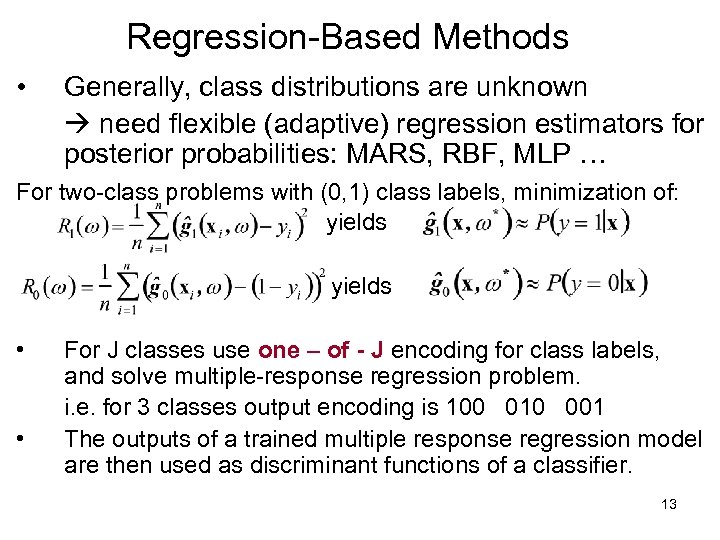 Regression-Based Methods • Generally, class distributions are unknown need flexible (adaptive) regression estimators for posterior probabilities: MARS, RBF, MLP … For two-class problems with (0, 1) class labels, minimization of: yields • • For J classes use one – of - J encoding for class labels, and solve multiple-response regression problem. i. e. for 3 classes output encoding is 100 010 001 The outputs of a trained multiple response regression model are then used as discriminant functions of a classifier. 13
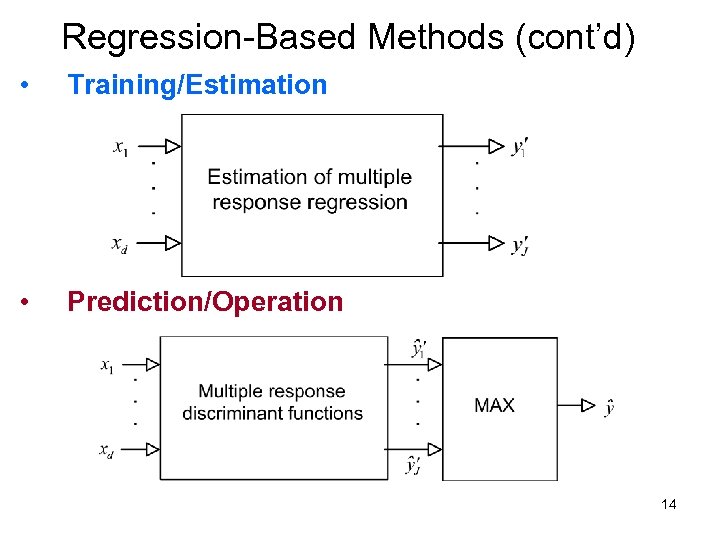 Regression-Based Methods (cont’d) • Training/Estimation • Prediction/Operation 14
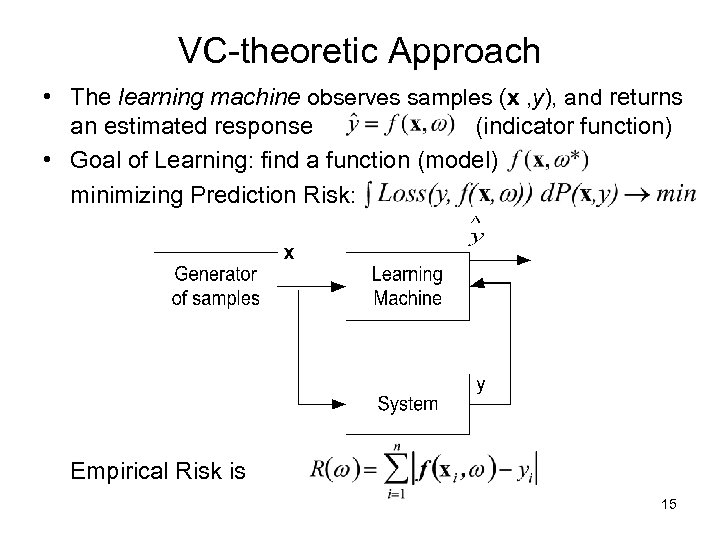 VC-theoretic Approach • The learning machine observes samples (x , y), and returns an estimated response (indicator function) • Goal of Learning: find a function (model) minimizing Prediction Risk: Empirical Risk is 15
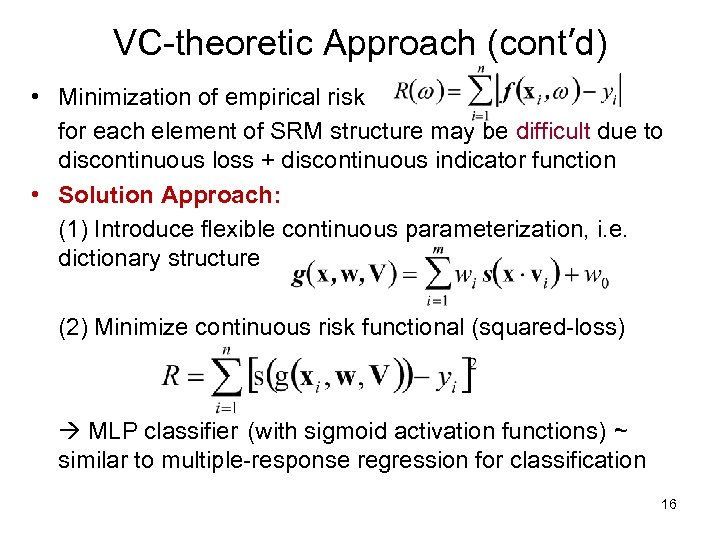 VC-theoretic Approach (cont’d) • Minimization of empirical risk for each element of SRM structure may be difficult due to discontinuous loss + discontinuous indicator function • Solution Approach: (1) Introduce flexible continuous parameterization, i. e. dictionary structure (2) Minimize continuous risk functional (squared-loss) MLP classifier (with sigmoid activation functions) ~ similar to multiple-response regression for classification 16
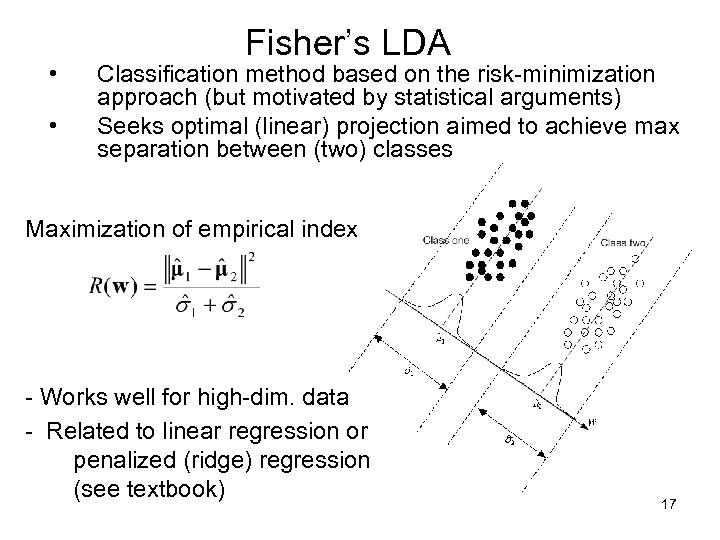 • • Fisher’s LDA Classification method based on the risk-minimization approach (but motivated by statistical arguments) Seeks optimal (linear) projection aimed to achieve max separation between (two) classes Maximization of empirical index - Works well for high-dim. data - Related to linear regression or penalized (ridge) regression (see textbook) 17
 OUTLINE • • • Problem statement and approaches Methods’ taxonomy Representative methods for classification Practical aspects and application study Combining methods and Boosting Summary 18
 Methods’ Taxonomy • Estimating classifier from data requires specification of : (1) a set of indicator functions indexed by complexity (2) loss function suitable for optimization • (3) optimization method Optimization method correlates with loss fct (2) Taxonomy based on optimization method 19
 Methods’ Taxonomy • • Based on optimization method used: - continuous nonlinear optimization (regression-based methods) - greedy optimization (decision trees) - local methods (estimate decision boundary locally) Each class of methods has its own implementation issues 20
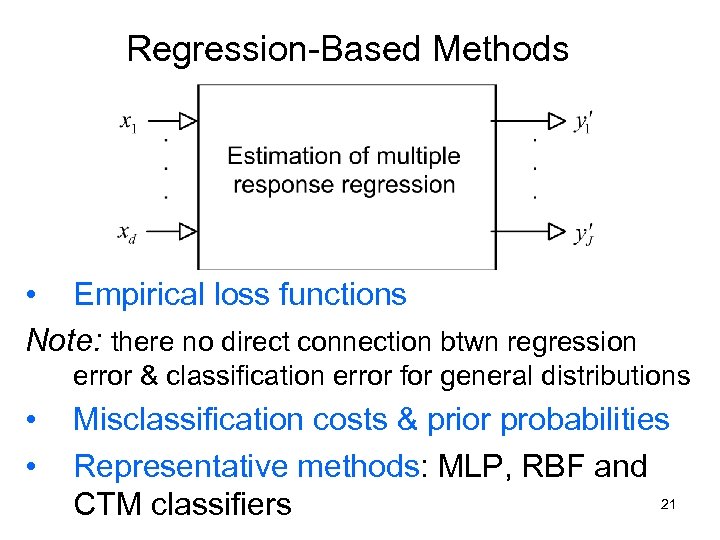 Regression-Based Methods • Empirical loss functions Note: there no direct connection btwn regression error & classification error for general distributions • • Misclassification costs & prior probabilities Representative methods: MLP, RBF and 21 CTM classifiers
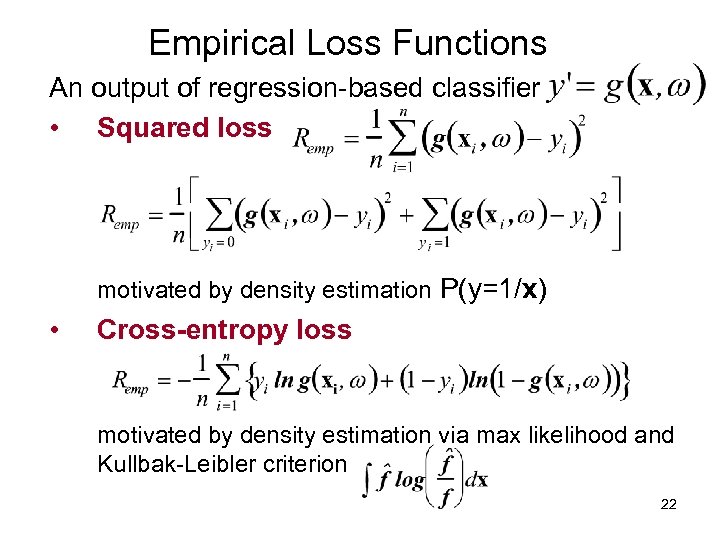 Empirical Loss Functions An output of regression-based classifier • Squared loss motivated by density estimation P(y=1/x) • Cross-entropy loss motivated by density estimation via max likelihood and Kullbak-Leibler criterion 22
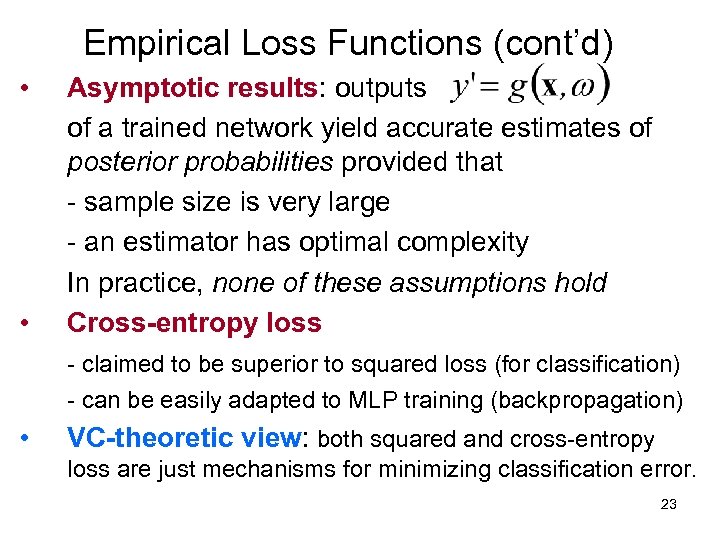 Empirical Loss Functions (cont’d) • • Asymptotic results: outputs of a trained network yield accurate estimates of posterior probabilities provided that - sample size is very large - an estimator has optimal complexity In practice, none of these assumptions hold Cross-entropy loss - claimed to be superior to squared loss (for classification) - can be easily adapted to MLP training (backpropagation) • VC-theoretic view: both squared and cross-entropy loss are just mechanisms for minimizing classification error. 23
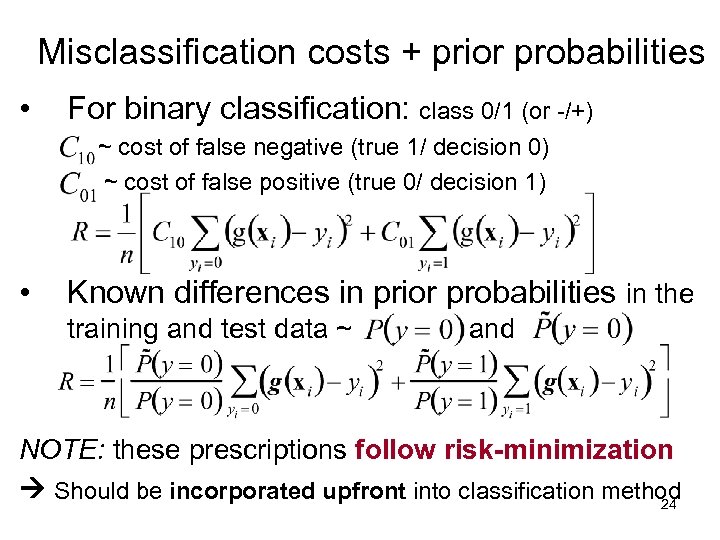 Misclassification costs + prior probabilities • For binary classification: class 0/1 (or -/+) ~ cost of false negative (true 1/ decision 0) ~ cost of false positive (true 0/ decision 1) • Known differences in prior probabilities in the training and test data ~ and NOTE: these prescriptions follow risk-minimization Should be incorporated upfront into classification method 24
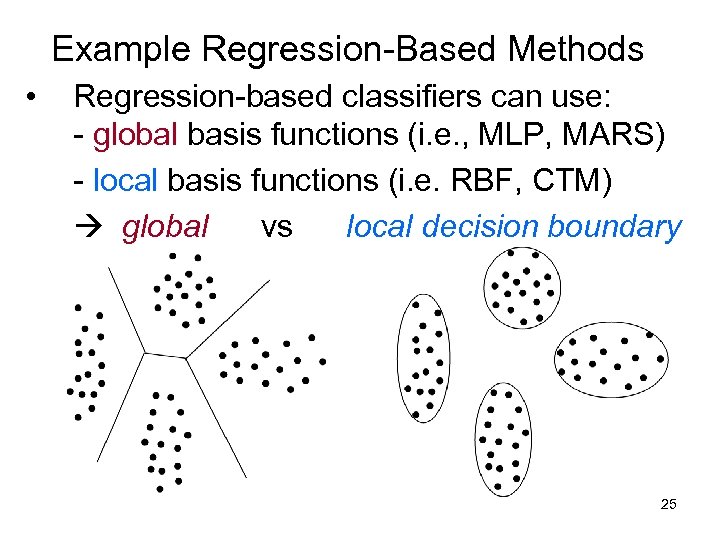 Example Regression-Based Methods • Regression-based classifiers can use: - global basis functions (i. e. , MLP, MARS) - local basis functions (i. e. RBF, CTM) global vs local decision boundary 25
 MLP Networks for Classification • • Standard MLP network with J output units: use 1 -of-J encoding for the outputs Practical issues for MLP classifiers - prescaling of input values to [-0. 5, 0. 5] range - initialization of weights (to small values) - set training output (y) values: 0. 1 and 0. 9 rather than 0/1 (to avoid long training time) • Stopping rule (1) for training: keep decreasing • Stopping rule (2) for complexity control: use • Multiple local minima: use classification error to select squared error as long as it reduces classification error for resampling good local minimum during training 26
 • • RBF Classifiers Standard multiple-output RBF network (J outputs) Practical issues for RBF classifiers - prescaling of input values to [-0. 5, 0. 5] range - typically non-adaptive training (as for RBF regression) i. e. estimating RBF centers and widths via unsupervised learning, followed by estimation of weights W via OLS • Complexity control: - usually the number of basis functions selected via resampling. - classification error (not squared-error) is used for selecting optimal complexity parameter (~number of RBFs) • RBF Classifiers work best when the number of basis functions is small, i. e. training data can be accurately represented by a small number of ‘RBF clusters’. 27
 CTM Classifiers • Standard CTM for regression: each unit has single output y implementing local linear regression • CTM classifier: each unit has J outputs (via 1 -of-J encoding) implementing local linear decision boundary • CTM uses the same map for all outputs: - the same map topology - the same neighborhood schedule - the same adaptive scaling of input variables • • Prediction: local predictions using max output (of a unit) Complexity control: determined by both - the final neighborhood size - the number of CTM units (local basis functions) 28
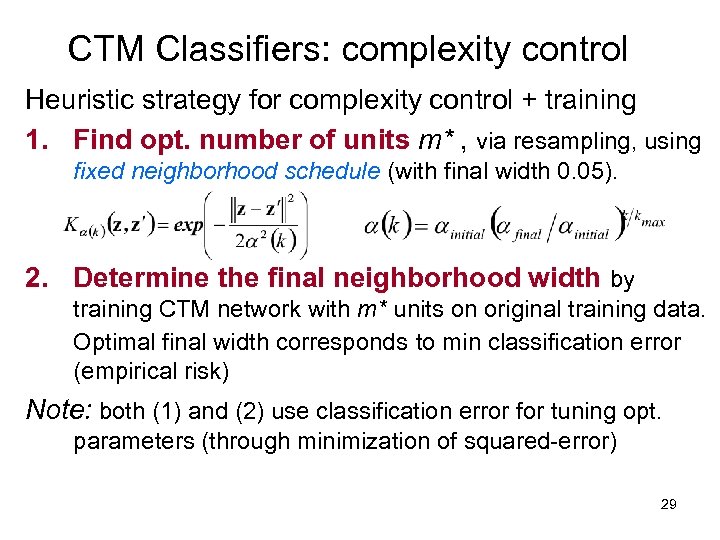 CTM Classifiers: complexity control Heuristic strategy for complexity control + training 1. Find opt. number of units m* , via resampling, using fixed neighborhood schedule (with final width 0. 05). 2. Determine the final neighborhood width by training CTM network with m* units on original training data. Optimal final width corresponds to min classification error (empirical risk) Note: both (1) and (2) use classification error for tuning opt. parameters (through minimization of squared-error) 29
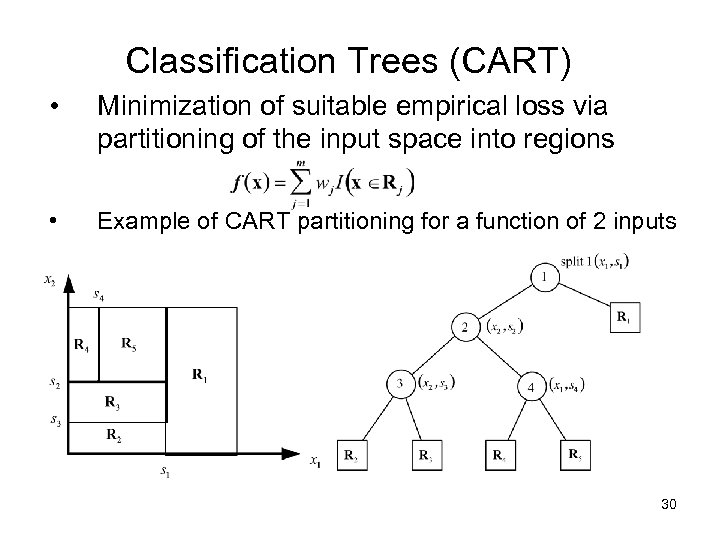 Classification Trees (CART) • Minimization of suitable empirical loss via partitioning of the input space into regions • Example of CART partitioning for a function of 2 inputs 30
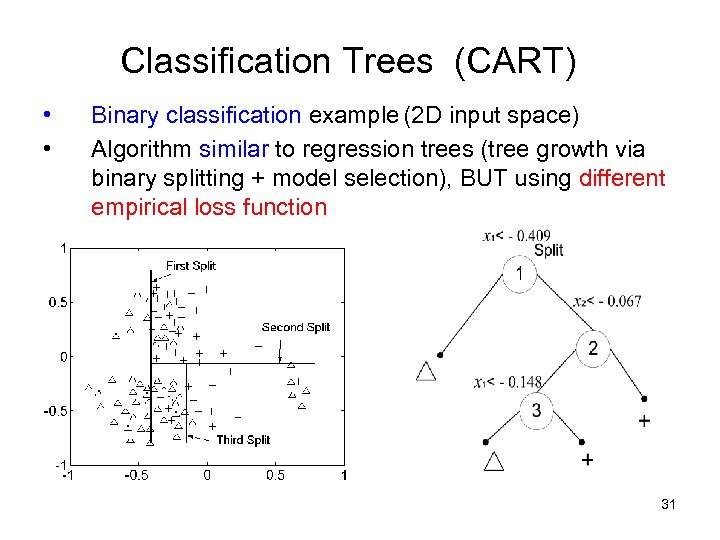 Classification Trees (CART) • • Binary classification example (2 D input space) Algorithm similar to regression trees (tree growth via binary splitting + model selection), BUT using different empirical loss function 31
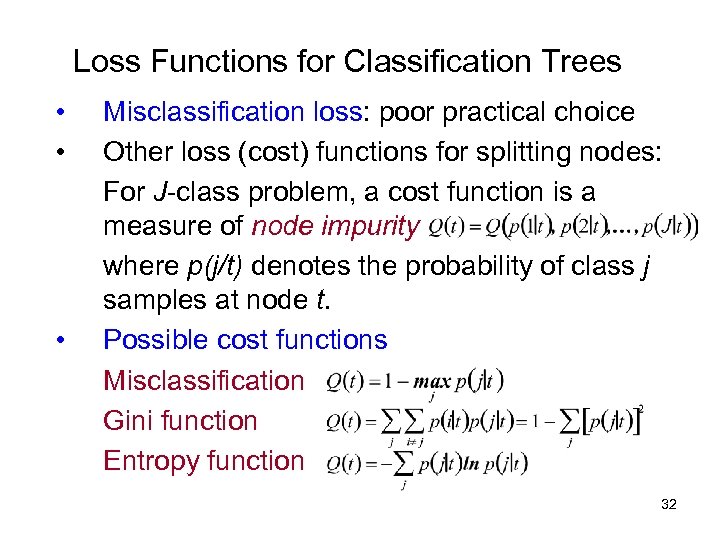 Loss Functions for Classification Trees • • • Misclassification loss: poor practical choice Other loss (cost) functions for splitting nodes: For J-class problem, a cost function is a measure of node impurity where p(j/t) denotes the probability of class j samples at node t. Possible cost functions Misclassification Gini function Entropy function 32
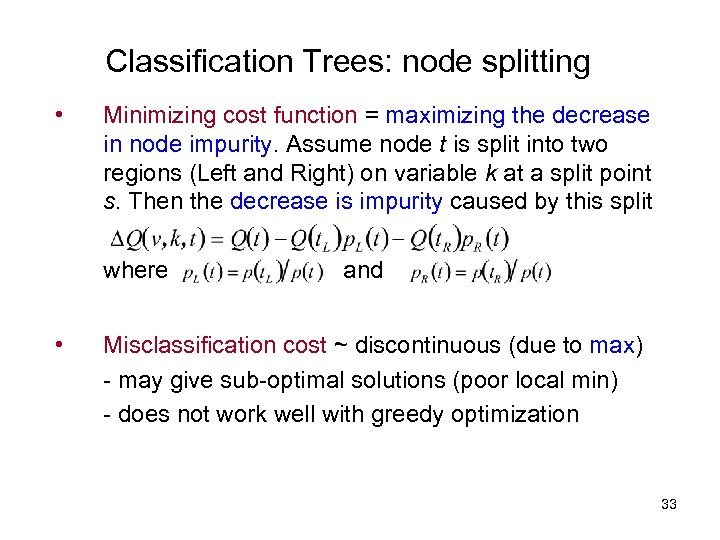 Classification Trees: node splitting • Minimizing cost function = maximizing the decrease in node impurity. Assume node t is split into two regions (Left and Right) on variable k at a split point s. Then the decrease is impurity caused by this split where • and Misclassification cost ~ discontinuous (due to max) - may give sub-optimal solutions (poor local min) - does not work well with greedy optimization 33
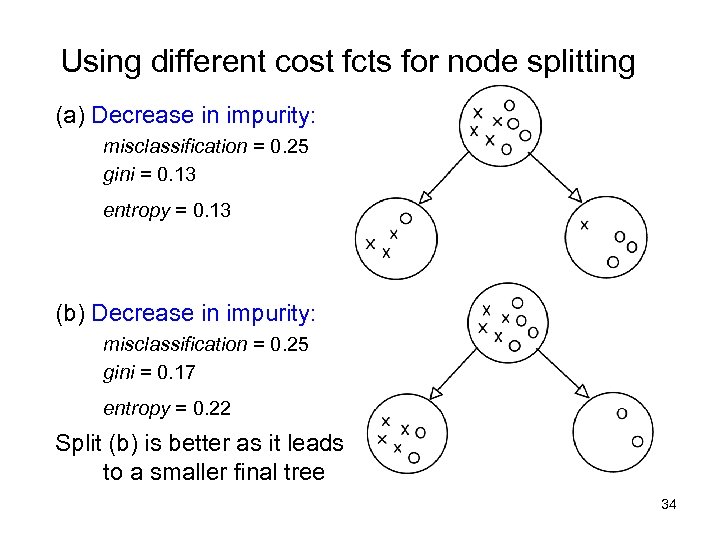 Using different cost fcts for node splitting (a) Decrease in impurity: misclassification = 0. 25 gini = 0. 13 entropy = 0. 13 (b) Decrease in impurity: misclassification = 0. 25 gini = 0. 17 entropy = 0. 22 Split (b) is better as it leads to a smaller final tree 34
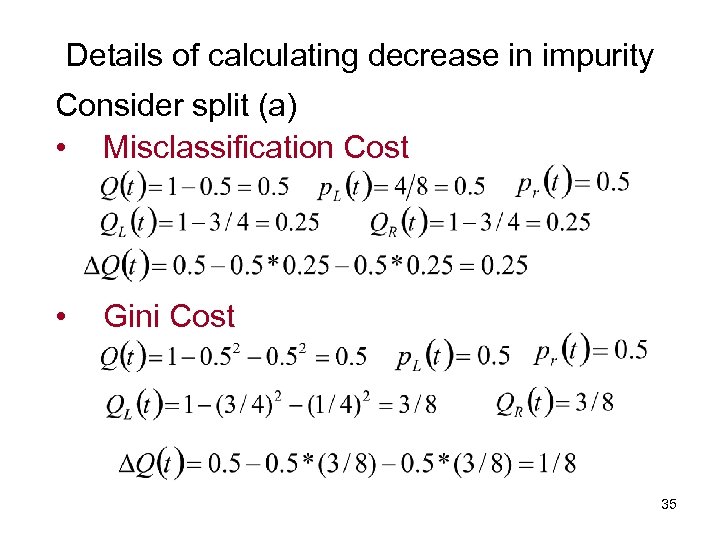 Details of calculating decrease in impurity Consider split (a) • Misclassification Cost • Gini Cost 35
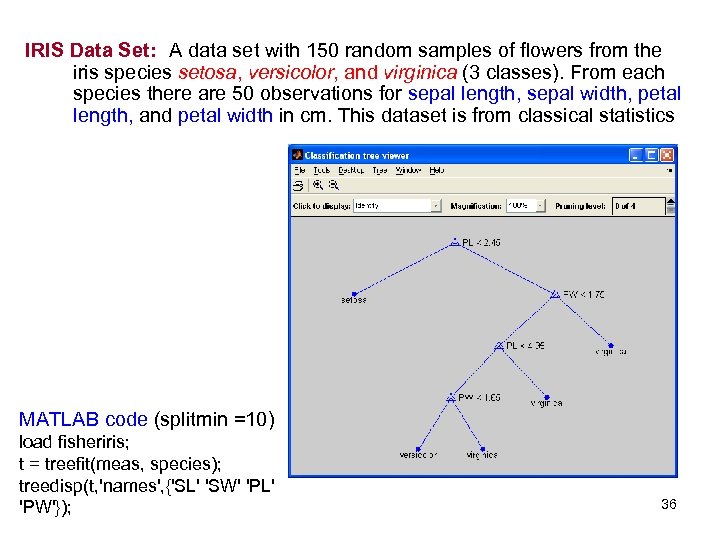 IRIS Data Set: A data set with 150 random samples of flowers from the iris species setosa, versicolor, and virginica (3 classes). From each species there are 50 observations for sepal length, sepal width, petal length, and petal width in cm. This dataset is from classical statistics MATLAB code (splitmin =10) load fisheriris; t = treefit(meas, species); treedisp(t, 'names', {'SL' 'SW' 'PL' 'PW'}); 36
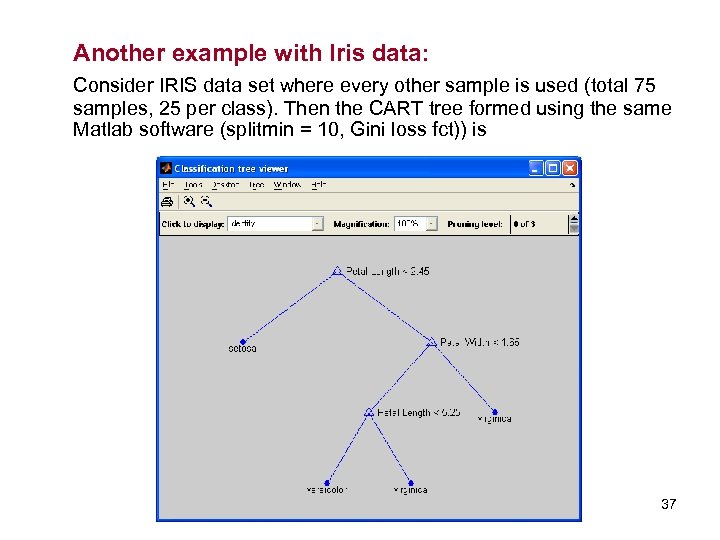 Another example with Iris data: Consider IRIS data set where every other sample is used (total 75 samples, 25 per class). Then the CART tree formed using the same Matlab software (splitmin = 10, Gini loss fct)) is 37
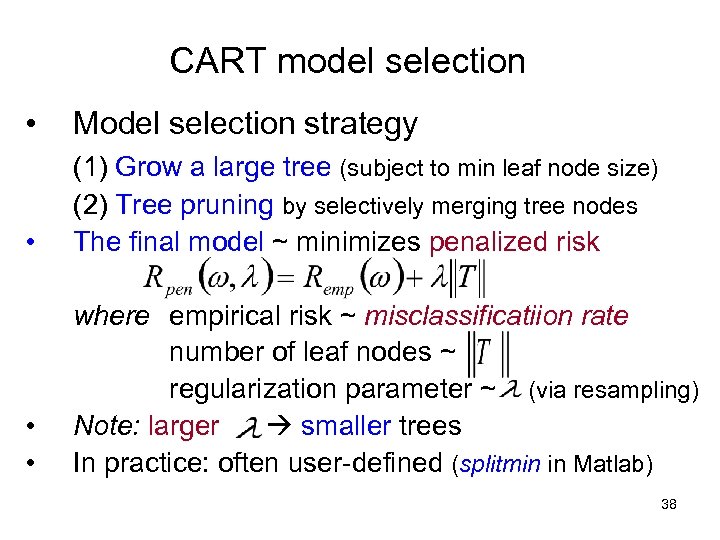 CART model selection • Model selection strategy • (1) Grow a large tree (subject to min leaf node size) (2) Tree pruning by selectively merging tree nodes The final model ~ minimizes penalized risk • • where empirical risk ~ misclassificatiion rate number of leaf nodes ~ regularization parameter ~ (via resampling) Note: larger smaller trees In practice: often user-defined (splitmin in Matlab) 38
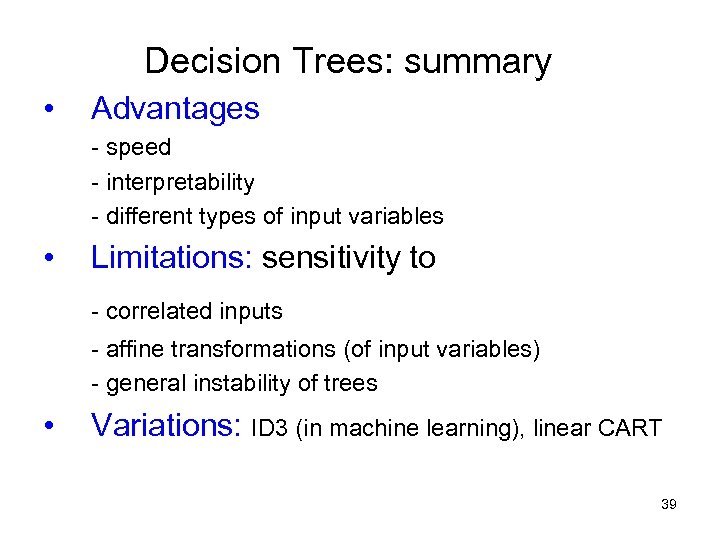 Decision Trees: summary • Advantages - speed - interpretability - different types of input variables • Limitations: sensitivity to - correlated inputs - affine transformations (of input variables) - general instability of trees • Variations: ID 3 (in machine learning), linear CART 39
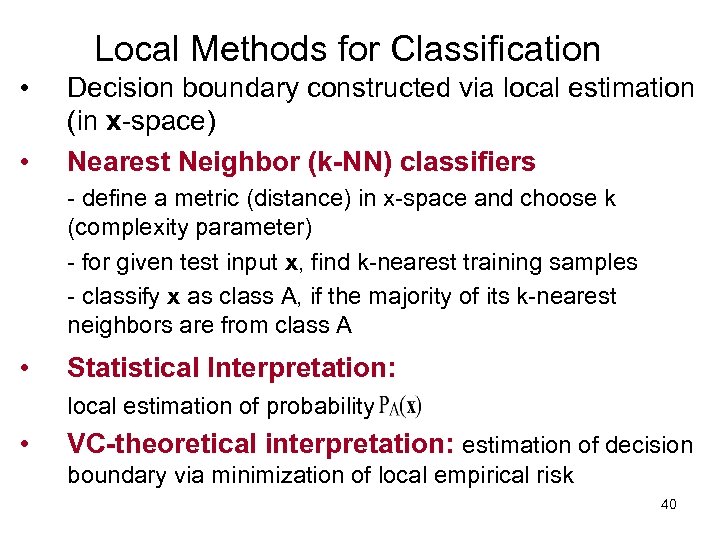 Local Methods for Classification • • Decision boundary constructed via local estimation (in x-space) Nearest Neighbor (k-NN) classifiers - define a metric (distance) in x-space and choose k (complexity parameter) - for given test input x, find k-nearest training samples - classify x as class A, if the majority of its k-nearest neighbors are from class A • Statistical Interpretation: local estimation of probability • VC-theoretical interpretation: estimation of decision boundary via minimization of local empirical risk 40
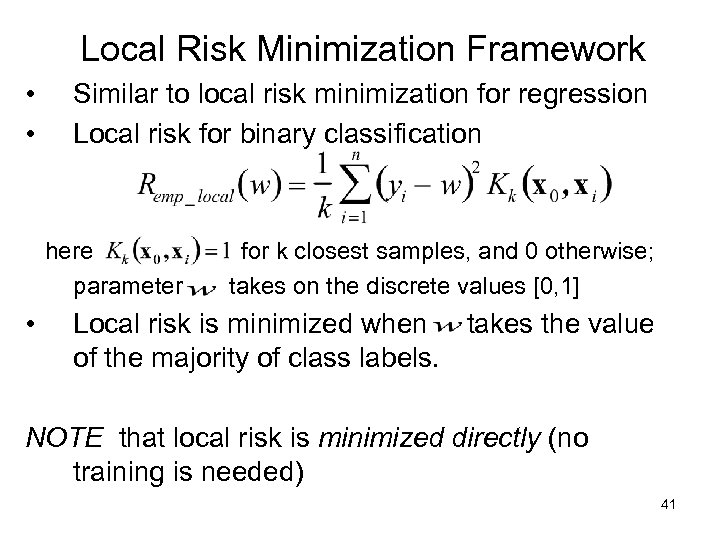 Local Risk Minimization Framework • • Similar to local risk minimization for regression Local risk for binary classification here parameter • for k closest samples, and 0 otherwise; takes on the discrete values [0, 1] Local risk is minimized when takes the value of the majority of class labels. NOTE that local risk is minimized directly (no training is needed) 41
 Nearest Neighbor Classifiers • • • Advantages - easy to implement - no training needed Limitations - choice of distance metric - irrelevant inputs contribute to noise - poor on-line performance when training size is large (especially with high-dimensional data) Computationally efficient variations - tree implementations of k-NN - condensed k-NN 42
 OUTLINE • • Problem statement and approaches Methods’ taxonomy Representative methods for classification Practical aspects and examples - Problem formalization - Data Quality - Promising Application Areas: financial engineering, biomedical/ life sciences, fraud detection • • Combining methods and Boosting Summary 43
 Data Quality • Data is obtained under observational setting, NOT as a result of scientific experiment • • • Always question integrity of the data Example 1: Stock market data - stock market data: dividend distribution, holidays Example 2: Pima Indians Diabetes Data (UCI Database) - 35 out of 768 total samples (female Pima Indians) show blood pressure value of zero Example 3: Transportation study: Safety Performance of Compliance Reviews 44
 Promising Application Areas • Financial Applications (Financial Engineering) - misunderstanding of predictive learning, i. e. backtesting - main problem: what is/ how to measure risk? misunderstanding of uncertainty/ risk - non-stationarity can use only short-term modeling • Successful investing: two extremes (1) Based on fundamentals/ deep understanding Buy-and-Hold (Warren Buffett) (2) Short-term, purely quantitative (predictive learning) Always involves risk (~ losing money) 45
 Promising Application Areas • Biomedical + Life Sciences - great social+practical importance - main problem: cost of human life should be agreed upon by society - ineffectiveness of medical care: due to existence of many subsystems that put different value on human life • Two possible applications of predictive learning (1) Imitate diagnosis performed by human doctors training data ~ diagnostic decisions made by humans (2) Substitute human diagnosis/ decision making training data ~ objective medical outcomes ASIDE: Medical doctors expected/required to make no errors 46
 Virtual Biopsy Project (NIH – 2007) Is It Possible to Use Computer Methods to Get the Information a Biopsy Provides without Performing a Biopsy? (Jim De. Leo, NIH Clinical Center) Goal: to reduce the number of unnecessary biopsies + reduce cost 47
 Prostate Cancer Predictive computer model (binary classifier) reduces unnecessary biopsies by more than one-third June 25, 2003. Using a predictive computer model could reduce unnecessary prostate biopsies by almost 38%, according to a study conducted by Oregon Health & Science University researchers. The study was presented at the American Society of Clinical Oncology's annual meeting in Chicago. "While current prostate cancer screening practices are good at helping us find patients with cancer, they unfortunately also identify many patients who don't have cancer. In fact, three out of four men who undergo a prostate biopsy do not have cancer at all, " said Mark Garzotto, MD, lead study investigator and member of the OHSU Cancer Institute. "Until now most patients with abnormal screening results were counseled to have prostate biopsies because physicians were unable to discriminate between those with cancer and those without cancer. " 48
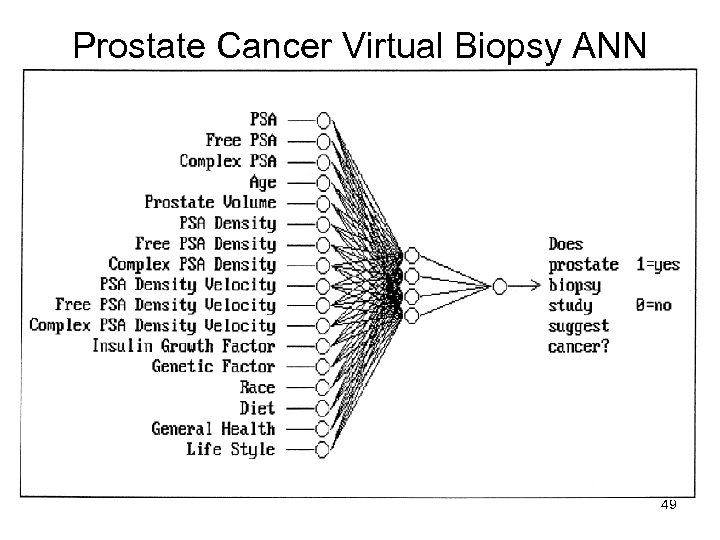 Prostate Cancer Virtual Biopsy ANN 49
 OUTLINE • • • Problem statement and approaches Methods’ taxonomy Representative methods for classification Practical aspects and examples Combining methods and Boosting Summary 50
 Strategies for Combining Methods • Predictive model depends on 3 factors (a) parameterization of admissible models (b) random training sample (c) empirical loss (for risk minimization) • Three combining strategies (for improved generalization) 1. Different (a), the same (b) and (c) Committee of Networks, Stacking, Bayesian averaging 2. Different (b), the same (a) and (c) Bagging 3. Different (c), the same (a) and (b) Boosting 51
 Combining strategy 3 (Boosting) • Boosting: apply the same method to training data, where the data samples are adaptively weighted (in the empirical loss function) • Boosting: designed and used for classification • Implementation of Boosting: - apply the same method (base classifier) to many (modified) realizations of training data - combine the resulting model as a weighted average 52
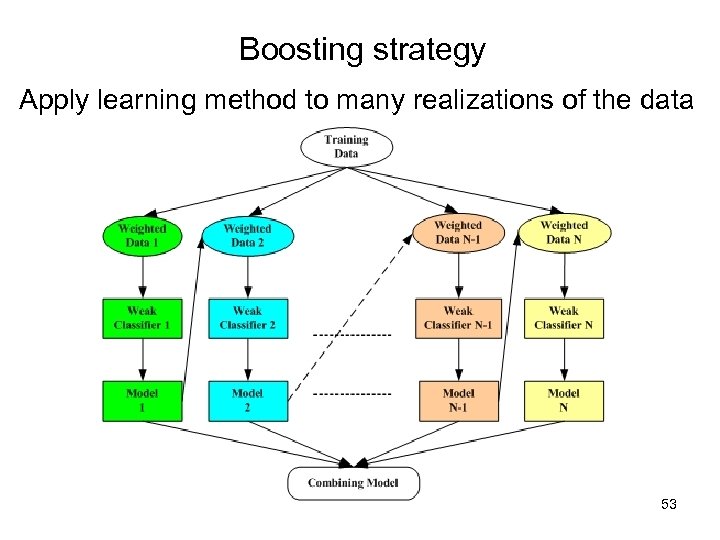 Boosting strategy Apply learning method to many realizations of the data 53
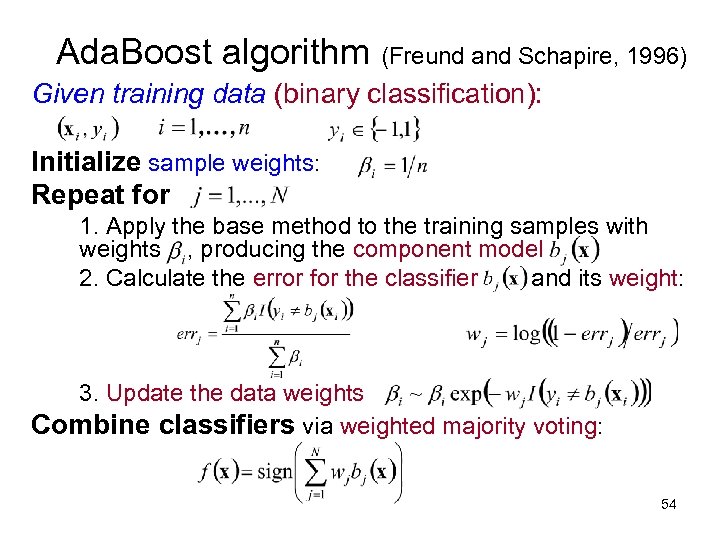 Ada. Boost algorithm (Freund and Schapire, 1996) Given training data (binary classification): Initialize sample weights: Repeat for 1. Apply the base method to the training samples with weights , producing the component model 2. Calculate the error for the classifier and its weight: 3. Update the data weights Combine classifiers via weighted majority voting: 54
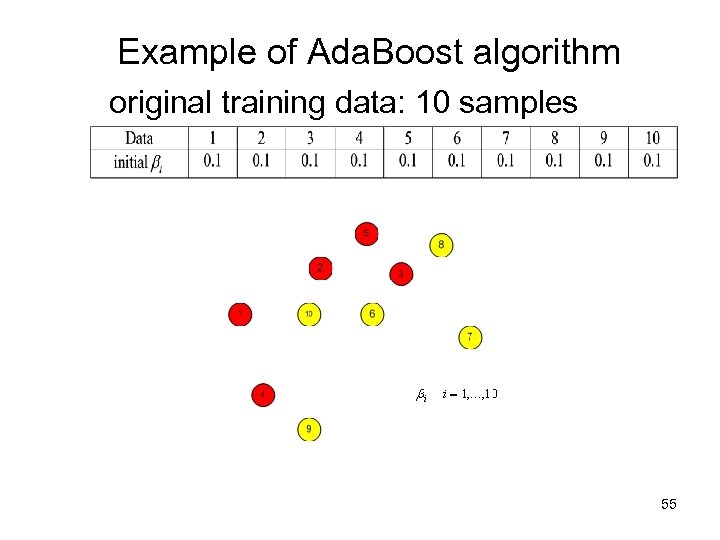 Example of Ada. Boost algorithm original training data: 10 samples 55
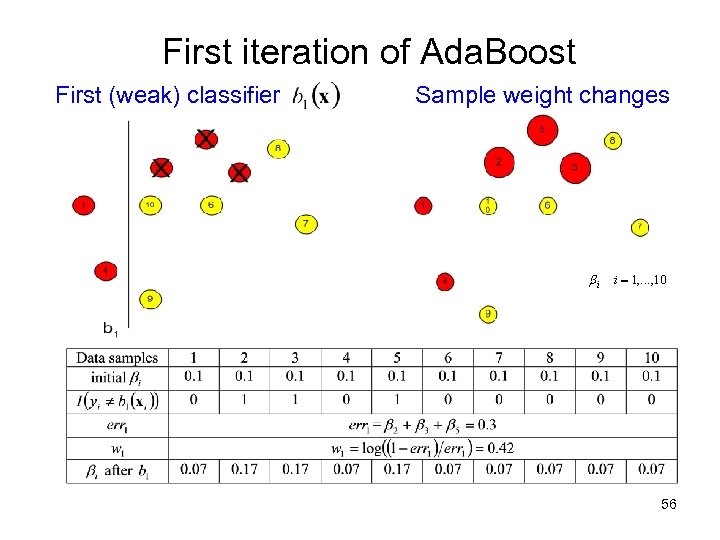 First iteration of Ada. Boost First (weak) classifier Sample weight changes 56
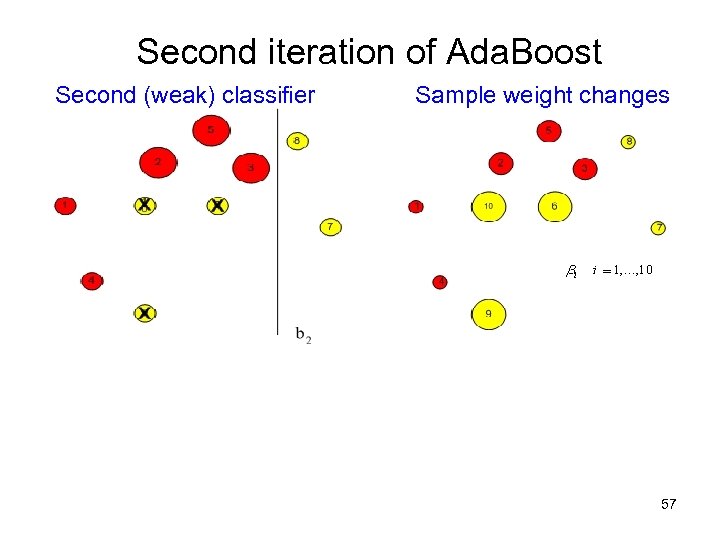 Second iteration of Ada. Boost Second (weak) classifier Sample weight changes 57
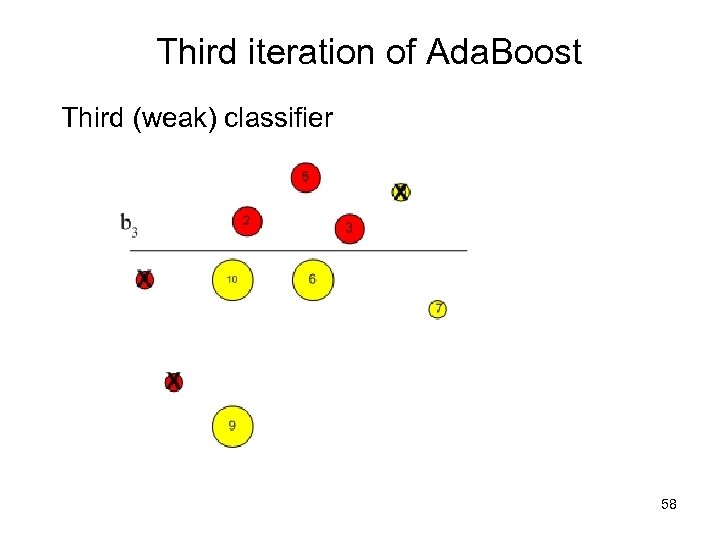 Third iteration of Ada. Boost Third (weak) classifier 58
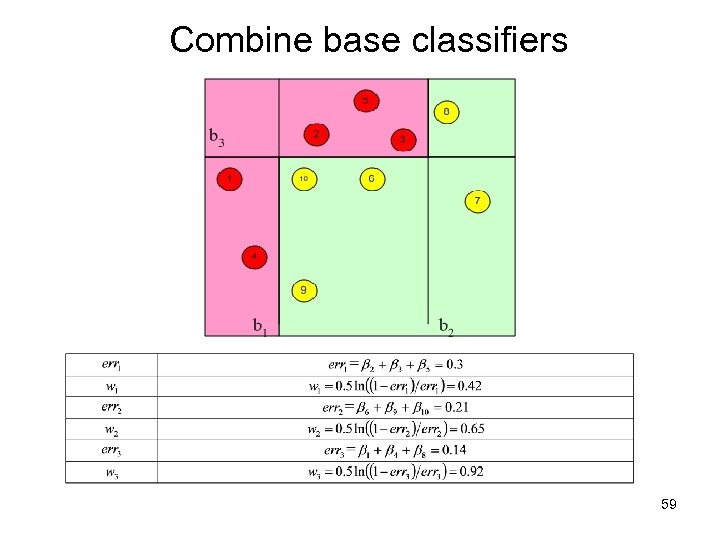 Combine base classifiers 59
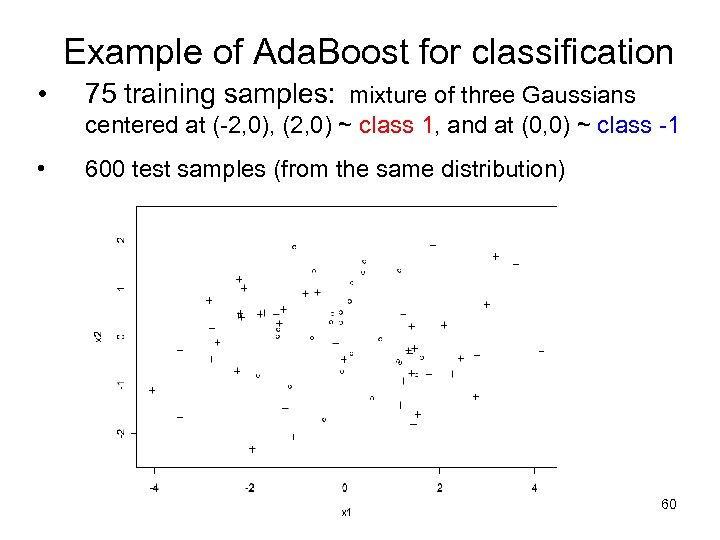 Example of Ada. Boost for classification • 75 training samples: mixture of three Gaussians centered at (-2, 0), (2, 0) ~ class 1, and at (0, 0) ~ class -1 • 600 test samples (from the same distribution) 60
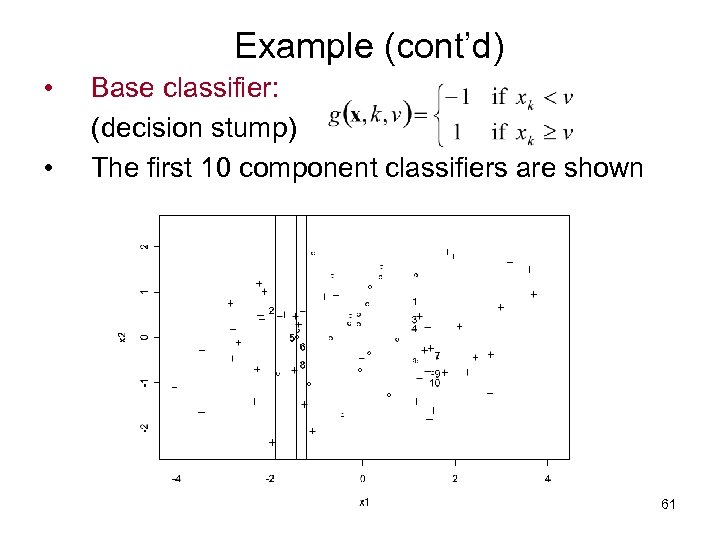 Example (cont’d) • • Base classifier: (decision stump) The first 10 component classifiers are shown 61
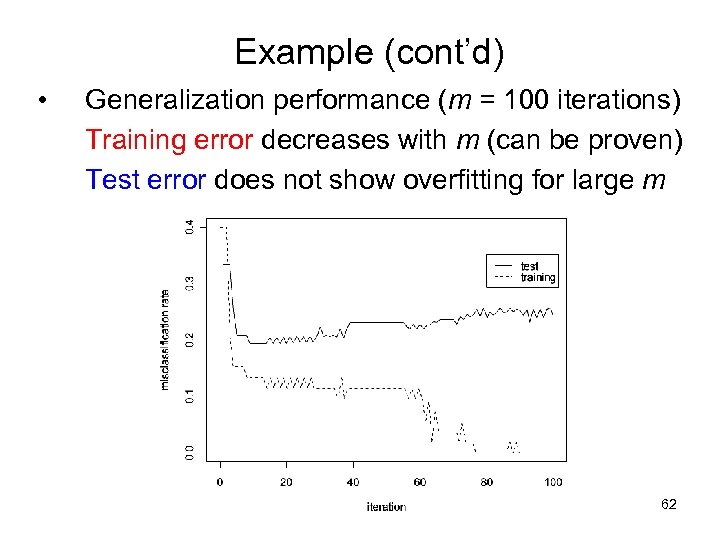 Example (cont’d) • Generalization performance (m = 100 iterations) Training error decreases with m (can be proven) Test error does not show overfitting for large m 62
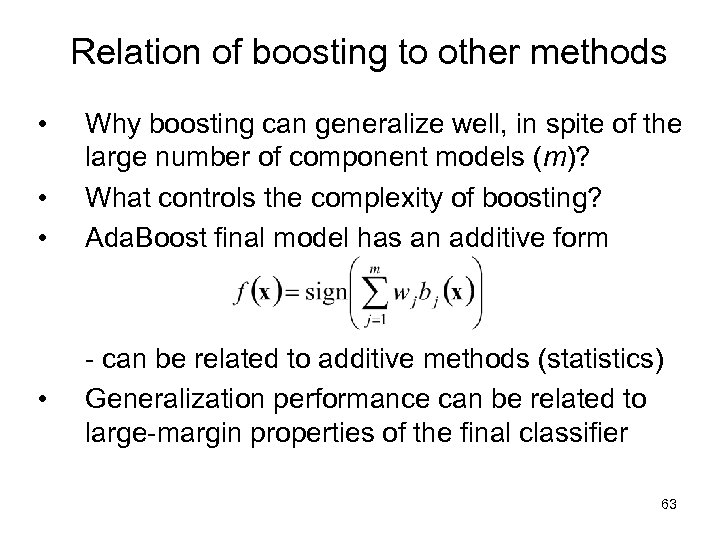 Relation of boosting to other methods • • Why boosting can generalize well, in spite of the large number of component models (m)? What controls the complexity of boosting? Ada. Boost final model has an additive form - can be related to additive methods (statistics) Generalization performance can be related to large-margin properties of the final classifier 63
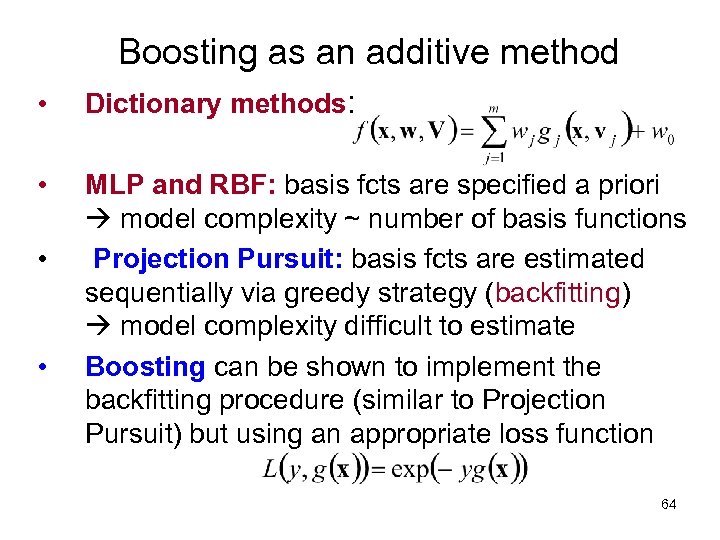 Boosting as an additive method • Dictionary methods: • MLP and RBF: basis fcts are specified a priori model complexity ~ number of basis functions Projection Pursuit: basis fcts are estimated sequentially via greedy strategy (backfitting) model complexity difficult to estimate Boosting can be shown to implement the backfitting procedure (similar to Projection Pursuit) but using an appropriate loss function • • 64
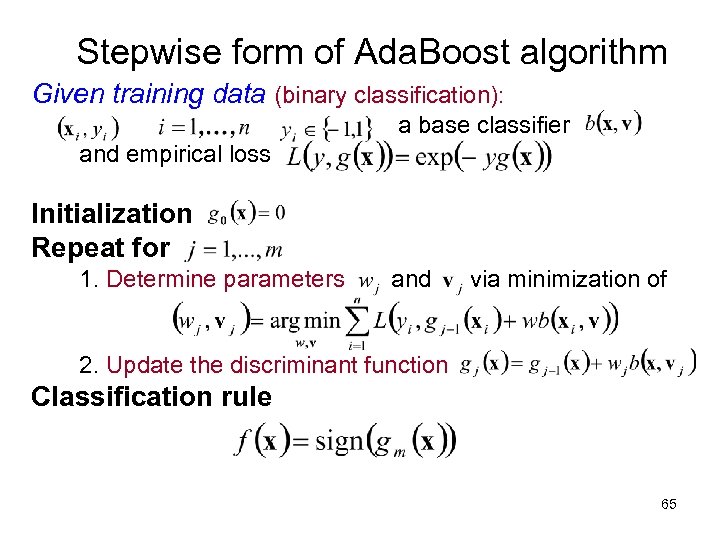 Stepwise form of Ada. Boost algorithm Given training data (binary classification): a base classifier and empirical loss Initialization Repeat for 1. Determine parameters and via minimization of 2. Update the discriminant function Classification rule 65
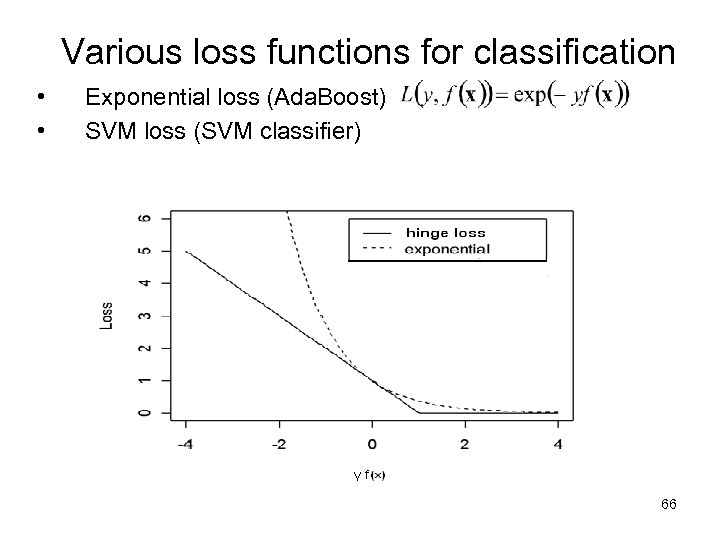 Various loss functions for classification • • Exponential loss (Ada. Boost) SVM loss (SVM classifier) 66
 Generalization Performance of Ada. Boost • • Similarity between SVM and exponential loss helps to explain good performance of Ada. Boosting tends to increase the degree of separation between two classes (margin) Generalization properties poorly understood Complexity control via - the number of components - complexity of a base classifier • Poor performance for noisy data sets 67
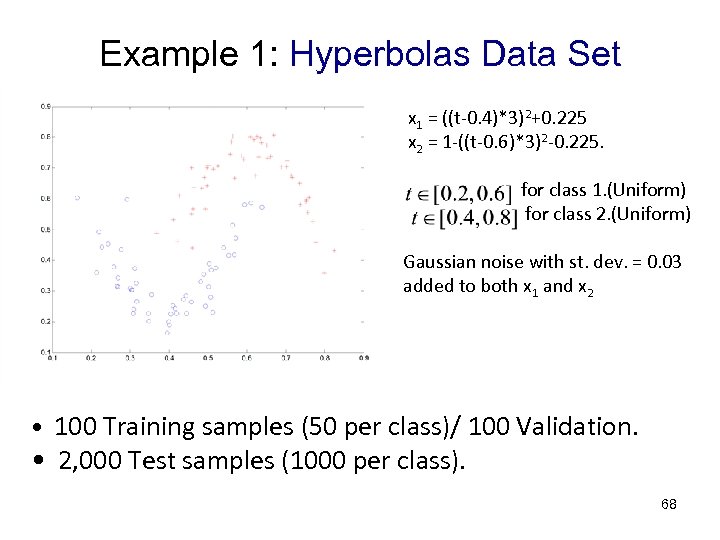 Example 1: Hyperbolas Data Set x 1 = ((t-0. 4)*3)2+0. 225 x 2 = 1 -((t-0. 6)*3)2 -0. 225. for class 1. (Uniform) for class 2. (Uniform) Gaussian noise with st. dev. = 0. 03 added to both x 1 and x 2 • 100 Training samples (50 per class)/ 100 Validation. • 2, 000 Test samples (1000 per class). 68
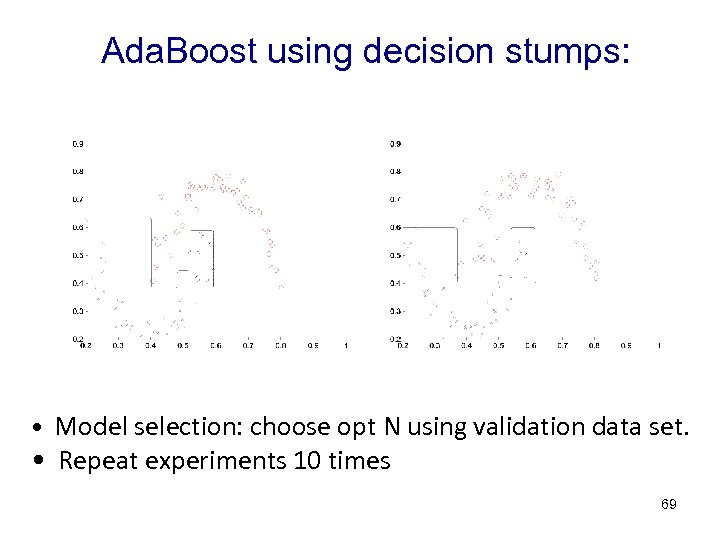 Ada. Boost using decision stumps: • Model selection: choose opt N using validation data set. • Repeat experiments 10 times 69
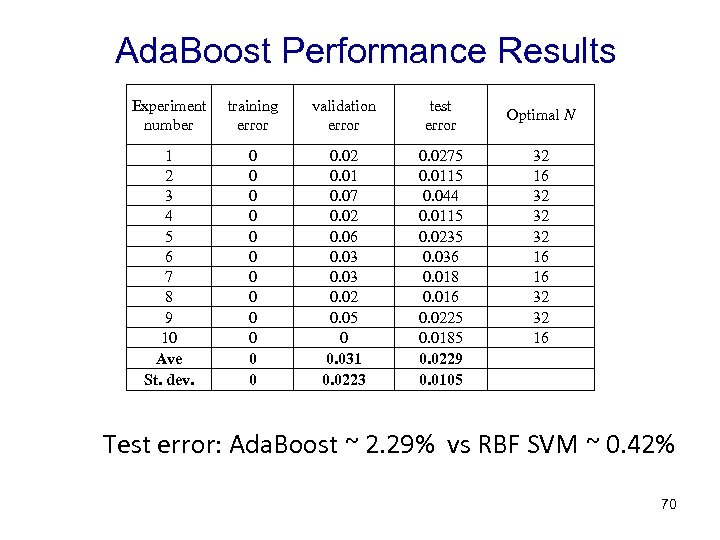 Ada. Boost Performance Results Experiment number training error validation error test error 1 2 3 4 5 6 7 8 9 10 Ave St. dev. 0 0 0 0. 02 0. 01 0. 07 0. 02 0. 06 0. 03 0. 02 0. 05 0 0. 031 0. 0223 0. 0275 0. 0115 0. 044 0. 0115 0. 0235 0. 036 0. 018 0. 016 0. 0225 0. 0185 0. 0229 0. 0105 Optimal N 32 16 32 32 32 16 16 32 32 16 Test error: Ada. Boost ~ 2. 29% vs RBF SVM ~ 0. 42% 70
 OUTLINE • • • Problem statement and approaches Methods’ taxonomy Representative methods for classification Practical aspects and examples Combining methods and Boosting Summary 71
 Discussion • • Predictive risk minimization and statistical approaches often yield similar learning methods But the conceptual basis & motivation are different may result in confusion This difference may lead to variations in: - empirical loss function - implementation of complexity control - interpretation of the trained model outputs - evaluation of classifier performance Most competitive methods follow the riskminimization approach, even when presented using statistical terminology 72
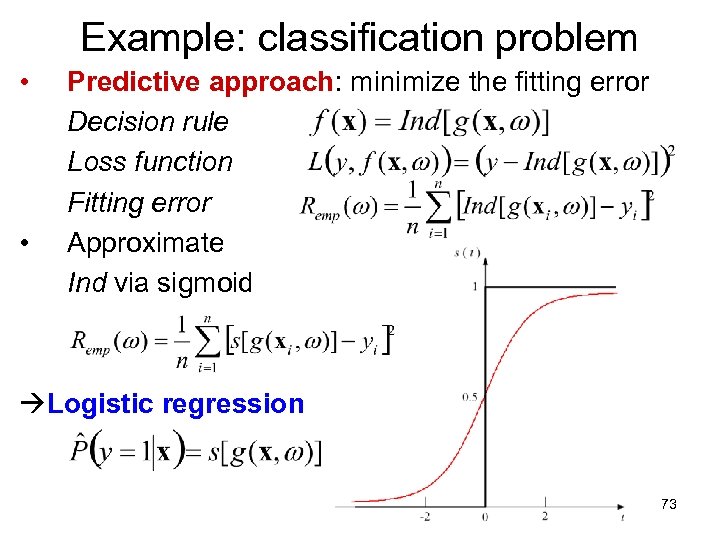 Example: classification problem • • Predictive approach: minimize the fitting error Decision rule Loss function Fitting error Approximate Ind via sigmoid Logistic regression 73
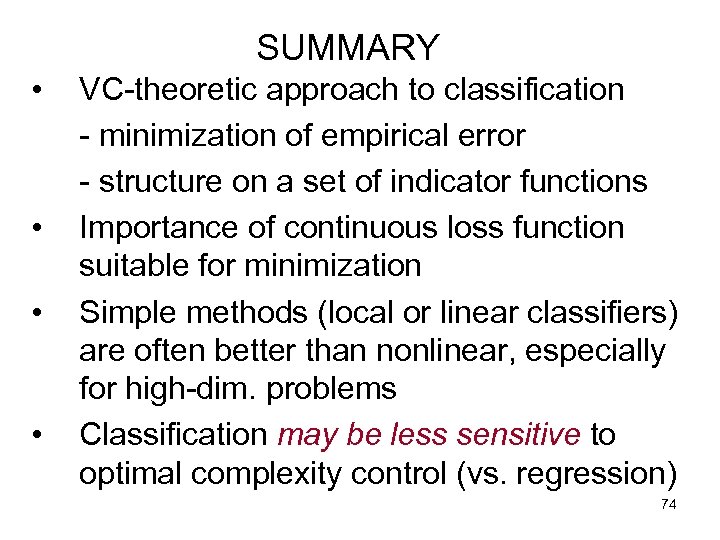 SUMMARY • • VC-theoretic approach to classification - minimization of empirical error - structure on a set of indicator functions Importance of continuous loss function suitable for minimization Simple methods (local or linear classifiers) are often better than nonlinear, especially for high-dim. problems Classification may be less sensitive to optimal complexity control (vs. regression) 74