 Скачать презентацию Prediction of Phase Equilibrium Related Properties by Correlations
6a02aefde616d47abef6cbe28546fd4b.ppt
- Количество слайдов: 22




Prediction of Phase Equilibrium Related Properties by Correlations Based on Similarity of Molecular Structures N. Braunera, M. Shachamb, R. P. Statevac and G. St. Cholakovd a. School b. Dept. c. Inst. of Engineering, Tel-Aviv University, Tel-Aviv, Israel Chem. Engng, Ben-Gurion University, Beer-Sheva, Israel Chem. Engn. , Bulgarian Academy of Sciences, Sofia, Bulgaria d. University of Chemical Technology and Metalurgy, Sofia, Bulgaria 1
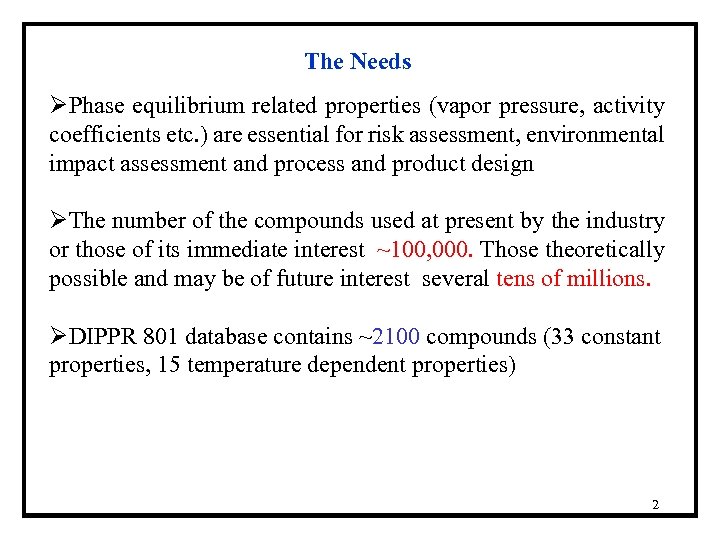
The Needs ØPhase equilibrium related properties (vapor pressure, activity coefficients etc. ) are essential for risk assessment, environmental impact assessment and process and product design ØThe number of the compounds used at present by the industry or those of its immediate interest ~100, 000. Those theoretically possible and may be of future interest several tens of millions. ØDIPPR 801 database contains ~2100 compounds (33 constant properties, 15 temperature dependent properties) 2
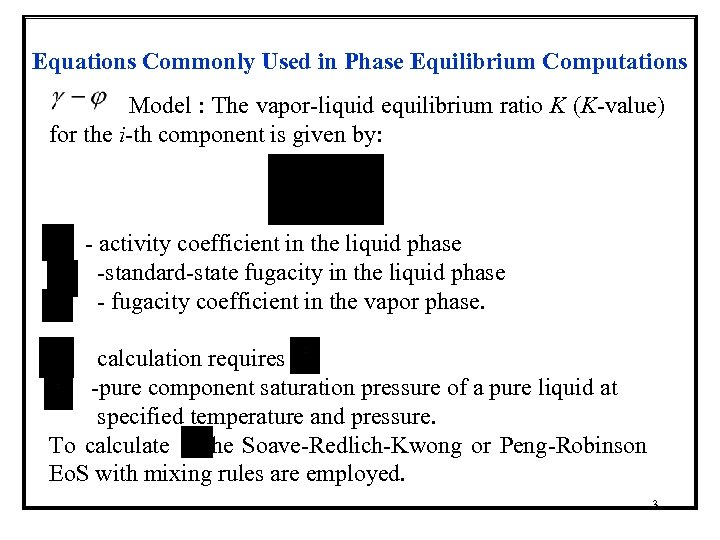
Equations Commonly Used in Phase Equilibrium Computations Model : The vapor-liquid equilibrium ratio K (K-value) for the i-th component is given by: - activity coefficient in the liquid phase -standard-state fugacity in the liquid phase - fugacity coefficient in the vapor phase. calculation requires -pure component saturation pressure of a pure liquid at specified temperature and pressure. To calculate the Soave-Redlich-Kwong or Peng-Robinson Eo. S with mixing rules are employed. 3
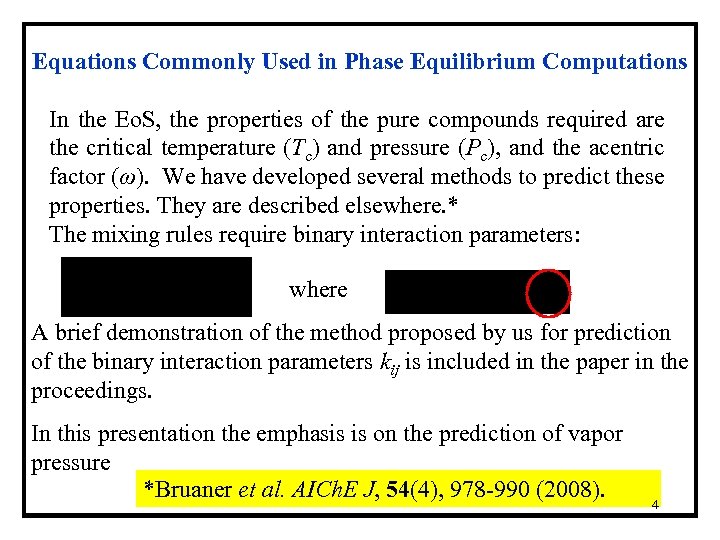
Equations Commonly Used in Phase Equilibrium Computations In the Eo. S, the properties of the pure compounds required are the critical temperature (Tc) and pressure (Pc), and the acentric factor (ω). We have developed several methods to predict these properties. They are described elsewhere. * The mixing rules require binary interaction parameters: where A brief demonstration of the method proposed by us for prediction of the binary interaction parameters kij is included in the paper in the proceedings. In this presentation the emphasis is on the prediction of vapor pressure *Bruaner et al. AICh. E J, 54(4), 978 -990 (2008). 4
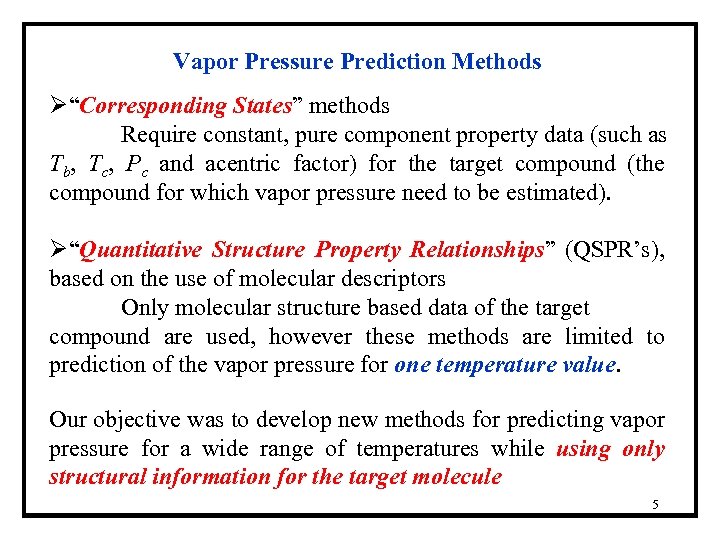
Vapor Pressure Prediction Methods Ø“Corresponding States” methods Require constant, pure component property data (such as Tb, Tc, Pc and acentric factor) for the target compound (the compound for which vapor pressure need to be estimated). Ø“Quantitative Structure Property Relationships” (QSPR’s), based on the use of molecular descriptors Only molecular structure based data of the target compound are used, however these methods are limited to prediction of the vapor pressure for one temperature value. Our objective was to develop new methods for predicting vapor pressure for a wide range of temperatures while using only structural information for the target molecule 5
A Generalized Algorithm for Prediction of Saturation Temperatures (1) ØSimilarity group selection - Identify compounds that are structurally similar to the target compound (i. e. , members of homologous series, or apply the TQSPR algorithm*). Ø It is assumed that data for the normal boiling temperature (Tb) are available for members of the similarity group, and for a few of them (at least two compounds) experimental data and/or models for vapor pressure available. ØSelection of the predictive descriptor - Use a stepwise regression program to identify a molecular descriptor that is colinear with Tb for the similarity group. *Shacham et al. Chem. Eng. Sci. 62 (22), 6222 (2007) 6
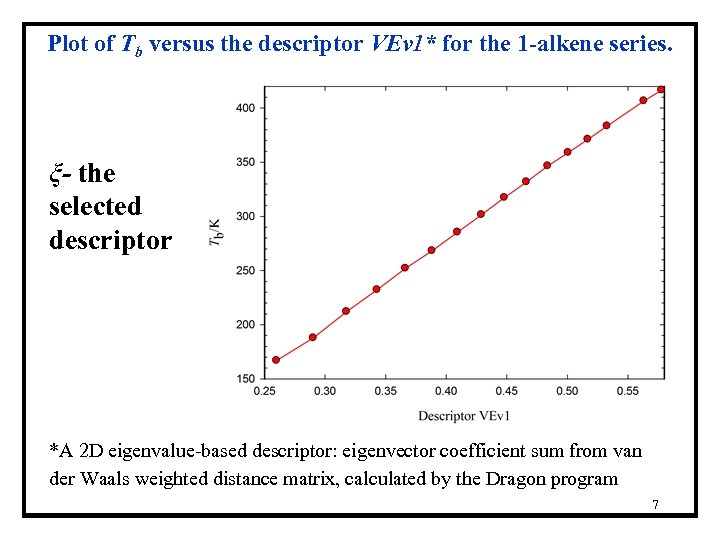
Plot of Tb versus the descriptor VEv 1* for the 1 -alkene series. ξ- the selected descriptor *A 2 D eigenvalue-based descriptor: eigenvector coefficient sum from van der Waals weighted distance matrix, calculated by the Dragon program 7
A Generalized Algorithm for Prediction of Saturation Temperatures (2) ØRecalling that Tb is the saturation temperature (Ts) at atmospheric pressure suggests that the same descriptor is also collinear with Ts at other pressures ØPredictive compounds selection - Select two (or three) predictive compounds, closest to the target compound (in terms of the selected descriptor value) and preferably located on opposite sides of the target compound. Experimental data and/or models for vapor pressure must be available for the selected predictive compounds (e. g. , Antoine, Riedel or Wagner). ØModel applicability range - determine the applicability range of the predictive model to be developed based on the common vapor pressure range where data are available for all predictive 8 compounds.
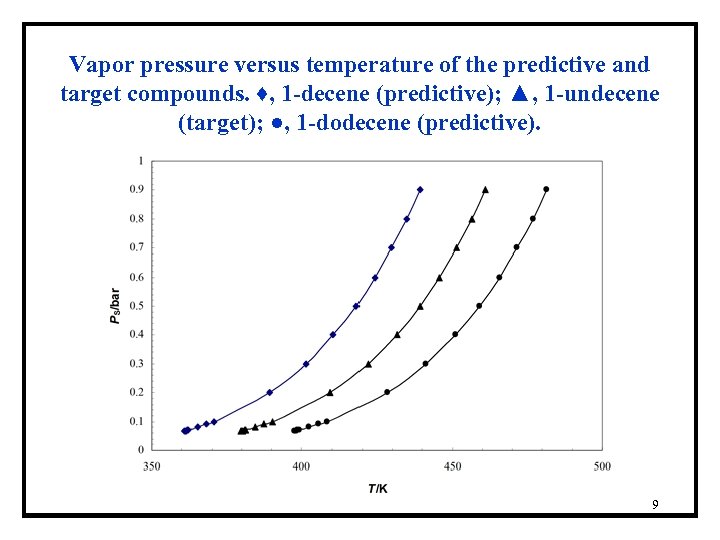
Vapor pressure versus temperature of the predictive and target compounds. ♦, 1 -decene (predictive); ▲, 1 -undecene (target); ●, 1 -dodecene (predictive). 9
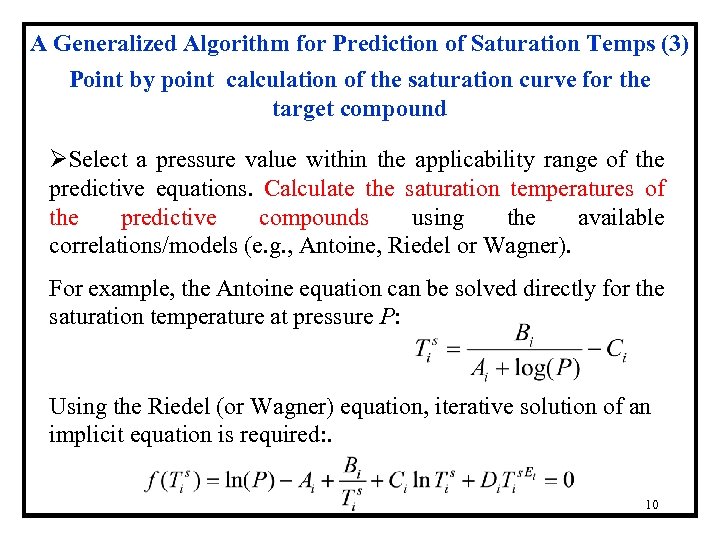
A Generalized Algorithm for Prediction of Saturation Temps (3) Point by point calculation of the saturation curve for the target compound ØSelect a pressure value within the applicability range of the predictive equations. Calculate the saturation temperatures of the predictive compounds using the available correlations/models (e. g. , Antoine, Riedel or Wagner). For example, the Antoine equation can be solved directly for the saturation temperature at pressure P: Using the Riedel (or Wagner) equation, iterative solution of an implicit equation is required: . 10
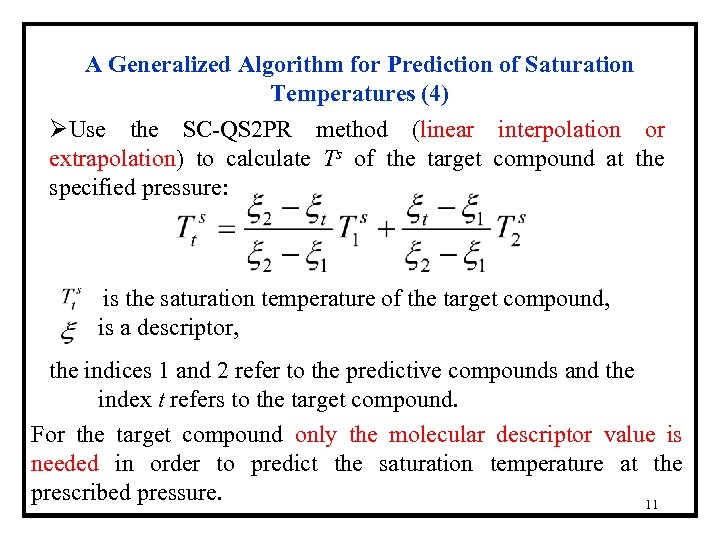
A Generalized Algorithm for Prediction of Saturation Temperatures (4) ØUse the SC-QS 2 PR method (linear interpolation or extrapolation) to calculate Ts of the target compound at the specified pressure: is the saturation temperature of the target compound, is a descriptor, the indices 1 and 2 refer to the predictive compounds and the index t refers to the target compound. For the target compound only the molecular descriptor value is needed in order to predict the saturation temperature at the prescribed pressure. 11
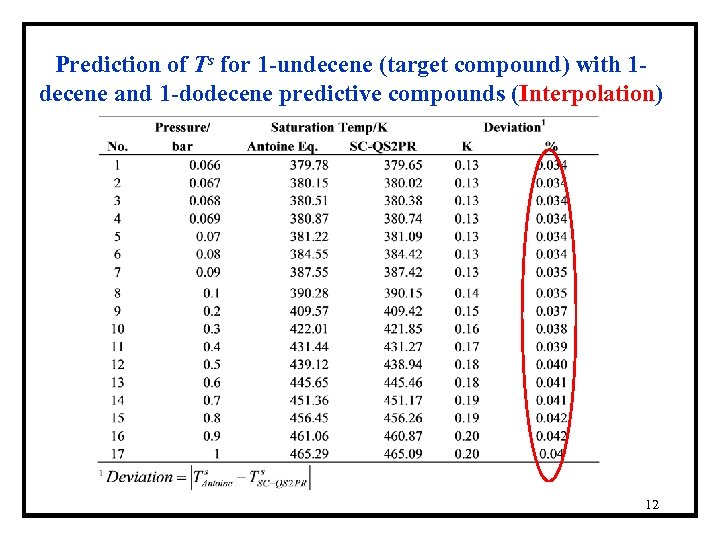
Prediction of Ts for 1 -undecene (target compound) with 1 decene and 1 -dodecene predictive compounds (Interpolation) 12
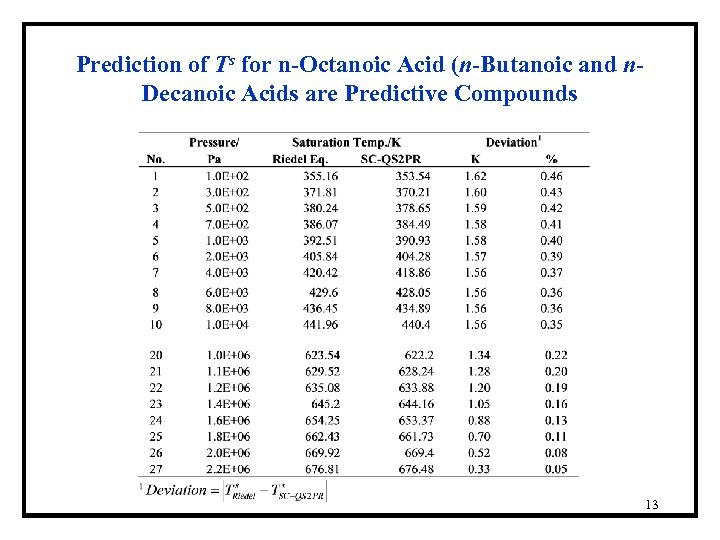
Prediction of Ts for n-Octanoic Acid (n-Butanoic and n. Decanoic Acids are Predictive Compounds 13
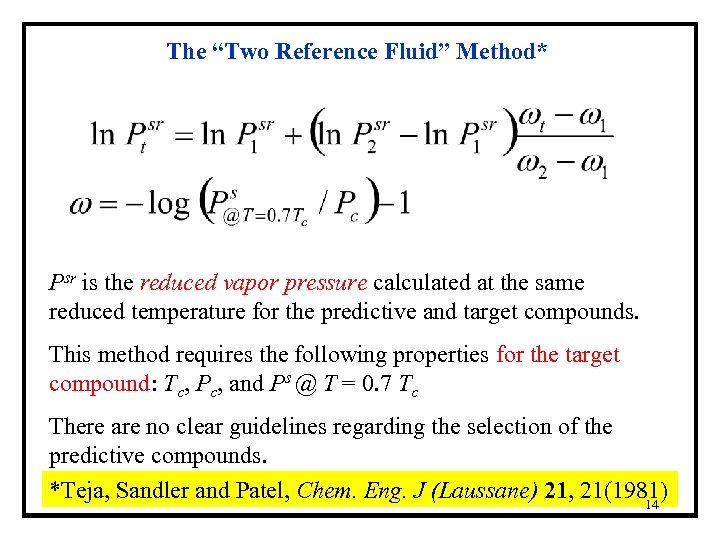
The “Two Reference Fluid” Method* Psr is the reduced vapor pressure calculated at the same reduced temperature for the predictive and target compounds. This method requires the following properties for the target compound: Tc, Pc, and Ps @ T = 0. 7 Tc There are no clear guidelines regarding the selection of the predictive compounds. *Teja, Sandler and Patel, Chem. Eng. J (Laussane) 21, 21(1981) 14
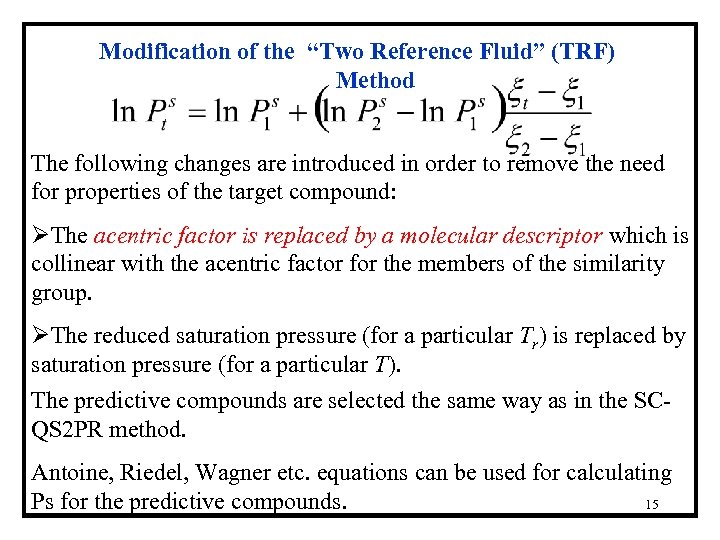
Modification of the “Two Reference Fluid” (TRF) Method The following changes are introduced in order to remove the need for properties of the target compound: ØThe acentric factor is replaced by a molecular descriptor which is collinear with the acentric factor for the members of the similarity group. ØThe reduced saturation pressure (for a particular Tr) is replaced by saturation pressure (for a particular T). The predictive compounds are selected the same way as in the SCQS 2 PR method. Antoine, Riedel, Wagner etc. equations can be used for calculating Ps for the predictive compounds. 15
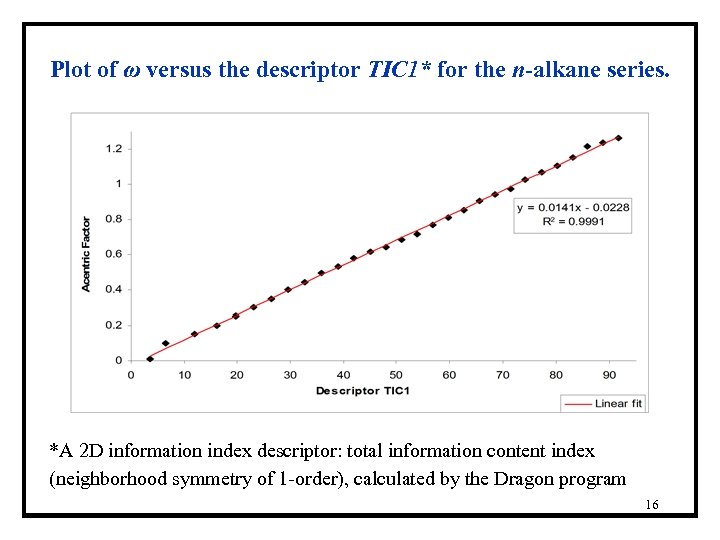
Plot of ω versus the descriptor TIC 1* for the n-alkane series. *A 2 D information index descriptor: total information content index (neighborhood symmetry of 1 -order), calculated by the Dragon program 16
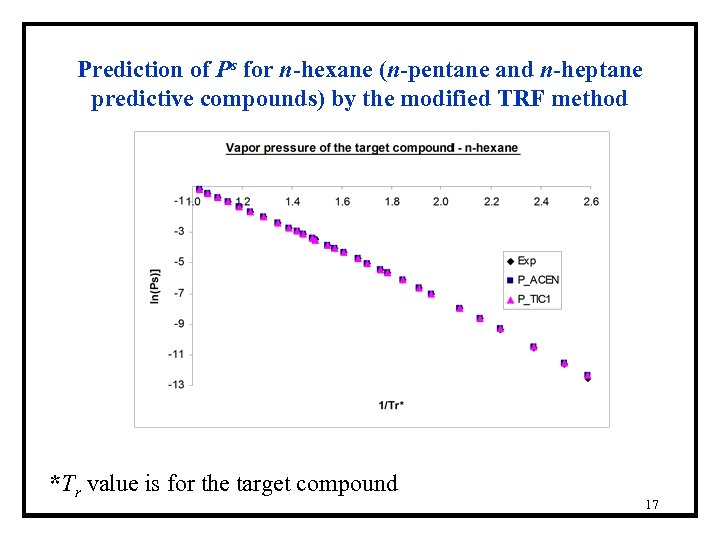
Prediction of Ps for n-hexane (n-pentane and n-heptane predictive compounds) by the modified TRF method *Tr value is for the target compound 17
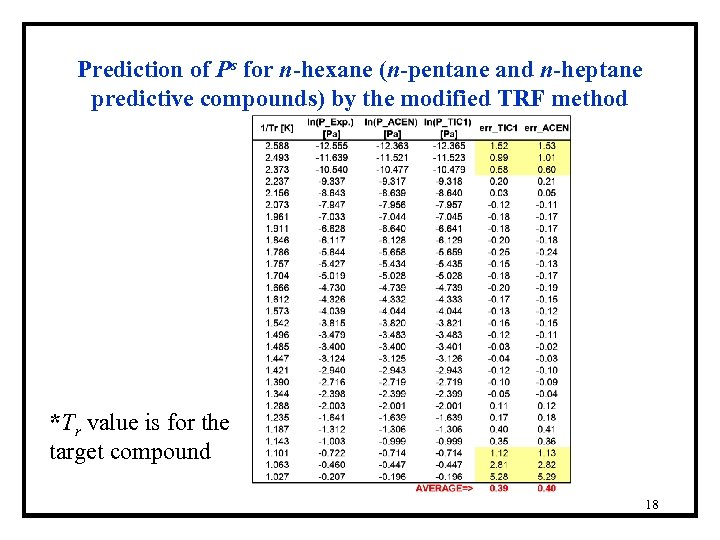
Prediction of Ps for n-hexane (n-pentane and n-heptane predictive compounds) by the modified TRF method *Tr value is for the target compound 18
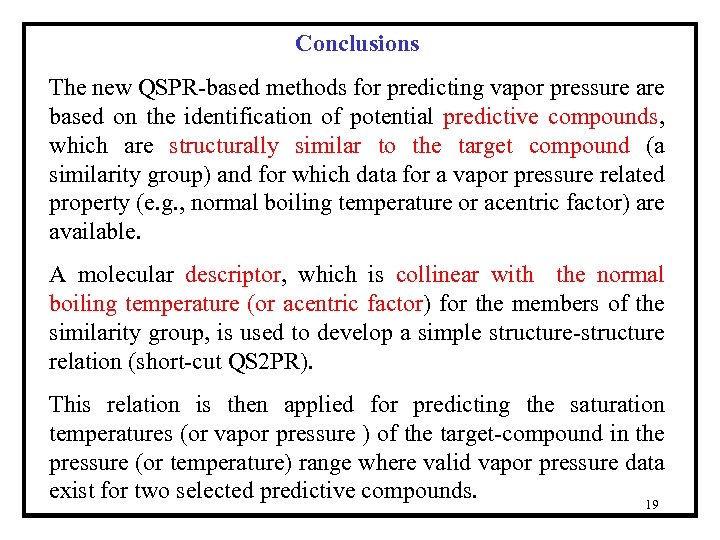
Conclusions The new QSPR-based methods for predicting vapor pressure are based on the identification of potential predictive compounds, which are structurally similar to the target compound (a similarity group) and for which data for a vapor pressure related property (e. g. , normal boiling temperature or acentric factor) are available. A molecular descriptor, which is collinear with the normal boiling temperature (or acentric factor) for the members of the similarity group, is used to develop a simple structure-structure relation (short-cut QS 2 PR). This relation is then applied for predicting the saturation temperatures (or vapor pressure ) of the target-compound in the pressure (or temperature) range where valid vapor pressure data exist for two selected predictive compounds. 19
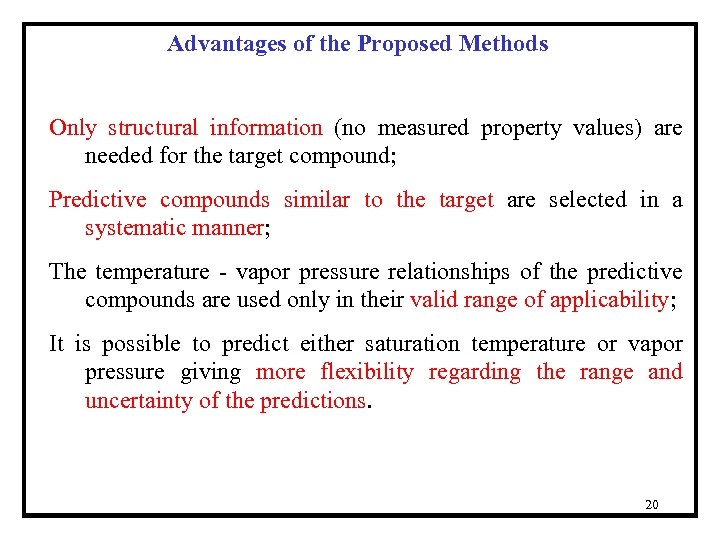
Advantages of the Proposed Methods Only structural information (no measured property values) are needed for the target compound; Predictive compounds similar to the target are selected in a systematic manner; The temperature - vapor pressure relationships of the predictive compounds are used only in their valid range of applicability; It is possible to predict either saturation temperature or vapor pressure giving more flexibility regarding the range and uncertainty of the predictions. 20
Presentation Outline ØCategorizing the Molecular Descriptors According to the Trend of Their Change with n. C for Homologous Series ØIdentifying Training Sets from Compounds Belonging to the Target Compounds Homologous Series ØPredicting Critical Properties, Normal Boiling and Melting Temperatures, Liquid Molar Volume and Refractive Index for Five Homologous Series with and without the Use of 3 -D descriptors. Ø Comparison of the Results and Conclusions 21
Presentation Outline ØCategorizing the Molecular Descriptors According to the Trend of Their Change with n. C for Homologous Series ØIdentifying Training Sets from Compounds Belonging to the Target Compounds Homologous Series ØPredicting Critical Properties, Normal Boiling and Melting Temperatures, Liquid Molar Volume and Refractive Index for Five Homologous Series with and without the Use of 3 -D descriptors. Ø Comparison of the Results and Conclusions 22
Скачать презентацию Prediction of Phase Equilibrium Related Properties by Correlations
6a02aefde616d47abef6cbe28546fd4b.ppt