 Скачать презентацию Precision Measurements of Electromagnetic Properties of 0 η
59c8c5221b79a5a88b131155b6c163c8.ppt
- Количество слайдов: 38



Precision Measurements of Electromagnetic Properties of 0, η and η’ Mesons at JLab A. Gasparian NC A&T State University, Greensboro, NC and the Prim. Ex Collaboration Outline Ø The project and physics motivation: Ø The first experiment: 0 lifetime Ø Results for the 0 lifetime Ø Prim. Ex at 12 Ge. V Ø The proposed → experiment with Glue. X Ø Summary
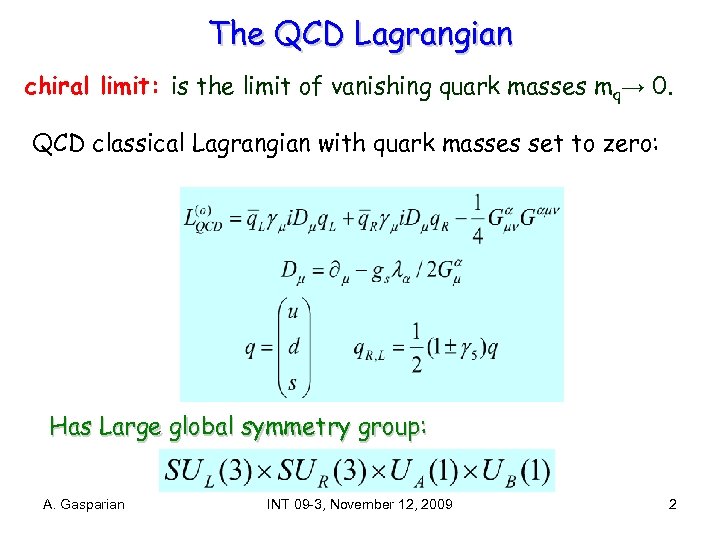
The QCD Lagrangian chiral limit: is the limit of vanishing quark masses mq→ 0. QCD classical Lagrangian with quark masses set to zero: Has Large global symmetry group: A. Gasparian INT 09 -3, November 12, 2009 2
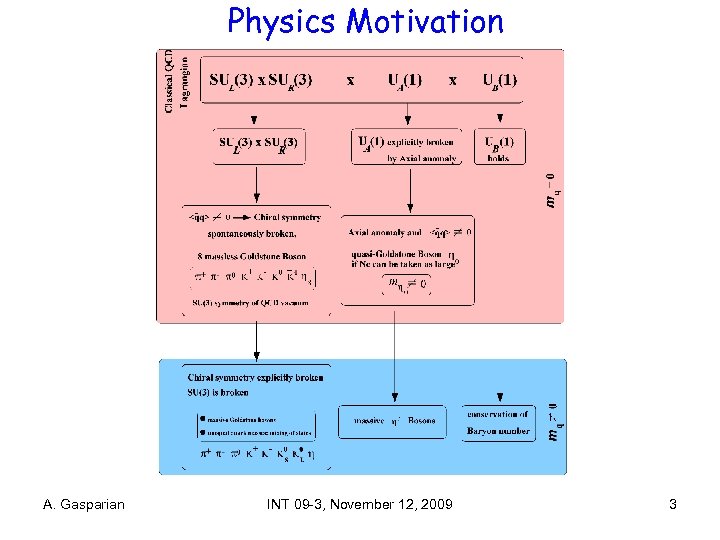
Physics Motivation A. Gasparian INT 09 -3, November 12, 2009 3
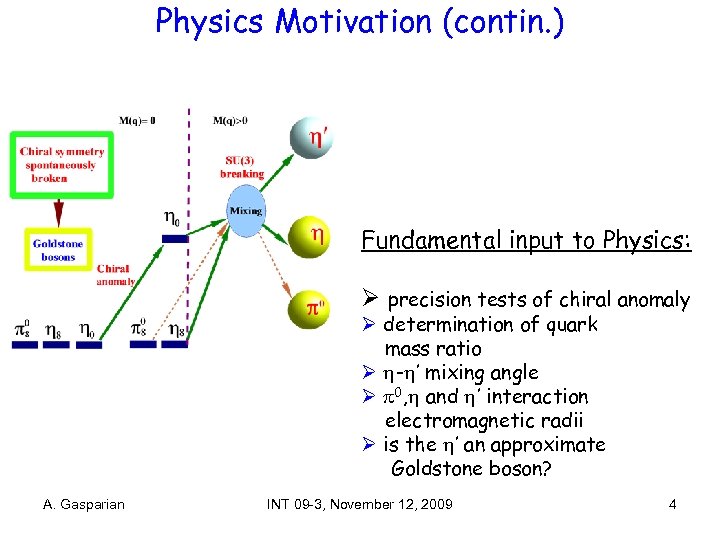
Physics Motivation (contin. ) Fundamental input to Physics: Ø precision tests of chiral anomaly Ø determination of quark mass ratio Ø - ’ mixing angle Ø 0, and ’ interaction electromagnetic radii Ø is the ’ an approximate Goldstone boson? A. Gasparian INT 09 -3, November 12, 2009 4
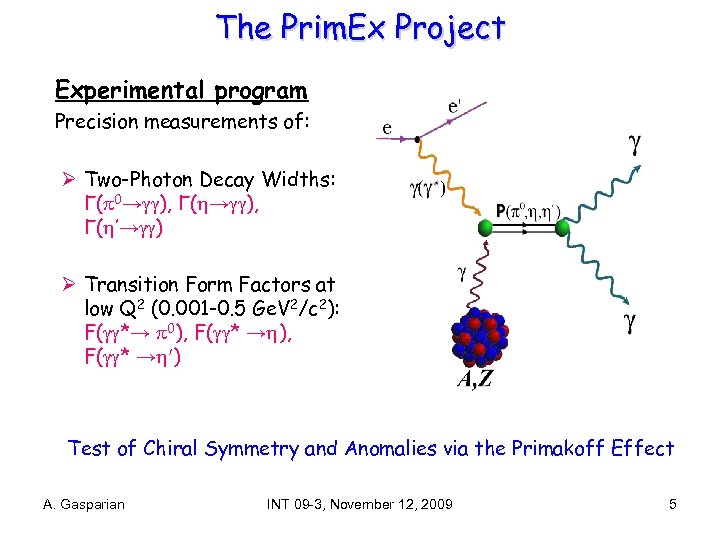
The Prim. Ex Project Experimental program Precision measurements of: Ø Two-Photon Decay Widths: Γ( 0→ ), Γ( ’→ ) Ø Transition Form Factors at low Q 2 (0. 001 -0. 5 Ge. V 2/c 2): F( *→ 0), F( * → ) Test of Chiral Symmetry and Anomalies via the Primakoff Effect A. Gasparian INT 09 -3, November 12, 2009 5
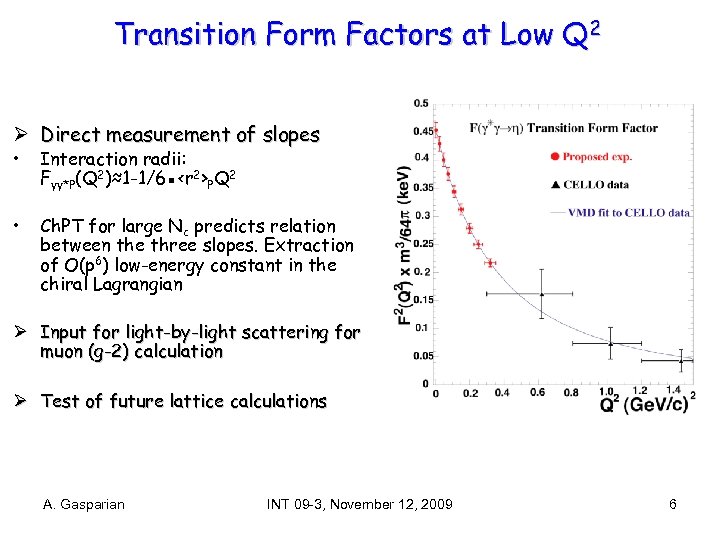
Transition Form Factors at Low Q 2 Ø Direct measurement of slopes • Interaction radii: Fγγ*P(Q 2)≈1 -1/6▪<r 2>PQ 2 • Ch. PT for large Nc predicts relation between the three slopes. Extraction of Ο(p 6) low-energy constant in the chiral Lagrangian Ø Input for light-by-light scattering for muon (g-2) calculation Ø Test of future lattice calculations A. Gasparian INT 09 -3, November 12, 2009 6
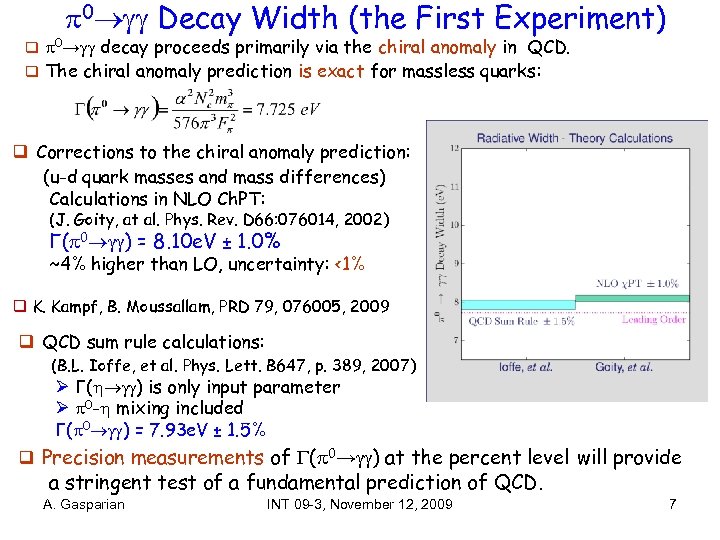
0 Decay Width (the First Experiment) q 0→ decay proceeds primarily via the chiral anomaly in QCD. q The chiral anomaly prediction is exact for massless quarks: q Corrections to the chiral anomaly prediction: (u-d quark masses and mass differences) Calculations in NLO Ch. PT: (J. Goity, at al. Phys. Rev. D 66: 076014, 2002) Γ( 0 ) = 8. 10 e. V ± 1. 0% ~4% higher than LO, uncertainty: <1% q K. Kampf, B. Moussallam, PRD 79, 076005, 2009 q QCD sum rule calculations: (B. L. Ioffe, et al. Phys. Lett. B 647, p. 389, 2007) Ø Γ( ) is only input parameter Ø 0 - mixing included Γ( 0 ) = 7. 93 e. V ± 1. 5% q Precision measurements of ( 0→ ) at the percent level will provide a stringent test of a fundamental prediction of QCD. A. Gasparian INT 09 -3, November 12, 2009 7
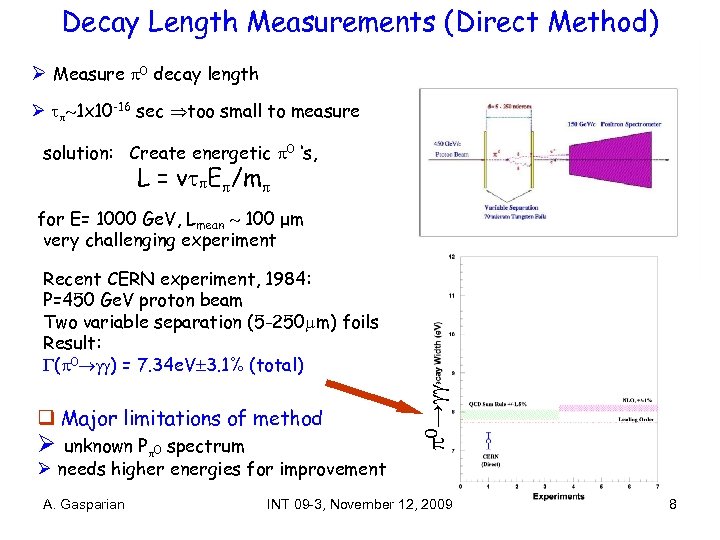
Decay Length Measurements (Direct Method) Ø Measure 0 decay length Ø 1 x 10 -16 sec too small to measure solution: Create energetic 0 ‘s, L = v E /m for E= 1000 Ge. V, Lmean 100 μm very challenging experiment q Major limitations of method Ø unknown P 0 spectrum 0→ Recent CERN experiment, 1984: P=450 Ge. V proton beam Two variable separation (5 -250 m) foils Result: ( 0 ) = 7. 34 e. V 3. 1% (total) Ø needs higher energies for improvement A. Gasparian INT 09 -3, November 12, 2009 8
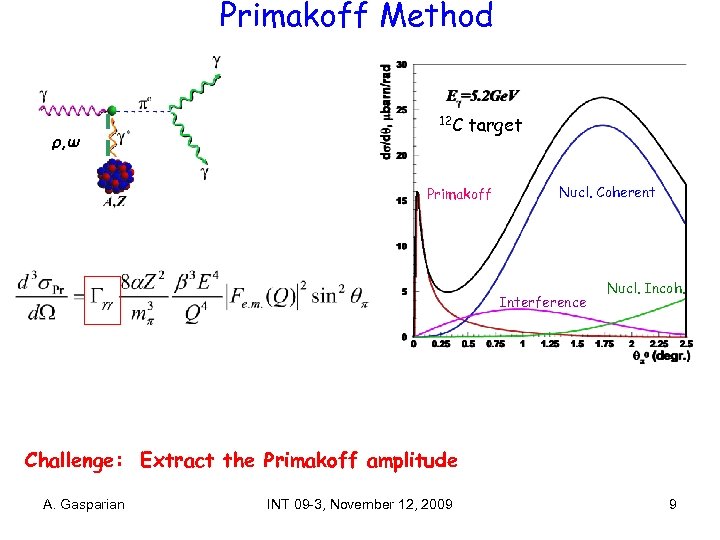
Primakoff Method ρ, ω 12 C target Primakoff Nucl. Coherent Interference Nucl. Incoh. Challenge: Extract the Primakoff amplitude A. Gasparian INT 09 -3, November 12, 2009 9
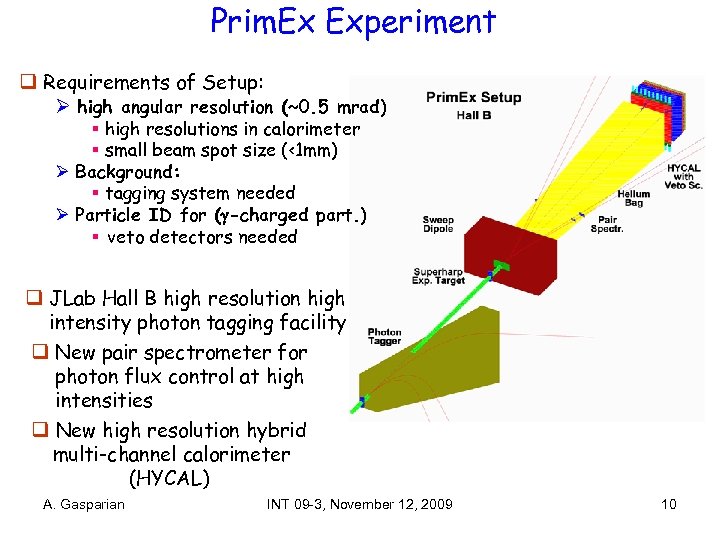
Prim. Ex Experiment q Requirements of Setup: Ø high angular resolution (~0. 5 mrad) § high resolutions in calorimeter § small beam spot size (‹ 1 mm) Ø Background: § tagging system needed Ø Particle ID for ( -charged part. ) § veto detectors needed q JLab Hall B high resolution high intensity photon tagging facility q New pair spectrometer for photon flux control at high intensities q New high resolution hybrid multi-channel calorimeter (HYCAL) A. Gasparian INT 09 -3, November 12, 2009 10
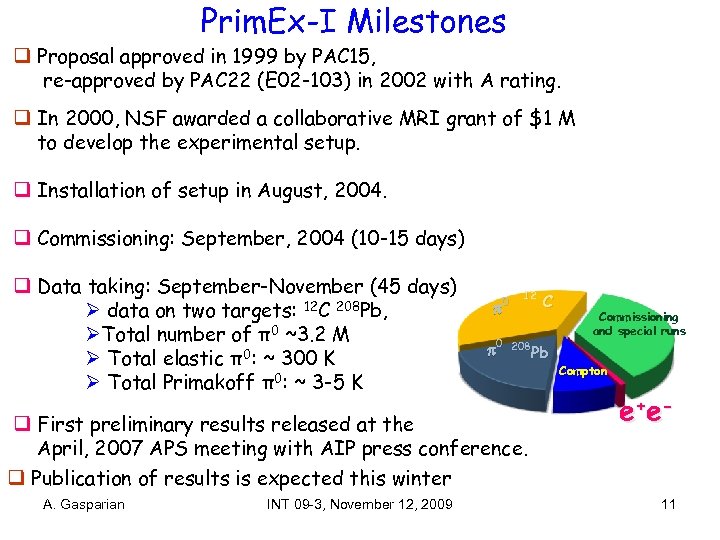
Prim. Ex-I Milestones q Proposal approved in 1999 by PAC 15, re-approved by PAC 22 (E 02 -103) in 2002 with A rating. q In 2000, NSF awarded a collaborative MRI grant of $1 M to develop the experimental setup. q Installation of setup in August, 2004. q Commissioning: September, 2004 (10 -15 days) q Data taking: September-November (45 days) Ø data on two targets: 12 C 208 Pb, ØTotal number of π0 ~3. 2 M Ø Total elastic π0: ~ 300 K Ø Total Primakoff π0: ~ 3 -5 K 0 0 12 208 q First preliminary results released at the April, 2007 APS meeting with AIP press conference. q Publication of results is expected this winter A. Gasparian INT 09 -3, November 12, 2009 C Pb Commissioning and special runs Compton e+ e 11
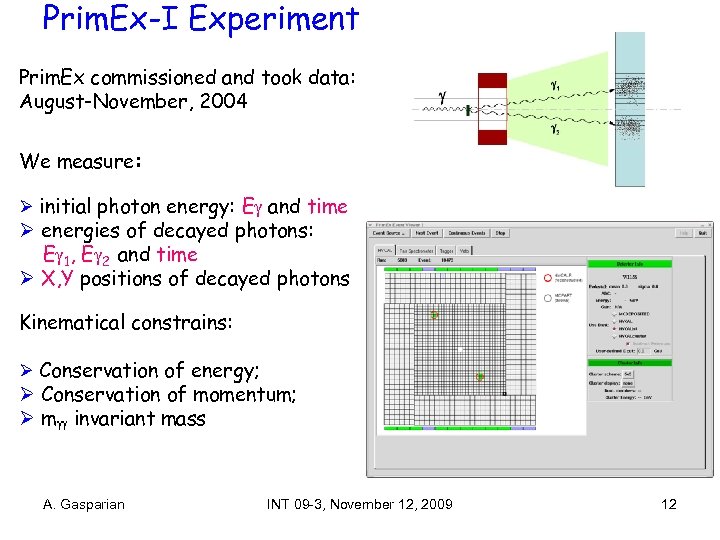
Prim. Ex-I Experiment Prim. Ex commissioned and took data: August-November, 2004 We measure: Ø initial photon energy: E and time Ø energies of decayed photons: E 1, E 2 and time Ø X, Y positions of decayed photons Kinematical constrains: Ø Conservation of energy; Ø Conservation of momentum; Ø m invariant mass A. Gasparian INT 09 -3, November 12, 2009 12
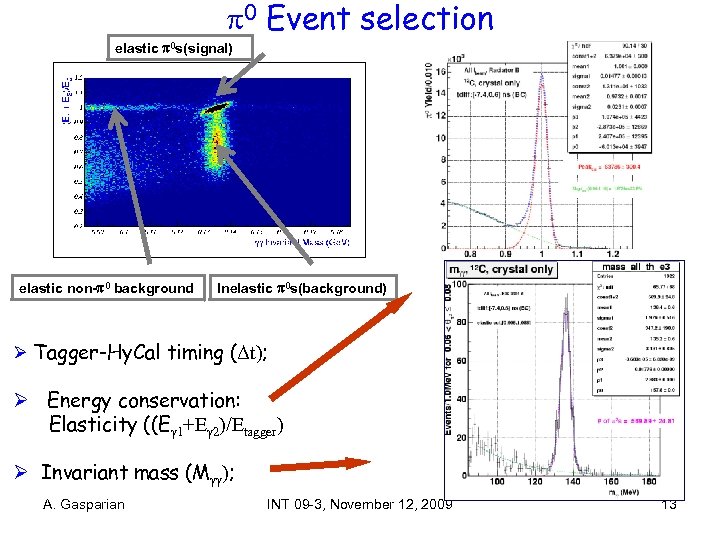
0 Event selection elastic 0 s(signal) elastic non- 0 background Inelastic 0 s(background) Ø Tagger-Hy. Cal timing (Δt); Ø Energy conservation: Elasticity ((Eγ 1+Eγ 2)/Etagger) Ø Invariant mass (Mγγ); A. Gasparian INT 09 -3, November 12, 2009 13
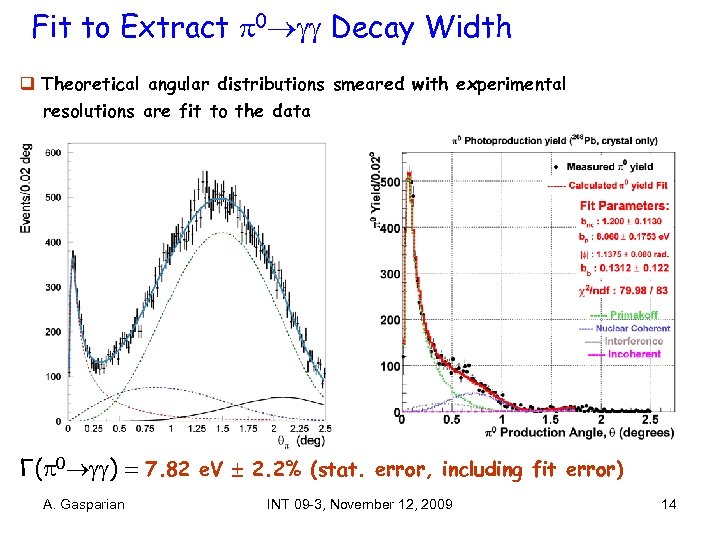
Fit to Extract 0 Decay Width q Theoretical angular distributions smeared with experimental resolutions are fit to the data Γ( 0 ) 7. 82 e. V 2. 2% (stat. error, including fit error) A. Gasparian INT 09 -3, November 12, 2009 14
Systematic Errors in ( 0→ ) q The sources of Systematic Errors: Ø Instrumental (experimental setup) Ø Model errors (from fit) q Independent verifications of the extracted cross sections are needed q The data for the following QED processes had been taken periodically in this experiment: Ø e+e- pair production Ø Compton scattering A. Gasparian INT 09 -3, November 12, 2009 15
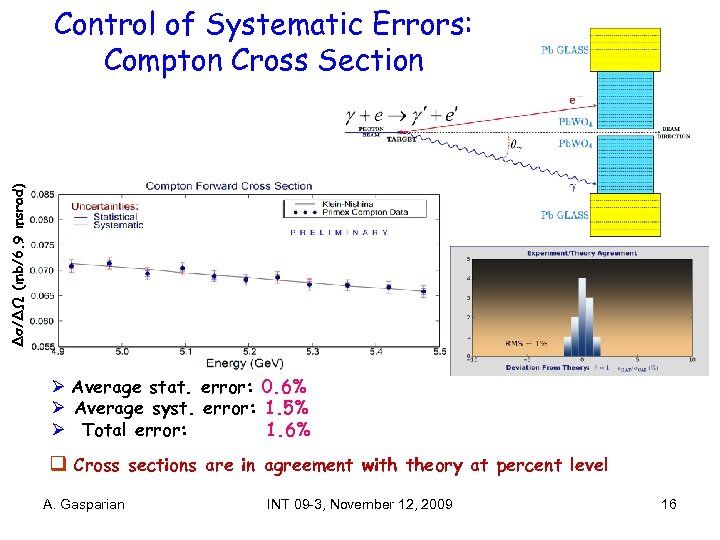
Δσ/ΔΩ (mb/6. 9 msrad) Control of Systematic Errors: Compton Cross Section Ø Average stat. error: 0. 6% Ø Average syst. error: 1. 5% Ø Total error: 1. 6% q Cross sections are in agreement with theory at percent level A. Gasparian INT 09 -3, November 12, 2009 16
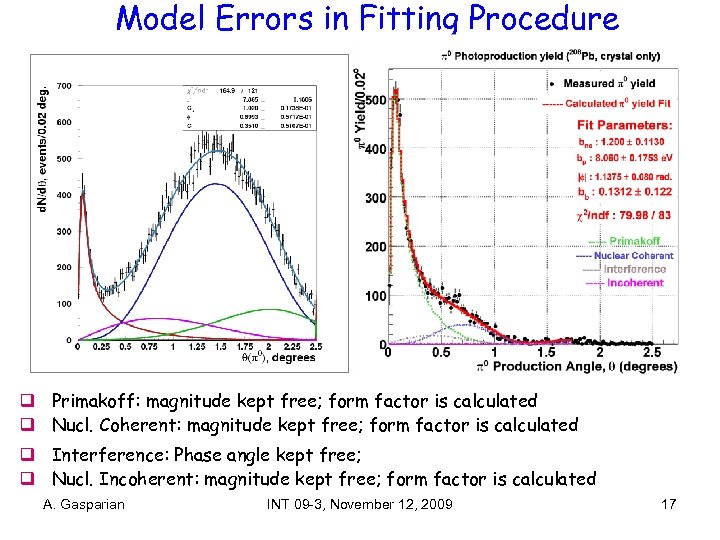
Model Errors in Fitting Procedure q Primakoff: magnitude kept free; form factor is calculated q Nucl. Coherent: magnitude kept free; form factor is calculated q Interference: Phase angle kept free; q Nucl. Incoherent: magnitude kept free; form factor is calculated A. Gasparian INT 09 -3, November 12, 2009 17
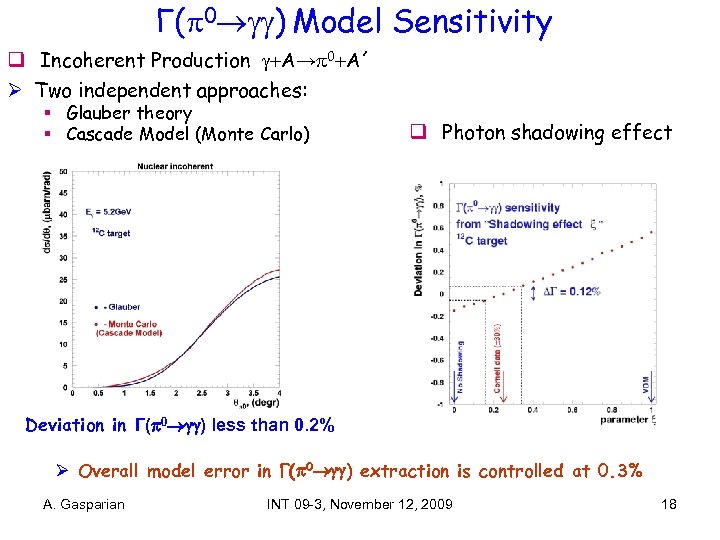
Γ( 0 ) Model Sensitivity q Incoherent Production A→ 0 A´ Ø Two independent approaches: § Glauber theory § Cascade Model (Monte Carlo) q Photon shadowing effect Deviation in Γ( 0 ) less than 0. 2% Ø Overall model error in Γ( 0 ) extraction is controlled at 0. 3% A. Gasparian INT 09 -3, November 12, 2009 18
![Estimated Systematic Errors Contributions Error, [%] Photon flux Target 0. 1 Yield extraction 1.](https://present5.com/presentation/59c8c5221b79a5a88b131155b6c163c8/image-19.jpg "Estimated Systematic Errors Contributions Error, [%] Photon flux Target 0. 1 Yield extraction 1.")
Estimated Systematic Errors Contributions Error, [%] Photon flux Target 0. 1 Yield extraction 1. 6 HYCAL eff. 0. 5 Beam parameters 0. 4 Trigger eff. 0. 1 VETO eff. 0. 4 Acceptance 0. 3 Model errors (theory) 0. 3 Physics background 0. 25 Branching ratio 0. 03 Total A. Gasparian 1. 0 2. 1 INT 09 -3, November 12, 2009 19
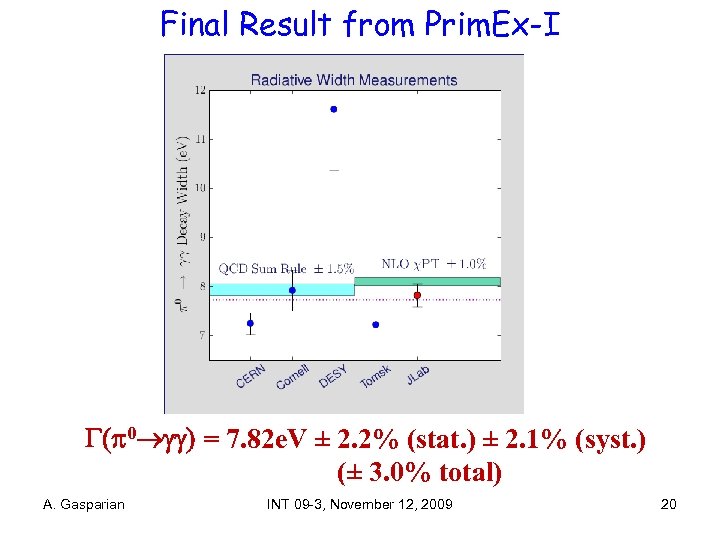
Final Result from Prim. Ex-I 0 = 7. 82 e. V ± 2. 2% (stat. ) ± 2. 1% (syst. ) (± 3. 0% total) A. Gasparian INT 09 -3, November 12, 2009 20
![Planned Prim. Ex-II Experiment ØStatistical error: 0. 44% Contributions Error, [%] Photon flux 1.](https://present5.com/presentation/59c8c5221b79a5a88b131155b6c163c8/image-21.jpg "Planned Prim. Ex-II Experiment ØStatistical error: 0. 44% Contributions Error, [%] Photon flux 1.")
Planned Prim. Ex-II Experiment ØStatistical error: 0. 44% Contributions Error, [%] Photon flux 1. 0 Target 0. 1 Yield extraction 0. 5 HYCAL eff. 0. 2 Beam parameters 0. 4 Trigger eff. 0. 1 VETO eff. 0. 3 Acceptance 0. 3 Model errors (theory) 0. 3 Physics background 0. 25 Branching ratio 0. 03 Total (syst. ) 1. 3 A. Gasparian INT 09 -3, November 12, 2009 Projected Prim. Ex-II (1. 4%) 21
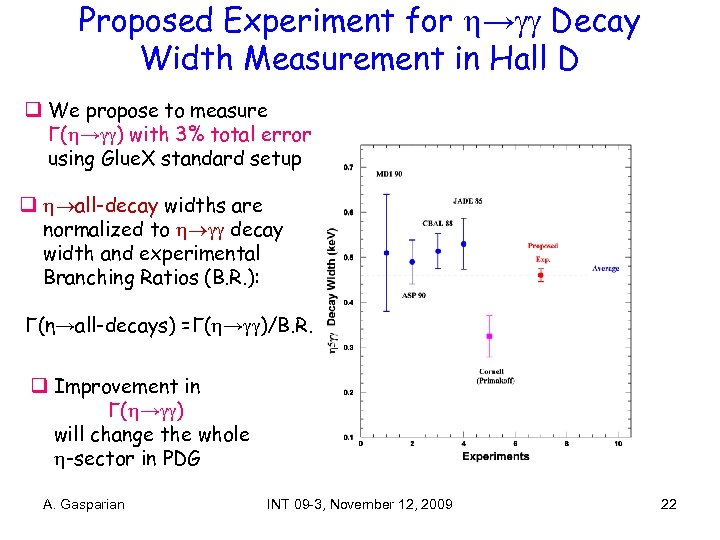
Proposed Experiment for → Decay Width Measurement in Hall D q We propose to measure Γ( → ) with 3% total error using Glue. X standard setup q all-decay widths are normalized to decay width and experimental Branching Ratios (B. R. ): Γ(η→all-decays) =Γ( → )/B. R. q Improvement in Γ( → ) will change the whole -sector in PDG A. Gasparian INT 09 -3, November 12, 2009 22
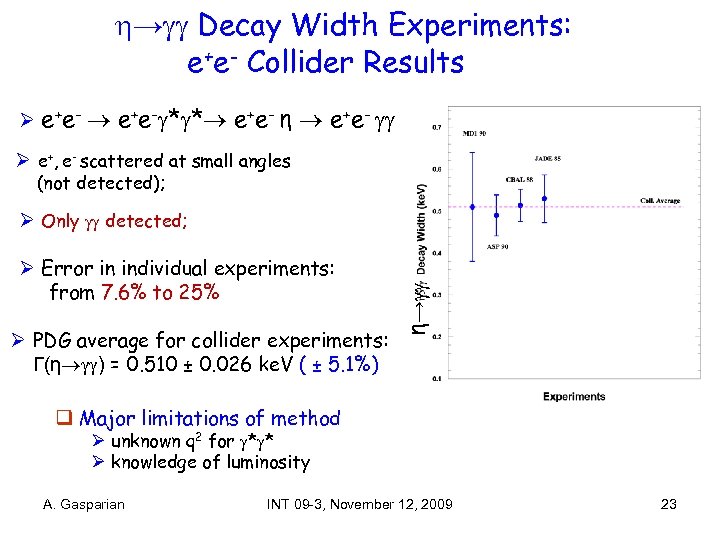
→ Decay Width Experiments: e+e- Collider Results Ø e+e- * * e+e- η e+e- Ø e+, e- scattered at small angles (not detected); Ø Error in individual experiments: from 7. 6% to 25% Ø PDG average for collider experiments: Γ(η ) = 0. 510 ± 0. 026 ke. V ( ± 5. 1%) η→ Ø Only detected; q Major limitations of method Ø unknown q 2 for * * Ø knowledge of luminosity A. Gasparian INT 09 -3, November 12, 2009 23
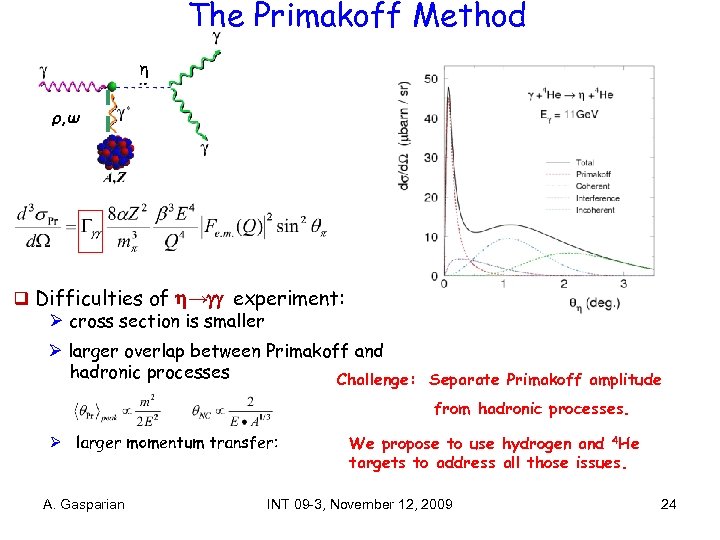
The Primakoff Method η ρ, ω q Difficulties of → experiment: Ø cross section is smaller Ø larger overlap between Primakoff and hadronic processes Challenge: Separate Primakoff amplitude from hadronic processes. Ø larger momentum transfer: A. Gasparian We propose to use hydrogen and 4 He targets to address all those issues. INT 09 -3, November 12, 2009 24
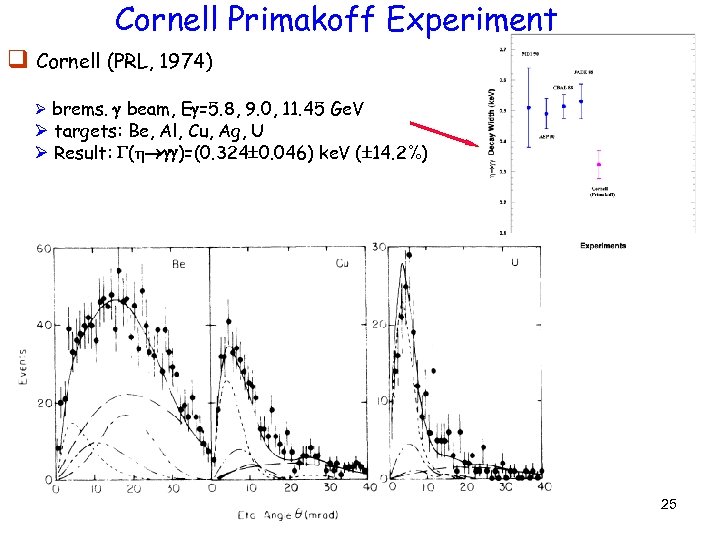
Cornell Primakoff Experiment q Cornell (PRL, 1974) Ø brems. beam, E =5. 8, 9. 0, 11. 45 Ge. V Ø targets: Be, Al, Cu, Ag, U Ø Result: (η )=(0. 324 0. 046) ke. V ( 14. 2%) A. Gasparian INT 09 -3, November 12, 2009 25
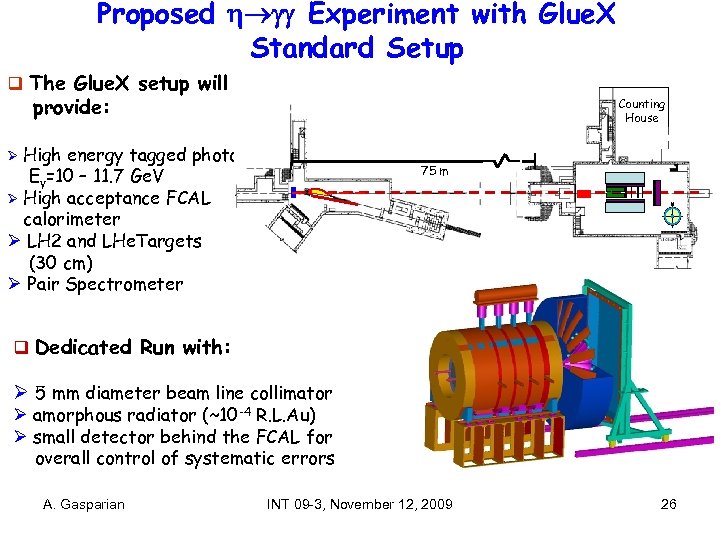
Proposed Experiment with Glue. X Standard Setup q The Glue. X setup will provide: Counting House Ø High energy tagged photon beam Eγ=10 – 11. 7 Ge. V Ø High acceptance FCAL calorimeter Ø LH 2 and LHe. Targets (30 cm) Ø Pair Spectrometer 75 m q Dedicated Run with: Ø 5 mm diameter beam line collimator Ø amorphous radiator (~10 -4 R. L. Au) Ø small detector behind the FCAL for overall control of systematic errors A. Gasparian INT 09 -3, November 12, 2009 26
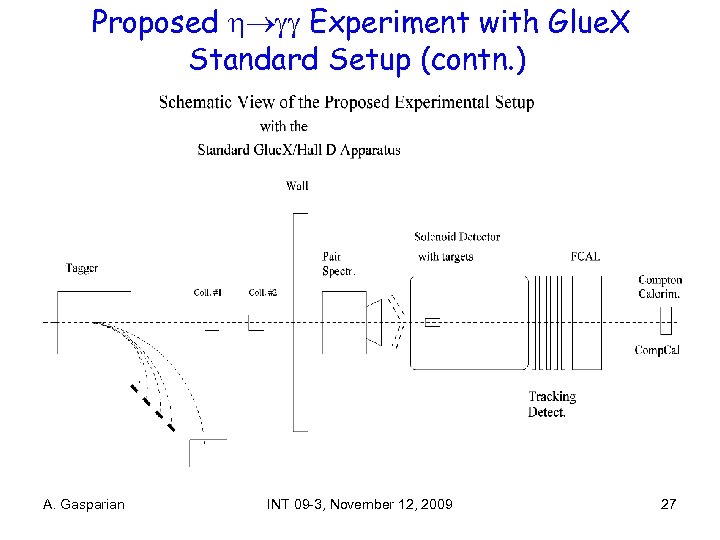
Proposed Experiment with Glue. X Standard Setup (contn. ) A. Gasparian INT 09 -3, November 12, 2009 27
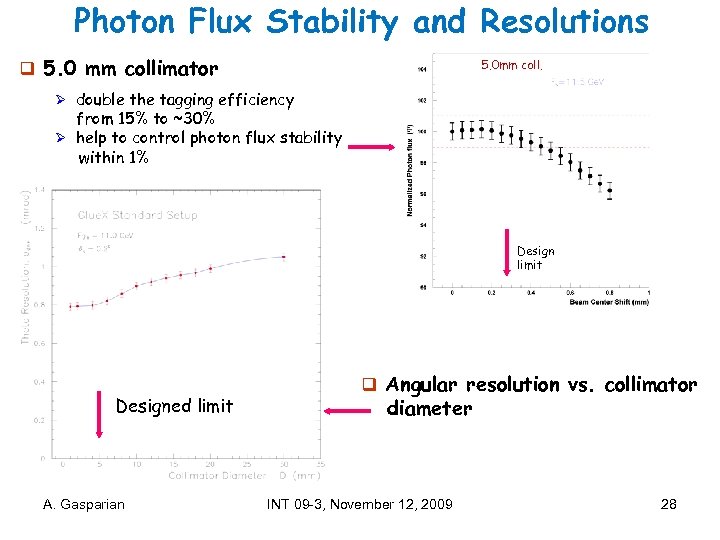
Photon Flux Stability and Resolutions q 5. 0 mm collimator 5. 0 mm coll. Ø double the tagging efficiency from 15% to ~30% Ø help to control photon flux stability within 1% Design limit Designed limit A. Gasparian q Angular resolution vs. collimator diameter INT 09 -3, November 12, 2009 28
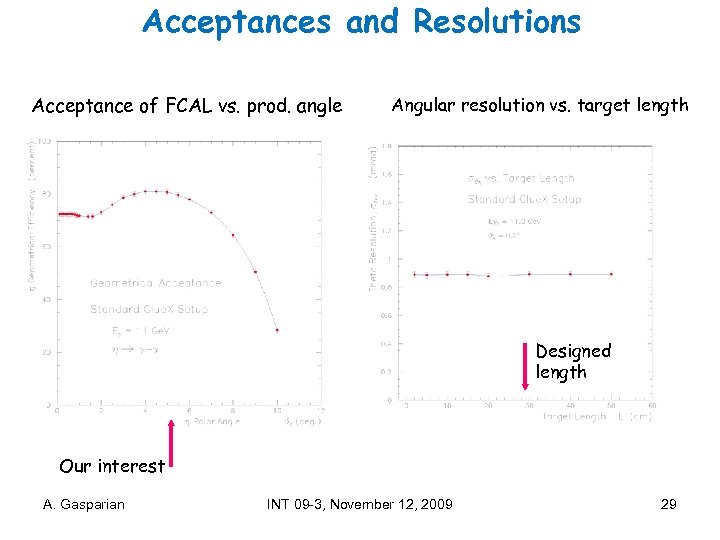
Acceptances and Resolutions Acceptance of FCAL vs. prod. angle Angular resolution vs. target length Designed length Our interest A. Gasparian INT 09 -3, November 12, 2009 29
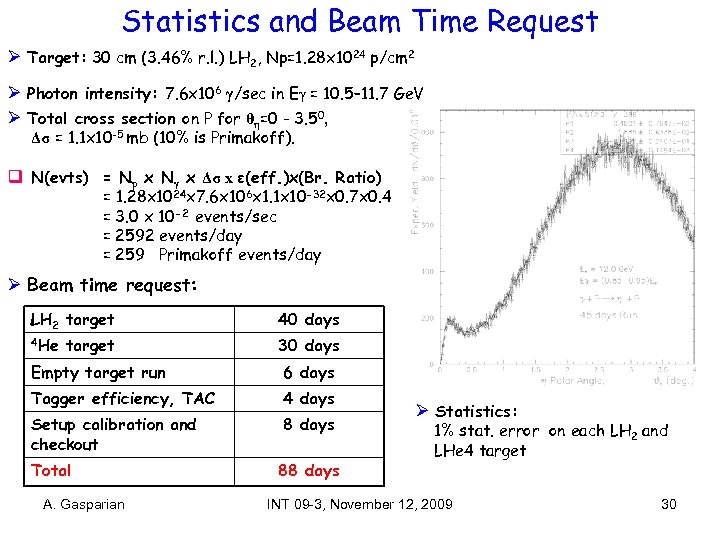
Statistics and Beam Time Request Ø Target: 30 cm (3. 46% r. l. ) LH 2, Np=1. 28 x 1024 p/cm 2 Ø Photon intensity: 7. 6 x 10⁶ γ/sec in Eγ = 10. 5– 11. 7 Ge. V Ø Total cross section on P for θη=0 - 3. 50, Δσ = 1. 1 x 10 -5 mb (10% is Primakoff). q N(evts) = Np x Nγ x Δσ x ε(eff. )x(Br. Ratio) = 1. 28 x 1024 x 7. 6 x 106 x 1. 1 x 10 -32 x 0. 7 x 0. 4 = 3. 0 x 10 -2 events/sec = 2592 events/day = 259 Primakoff events/day Ø Beam time request: LH 2 target 40 days 4 He 30 days target Empty target run 6 days Tagger efficiency, TAC 4 days Setup calibration and checkout 8 days Total A. Gasparian 88 days Ø Statistics: 1% stat. error on each LH 2 and LHe 4 target INT 09 -3, November 12, 2009 30
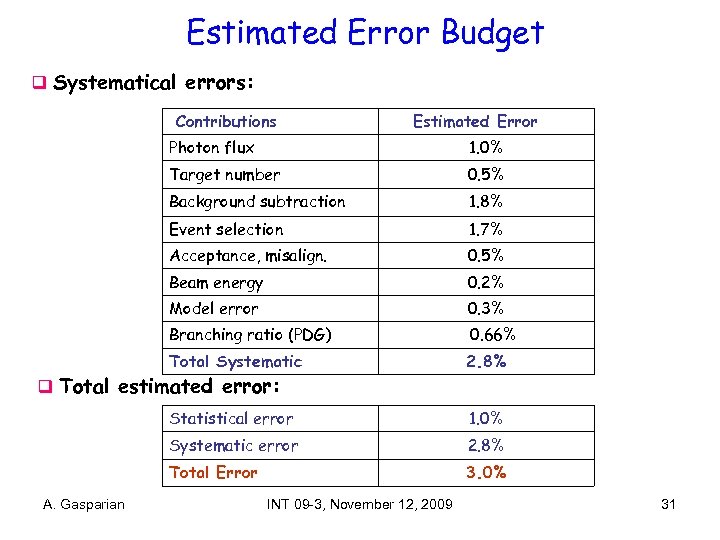
Estimated Error Budget q Systematical errors: Contributions Estimated Error Photon flux 1. 0% Target number 0. 5% Background subtraction 1. 8% Event selection 1. 7% Acceptance, misalign. 0. 5% Beam energy 0. 2% Model error 0. 3% Branching ratio (PDG) 0. 66% Total Systematic 2. 8% Statistical error 1. 0% Systematic error 2. 8% Total Error 3. 0% q Total estimated error: A. Gasparian INT 09 -3, November 12, 2009 31
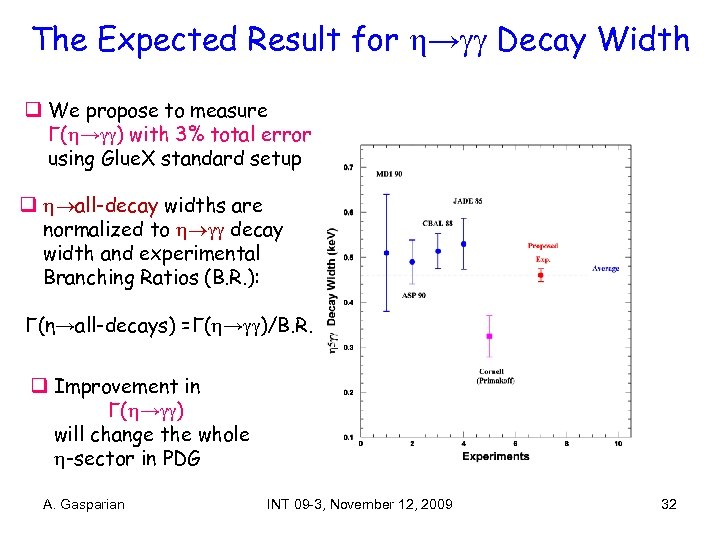
The Expected Result for → Decay Width q We propose to measure Γ( → ) with 3% total error using Glue. X standard setup q all-decay widths are normalized to decay width and experimental Branching Ratios (B. R. ): Γ(η→all-decays) =Γ( → )/B. R. q Improvement in Γ( → ) will change the whole -sector in PDG A. Gasparian INT 09 -3, November 12, 2009 32
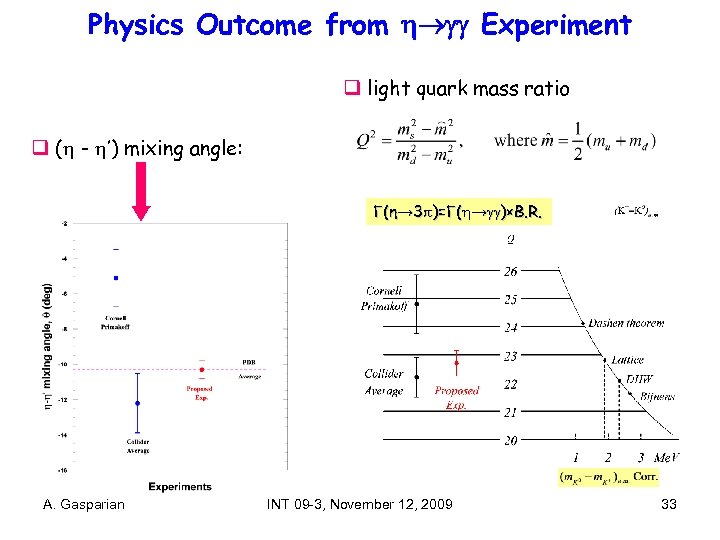
Physics Outcome from Experiment q light quark mass ratio q ( - ’) mixing angle: Γ(η→ 3 )=Γ( → )×B. R. A. Gasparian INT 09 -3, November 12, 2009 33
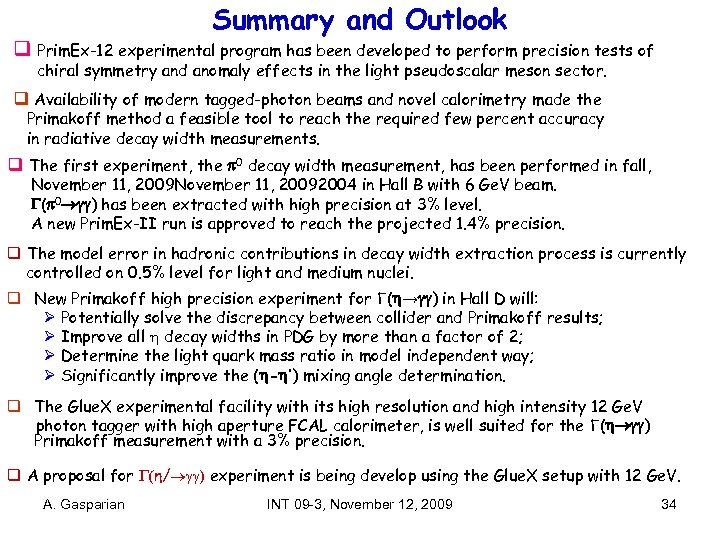
Summary and Outlook q Prim. Ex-12 experimental program has been developed to perform precision tests of chiral symmetry and anomaly effects in the light pseudoscalar meson sector. q Availability of modern tagged-photon beams and novel calorimetry made the Primakoff method a feasible tool to reach the required few percent accuracy in radiative decay width measurements. q The first experiment, the 0 decay width measurement, has been performed in fall, November 11, 20092004 in Hall B with 6 Ge. V beam. ( 0 ) has been extracted with high precision at 3% level. A new Prim. Ex-II run is approved to reach the projected 1. 4% precision. q The model error in hadronic contributions in decay width extraction process is currently controlled on 0. 5% level for light and medium nuclei. q New Primakoff high precision experiment for Г( → ) in Hall D will: Ø Potentially solve the discrepancy between collider and Primakoff results; Ø Improve all decay widths in PDG by more than a factor of 2; Ø Determine the light quark mass ratio in model independent way; Ø Significantly improve the ( - ’) mixing angle determination. q The Glue. X experimental facility with its high resolution and high intensity 12 Ge. V photon tagger with high aperture FCAL calorimeter, is well suited for the Г( ) Primakoff measurement with a 3% precision. q A proposal for η/ experiment is being develop using the Glue. X setup with 12 Ge. V. A. Gasparian INT 09 -3, November 12, 2009 34

The End A. Gasparian INT 09 -3, November 12, 2009 35
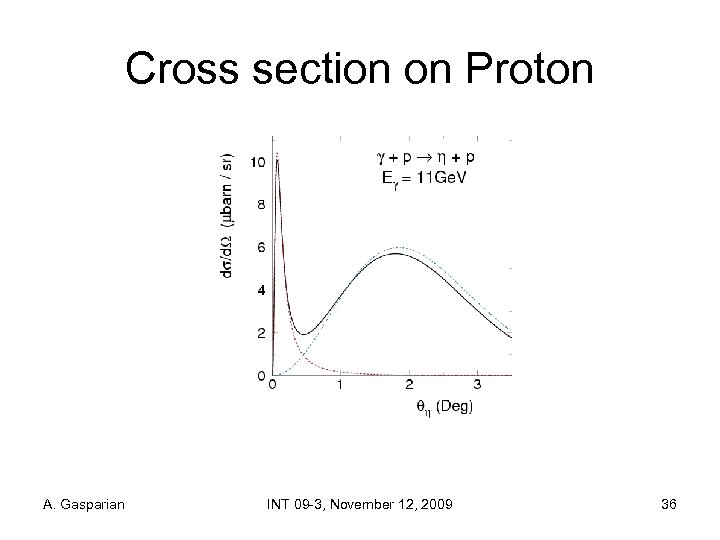
Cross section on Proton A. Gasparian INT 09 -3, November 12, 2009 36
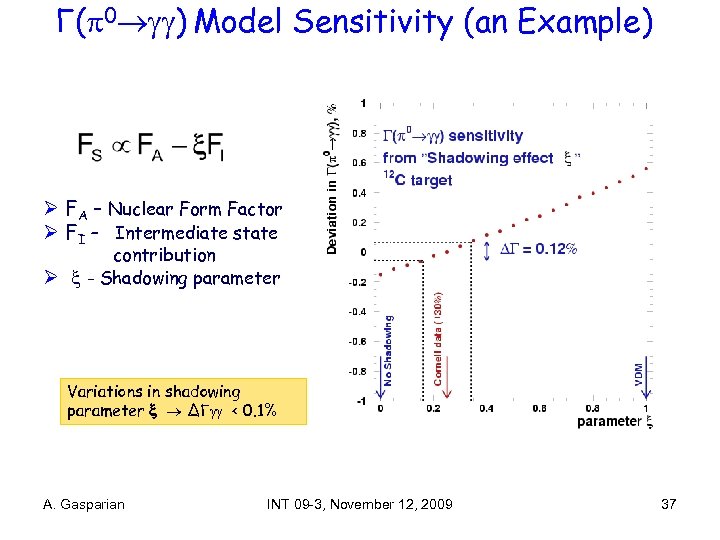
Γ( 0 ) Model Sensitivity (an Example) Ø FA – Nuclear Form Factor Ø FI – Intermediate state contribution Ø - Shadowing parameter Variations in shadowing parameter x ΔΓ < 0. 1% A. Gasparian INT 09 -3, November 12, 2009 37
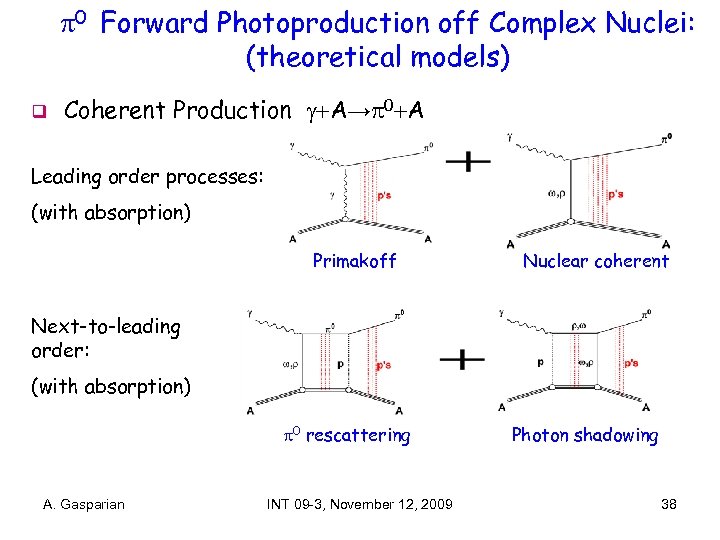
0 Forward Photoproduction off Complex Nuclei: (theoretical models) q Coherent Production A→ 0 A Leading order processes: (with absorption) Primakoff Nuclear coherent Next-to-leading order: (with absorption) 0 rescattering A. Gasparian INT 09 -3, November 12, 2009 Photon shadowing 38
Скачать презентацию Precision Measurements of Electromagnetic Properties of 0 η
59c8c5221b79a5a88b131155b6c163c8.ppt