 Скачать презентацию PRE-PROPOSAL CONFERENCE December 13 2013 10 30 AM
652e5bcf94ab108d5db621a8e9c1d191.ppt
- Количество слайдов: 55



PRE-PROPOSAL CONFERENCE December 13, 2013 10: 30 AM NYMTC’s Offices 199 Water Street, 22 nd Floor, New York, NY 10038 REQUEST FOR PROPOSALS: NEW YORK BEST PRACTICE MODEL 2012 BASE YEAR UPDATE CONTRACT No. : C 000791 1
PRE-PROPOSAL CONFERENCE AGENDA • Introductions, Housekeeping • Review of Solicitation: • - Ali Mohseni, NYMTC, Project Manager – Ismet Apdiroglu, NYMTC Contract Liaison – Shalendra Ramadhin, NYMTC Contract Staff – Al Hasenkopf, NYSDOT Contract Management • Project Background & Purpose • Project Scope & General Conditions 2
CONFERENCE AGENDA (Cont'd) • Technical Proposal Instructions • Cost & Contract Proposal Instructions • Evaluation Criteria • Administrative Specifications • Review of NYSDOT Consultant Selection Process Best Value Schedule • Questions & Answers 3
Project Purpose • Retain a Qualified consultant for development of the next generation of its Activity Based Travel Demand Model, NYBPM • The resulting model should be as capable or better at performing all tasks performed by NYBPM including: § § § Highway alternatives analysis Transit FTA-compliant alternatives analysis Air Quality Conformity demonstrations Long range planning Member agencies transportation analysis Applicability/Compatibility
Project Purpose • Improve NYMTC’s ability to perform innovative analysis such as: § § Planning and implementation of Road pricing studies Analysis of transportation related Air Quality impacts Analysis of non-motorized transportation Analysis of transportation responses to energy market changes
Project Objective NYMTC’s overall goal for model improvement is to continuously maintain and apply a model that is representative of the state of the practice in travel demand forecasting and provides the MPO, its policy board, and local jurisdictions the support that is needed for informed decision making in a complex region.
NYBPM Background • Developed and unveiled at TRB conference on January 2002, Base year was 1996 • One of the first Activity Based Model ever developed in the US • The first Activity Based Model ever used for conformity process.
Background Highlights of NYBPM • Journey-based model • Micro-Simulation choice models • Population synthesis and intra-household travel interactions • Comprehensive coverage of all modes • Mode-Destination Choice (nested logit) • Stop frequency and location sub-model • Full multi-modal analysis / assignment 8
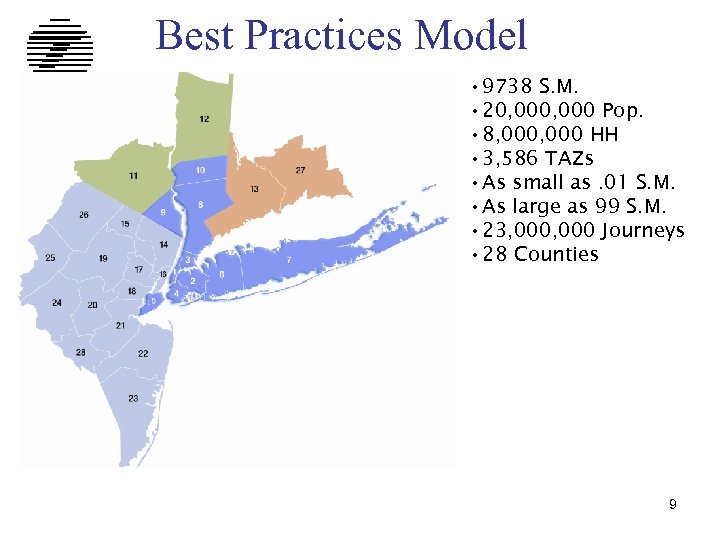
Best Practices Model • 9738 S. M. • 20, 000 Pop. • 8, 000 HH • 3, 586 TAZs • As small as. 01 S. M. • As large as 99 S. M. • 23, 000 Journeys • 28 Counties 9
BPM 2002 Base Update (2004 -2005) • Update of the data bases that support the BPM, from original Base Year 1996 to Base Year 2002 set. • Revisions to highway and Transit networks • Modification of several BPM application procedures • Calibration of BPM to a base Year 2002 • Improvements to the Post-processing procedures used for air quality analysis
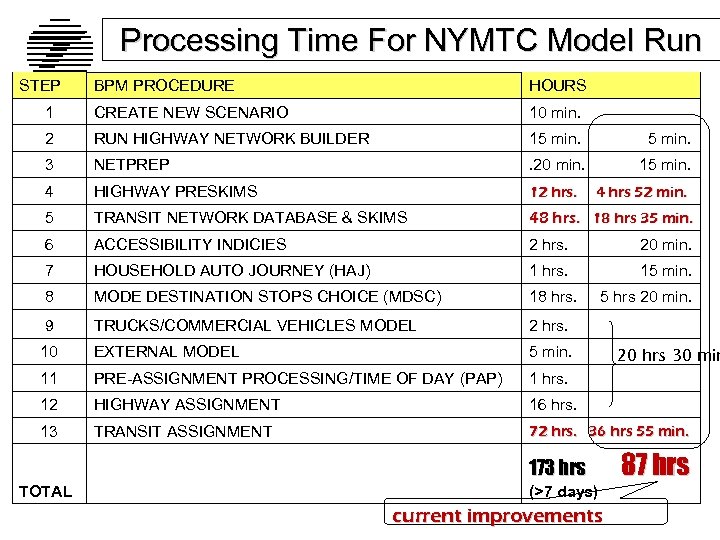
Processing Time For NYMTC Model Run STEP BPM PROCEDURE HOURS 1 CREATE NEW SCENARIO 10 min. 2 RUN HIGHWAY NETWORK BUILDER 15 min. 5 min. 3 NETPREP . 20 min. 15 min. 4 HIGHWAY PRESKIMS 12 hrs. 5 TRANSIT NETWORK DATABASE & SKIMS 48 hrs. 18 hrs 35 min. 6 ACCESSIBILITY INDICIES 2 hrs. 20 min. 7 HOUSEHOLD AUTO JOURNEY (HAJ) 1 hrs. 15 min. 8 MODE DESTINATION STOPS CHOICE (MDSC) 18 hrs. 5 hrs 20 min. 9 TRUCKS/COMMERCIAL VEHICLES MODEL 2 hrs. 10 EXTERNAL MODEL 5 min. 11 PRE-ASSIGNMENT PROCESSING/TIME OF DAY (PAP) 1 hrs. 12 HIGHWAY ASSIGNMENT 16 hrs. 13 TRANSIT ASSIGNMENT 72 hrs. 36 hrs 55 min. 4 hrs 52 min. 173 hrs TOTAL 20 hrs 30 min 87 hrs (>7 days) (4 days) current improvements
NYBPM 2005 Base Update (2008 -2009) • • Update of BPM data Update of BPM networks Update of Transit Service and network Improvement of External Forecasting method • Modification of procedures • Re-calibration • Validation
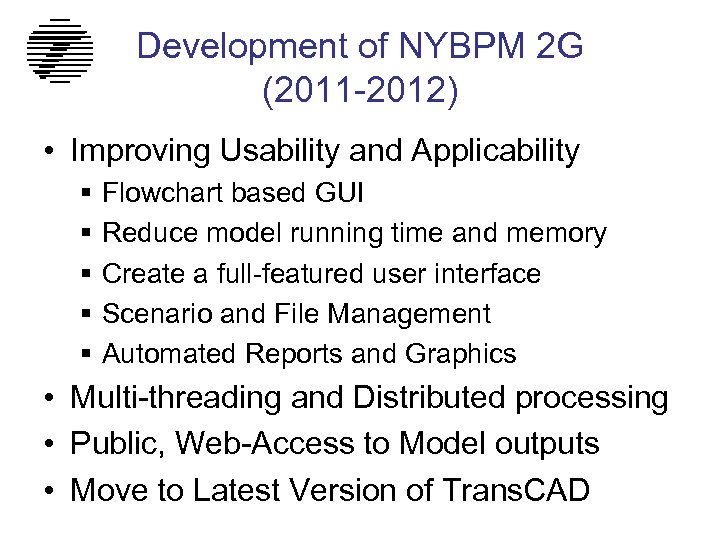
Development of NYBPM 2 G (2011 -2012) • Improving Usability and Applicability § § § Flowchart based GUI Reduce model running time and memory Create a full-featured user interface Scenario and File Management Automated Reports and Graphics • Multi-threading and Distributed processing • Public, Web-Access to Model outputs • Move to Latest Version of Trans. CAD
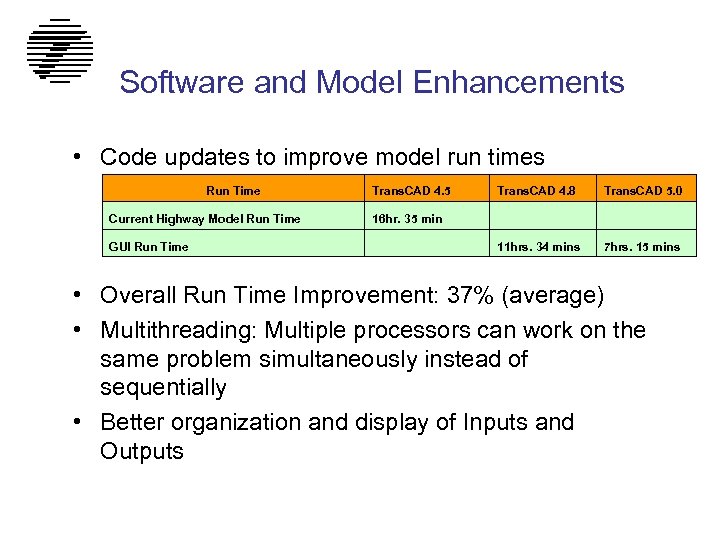
Software and Model Enhancements • Code updates to improve model run times Run Time Trans. CAD 4. 5 Trans. CAD 4. 8 Trans. CAD 5. 0 Current Highway Model Run Time 16 hr. 35 min GUI Run Time 11 hrs. 34 mins 7 hrs. 15 mins • Overall Run Time Improvement: 37% (average) • Multithreading: Multiple processors can work on the same problem simultaneously instead of sequentially • Better organization and display of Inputs and Outputs
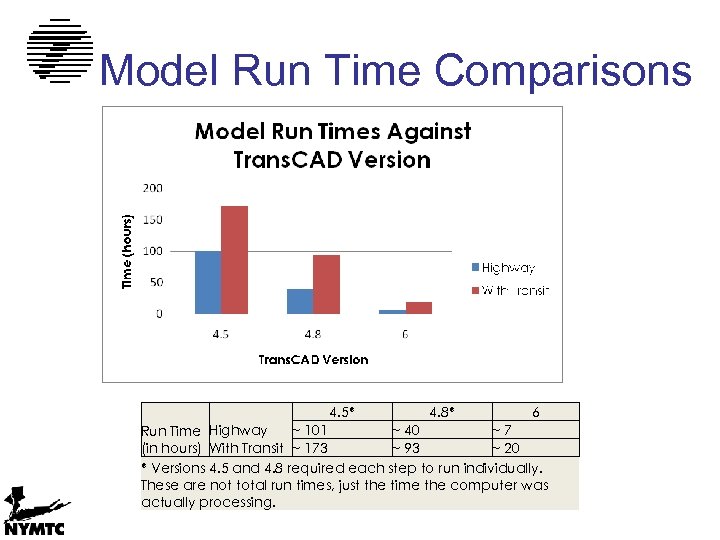
Model Run Time Comparisons 4. 5* 4. 8* 6 ~ 101 ~ 40 ~7 Run Time Highway (in hours) With Transit ~ 173 ~ 93 ~ 20 * Versions 4. 5 and 4. 8 required each step to run individually. These are not total run times, just the time the computer was actually processing.
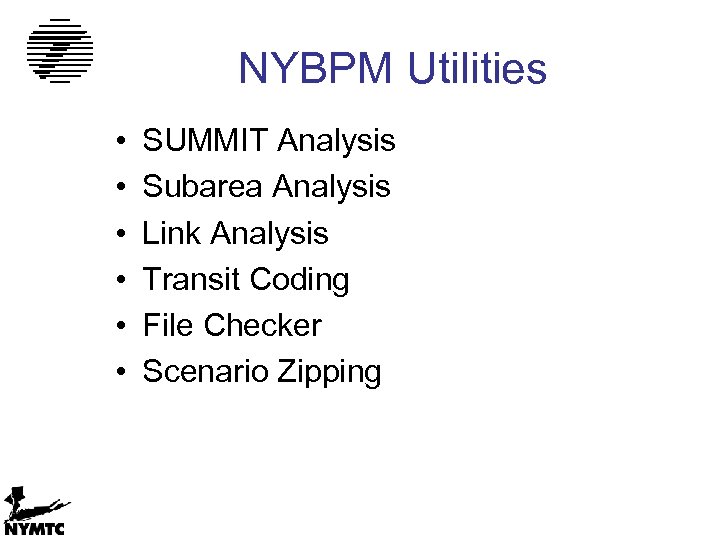
NYBPM Utilities • • • SUMMIT Analysis Subarea Analysis Link Analysis Transit Coding File Checker Scenario Zipping
Automatic Reporting System • Automatic Report Generation § One click access to each report § Creates a spreadsheet and pdf file for distribution • Automatic Interactive GIS Maps § One click access to each map § Easily save maps to pdf for distribution § Allows for instant analysis
Report Generation Type of Reports Available: Network/Flow Results Demographics HAJ Results MDC Results Highway OD Trip Matrices Highway Trip Length Distributions Highway Assignment Comparisons Transit OD Trip Matrices Transit Trip Length Distributions Transit Flows
Other Improvements and Related Tools Implementation of FTA New Starts Analysis Capabilities with NYBPM Implementation of Feedback and Convergence Criteria for NYBPM
NYBPM 2010 Base Update • Incorporating the 2010 Zonal Level SED data • Update of Screenline Traffic Counts § Compile available traffic volume sources § Review available traffic volume sources § Reconcile the 2010 BPM highway network with the 2010 screenline database to account for new highway links that cross the various screenlines. § Update the BPM screenline database
NYBPM 2010 Base Update • • Update Vehicle Class Counts Update Transit Counts Update Highway and Transit networks Update Cost inputs Update transit fares to 2010 Rail service Update to Current (2010) Bus network and service updated to current (2010)
NYBPM 2010 Base Update • Restructuring and modification of procedures § Trip table results by purpose in addition to the results by mode § Ability to run the MDSC by individual purpose or combination of purposes § Ability to calibrate the model at a finer level (district level) § Development of scenario/file management system for transit coding § Incorporating the ITS project coding and scenario/file management system into GUI for the NYBPM § Review of FTA forecasting guidelines to improve consistency and compatibility of the BPM with FTA New Starts program
NYBPM 2010 Base Update • Model Refinements: Update Truck and Commercial Vehicle Model • Recalibration and validation – Targets § Updated traffic counts § Hub-bound volumes by mode and time of day § Trans-Hudson Calibration data § Census 2010 § ACS data § RHTS – Re-weighted to 2010 Households.
NYBPM 2012 Base Update Scope of Work Project Tasks • Task 1: Coordination, Administrative Structure and Meeting • Task 2: Identification of Recommended Model Improvement • Task 3: Project Management and Work Plan • Task 4: Identification of Data Needs and Available Data Resources • Task 5: SED Zonal level (Base Year & Future Years) • Task 6: Update Screenline Traffic Counts
Scope of Work Project Tasks • Task 7: Update Vehicle Class Counts • Task 8: Update Transit Counts • Task 9: Base Year Highway Corrections and Improvements • Task 10: Highway Network Update-Truck Routes • Task 11: Update NYBPM Costs Inputs, including Tolls, to 2012 • Task 12: Transit Network Update
Scope of Work Project Tasks • Task 13: Bus network and Service Updated to 2012 condition • Task 14: Update Transit Fares to 2012 • Task 15: Restructure/ Modify Specified NYBPM Procedures • Task 16: Model Refinements: Update Truck and Commercial Vehicle Model • Task 17: NYBPM Re-Estimation • Task 18: Model Calibration
Scope of Work Project Tasks • Task 19: Model Delivery, Acceptance Testing and Reasonableness Checking • Task 20: General Report – Base Year 2012 • Task 21: User Documentation, Training and Support
Required Model Components • Maintain an open infrastructure for potential improvements through a modular structure with the ability to turn on/off and add components, and to address the NYMTC region’s special modeling needs • Update all available transportation system elements within the 28 -county model study area, including streets and highways, transit routes and stops, park & ride facilities, off-street parking facilities, and major trip generations/attractions
Desired Model Components • Incorporate new approaches to transportation networks to support more robust and efficient mode choice and multimodal network assignments, e. g. : § Integrate road and transit networks on the same base map and link them, so that interactions between autos and transit can be more easily captured; § Provide a region-wide non-motorized network;
Desired Model Components • Incorporate advanced programming techniques to utilize computer processing power as well as new logics in order to expedite the modeling process and improve operational efficiencies and reduce run times. • Create an additional level of Micro Analysis Zones (MAZ) to the standard Traffic Analysis Zones (TAZs), to allow for trips to be broken down more readily to activity locations;
Desired Model Components • Implement “planning-level” Dynamic Traffic Assignment (DTA) procedures with a 1 -hour resolution, and/or improved capabilities to use NYBPM to support external meso- and microscopic traffic simulation models; • Improve the Population Synthesis model to include household and person control as well as flexible geography;
Desired Model Components • Improve the Long-Term Choice Model to include occupation, usual place of employment/or school location, transit pass and E-ZPass ownership, driver’s license, auto ownership and free parking eligibility for people whose usual place of employment is in the Central Business District (CBD); • Incorporate an advanced Daily Activity Pattern (DAP) model to provide better intra-household interactions travel decisions, as well as trip substitution options such as telecommuting and on -line shopping;
Desired Model Components • Incorporate new components into the mode choice process such as accessibility , reliability, flexibility, desirability, occupancy, and surrounding environment along with density; • Develop a realistic destination choice model by time-ofday pattern by: § Including findings from NYMTC’s Establishment Survey § Enriching the set of explanatory variables describing activity locations § Improving multi-modal accessibility measures, specifically accounting for non-linear time, cost, and distance effects § Improving the model design through enhanced calibration and validation techniques; •
Desired Model Components • Improve pricing elements to include various pricing schemes, and taking into account variables such as growth, inflation, gas price, toll scenarios, dynamic priced lanes, and congestion pricing; • Improve the model’s procedures forecasting commercial vehicle activity, e. g. explicit incorporation of freight and logistic activity into the model or adoption of NJTPA’s new freight forecasting methodology;
Desired Model Components • Create a non-resident/visitor sub model; and • Develop procedures for integrating output from a separate airport ground access model, including creation of a special class for air passengers, and integration of airport mode choice model results into NYBPM’s highway and transit assignment procedures.
Desired Model Components • Protocols shall be proposed for maintenance and updates. The software interface, protocols for updates and maintenance procedures should be standardized before or in the process of the model development.
At the conclusion… • NYMTC expects to have an advanced ABM which is fully vetted and capable for use as a forecasting and planning tool without further testing. • Two back-casting exercises should be conducted. • Sensitivity testing will also be done, including checks of the effect of transit fare, highway tolls, and other changes. • Two future year scenarios will also be conducted and the results compared against the most up to date version of NYBPM.
Contract Objectives • Contract Term: 3 Year Base Term, with Two Optional 1 Year Extension Lump sum milestone-type payment method. • Level of Effort: Equivalent of 10 -14 fully loaded staff years of effort to complete 38
DBE PARTICIPATION • • • DBE Participation Goal: 18% of Budget Otherwise, proof of Good Faith Effort Subconsultants Only No WBE, No MBE, No Primes ID Firms, % Participation, DBE Cert https: //www. nysdot. gov/portal/page/portal/ main/business-center/civil-rights 39
PART I INSTRUCTIONS: TECHNICAL PROPOSAL • OVERALL: Title Page Table of Contents FOIL • Suggested Sections 1. EXECUTIVE SUMMARY & NARRATIVE 2. APPROACH & SCOPE OF SERVICES 3. ORGANIZATION & STAFFING 4. EXPERIENCE OF PROPOSED PERSONNEL 5. Complete Offeror’s Proposal Traceability to Requirements 40
TECHNICAL PROPOSAL (PART I INSTRUCTIONS - Cont'd) ORGANIZATION • Legible Organizational Chart for the Project • Staffing Table With Hours By Task (No Rates) Table A-1 • Resumes for all Key Personnel • Experience of Proposing Firm(s) • List of Prior or Current Relevant Project Experience • Reference or Experience Verification Contact Information • Subconsultant Arrangement(s), If Any 41
PART II INSTRUCTIONS COST & CONTRACT SUBMITTAL • COST PROPOSAL (3 YEARS): – SALARIES: Labor only Hourly Rates (Table A-2 with Rates) Include Estimated Budget Table Direct Technical Salaries, Overhead, Subs. & Fee Total Cost for Entire Project Direct Non-Salary Costs: Estimate (travel expenses per DOT website, similar to Federal rates) – Method of Payment Lump Sum Milestones- Propose milestone payment schedule. Include separate draft and final reports. Actual to be negotiated. 42
COST & CONTRACT SUBMITTAL PART II INSTRUCTIONS (Cont’d) • Statement of ACCEPTANCE of ALL TERMS AND CONDITIONS In Contract Proposal (exceptions in cover letter) • Accept Questions During Q&A (deadline) • DBE Status and Percentage of total labor • Consultant Identification Number (CIN) and SFS Vendor ID Number if known • Procurement Lobbying Law Compliance • Consultant Employment Disclosure Legislation 43
PROPOSAL EVALUATION • PART I - TECHNICAL AND MANAGEMENT: Point Scored – 60 Technical + 10 Technical Interviews Clarification questions Evaluation Factors: 1. General Technical and Management Submittal (60 Points) Experience of Proposed Personnel Firm Experience Quality of Proposal Approach and Scope of Services Organization and Staffing 44
PROPOSAL EVALUATION (Cont'd) • PART II - Cost Proposal: • Point Scored – 30 Points • Lowest Cost Proposal Receives Perfected Score of 30 • Proposals with Higher Costs Receive Proportionally Lower Scores 45
PROPOSAL EVALUATION (Cont'd) Technical Interview - 10 Points • Short-listed Firms Only • Proposal Overview • Bring Consultant Project Manager + Necessary Key Personnel 46
PROPOSAL EVALUATION (Cont'd) DBE Participation 18% requested or Good Faith Effort Documentation - Failure to meet requirements may result in it being deemed non-responsive • Federal DBE Program • No W/MBE or Prime DBE Credit • https: //www. nysdot. gov/portal/page/portal/main/busi ness-center/civil-rights 47
ADMINISTRATIVE SPECIFICATIONS • PROPOSAL SUBMISSION (due July 24, 2013) – 10 Copies of Part I. Send 7 copies to NYMTC; send 3 reference copies to NYSDOT Contracts; – Three (3) Copies of PART II (2 copies to NYSDOT Contracts; 1 copy to NYMTC – Signature by AUTHORIZED INDIVIDUAL – Required 365 -Day FIRM OFFER (Minimum) – two read-only softcopies on CD in MS Office 2003 compatible format or Adobe pdf format (1 each to NYMTC and NYSDOT Contracts) 48
ADMINISTRATIVE SPECs (Cont’d) • PROPOSAL EVALUATION – Technical Evaluation By Committee: Questions & Answers Technical Interviews Best & Final Offers (optional) – Cost Evaluation 49
ADMINISTRATIVE SPECs (Cont’d) • State’s Rights • Must Provide VENDOR RESPONSIBILITY Information (Before Designation for Award) • Contractor Tax Certification (ST-220 -CA & ST-220 -TD: Submit Prior to Negotiations) • Notification of Award • Method of Payment (Monthly Reimbursement) • Inquiries & Information 50
QUESTIONS & INQUIRIES All Questions Concerning This Solicitation Must Be Directed ONLY to: Mr. l. SMET APDIROGLU of NYMTC Phone: (212) 383 -2414 E-Mail: ismet. apdiroglu@dot. ny. gov - Or – Mr. Al Hasenkopf of NYSDOT Office of Contract Management Phone: (518) 457 -2600 E-Mail: alfred. hasenkopf@dot. ny. gov • Last Date to Submit Written Questions: January 14, 2014 • All Letter Inquiries Addressed To: NEW YORK METROPOLITAN TRANSPORTATION COUNCIL (NYMTC) 199 Water Street, 22 nd Floor New York, NY 10038 -3534 ATTENTION: Mr. ISMET APDIROGLU Contract C 000789 51
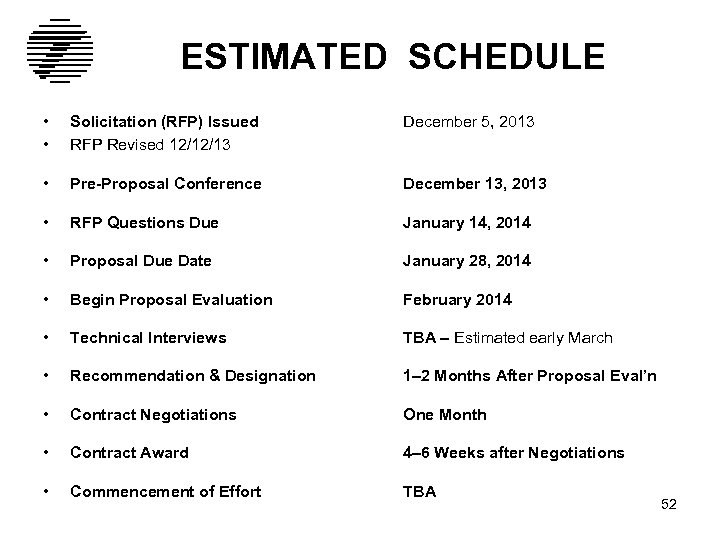
ESTIMATED SCHEDULE • • Solicitation (RFP) Issued RFP Revised 12/12/13 December 5, 2013 • Pre-Proposal Conference December 13, 2013 • RFP Questions Due January 14, 2014 • Proposal Due Date January 28, 2014 • Begin Proposal Evaluation February 2014 • Technical Interviews TBA – Estimated early March • Recommendation & Designation 1– 2 Months After Proposal Eval’n • Contract Negotiations One Month • Contract Award 4– 6 Weeks after Negotiations • Commencement of Effort TBA 52
QUESTIONS? • Written answers to all questions received shall be sent to all interested firms in RFP Modification Number 1 • We request an email repeating questions asked during the pre-proposal conference • Modification Number 1 to be released shortly after close of Q&A period. 53
Email • All are requested to send an email to facilitate communications to: • ismet. apdiroglu@dot. ny. gov • Copy to: alfred. hasenkopf@dot. ny. gov 54

THANK YOU! 55
Скачать презентацию PRE-PROPOSAL CONFERENCE December 13 2013 10 30 AM
652e5bcf94ab108d5db621a8e9c1d191.ppt