


 Скачать презентацию Pre-curriculum Review Advisory Committee Report Suzanne Allen MD
e65befee2a2d33ac093a581937c826e4.ppt
- Количество слайдов: 22
 Pre-curriculum Review Advisory Committee Report Suzanne Allen, MD, MPH Michael Ryan, MD
 Overview Background Process Findings Recommendations Next steps
 Background Successful LCME accreditation June 2010 Last curriculum review 1998 -2001 Expansion of class size for workforce needs Pre-curriculum review advisory committee charged September 2010 Curricular strengths and areas for improvement Approaches to expand class size Engage with all constituents across the region Develop rationale and proposed approach to a curriculum review
 Committee Members Co-Chairs: Suzanne Allen, M. D. , M. P. H. , Vice Dean for Regional Affairs Michael J. Ryan, M. D. , Associate Dean for Curriculum Committee Members: David Acosta, M. D. , Associate Dean for Multicultural Affairs Daniel Benedetti, Fourth-year medical student Courtney Boulton, Fourth-year medical student Jan Carline, Ph. D. , Professor, Medical Education & Biomedical Informatics Kellie Engle, Program Operations Manager, Regional Affairs Yogesh Khanal, Fourth-year medical student Dennis Kirby, Fourth-year medical student Andrew Luks, M. D. , Assistant Professor, Medicine Ramoncita Maestas, M. D. , Associate Professor, Family Medicine Kathleen Mulligan, Ph. D. , Senior Lecturer, Biological Structure Kenneth Roberts, Ph. D. , Assistant Dean, WWAMI-Spokane Lorna Shanks, Fourth-year medical student Roger Tatum, M. D. , Associate Professor, Surgery Marjorie Wenrich, Chief of Staff, UW Medicine Mark Whipple, M. D. , Associate Professor, Otolaryngology-Head & Neck Surgery
 Information Reviewed Past curriculum reviews Current curriculum Curricula at other medical schools Current literature on curricula in medical schools LCME self-study AAMC graduation study results Internal end-of-year program evaluation USMLE Step 1 and Step 2 Board scores
 Meetings Held Curriculum committees Educational leaders Educational program leaders Teaching faculty: basic science and clinical region-wide Medical students Community physicians and leaders Residency program directors Medical school finance administrators Technology specialists ISIS leadership Other health science disciplines UW Medicine senior leaders Town Hall and open forum meetings Catalyst website
 Findings Strengths: ICM course/Colleges program/mentoring Small classes/unique opportunities at 1 st year sites The few current active learning/small groups in 2 nd year classes Diversity and quality of clinical offerings across the region Dedicated and enthusiastic faculty Many opportunities for unique, rural learning
 Findings Areas identified for improvement: Governance Large, growing content without clear mechanisms to decrease content Departmentally based curricula do not foster integration of basic science and clinical, horizontally or vertically Lack of flexibility in the curriculum to adapt to changes Decline in USMLE Step 1 scores Inadequate standardization across regional sites Reliance on lecture-based instruction
 Findings Areas identified for improvement: Insufficient instruction in critical thinking and evaluation of the medical literature Insufficient emphasis on life-long learning Emphasis on memorization instead of clinical thinking Insufficient instruction in biomedical informatics and population-based medicine Lack of opportunities for career exploration
 Findings Areas identified for improvement: Insufficient time carved out for faculty to teach and lack of acknowledgement of teaching as core activity Difficulty in attracting and retaining clinical community teaching sites due to clinical productivity demands Insufficient attention to the continuum of education from pre-med to practice Continued need for physician workforce development
 Applicants comments who declined admission to UWSOM “I decided to go to Columbia University because I was accepted into the Columbia. Bassett program--a new program that focuses on longitudinal care…. Plus, I really liked the 18 -month curriculum at Columbia, which gets me into clinicals earlier. ”
 Applicants comments who declined admissions to UWSOM “Strengths of UCSF include …. systems based curriculum, pass/fail for 2 years, more small group work, emphasis on early clinical experience, and more innovative and adaptive curriculum. ”
 Applicants comments who declined admissions to UWSOM “UCLA has a non-traditional curriculum with a systems-based approach, PBL and doctoring minimizing the number of hours spent in a lecture hall to 2 hours/day. This was a HUGE difference when compared to the traditional curriculum that UW has and was one of the major factors influencing my decision. ”
 Applicant comments who declined admissions to UWSOM “I did not like the curriculum at the University of Washington. I am an active learner and I felt that the curriculum had too much lecture time. Also, I prefer curriculum that are more integrated and after talking to students the curriculum at the UW is not that integrated. ”
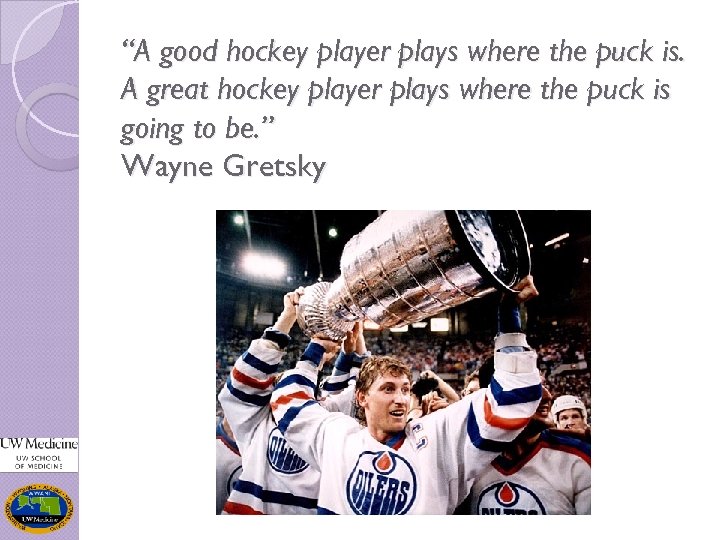 “A good hockey player plays where the puck is. A great hockey player plays where the puck is going to be. ” Wayne Gretsky
 Time for change Explosion of medical and scientific information Explosion of information technology Enhanced patient knowledge and understanding Generational characteristics of students Changes in learning styles National movement to active learning modalities Changes in the roles of physicians in rapidly evolving healthcare system
 Areas for change Increase active learning Increase curricular flexibility Integrate the curriculum vertically and horizontally Allow students to individualize their training Integrate critical thinking, information management, techniques for lifelong learning throughout the curriculum
 Specific Recommendations Continuous curriculum improvement process Governance structure Convene a “visioning committee” Develop and define the “product” i. e. overarching curricular goals, objectives and outcomes Adjust and redesign the curriculum to meet these goals, objectives and outcomes Improve USMLE Step 1 and 2 scores to increase successful residency matches for students
 Specific Recommendations Focus on continuum of education and lifelong learning Maintain focus on contextual learning opportunities and needs through horizontal and vertical integration Incorporate new training foci and modalities into the curriculum, including simulation, IPE, information management Support faculty through faculty development, funding, sufficient time for teaching and acknowledgement of value of teaching and curriculum involvement
 Specific Recommendations Continue working to meet workforce needs across the WWAMI region Expand class size to help meet workforce needs Will require all of basic sciences to be taught in the region
 Next Steps Share findings and recommendations Charge and appoint the visioning committee Establish interactive web site for ongoing curriculum improvement and communication Pilot teaching all of the basic sciences in the region
 Questions?