


 Скачать презентацию Pre-Calculus Day 12 Graphs of a Special Polynomial
f93a449e900d1c230df1093f4ae97c40.ppt
- Количество слайдов: 22
 Pre-Calculus Day 12 Graphs of a Special Polynomial Functionthe Quadratic
 Review Homework Introduction to Polynomials Quadratics (a special polynomial) Homework Plan for the Day 2
 • Analyze graphs of quadratic functions. • Write quadratic functions in standard form and use the results to sketch graphs of functions. • Find minimum and maximum values of quadratic functions in real-life applications. What You Should Learn
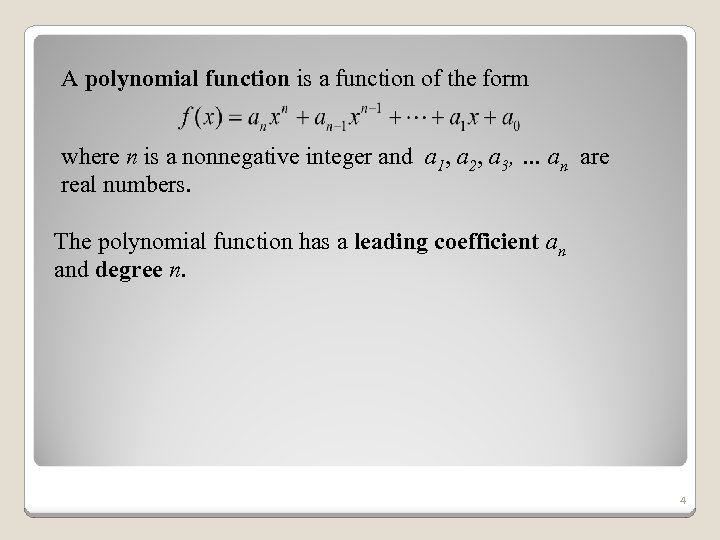 A polynomial function is a function of the form where n is a nonnegative integer and a 1, a 2, a 3, … an are real numbers. The polynomial function has a leading coefficient an and degree n. 4
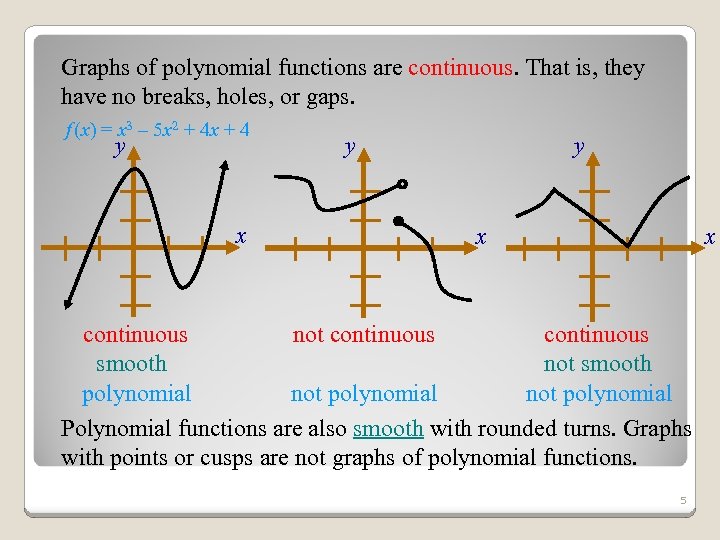 Graphs of polynomial functions are continuous. That is, they have no breaks, holes, or gaps. f (x) = x 3 – 5 x 2 + 4 x + 4 y x y y x x continuous not continuous smooth not smooth polynomial not polynomial Polynomial functions are also smooth with rounded turns. Graphs with points or cusps are not graphs of polynomial functions. 5
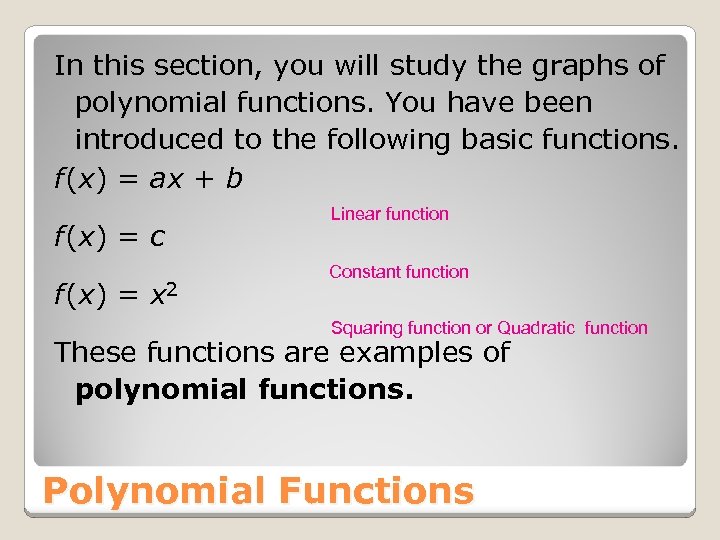 In this section, you will study the graphs of polynomial functions. You have been introduced to the following basic functions. f (x) = ax + b f (x) = c f (x) = x 2 Linear function Constant function Squaring function or Quadratic function These functions are examples of polynomial functions. Polynomial Functions
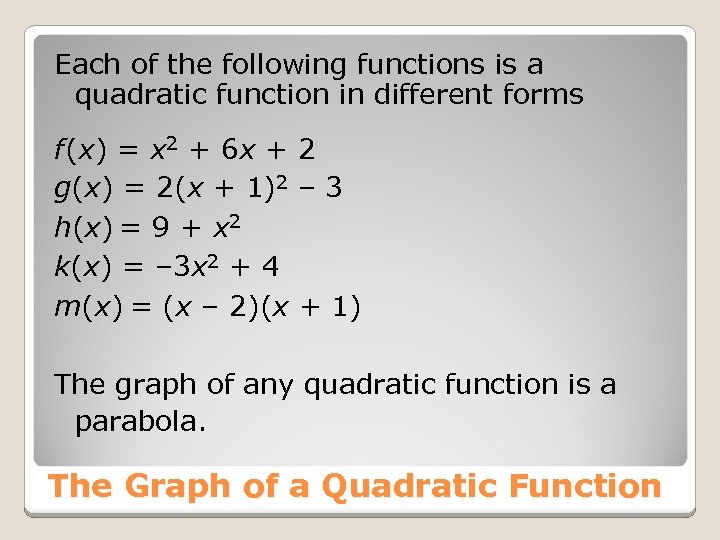 Each of the following functions is a quadratic function in different forms f (x) = x 2 + 6 x + 2 g(x) = 2(x + 1)2 – 3 h(x) = 9 + x 2 k(x) = – 3 x 2 + 4 m(x) = (x – 2)(x + 1) The graph of any quadratic function is a parabola. The Graph of a Quadratic Function
 Finding key points – what would they be? Sketching a graph based upon translation from the parent graph y = x 2. Moving from one format to another to help find key points. What is the method to move from standard form to graphing form? Analyzing a Quadratic Equation 8
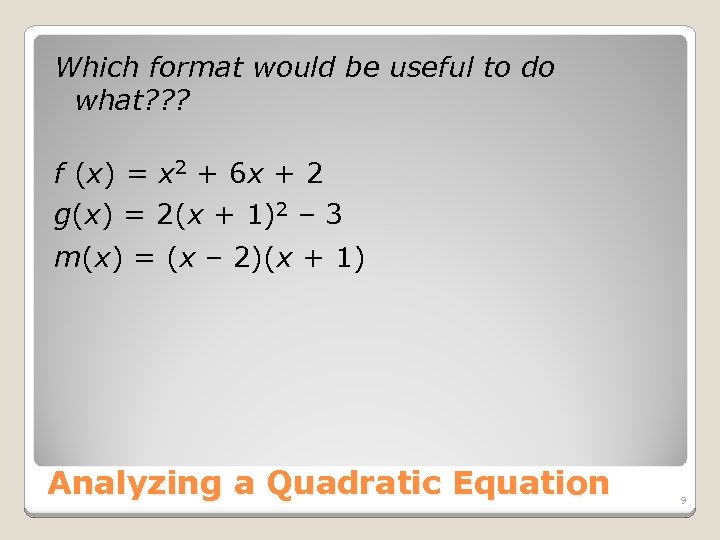 Which format would be useful to do what? ? ? f (x) = x 2 + 6 x + 2 g(x) = 2(x + 1)2 – 3 m(x) = (x – 2)(x + 1) Analyzing a Quadratic Equation 9
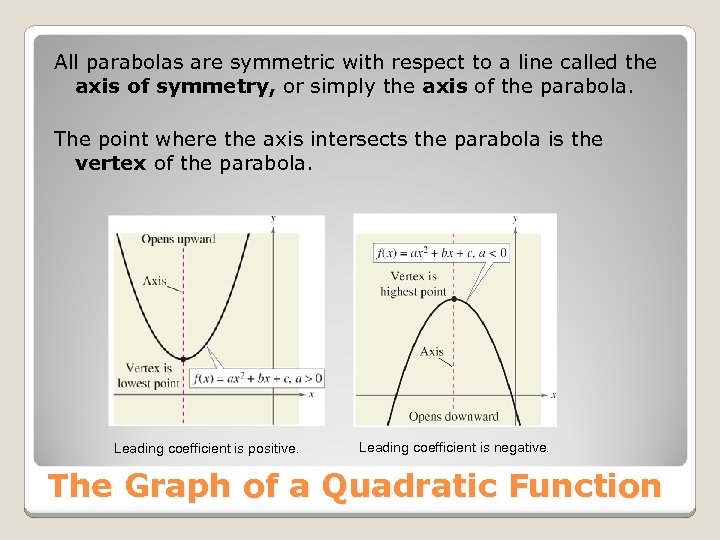 All parabolas are symmetric with respect to a line called the axis of symmetry, or simply the axis of the parabola. The point where the axis intersects the parabola is the vertex of the parabola. Leading coefficient is positive. Leading coefficient is negative. The Graph of a Quadratic Function
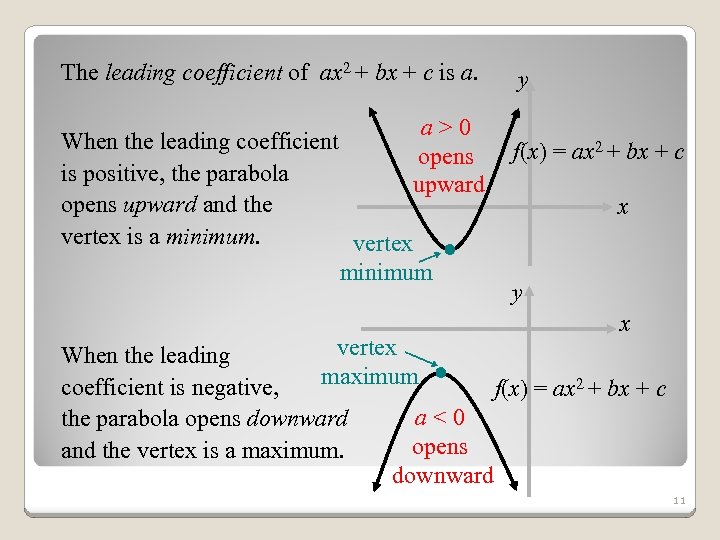 The leading coefficient of ax 2 + bx + c is a. a>0 opens upward When the leading coefficient is positive, the parabola opens upward and the vertex is a minimum. vertex minimum y f(x) = ax 2 + bx + c x y x vertex When the leading maximum coefficient is negative, f(x) = ax 2 + bx + c a<0 the parabola opens downward opens and the vertex is a maximum. downward 11
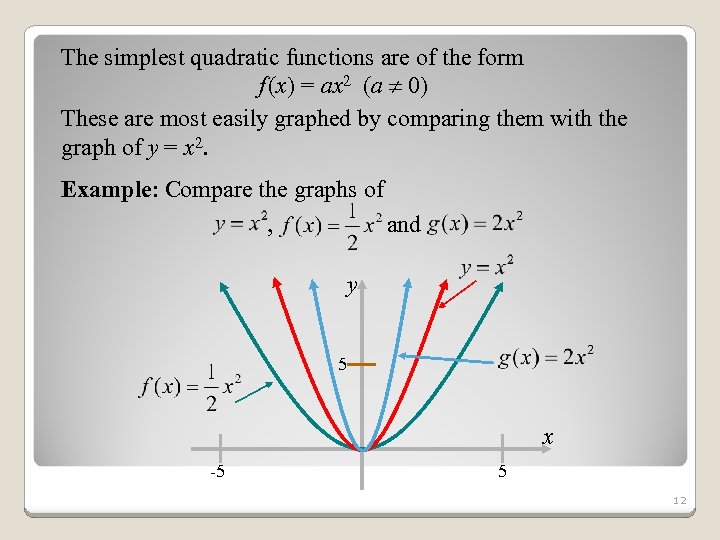 The simplest quadratic functions are of the form f (x) = ax 2 (a 0) These are most easily graphed by comparing them with the graph of y = x 2. Example: Compare the graphs of , and y 5 x -5 5 12
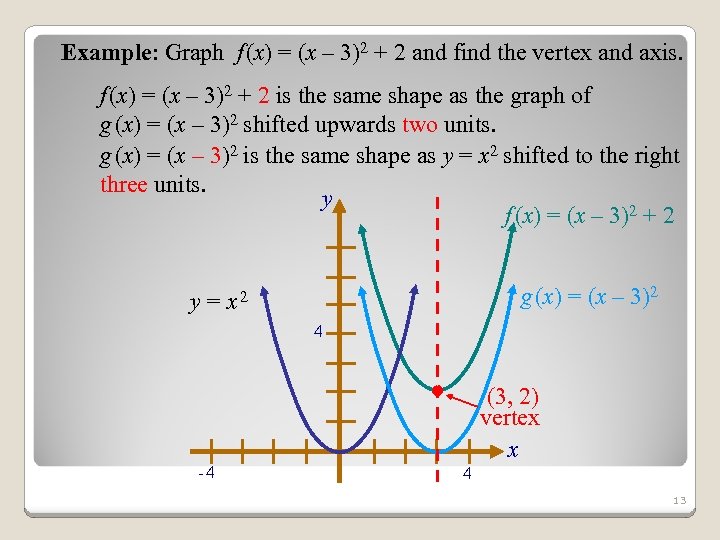 Example: Graph f (x) = (x – 3)2 + 2 and find the vertex and axis. f (x) = (x – 3)2 + 2 is the same shape as the graph of g (x) = (x – 3)2 shifted upwards two units. g (x) = (x – 3)2 is the same shape as y = x 2 shifted to the right three units. y f (x) = (x – 3)2 + 2 g (x) = (x – 3)2 y = x 2 4 -4 (3, 2) vertex x 4 13
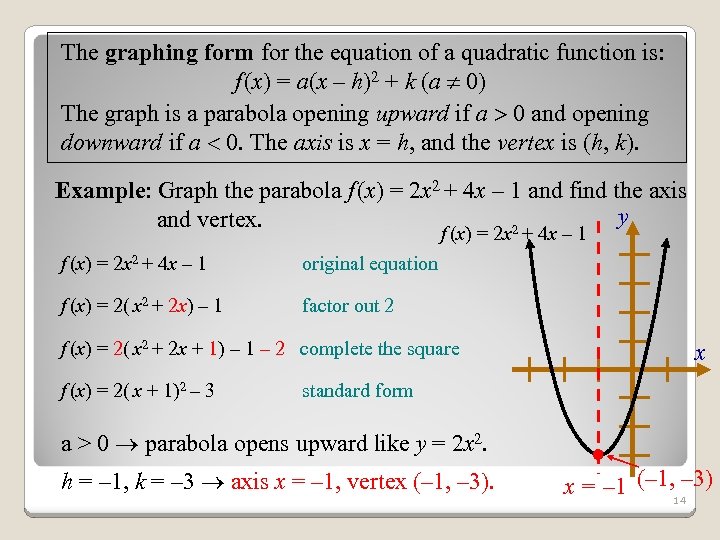 The graphing form for the equation of a quadratic function is: f (x) = a(x – h)2 + k (a 0) The graph is a parabola opening upward if a 0 and opening downward if a 0. The axis is x = h, and the vertex is (h, k). Example: Graph the parabola f (x) = 2 x 2 + 4 x – 1 and find the axis y and vertex. 2 f (x) = 2 x + 4 x – 1 f (x) = 2 x 2 + 4 x – 1 original equation f (x) = 2( x 2 + 2 x) – 1 factor out 2 f (x) = 2( x 2 + 2 x + 1) – 1 – 2 complete the square f (x) = 2( x + 1)2 – 3 x standard form a > 0 parabola opens upward like y = 2 x 2. h = – 1, k = – 3 axis x = – 1, vertex (– 1, – 3) x = – 1 (– 1, 14
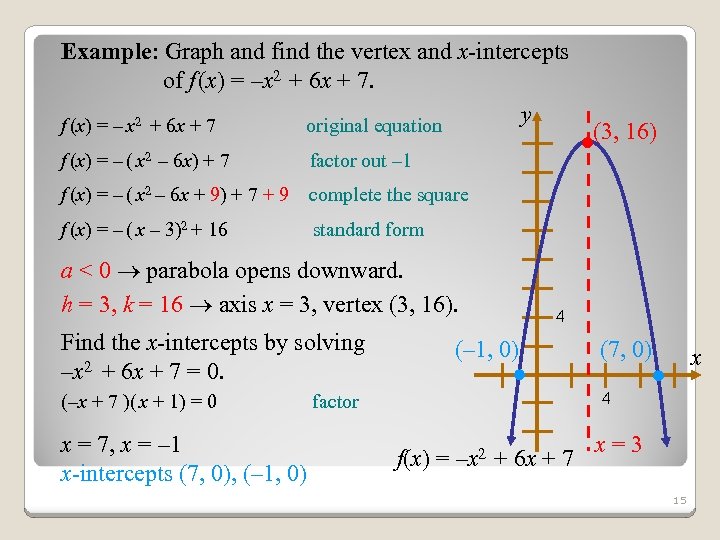 Example: Graph and find the vertex and x-intercepts of f (x) = –x 2 + 6 x + 7. y f (x) = – x 2 + 6 x + 7 original equation f (x) = – ( x 2 – 6 x) + 7 factor out – 1 f (x) = – ( x 2 – 6 x + 9) + 7 + 9 complete the square f (x) = – ( x – 3)2 + 16 (3, 16) standard form a < 0 parabola opens downward. h = 3, k = 16 axis x = 3, vertex (3, 16). Find the x-intercepts by solving –x 2 + 6 x + 7 = 0. (–x + 7 )( x + 1) = 0 x = 7, x = – 1 x-intercepts (7, 0), (– 1, 0) 4 (– 1, 0) (7, 0) x 4 factor f(x) = –x 2 + 6 x + 7 x=3 15
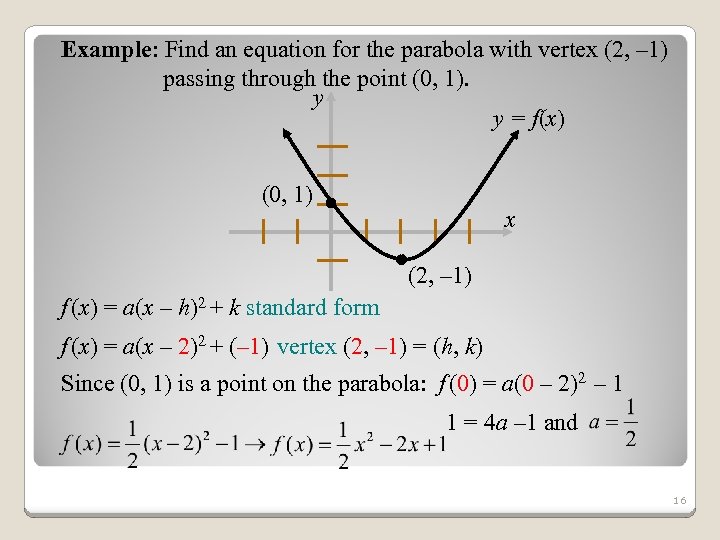 Example: Find an equation for the parabola with vertex (2, – 1) passing through the point (0, 1). y y = f(x) (0, 1) x (2, – 1) f (x) = a(x – h)2 + k standard form f (x) = a(x – 2)2 + (– 1) vertex (2, – 1) = (h, k) Since (0, 1) is a point on the parabola: f (0) = a(0 – 2)2 – 1 1 = 4 a – 1 and 16
 Do you remember… Averaging the intercepts… The resulting formula… Think about the quadratic formula… Another Method for finding the vertex 17
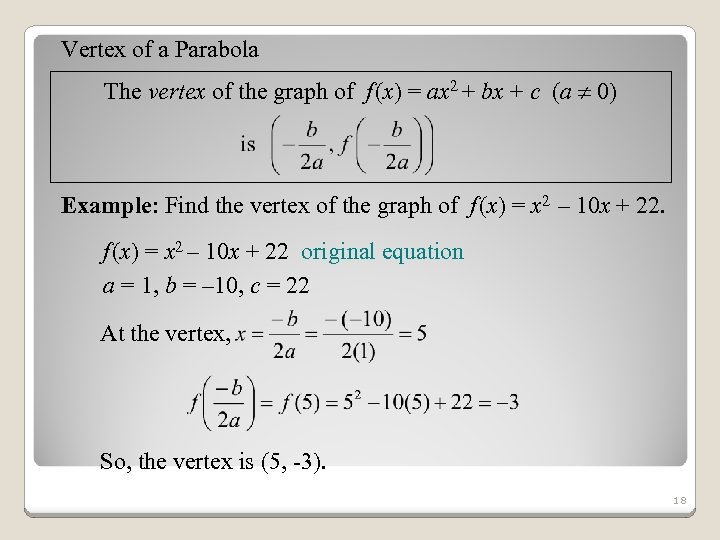 Vertex of a Parabola The vertex of the graph of f (x) = ax 2 + bx + c (a 0) Example: Find the vertex of the graph of f (x) = x 2 – 10 x + 22 original equation a = 1, b = – 10, c = 22 At the vertex, So, the vertex is (5, -3). 18
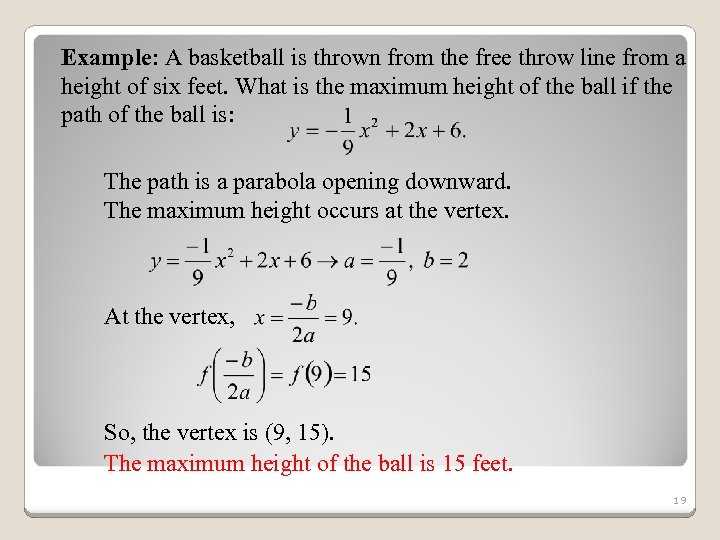 Example: A basketball is thrown from the free throw line from a height of six feet. What is the maximum height of the ball if the path of the ball is: The path is a parabola opening downward. The maximum height occurs at the vertex. At the vertex, So, the vertex is (9, 15). The maximum height of the ball is 15 feet. 19
 I have a new puppy named Pickle. I want to build a fence behind my house to keep Pickle safe. I have 60 feet of fencing and I will be using the back of the house for one side (the house is 50 feet long). Using your graphing calculator answer the following: Using all the fencing, what would be the dimensions of the fence if I want Pickle to have 400 square feet of space? What would be the dimensions for the largest possible space for Pickle? Another Example 20
 • Analyze graphs of quadratic functions. • Write quadratic functions in standard form and use the results to sketch graphs of functions. • Find minimum and maximum values of quadratic functions in real-life applications. What You Should Learn
 Section 2. 1 Page 116 1 -8 all (matching) 29 -33 (odd) algebraic and graphing calculator 37 -45 (odd) 77, 79, 83 Quiz next class – radicals Homework 7 22