


 Скачать презентацию Pratap Vijay Simha 2006045 Mayur Wadhwa 2007029 Rajesh
8eeaa5fab2b5f5bd261b1b08d5e80e4c.ppt
- Количество слайдов: 72
 Pratap Vijay Simha 2006045 Mayur Wadhwa 2007029 Rajesh Goli 2007044 K Md Feroz Irfan 2007088 Dipankar Datta 2004119 Ramesh Shanbhag 2006048 Sudhir Chandrappa 2006057 SUNIL BHARTI MITTAL Is he a strategist?
 BHARTI INTO RETAIL WITH WAL -MART
 WHY RETAIL? Late mover Very limited front end retail stores Currently, focused on cash & carry
 IS THIS HOW SUNIL MITTAL OPERATES? His approach towards Airtel First mover Choose speed over perfection “Get big fast” The strategy in retail seems to be different!
 ABOUT THE INDIAN RETAIL INDUSTRY Largest industry in India – employment of 8% and contributing to around 10% of the GDP. Currently at $500 billion The organized retailing sector in India is about 4 -5% and growing. Next wave of growth expected to be driven by semi-urban and rural India Large number of retail players Weak and fragmented suppliers Regulation – 100% FDI is allowed in cash-and-carry wholesale formats 51% FDI is allowed in single-brand retailing
 CRITICAL SUCCESS FACTORS What are the critical success factors in retail? Low cost Scale Location(s) Ability to navigate through the system Regional and cultural differences
 WHAT'S THE RATIONALE? Achieve low cost via Better supply chain management Logistics Develop ecosystem of suppliers Bargaining power with FMCG manufacturers Scale Leverage JV partner Location Bharti Realty Acquisition of 10 million sqft by 2015 Low-key entry in a small way in Ludhiana, Punjab
 WHAT'S THE RATIONALE? This JV is a winning combination. Wal-Mart's logistics skill and Bharti's execution capability will create a potent force in the Indian market He needed expertise more than money. Hence, Bharti is investing $2. 5 B Contrast with Singtel: Money & telecom expertise Contrast with Warburg Pincus: Money & financial expertise Contrast with Subiksha Went for low cost (good strategy, in principle) Did not have mechanism to achieve low cost (Assumption: No conspiracy)
 AIRTEL DTH
 AGAIN, NOT TYPICAL Last mover in DTH has adoption problems Unrelated to Airtel’s existing businesses What has GSM in common with Satellite DTH from an infrastructure point of view?
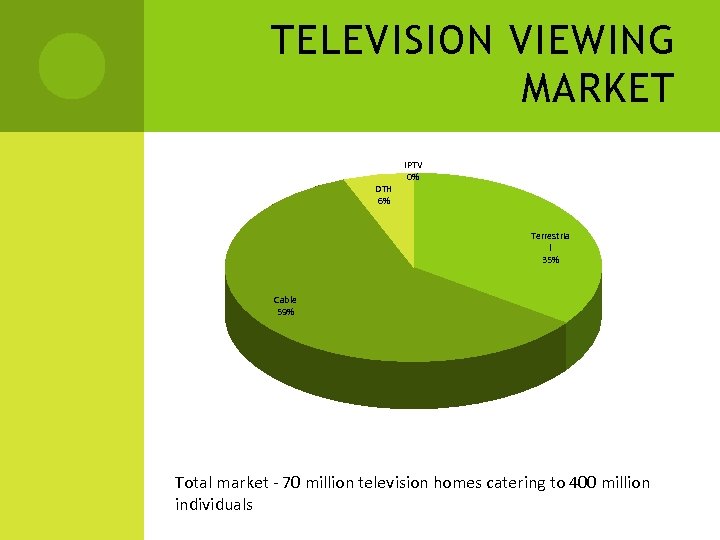 TELEVISION VIEWING MARKET DTH 6% IPTV 0% Terrestria l 35% Cable 59% Total market - 70 million television homes catering to 400 million individuals
 DTH INDUSTRY Big four private DTH players has made a head-start. Dish. TV, Tata. Sky, Big TV and Sun Direct Intense price war Weak financials (all are in loss) Lack of exclusive content issue Foreign Investment cap – DTH: Foreign equity cap of 49% and within that FDI component cannot exceed 20% Cable: Foreign equity cap on cable industry is at 74% with no limit on FDI Satellite transponder capacity Quality of service issue
 THE LOGIC Current DTH market is 8 million subscribers and expected to grow to 40 million by 2015 The industry is evolving Airtel’s DTH strategy Leverage existing distribution channels and customer service Integrate its operations with mobile phone, internet and TV and bundle these services Provide larger dish antenna to provide higher Qo. S Customer switching from existing provider might be difficult But, what about rural market? Is it a strong logic for being a late entrant in DTH market? Did he miss the opportunity at the beginning?
 THE RHETORIC Airtel wants to be in all three screens Mobile PC TV Is it strategic or motto driven? Or is it the market potential (just as in retail)?
 FORMATIVE BUSINESS YEARS
 1976 TO 1984 Very complex import and export policies, industrial licensing regime. Licenses were required right from manufacturing a pin to manufacturing a car People who found favor with the government could get industrial licenses. The entrepreneurs had to find out small openings in various government policies and move ahead, every now and then turn lucky. In 1976, Sunil at age of 18, with a capital of 20 K, started making Bicycle parts. From 1981 to 1984 he took an agency of Suzuki to importable generators. Imports became very successful. Made a lot of money and more importantly, set up a large distribution system across the country In 1984 due to lobbying two business houses(who managed to get licenses to manufacture generators) the government decided to ban import of generators. No amount of pleading or lobbying by a young entrepreneur would have made any difference. So overnight there was no business.
 VALUABLE LESSONS LEARNT ? Did Sunil learnt his valuable lessons from his initial ventures ? “These were the times when entrepreneurs were at the mercy of government policy, and you always had to be prepared, sitting in your hot seat, to take a jump and plunge into something else as soon as the government hit you with a change in policy. ”
 ENTRY INTO TELECOM
 WHY TELECOM? Mittal saw the huge gap between potential demand & supply from state run telecom companies Reforms in telecom sector began in 1980 followed by national telecom policy in 1994 & 1999 Technology advances in 1990 s led to better quality of service at lower tariff rates – beginning of a service which could be marketed to the Indian urban masses, and then rural masses NTP 1994 attempted to provide telephone on demand & telecom services at affordable prices to the Indian populace, and this policy further encouraged Mittal to get into telephony.
 WHY TELECOM? NTP 1999 further reformed the telecom sector with guidelines for internet telephony & broadband Booming industry in India required high end services like leased lines, ISDN & videoconferencing
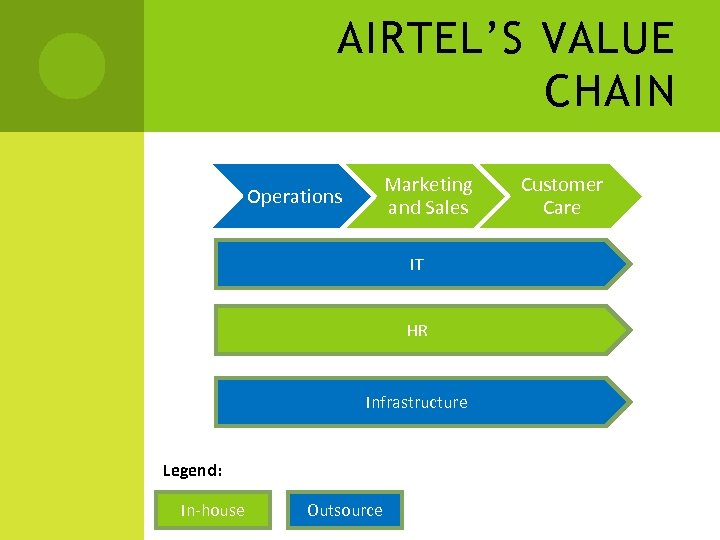
 OUTSOURCING OF NETWORK AND IT BY BHARTI AIRTEL
 UNCONVENTIONAL WISDOM ? OUTSOURCING OF NETWORK When every one said network is the critical factor to a telecom service provider Bharti decides to outsource its networks Do reverse of conventional Wisdom Does Sunil know the Telecom Business like Baba Kalyani knew Forging ?
 HOW MUCH DID AIRTEL OUTSOURCE ON NETWORK? Sept 07 – Extended the contract with Ericsson for $2 B. This is Ericsson’s biggest contract award to-date Ericsson will design, plan, deploy, optimize, and manage Bharti Airtel's GSM network across 15 regional "circles" in India, as well as its pan. India pre-paid platform across 23 circles Sep ‘ 07 - Bharti Airtel revealed plans to award a $900 million GSM network expansion contract to Nokia Siemens Networks
 GOAL IN 2004 RAPID GROWTH Airtel wanted to grow From 8. 2 million subscribers in 2004 to 25 million by 2007
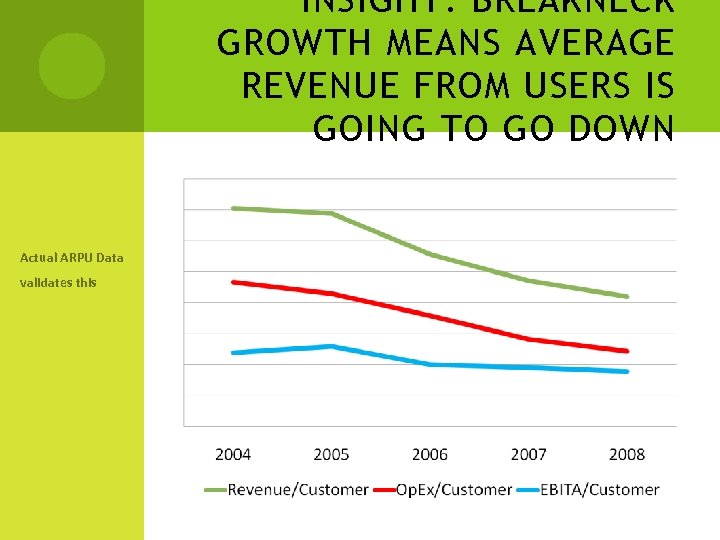 INSIGHT: BREAKNECK GROWTH MEANS AVERAGE REVENUE FROM USERS IS GOING TO GO DOWN Actual ARPU Data validates this
 QUESTION SET#1 How to drive down operating costs faster than rate at which ARPU will go down? Can Bharti Airtel run the network and IT and still drive down costs? Should they outsource? What are the risks? Is this core, non-core or something else?
 QUESTION SET#2 If Air. Tel keeps Network in house, can it deploy and grow fast enough to keep pace? Is outsourcing better suited for Growth?
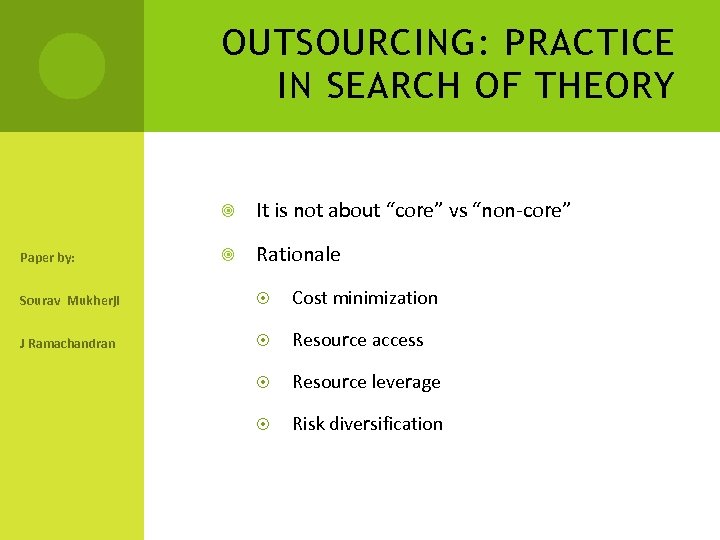 OUTSOURCING: PRACTICE IN SEARCH OF THEORY Paper by: It is not about “core” vs “non-core” Rationale Sourav Mukherji Cost minimization J Ramachandran Resource access Resource leverage Risk diversification
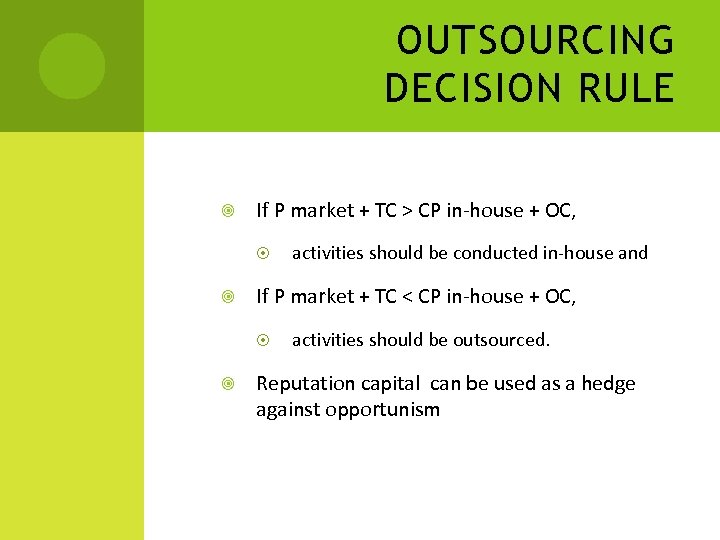 OUTSOURCING DECISION RULE If P market + TC > CP in-house + OC, If P market + TC < CP in-house + OC, activities should be conducted in-house and activities should be outsourced. Reputation capital can be used as a hedge against opportunism
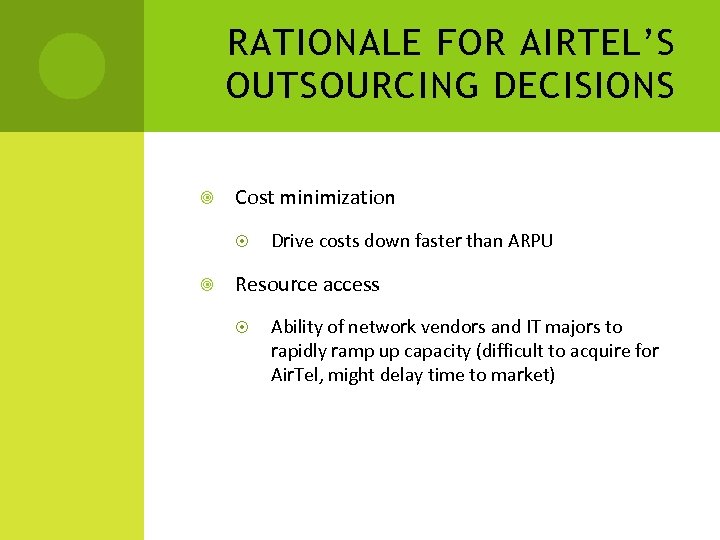 RATIONALE FOR AIRTEL’S OUTSOURCING DECISIONS Cost minimization Drive costs down faster than ARPU Resource access Ability of network vendors and IT majors to rapidly ramp up capacity (difficult to acquire for Air. Tel, might delay time to market)
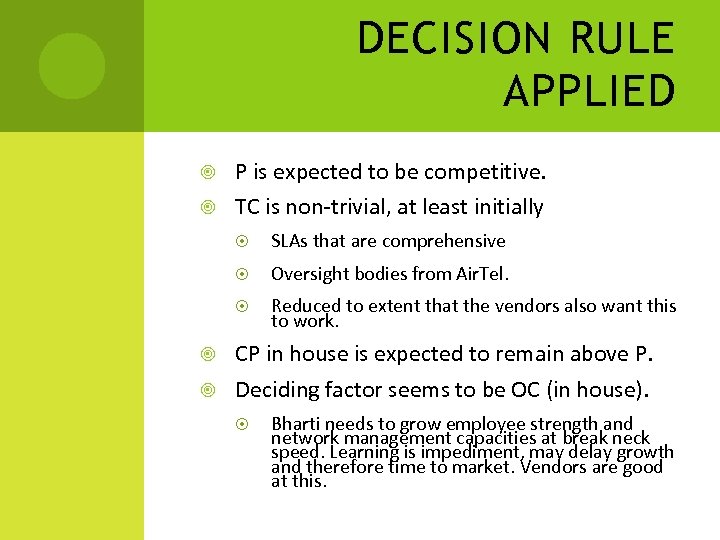 DECISION RULE APPLIED P is expected to be competitive. TC is non-trivial, at least initially SLAs that are comprehensive Oversight bodies from Air. Tel. Reduced to extent that the vendors also want this to work. CP in house is expected to remain above P. Deciding factor seems to be OC (in house). Bharti needs to grow employee strength and network management capacities at break neck speed. Learning is impediment, may delay growth and therefore time to market. Vendors are good at this.
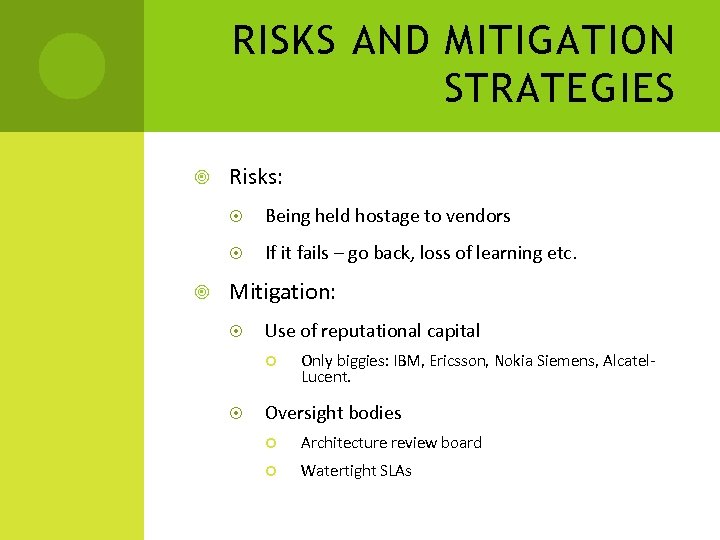 RISKS AND MITIGATION STRATEGIES Risks: Being held hostage to vendors If it fails – go back, loss of learning etc. Mitigation: Use of reputational capital Only biggies: IBM, Ericsson, Nokia Siemens, Alcatel. Lucent. Oversight bodies Architecture review board Watertight SLAs
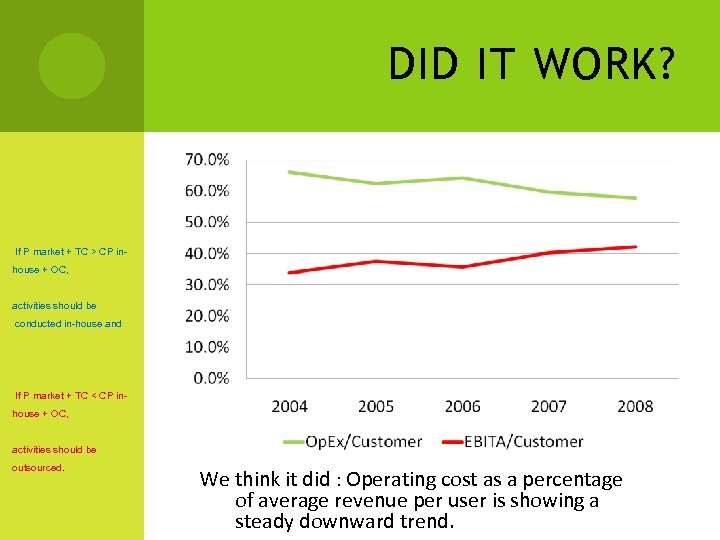 DID IT WORK? If P market + TC > CP inhouse + OC, activities should be conducted in-house and If P market + TC < CP inhouse + OC, activities should be outsourced. We think it did : Operating cost as a percentage of average revenue per user is showing a steady downward trend.
 MTN DEAL
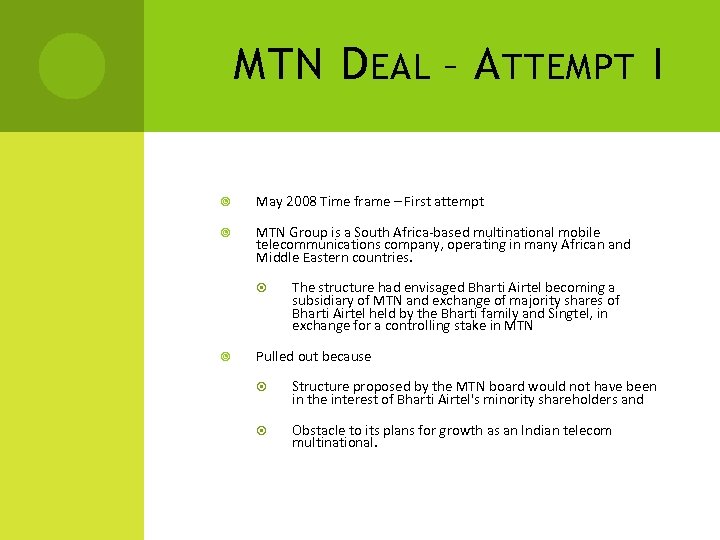 MTN D EAL – A TTEMPT I May 2008 Time frame – First attempt MTN Group is a South Africa-based multinational mobile telecommunications company, operating in many African and Middle Eastern countries. The structure had envisaged Bharti Airtel becoming a subsidiary of MTN and exchange of majority shares of Bharti Airtel held by the Bharti family and Singtel, in exchange for a controlling stake in MTN Pulled out because Structure proposed by the MTN board would not have been in the interest of Bharti Airtel's minority shareholders and Obstacle to its plans for growth as an Indian telecom multinational.
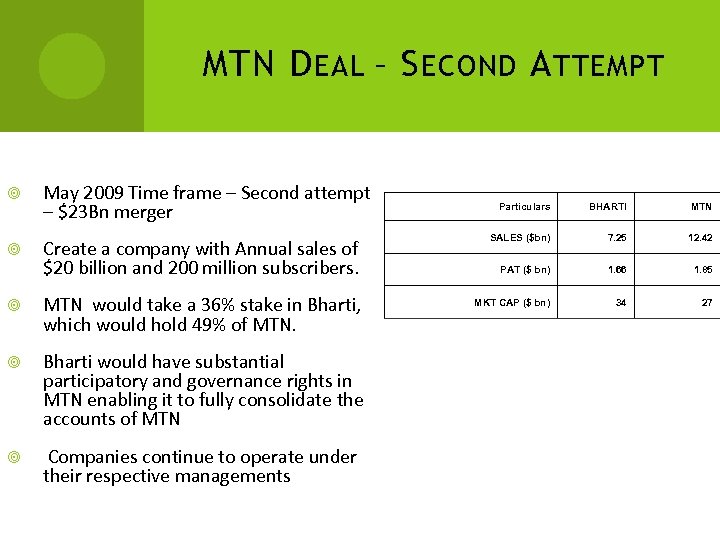 MTN D EAL – S ECOND A TTEMPT May 2009 Time frame – Second attempt – $23 Bn merger Particulars BHARTI MTN Create a company with Annual sales of $20 billion and 200 million subscribers. SALES ($bn) 7. 25 12. 42 PAT ($ bn) 1. 66 1. 85 MTN would take a 36% stake in Bharti, which would hold 49% of MTN. MKT CAP ($ bn) 34 27 Bharti would have substantial participatory and governance rights in MTN enabling it to fully consolidate the accounts of MTN Companies continue to operate under their respective managements
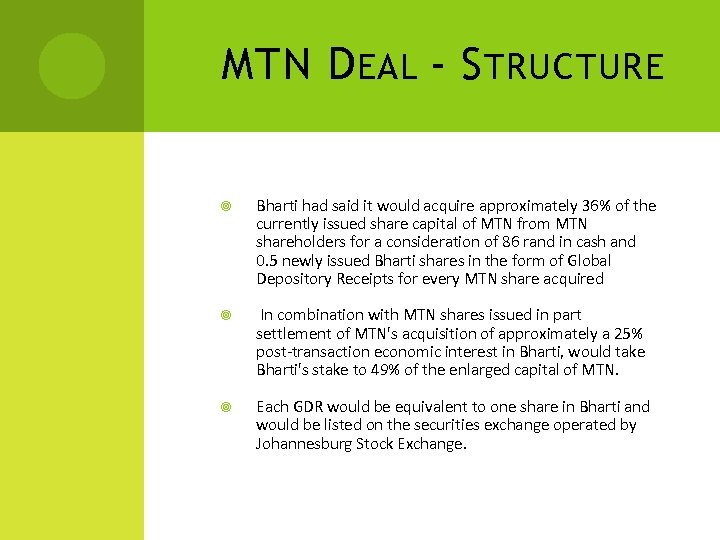 MTN D EAL - S TRUCTURE Bharti had said it would acquire approximately 36% of the currently issued share capital of MTN from MTN shareholders for a consideration of 86 rand in cash and 0. 5 newly issued Bharti shares in the form of Global Depository Receipts for every MTN share acquired In combination with MTN shares issued in part settlement of MTN's acquisition of approximately a 25% post-transaction economic interest in Bharti, would take Bharti's stake to 49% of the enlarged capital of MTN. Each GDR would be equivalent to one share in Bharti and would be listed on the securities exchange operated by Johannesburg Stock Exchange.
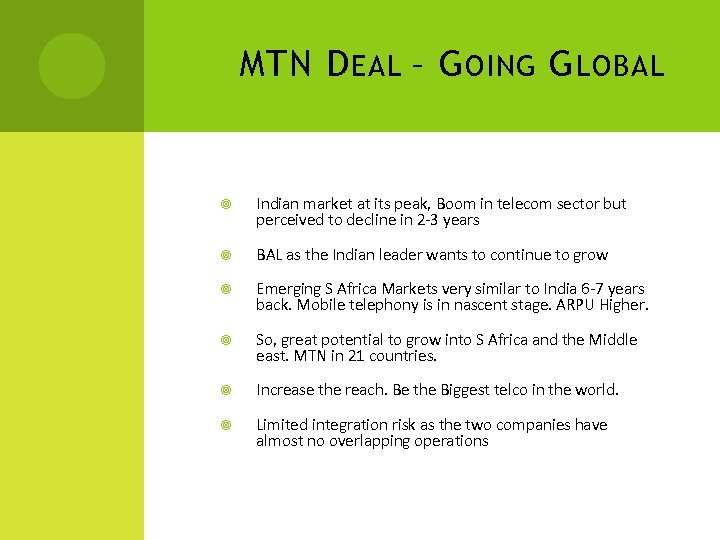 MTN D EAL – G OING G LOBAL Indian market at its peak, Boom in telecom sector but perceived to decline in 2 -3 years BAL as the Indian leader wants to continue to grow Emerging S Africa Markets very similar to India 6 -7 years back. Mobile telephony is in nascent stage. ARPU Higher. So, great potential to grow into S Africa and the Middle east. MTN in 21 countries. Increase the reach. Be the Biggest telco in the world. Limited integration risk as the two companies have almost no overlapping operations
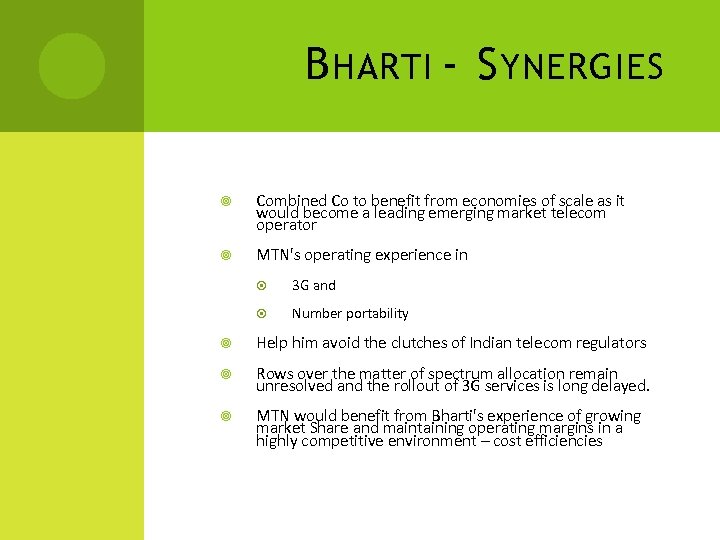 B HARTI - S YNERGIES Combined Co to benefit from economies of scale as it would become a leading emerging market telecom operator MTN's operating experience in 3 G and Number portability Help him avoid the clutches of Indian telecom regulators Rows over the matter of spectrum allocation remain unresolved and the rollout of 3 G services is long delayed. MTN would benefit from Bharti's experience of growing market Share and maintaining operating margins in a highly competitive environment – cost efficiencies
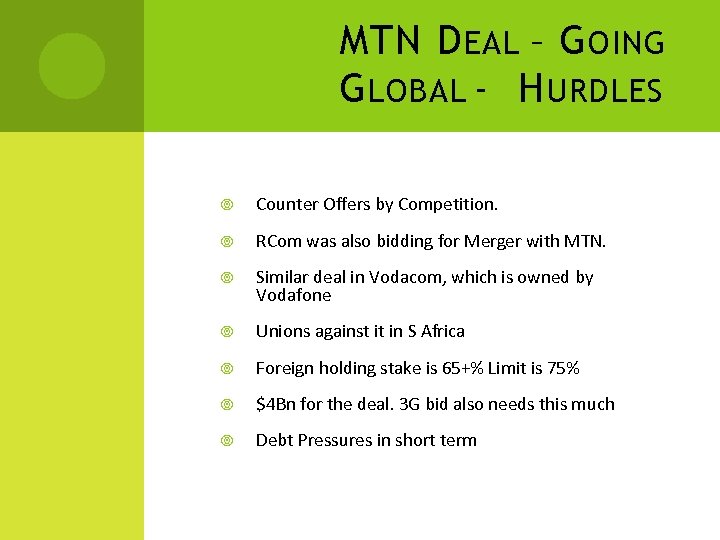 MTN D EAL – G OING G LOBAL - H URDLES Counter Offers by Competition. RCom was also bidding for Merger with MTN. Similar deal in Vodacom, which is owned by Vodafone Unions against it in S Africa Foreign holding stake is 65+% Limit is 75% $4 Bn for the deal. 3 G bid also needs this much Debt Pressures in short term
 KEY DATA ABOUT BHARTI
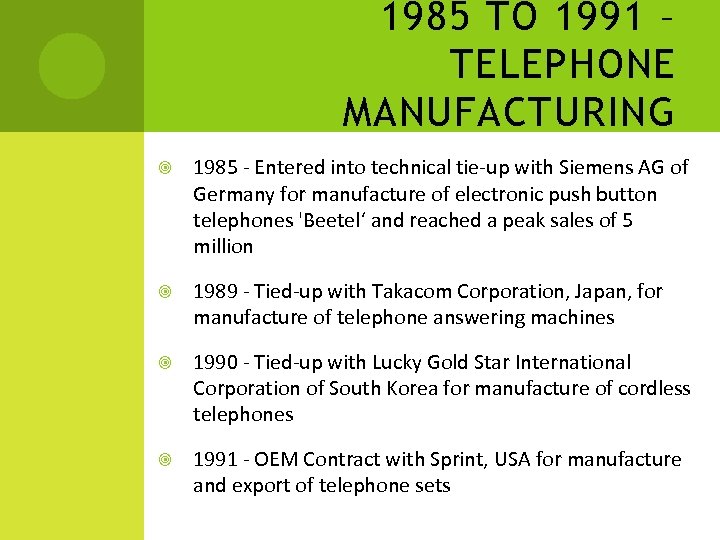 1985 TO 1991 – TELEPHONE MANUFACTURING 1985 - Entered into technical tie-up with Siemens AG of Germany for manufacture of electronic push button telephones 'Beetel‘ and reached a peak sales of 5 million 1989 - Tied-up with Takacom Corporation, Japan, for manufacture of telephone answering machines 1990 - Tied-up with Lucky Gold Star International Corporation of South Korea for manufacture of cordless telephones 1991 - OEM Contract with Sprint, USA for manufacture and export of telephone sets
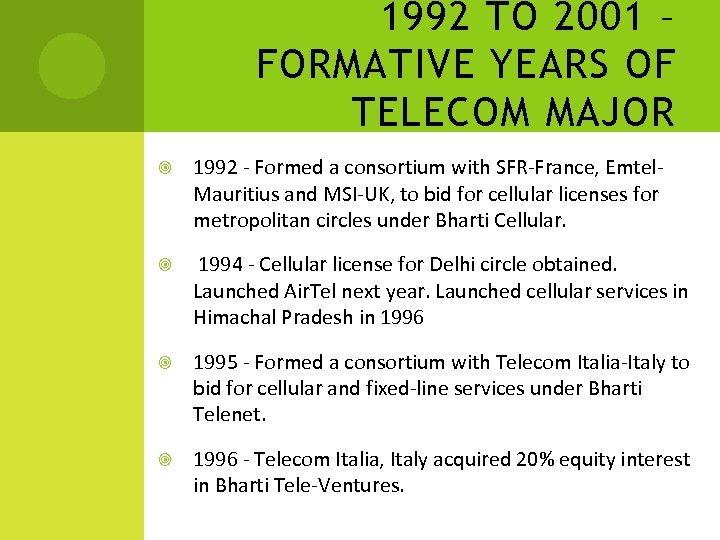 1992 TO 2001 – FORMATIVE YEARS OF TELECOM MAJOR 1992 - Formed a consortium with SFR-France, Emtel. Mauritius and MSI-UK, to bid for cellular licenses for metropolitan circles under Bharti Cellular. 1994 - Cellular license for Delhi circle obtained. Launched Air. Tel next year. Launched cellular services in Himachal Pradesh in 1996 1995 - Formed a consortium with Telecom Italia-Italy to bid for cellular and fixed-line services under Bharti Telenet. 1996 - Telecom Italia, Italy acquired 20% equity interest in Bharti Tele-Ventures.
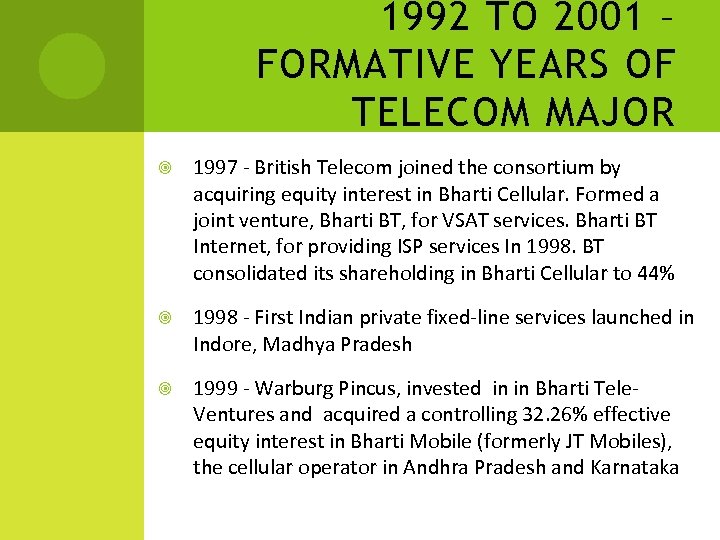 1992 TO 2001 – FORMATIVE YEARS OF TELECOM MAJOR 1997 - British Telecom joined the consortium by acquiring equity interest in Bharti Cellular. Formed a joint venture, Bharti BT, for VSAT services. Bharti BT Internet, for providing ISP services In 1998. BT consolidated its shareholding in Bharti Cellular to 44% 1998 - First Indian private fixed-line services launched in Indore, Madhya Pradesh 1999 - Warburg Pincus, invested in in Bharti Tele. Ventures and acquired a controlling 32. 26% effective equity interest in Bharti Mobile (formerly JT Mobiles), the cellular operator in Andhra Pradesh and Karnataka
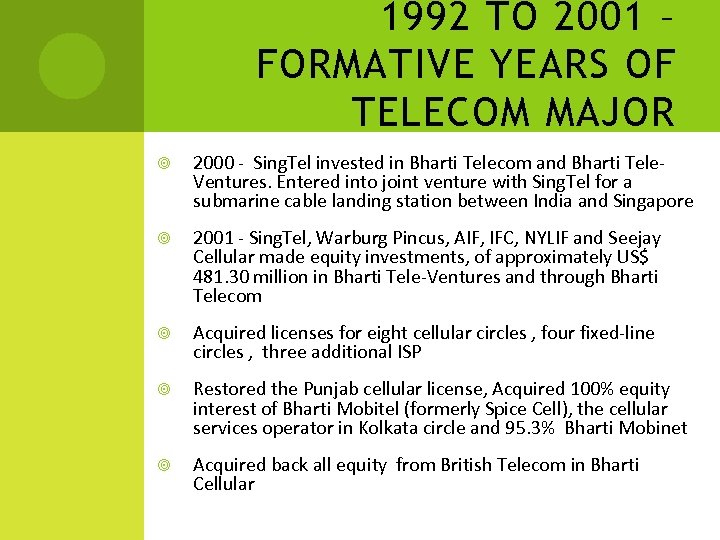 1992 TO 2001 – FORMATIVE YEARS OF TELECOM MAJOR 2000 - Sing. Tel invested in Bharti Telecom and Bharti Tele. Ventures. Entered into joint venture with Sing. Tel for a submarine cable landing station between India and Singapore 2001 - Sing. Tel, Warburg Pincus, AIF, IFC, NYLIF and Seejay Cellular made equity investments, of approximately US$ 481. 30 million in Bharti Tele-Ventures and through Bharti Telecom Acquired licenses for eight cellular circles , four fixed-line circles , three additional ISP Restored the Punjab cellular license, Acquired 100% equity interest of Bharti Mobitel (formerly Spice Cell), the cellular services operator in Kolkata circle and 95. 3% Bharti Mobinet Acquired back all equity from British Telecom in Bharti Cellular
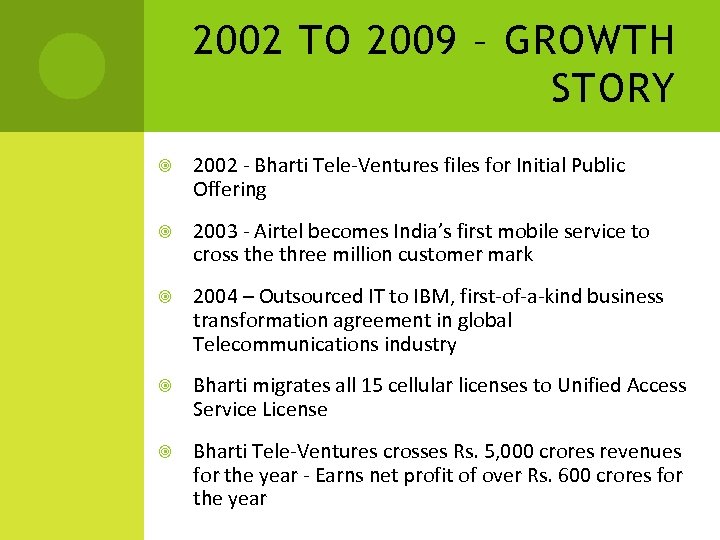 2002 TO 2009 – GROWTH STORY 2002 - Bharti Tele-Ventures files for Initial Public Offering 2003 - Airtel becomes India’s first mobile service to cross the three million customer mark 2004 – Outsourced IT to IBM, first-of-a-kind business transformation agreement in global Telecommunications industry Bharti migrates all 15 cellular licenses to Unified Access Service License Bharti Tele-Ventures crosses Rs. 5, 000 crores revenues for the year - Earns net profit of over Rs. 600 crores for the year
 2002 TO 2009 – GROWTH STORY 2004 - Bharti & Siemens join hands to build & manage Air. Tel networks in three circles 2005 - Airtel completes its 23 circle all India footprint Bharti announces agreement with Vodafone marking the entry of the World's Largest Telecom Operator into India Bharti Enterprises & DE Rothschilds announce a 50: 50 JV for export of fresh fruits & vegetables
 2002 TO 2009 – GROWTH STORY 2006 – Gets into AXA life and general insurance 2007 - Partnership with Vodafone to roll-out telecom services in Channel Islands (Europe) Bharti Airtel awards network expansion contract to Nokia Siemens and Ericsson Bharti Enterprises and Wal-Mart join hands in wholesale cash-and-carry to serve small retailers, manufacturers and farmers 2008 - Airtel makes its television debut - Set to redefine home entertainment with Airtel digital TV Bharti Airtel launches Triple Play with Airtel digital TV interactive – Telephone, Broadband now TV on a single line Bharti Airtel and Alcatel-Lucent form Managed Services Joint Venture for Broadband Telephone Services “Hello Sri Lanka” says Airtel
 2002 TO 2009 – GROWTH STORY 2009 - Bharti Airtel launches Triple Play with Airtel digital TV interactive – Telephone, Broadband now TV on a single line Bharti Airtel and Alcatel-Lucent form Managed Services Joint Venture for Broadband Telephone Services
 B HARTI G ROUP C OMPANIES Bharti Airtel Bharti Teletech Telecom Seychelles Comviva Technologies Ltd Field. Fresh Foods Pvt. Ltd Bharti Retail Bharti AXA General Insurance
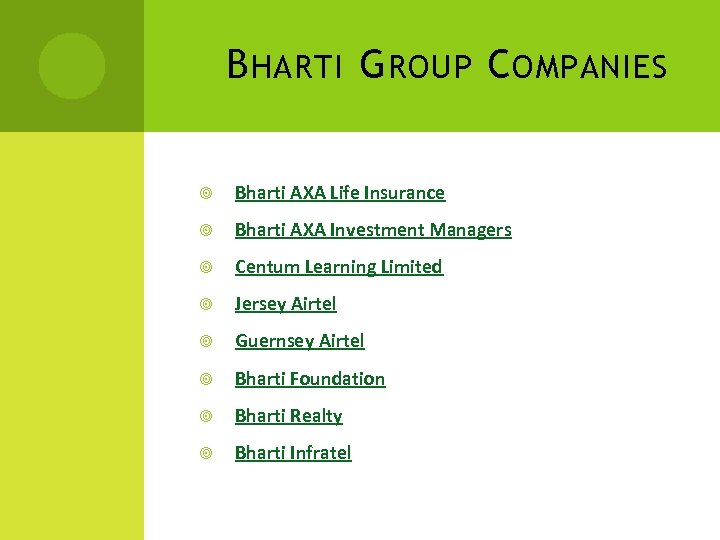 B HARTI G ROUP C OMPANIES Bharti AXA Life Insurance Bharti AXA Investment Managers Centum Learning Limited Jersey Airtel Guernsey Airtel Bharti Foundation Bharti Realty Bharti Infratel
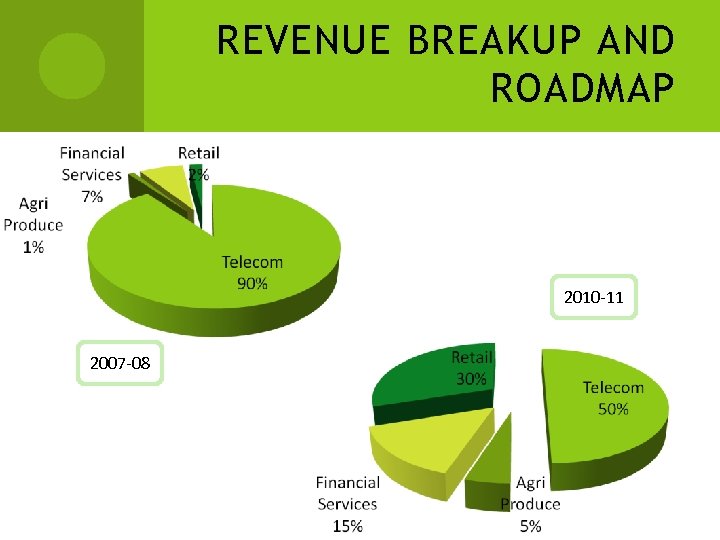 REVENUE BREAKUP AND ROADMAP 2010 -11 2007 -08
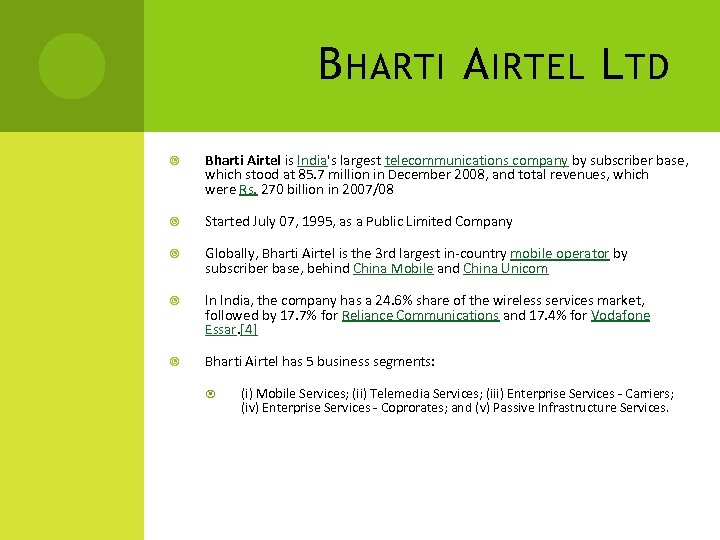 B HARTI A IRTEL L TD Bharti Airtel is India's largest telecommunications company by subscriber base, which stood at 85. 7 million in December 2008, and total revenues, which were Rs. 270 billion in 2007/08 Started July 07, 1995, as a Public Limited Company Globally, Bharti Airtel is the 3 rd largest in-country mobile operator by subscriber base, behind China Mobile and China Unicom In India, the company has a 24. 6% share of the wireless services market, followed by 17. 7% for Reliance Communications and 17. 4% for Vodafone Essar. [4] Bharti Airtel has 5 business segments: (i) Mobile Services; (ii) Telemedia Services; (iii) Enterprise Services - Carriers; (iv) Enterprise Services - Coprorates; and (v) Passive Infrastructure Services.
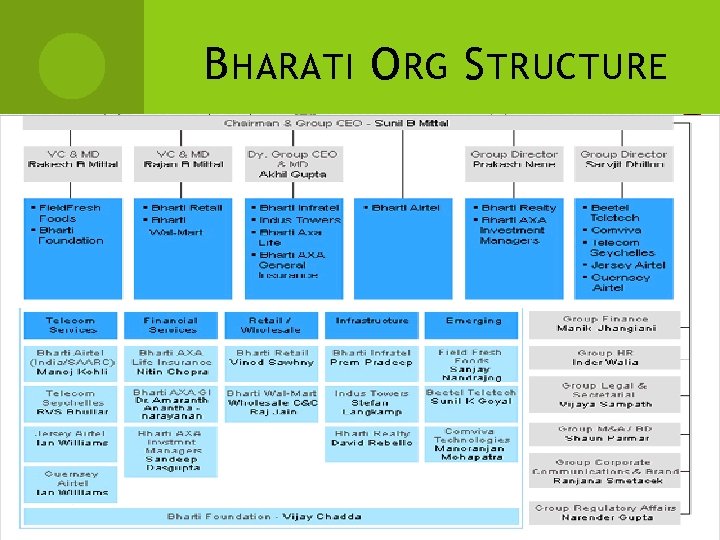 B HARATI O RG S TRUCTURE
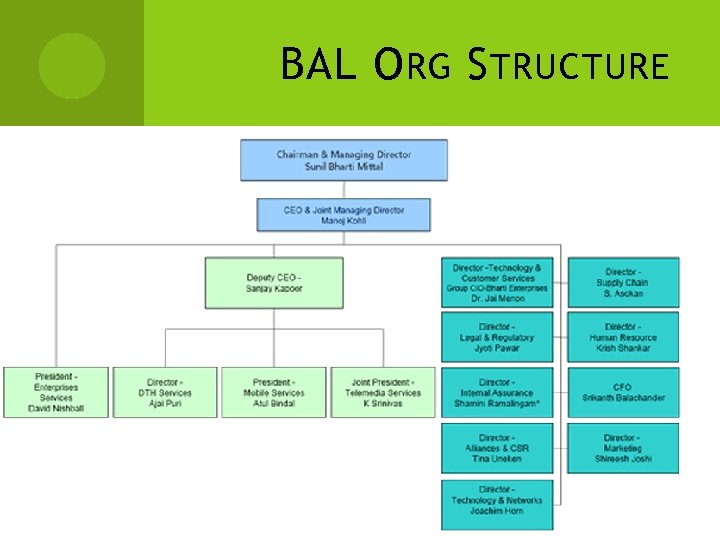 BAL O RG S TRUCTURE
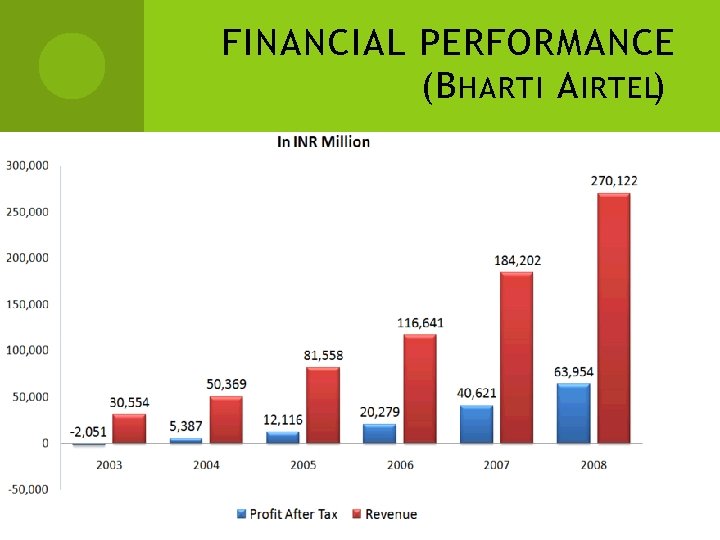 FINANCIAL PERFORMANCE (B HARTI A IRTEL)
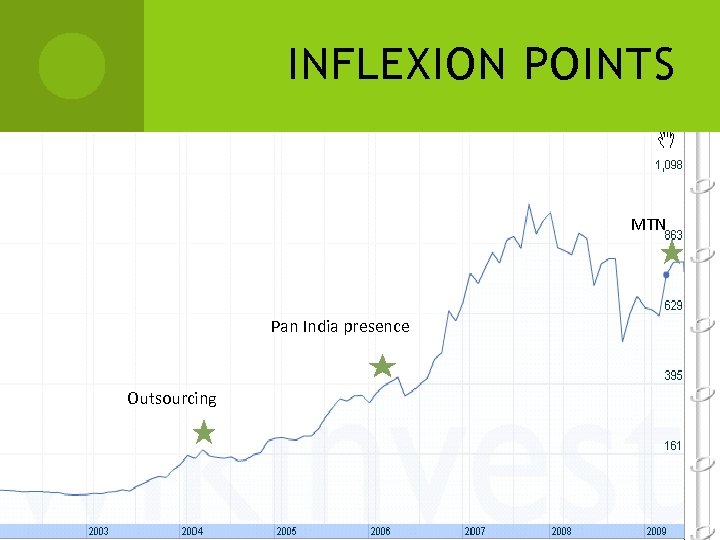
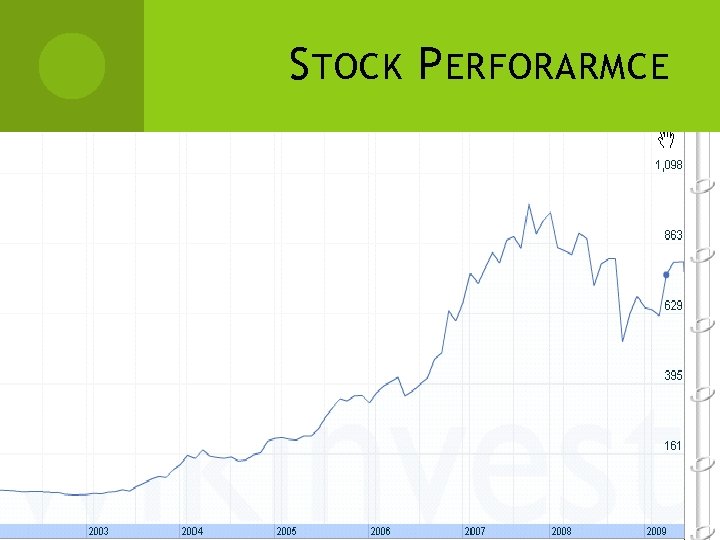 S TOCK P ERFORARMCE BAL has been growing at an exponential rate in terms of subscriber base, revenues and Net profits
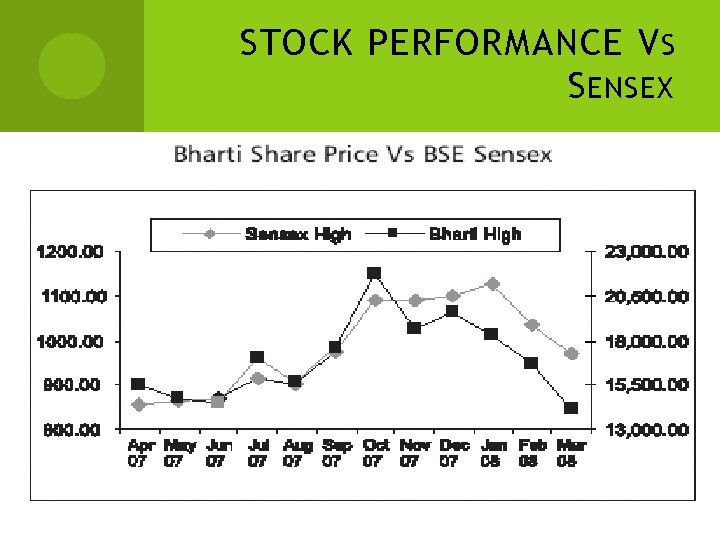 STOCK PERFORMANCE V S S ENSEX
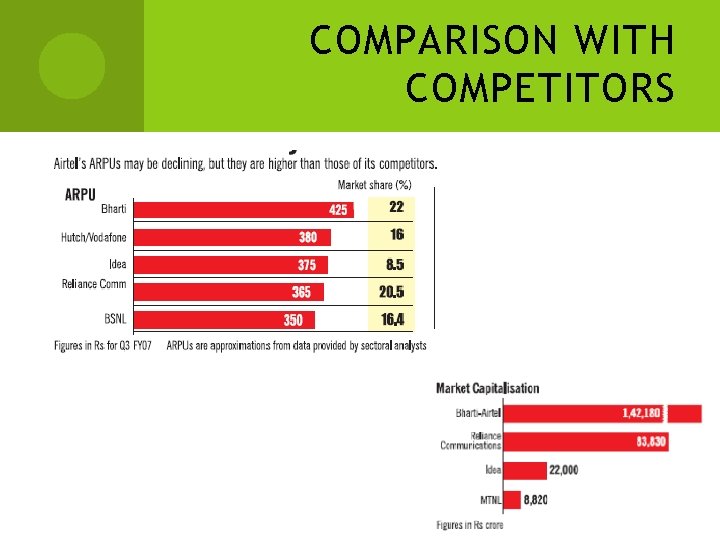 COMPARISON WITH COMPETITORS
![SUBSCRIBER & P&L DATA Annual Data[2] Units 2004 2005 2006 2007 2008 Total Customer](https://present5.com/presentation/8eeaa5fab2b5f5bd261b1b08d5e80e4c/image-60.jpg "SUBSCRIBER & P&L DATA Annual Data[2] Units 2004 2005 2006 2007 2008 Total Customer") SUBSCRIBER & P&L DATA Annual Data[2] Units 2004 2005 2006 2007 2008 Total Customer Base 000 s 7, 141 11, 842 20, 926 39, 013 64, 268 Mobile Services 000 s 6, 504 10, 984 19, 579 37, 141 61, 985 Telemedia Services 000 s 637 857 1, 347 1, 871 2, 283 Revenue Rs. million 50, 369 81, 558 116, 641 184, 202 270, 122 EBITDA Rs. million 17, 055 30, 658 41, 636 74, 407 114, 018 Cash Profit from Operations Rs. million 14, 363 28, 219 40, 006 73, 037 111, 535 Earnings before Tax Rs. million 5, 527 15, 832 23, 455 46, 784 73, 115 Net Profit Rs. million 5, 387 12, 116 20, 279 40, 621 63, 954 Return on Equity (ROE) % 12. 00% 23. 70% 32. 00% 43. 10% 38. 50% Earnings per Share (EPS) Rs. million 3. 15 6. 53 10. 78 21. 43 34. 23 Based on Statement of Operations Key Ratios
SUBSCRIBER & P&L DATA Annual Data[2] Units 2004 2005 2006 2007 2008 Total Customer Base 000 s 7, 141 11, 842 20, 926 39, 013 64, 268 Mobile Services 000 s 6, 504 10, 984 19, 579 37, 141 61, 985 Telemedia Services 000 s 637 857 1, 347 1, 871 2, 283 Revenue Rs. million 50, 369 81, 558 116, 641 184, 202 270, 122 EBITDA Rs. million 17, 055 30, 658 41, 636 74, 407 114, 018 Cash Profit from Operations Rs. million 14, 363 28, 219 40, 006 73, 037 111, 535 Earnings before Tax Rs. million 5, 527 15, 832 23, 455 46, 784 73, 115 Net Profit Rs. million 5, 387 12, 116 20, 279 40, 621 63, 954 Return on Equity (ROE) % 12. 00% 23. 70% 32. 00% 43. 10% 38. 50% Earnings per Share (EPS) Rs. million 3. 15 6. 53 10. 78 21. 43 34. 23 Based on Statement of Operations Key Ratios
 BHARTI AS AN EMPLOYER In 2004, Bharti Airtel was ranked the No. 2 best employer in India by Hewitt Associates; in 2006 it was ranked No. 10 in Business. Week's IT 100 list. The company's other benefits include half days on birthdays, gifts for anniversaries, no meetings on weekends, flexible work time, gym, yoga classes and regular health checks on campus
 FRAMEWORKS AND CONCLUSIONS
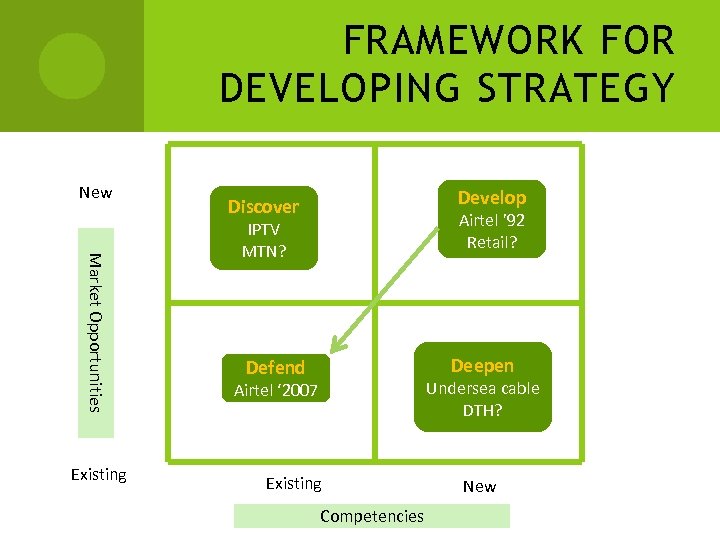 FRAMEWORK FOR DEVELOPING STRATEGY New Market Opportunities Existing Develop Discover Airtel ’ 92 Retail? IPTV MTN? Deepen Defend Undersea cable DTH? Airtel ‘ 2007 Existing Competencies New
 AIRTEL’S VALUE CHAIN Marketing and Sales Operations IT HR Infrastructure Legend: In-house Outsource Customer Care
 SUNIL MITTAL: MANAGEMENT STYLE Ability to navigate through the socio, legal processes Entrepreneur style at the early stages and then evolved to professional management style Ability to convince lenders to provide him capital Hands-on – himself tests out Airtel’s IPTV Known to routinely travel to remote areas around India to boost the morale of his sales troops as well as to experience firsthand how good or poor his company’s telecom services are
 SUNIL MITTAL: MANAGEMENT STYLE Agile decisions: “Speed over perfection” Sets clear and bold targets for the organization His ability to rope in big players with deep pockets (like Sing. Tel, Vodafone, Warburg Pincus & Siemens) Ability to collaborate - sharing towers, network with competitors At the age of 50, he stepped back to delegate operational control to the professional Managers to lead the various entities Ability to attract and retain the best management team His ability to think big and execute it flawlessl
 INFLEXION POINTS BAL has been growing at an exponential rate in terms of subscriber base, revenues and Net profits MTN Pan India presence Outsourcing
 FUTURE OF BHARTI
 FUTURE Enter into Education. Mittal’s vision of building a knowledgeable society in India Advocates CSR Seeking reforms in Insurance and Retail sectors Grow the diversified businesses Protect Airtel’s market share Foray into Global markets Wants to be the most respected conglomerate by 2020
 THANK YOU
 APPENDIX
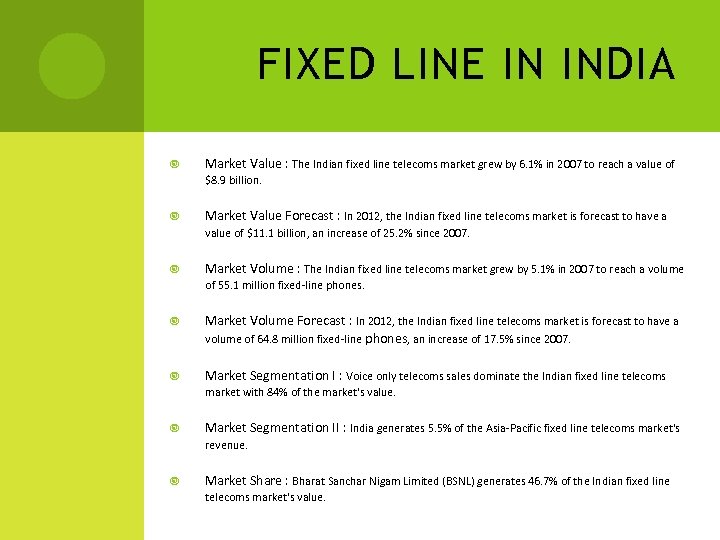 FIXED LINE IN INDIA Market Value : The Indian fixed line telecoms market grew by 6. 1% in 2007 to reach a value of $8. 9 billion. Market Value Forecast : In 2012, the Indian fixed line telecoms market is forecast to have a value of $11. 1 billion, an increase of 25. 2% since 2007. Market Volume : The Indian fixed line telecoms market grew by 5. 1% in 2007 to reach a volume of 55. 1 million fixed-line phones. Market Volume Forecast : In 2012, the Indian fixed line telecoms market is forecast to have a volume of 64. 8 million fixed-line phones, an increase of 17. 5% since 2007. Market Segmentation I : Voice only telecoms sales dominate the Indian fixed line telecoms market with 84% of the market's value. Market Segmentation II : India generates 5. 5% of the Asia-Pacific fixed line telecoms market's revenue. Market Share : Bharat Sanchar Nigam Limited (BSNL) generates 46. 7% of the Indian fixed line telecoms market's value.