


 Скачать презентацию Practical Text Mining Ronen Feldman Information Systems Department
28afde13f86d2809302a499c6d73cb1e.ppt
- Количество слайдов: 40
 Practical Text Mining Ronen Feldman Information Systems Department School of Business Administration Hebrew University, Jerusalem, ISRAEL Ronen. Feldman@huji. ac. il
 Background • Rapid proliferation of information available in digital format • People have less time to absorb more information
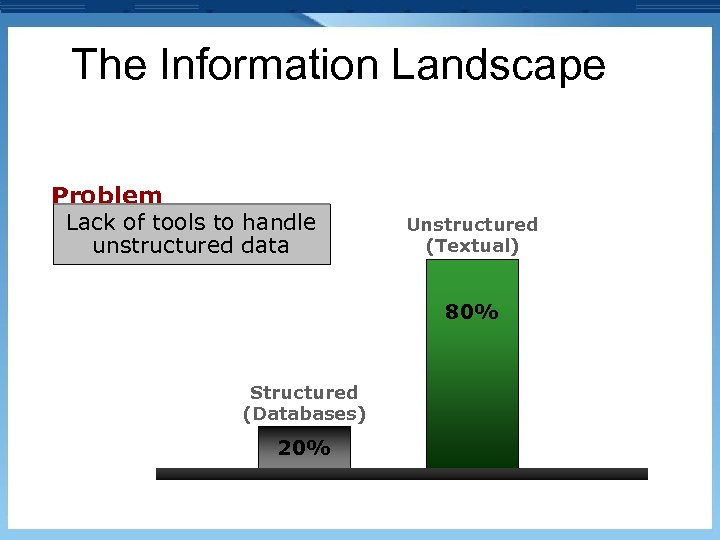 The Information Landscape Problem Lack of tools to handle unstructured data Unstructured (Textual) 80% Structured (Databases) 20%
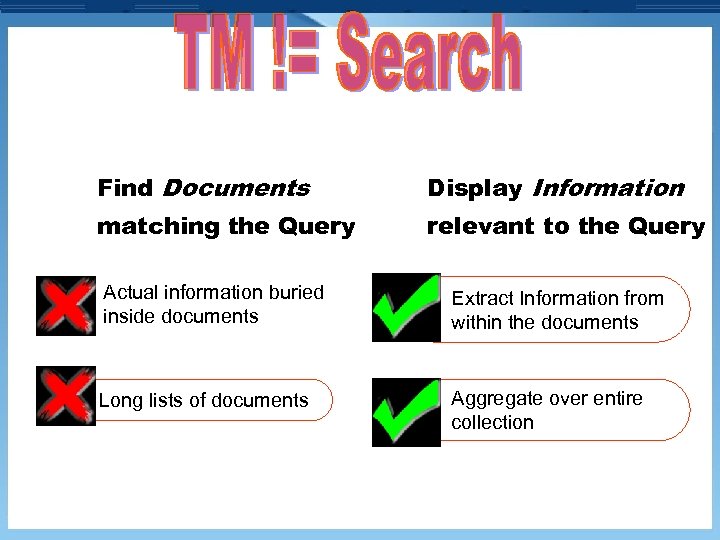 Find Documents Display Information matching the Query relevant to the Query Actual information buried inside documents Extract Information from within the documents Long lists of documents Aggregate over entire collection
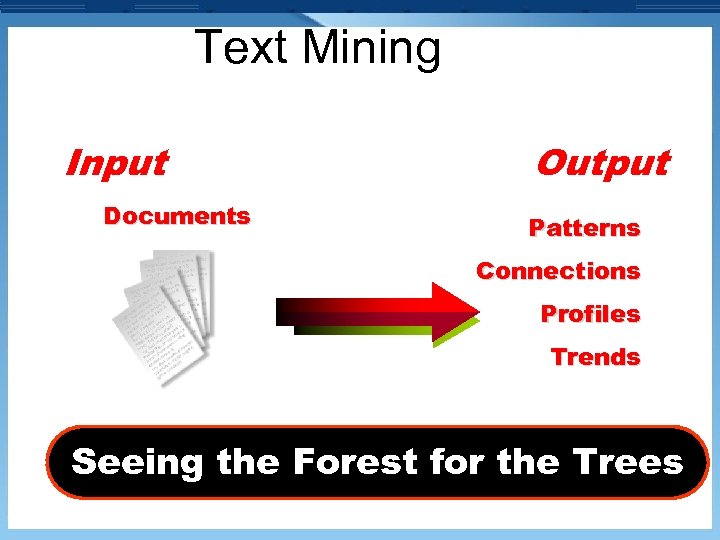 Text Mining Input Documents Output Patterns Connections Profiles Trends Seeing the Forest for the Trees
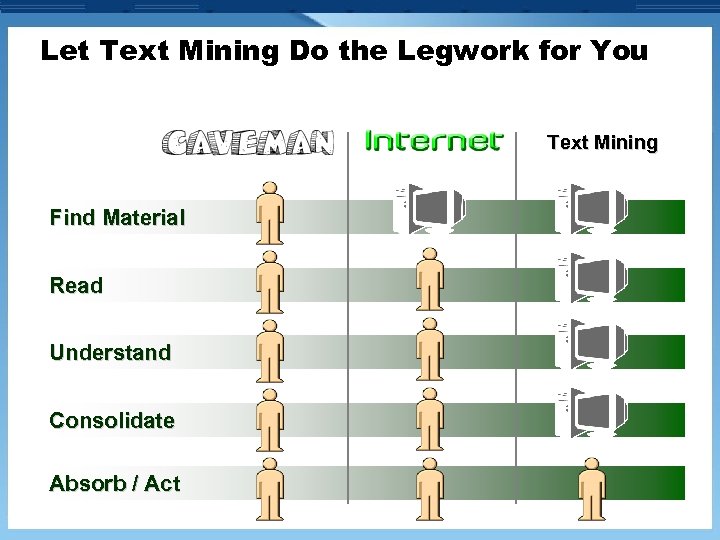 Let Text Mining Do the Legwork for You Text Mining Find Material Read Understand Consolidate Absorb / Act
 What Is Unique in Text Mining? • Feature extraction. • Very large number of features that represent each of the documents. • The need for background knowledge. • Even patterns supported by small number of document may be significant. • Huge number of patterns, hence need for visualization, interactive exploration.
 Document Types • Structured documents – Output from CGI • Semi-structured documents – Seminar announcements – Job listings – Ads • Free format documents – News – Scientific papers
 Text Representations • • Character Trigrams Words Linguistic Phrases Non-consecutive phrases Frames Scripts Role annotation Parse trees
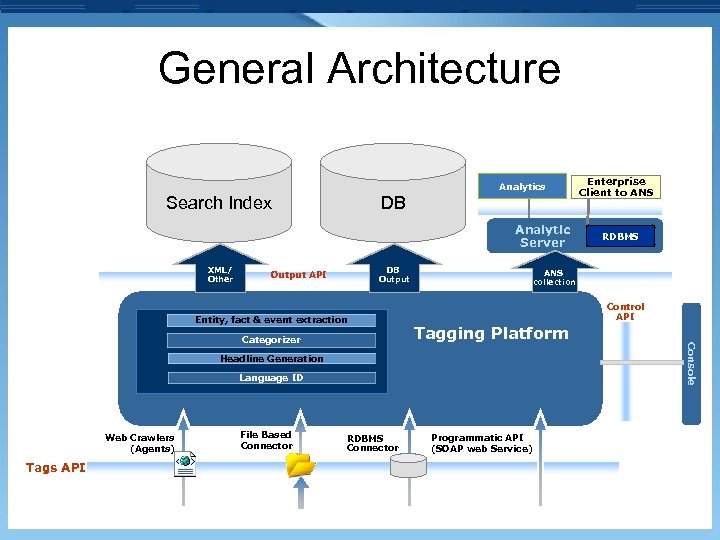 General Architecture Analytics Search Index DB Analytic Server XML/ Other DB Output API Entity, fact & event extraction ANS collection Control API Tagging Platform Headline Generation Language ID Web Crawlers (Agents) Tags API File Based Connector RDBMS Programmatic API (SOAP web Service) Console Categorizer Enterprise Client to ANS
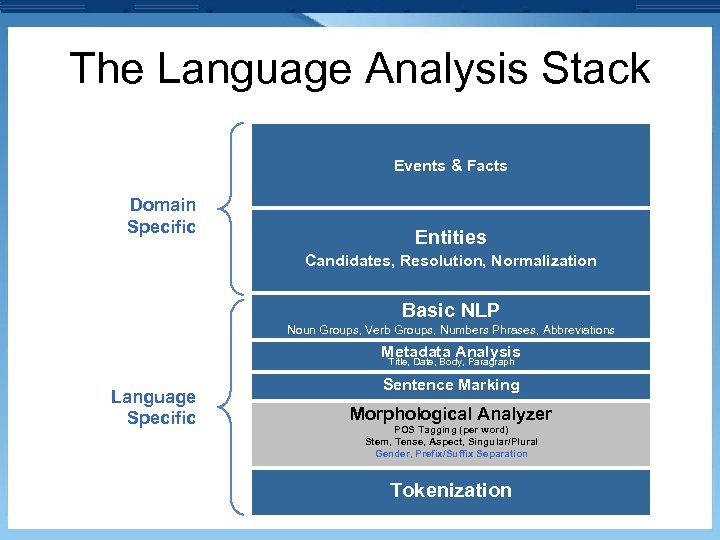 The Language Analysis Stack Events & Facts Domain Specific Entities Candidates, Resolution, Normalization Basic NLP Noun Groups, Verb Groups, Numbers Phrases, Abbreviations Metadata Analysis Title, Date, Body, Paragraph Language Specific Sentence Marking Morphological Analyzer POS Tagging (per word) Stem, Tense, Aspect, Singular/Plural Gender, Prefix/Suffix Separation Tokenization
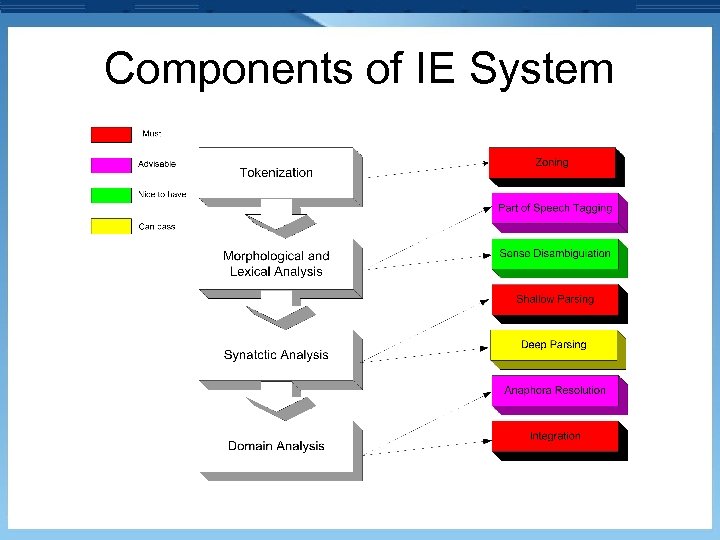 Components of IE System
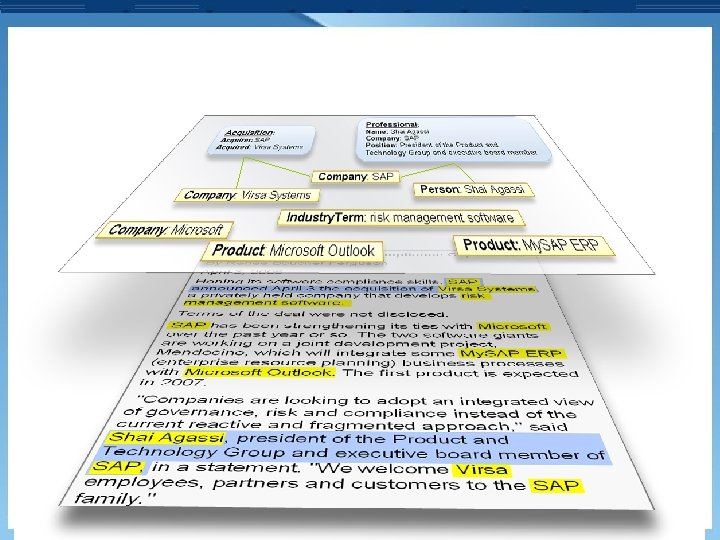
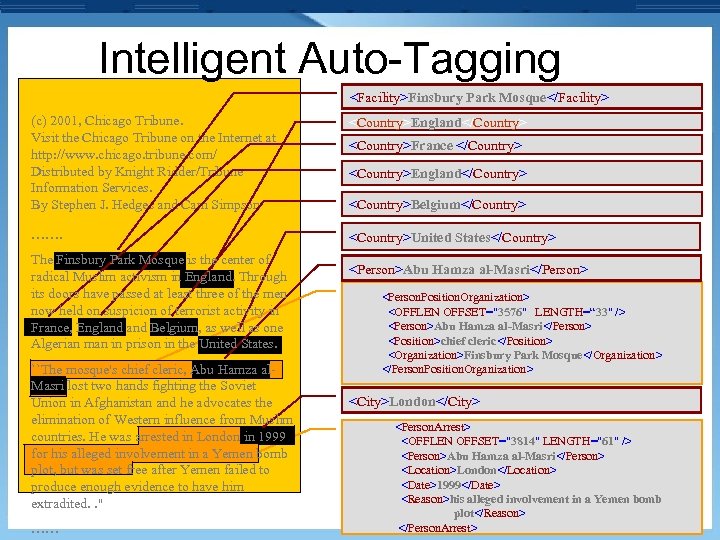 Intelligent Auto-Tagging
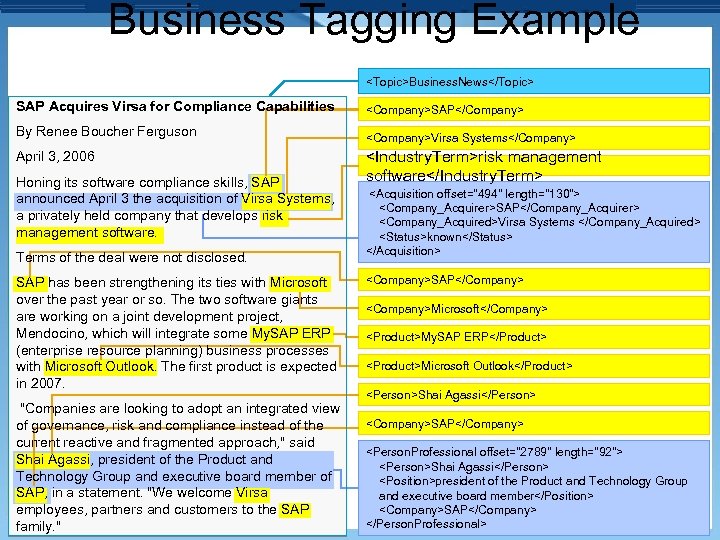 Business Tagging Example
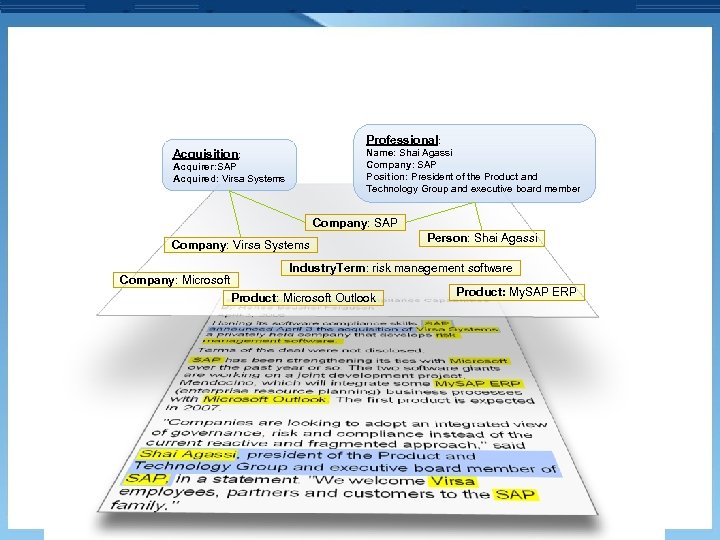 Professional: Name: Shai Agassi Company: SAP Position: President of the Product and Technology Group and executive board member Acquisition: Acquirer: SAP Acquired: Virsa Systems Company: SAP Company: Virsa Systems Company: Microsoft Person: Shai Agassi Industry. Term: risk management software Product: Microsoft Outlook Product: My. SAP ERP
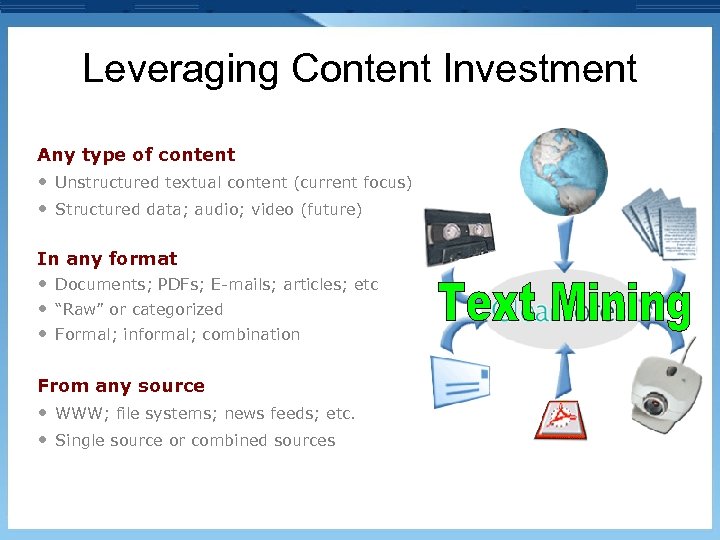 Leveraging Content Investment Any type of content • Unstructured textual content (current focus) • Structured data; audio; video (future) In any format • Documents; PDFs; E-mails; articles; etc • “Raw” or categorized • Formal; informal; combination From any source • WWW; file systems; news feeds; etc. • Single source or combined sources
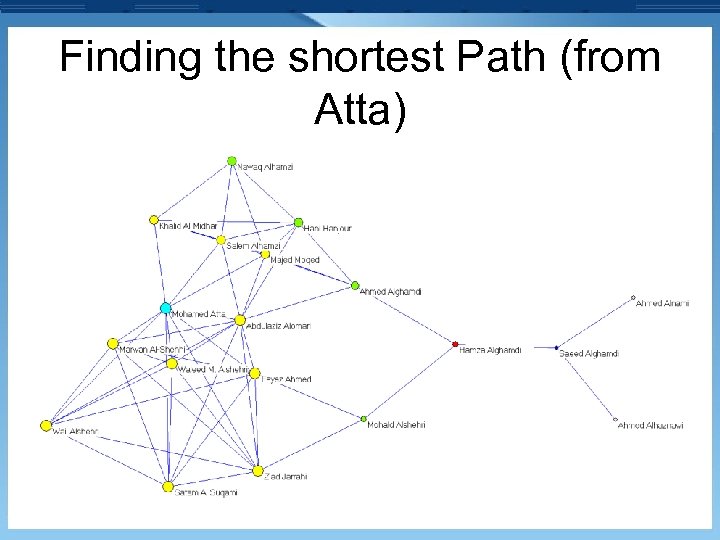
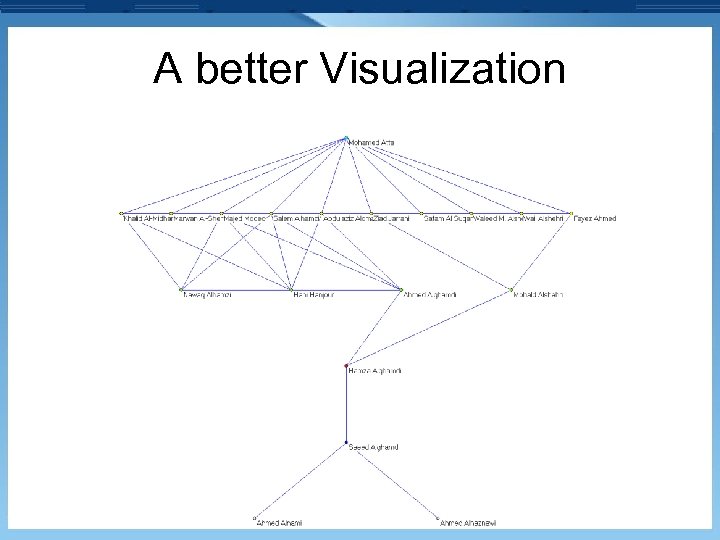
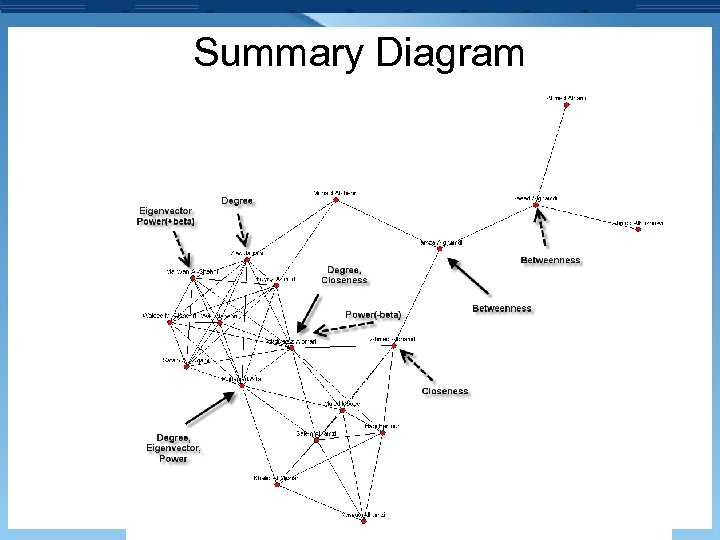
 Link Analysis in Textual Networks
 Running Example
 Kamada and Kawai’s (KK) Method
 Finding the shortest Path (from Atta)
 A better Visualization
 Summary Diagram
 Information Extraction Theory and Practice
 What is Information Extraction? • IE does not indicate which documents need to be read by a user, it rather extracts pieces of information that are salient to the user's needs. • Links between the extracted information and the original documents are maintained to allow the user to reference context. • The kinds of information that systems extract vary in detail and reliability. • Named entities such as persons and organizations can be extracted with reliability in the 90 th percentile range, but do not provide attributes, facts, or events that those entities have or participate in.
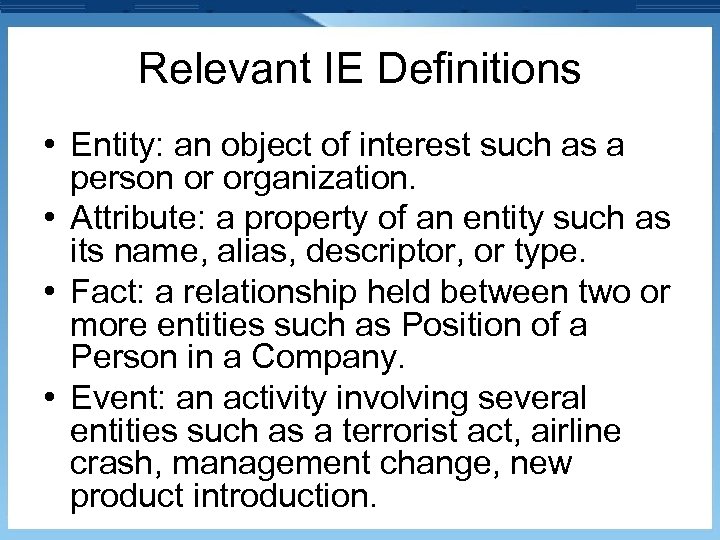 Relevant IE Definitions • Entity: an object of interest such as a person or organization. • Attribute: a property of an entity such as its name, alias, descriptor, or type. • Fact: a relationship held between two or more entities such as Position of a Person in a Company. • Event: an activity involving several entities such as a terrorist act, airline crash, management change, new product introduction.
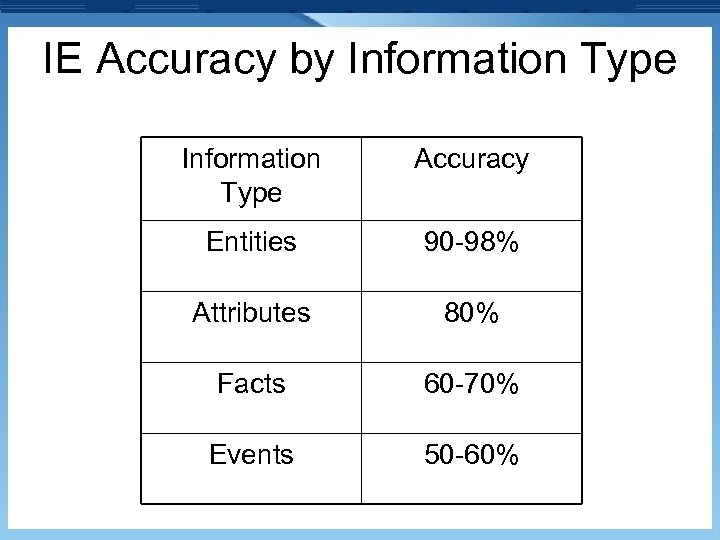 IE Accuracy by Information Type Accuracy Entities 90 -98% Attributes 80% Facts 60 -70% Events 50 -60%
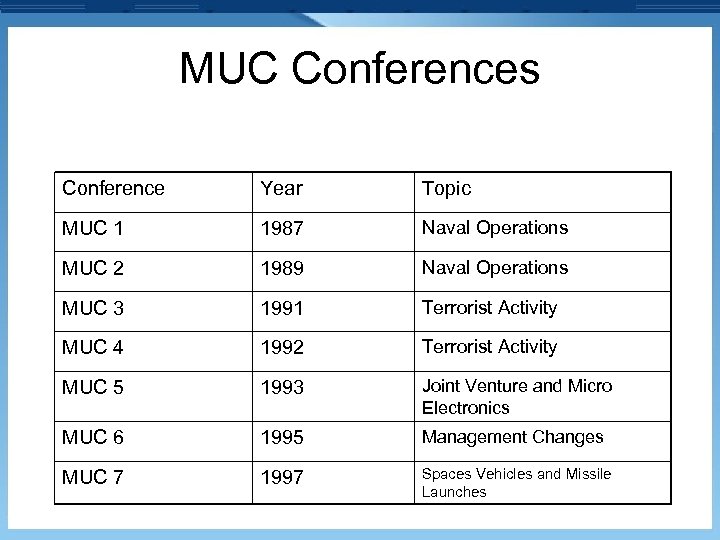 MUC Conferences Conference Year Topic MUC 1 1987 Naval Operations MUC 2 1989 Naval Operations MUC 3 1991 Terrorist Activity MUC 4 1992 Terrorist Activity MUC 5 1993 Joint Venture and Micro Electronics MUC 6 1995 Management Changes MUC 7 1997 Spaces Vehicles and Missile Launches
 Applications of Information Extraction • Routing of Information • Infrastructure for IR and for Categorization (higher level features) • Event Based Summarization. • Automatic Creation of Databases and Knowledge Bases.
 Approaches for Building IE Systems • Knowledge Engineering Approach – Rules are crafted by linguists in cooperation with domain experts. – Most of the work is done by inspecting a set of relevant documents. – Can take a lot of time to fine tune the rule set. – Best results were achieved with KB based IE systems. – Skilled/gifted developers are needed. – A strong development environment is a MUST!
 Approaches for Building IE Systems • Automatically Trainable Systems – The techniques are based on pure statistics and almost no linguistic knowledge – They are language independent – The main input is an annotated corpus – Need a relatively small effort when building the rules, however creating the annotated corpus is extremely laborious. – Huge number of training examples is needed in order to achieve reasonable accuracy. – Hybrid approaches can utilize the user input in the development loop.
 Sentiment Analysis from User Forums Ronen Feldman Information Systems Department School of Business Administration Hebrew University, Jerusalem, ISRAEL Ronen. Feldman@huji. ac. il
 Research Objective – Can we use the Web as a marketing research playground? – Uncovering market structure from information consumers are posting on the web – An example of the rapidly growing area of sentiment mining
 What are we going to do? • Text mine consumer postings • Use network analysis framework and other methods of analysis to reveal the underlying market structure
 Example Applications ¨ Three applications Running shoes (“professionals” community) Sedan cars (mature and common market) i. Phone (innovation, pre-during-after launch)
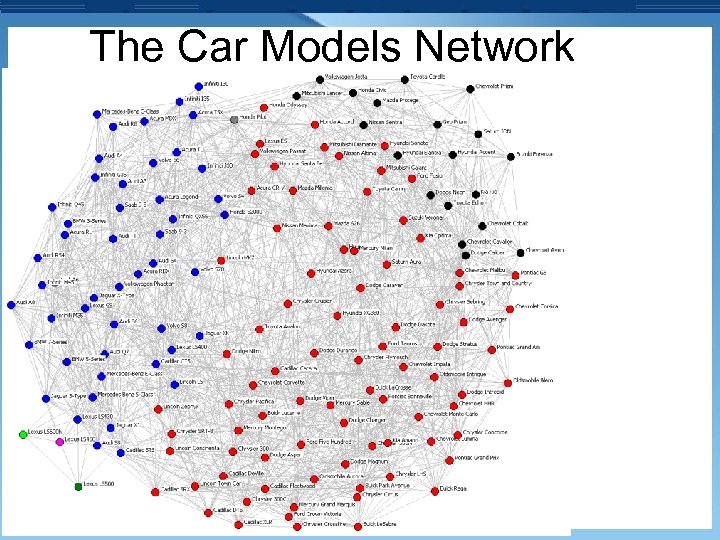 The Car Models Network
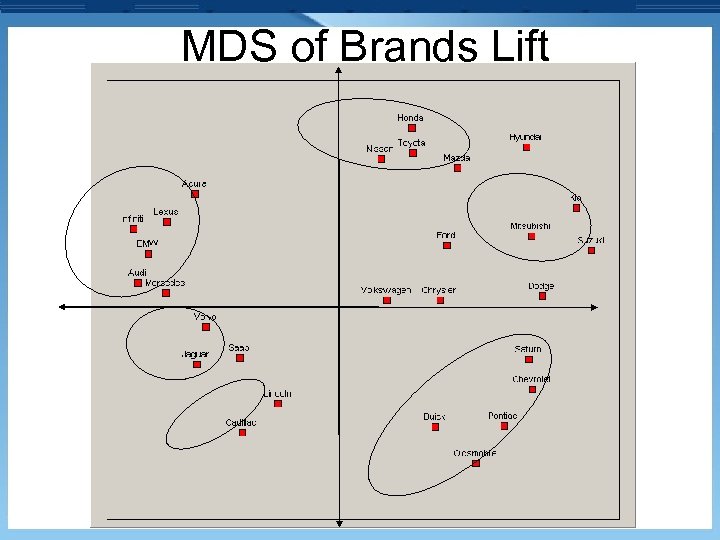 MDS of Brands Lift
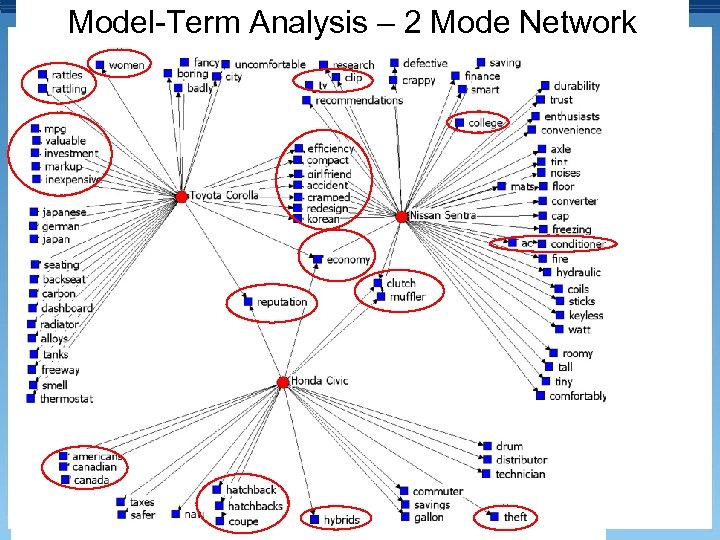 Model-Term Analysis – 2 Mode Network
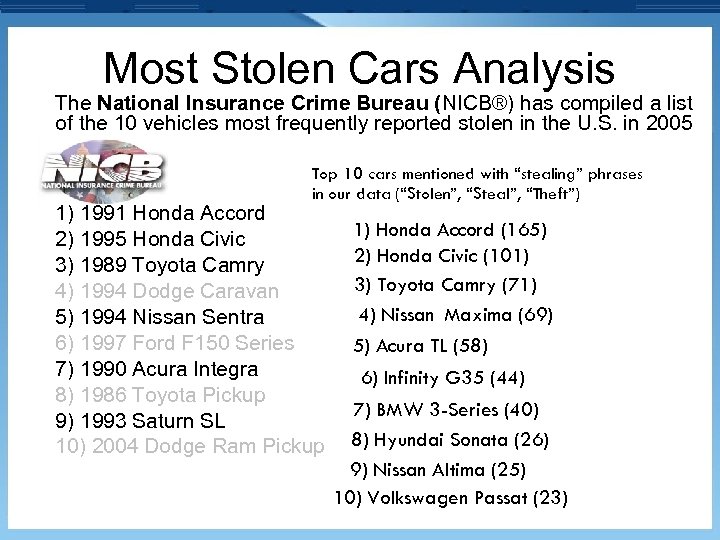 Most Stolen Cars Analysis The National Insurance Crime Bureau (NICB®) has compiled a list of the 10 vehicles most frequently reported stolen in the U. S. in 2005 Top 10 cars mentioned with “stealing” phrases in our data (“Stolen”, “Steal”, “Theft”) 1) 1991 Honda Accord 1) Honda Accord (165) 2) 1995 Honda Civic 2) Honda Civic (101) 3) 1989 Toyota Camry 3) Toyota Camry (71) 4) 1994 Dodge Caravan 4) Nissan Maxima (69) 5) 1994 Nissan Sentra 6) 1997 Ford F 150 Series 5) Acura TL (58) 7) 1990 Acura Integra 6) Infinity G 35 (44) 8) 1986 Toyota Pickup 7) BMW 3 -Series (40) 9) 1993 Saturn SL 10) 2004 Dodge Ram Pickup 8) Hyundai Sonata (26) 9) Nissan Altima (25) 10) Volkswagen Passat (23)