


 Скачать презентацию Practical risk management Stuart Lawson April 2013
Risk. Is it in you.pptx
- Количество слайдов: 54
 Practical risk management Stuart Lawson April 2013
 Contact Stuart Lawson, Executive Director Tel. : +7 (495) 662 -9312 E-mail: Stuart. Lawson@ru. ey. com ► 35 years in banking in EM and OECD. ► 25 years in Citibank in 11 countries including 10 as crisis manager. ► 15 years in Russia as CEO/Chairman Citibank, Deltabank, Banks Soyuz, HSBC, director Trust, Menatep. ► Chairman AEB Finance and Investment, Deputy Chairman The. City. UK Russia stream, Supervisory Board IDA. Page 2 Practical risk management
 How to take risk?
 A practitioner’s course ► What is risk? A vocabulary. ► Risk management, how to maximise appropriate returns. ► Black swans can get in the way. ► Risk tools, the quadrants and heat map. Page 4 Practical risk management
 Heads or Tails?
 What is risk? ► Flip a coin, no financial outcome, does it have risk? (flipped coins have no memory) ► Interest in outcome creates concept of financial risk. ► Risk must deal with concept of loss but is inherent in the concept of profitability. Page 6 Practical risk management
 What types of risk? ► Across a broad spectrum. ► External, outside your control. ► Within your control. ► The element of context and time. ► Types of risks. ► The constituents. ► The role of the board. Page 7 Practical risk management
 Risks you don’t control ► Macroeconomic, financial markets, domestic, international. ► Political, cross border. ► Industrial, cyclical, paradigm. ► Technological progress ► Business environment, local customs. ► Legal and regulatory. ► Acts of nature. Page 8 Practical risk management
 Risks you do control ► Financial within company. ► Company strategy and tactics. ► Technology, systems, IT security. ► Operational, across all processes. ► Management, key man and team. ► Reputational and PR. ► Legal (not environmental). Page 9 Practical risk management
 Industrial ► Innovations can create new paradigm. ► Market dominance and impact on price led or followed. ► Supply chain changes and flexibility. ► Cyclical or not, correlated to what factors (input prices, within without control). Page 10 Practical risk management
 Political ► Socio economic factors, short term elections, long term demographics. ► Can have broad repercussions across all industries and trading profiles. ► Impacts demand foreign direct investment. ► Cross border concepts and pricing. Impact of aggressive market positioning. Page 11 Practical risk management
 Company ► Dependent on corporate organisation, might be single entity, group or part of group. ► Driven by company specific tactics or strategy. ► Internal risk management failure. ► Relationships with employees. ► Impact of counterparty, suppliers, tax, banks. ► Risk profile of specific corporate. Page 12 Practical risk management
 Finance ► Balance between risk and return on capital, leverage ► Availability of liquidity resources during period of risk. ► Ability to extend trade creditors etc ► Crisis management and restructuring protocols. ► Shareholder support. Page 13 Practical risk management
 Technology ► Differing profiles of vulnerability to technology but always essential. Correct infrastructure regularly reviewed, properly documented ► Importance of appropriate MIS, training. ► Information security, vulnerability to internet and vendors. business continuity. ► Competitive map, what developments are needed to keep up? IT implementation ► Danger of the techies not understood by board, management. Competence to understand. Page 14 Practical risk management
 Operational risk ► Holistic view of all aspects of the environment, what could go wrong? ► Protocols in place to govern intersection of entity with external events. ► A ‘what if’ set of action plans to address development of differing levels of risk. ► Physical risk to plant and employees. ► Intersection with technology, importance of processes. Page 15 Practical risk management
 Management risk ► Misaligned organisational structures. ► Role of KPI’s. ► Key man risk, role of succession planning. ► Importance of corporate culture to bridge ‘gaps’. Page 16 Practical risk management
 Legal risk ► Enforceability of ownership rights fundamental to entrepreneurship. ► Regulation of rights between constituents. ► Trademarks, IP. ► Overly strong creditor rights enabling banks to seize assets. ► Unclear legal environment with changing laws. ► Corruption. Page 17 Practical risk management
 Reputational ► Enhances or diminishes brand value and ability to super price. ► Cuts across all business lines. ► Subject to event risk, importance of tight public relations. ► Requires clearly delineated ‘rules of road’ for interaction with media. ► Once broken, extremely difficult, costly and time consuming to repair. Page 18 Practical risk management
 PR ► Once out, particularly on internet, you can’t put it back ► It develops a momentum of its own ► Can be controlled by competitors ► Impact on brand value ► Who controls the ‘storyline’ Page 19 Practical risk management
 Perspective, context and time ► Experience is memory based and we have selective memories. ► History will influence the view of risk (eg been lucky in the past). ► Representative bias, that things should make sense. ► Risk does not take place in a vacuum (competitors, macro, industry). Page 20 Practical risk management
 Types of risk ► Market versus firm specific. ► Continuous versus event risk. ► Catastrophic versus smaller risk. ► Risks don’t have same rankings over time. ► ‘Chemistry’ of risks, not predictable. Page 21 Practical risk management
 Who are the constituents? ► The management ► The customers ► The regulators ► The employees ► The shareholders Page 22 Practical risk management
 Role of board in risk ► Management board ► Set up the vocabulary of risk. ► Dialogue with the supervisory board to set return parameters. ► Create and enforce control environment ► Supervisory board ► Represents the interests of the shareholders. ► Approves the overall risk and reward appetite. Page 23 Practical risk management 23
 Risk management, a balancing act….
 What to do with risk? ► Avoid, strategic or tactical repositioning. ► Transfer, economically, to customers, banks, insurance companies. ► Mitigate, operational controls, redundancy systems. ► Keep. ► Maximise. An appropriate return for risk taken Page 25 Practical risk management
 Dangers of risk management ► Wrong risk culture means faster to wrong conclusions, the herd mentality. ► Wrong input, wrong output (credit scoring Russia). ► Enables increased risks to systemic level. ► Can be used to disguise underlying risks. ► By changing shape of cash flow, may benefit one constituent at expense of another (compensation and career path). Page 26 Practical risk management 26
 …if you get it right ► Grow faster at more efficient rate of capital. ► Lengthens growth period. ► Impacts the default rate and therefore cost of debt. ► Creates a greater upside opportunity where the firm focuses on areas where it has competitive advantage. ► Allows stability of earnings that may be reflected in market valuation. ► Tax impact of earnings smoothing, reduces tax on excessive profit. Page 27 Practical risk management
 Black swan risk
 Black swan, what is it? ► An outlier, outside normal expectations, rarity (the fat tail). ► Carries an extreme impact. ► Human nature causes us to explain why it occurred AFTER the event. ► Non occurance of the probable. ► Differing timeframes (earthquakes and internet). ► Unknown unknowns. Page 29 Practical risk management
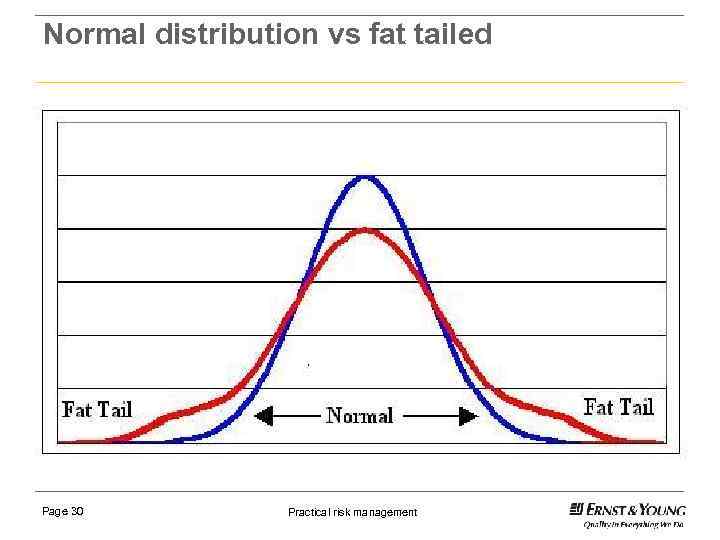 Normal distribution vs fat tailed Page 30 Practical risk management
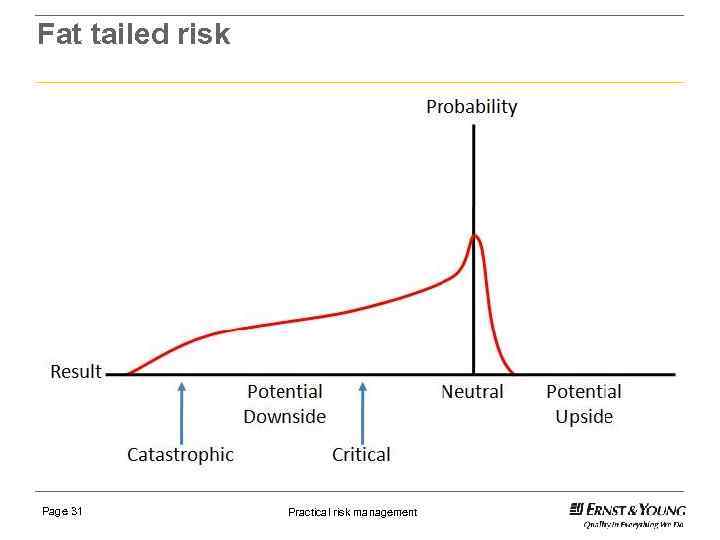 Fat tailed risk Page 31 Practical risk management
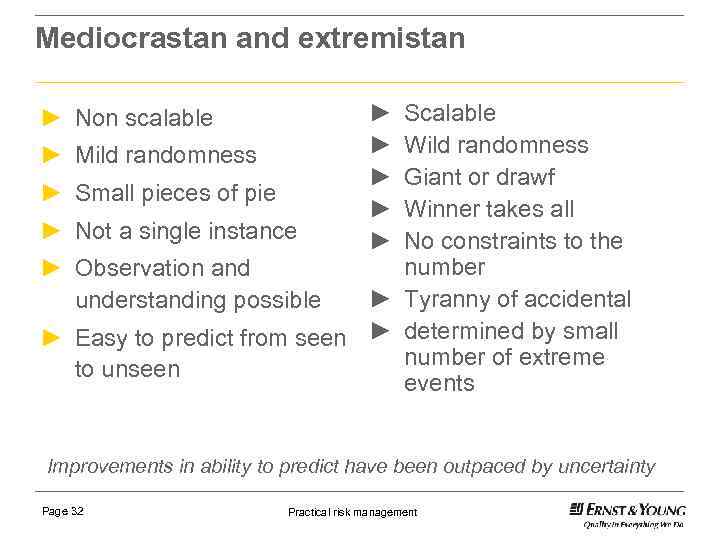 Mediocrastan and extremistan ► ► ► ► ► Scalable Wild randomness Mild randomness Giant or drawf Small pieces of pie Winner takes all Not a single instance No constraints to the number Observation and ► Tyranny of accidental understanding possible Easy to predict from seen ► determined by small number of extreme to unseen events ► Non scalable Improvements in ability to predict have been outpaced by uncertainty Page 32 Practical risk management
 And so? ? ? ► Allowing unexpected to happen key to success. ► Importance of trial and error, be as exposed as possible to chance encounters. ► Key to success is not always skills doesn’t mean skills not relevant. ► Can deliver black swans after thousands of white swans (the past does not predict the future, as a turkey around Thanksgiving). ► BS unpredictable consequences, retrospective explainability. ► Won’t know the unknown but maximise upside exposure to it. ► Preparedness not prediction, chance favours the prepared. Focus on consequences not probability Page 33 Practical risk management
 Four quadrants of risk
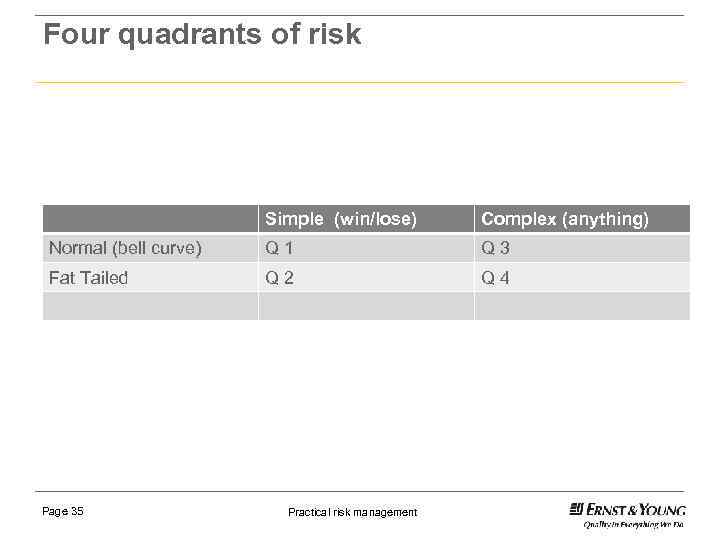 Four quadrants of risk Simple (win/lose) Complex (anything) Normal (bell curve) Q 1 Q 3 Fat Tailed Q 2 Q 4 Page 35 Practical risk management
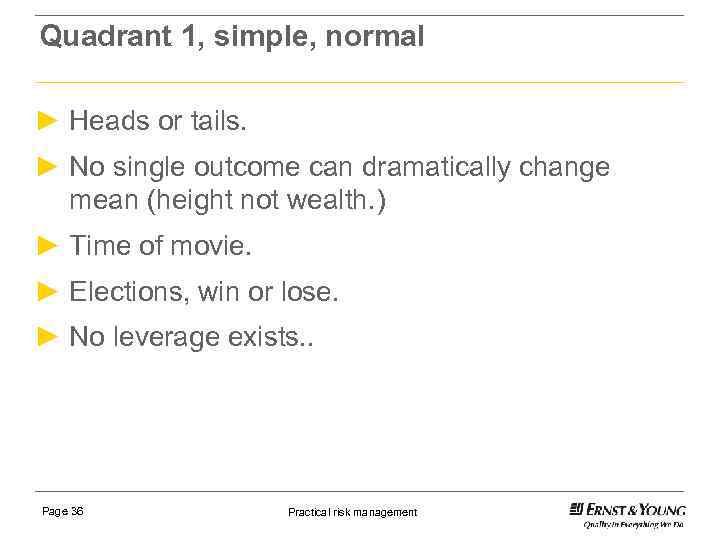 Quadrant 1, simple, normal ► Heads or tails. ► No single outcome can dramatically change mean (height not wealth. ) ► Time of movie. ► Elections, win or lose. ► No leverage exists. . Page 36 Practical risk management
 Quadrant 1 tools ► Probabilities from historical data work well. ► No outlier, surprises. ► At risk type models work well (VAR). Page 37 Practical risk management
 Quadrant 2, simple, fat tailed ► Payoff simple (happens or not). ► Able to understand the outcomes of events that might happen. ► Manageable risks. ► Apple (Q 1) coconut (Q 2) trees. ► Shark attack. ► Oil spills. ► Define risks. Page 38 Practical risk management
 Quadrant 2 tools ► Do not understand the distribution of risks well. ► Do not know when a dramatic event may occur. ► But we do know the consequences. ► Don’t know timing or how bad. . ► If size matters and timing everything, we have a problem. ► Generally the risks can be managed, rules based, reduce, cap, mitigate. Page 39 Practical risk management
 Q 3, complex, normal distribution ► No leverage. ► Outcome predictable with high level of certainty. ► Errors mostly human not physical ► O rings on challenger. ► Auto parts, complex machinery. ► Lunar expedition. ► Are historical statistics reliable guide? Page 40 Practical risk management
 Quadrant 3 tools ► Resilient, redundancy, fail safe systems. ► Are the tails really thin or is it a lack of historical data (ie are we fooling ourselves). ► True Quadrant 3 risks can be managed around. Page 41 Practical risk management
 Q 4 complex, fat tailed ► Black swan territory. ► Infrequent but massive impact. ► Leverage is often excessive. ► Risk models dont work. ► Extremistan. ► Social impact high (job loss, government fail). ► Dont rely on statistics or models. Page 42 Practical risk management
 Quadrant 4 tools ► We cannot manage or model the unknown risks of Q 4. ► Limit the downside risk contractually. ► Reduce the impact of relationships and complexities we do not understand. ► Build in redundancies, train. Page 43 Practical risk management 43
 Risk tools
 Over the horizon, strategic ► Longer the horizon, more strategic needs more discussion and challenge to historical bias. ► Challenge the output with independent experts. ► Small cross functional risk team that collates silo’s information and looks for patterns etc. ► Maps of potential risk and response. Page 45 Practical risk management
 External ► External, uncontrollable risks (black swans excluded). ► Stress testing, but watch out for recent history (eg USA real estate) causing myopia ► Scenario planning, define time horizon, which events will have maximum impact on company (watch out for over optimism). ► War gaming, teams develop what competitors (actual and potential) could do to disrupt plan. Page 46 Practical risk management
 Preventable, predictable risks ► Compliance, rules based systems with appropriate exceptions (important to know who can make the call). ► Standard operating procedure and clear internal culture around strong mission statement ► Integrated risk management alongside line, but beware of ‘going local’ ► Checked with internal audit, line reviews Page 47 Practical risk management
 Some tools ► Scenarios, separate risks, three outcomes ► Decision trees, separate risks, many outcomes ► Scenario planning, continuous risk, correlated, built into each simulation Page 48 Practical risk management
 Practical approach to risk management ► Make inventory of all risks, categorise them ► Quantify risk for entity, high, medium, low ► Manage the downside whilst maximising the upside. Decide which risks to hedge, which to pass through to investors. Cost versus impact. ► What risk hedging products are available, correlation? ► Which risks can be handled better than competition? ► Create strategies to maximise exposure to risks which entity can better handle Page 49 Practical risk management 49
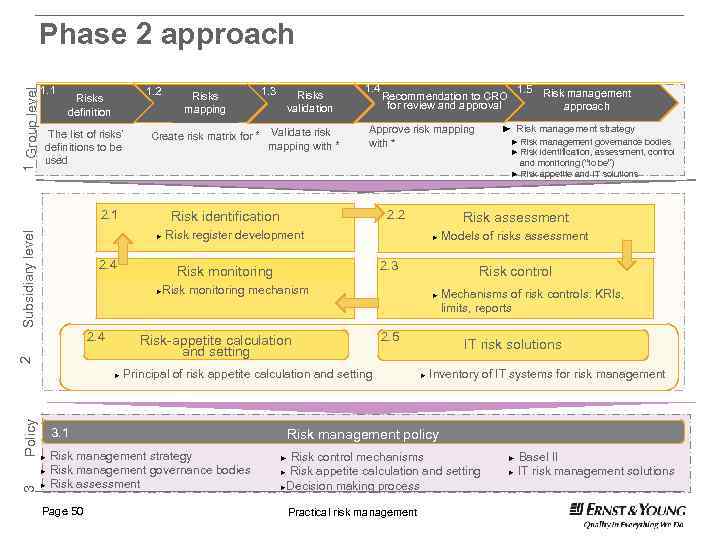 1 Group level Phase 2 approach 1. 1 1. 2 Risks definition The list of risks’ definitions to be used Risks mapping 1. 4 1. 5 Risk management approach Recommendation to CRO for review and approval ► Risk management strategy Approve risk mapping with * ► Risk management governance bodies ► Risk identification, assessment, control and monitoring (“to be”) ► Risk appetite and IT solutions Subsidiary level 2. 2 Risk identification ► 2. 4 Risk assessment Risk register development ► 2. 3 Risk monitoring mechanism 2 Risk-appetite calculation and setting ► 3. 1 Risk management strategy ► Risk management governance bodies ► Risk assessment ► Page 50 ► 2. 5 Principal of risk appetite calculation and setting Models of risks assessment Risk control ► 2. 4 Policy Risks validation Create risk matrix for * Validate risk mapping with * 2. 1 3 1. 3 Mechanisms of risk controls: KRIs, limits, reports IT risk solutions ► Inventory of IT systems for risk management Risk management policy Risk control mechanisms Risk appetite calculation and setting ►Decision making process ► ► Practical risk management Basel II IT risk management solutions
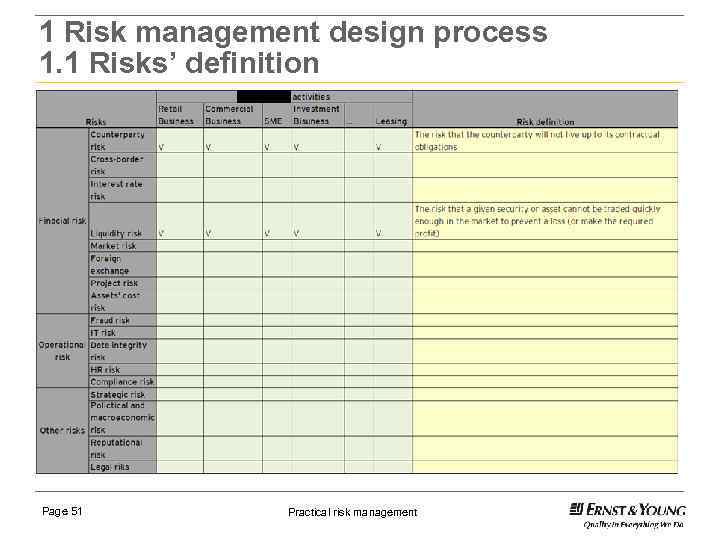 1 Risk management design process 1. 1 Risks’ definition Page 51 Practical risk management
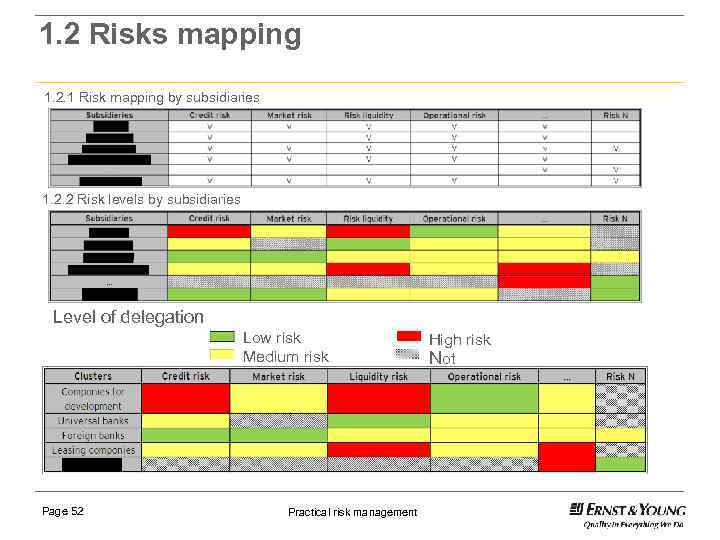 1. 2 Risks mapping 1. 2. 1 Risk mapping by subsidiaries 1. 2. 2 Risk levels by subsidiaries Level of delegation Low risk Medium risk 1. 2. 3 Risk levels by clusters Page 52 Practical risk management High risk Not applicable
 Conclusion ► Before you have the discussion, create the vocabulary. ► Create a broad log of all risks. ► Ensure that all constituents participate. ► Map risks against quadrants. ► Review appropriate actions against each set of risks. ► Schedule regular reviews, risks change over time. Page 53 Practical risk management
 Thank you !