


 Скачать презентацию Practical lesson 10 Topic Theory and technology of
Practical lesson #10.pptx
- Количество слайдов: 20
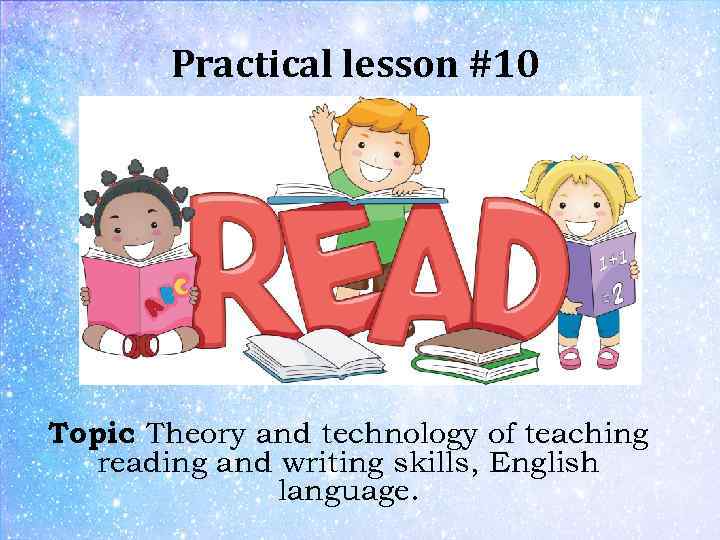 Practical lesson #10 Topic Theory and technology of teaching : reading and writing skills, English language.
 Key special words • reading and writing skills, reading strategies, storytelling, ask questions, answer, skimming and scanning, writing strategies, dictation, essay, Russian, Kazakh, English language, written speech, literary reading, ABC, letter, sound, word, sentence, paragraph, text, capital letter, four speech activities (reading, writing, listening, speaking), spelling, literature, children authors, fiction, fairytale, narrator, folklore, poem, poetry, tale, legend, myth, diary, bibliography, encyclopedia, excerpt, glossary, prologue, epilogue, plagiarism, eulogy, drama, tragedy, dialogue, monologue, playwright, play, theatre, critical writing, creative writing, glossary, vocabulary
 Answer the questions: • Do you like reading? • What is your favourite book (s)? • What is your favourite book character? • What is your favourite film adaption of the book? • What English and American children writers do you know?
 Assignments • Translate the key words of practical lesson #10 • Practice their reading • Record your reading these key words with translation • Learn the questions and answer them (write in your notebook). Record your reading. • Work with the film ‘Alice in Wonderland’. • Choose 5 tongue twisters and read them as fast as you can. • Didactic cinquain.
 What can you do to develop as a teacher? • • • I can try a blind observation. I can keep a teaching diary. I can talk to other teachers. I can read about my profession in teaching journals, books, online articles, blogs, etc. I can try team teaching. I can give a workshop at my school. I can start a professional community. I can pass (пройти) professional training. I can try new ideas and look for ways to learn more about your profession.
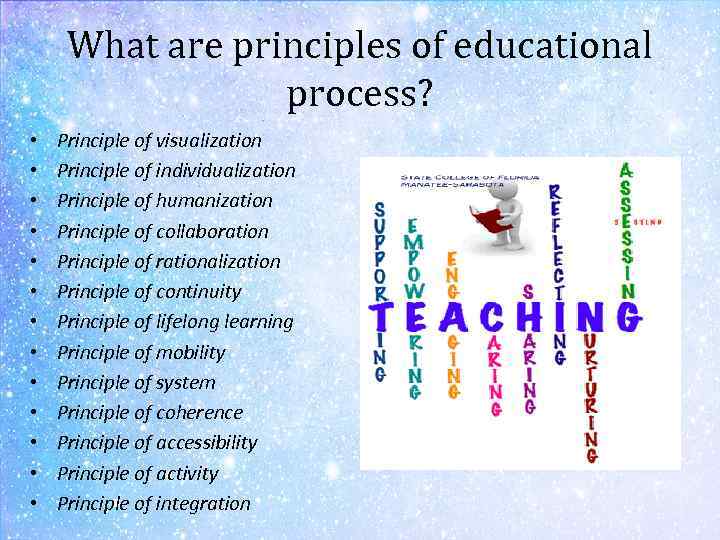 What are principles of educational process? • • • • Principle of visualization Principle of individualization Principle of humanization Principle of collaboration Principle of rationalization Principle of continuity Principle of lifelong learning Principle of mobility Principle of system Principle of coherence Principle of accessibility Principle of activity Principle of integration
 • There are main, extra and auxiliary forms of organizing educational process. • The main form of organizing educational process is a lesson. • There are 2 types of lesson: traditional (for example) and non-traditional. • The extra forms include (включают в себя) … • The auxiliary forms include … What are forms of organizing educational process?
 Questions: • What traditional methods of teaching do you know? • What non-traditional methods of teaching do you know? • What traditional educational technologies do you know? • What non-traditional educational technologies do you know? • What author’s educational technologies do you know?
 Six thinking hats deal with – иметь дело White hat deals with information and facts. Red hat deals with emotion, feelings and intuition. Yellow Hat deals with brightness and optimism. Black Hat deals with judgment, critic and disadvantages. Green Hat deals with creativity, possibilities and new ideas. • Blue Hat deals with management of thinking process. • • •
 Read tongue twisters as fast as you can: • • • A big black bug bit a big black bear, A big black bear bit a big black bug. A box of biscuits, a batch of mixed biscuit. It appears that peers prefer pears particularly if pears are presented in pairs. Tomorrow is the third Thursday of this month. Thirty thousand thirsty snakes thirstily drank three thousand lakes. Whether the weather is cold, or whether the weather is hot, We’ll be together whatever the weather, whether we like it or not. I thought a thought. But the thought I thought wasn’t the thought I thought. Flee from fog to fight flu fast! Red lorry, yellow lorry, red lorry, yellow lorry. ‘Round and ‘round the rugged rocks the raggedly rascal ran.
 Read tongue twisters as fast as you can: • These sheep shouldn’t sleep in a shack; sheep should sleep in a shed. • A sailor went to the sea To see what he could see, And all that he could see, Was sea, sea. • The sun shines on the shop signs. • Swan swam over the sea, Swim, swan, swim; Swan swam back again, Well swum, swan! • I wish to wish the wish you wish to wish, but if you wish the witch wishes, I won’t wish the wish you wish to wish. • Once a fellow met a fellow In a field of beans. Said a fellow to a fellow, “If a fellow asks a fellow, Can a fellow tell a fellow What a fellow means? ” • I scream, you scream, we all scream for ice cream! • Do tongue twisters twist your tongue?
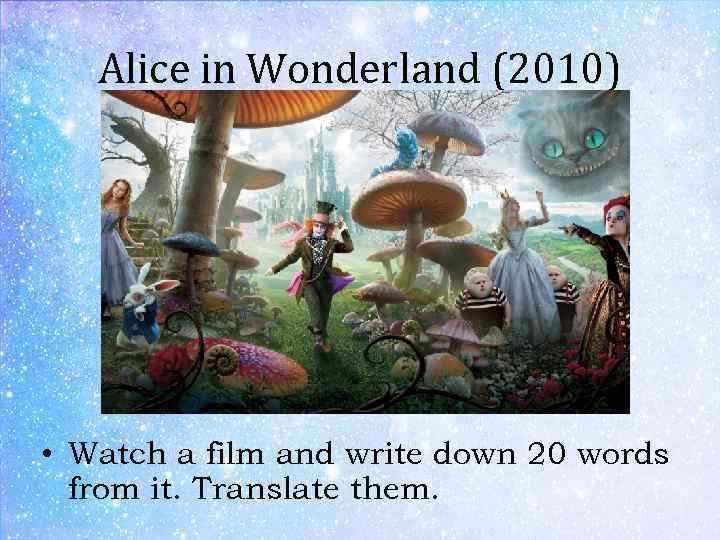 Alice in Wonderland (2010) • Watch a film and write down 20 words from it. Translate them.
 Answer the questions (written) • Who wrote ‘Alice in Wonderland’ (writer)? • Who is film-director of Alice in Wonderland (2010)? • What are the main characters of Alice in Wonderland (2010)? (write in English and Russian/ Kazakh) • Describe each character in short.
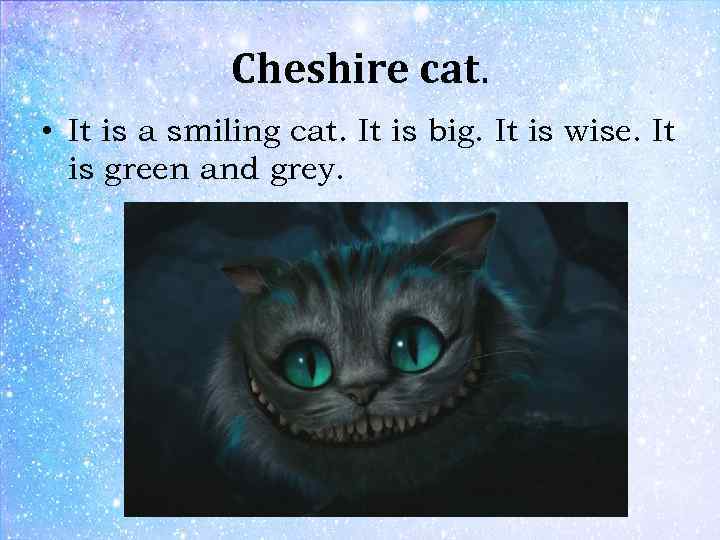 Cheshire cat. • It is a smiling cat. It is big. It is wise. It is green and grey.
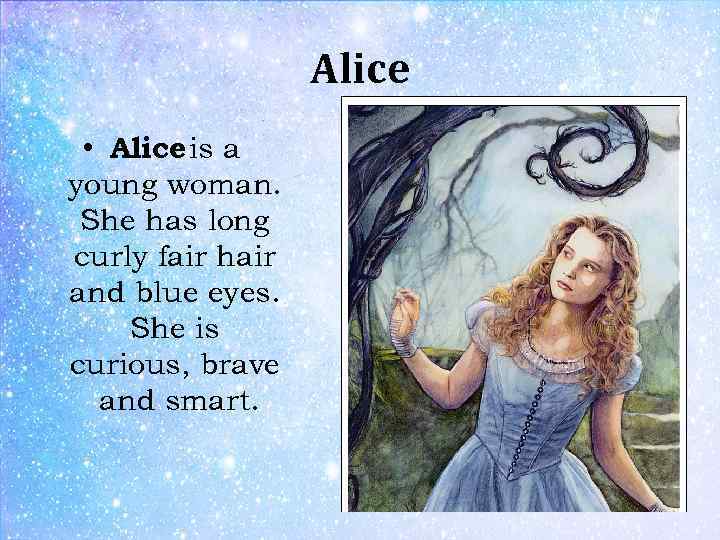 Alice • Alice is a young woman. She has long curly fair hair and blue eyes. She is curious, brave and smart.
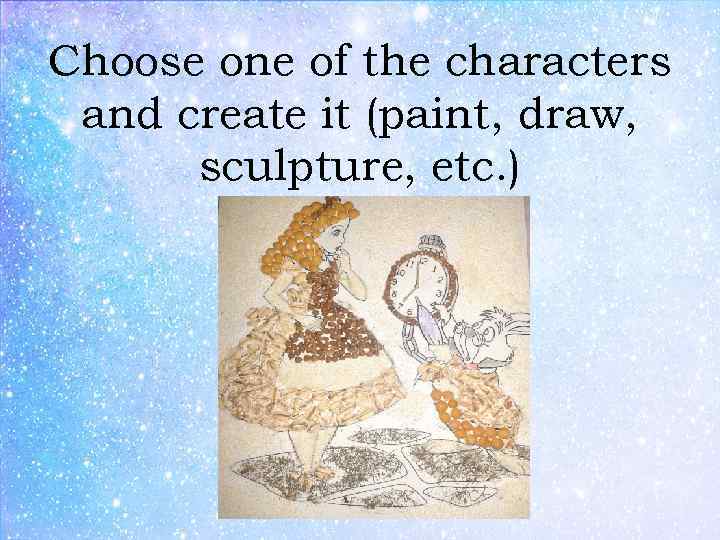 Choose one of the characters and create it (paint, draw, sculpture, etc. )
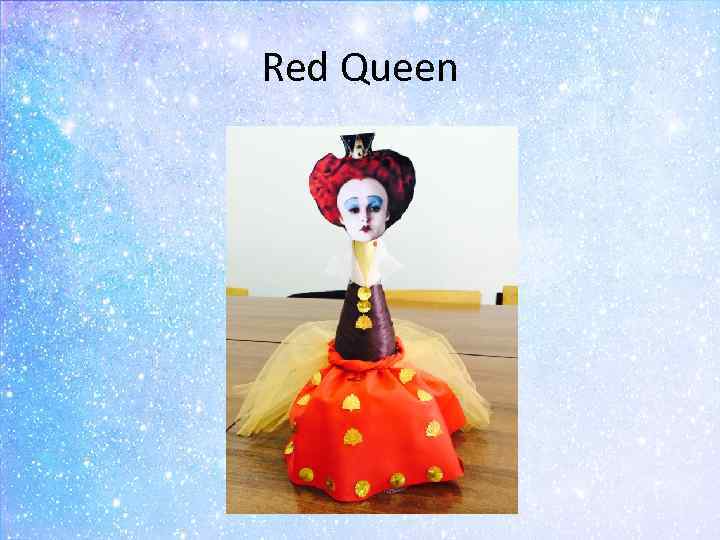 Red Queen
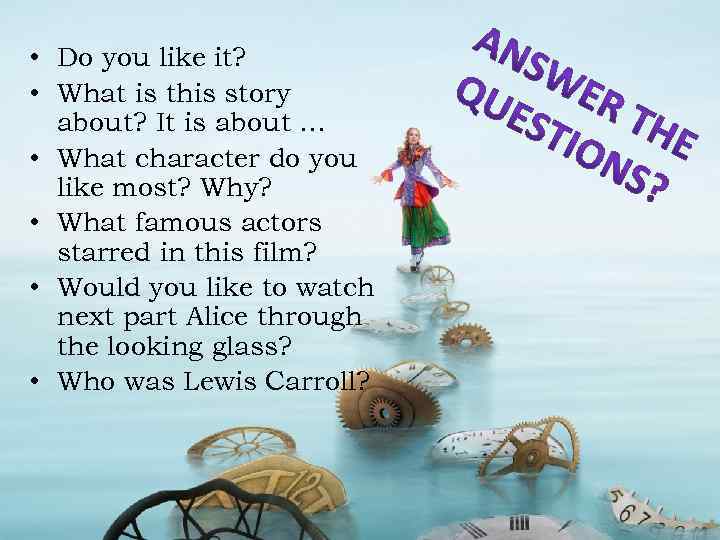 • Do you like it? • What is this story about? It is about … • What character do you like most? Why? • What famous actors starred in this film? • Would you like to watch next part Alice through the looking glass? • Who was Lewis Carroll?
 Didactic cinquain • • • Structure Topic 2 describing adjectives 3 verbs Your opinion (4 words) General idea (1 word) • • For example: Snow Silent, white Dancing, falling, drifting Covering everything it touches Blanket Topics for cinquain: rain, weather, Cinderella, Wonderland, family, learning, reading, writing, foreign language, space
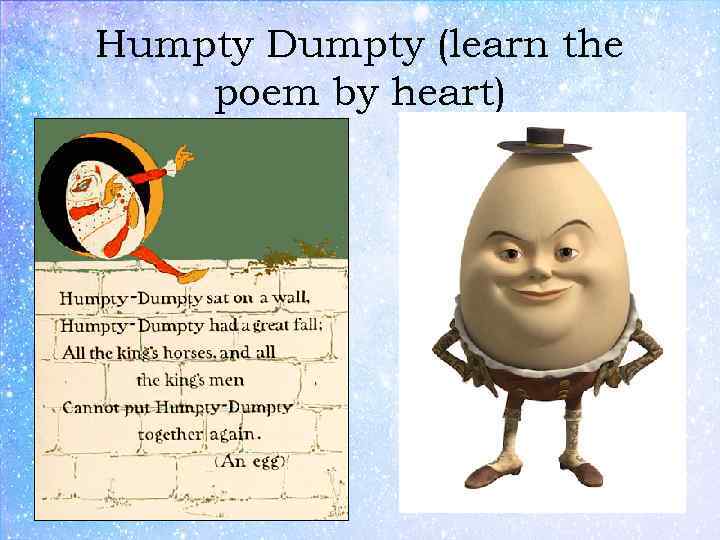 Humpty Dumpty (learn the poem by heart)