 Скачать презентацию Practical Goal-based Reasoning in Ontology-Driven Applications Huy Pham
31e8791f512d2e59938ee3c791496db4.ppt
- Количество слайдов: 15



Practical Goal-based Reasoning in Ontology-Driven Applications Huy Pham & Deborah Stacey School of Computer Science University of Guelph, Ontario, Canada
Quick Overview • A more practical way to do planning in ontologydriven applications • Some interesting challenges, and some (hopefully) interesting ideas • Result: A reusable integration framework for bringing planning into onto-driven apps Slide 2 of 15 Knowledge Engineering and Ontology Development 2011
Motivation • Today's intelligent systems are knowledgeintensive • And would benefit from an onto-driven approach • Standardized semantics Reusable • KB built for one app is understood by many others • Expressive Rich models • Reasoning services Modular models • Problem: Inadequate reasoning support Slide 3 of 15 Knowledge Engineering and Ontology Development 2011
Onto Reasoning vs Goal-based Reasoning • Reasoning about structure vs reasoning about actions “Is this class a subclass of that class? ” vs “Is there a way to get to the goal state? ” • Static vs Dynamic • Tableaux (DL, Open-world) vs Resolution (LP, Closed-world) Slide 4 of 15 Knowledge Engineering and Ontology Development 2011
Existing Approaches Language-based Approaches • Idea: • Modify/Extend/Restrict DL to provide rule-based support • SWRL, DLP, etc. • Very challenging • Theoretical: Decidability, Boundary, etc. • Practical: Tooling support, User acceptance, etc. • Awaiting more case studies Slide 5 of 15 Knowledge Engineering and Ontology Development 2011
Existing Approaches Parallel Modeling Approaches Idea • Model application knowledge in ontologies • Model planning-related knowledge in a planning language • Have planning programs query the ontologies at runtime Challenges • KBs in two languages • System developers have to be well-versed in both • Integration is more likely to be app-specific Slide 6 of 15 Knowledge Engineering and Ontology Development 2011
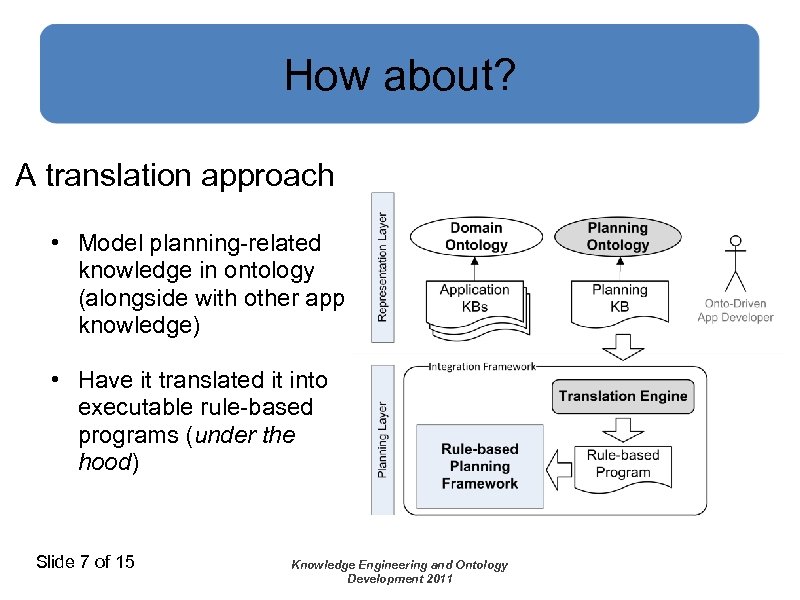
How about? A translation approach • Model planning-related knowledge in ontology (alongside with other app knowledge) • Have it translated it into executable rule-based programs (under the hood) Slide 7 of 15 Knowledge Engineering and Ontology Development 2011
Crazy Ideas? • Perhaps! • But planning KBs are now ontology-based • • Universally understood/reusable by other apps Smaller risk of being “stuck” in a non-mainstream language Make use of existing and mature tool and frameworks Total independence from the underlying planning framework • Also, user does not need to learn/worry about the underlying planning formalism • Partially investigated by Rajpathak et al and Gil et al Slide 8 of 15 Knowledge Engineering and Ontology Development 2011
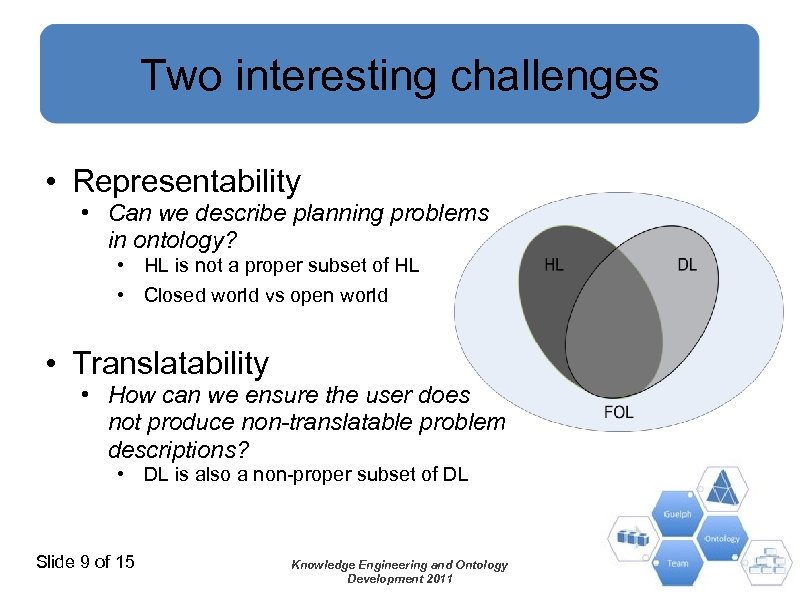
Two interesting challenges • Representability • Can we describe planning problems in ontology? • HL is not a proper subset of HL • Closed world vs open world • Translatability • How can we ensure the user does not produce non-translatable problem descriptions? • DL is also a non-proper subset of DL Slide 9 of 15 Knowledge Engineering and Ontology Development 2011
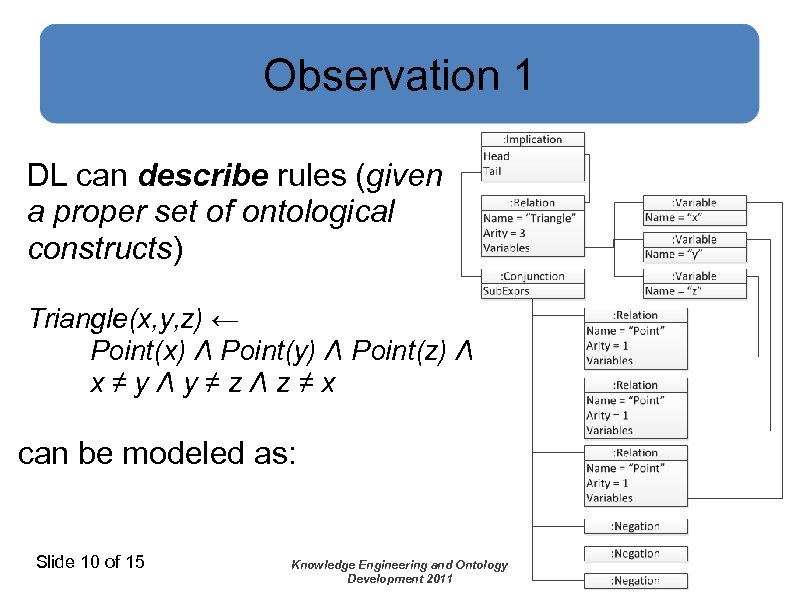
Observation 1 DL can describe rules (given a proper set of ontological constructs) Triangle(x, y, z) ← Point(x) Ʌ Point(y) Ʌ Point(z) Ʌ x≠yɅy≠zɅz≠x can be modeled as: Slide 10 of 15 Knowledge Engineering and Ontology Development 2011
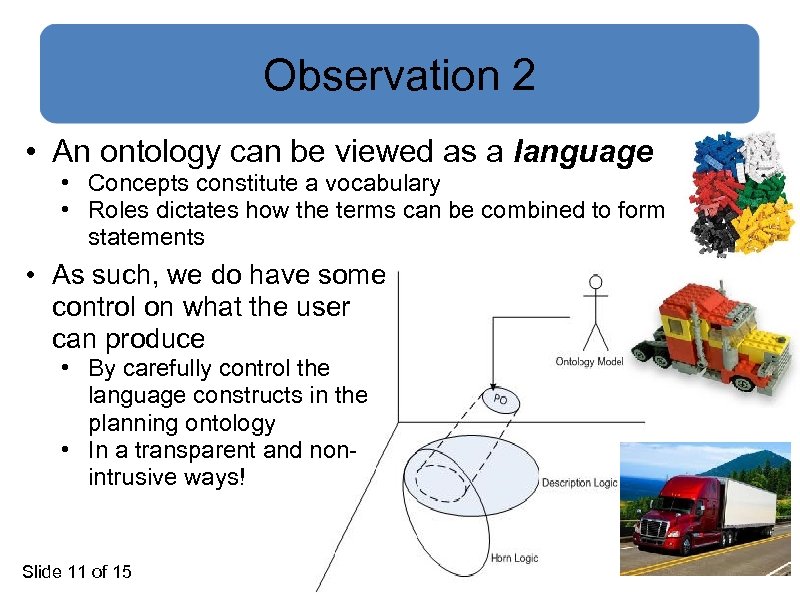
Observation 2 • An ontology can be viewed as a language • Concepts constitute a vocabulary • Roles dictates how the terms can be combined to form statements • As such, we do have some control on what the user can produce • By carefully control the language constructs in the planning ontology • In a transparent and nonintrusive ways! Slide 11 of 15
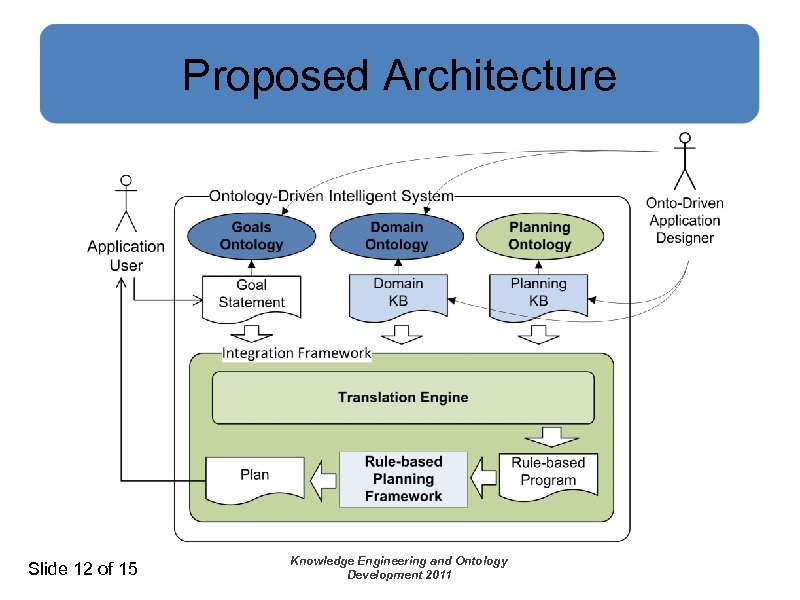
Proposed Architecture Slide 12 of 15 Knowledge Engineering and Ontology Development 2011
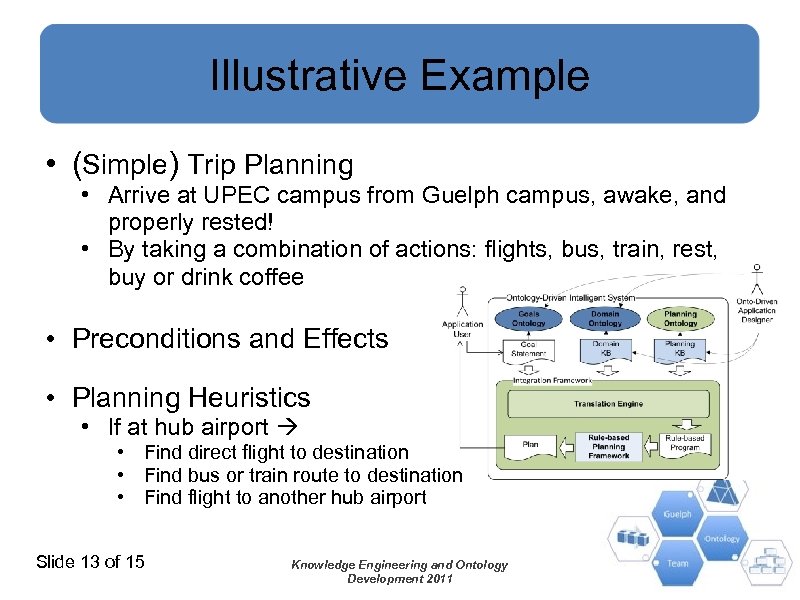
Illustrative Example • (Simple) Trip Planning • Arrive at UPEC campus from Guelph campus, awake, and properly rested! • By taking a combination of actions: flights, bus, train, rest, buy or drink coffee • Preconditions and Effects • Planning Heuristics • If at hub airport • Find direct flight to destination • Find bus or train route to destination • Find flight to another hub airport Slide 13 of 15 Knowledge Engineering and Ontology Development 2011
Discussions • Contributions • An integration framework for bringing planning into Ontodriven apps • Plus 2 interesting challenges/observations • What worked? • Demonstrated feasibility with a toy problem • Demonstrated effectiveness with a real-world problem • What didn't? • Tooling support • Debugging • Usability • Language is still a bit technical for an average modeler Slide 14 of 15 Knowledge Engineering and Ontology Development 2011
Questions and Suggestions Hope you will read our paper! More details available at: http: //ontology. socs. uoguelph. ca Thank you! Slide 15 of 15 Knowledge Engineering and Ontology Development 2011
Скачать презентацию Practical Goal-based Reasoning in Ontology-Driven Applications Huy Pham
31e8791f512d2e59938ee3c791496db4.ppt