


 Скачать презентацию Practical experience with new European fire testing standards
50fc6b65fb63da3078d74549fe96ed51.ppt
- Количество слайдов: 35
 Practical experience with new European fire testing standards and European technical approval U. Wörsdörfer + H. Haselmair Hilti Corporation, Schaan, FL
 This presentation is given in commemoration of my dear colleague Udo Wörsdörfer who should have given the presentation but died unexpectedly some weeks ago
 Introduction • Limited practical experience: – ETAG 018 (FPP) published in 2006 (part 4) and 2007 (part 2 and 3) – ENV 13381 -4: 2002 EN 13381 -8 (intumescent coatings): Formal Vote EN 13381 -4 revised (boards, renderings): Inquiry – – ETAG 026 (FSSP) published early 2008 EN 1366 -3 (penetration seals): 09/2004, revision 03/2009 EN 1366 -4 (linear joint seals): 08/2006 EN 1364 -4 (curtain wall, part configuration): 06/2007 FPP = Fire Protective Products, FSSP = Fire Stopping and Fire Sealing Products
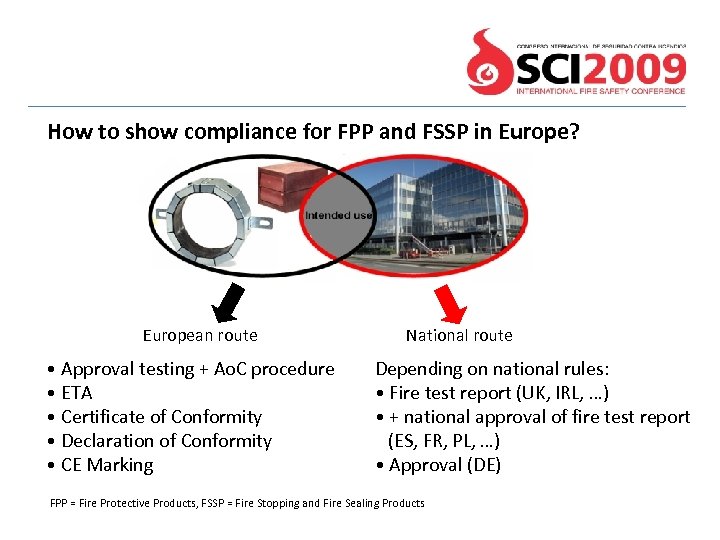 How to show compliance for FPP and FSSP in Europe? European route • Approval testing + Ao. C procedure • ETA • Certificate of Conformity • Declaration of Conformity • CE Marking National route Depending on national rules: • Fire test report (UK, IRL, …) • + national approval of fire test report (ES, FR, PL, …) • Approval (DE) FPP = Fire Protective Products, FSSP = Fire Stopping and Fire Sealing Products
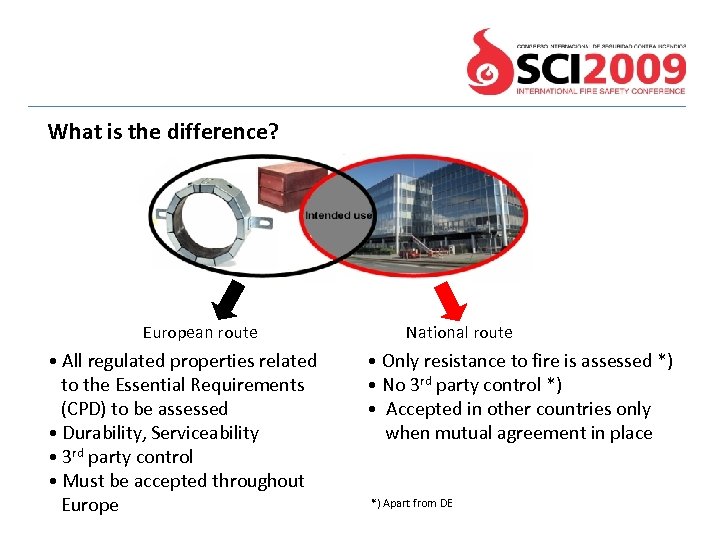 What is the difference? European route • All regulated properties related to the Essential Requirements (CPD) to be assessed • Durability, Serviceability • 3 rd party control • Must be accepted throughout Europe National route • Only resistance to fire is assessed *) • No 3 rd party control *) • Accepted in other countries only when mutual agreement in place *) Apart from DE
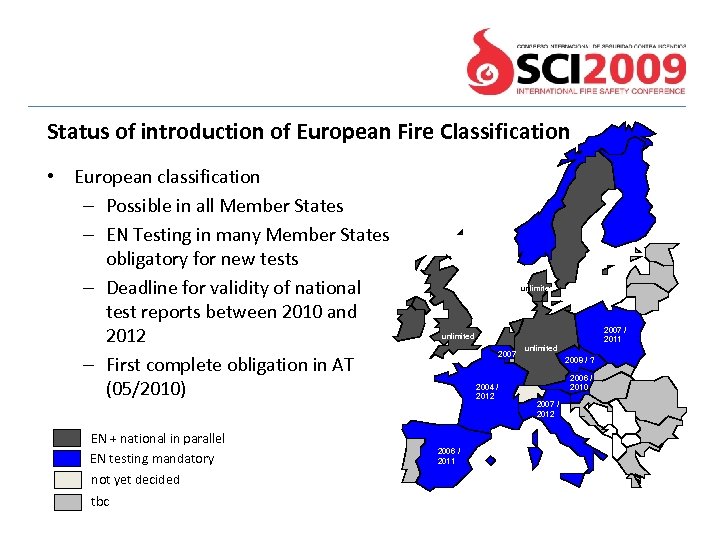 Status of introduction of European Fire Classification • European classification – Possible in all Member States – EN Testing in many Member States obligatory for new tests – Deadline for validity of national test reports between 2010 and 2012 – First complete obligation in AT (05/2010) EN + national in parallel EN testing mandatory not yet decided tbc unlimited 2007 / 2011 unlimited 2007 2004 / 2012 2006 / 2011 unlimited 2008 / ? 2006 / 2010 2007 / 2012
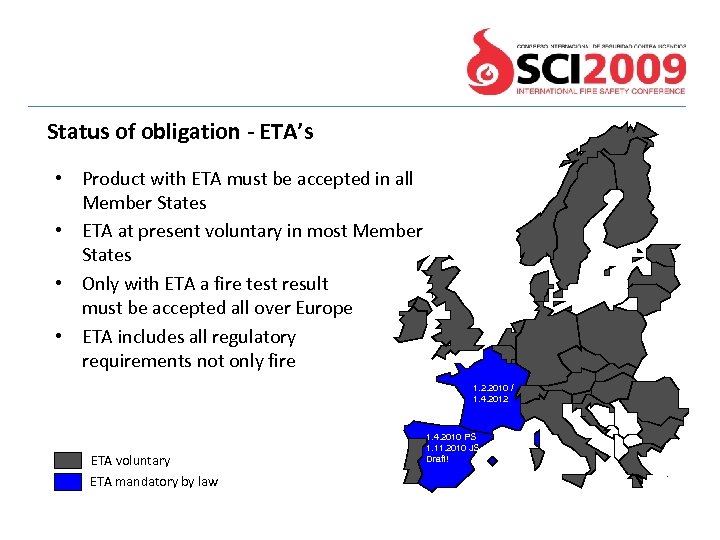 Status of obligation - ETA’s • Product with ETA must be accepted in all Member States • ETA at present voluntary in most Member States • Only with ETA a fire test result must be accepted all over Europe • ETA includes all regulatory requirements not only fire 1. 2. 2010 / 1. 4. 2012 ETA voluntary ETA mandatory by law 1. 4. 2010 PS 1. 11. 2010 JS Draft!
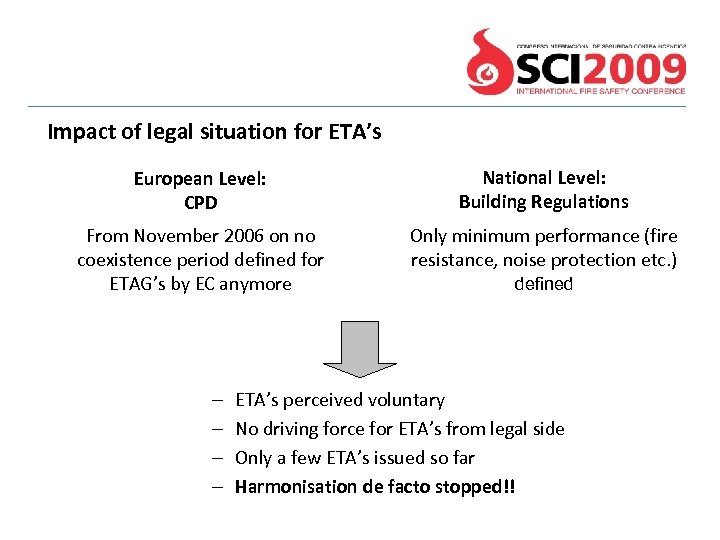 Impact of legal situation for ETA’s European Level: CPD National Level: Building Regulations From November 2006 on no coexistence period defined for ETAG’s by EC anymore Only minimum performance (fire resistance, noise protection etc. ) – – defined ETA’s perceived voluntary No driving force for ETA’s from legal side Only a few ETA’s issued so far Harmonisation de facto stopped!!
 What is the reason for reluctance of industry to use ETA’s? Market distortion because of • Differences between European and national test results • Less effort when using only fire test/classification report compared to a full ETA assessment
 Difference EN – National testing: Steel protection • Safety margins unrealistic high for reactive coatings => not competitive => Revision of EN 13381 -4 and separation in 2 parts • Hollow sections not covered
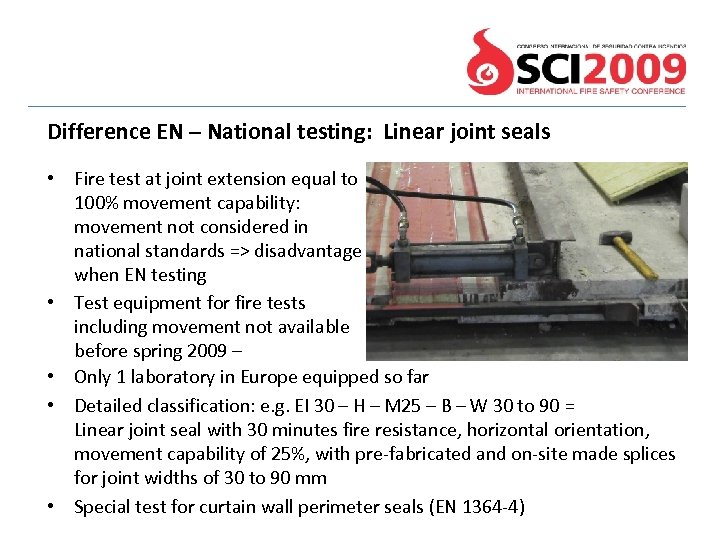 Difference EN – National testing: Linear joint seals • Fire test at joint extension equal to 100% movement capability: movement not considered in national standards => disadvantage when EN testing • Test equipment for fire tests including movement not available before spring 2009 – • Only 1 laboratory in Europe equipped so far • Detailed classification: e. g. EI 30 – H – M 25 – B – W 30 to 90 = Linear joint seal with 30 minutes fire resistance, horizontal orientation, movement capability of 25%, with pre-fabricated and on-site made splices for joint widths of 30 to 90 mm • Special test for curtain wall perimeter seals (EN 1364 -4)
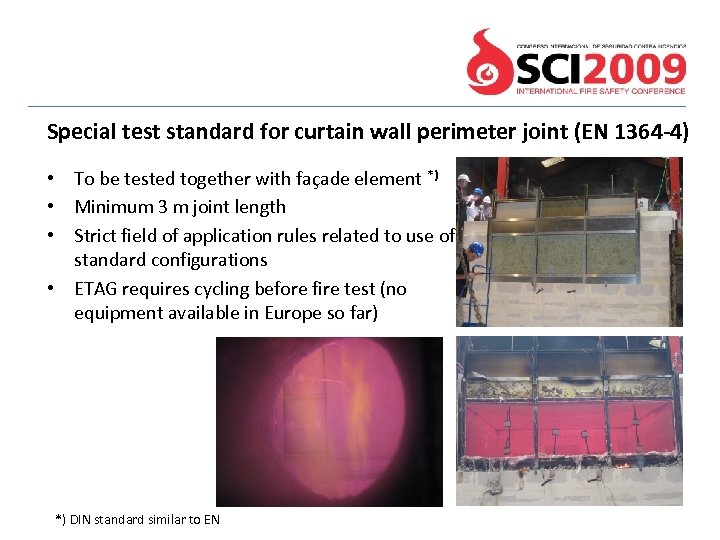 Special test standard for curtain wall perimeter joint (EN 1364 -4) • To be tested together with façade element *) • Minimum 3 m joint length • Strict field of application rules related to use of standard configurations • ETAG requires cycling before fire test (no equipment available in Europe so far) *) DIN standard similar to EN
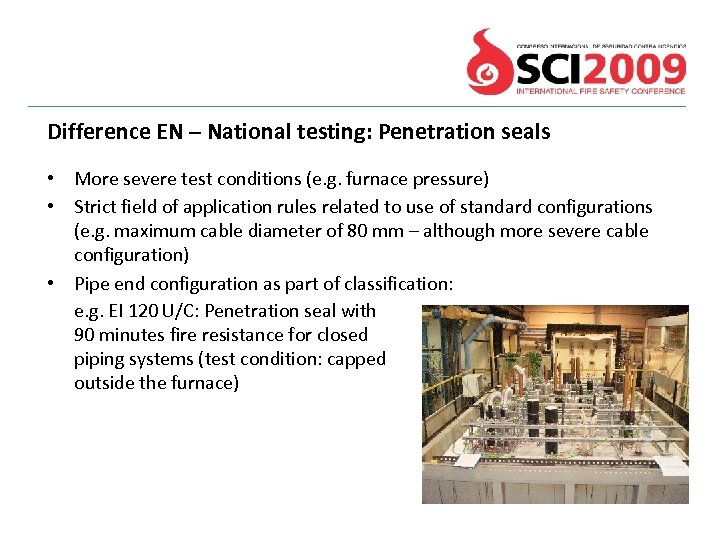 Difference EN – National testing: Penetration seals • More severe test conditions (e. g. furnace pressure) • Strict field of application rules related to use of standard configurations (e. g. maximum cable diameter of 80 mm – although more severe cable configuration) • Pipe end configuration as part of classification: e. g. EI 120 U/C: Penetration seal with 90 minutes fire resistance for closed piping systems (test condition: capped outside the furnace)
 Difference EN 1366 -3: 2004 and revised version 2009 • Furnace Pressure – Specimen location (5. 2): simpler approach • Distances: no obligation for 200 mm between pipes (6. 1) • Strut system as modern alternative for standard service support construction introduced, also for pipes (6. 3. 3. 2, Fig. A. 8 and E. 10) • Blank penetration seal necessary for definition of maximum seal size; definition of thermocouple location added (Fig. 3) • New definition of standard supporting constructions (7. 2) • New insulation pad for thermocouples (9. 1. 2. 1): simpler to install
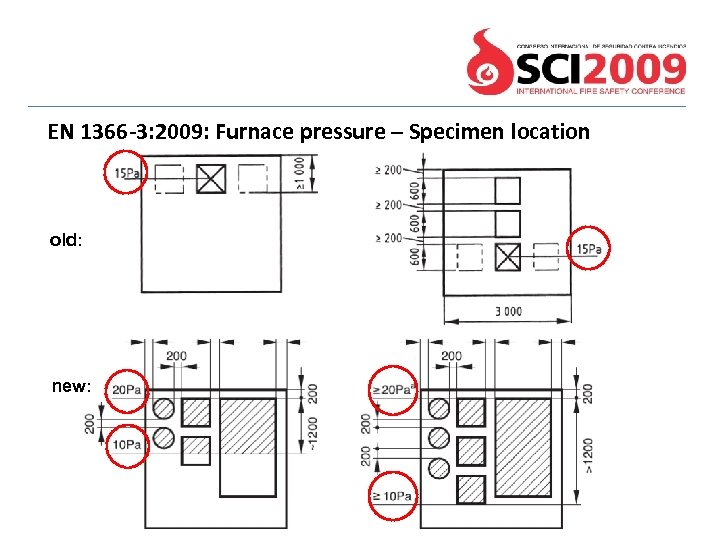 EN 1366 -3: 2009: Furnace pressure – Specimen location old: new:
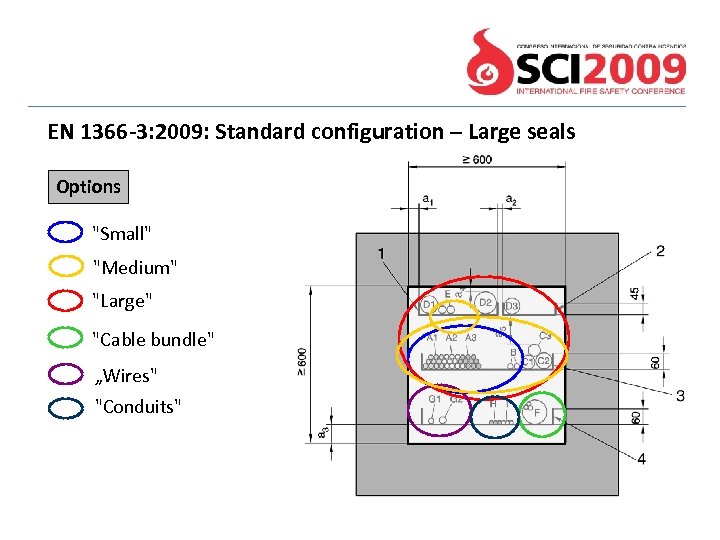
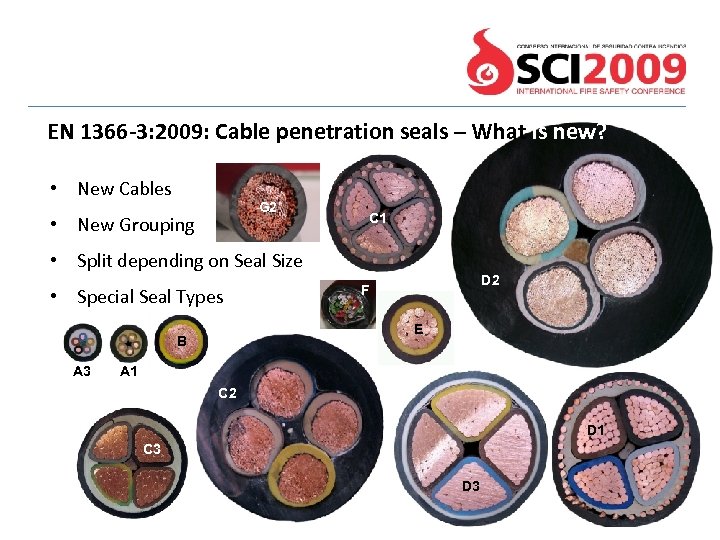 EN 1366 -3: 2009: Cable penetration seals – What is new? • New Cables G 2 • New Grouping C 1 • Split depending on Seal Size • Special Seal Types E B A 3 D 2 F A 1 C 2 D 1 C 3 D 3
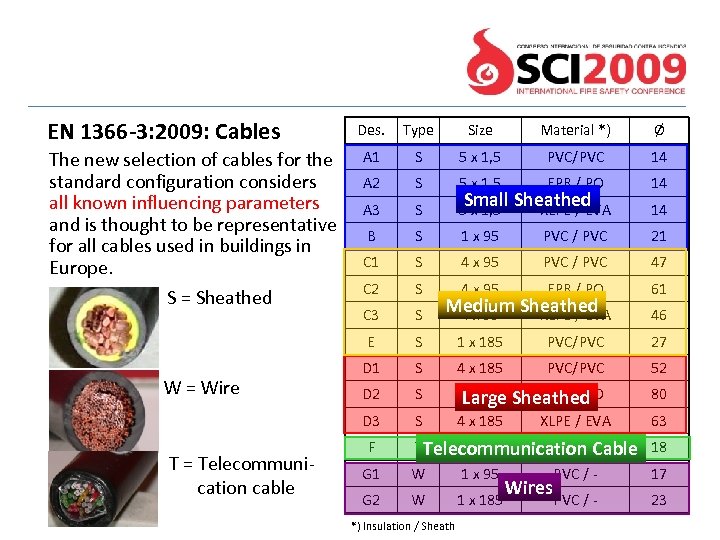 EN 1366 -3: 2009: Cables T = Telecommunication cable Size Material *) Ø A 1 S 5 x 1, 5 PVC/PVC 14 A 2 S 5 x 1, 5 EPR / PO 14 A 3 S Small c XLPE / EVA Sheathed 5 x 1, 5 B S 1 x 95 PVC / PVC 21 C 1 S 4 x 95 PVC / PVC 47 C 2 S 4 x 95 EPR / PO 61 C 3 S S 1 x 185 PVC/PVC 27 D 1 S 4 x 185 PVC/PVC 52 D 2 S 4 Large Sheathed x 185 EPR / PO 80 D 3 W = Wire Type E The new selection of cables for the standard configuration considers all known influencing parameters and is thought to be representative for all cables used in buildings in Europe. S = Sheathed Des. S 4 x 185 63 F Medium Sheathed 4 x 95 XLPE / EVA 14 46 T Telecommunication Cable 18 20 x 2 x 0, 6 G 1 W 1 x 95 G 2 W 1 x 185 *) Insulation / Sheath Wires PVC / - 17 PVC / - 23
 EN 1366 -3: 2009: Standard configuration – Large seals Options "Small" "Medium" "Large" "Cable bundle" „Wires" "Conduits"
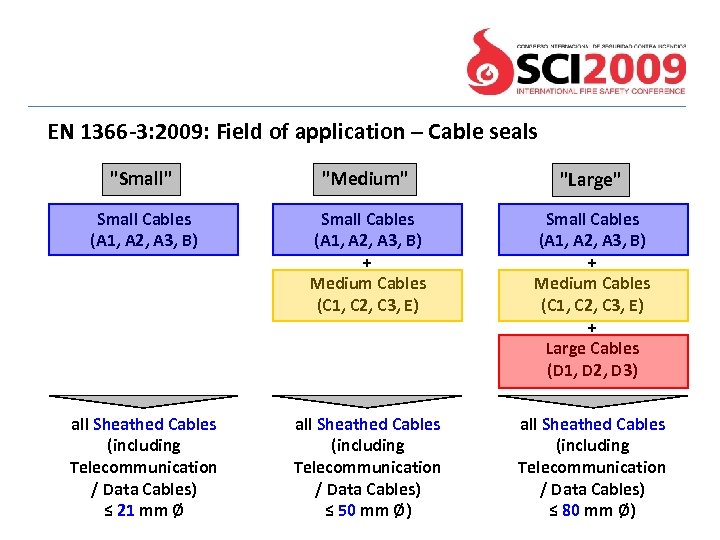 EN 1366 -3: 2009: Field of application – Cable seals "Small" "Medium" "Large" Small Cables (A 1, A 2, A 3, B) + Medium Cables (C 1, C 2, C 3, E) + Large Cables (D 1, D 2, D 3) all Sheathed Cables (including Telecommunication / Data Cables) ≤ 21 mm Ø all Sheathed Cables (including Telecommunication / Data Cables) ≤ 50 mm Ø) all Sheathed Cables (including Telecommunication / Data Cables) ≤ 80 mm Ø)
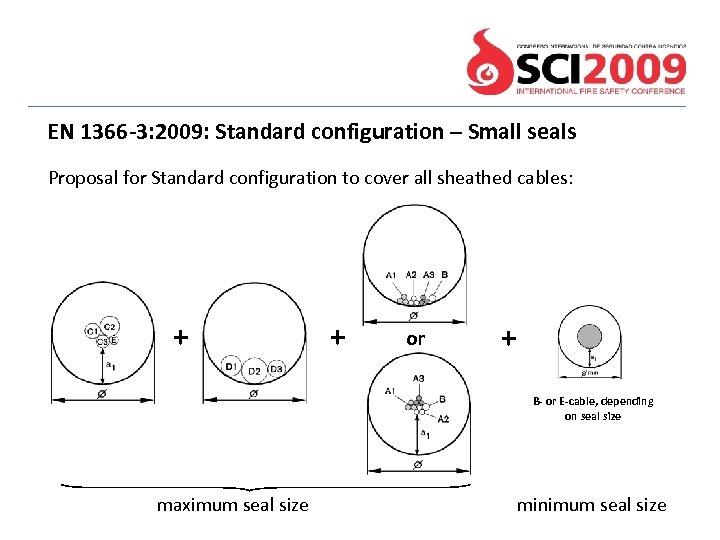 EN 1366 -3: 2009: Standard configuration – Small seals Proposal for Standard configuration to cover all sheathed cables: + + or + B- or E-cable, depending on seal size maximum seal size minimum seal size
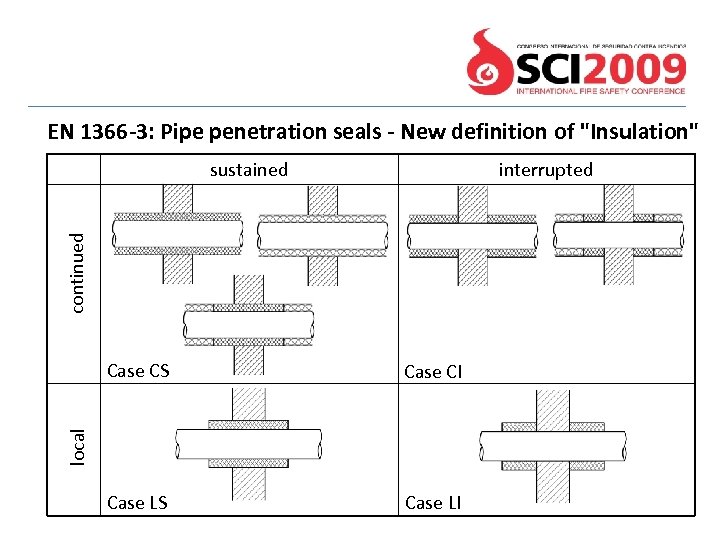 EN 1366 -3: Pipe penetration seals - New definition of "Insulation" interrupted continued sustained Case CI Case LS Case LI local Case CS
 EN 1366 -3: 2009: Pipe penetration seals • Maximum seal size to be determined by testing a blank seal (b or h x l), except for mortar seals and seals made from rigid boards or mineral wool boards with a density of ≥ 150 kg/m 3 l b or h • Pipe end configuration U/C (capped outside!) covers all situations => different to pipe end configuration commonly used in the past!
 EN 1366 -3: 2009: Plastic pipes - Selection of specimens • Determination of “Length Groups" and "Design Groups" (thickness and length of the active component of the pipe closure device is equal for varying device sizes / pipe diameters) • The maximum device size per design group is tested in combination with maximum and minimum pipe wall thickness • Design groups in the middle of the size range may be omitted, if the relevant parameters are located above the connection line (see diagram)
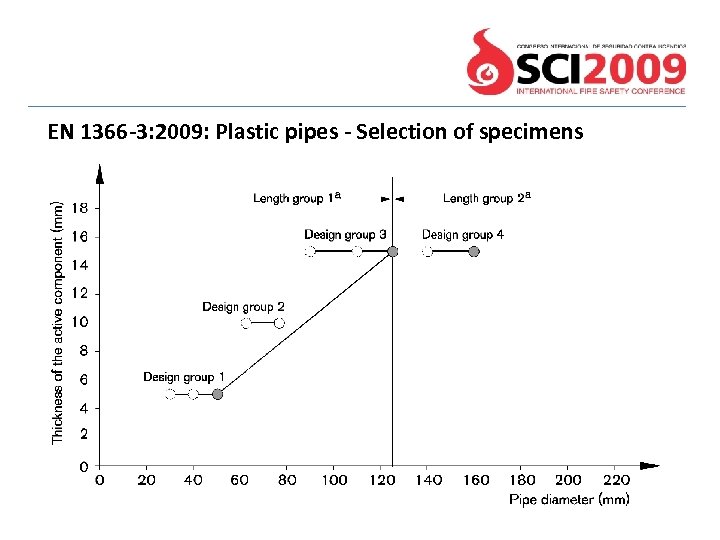 EN 1366 -3: 2009: Plastic pipes - Selection of specimens
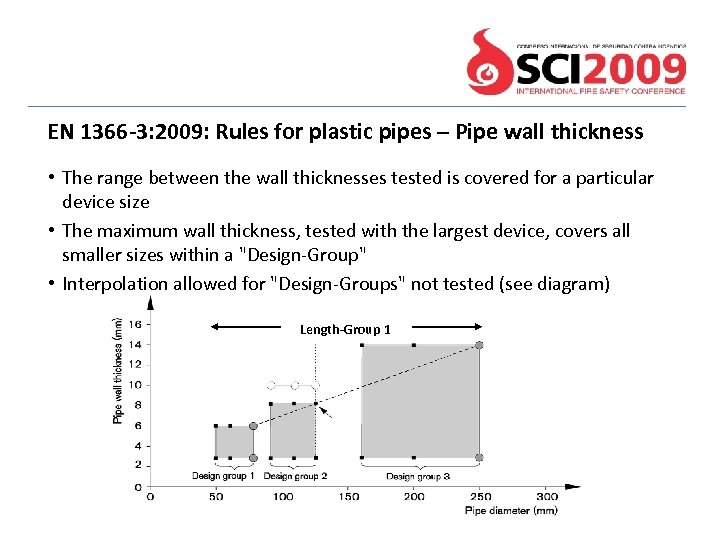 EN 1366 -3: 2009: Rules for plastic pipes – Pipe wall thickness • The range between the wall thicknesses tested is covered for a particular device size • The maximum wall thickness, tested with the largest device, covers all smaller sizes within a "Design-Group" • Interpolation allowed for "Design-Groups" not tested (see diagram) Length-Group 1
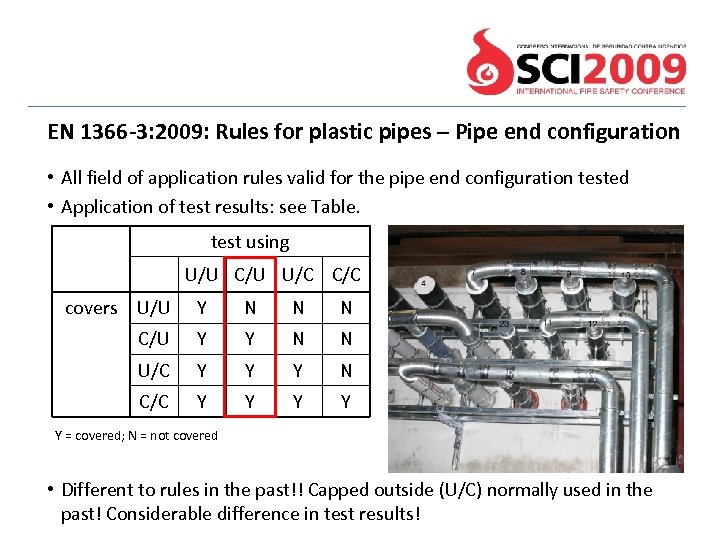 EN 1366 -3: 2009: Rules for plastic pipes – Pipe end configuration • All field of application rules valid for the pipe end configuration tested • Application of test results: see Table. test using U/U C/U U/C C/C covers U/U Y N N N C/U Y Y N N U/C Y Y Y N C/C Y Y Y = covered; N = not covered • Different to rules in the past!! Capped outside (U/C) normally used in the past! Considerable difference in test results!
 EN 1366 -3: 2009: Rules for plastic pipes – Pipe material • Similar approach like German “Stellvertreterprüfung” but only very limited number of materials covered when PVC-U or PE-HD pipes are tested • Pipe standard to be considered and recorded! • Reaction to fire behaviour of pipes may be different in Germany and other Member States (minimum requirements in DE) => different behaviour in fire test? • More experience necessary to extend the rules => common research project?
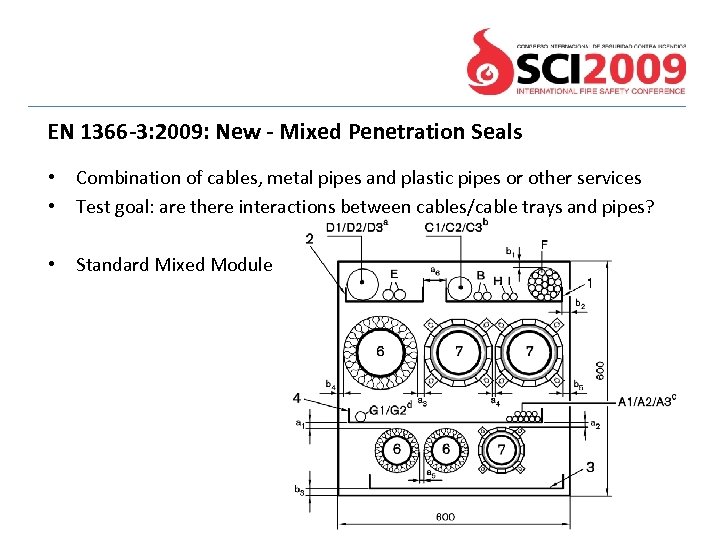 EN 1366 -3: 2009: New - Mixed Penetration Seals • • Combination of cables, metal pipes and plastic pipes or other services Test goal: are there interactions between cables/cable trays and pipes? • Standard Mixed Module
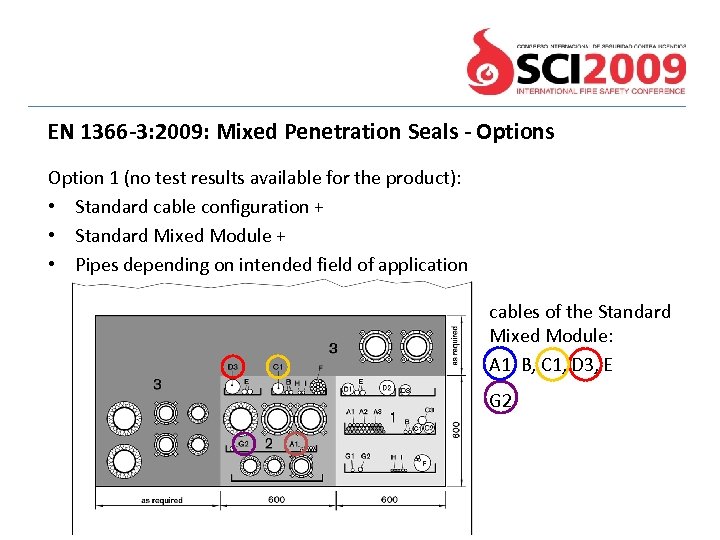 EN 1366 -3: 2009: Mixed Penetration Seals - Options Option 1 (no test results available for the product): • Standard cable configuration + • Standard Mixed Module + • Pipes depending on intended field of application cables of the Standard Mixed Module: A 1, B, C 1, D 3, E G 2
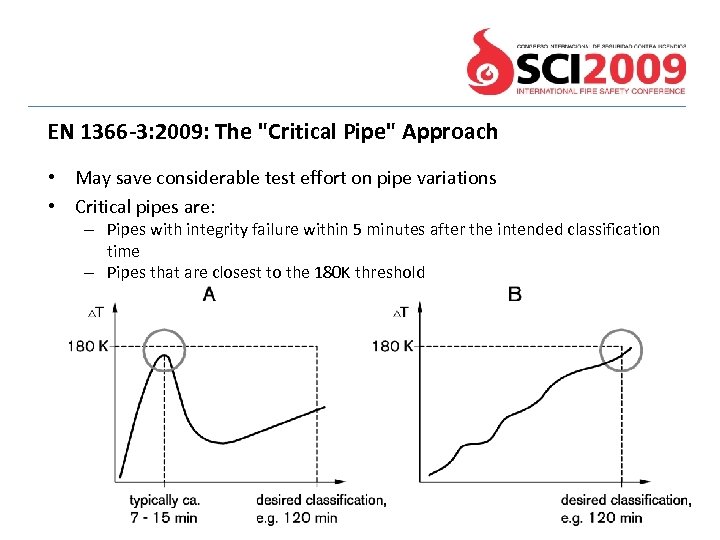 EN 1366 -3: 2009: The "Critical Pipe" Approach • May save considerable test effort on pipe variations • Critical pipes are: – Pipes with integrity failure within 5 minutes after the intended classification time – Pipes that are closest to the 180 K threshold
 EN 1366 -3: 2009: Standard flexible wall • Error in table of 2004 version corrected • Smaller width possible, restrained only top and bottom • New approach developed – Varying stud widths considered – Insulation of wall related to aperture framing: “one stop shop” test situation possible to cover both insulated and non-insulated walls – Number and thickness of boards only relevant when no aperture framing is used • Sandwich panel constructions are not covered! • Constructions with uncovered studs are not covered (e. g. shaft walls) • Applications in rigid walls (≥ thickness, ≥ density) are covered (exception pipe closure devices within the wall)
 EN 1366 -3: 2009: What to do with old test results? • 2009 version offers more options (e. g. mixed penetration seals) but is more detailed and restrictive in standard configurations and field of application rules • The difference has to be considered when test results from 2004 version are planned to be used: – e. g. only rubber cables of 2004 version may be considered => tests to be repeated to get full cable coverage! – Classical max/min size approach for collars/wraps not sufficient: more tests necessary • Tests laboratories have to make sure that a common approach is used throughout Europe: training necessary also for lab staff!
 The Future? - CPR (Construction Products Regulation) • First reading in Parliament passed with considerable number of amendments • Discussion in Council Working Group not yet finished • Current draft not consistent in itself • Obligation for products with European Approvals under discussion: high number of Member States in favour but no qualified majority so far
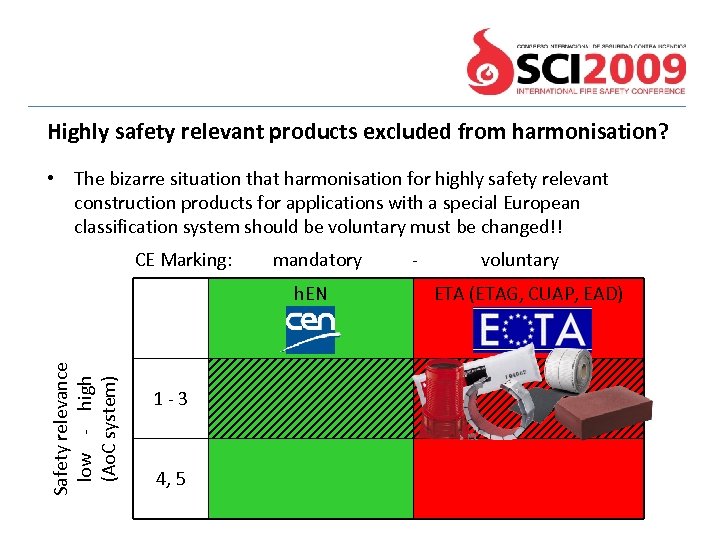 Highly safety relevant products excluded from harmonisation? • The bizarre situation that harmonisation for highly safety relevant construction products for applications with a special European classification system should be voluntary must be changed!! CE Marking: mandatory Safety relevance low - high (Ao. C system) h. EN 1 -3 4, 5 - voluntary ETA (ETAG, CUAP, EAD)
 Many thanks for your attention