


 Скачать презентацию Practical Erlang Programming Simon Thompson University of Kent
4aad37d617e0f699c13c40bf30a513c9.ppt
- Количество слайдов: 95
 Practical Erlang Programming Simon Thompson University of Kent Course Introduction Course Title @ Course Author 2007
 Contents • • Erlang History Erlang Highlights Open Telecom Platform Frequency Server Example Products The Community Events & Questions Practical Erlang Programming © 2001 -2009, Simon Thompson and Erlang Training and Consulting 2
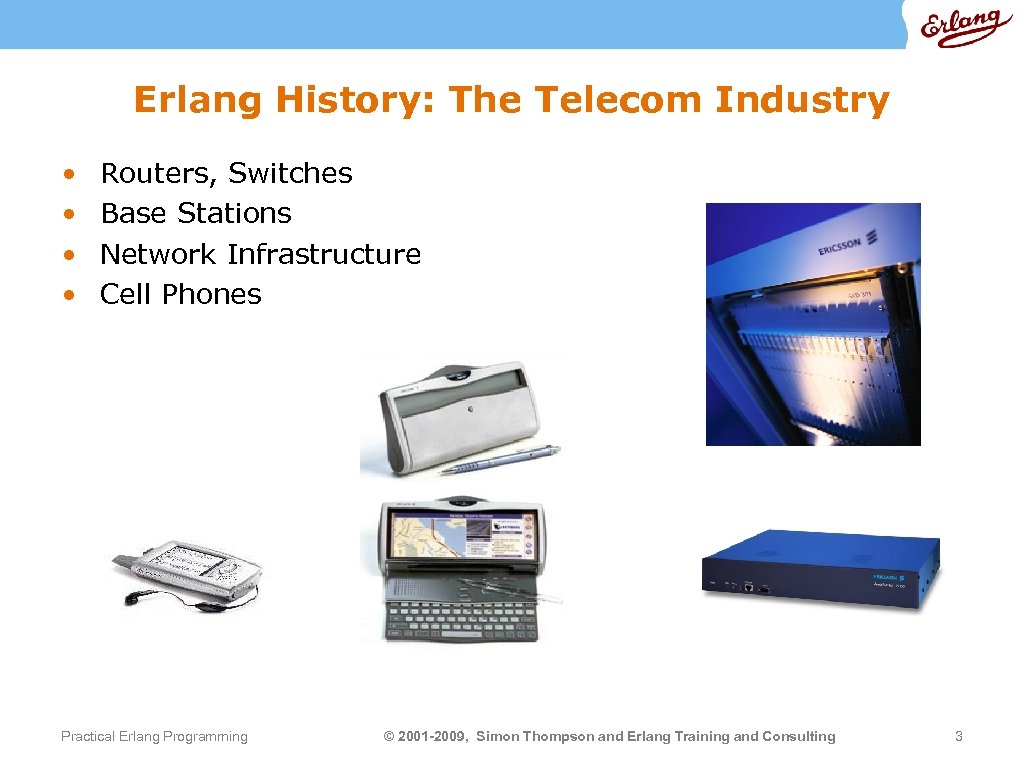 Erlang History: The Telecom Industry • • Routers, Switches Base Stations Network Infrastructure Cell Phones Practical Erlang Programming © 2001 -2009, Simon Thompson and Erlang Training and Consulting 3
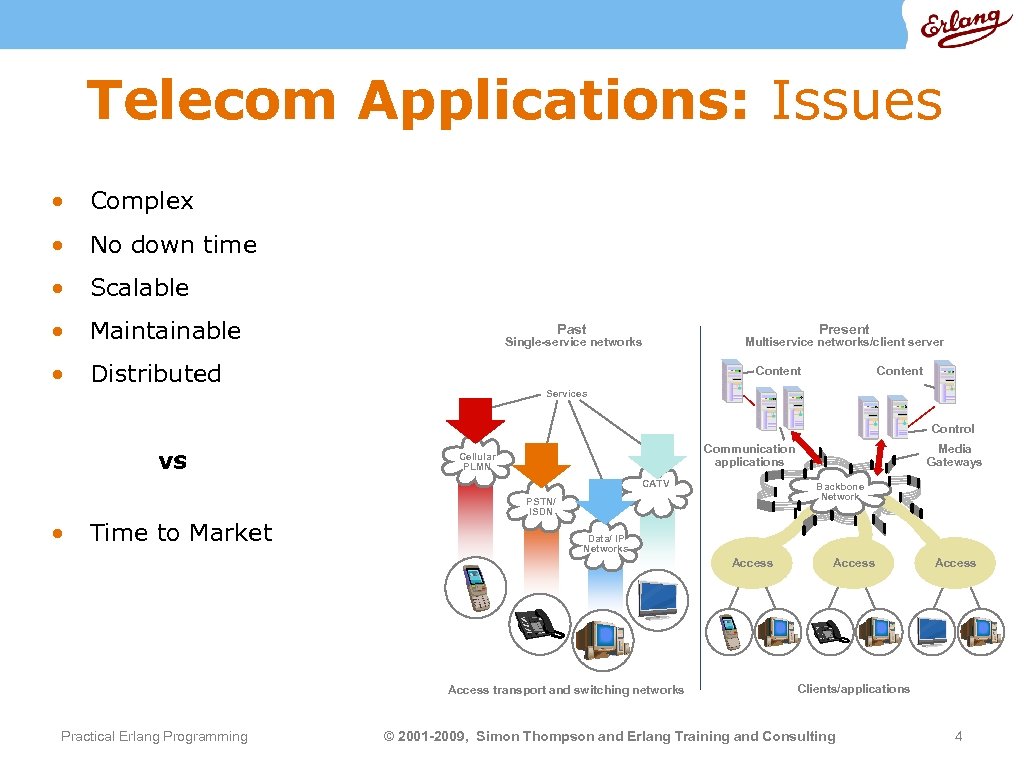 Telecom Applications: Issues • Complex • No down time • Scalable • Maintainable • Distributed Past Single-service networks Present Multiservice networks/client server Content Services Control vs Communication applications Cellular PLMN CATV • Time to Market Backbone Network PSTN/ ISDN Data/ IP Networks Access transport and switching networks Practical Erlang Programming Media Gateways Access Clients/applications © 2001 -2009, Simon Thompson and Erlang Training and Consulting 4
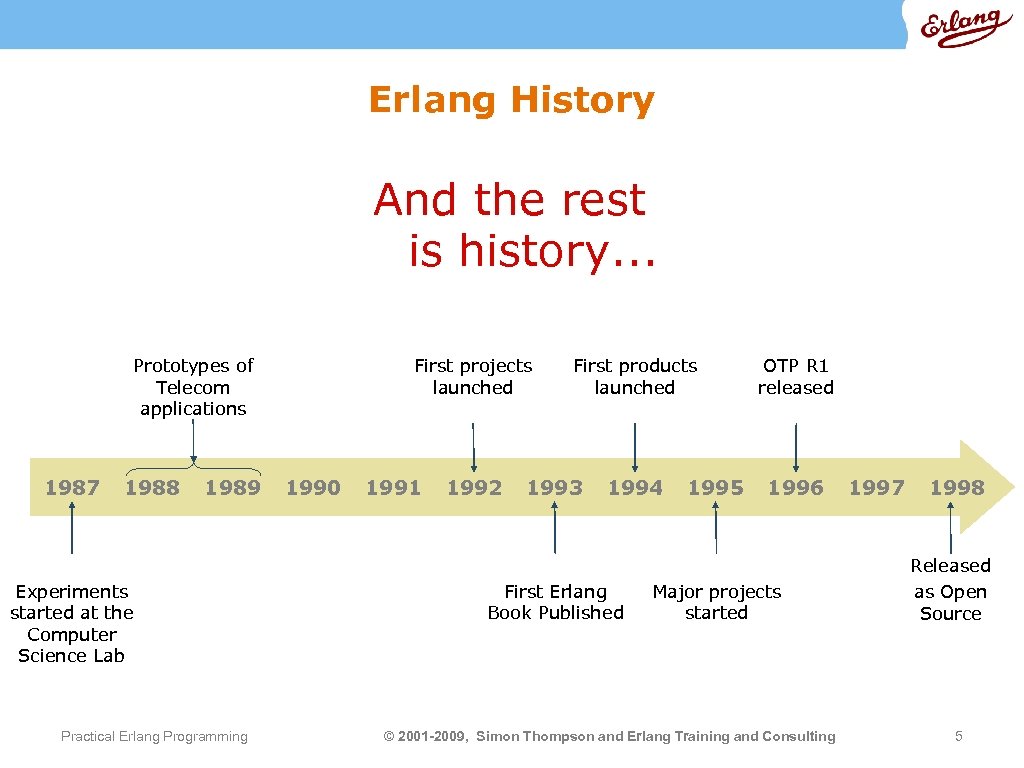 Erlang History It’s not “Find enough to rest - – you good themistakes on a Make right methods And the have ideas design scale, not in a must also small by to implement them to be able prototyping. ” is history. . . know that they work production project. Mike Willliams, CS LAB Mike Willliams First projects launched Prototypes of Telecom applications 1987 1988 1989 Experiments started at the Computer Science Lab Practical Erlang Programming 1990 1991 1992 First products launched 1993 1994 First Erlang Book Published 1995 OTP R 1 released 1996 Major projects started © 2001 -2009, Simon Thompson and Erlang Training and Consulting 1997 1998 Released as Open Source 5
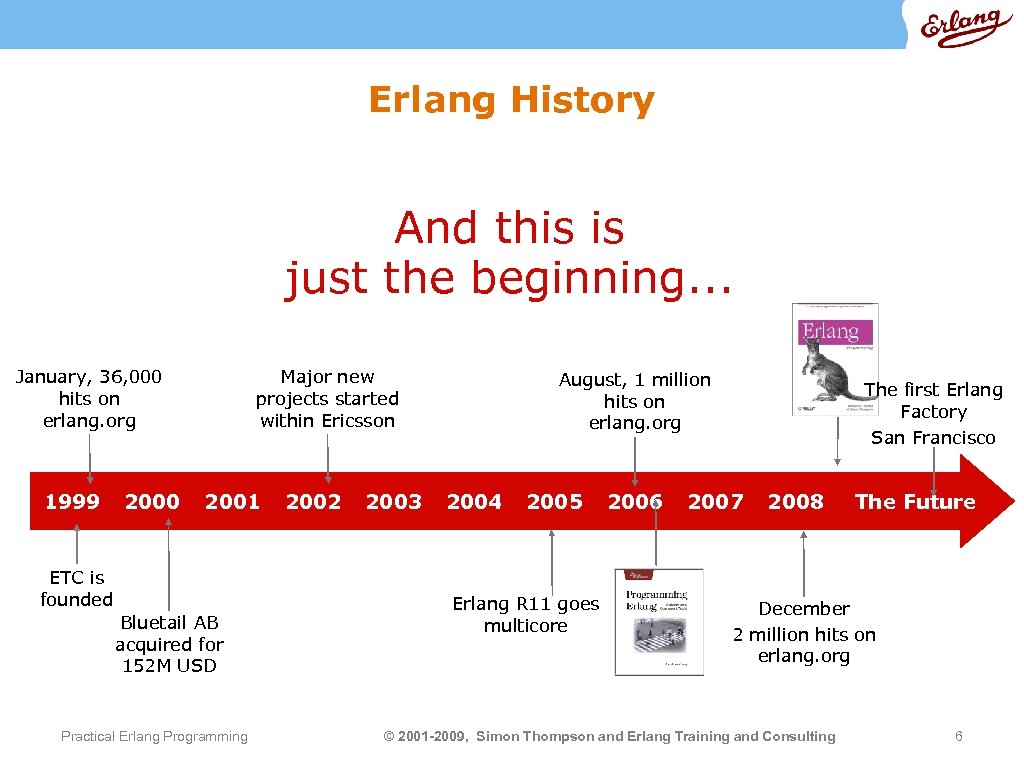 Erlang History “Erlang Next generation very important language. is going to be a high-performance, …if we had to start again we highly It could be the next Java. ” to be reliable web sites are going would And this is probably use Erlang… implemented using Erlang and Berkeley DB. just the beginning. . . Ralph Johnson Mike Shaver Dr. Margo Seltzer Co-author, “Design Patterns” (the “Gang-of-Four book”) Mozilla Foundation Original author, Berkeley DB January, 36, 000 hits on erlang. org 1999 2000 Major new projects started within Ericsson 2001 ETC is founded Bluetail AB acquired for 152 M USD Practical Erlang Programming 2002 2003 August, 1 million hits on erlang. org 2004 2005 Erlang R 11 goes multicore 2006 The first Erlang Factory San Francisco 2007 2008 The Future December 2 million hits on erlang. org © 2001 -2009, Simon Thompson and Erlang Training and Consulting 6
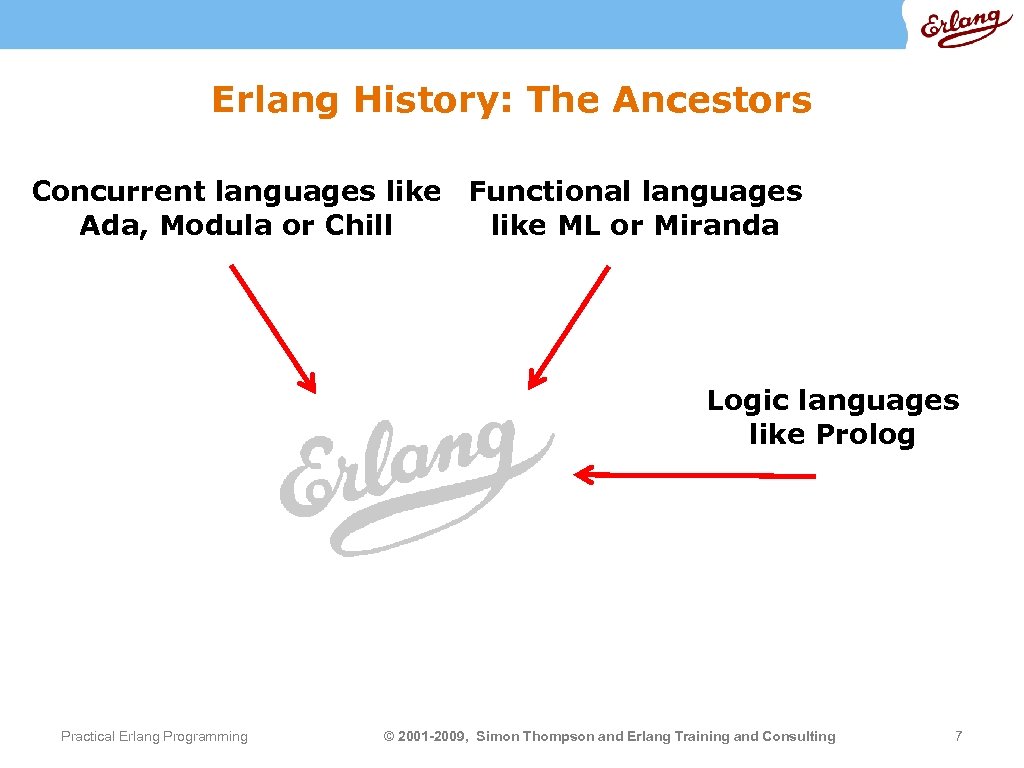 Erlang History: The Ancestors Concurrent languages like Functional languages Ada, Modula or Chill like ML or Miranda Logic languages like Prolog Practical Erlang Programming © 2001 -2009, Simon Thompson and Erlang Training and Consulting 7
 Contents • • Erlang History Erlang Highlights Open Telecom Platform Frequency Server Example Products The Community Events & Questions Practical Erlang Programming © 2001 -2009, Simon Thompson and Erlang Training and Consulting 8
 Erlang: Properties • Declarative Practical Erlang Programming Functional programming language, high abstraction level, pattern matching and concise readable programs © 2001 -2009, Simon Thompson and Erlang Training and Consulting 9
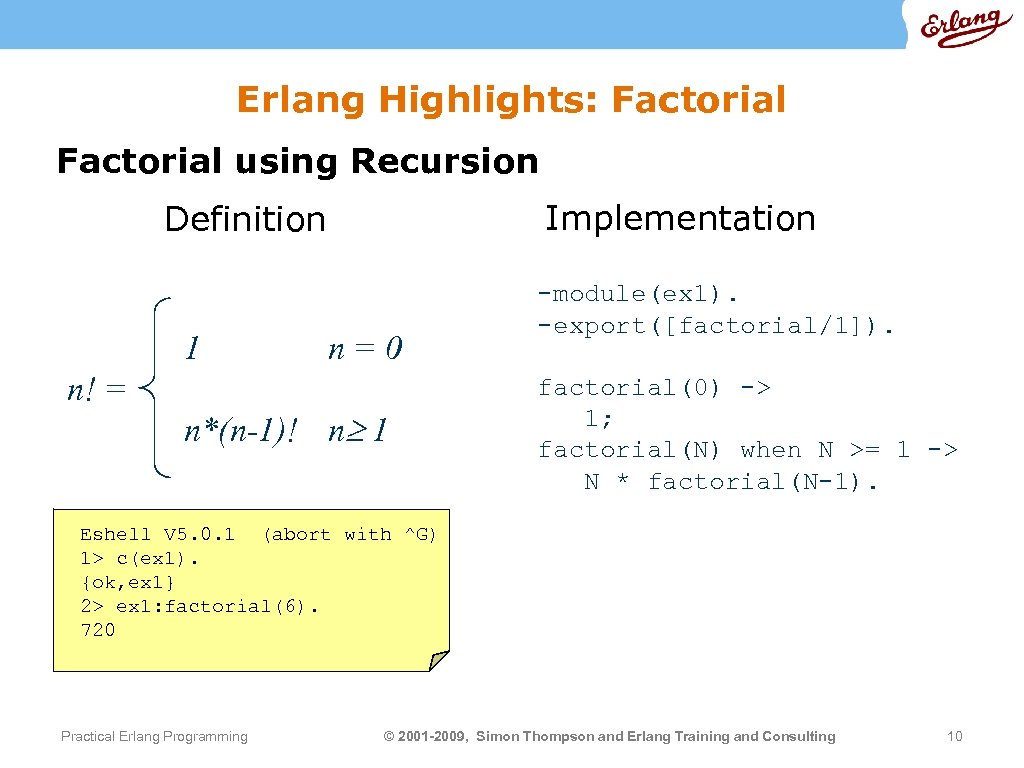 Erlang Highlights: Factorial using Recursion Implementation Definition 1 n! = n=0 n*(n-1)! n 1 -module(ex 1). -export([factorial/1]). factorial(0) -> 1; factorial(N) when N >= 1 -> N * factorial(N-1). Eshell V 5. 0. 1 (abort with ^G) 1> c(ex 1). {ok, ex 1} 2> ex 1: factorial(6). 720 Practical Erlang Programming © 2001 -2009, Simon Thompson and Erlang Training and Consulting 10
![Erlang Highlights: High-level Constructs Quick. Sort using List Comprehensions -module(ex 2). -export([qsort/1]). qsort([Head|Tail]) ->](https://present5.com/presentation/4aad37d617e0f699c13c40bf30a513c9/image-11.jpg "Erlang Highlights: High-level Constructs Quick. Sort using List Comprehensions -module(ex 2). -export([qsort/1]). qsort([Head|Tail]) ->") Erlang Highlights: High-level Constructs Quick. Sort using List Comprehensions -module(ex 2). -export([qsort/1]). qsort([Head|Tail]) -> First = qsort([X || X <- Tail, X =< Head]), Last = qsort([Y || Y <- Tail, Y > Head]), First ++ [Head|Last]; qsort([]) -> []. Eshell V 5. 0. 1 (abort with ^G) 1> c(ex 2). {ok, ex 2} 2> ex 2: qsort([7, 5, 3, 8, 1]). [1, 3, 5, 7, 8] Practical Erlang Programming "all objects Y taken from the list Tail, where Y > Head" © 2001 -2009, Simon Thompson and Erlang Training and Consulting 11
Erlang Highlights: High-level Constructs Quick. Sort using List Comprehensions -module(ex 2). -export([qsort/1]). qsort([Head|Tail]) -> First = qsort([X || X <- Tail, X =< Head]), Last = qsort([Y || Y <- Tail, Y > Head]), First ++ [Head|Last]; qsort([]) -> []. Eshell V 5. 0. 1 (abort with ^G) 1> c(ex 2). {ok, ex 2} 2> ex 2: qsort([7, 5, 3, 8, 1]). [1, 3, 5, 7, 8] Practical Erlang Programming "all objects Y taken from the list Tail, where Y > Head" © 2001 -2009, Simon Thompson and Erlang Training and Consulting 11
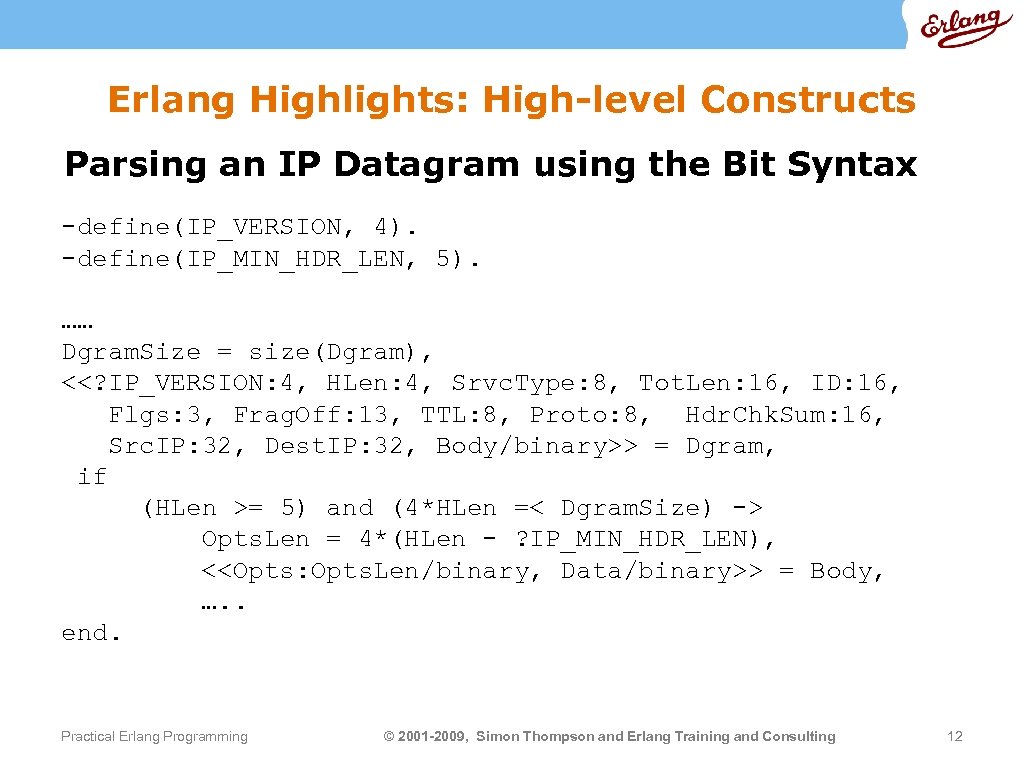 Erlang Highlights: High-level Constructs Parsing an IP Datagram using the Bit Syntax -define(IP_VERSION, 4). -define(IP_MIN_HDR_LEN, 5). …… Dgram. Size = size(Dgram), <> = Dgram, if (HLen >= 5) and (4*HLen =< Dgram. Size) -> Opts. Len = 4*(HLen - ? IP_MIN_HDR_LEN), <
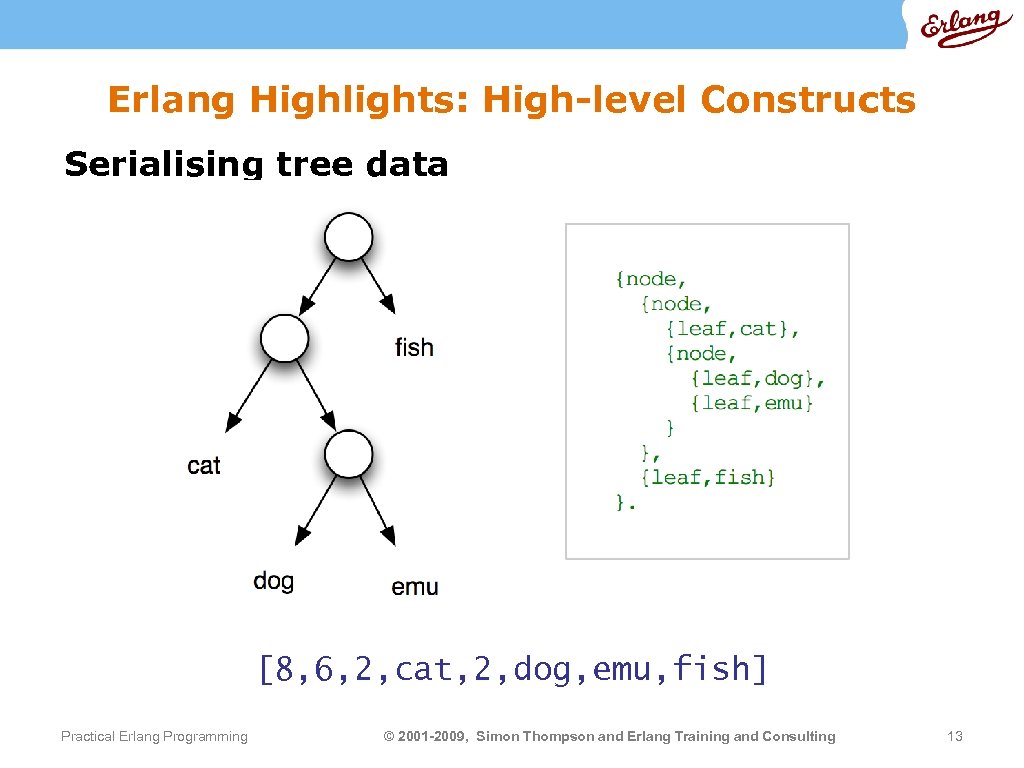 Erlang Highlights: High-level Constructs Serialising tree data [8, 6, 2, cat, 2, dog, emu, fish] Practical Erlang Programming © 2001 -2009, Simon Thompson and Erlang Training and Consulting 13
![Erlang Highlights: High-level Constructs Serialising tree data deserialize([_|Ls]) -> list. To. Tree(Ls). list. To.](https://present5.com/presentation/4aad37d617e0f699c13c40bf30a513c9/image-14.jpg "Erlang Highlights: High-level Constructs Serialising tree data deserialize([_|Ls]) -> list. To. Tree(Ls). list. To.") Erlang Highlights: High-level Constructs Serialising tree data deserialize([_|Ls]) -> list. To. Tree(Ls). list. To. Tree([2, N]) -> {leaf, N}; list. To. Tree([M|Rest] = Code) -> {Code 1, Code 2} = lists: split(M-1, Rest), {node, list. To. Tree(Code 1), list. To. Tree(Code 2) }. Practical Erlang Programming tree. To. List({leaf, N}) -> [2, N]; tree. To. List({node, T 1, T 2}) -> TTL 1 = tree. To. List(T 1), [Size 1|_] = TTL 1, TTL 2 = tree. To. List(T 2), [Size 2|List 2] = TTL 2, [Size 1+Size 2|TTL 1++List 2]. © 2001 -2009, Simon Thompson and Erlang Training and Consulting 14
Erlang Highlights: High-level Constructs Serialising tree data deserialize([_|Ls]) -> list. To. Tree(Ls). list. To. Tree([2, N]) -> {leaf, N}; list. To. Tree([M|Rest] = Code) -> {Code 1, Code 2} = lists: split(M-1, Rest), {node, list. To. Tree(Code 1), list. To. Tree(Code 2) }. Practical Erlang Programming tree. To. List({leaf, N}) -> [2, N]; tree. To. List({node, T 1, T 2}) -> TTL 1 = tree. To. List(T 1), [Size 1|_] = TTL 1, TTL 2 = tree. To. List(T 2), [Size 2|List 2] = TTL 2, [Size 1+Size 2|TTL 1++List 2]. © 2001 -2009, Simon Thompson and Erlang Training and Consulting 14
![Erlang Highlights: High-level Constructs Functions as arguments, expressions, results evens([]) -> []; evens([X|Xs]) ->](https://present5.com/presentation/4aad37d617e0f699c13c40bf30a513c9/image-15.jpg "Erlang Highlights: High-level Constructs Functions as arguments, expressions, results evens([]) -> []; evens([X|Xs]) ->") Erlang Highlights: High-level Constructs Functions as arguments, expressions, results evens([]) -> []; evens([X|Xs]) -> case X rem 2 == 0 of true -> [X| evens(Xs)]; _ -> evens(Xs) end. filter(P, []) -> []; filter(P, [X|Xs]) -> case P(X) of true -> [X| filter(P, Xs)]; _ -> filter(P, Xs) end. evens([2, 3, 2, 1, 5, 4]) = [2, 2, 4] evens(Xs) -> filter (fun(X) -> X rem 2 == 0 end, Xs). Practical Erlang Programming © 2001 -2009, Simon Thompson and Erlang Training and Consulting 15
Erlang Highlights: High-level Constructs Functions as arguments, expressions, results evens([]) -> []; evens([X|Xs]) -> case X rem 2 == 0 of true -> [X| evens(Xs)]; _ -> evens(Xs) end. filter(P, []) -> []; filter(P, [X|Xs]) -> case P(X) of true -> [X| filter(P, Xs)]; _ -> filter(P, Xs) end. evens([2, 3, 2, 1, 5, 4]) = [2, 2, 4] evens(Xs) -> filter (fun(X) -> X rem 2 == 0 end, Xs). Practical Erlang Programming © 2001 -2009, Simon Thompson and Erlang Training and Consulting 15
 Erlang: Properties • Declarative Functional programming language, high abstraction level, pattern matching and concise readable programs • Concurrency Either transparent or explicit concurrency, light-weight processes and highly scalable Practical Erlang Programming © 2001 -2009, Simon Thompson and Erlang Training and Consulting 16
![Erlang Highlights: Concurrency Creating a new process using spawn -module(ex 3). -export([activity/3]). activity(Name, Pos,](https://present5.com/presentation/4aad37d617e0f699c13c40bf30a513c9/image-17.jpg "Erlang Highlights: Concurrency Creating a new process using spawn -module(ex 3). -export([activity/3]). activity(Name, Pos,") Erlang Highlights: Concurrency Creating a new process using spawn -module(ex 3). -export([activity/3]). activity(Name, Pos, Size) -> ………… activity(Joe, 75, 1024) Pid = spawn(ex 3, activity, [Joe, 75, 1024]) Practical Erlang Programming © 2001 -2009, Simon Thompson and Erlang Training and Consulting 17
Erlang Highlights: Concurrency Creating a new process using spawn -module(ex 3). -export([activity/3]). activity(Name, Pos, Size) -> ………… activity(Joe, 75, 1024) Pid = spawn(ex 3, activity, [Joe, 75, 1024]) Practical Erlang Programming © 2001 -2009, Simon Thompson and Erlang Training and Consulting 17
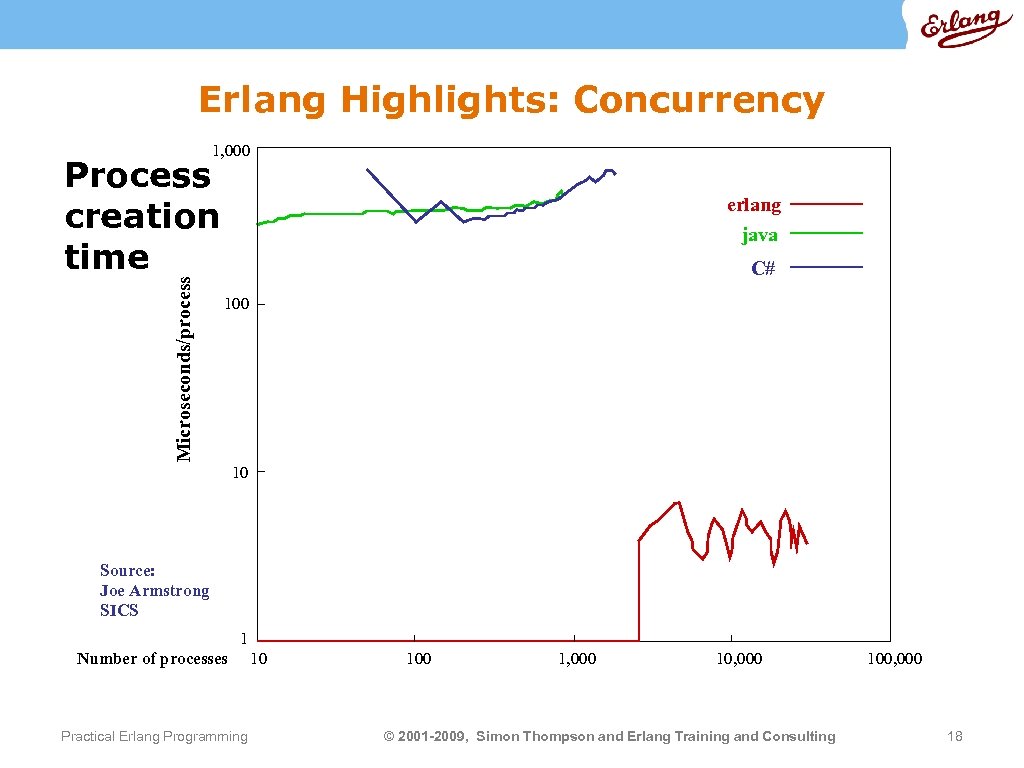 Erlang Highlights: Concurrency 1, 000 Microseconds/process Process creation time erlang java C# 100 10 Source: Joe Armstrong SICS 1 Number of processes Practical Erlang Programming 10 100 1, 000 10, 000 © 2001 -2009, Simon Thompson and Erlang Training and Consulting 100, 000 18
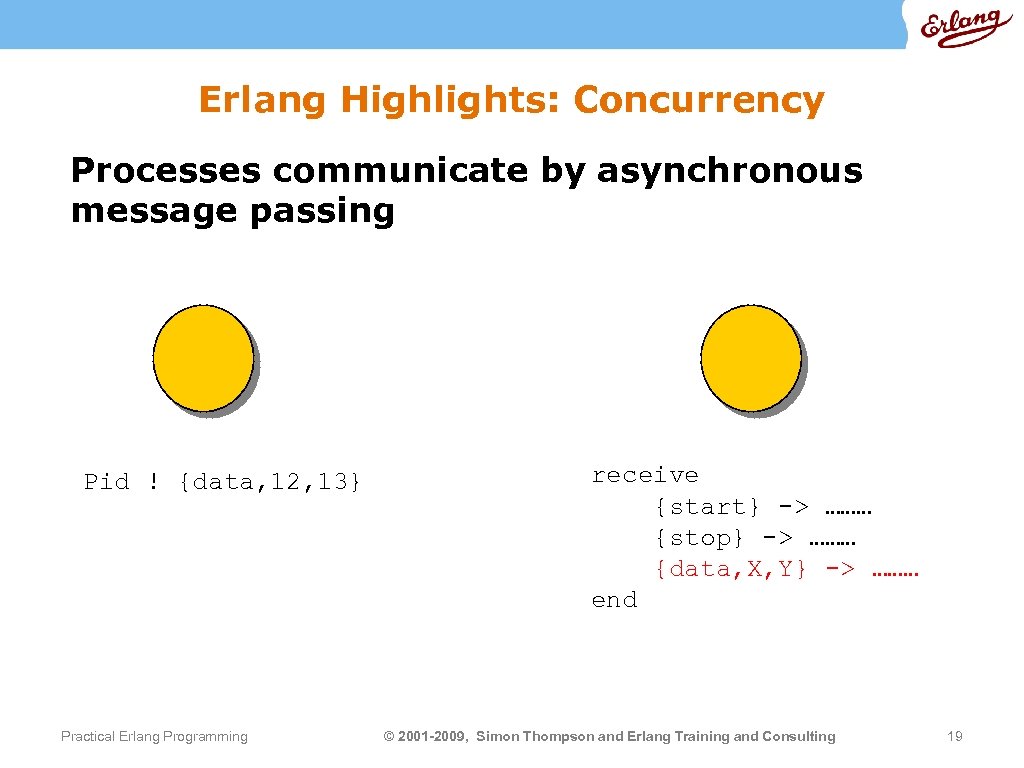 Erlang Highlights: Concurrency Processes communicate by asynchronous message passing Pid ! {data, 12, 13} Practical Erlang Programming receive {start} -> ……… {stop} -> ……… {data, X, Y} -> ……… end © 2001 -2009, Simon Thompson and Erlang Training and Consulting 19
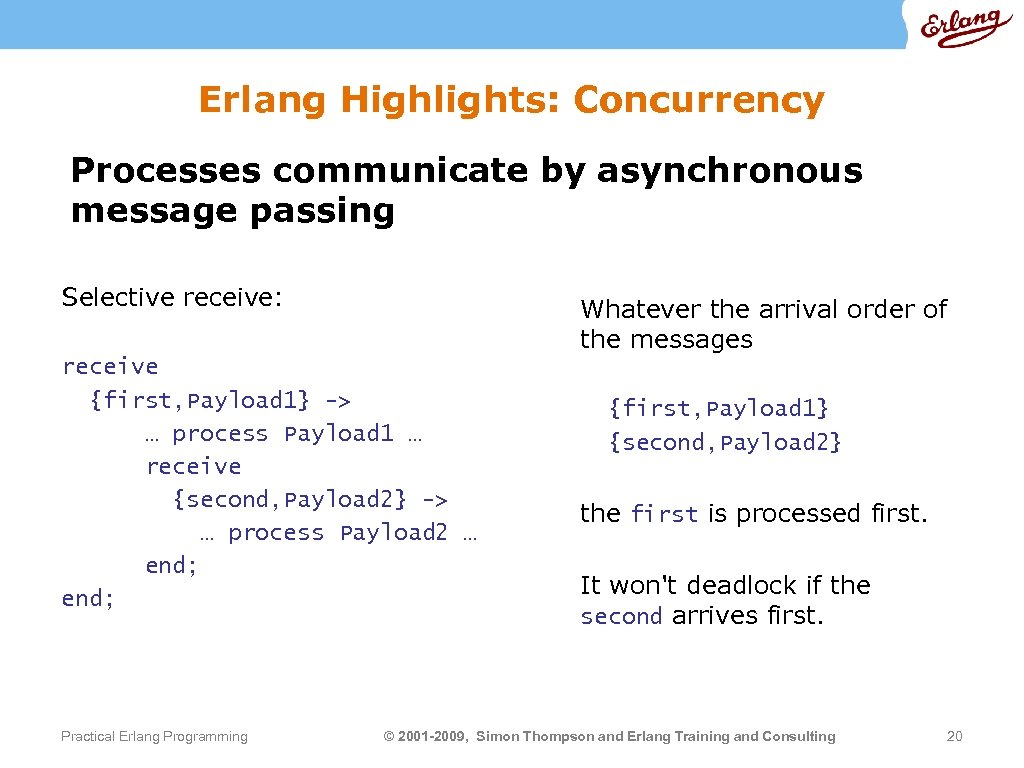 Erlang Highlights: Concurrency Processes communicate by asynchronous message passing Selective receive: Whatever the arrival order of the messages receive {first, Payload 1} -> … process Payload 1 … receive {second, Payload 2} -> … process Payload 2 … end; Practical Erlang Programming {first, Payload 1} {second, Payload 2} the first is processed first. It won't deadlock if the second arrives first. © 2001 -2009, Simon Thompson and Erlang Training and Consulting 20
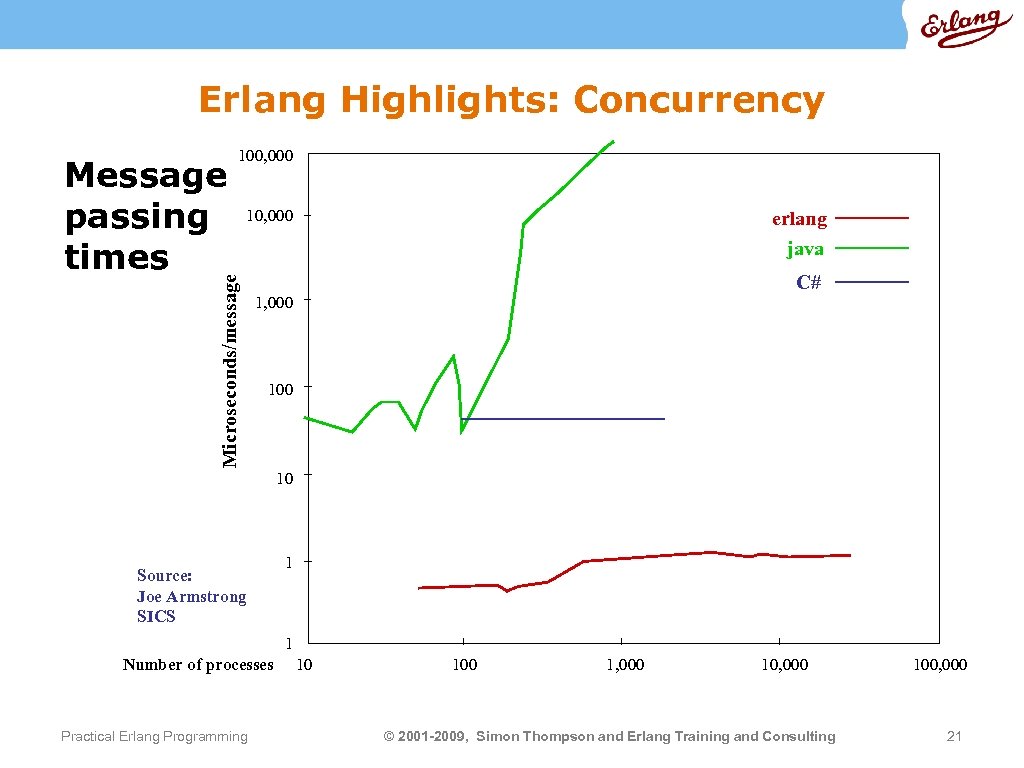 Erlang Highlights: Concurrency 10, 000 Microseconds/message Message passing times 100, 000 erlang java C# 1, 000 10 Source: Joe Armstrong SICS 1 1 Number of processes Practical Erlang Programming 10 100 1, 000 10, 000 © 2001 -2009, Simon Thompson and Erlang Training and Consulting 100, 000 21
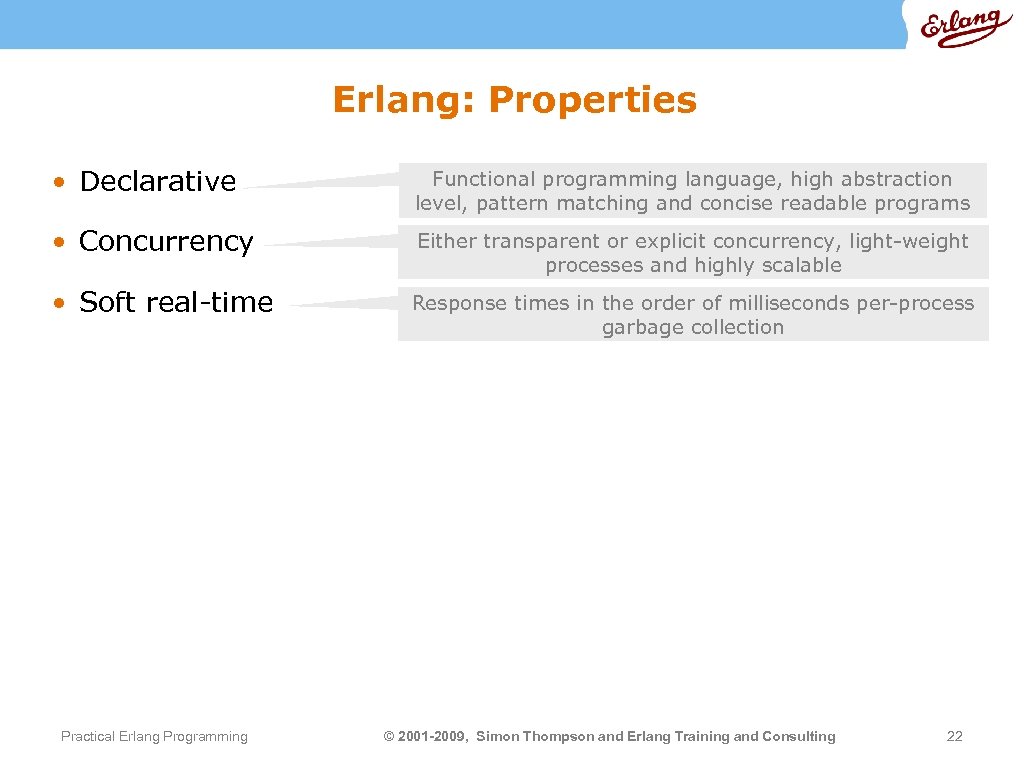 Erlang: Properties • Declarative Functional programming language, high abstraction level, pattern matching and concise readable programs • Concurrency Either transparent or explicit concurrency, light-weight processes and highly scalable • Soft real-time Response times in the order of milliseconds per-process garbage collection Practical Erlang Programming © 2001 -2009, Simon Thompson and Erlang Training and Consulting 22
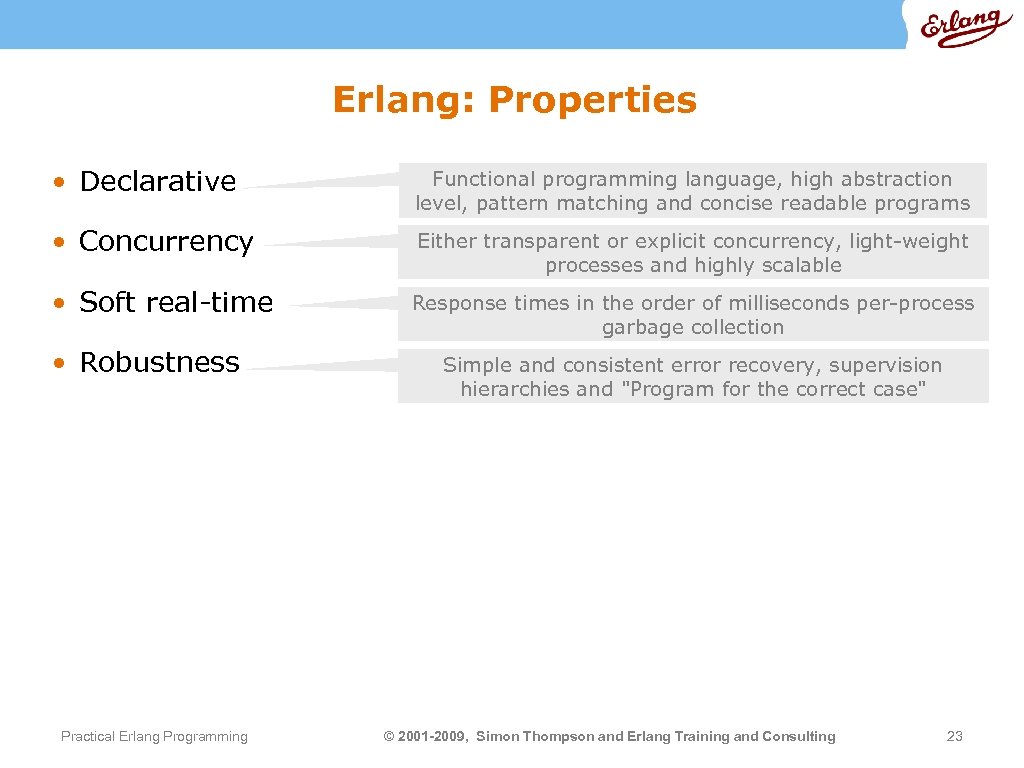 Erlang: Properties • Declarative Functional programming language, high abstraction level, pattern matching and concise readable programs • Concurrency Either transparent or explicit concurrency, light-weight processes and highly scalable • Soft real-time Response times in the order of milliseconds per-process garbage collection • Robustness Practical Erlang Programming Simple and consistent error recovery, supervision hierarchies and "Program for the correct case" © 2001 -2009, Simon Thompson and Erlang Training and Consulting 23
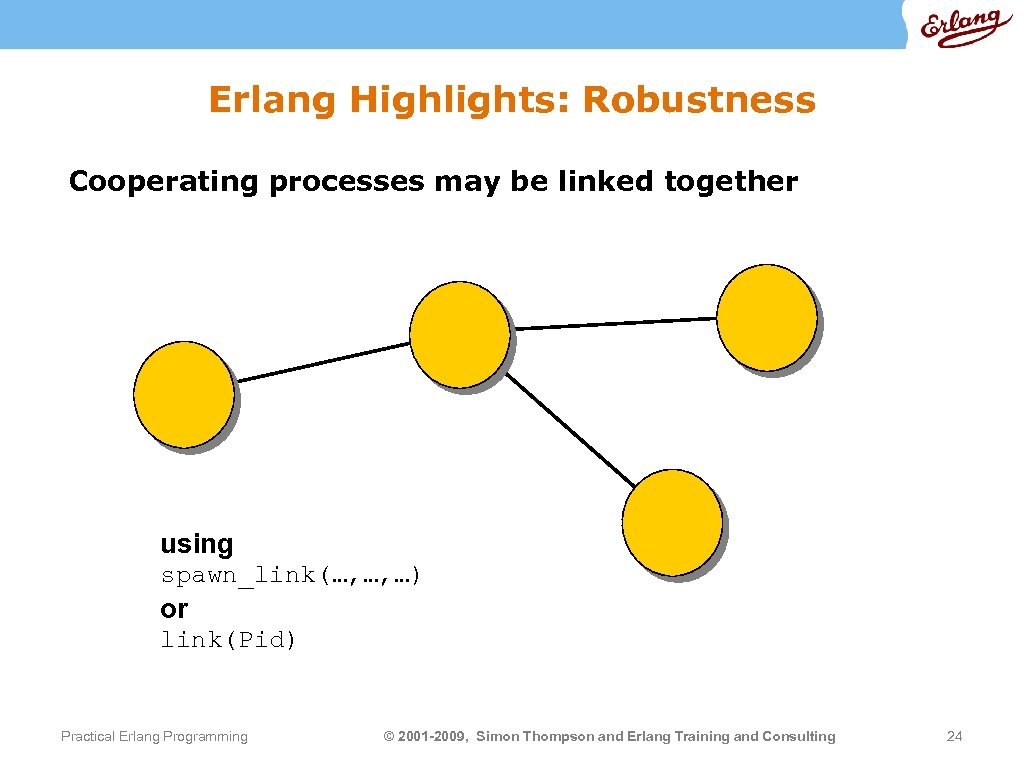 Erlang Highlights: Robustness Cooperating processes may be linked together using spawn_link(…, …, …) or link(Pid) Practical Erlang Programming © 2001 -2009, Simon Thompson and Erlang Training and Consulting 24
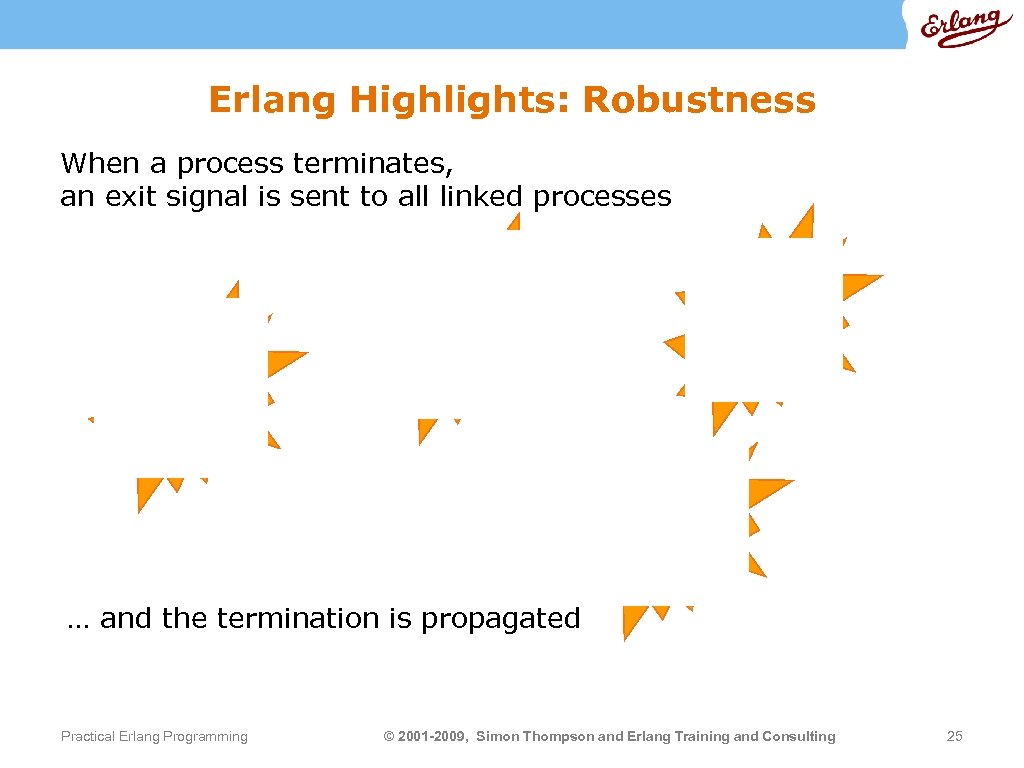 Erlang Highlights: Robustness When a process terminates, an exit signal is sent to all linked processes … and the termination is propagated Practical Erlang Programming © 2001 -2009, Simon Thompson and Erlang Training and Consulting 25
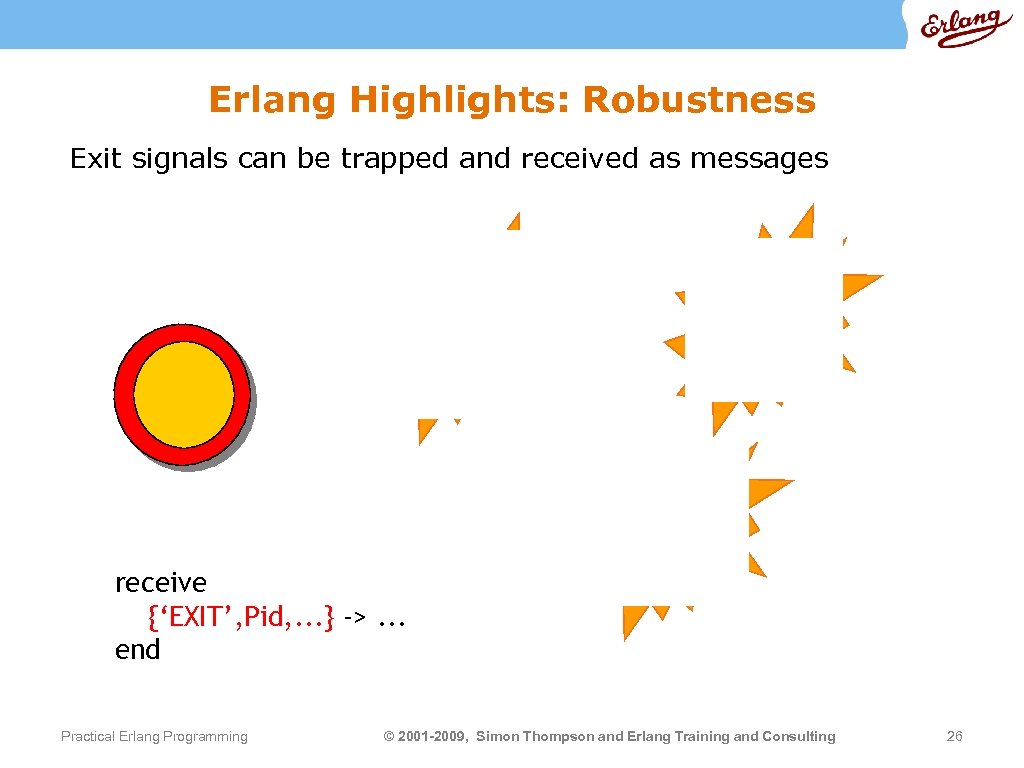 Erlang Highlights: Robustness Exit signals can be trapped and received as messages receive {‘EXIT’, Pid, . . . } ->. . . end Practical Erlang Programming © 2001 -2009, Simon Thompson and Erlang Training and Consulting 26
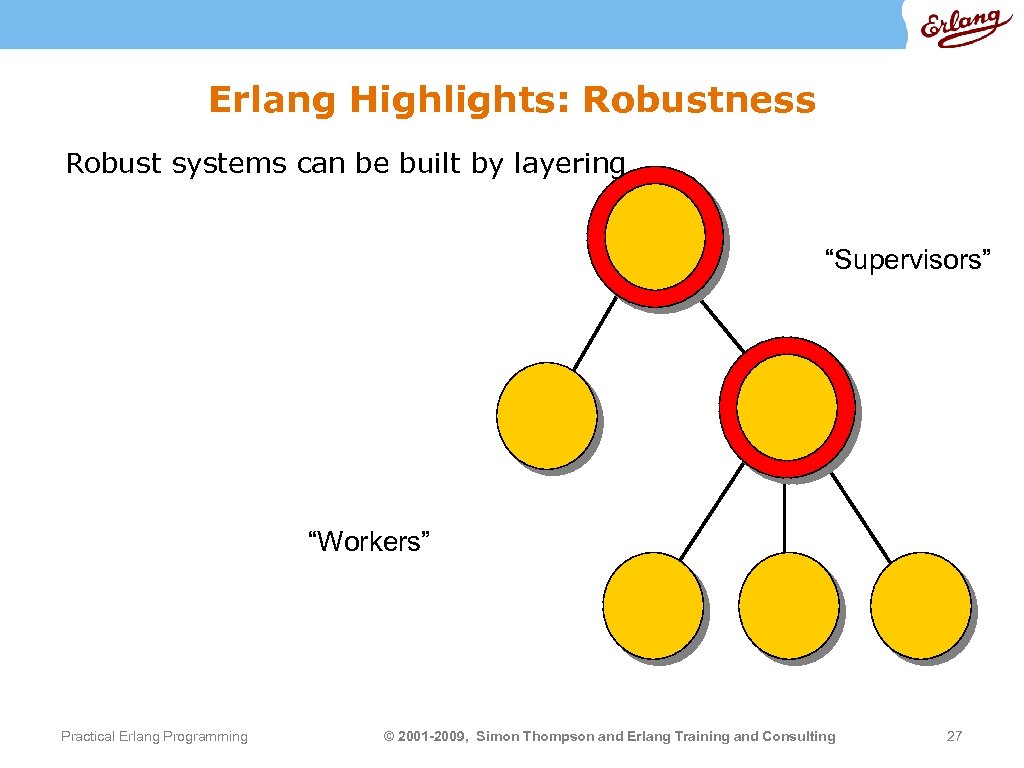 Erlang Highlights: Robustness Robust systems can be built by layering “Supervisors” “Workers” Practical Erlang Programming © 2001 -2009, Simon Thompson and Erlang Training and Consulting 27
 Erlang Highlights: Robustness Supervision hierarchies are policy-based. Supervision policies can govern • how many restarts in a given time • when to delegate restarts to your supervisor • do you restart your siblings? • … Practical Erlang Programming © 2001 -2009, Simon Thompson and Erlang Training and Consulting 28
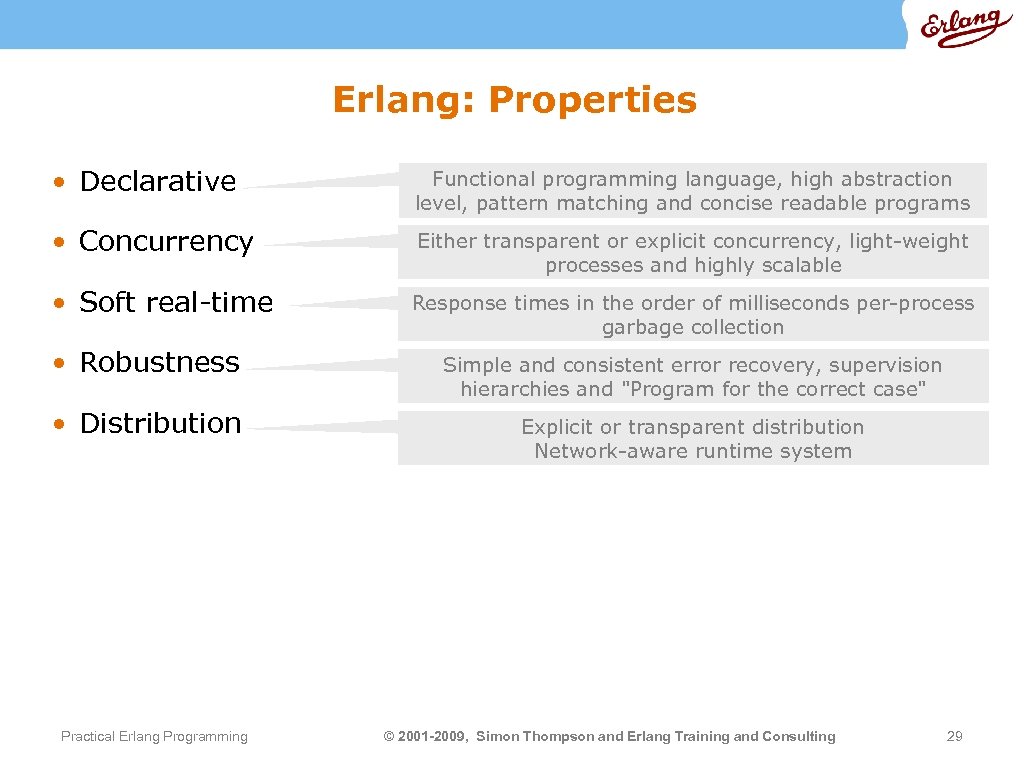 Erlang: Properties • Declarative Functional programming language, high abstraction level, pattern matching and concise readable programs • Concurrency Either transparent or explicit concurrency, light-weight processes and highly scalable • Soft real-time Response times in the order of milliseconds per-process garbage collection • Robustness Simple and consistent error recovery, supervision hierarchies and "Program for the correct case" • Distribution Explicit or transparent distribution Network-aware runtime system Practical Erlang Programming © 2001 -2009, Simon Thompson and Erlang Training and Consulting 29
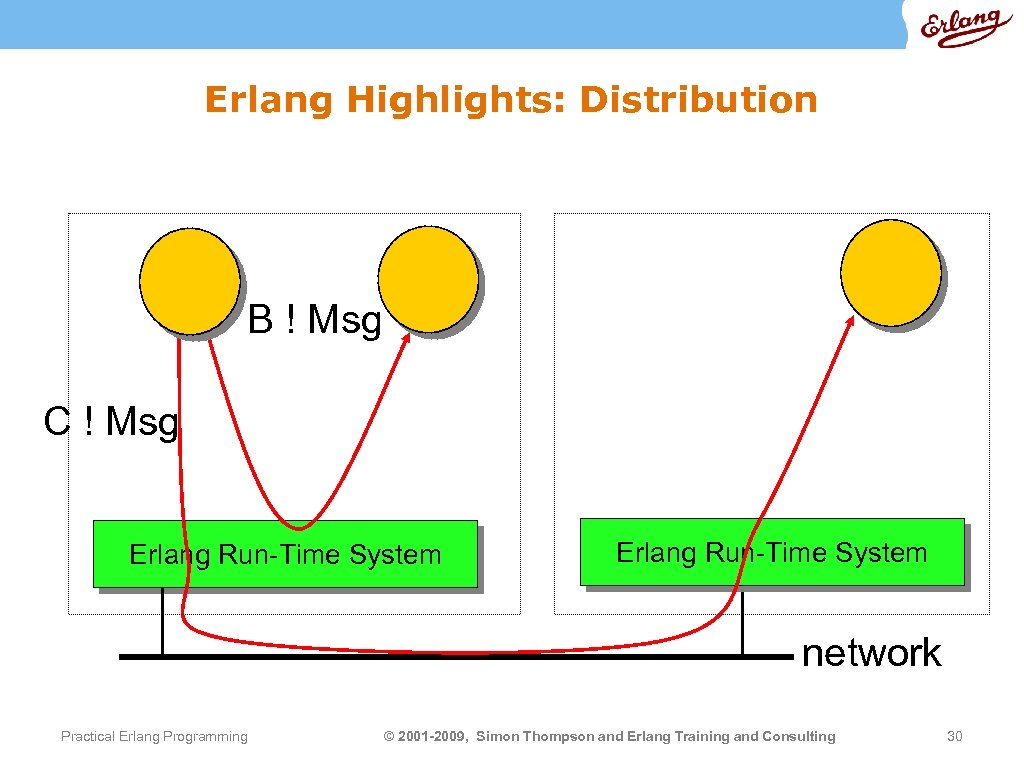 Erlang Highlights: Distribution B ! Msg C ! Msg Erlang Run-Time System network Practical Erlang Programming © 2001 -2009, Simon Thompson and Erlang Training and Consulting 30
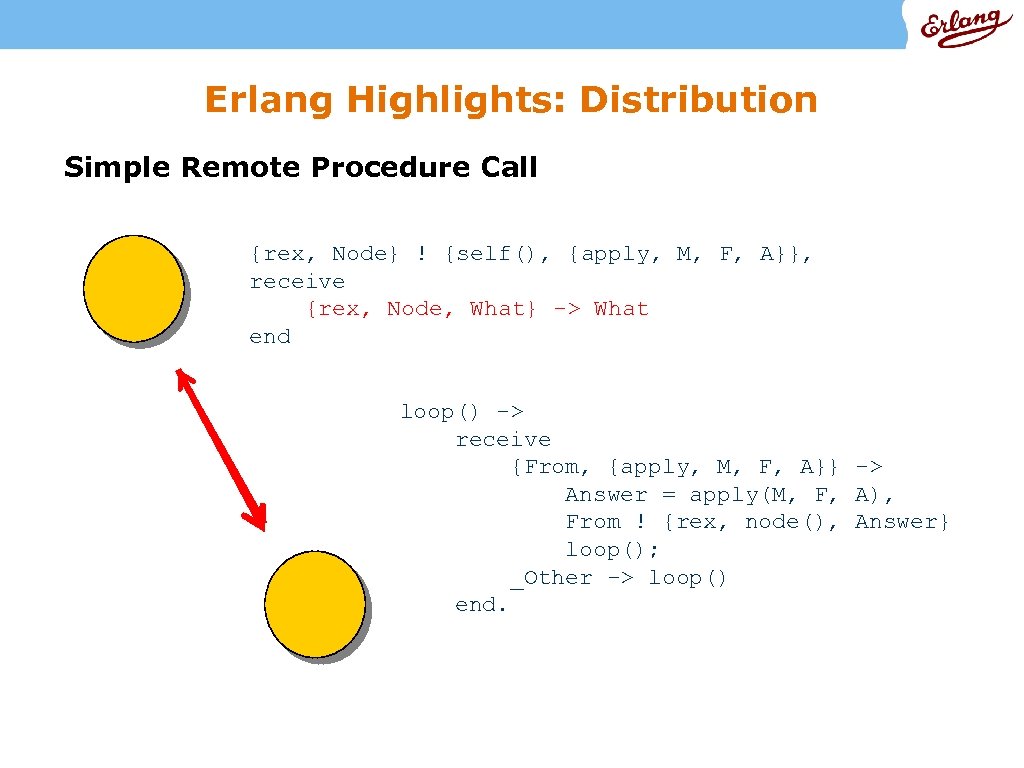 Erlang Highlights: Distribution Simple Remote Procedure Call {rex, Node} ! {self(), {apply, M, F, A}}, receive {rex, Node, What} -> What end loop() -> receive {From, {apply, M, F, A}} -> Answer = apply(M, F, A), From ! {rex, node(), Answer} loop(); _Other -> loop() end.
 Erlang Highlights: Distribution Built in support for distribution through socket-based libraries for SNMP, TCP, HTTP, SSL, … … allowing the systems to have more security than the default distribution mechanism. Practical Erlang Programming © 2001 -2009, Simon Thompson and Erlang Training and Consulting 32
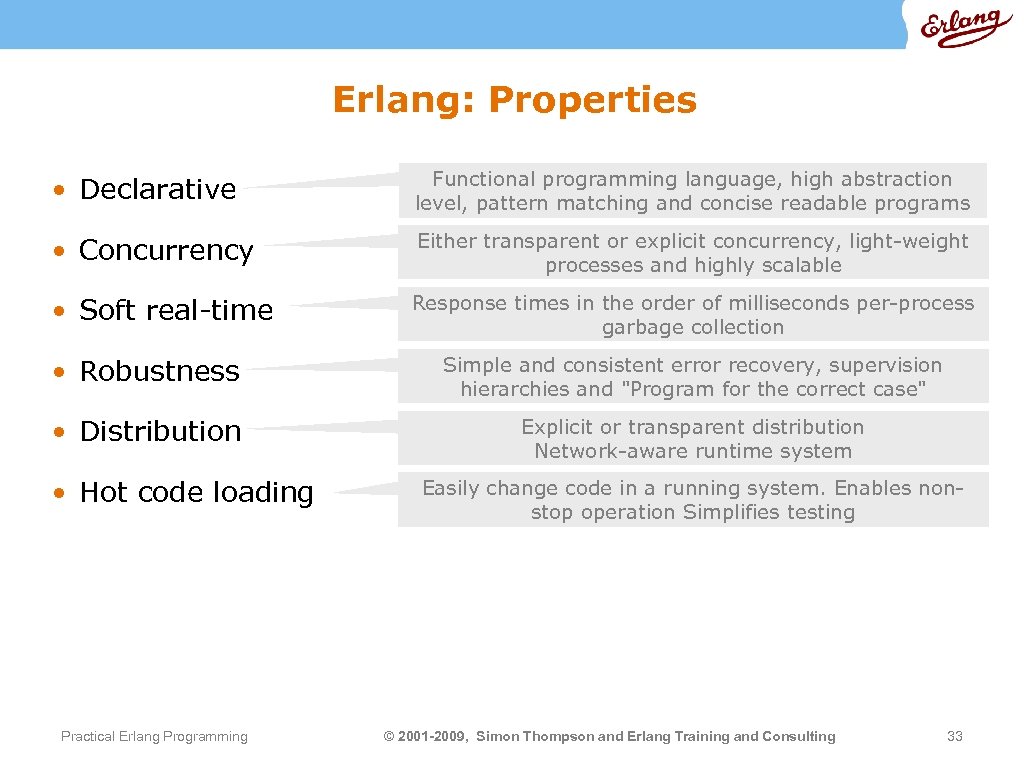 Erlang: Properties • Declarative Functional programming language, high abstraction level, pattern matching and concise readable programs • Concurrency Either transparent or explicit concurrency, light-weight processes and highly scalable • Soft real-time Response times in the order of milliseconds per-process garbage collection • Robustness Simple and consistent error recovery, supervision hierarchies and "Program for the correct case" • Distribution Explicit or transparent distribution Network-aware runtime system • Hot code loading Practical Erlang Programming Easily change code in a running system. Enables nonstop operation Simplifies testing © 2001 -2009, Simon Thompson and Erlang Training and Consulting 33
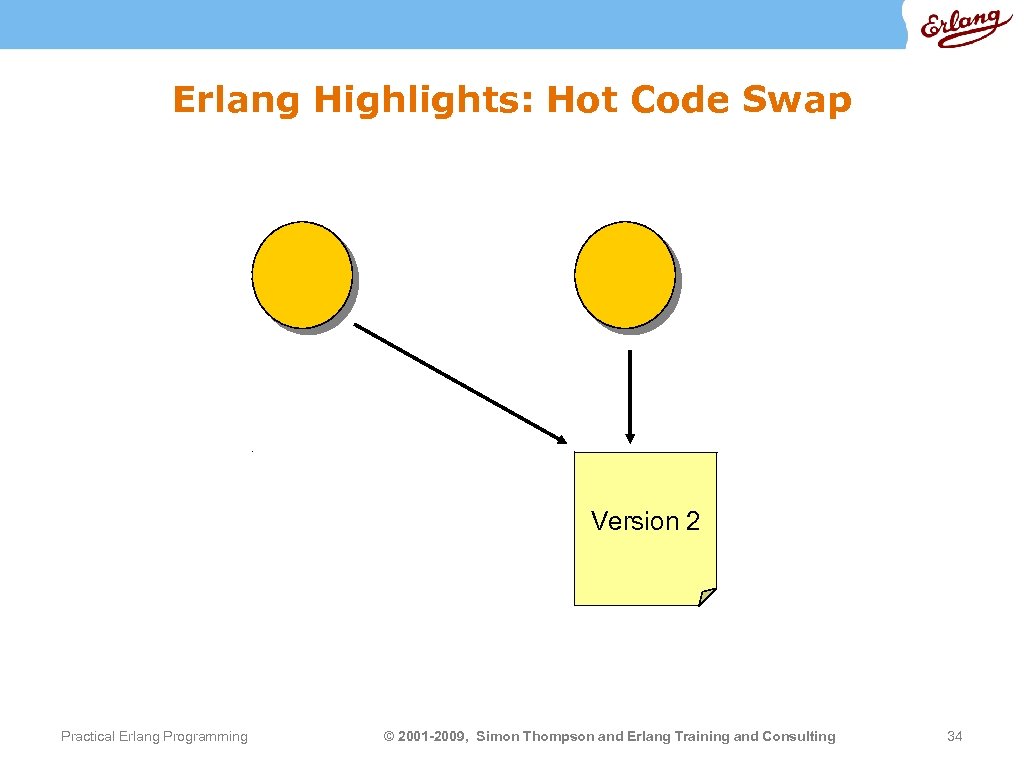 Erlang Highlights: Hot Code Swap Version 1 Practical Erlang Programming Version 2 © 2001 -2009, Simon Thompson and Erlang Training and Consulting 34
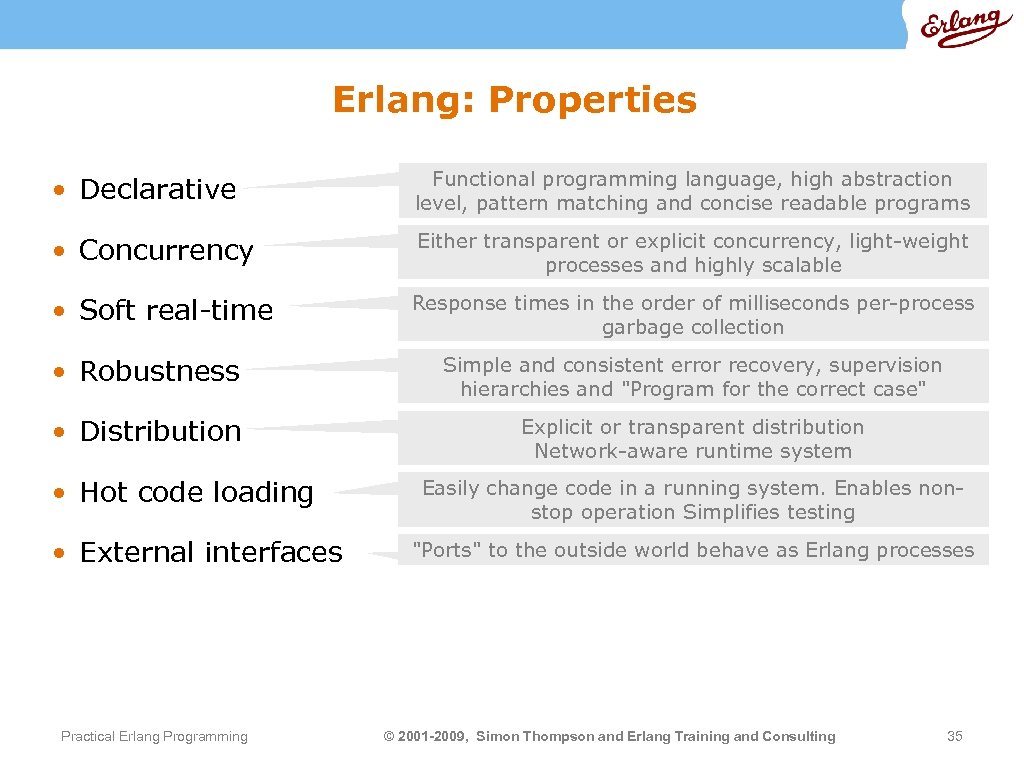 Erlang: Properties • Declarative Functional programming language, high abstraction level, pattern matching and concise readable programs • Concurrency Either transparent or explicit concurrency, light-weight processes and highly scalable • Soft real-time Response times in the order of milliseconds per-process garbage collection • Robustness Simple and consistent error recovery, supervision hierarchies and "Program for the correct case" • Distribution Explicit or transparent distribution Network-aware runtime system • Hot code loading • External interfaces Practical Erlang Programming Easily change code in a running system. Enables nonstop operation Simplifies testing "Ports" to the outside world behave as Erlang processes © 2001 -2009, Simon Thompson and Erlang Training and Consulting 35
![Erlang Highlights: External Interfaces Port External process Port ! {self(), {command, [1, 2, 3]}}](https://present5.com/presentation/4aad37d617e0f699c13c40bf30a513c9/image-36.jpg "Erlang Highlights: External Interfaces Port External process Port ! {self(), {command, [1, 2, 3]}}") Erlang Highlights: External Interfaces Port External process Port ! {self(), {command, [1, 2, 3]}} Practical Erlang Programming © 2001 -2009, Simon Thompson and Erlang Training and Consulting 36
Erlang Highlights: External Interfaces Port External process Port ! {self(), {command, [1, 2, 3]}} Practical Erlang Programming © 2001 -2009, Simon Thompson and Erlang Training and Consulting 36
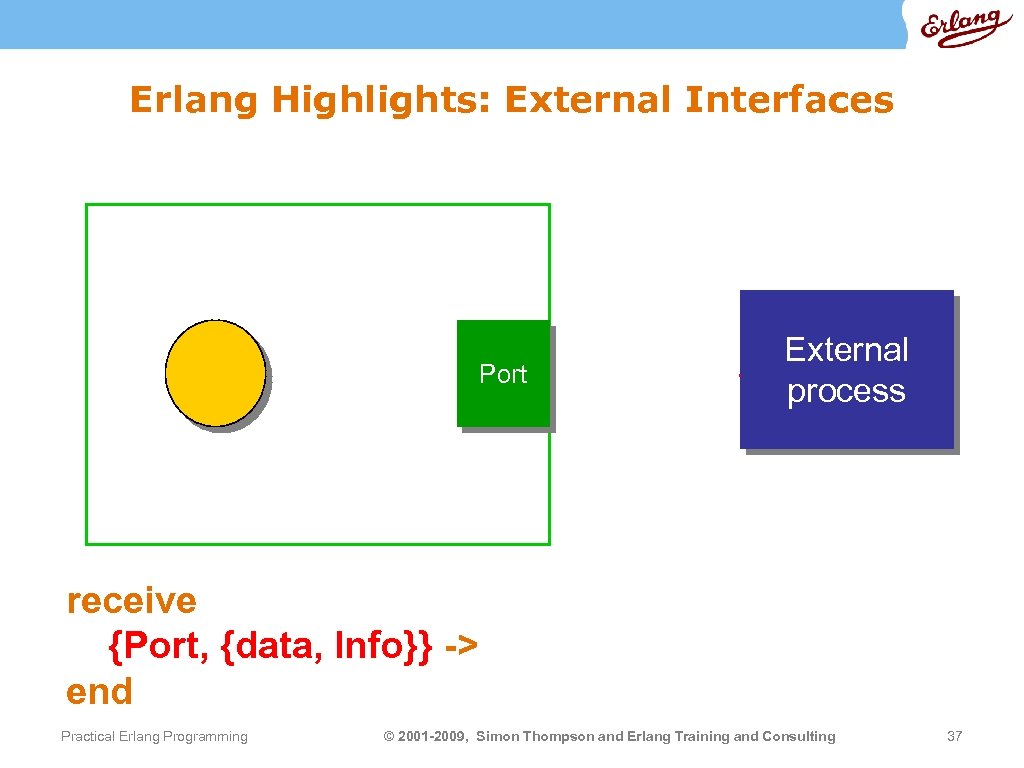 Erlang Highlights: External Interfaces Port External process receive {Port, {data, Info}} -> end Practical Erlang Programming © 2001 -2009, Simon Thompson and Erlang Training and Consulting 37
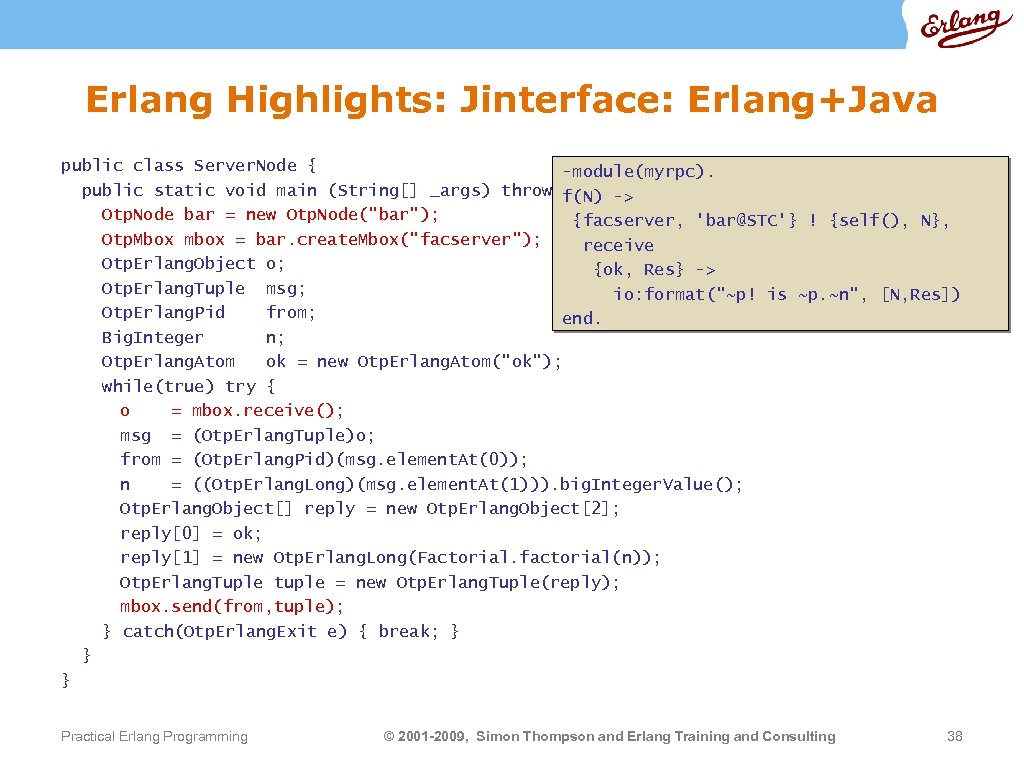 Erlang Highlights: Jinterface: Erlang+Java public class Server. Node { -module(myrpc). public static void main (String[] _args) throwsf(N) -> Exception{ Otp. Node bar = new Otp. Node("bar"); {facserver, 'bar@STC'} ! {self(), N}, Otp. Mbox mbox = bar. create. Mbox("facserver"); receive Otp. Erlang. Object o; {ok, Res} -> Otp. Erlang. Tuple msg; io: format("~p! is ~p. ~n", [N, Res]) Otp. Erlang. Pid from; end. Big. Integer n; Otp. Erlang. Atom ok = new Otp. Erlang. Atom("ok"); while(true) try { o = mbox. receive(); msg = (Otp. Erlang. Tuple)o; from = (Otp. Erlang. Pid)(msg. element. At(0)); n = ((Otp. Erlang. Long)(msg. element. At(1))). big. Integer. Value(); Otp. Erlang. Object[] reply = new Otp. Erlang. Object[2]; reply[0] = ok; reply[1] = new Otp. Erlang. Long(Factorial. factorial(n)); Otp. Erlang. Tuple tuple = new Otp. Erlang. Tuple(reply); mbox. send(from, tuple); } catch(Otp. Erlang. Exit e) { break; } } } Practical Erlang Programming © 2001 -2009, Simon Thompson and Erlang Training and Consulting 38
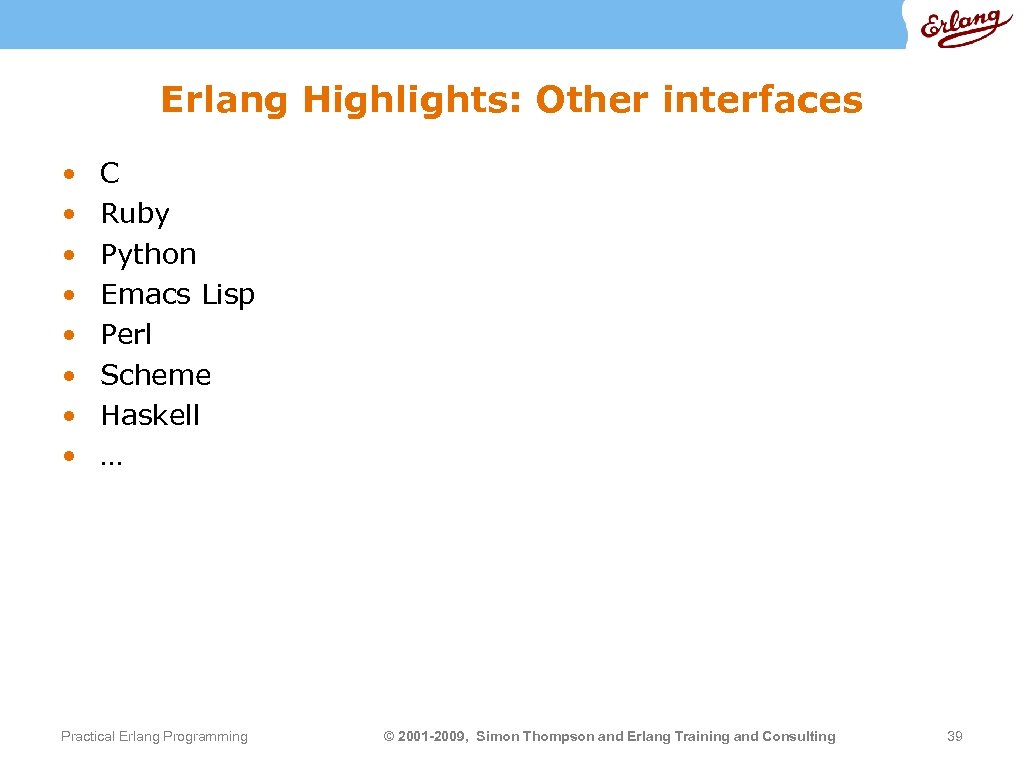 Erlang Highlights: Other interfaces • • C Ruby Python Emacs Lisp Perl Scheme Haskell … Practical Erlang Programming © 2001 -2009, Simon Thompson and Erlang Training and Consulting 39
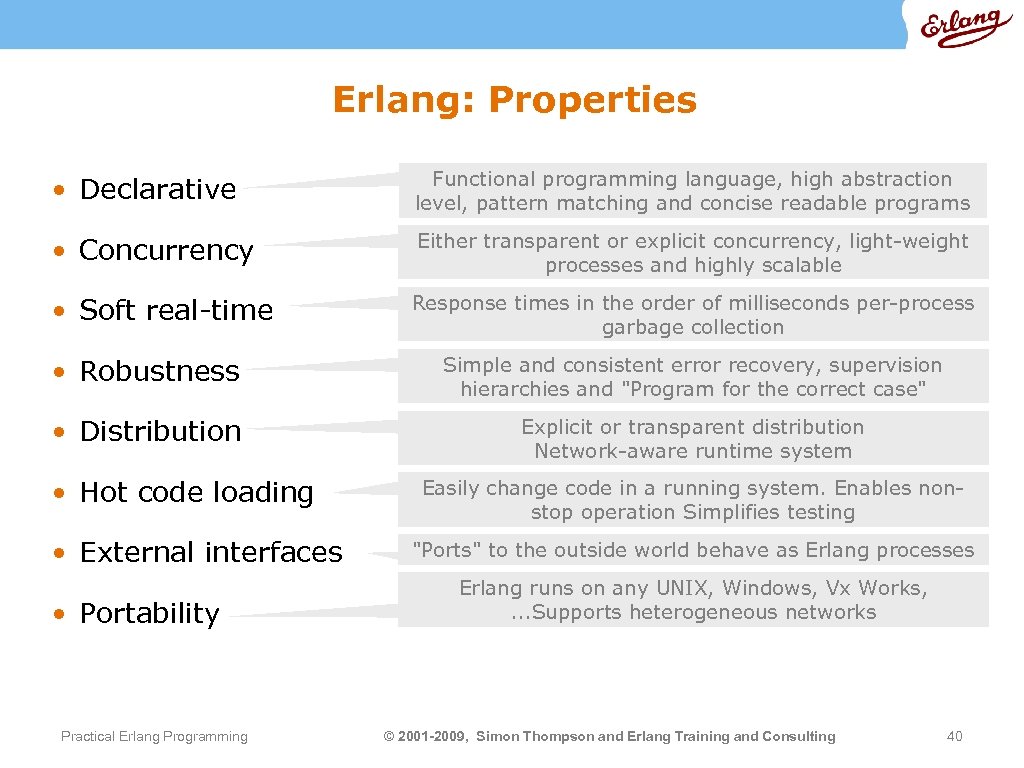 Erlang: Properties • Declarative Functional programming language, high abstraction level, pattern matching and concise readable programs • Concurrency Either transparent or explicit concurrency, light-weight processes and highly scalable • Soft real-time Response times in the order of milliseconds per-process garbage collection • Robustness Simple and consistent error recovery, supervision hierarchies and "Program for the correct case" • Distribution Explicit or transparent distribution Network-aware runtime system • Hot code loading • External interfaces • Portability Practical Erlang Programming Easily change code in a running system. Enables nonstop operation Simplifies testing "Ports" to the outside world behave as Erlang processes Erlang runs on any UNIX, Windows, Vx Works, . . . Supports heterogeneous networks © 2001 -2009, Simon Thompson and Erlang Training and Consulting 40
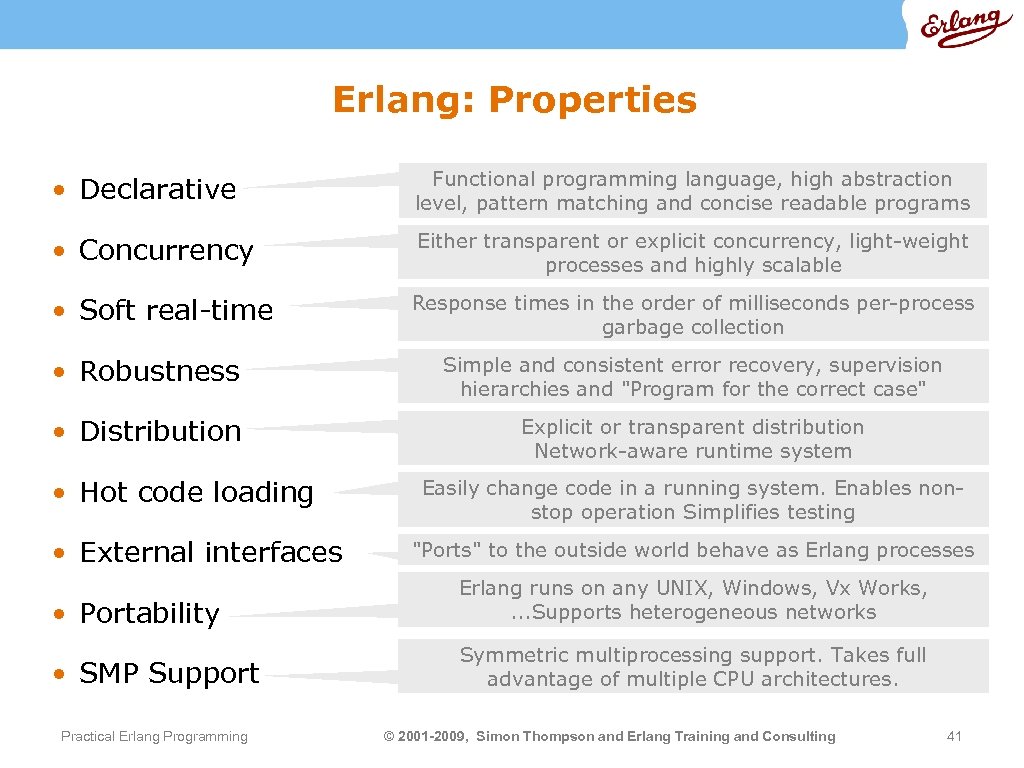 Erlang: Properties • Declarative Functional programming language, high abstraction level, pattern matching and concise readable programs • Concurrency Either transparent or explicit concurrency, light-weight processes and highly scalable • Soft real-time Response times in the order of milliseconds per-process garbage collection • Robustness Simple and consistent error recovery, supervision hierarchies and "Program for the correct case" • Distribution Explicit or transparent distribution Network-aware runtime system • Hot code loading • External interfaces Easily change code in a running system. Enables nonstop operation Simplifies testing "Ports" to the outside world behave as Erlang processes • Portability Erlang runs on any UNIX, Windows, Vx Works, . . . Supports heterogeneous networks • SMP Support Symmetric multiprocessing support. Takes full advantage of multiple CPU architectures. Practical Erlang Programming © 2001 -2009, Simon Thompson and Erlang Training and Consulting 41
 Erlang Highlights: SMP Support The Industry’s Dilema • • The shift to multicore is inevitable. Parallelizing legacy C (and Java) code is very hard. Debugging parallelized C (and Java) is even harder. ”. . . but what choice do we have? ” Practical Erlang Programming © 2001 -2009, Simon Thompson and Erlang Training and Consulting 42
 Erlang Highlights: SMP Support Erlang SMP ”Credo” SMP should be transparent to the programmer in much the same way as Erlang Distribution • You shouldn’t have to think about it. . . but sometimes you must • Use SMP mainly for stuff that you’d make concurrent anyway • Erlang uses concurrency as a structuring principle • Model for the natural concurrency in your problem Practical Erlang Programming © 2001 -2009, Simon Thompson and Erlang Training and Consulting 43
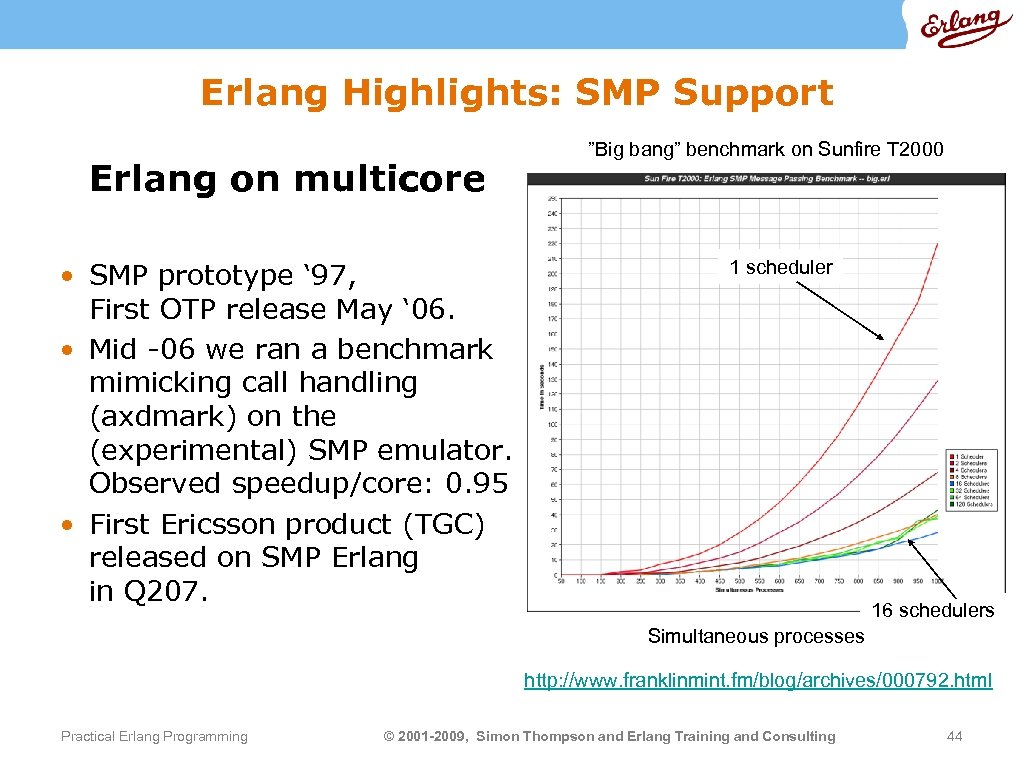 Erlang Highlights: SMP Support • Erlang on multicore • SMP prototype ‘ 97, First OTP release May ‘ 06. • Mid -06 we ran a benchmark mimicking call handling (axdmark) on the (experimental) SMP emulator. Observed speedup/core: 0. 95 • First Ericsson product (TGC) released on SMP Erlang in Q 207. ”Big bang” benchmark on Sunfire T 2000 1 scheduler 16 schedulers Simultaneous processes http: //www. franklinmint. fm/blog/archives/000792. html Practical Erlang Programming © 2001 -2009, Simon Thompson and Erlang Training and Consulting 44
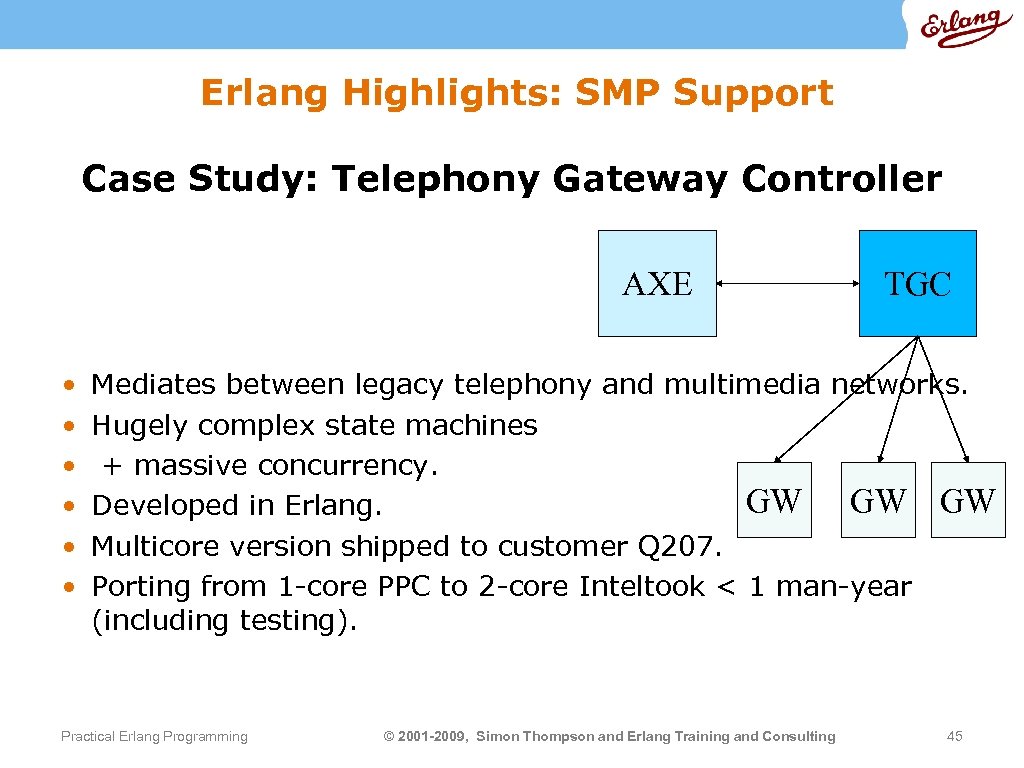 Erlang Highlights: SMP Support Case Study: Telephony Gateway Controller AXE • • • TGC Mediates between legacy telephony and multimedia networks. Hugely complex state machines + massive concurrency. GW GW GW Developed in Erlang. Multicore version shipped to customer Q 207. Porting from 1 -core PPC to 2 -core Inteltook < 1 man-year (including testing). Practical Erlang Programming © 2001 -2009, Simon Thompson and Erlang Training and Consulting 45
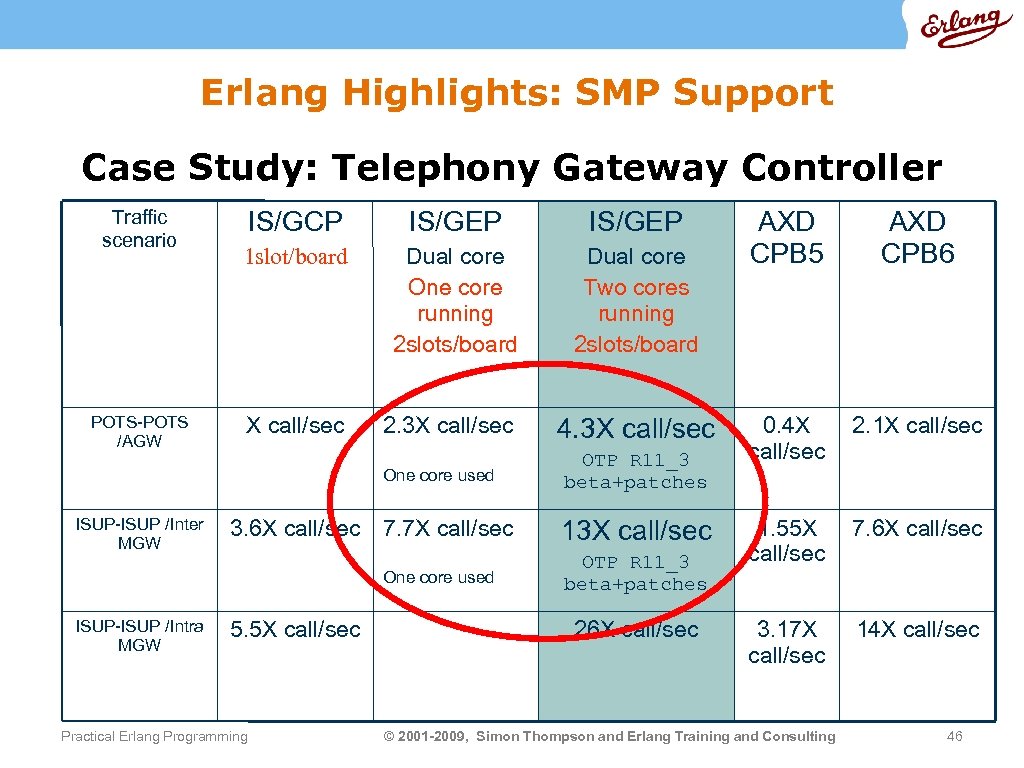 Erlang Highlights: SMP Support Case Study: Telephony Gateway Controller Traffic scenario POTS-POTS /AGW IS/GCP IS/GEP 1 slot/board Dual core One core running 2 slots/board Dual core Two cores running 2 slots/board X call/sec 2. 3 X call/sec One core used ISUP-ISUP /Inter MGW 3. 6 X call/sec 7. 7 X call/sec One core used ISUP-ISUP /Intra MGW 5. 5 X call/sec Practical Erlang Programming 4. 3 X call/sec OTP R 11_3 beta+patches 13 X call/sec OTP R 11_3 beta+patches 26 X call/sec AXD CPB 5 AXD CPB 6 0. 4 X call/sec 2. 1 X call/sec 1. 55 X call/sec 7. 6 X call/sec 3. 17 X call/sec 14 X call/sec © 2001 -2009, Simon Thompson and Erlang Training and Consulting 46
 Erlang Highlights: SMP support • Chatty • 1000 processes created • Each process randomly sends req/recieves ack from all other processes Practical Erlang Programming © 2001 -2009, Simon Thompson and Erlang Training and Consulting 47
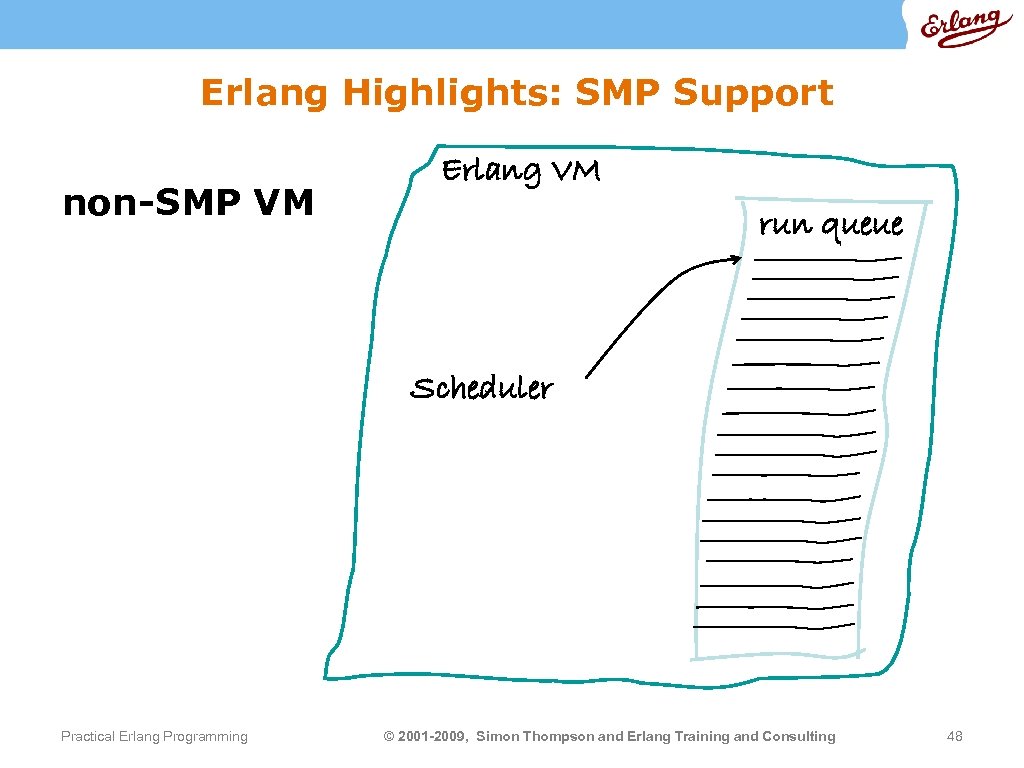 Erlang Highlights: SMP Support non-SMP VM Erlang VM run queue Scheduler Practical Erlang Programming © 2001 -2009, Simon Thompson and Erlang Training and Consulting 48
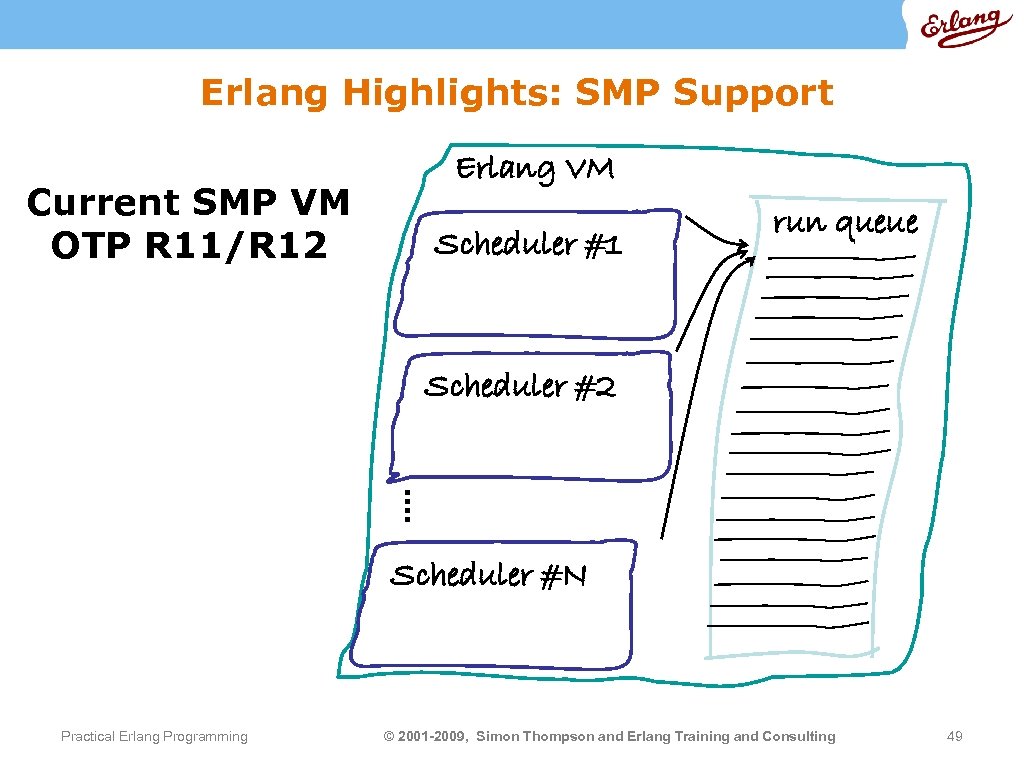 Erlang Highlights: SMP Support Current SMP VM OTP R 11/R 12 Erlang VM Scheduler #1 run queue Scheduler #2 Scheduler #N Practical Erlang Programming © 2001 -2009, Simon Thompson and Erlang Training and Consulting 49
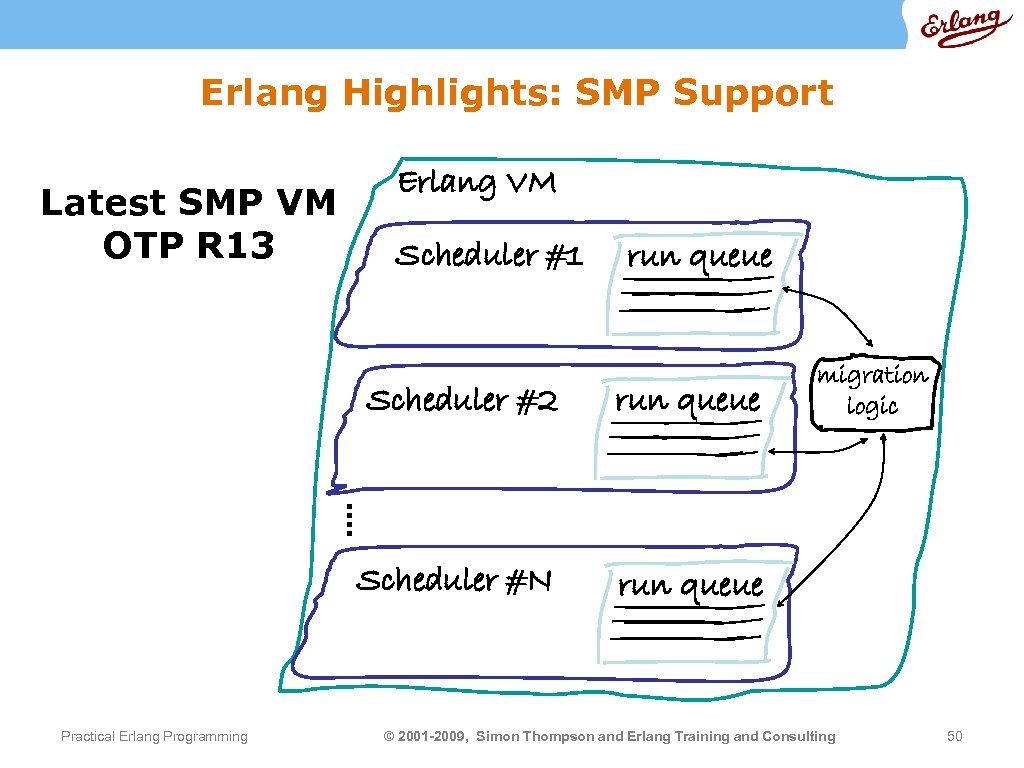 Erlang Highlights: SMP Support Latest SMP VM OTP R 13 Erlang VM Scheduler #1 run queue Scheduler #2 Scheduler #N Practical Erlang Programming run queue migration logic run queue © 2001 -2009, Simon Thompson and Erlang Training and Consulting 50
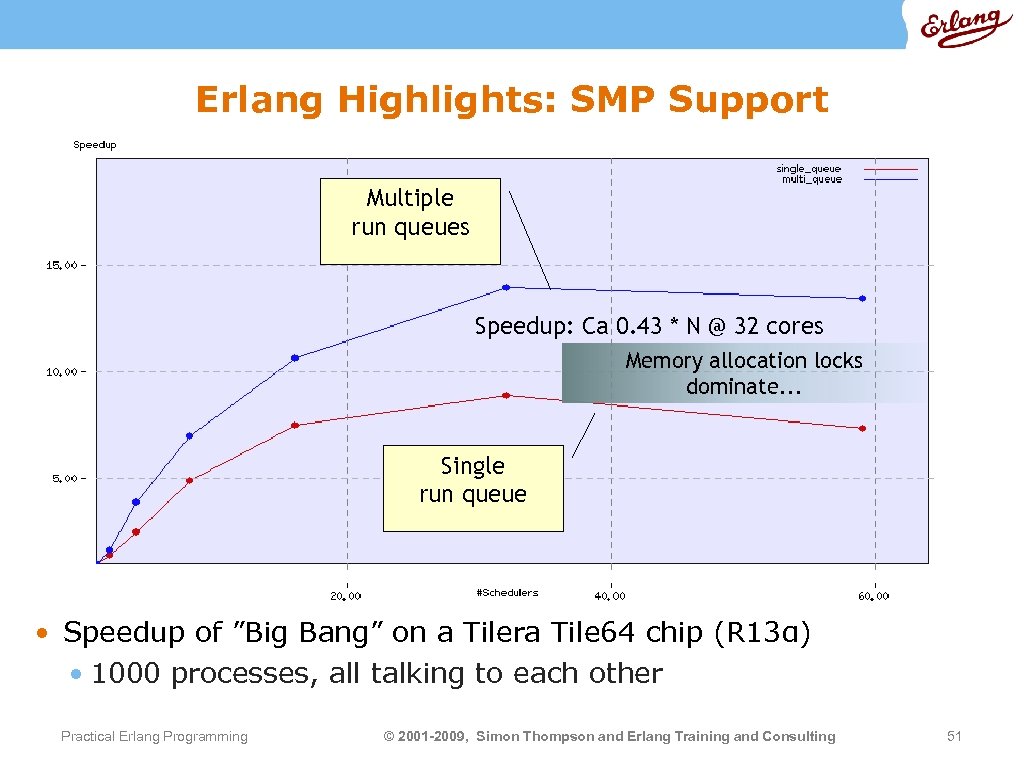 Erlang Highlights: SMP Support Multiple run queues Speedup: Ca 0. 43 * N @ 32 cores Memory allocation locks dominate. . . Single run queue • Speedup of ”Big Bang” on a Tilera Tile 64 chip (R 13α) • 1000 processes, all talking to each other Practical Erlang Programming © 2001 -2009, Simon Thompson and Erlang Training and Consulting 51
 Contents • • Erlang History Erlang Highlights Open Telecom Platform Frequency Server Example Products The Community Events & Questions Practical Erlang Programming © 2001 -2009, Simon Thompson and Erlang Training and Consulting 52
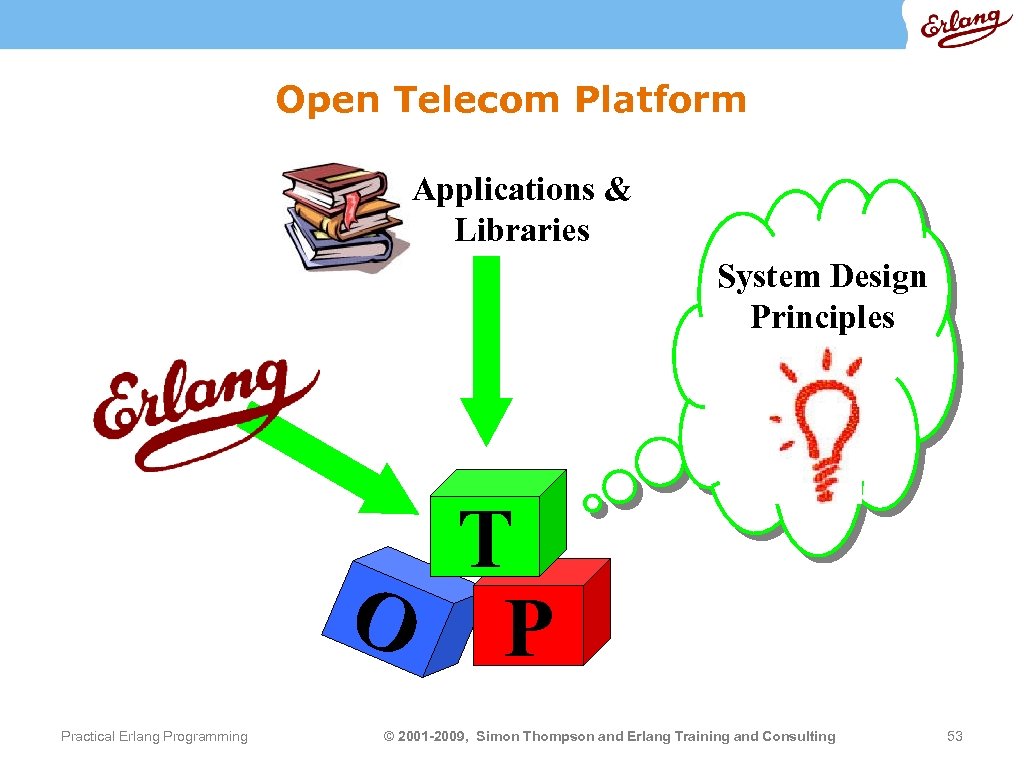 Open Telecom Platform Applications & Libraries System Design Principles T O P Practical Erlang Programming © 2001 -2009, Simon Thompson and Erlang Training and Consulting 53
 OTP: System Design Principles • A set of abstract principles and design rules. § They describe the software architecture of an Erlang System § Needed so existing tools will be compatible with them § Facilitate understanding of the system among teams • A set of generic behaviours. § Each behaviour is a formalisation of a design pattern § Contains frameworks with generic code § Solve a common problem § Have built in support for debugging and software upgrade § Facilitate understanding of the sub blocks in the system Practical Erlang Programming © 2001 -2009, Simon Thompson and Erlang Training and Consulting 54
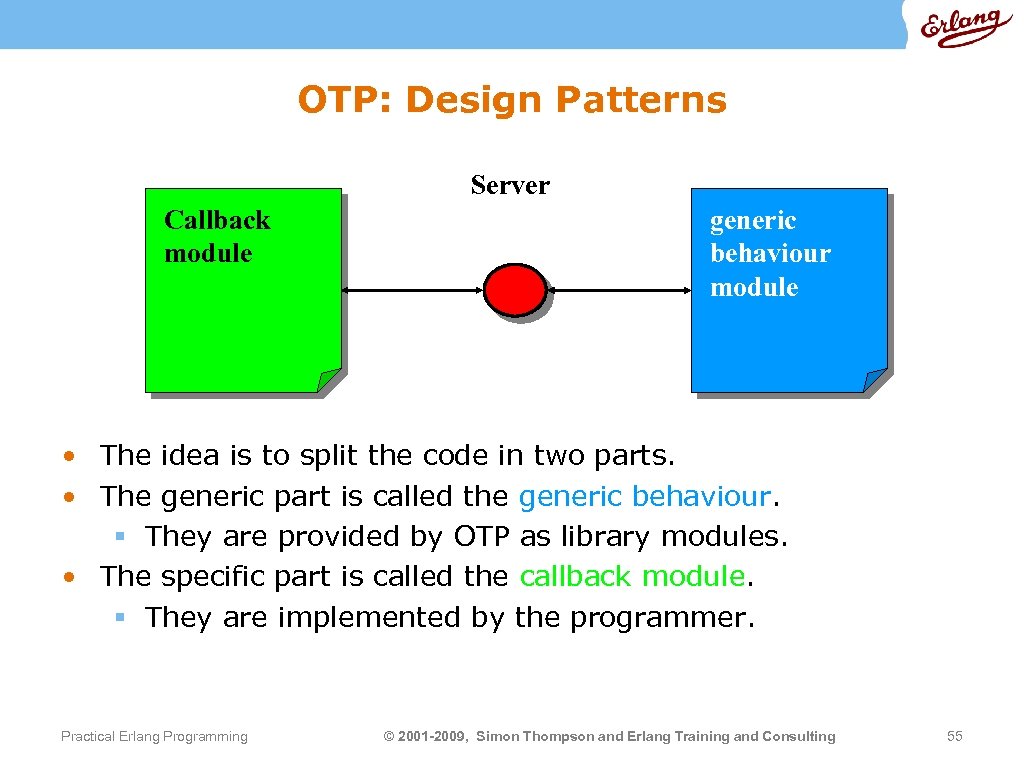 OTP: Design Patterns Server Callback module generic behaviour module • The idea is to split the code in two parts. • The generic part is called the generic behaviour. § They are provided by OTP as library modules. • The specific part is called the callback module. § They are implemented by the programmer. Practical Erlang Programming © 2001 -2009, Simon Thompson and Erlang Training and Consulting 55
 OTP: Design Patterns • Generic Servers § Used to model client server behaviour • Generic Finite State Machines § Used for finite state machine programming • Generic Event Server / Manager § Used for writing event handlers • Supervisor § Used for fault-tolerant supervision trees • Application § Used to encapsulate resources and functionality Practical Erlang Programming © 2001 -2009, Simon Thompson and Erlang Training and Consulting 56
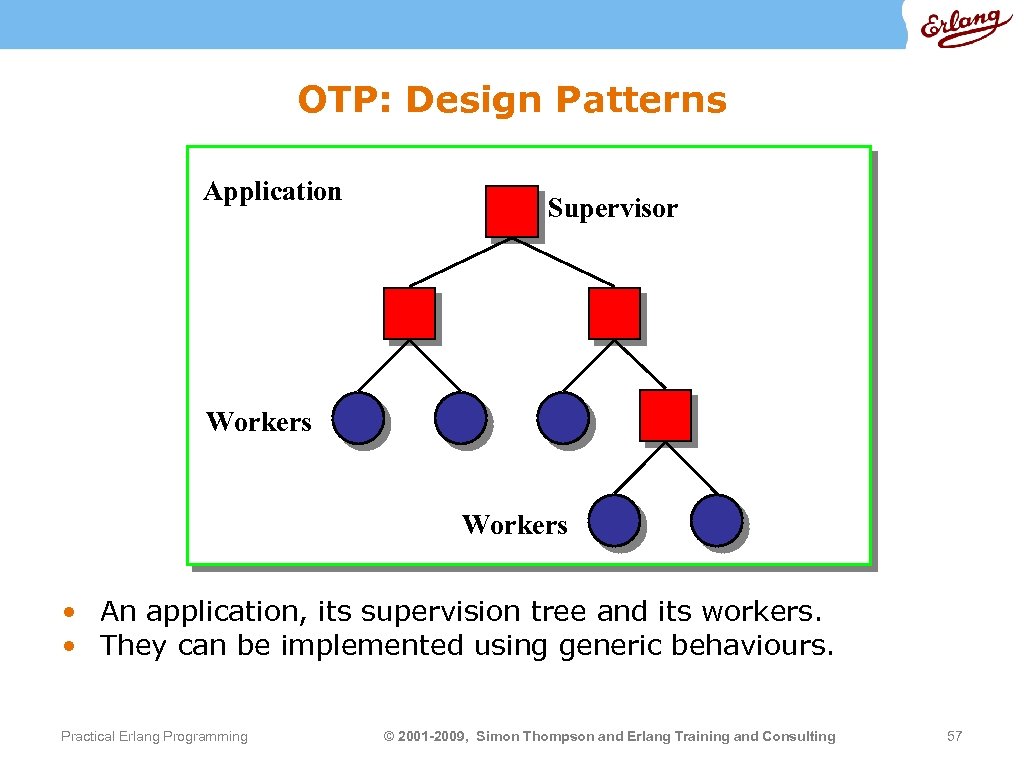 OTP: Design Patterns Application Supervisor Workers • An application, its supervision tree and its workers. • They can be implemented using generic behaviours. Practical Erlang Programming © 2001 -2009, Simon Thompson and Erlang Training and Consulting 57
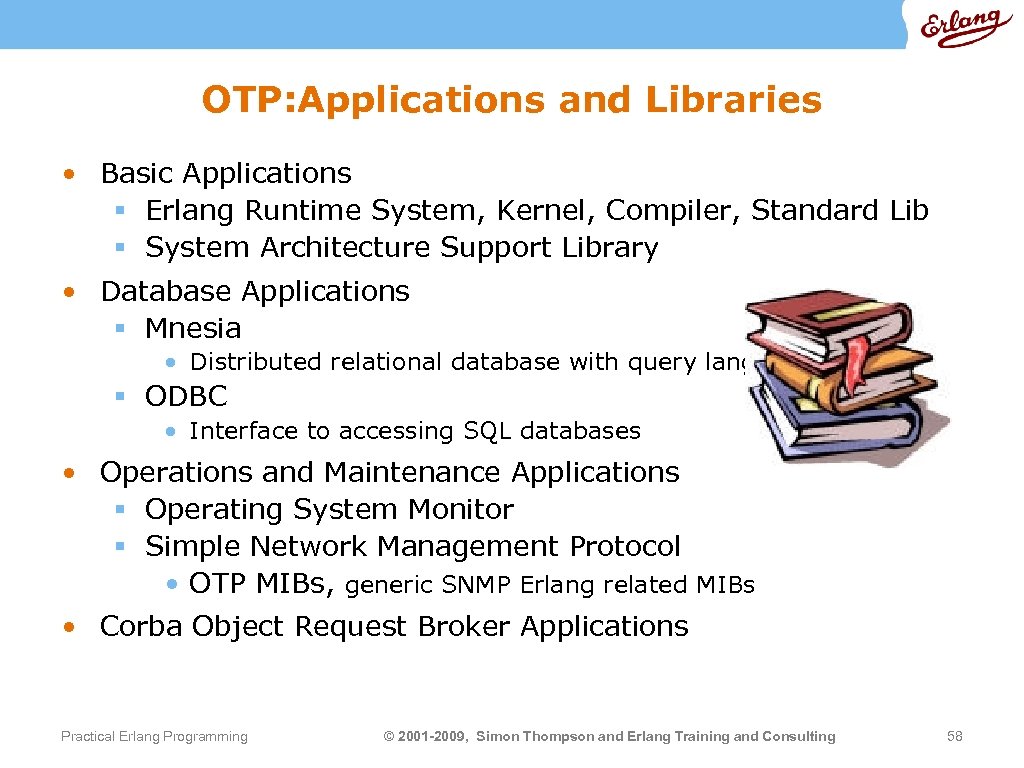 OTP: Applications and Libraries • Basic Applications § Erlang Runtime System, Kernel, Compiler, Standard Lib § System Architecture Support Library • Database Applications § Mnesia • Distributed relational database with query language § ODBC • Interface to accessing SQL databases • Operations and Maintenance Applications § Operating System Monitor § Simple Network Management Protocol • OTP MIBs, generic SNMP Erlang related MIBs • Corba Object Request Broker Applications Practical Erlang Programming © 2001 -2009, Simon Thompson and Erlang Training and Consulting 58
 OTP: Applications and Libraries • Interface and Communications Applications § ASN 1 compiler § Crypto § Graphics System § Inets • Ip related services including TCP, UDP, HTTP and FTP § Java Interface § Megaco Stack • Megaco/H. 248 Stack § SSH, SSL § XML Parsing § Erlang to C Interface Practical Erlang Programming © 2001 -2009, Simon Thompson and Erlang Training and Consulting 59
 OTP: Applications and Libraries • Tool Applications § Appmon, Pman, Debugger, Event Trace, Table Visualiser • Graphical debugging tools § Dialyzer • Type checking tool § Docbuilder, Edoc • Documentation tools § Invisio, Observer § Percept • Erlang Concurrency Profiler Tool § Parse & Syntax Tools • YECC Erlang Implementation • Handling abstract Erlang syntax trees § Runtime and Profiling Tools • Tools for debugging production systems • Tools for profiling, coverage analysis, and development support Practical Erlang Programming © 2001 -2009, Simon Thompson and Erlang Training and Consulting 60
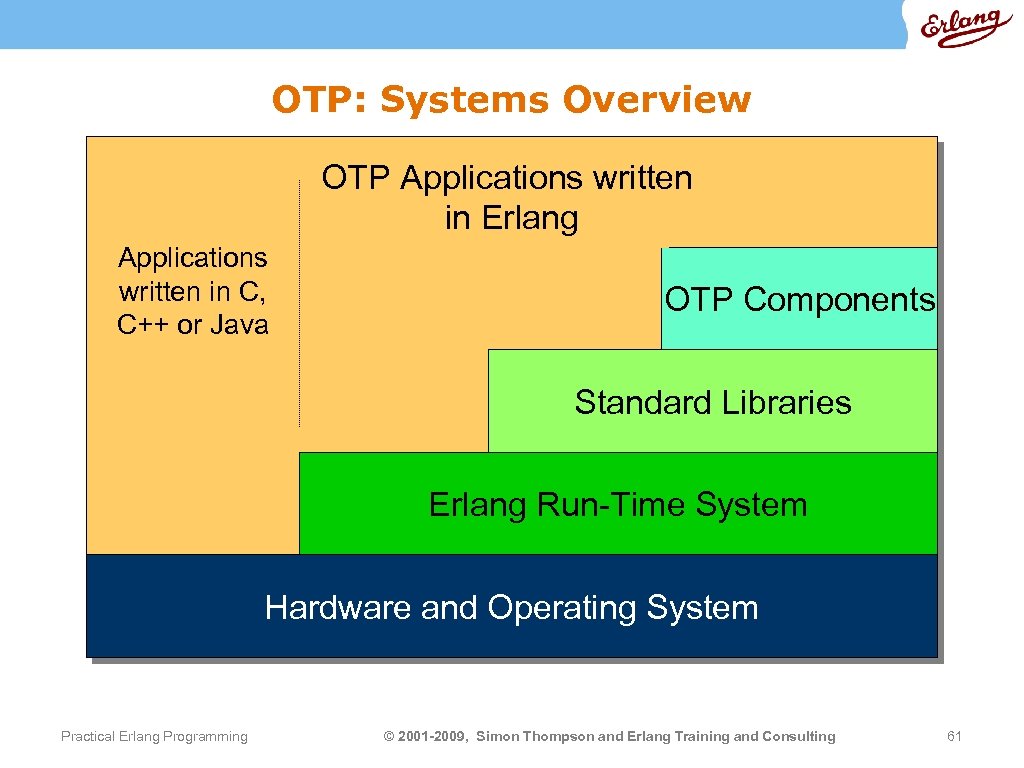 OTP: Systems Overview OTP Applications written in Erlang Applications written in C, C++ or Java OTP Components Standard Libraries Erlang Run-Time System Hardware and Operating System Practical Erlang Programming © 2001 -2009, Simon Thompson and Erlang Training and Consulting 61
 Contents • • Erlang History Erlang Highlights Open Telecom Platform Frequency Server Example Products The Community Events & Questions Practical Erlang Programming © 2001 -2009, Simon Thompson and Erlang Training and Consulting 62
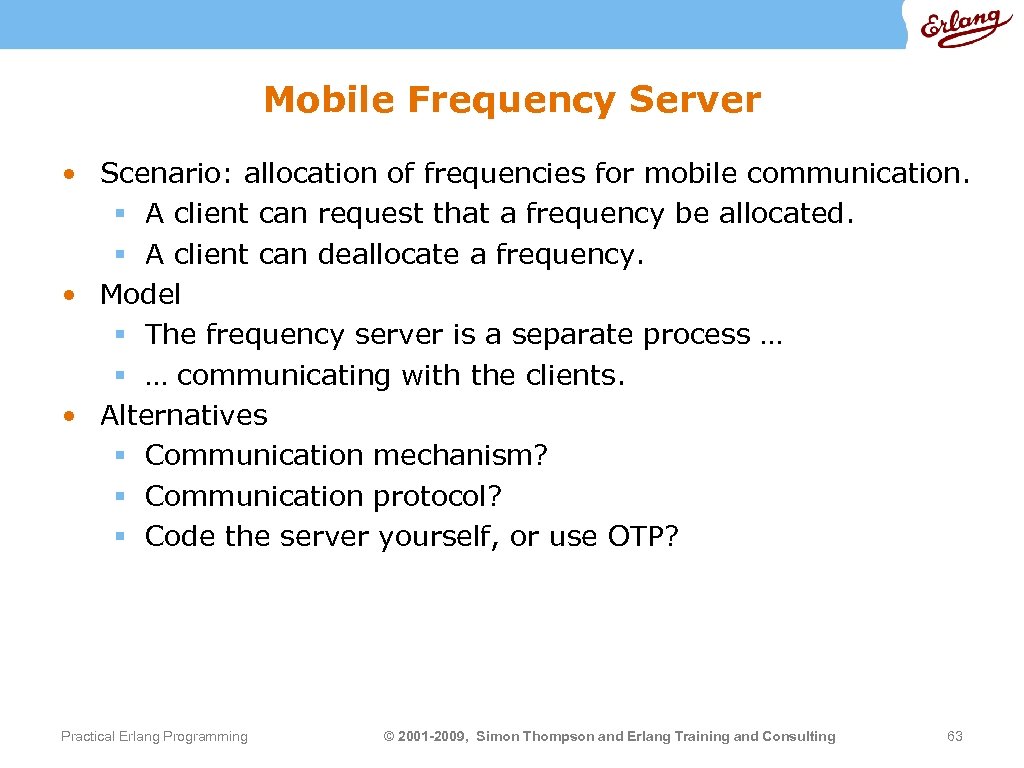 Mobile Frequency Server • Scenario: allocation of frequencies for mobile communication. § A client can request that a frequency be allocated. § A client can deallocate a frequency. • Model § The frequency server is a separate process … § … communicating with the clients. • Alternatives § Communication mechanism? § Communication protocol? § Code the server yourself, or use OTP? Practical Erlang Programming © 2001 -2009, Simon Thompson and Erlang Training and Consulting 63
![Frequency Allocation and Deallocation allocate({[], Allocated}, _Pid) -> {{[], Allocated}, {error, no_frequency}}; • A](https://present5.com/presentation/4aad37d617e0f699c13c40bf30a513c9/image-64.jpg "Frequency Allocation and Deallocation allocate({[], Allocated}, _Pid) -> {{[], Allocated}, {error, no_frequency}}; • A") Frequency Allocation and Deallocation allocate({[], Allocated}, _Pid) -> {{[], Allocated}, {error, no_frequency}}; • A pair of lists models the free and allocated frequencies. allocate({[Freq|Free], Allocated}, Pid) -> {{Free, [{Freq, Pid}|Allocated]}, {ok, Freq}}. • Return the new pair plus a result message indicating failure or success. deallocate({Free, Allocated}, Freq) -> New. Allocated =lists: keydelete(Freq, 1, Allocated), {[Freq|Free], New. Allocated}. • Deallocation always succeeds, assuming the Freq was already allocated. • Nice example of pattern matching! Practical Erlang Programming © 2001 -2009, Simon Thompson and Erlang Training and Consulting 64
Frequency Allocation and Deallocation allocate({[], Allocated}, _Pid) -> {{[], Allocated}, {error, no_frequency}}; • A pair of lists models the free and allocated frequencies. allocate({[Freq|Free], Allocated}, Pid) -> {{Free, [{Freq, Pid}|Allocated]}, {ok, Freq}}. • Return the new pair plus a result message indicating failure or success. deallocate({Free, Allocated}, Freq) -> New. Allocated =lists: keydelete(Freq, 1, Allocated), {[Freq|Free], New. Allocated}. • Deallocation always succeeds, assuming the Freq was already allocated. • Nice example of pattern matching! Practical Erlang Programming © 2001 -2009, Simon Thompson and Erlang Training and Consulting 64
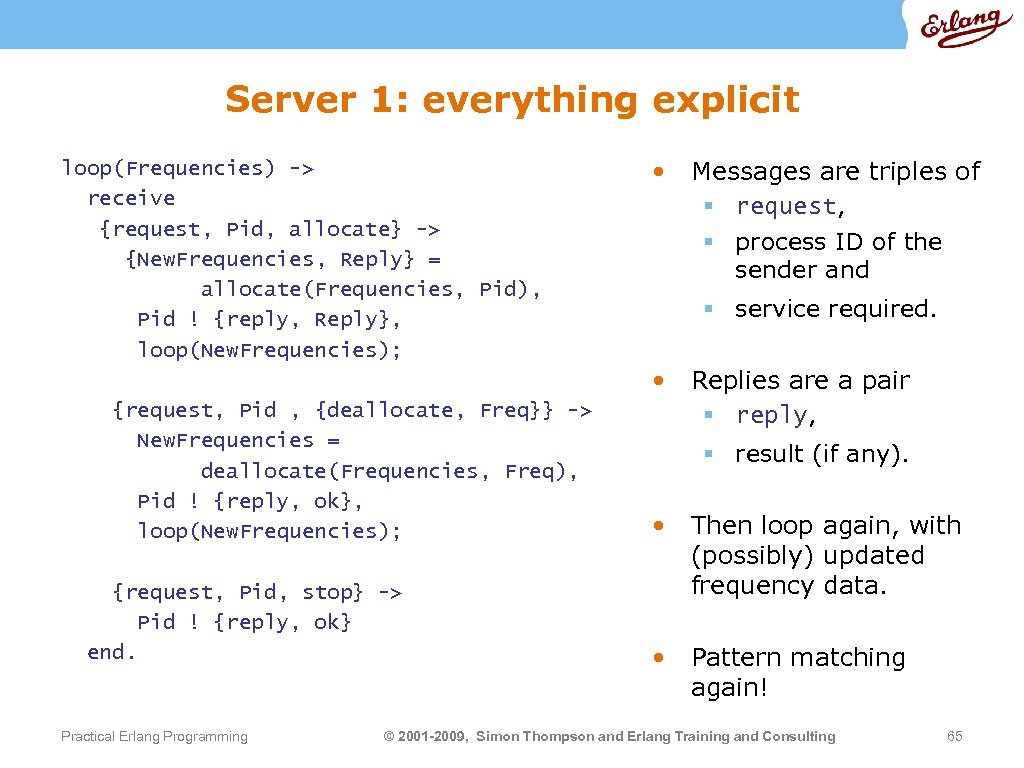 Server 1: everything explicit loop(Frequencies) -> receive {request, Pid, allocate} -> {New. Frequencies, Reply} = allocate(Frequencies, Pid), Pid ! {reply, Reply}, loop(New. Frequencies); {request, Pid , {deallocate, Freq}} -> New. Frequencies = deallocate(Frequencies, Freq), Pid ! {reply, ok}, loop(New. Frequencies); {request, Pid, stop} -> Pid ! {reply, ok} end. Practical Erlang Programming • Messages are triples of § request, § process ID of the sender and § service required. • Replies are a pair § reply, § result (if any). • Then loop again, with (possibly) updated frequency data. • Pattern matching again! © 2001 -2009, Simon Thompson and Erlang Training and Consulting 65
![Setting up the server start() -> register(frequency, spawn(frequency 0, init, [])). init() -> Frequencies](https://present5.com/presentation/4aad37d617e0f699c13c40bf30a513c9/image-66.jpg "Setting up the server start() -> register(frequency, spawn(frequency 0, init, [])). init() -> Frequencies") Setting up the server start() -> register(frequency, spawn(frequency 0, init, [])). init() -> Frequencies = {get_frequencies(), []}, loop(Frequencies). % Hard Coded get_frequencies() -> [10, 11, 12, 13, 14, 15]. %% The Main Loop loop(Frequencies) -> receive {request, Pid, allocate} -> etc. Practical Erlang Programming • The system is started by spawning a process to run the init function … • … and then registering this process with the name frequency. • init itself will set up the loop data and call the loop for the first time. • DIY control. © 2001 -2009, Simon Thompson and Erlang Training and Consulting 66
Setting up the server start() -> register(frequency, spawn(frequency 0, init, [])). init() -> Frequencies = {get_frequencies(), []}, loop(Frequencies). % Hard Coded get_frequencies() -> [10, 11, 12, 13, 14, 15]. %% The Main Loop loop(Frequencies) -> receive {request, Pid, allocate} -> etc. Practical Erlang Programming • The system is started by spawning a process to run the init function … • … and then registering this process with the name frequency. • init itself will set up the loop data and call the loop for the first time. • DIY control. © 2001 -2009, Simon Thompson and Erlang Training and Consulting 66
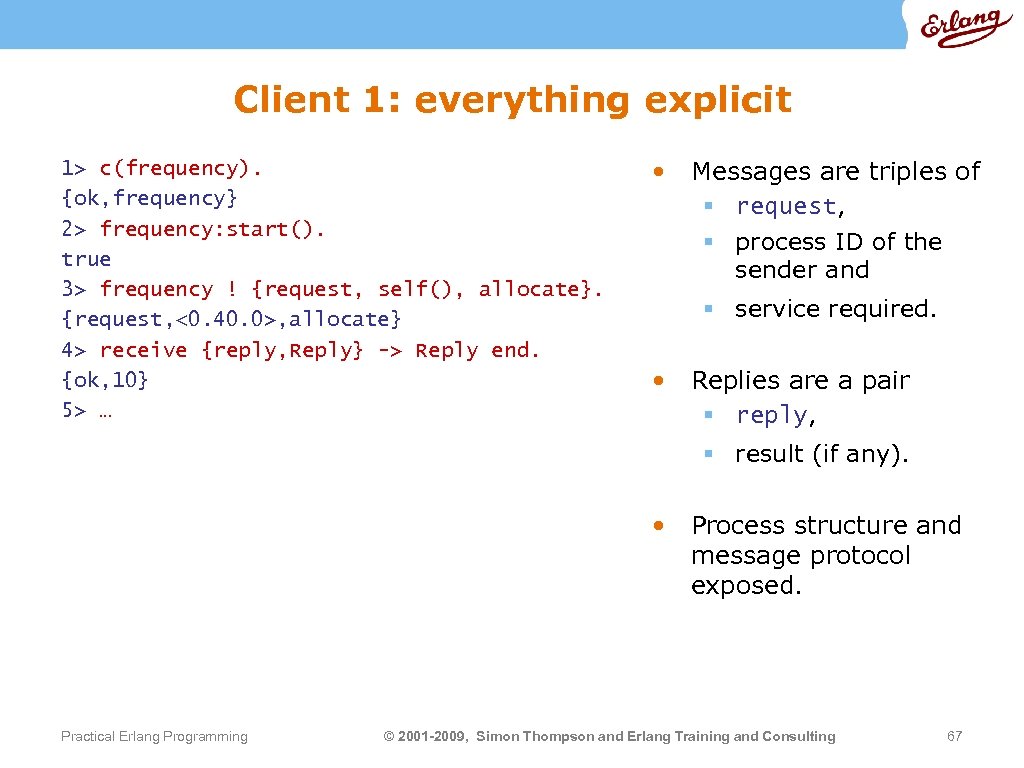 Client 1: everything explicit 1> c(frequency). {ok, frequency} 2> frequency: start(). true 3> frequency ! {request, self(), allocate}. {request, <0. 40. 0>, allocate} 4> receive {reply, Reply} -> Reply end. {ok, 10} 5> … • Messages are triples of § request, § process ID of the sender and § service required. • Replies are a pair § reply, § result (if any). • Process structure and message protocol exposed. Practical Erlang Programming © 2001 -2009, Simon Thompson and Erlang Training and Consulting 67
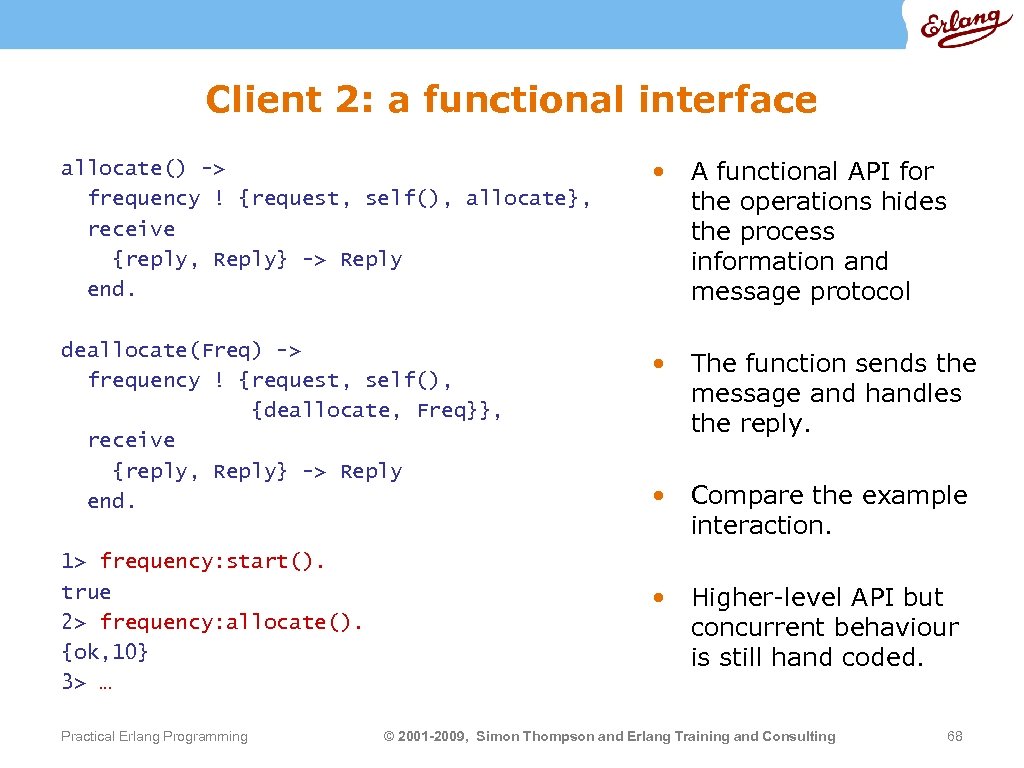 Client 2: a functional interface allocate() -> frequency ! {request, self(), allocate}, receive {reply, Reply} -> Reply end. • A functional API for the operations hides the process information and message protocol deallocate(Freq) -> frequency ! {request, self(), {deallocate, Freq}}, receive {reply, Reply} -> Reply end. • The function sends the message and handles the reply. 1> frequency: start(). true 2> frequency: allocate(). {ok, 10} 3> … Practical Erlang Programming • Compare the example interaction. • Higher-level API but concurrent behaviour is still hand coded. © 2001 -2009, Simon Thompson and Erlang Training and Consulting 68
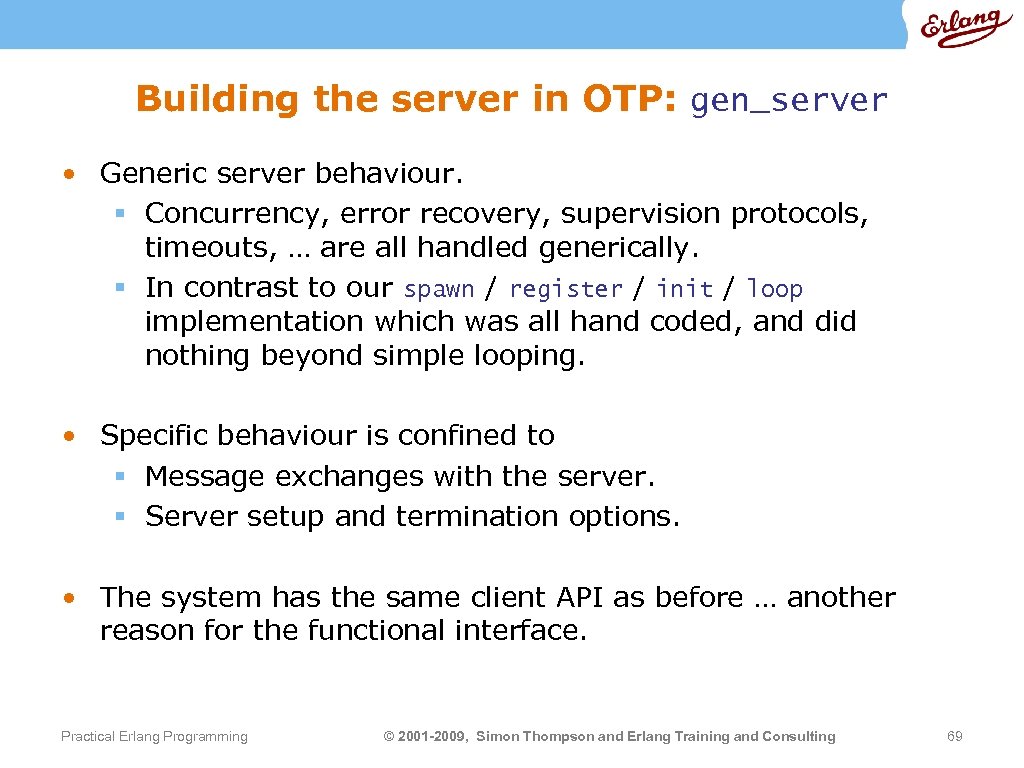 Building the server in OTP: gen_server • Generic server behaviour. § Concurrency, error recovery, supervision protocols, timeouts, … are all handled generically. § In contrast to our spawn / register / init / loop implementation which was all hand coded, and did nothing beyond simple looping. • Specific behaviour is confined to § Message exchanges with the server. § Server setup and termination options. • The system has the same client API as before … another reason for the functional interface. Practical Erlang Programming © 2001 -2009, Simon Thompson and Erlang Training and Consulting 69
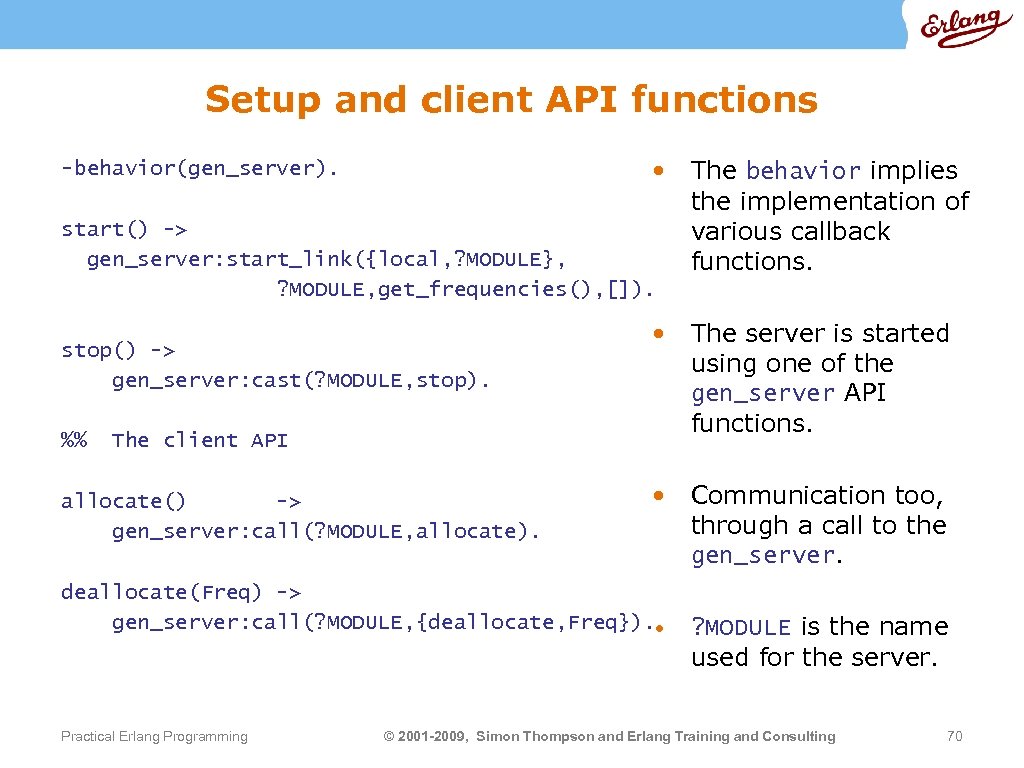 Setup and client API functions • The behavior implies the implementation of various callback functions. -behavior(gen_server). start() -> gen_server: start_link({local, ? MODULE}, ? MODULE, get_frequencies(), []). stop() -> gen_server: cast(? MODULE, stop). %% The client API allocate() -> gen_server: call(? MODULE, allocate). • The server is started using one of the gen_server API functions. • Communication too, through a call to the gen_server. deallocate(Freq) -> gen_server: call(? MODULE, {deallocate, Freq}). • Practical Erlang Programming ? MODULE is the name used for the server. © 2001 -2009, Simon Thompson and Erlang Training and Consulting 70
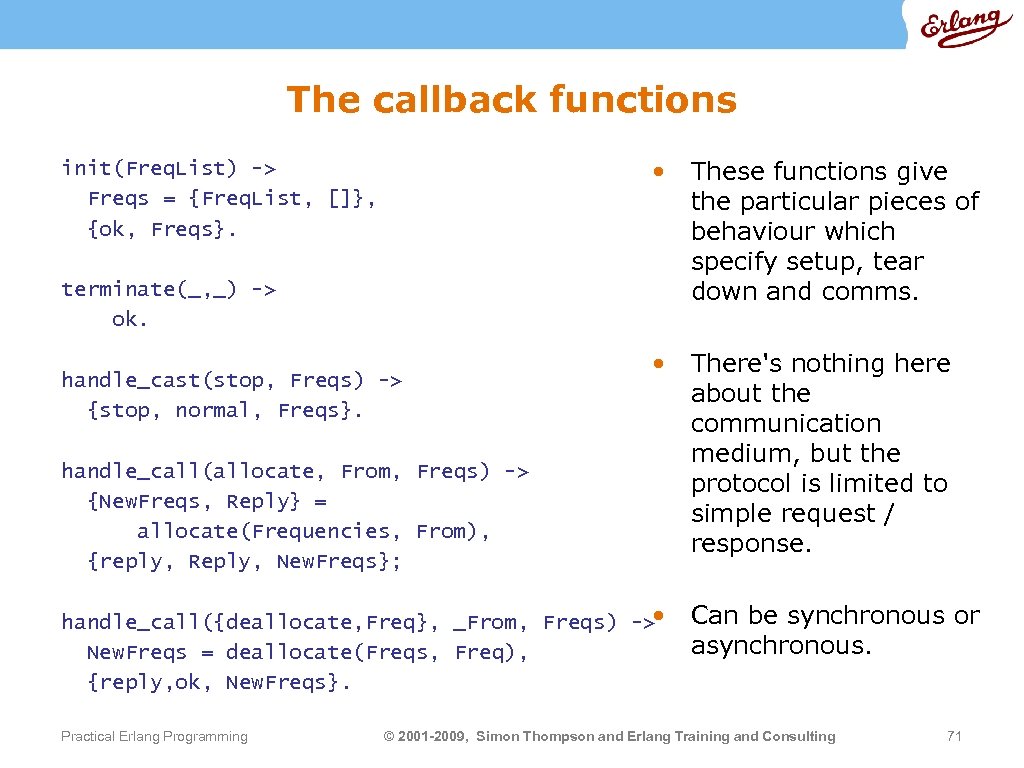 The callback functions • These functions give the particular pieces of behaviour which specify setup, tear down and comms. init(Freq. List) -> Freqs = {Freq. List, []}, {ok, Freqs}. terminate(_, _) -> ok. handle_cast(stop, Freqs) -> {stop, normal, Freqs}. handle_call(allocate, From, Freqs) -> {New. Freqs, Reply} = allocate(Frequencies, From), {reply, Reply, New. Freqs}; • There's nothing here about the communication medium, but the protocol is limited to simple request / response. handle_call({deallocate, Freq}, _From, Freqs) -> • New. Freqs = deallocate(Freqs, Freq), {reply, ok, New. Freqs}. Practical Erlang Programming Can be synchronous or asynchronous. © 2001 -2009, Simon Thompson and Erlang Training and Consulting 71
 Contents • • Erlang History Erlang Highlights Open Telecom Platform Frequency Server Example Products The Community Events & Questions Practical Erlang Programming © 2001 -2009, Simon Thompson and Erlang Training and Consulting 72
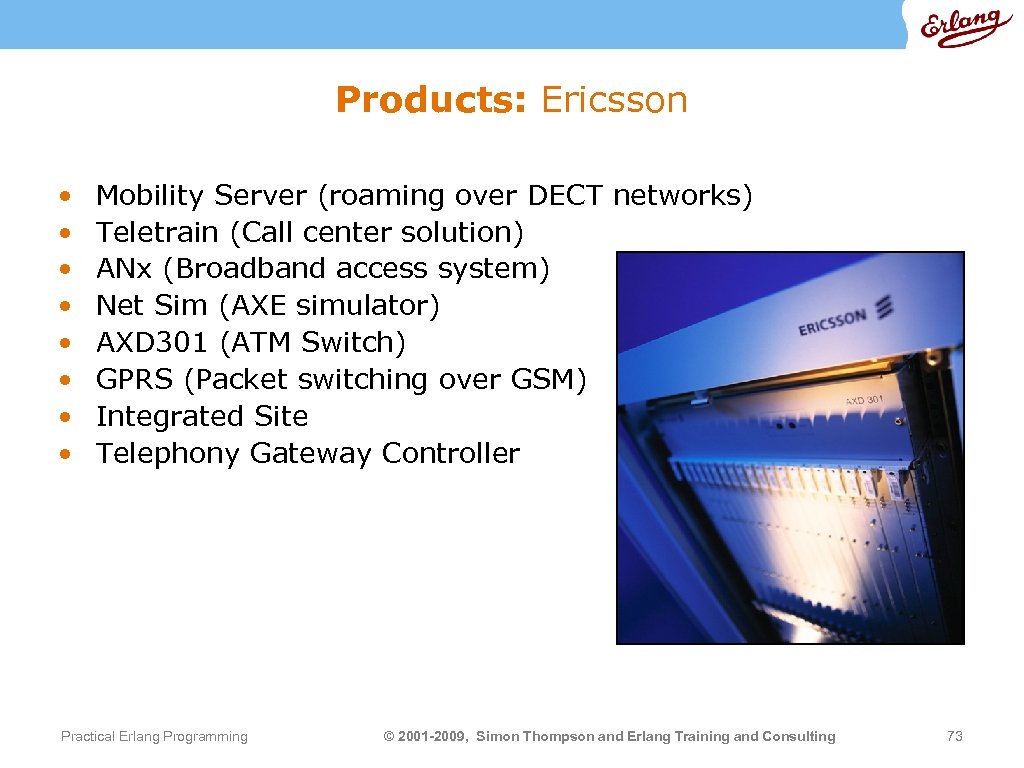 Products: Ericsson • • Mobility Server (roaming over DECT networks) Teletrain (Call center solution) ANx (Broadband access system) Net Sim (AXE simulator) AXD 301 (ATM Switch) GPRS (Packet switching over GSM) Integrated Site Telephony Gateway Controller Practical Erlang Programming © 2001 -2009, Simon Thompson and Erlang Training and Consulting 73
 Products: AXD 301 Switch • A Telephony-Class, scalable (10 – 160 GBps) ATM switch • Designed from scratch in less than 3 years • AXD 301 Success factors: § Competent organisation and people § Efficient process § Excellent technology (e. g. Erlang/OTP) Practical Erlang Programming © 2001 -2009, Simon Thompson and Erlang Training and Consulting 74
 Products: AXD 301 Switch • Erlang: ca 1. 5 million lines of code § Nearly all the complex control logic § Operation & Maintenance § Web server and runtime HTML/ Java. Script generation • C/C++: ca 500 k lines of code § Third party software § Low-level protocol drivers § Device drivers • Java: ca 13 k lines of code § Operator GUI applets Practical Erlang Programming © 2001 -2009, Simon Thompson and Erlang Training and Consulting 75
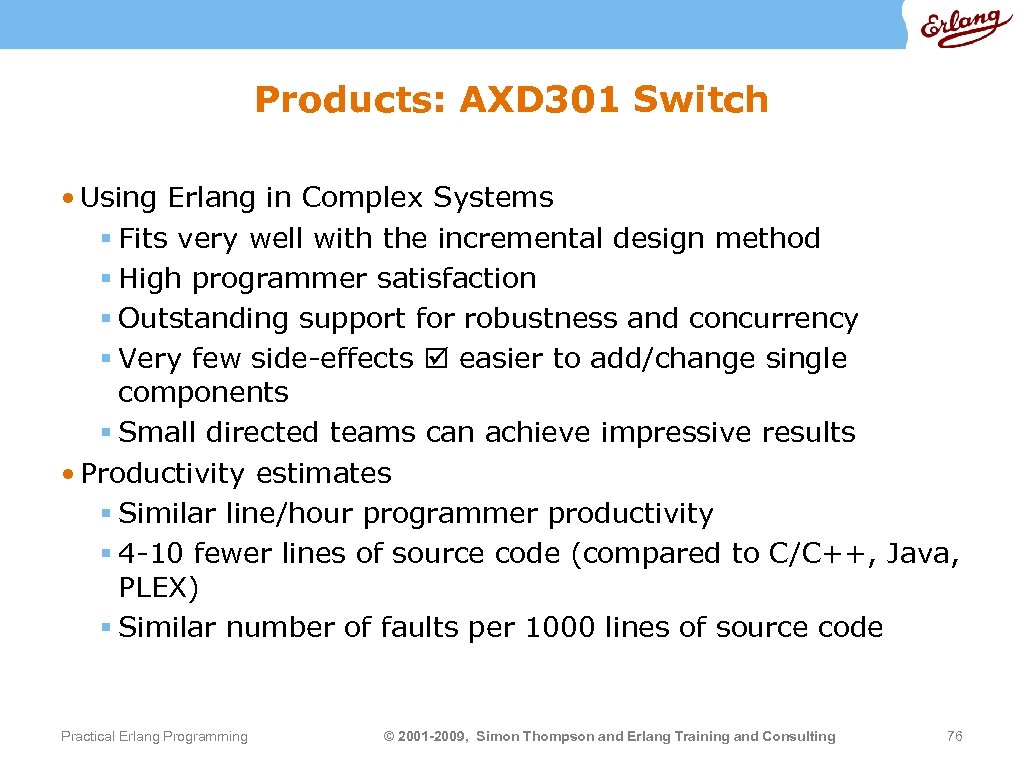 Products: AXD 301 Switch • Using Erlang in Complex Systems § Fits very well with the incremental design method § High programmer satisfaction § Outstanding support for robustness and concurrency § Very few side-effects easier to add/change single components § Small directed teams can achieve impressive results • Productivity estimates § Similar line/hour programmer productivity § 4 -10 fewer lines of source code (compared to C/C++, Java, PLEX) § Similar number of faults per 1000 lines of source code Practical Erlang Programming © 2001 -2009, Simon Thompson and Erlang Training and Consulting 76
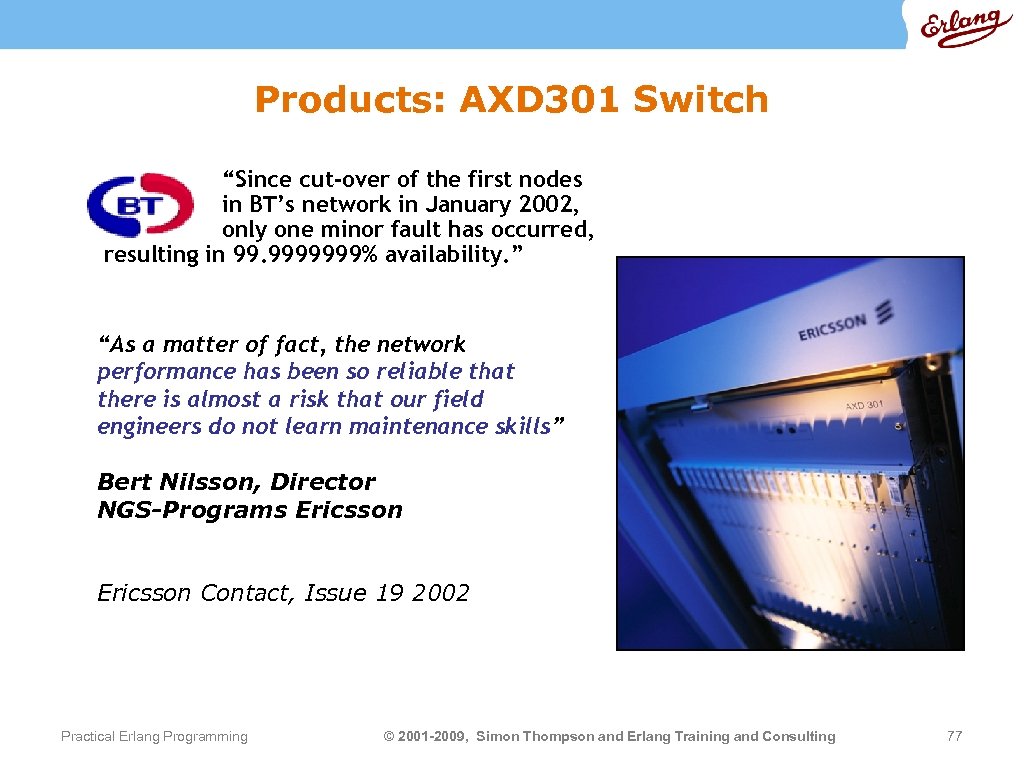 Products: AXD 301 Switch “Since cut-over of the first nodes in BT’s network in January 2002, only one minor fault has occurred, resulting in 99. 9999999% availability. ” "We a matter of fact, the network “As are extremely pleased with the outcome of the initial phase of this performance has been so reliable that project. almost a risk that our field there is This is major step in the phased development ofmaintenance skills” engineers do not learn what we believe is a world-leading Next Generation Network, " said Richard Newman, General Bert Nilsson, Director Manager of Planning and Delivery of NGS-Programs Ericsson Network Transport at BT Wholesale. Ericsson Press Release 5 July, 2002 Ericsson Contact, Issue 19 2002 Practical Erlang Programming © 2001 -2009, Simon Thompson and Erlang Training and Consulting 77
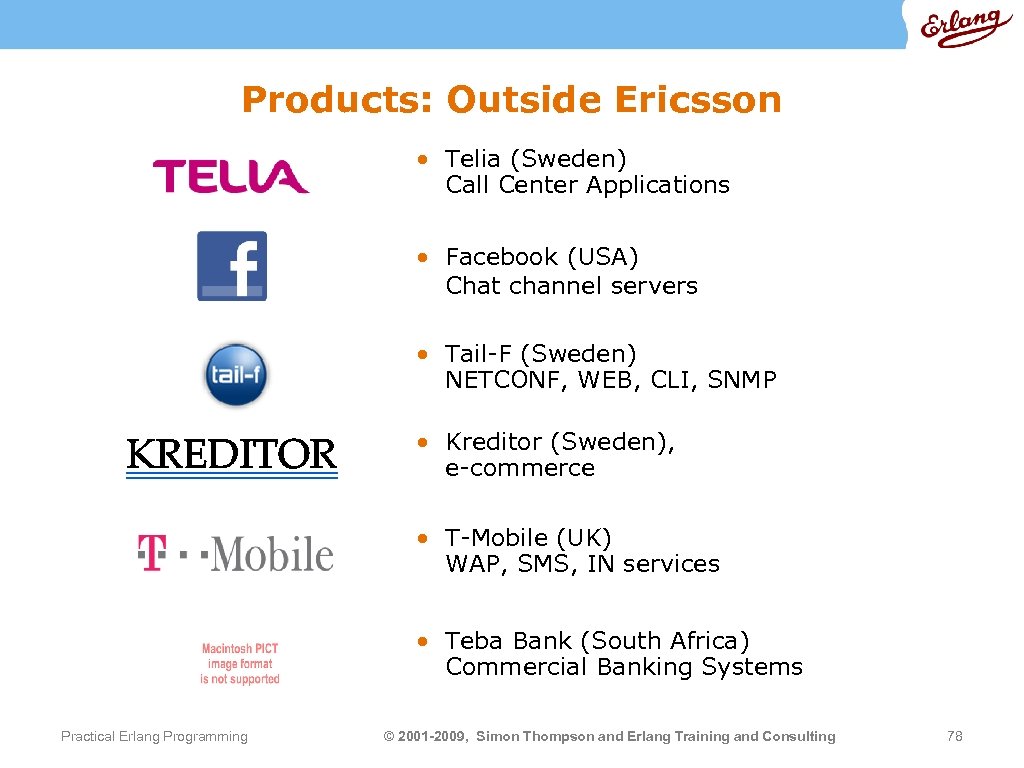 Products: Outside Ericsson • Telia (Sweden) Call Center Applications • Facebook (USA) Chat channel servers • Tail-F (Sweden) NETCONF, WEB, CLI, SNMP • Kreditor (Sweden), e-commerce • T-Mobile (UK) WAP, SMS, IN services • Teba Bank (South Africa) Commercial Banking Systems Practical Erlang Programming © 2001 -2009, Simon Thompson and Erlang Training and Consulting 78
 Contents • • Erlang History Erlang Highlights Open Telecom Platform Frequency Server Example Products The Community Events & Questions Practical Erlang Programming © 2001 -2009, Simon Thompson and Erlang Training and Consulting 79
 Community: Downloads from erlang. org Practical Erlang Programming © 2001 -2009, Simon Thompson and Erlang Training and Consulting 80
 Community: Page hits on erlang. org Practical Erlang Programming © 2001 -2009, Simon Thompson and Erlang Training and Consulting 81
 Community: Research • HIPE (Uppsala University, Sweden) • Telecom Programming (Heriot-Watt University, Scotland) • Major Projects (University of Corũna, Spain) • Code Refactoring (University of Kent, Canterbury, UK) • Code Refactoring (Eötvös Loránd University, Hungary) • Robots & Agents (University of Catania, Italy) Practical Erlang Programming © 2001 -2009, Simon Thompson and Erlang Training and Consulting 82
 Community: Open Source • Couch. DB, A Distributed Robust document database server • Wings 3 D, a 3 D modeller based on Nendo • YAWS, Yet Another Web Server • Rabbit. MQ, high performance enterprise messaging • Ejabberd, instant messaging server • Erlyweb, component-based web development framework Practical Erlang Programming © 2001 -2009, Simon Thompson and Erlang Training and Consulting 83
 Couch. DB • Schema-less database, document oriented. • Distributed, fault-tolerant, • Robust, incremental replication. • Bi-directional conflict detection and resolution. • Queryable and indexable using a table-oriented view engine. • Java. Script acting as the default view definition language. • Apache project … • … supported by IBM. Practical Erlang Programming © 2001 -2009, Simon Thompson and Erlang Training and Consulting 84
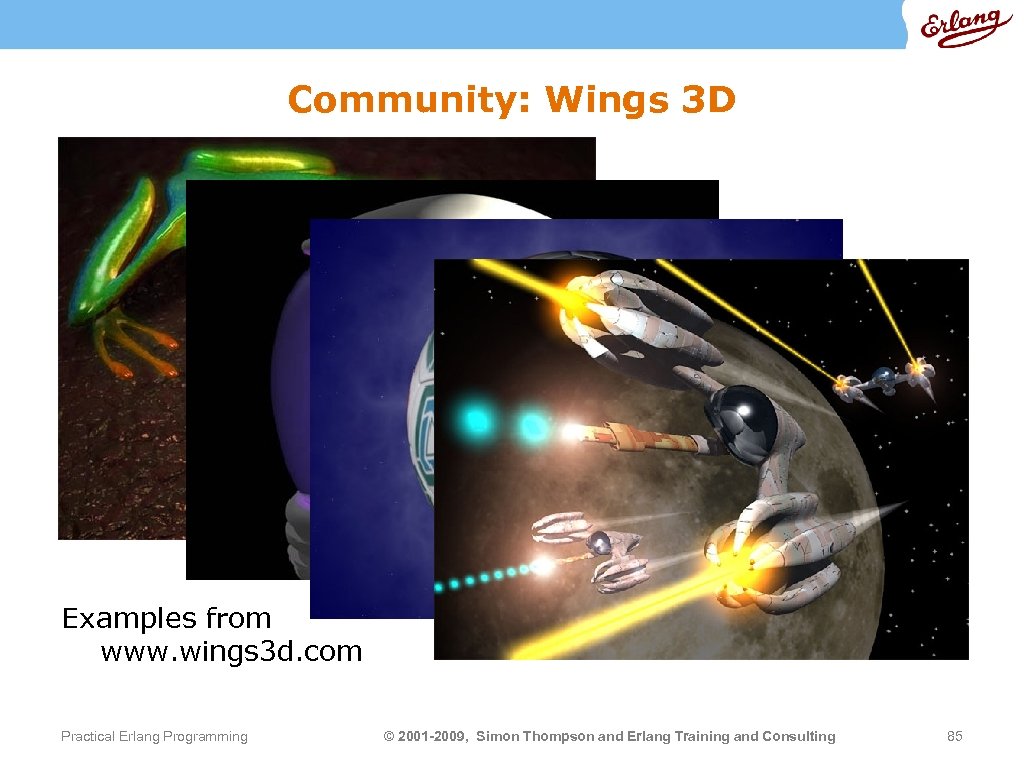 Community: Wings 3 D Examples from www. wings 3 d. com Practical Erlang Programming © 2001 -2009, Simon Thompson and Erlang Training and Consulting 85
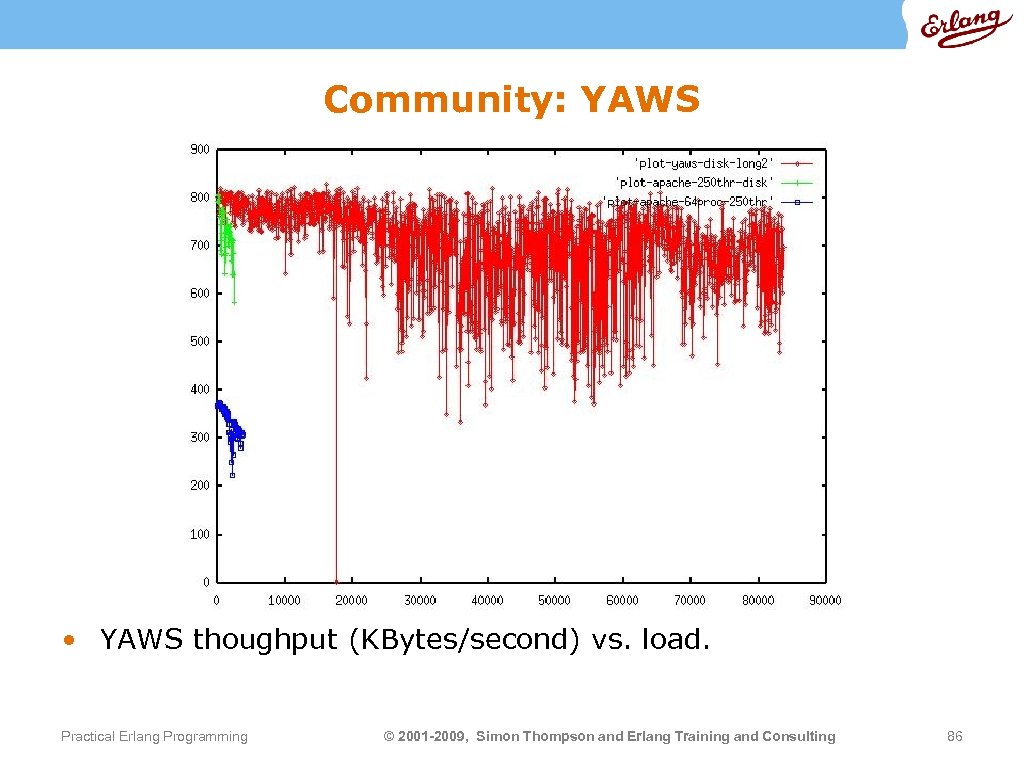 Community: YAWS • YAWS thoughput (KBytes/second) vs. load. Practical Erlang Programming © 2001 -2009, Simon Thompson and Erlang Training and Consulting 86
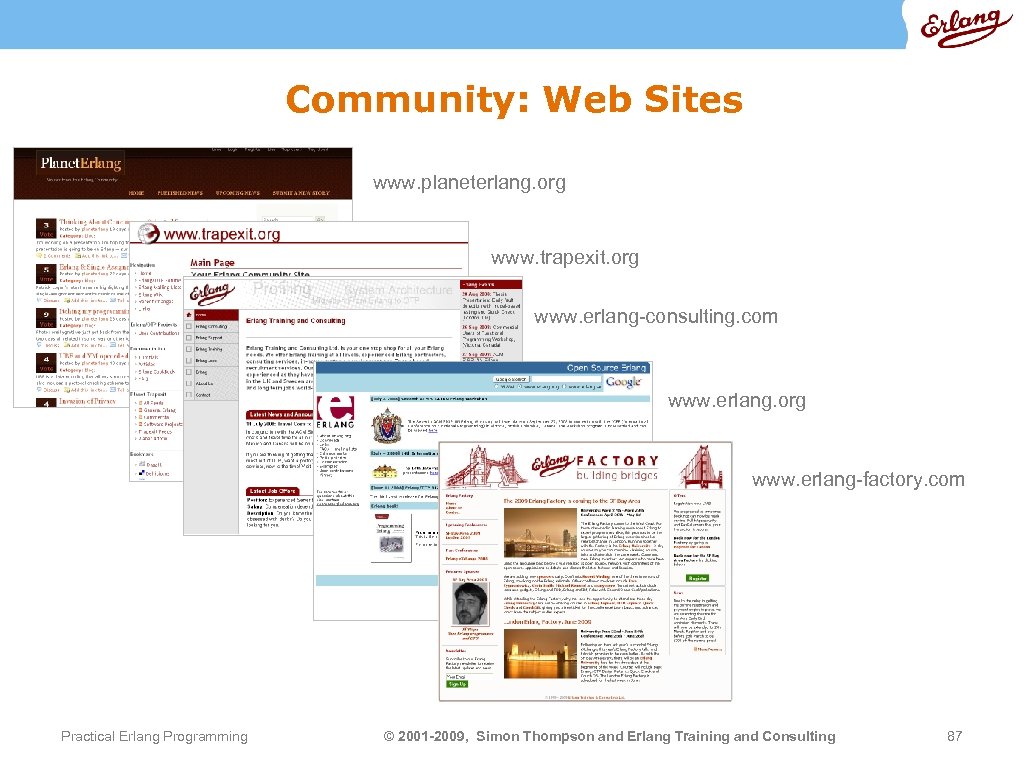 Community: Web Sites www. planeterlang. org www. trapexit. org www. erlang-consulting. com www. erlang. org www. erlang-factory. com Practical Erlang Programming © 2001 -2009, Simon Thompson and Erlang Training and Consulting 87
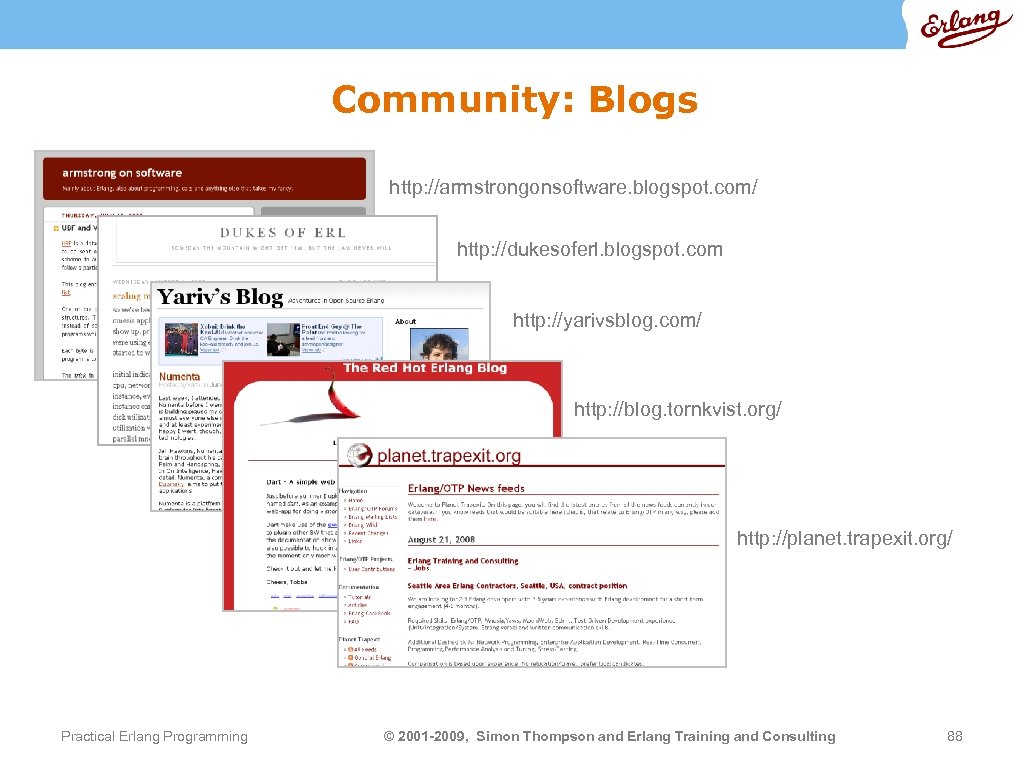 Community: Blogs http: //armstrongonsoftware. blogspot. com/ http: //dukesoferl. blogspot. com http: //yarivsblog. com/ http: //blog. tornkvist. org/ http: //planet. trapexit. org/ Practical Erlang Programming © 2001 -2009, Simon Thompson and Erlang Training and Consulting 88
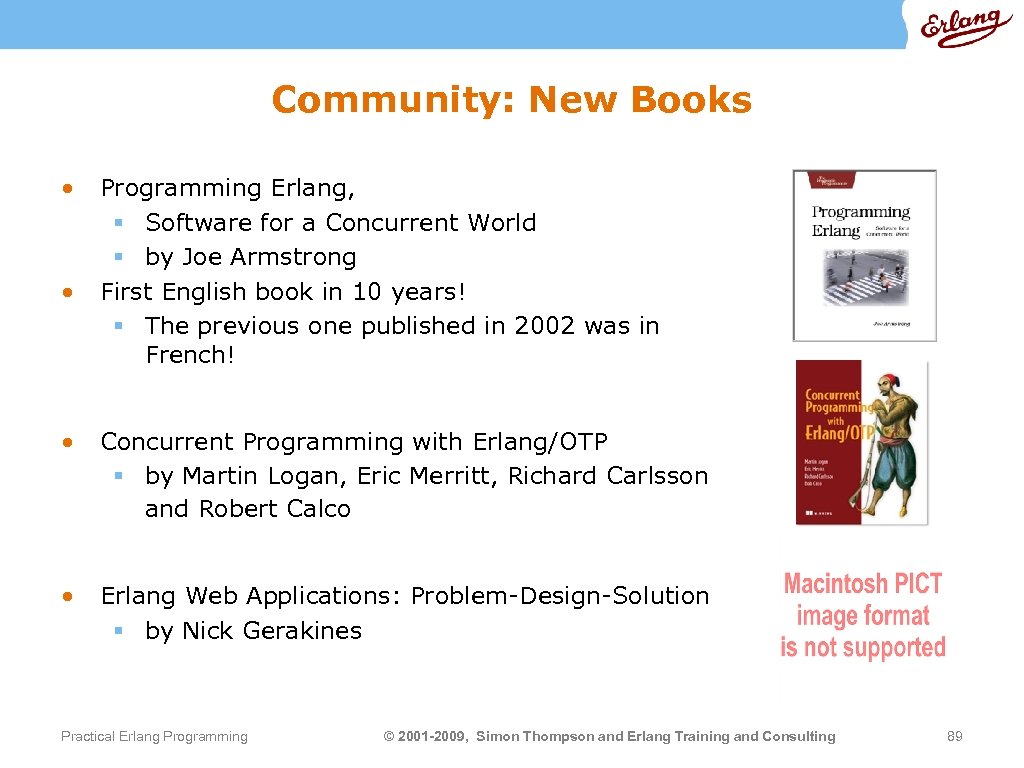 Community: New Books • • Programming Erlang, § Software for a Concurrent World § by Joe Armstrong First English book in 10 years! § The previous one published in 2002 was in French! • Concurrent Programming with Erlang/OTP § by Martin Logan, Eric Merritt, Richard Carlsson and Robert Calco • Erlang Web Applications: Problem-Design-Solution § by Nick Gerakines Practical Erlang Programming © 2001 -2009, Simon Thompson and Erlang Training and Consulting 89
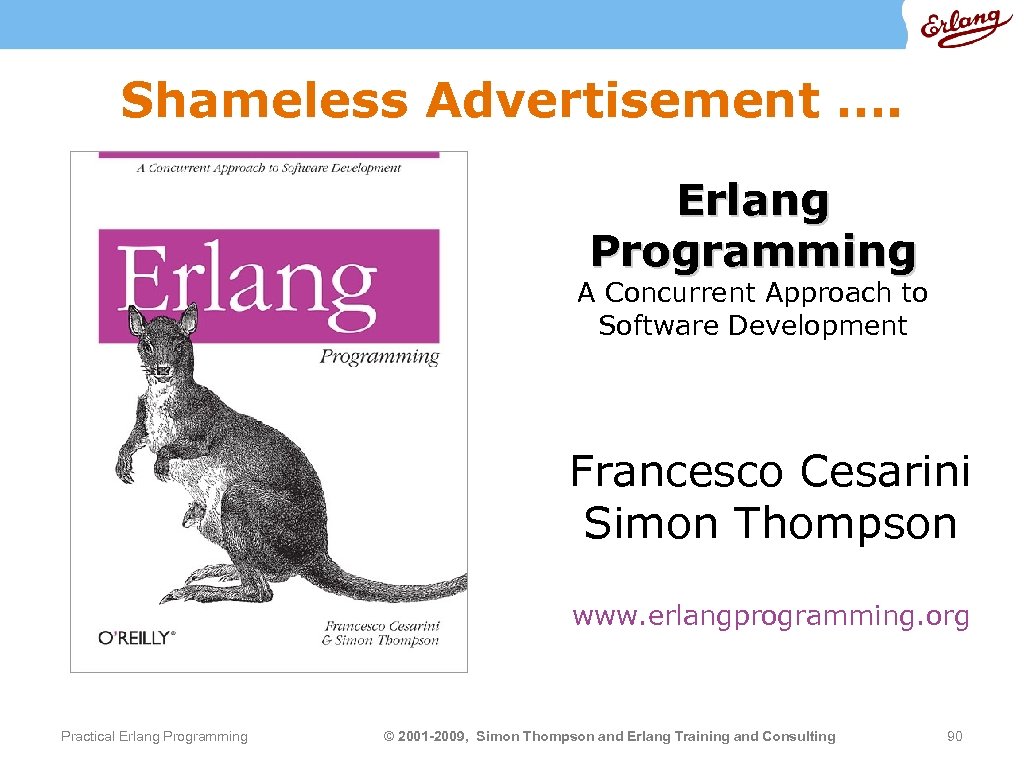 Shameless Advertisement …. Erlang Programming A Concurrent Approach to Software Development Francesco Cesarini Simon Thompson www. erlangprogramming. org Practical Erlang Programming © 2001 -2009, Simon Thompson and Erlang Training and Consulting 90
 Contents • • Erlang History Erlang Highlights Open Telecom Platform Frequency Server Example Products The Community Events & Questions Practical Erlang Programming © 2001 -2009, Simon Thompson and Erlang Training and Consulting 91
 Events • ACM SIGPLAN Erlang Workshop § Held every year as a satellite event of the International Conference of Functional Programming § Alternates between the US and Europe § A forum to submit academic papers • International Erlang User Conference § Held every year in Stockholm, Sweden § Informal mixture of industrial applications and research Practical Erlang Programming © 2001 -2009, Simon Thompson and Erlang Training and Consulting 92
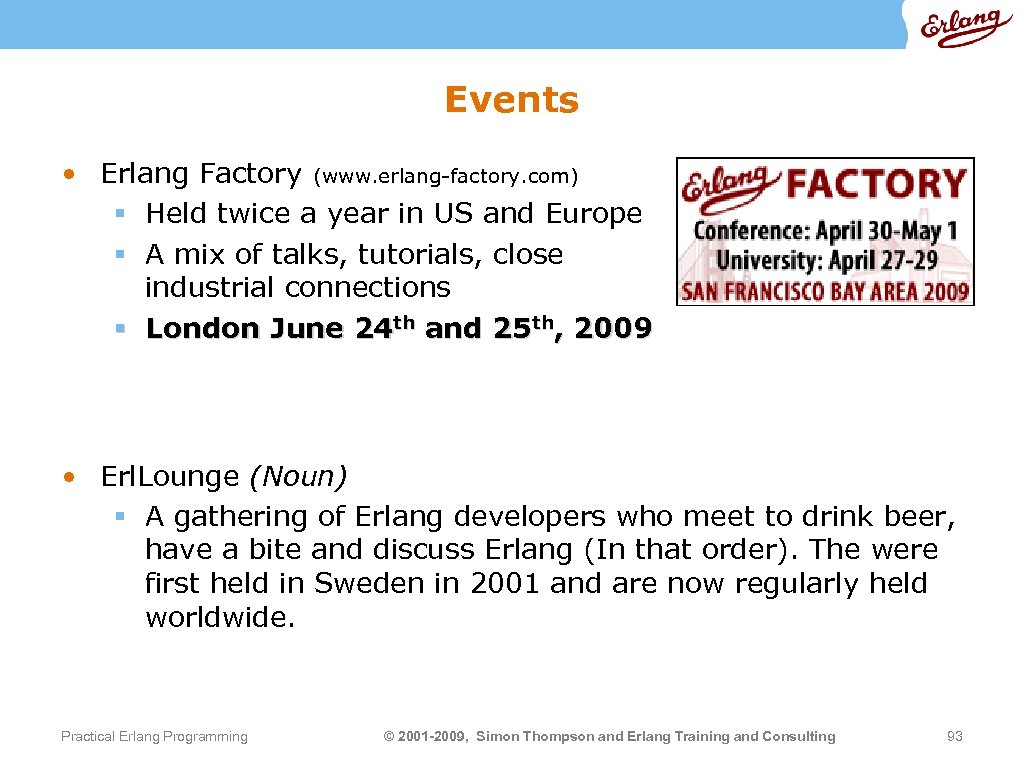 Events • Erlang Factory (www. erlang-factory. com) § Held twice a year in US and Europe § A mix of talks, tutorials, close industrial connections § London June 24 th and 25 th, 2009 • Erl. Lounge (Noun) § A gathering of Erlang developers who meet to drink beer, have a bite and discuss Erlang (In that order). The were first held in Sweden in 2001 and are now regularly held worldwide. Practical Erlang Programming © 2001 -2009, Simon Thompson and Erlang Training and Consulting 93
 Questions Practical Erlang Programming © 2001 -2009, Simon Thompson and Erlang Training and Consulting 94
 Contents • • Erlang History Erlang Highlights Open Telecom Platform Frequency Server Example Products The Community Events & Questions Practical Erlang Programming © 2001 -2009, Simon Thompson and Erlang Training and Consulting 95