 Скачать презентацию Practical English Book II Unit 2 Advertising Part
e771dc554b520e8a3e3252fdbf939a24.ppt
- Количество слайдов: 96



Practical English, Book II Unit 2 Advertising Part B
Unit 2: Part B • Text B • Practice
Unit 2: Text B • Text-related Information • Warm-up Activity • Text Learning • After-reading Task
Text-related Information Definition of Advertising’s Categories History Review of Advertising Charges for Advertising Popularity of Advertising Development of Advertising Role of Advertising
Text Learning • Outline of the Text • Language Points • Summary
After-reading Task • Reading Comprehension Exercise 2 • Vocabulary and Structure Exercise 3 Exercise 4
Practice • Exercise Check-up Exercise 5 Exercise 6 Exercise 8 • Listening Practice
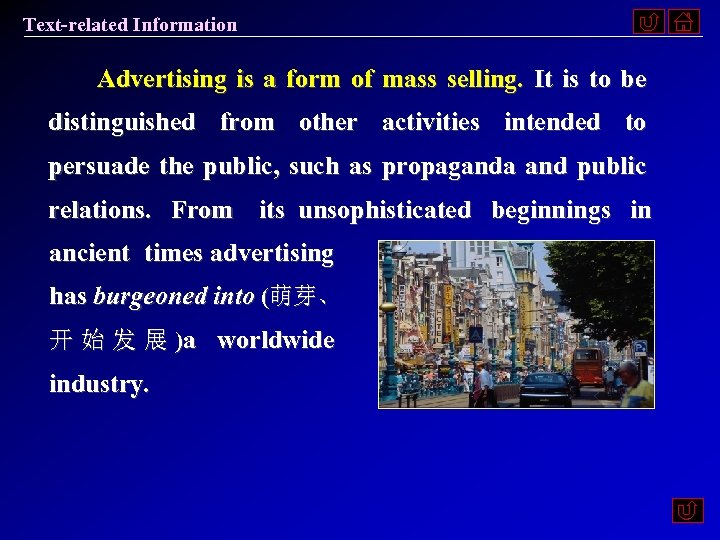
Text-related Information Advertising is a form of mass selling. It is to be distinguished from other activities intended to persuade the public, such as propaganda and public relations. From its unsophisticated beginnings in ancient times advertising has burgeoned into (萌芽、 开 始 发 展 )a worldwide industry.
Text-related Information Advertising falls into two main categories: consumer advertising, directed to the ultimate purchaser. And trade advertising, in which the appeal is made to dealers through trade journals and other media. Both consumer and trade advertising employ many specialized types of commercial persuasion.
Text-related Information A relatively minor, but important, form of advertising is institutional advertising, which is designed solely to build prestige (名 气 , 声 誉 ) and public respect for particular business concerns as important American institutions. Each year millions of dollars are spent on institutional advertising, which usually mentions products or services for sale only incidentally (附带地).
Text-related Information The origins of advertising antedate ( 发生在…之前 ) the Christian era by many centuries. One of the first known methods of advertising was the outdoor display, usually an eye-catching sign painted on the wall of a building.
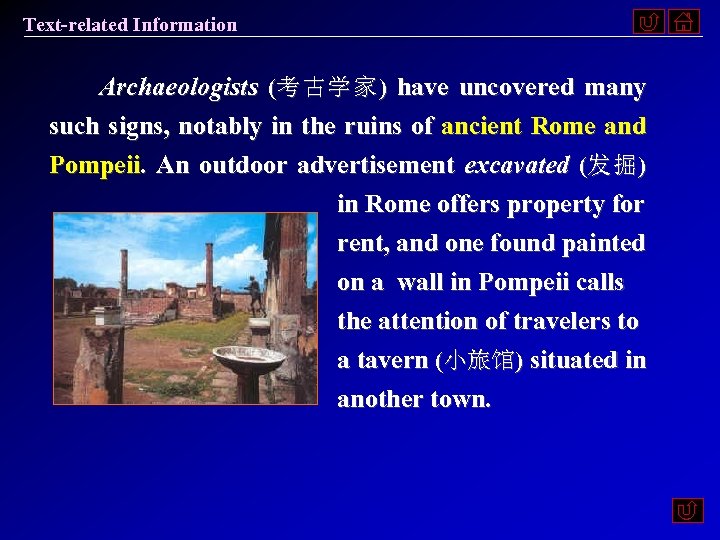
Text-related Information Archaeologists (考 古 学 家 ) have uncovered many such signs, notably in the ruins of ancient Rome and Pompeii. An outdoor advertisement excavated (发 掘 ) in Rome offers property for rent, and one found painted on a wall in Pompeii calls the attention of travelers to a tavern (小旅馆) situated in another town.
Text-related Information Advertising may be local, national, or international in scope. The rates charged for the three different levels of advertising vary sharply, particularly in newspapers; varying rates are set also by newspapers for amusement, legal, political, financial, religious, and charitable advertisement.
Text-related Information With about 3 million business enterprises using one or more forms of advertising, almost every American citizen hears or sees advertising every day. In the U. S. the money invested in advertising equaled approximately $370 per capita in the mid-1980 s. And in the late 1980 s, approximately $120 billion was spent in a single year on advertising to influence the purchase of commodities and services.
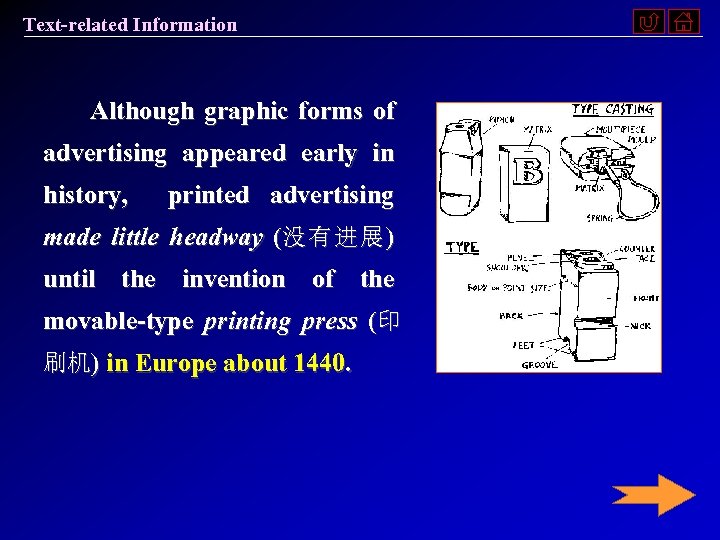
Text-related Information Although graphic forms of advertising appeared early in history, printed advertising made little headway (没 有 进 展 ) until the invention of the movable-type printing press (印 刷机) in Europe about 1440.
Text-related Information The trademark (商标), a two-or-three-dimensional insignia (平面或立体徽章) symbolizing a company or industry, dates from about the 16 th century, when tradespeople and guild members posted characteristic symbols outside their shops. Among the best-known trademarks surviving from early modern times are the striped pole of the barber and the three-ball sign of the pawnbroker (当铺老板).
Text-related Information Having proven its force in the movement of economic goods and services, advertising since the early 1960 s has been directed in increasing quantity toward matters of social concern. In the U. S. Modern advertising is an integral segment (部 分 ) of urban industrial civilization, mirroring contemporary life in its best and worst aspects.
Text-related Information By stimulating consumers to purchase commodities, advertising enables manufacturers and others to sell their products in larger quantities than they would otherwise; the increased volume of sales in turn enables companies to sell individual units at lower cost than if they were produced in small quantities.
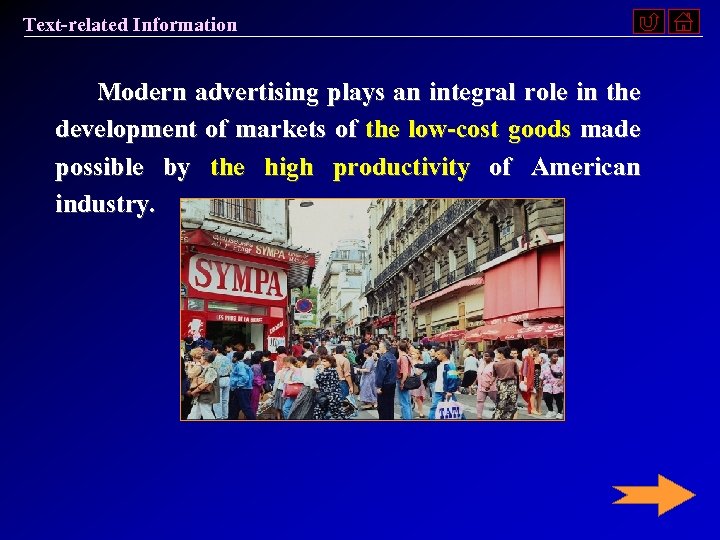
Text-related Information Modern advertising plays an integral role in the development of markets of the low-cost goods made possible by the high productivity of American industry.
Warm-up Activity 1. Does advertising play a very important role in our life? 2. Have you bought anything advertised? 3. 3. What kind of business do you think advertising?
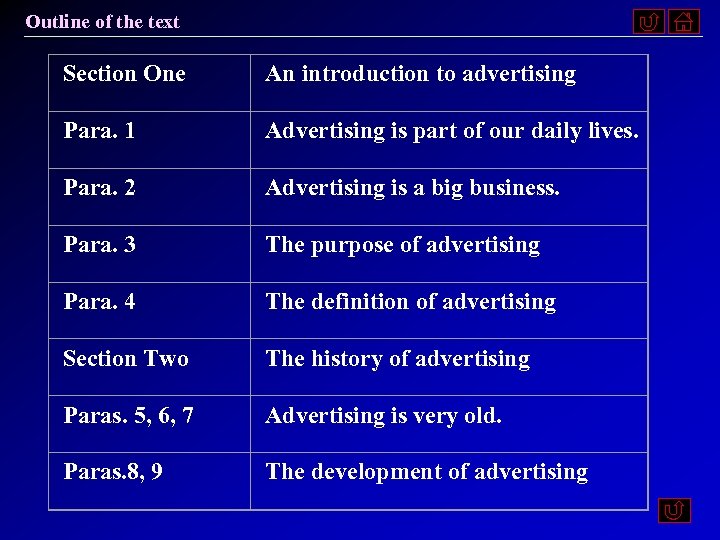
Outline of the text Section One An introduction to advertising Para. 1 Advertising is part of our daily lives. Para. 2 Advertising is a big business. Para. 3 The purpose of advertising Para. 4 The definition of advertising Section Two The history of advertising Paras. 5, 6, 7 Advertising is very old. Paras. 8, 9 The development of advertising
Language Points Advertising
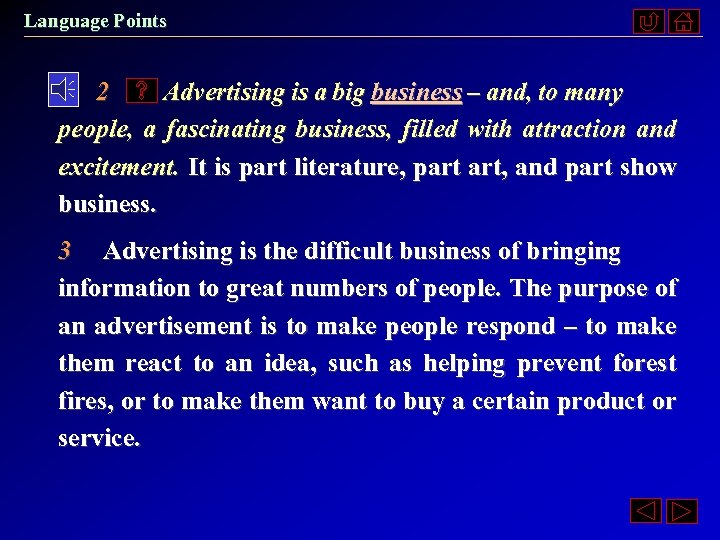
Language Points 2 Advertising is a big business – and, to many people, a fascinating business, filled with attraction and excitement. It is part literature, part art, and part show business. 3 Advertising is the difficult business of bringing information to great numbers of people. The purpose of an advertisement is to make people respond – to make them react to an idea, such as helping prevent forest fires, or to make them want to buy a certain product or service.

Language Points
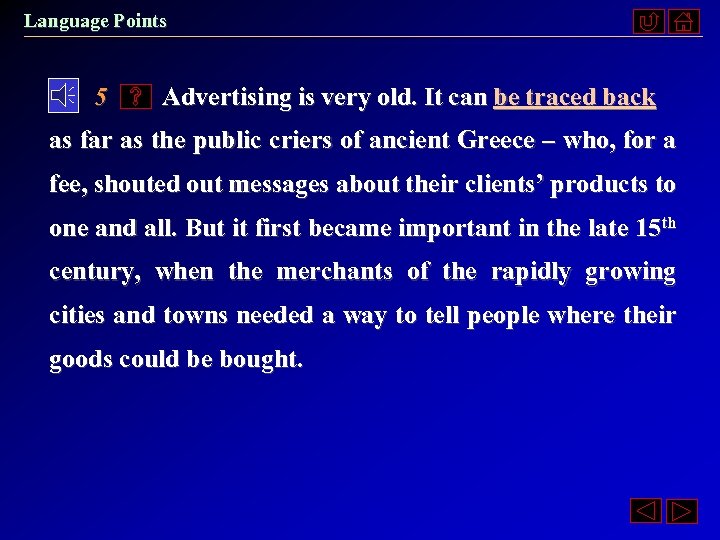
Language Points 5 Advertising is very old. It can be traced back as far as the public criers of ancient Greece – who, for a fee, shouted out messages about their clients’ products to one and all. But it first became important in the late 15 th century, when the merchants of the rapidly growing cities and towns needed a way to tell people where their goods could be bought.

Language Points
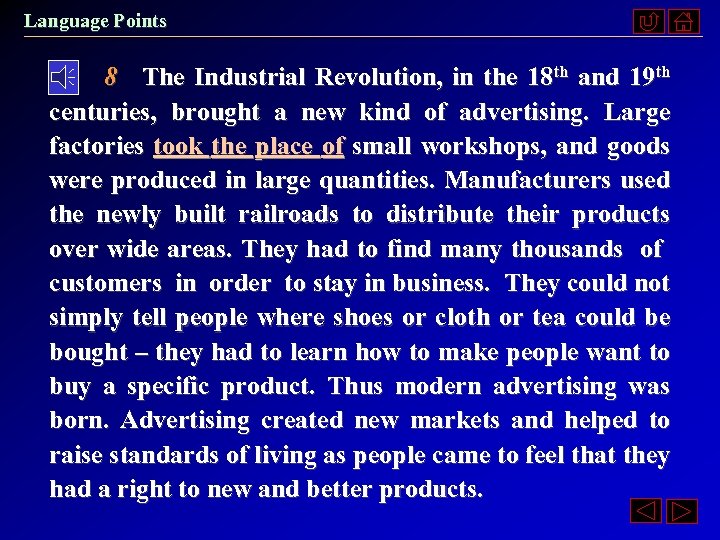
Language Points 8 The Industrial Revolution, in the 18 th and 19 th centuries, brought a new kind of advertising. Large factories took the place of small workshops, and goods were produced in large quantities. Manufacturers used the newly built railroads to distribute their products over wide areas. They had to find many thousands of customers in order to stay in business. They could not simply tell people where shoes or cloth or tea could be bought – they had to learn how to make people want to buy a specific product. Thus modern advertising was born. Advertising created new markets and helped to raise standards of living as people came to feel that they had a right to new and better products.

Language Points
turn leaf through: to looking at them carefully e. g. • While we are waiting in the waiting-room, we are often offered some magazines and newspapers to leaf through. • Mr Thompson is busy now. If you are not in a hurry, please sit down, have a cup of coffee and leaf through these magazines.
commercial: an advertisement that is broadcast on television or radio
respond to: be affected by; react to 对…反应、有效果、有影响 e. g. • He often responds to the pressure by having a good rest. • The stranger responded to my offer of help with a smile. • The disease failed to respond to the drugs.
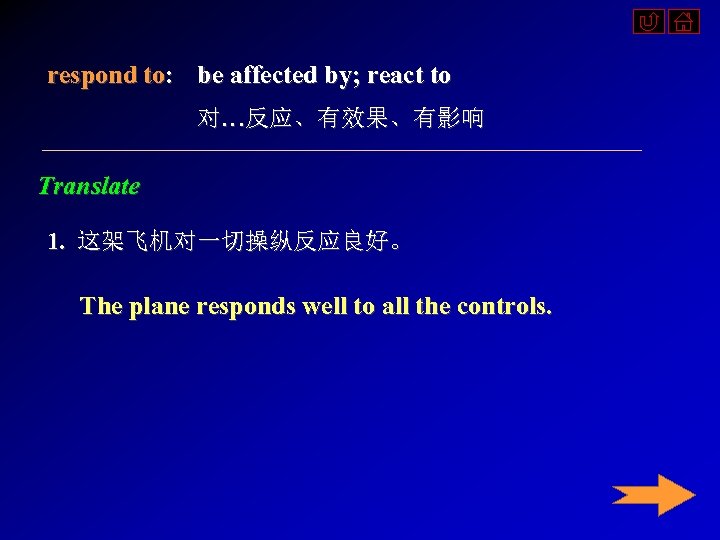
respond to: be affected by; react to 对…反应、有效果、有影响 Translate 1. 这架飞机对一切操纵反应良好。 The plane responds well to all the controls.
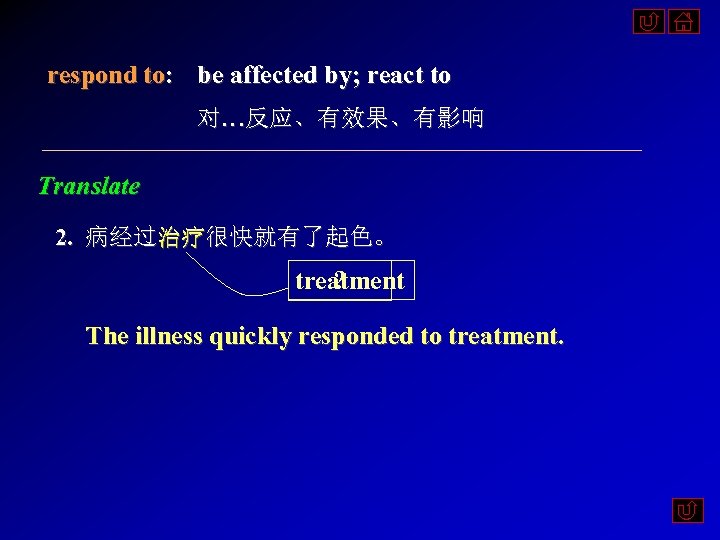
respond to: be affected by; react to 对…反应、有效果、有影响 Translate 2. 病经过治疗很快就有了起色。 治疗 treatment ? The illness quickly responded to treatment.
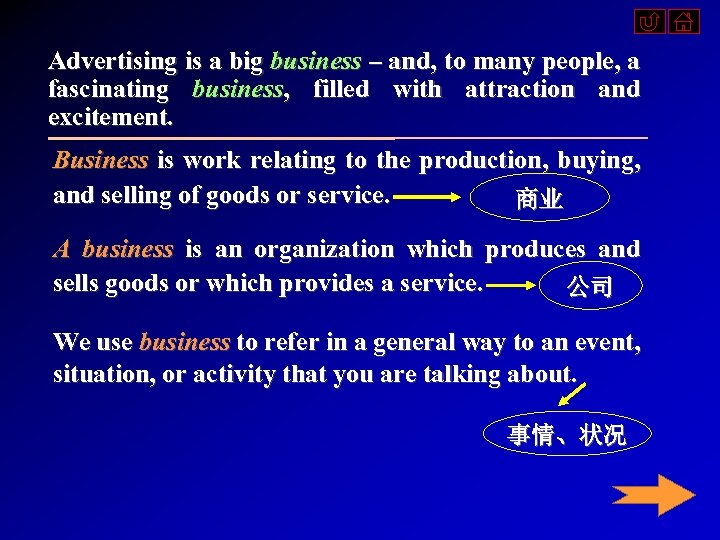
Advertising is a big business – and, to many people, a fascinating business, filled with attraction and excitement. Business is work relating to the production, buying, and selling of goods or service. 商业 A business is an organization which produces and sells goods or which provides a service. 公司 We use business to refer in a general way to an event, situation, or activity that you are talking about. 事情、状况
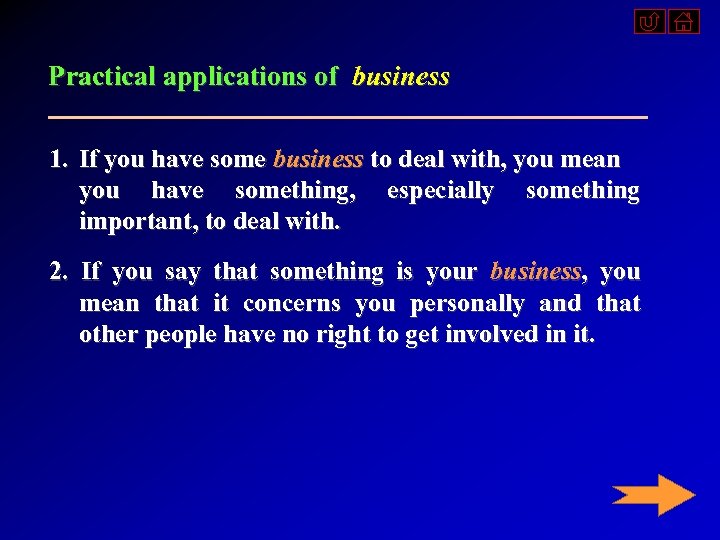
Practical applications of business 1. If you have some business to deal with, you mean you have something, especially something important, to deal with. 2. If you say that something is your business, you mean that it concerns you personally and that other people have no right to get involved in it.
Practical applications of business 3. If you say that someone has no business to do something, you mean that they have no right to do it. 4. If you say to someone “Mind your own business” or “It’s none of your business”, you are telling them not to ask about something that does not concern them.
Translate Advertising is a big business – and, to many people, a fascinating business, filled with attraction and excitement. 广告是一宗大买卖,对许多人而言, 又是富有吸引力的 事业,充满了魅力和激情。
describe…as: to say that (sb or sth) has certain qualities; depict sth in words; qualify e. g. • I hesitate to describe him as really clever. • She described herself as a first-class singer. • The newspaper is well described as a daily history of the world.
describe…as: to say that (sb or sth) has certain qualities; depict sth in words; qualify Translate 灵魂 1. 他的画被形容为没有灵魂的作品。 spirit / soul ? His painting was described as works without soul.
describe…as: to say that (sb or sth) has certain qualities; depict sth in words; qualify Translate 2. 她把她的家乡描述得就像天堂。 She described her hometown as heaven.
trace back: to find the origins of; go back to 追溯 / 追究 e. g. • The history of this black family can be traced back to the 10 th century. • He traces his descent (血统) back to an old Norman family.
trace back: to find the origins of; go back to 追溯 / 追究 Translate 1. 我们两国的友好关系可以追溯到明朝。 The friendly relationship between out two countries can be traced back to the Ming Dynasty.
trace back: to find the origins of; go back to 追溯 / 追究 Translate 2. 他对狗的恐惧( fear) 溯自孩童时代的一次经验。 His fear of dogs was traced back to a childhood experience. He traced his fear of dogs back to a childhood experience.
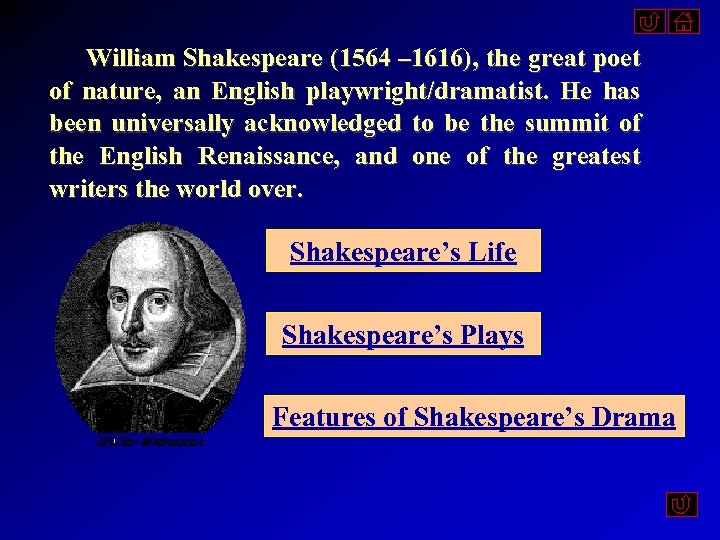
William Shakespeare (1564 – 1616), the great poet of nature, an English playwright/dramatist. He has been universally acknowledged to be the summit of the English Renaissance, and one of the greatest writers the world over. Shakespeare’s Life Shakespeare’s Plays Features of Shakespeare’s Drama
William Shakespeare was born on April 23 1564, in Stratford-on-Avon, a village in Warwickshire. At the age of seven he was sent to the local grammar school which he attended for six years. He read widely in the books current in his day and picked up “small Latin and less Greek. ” When Shakespeare was fourteen, his father fell into debt, and the boy
probably left school and became a country schoolmaster, to help support his family. In order to escape from persecution by a rich landlord – Sir Thomas Lucy, he was compelled to leave Stratford and seek refuge in London in 1586 or 1587. He must have gone through many hardships and undertaken many odd jobs. Then he became an actor of some dramatic troupe (戏班), playing minor parts.
He learned much of the technique of dramatic art from his personal experience with the stage. While leading the busy life of an actor, Shakespeare worked hard with his pen. He revised old plays and wrote new ones at the rate of about two a year. But somehow, he retired to his native town about 1611, though still in the prime of life.
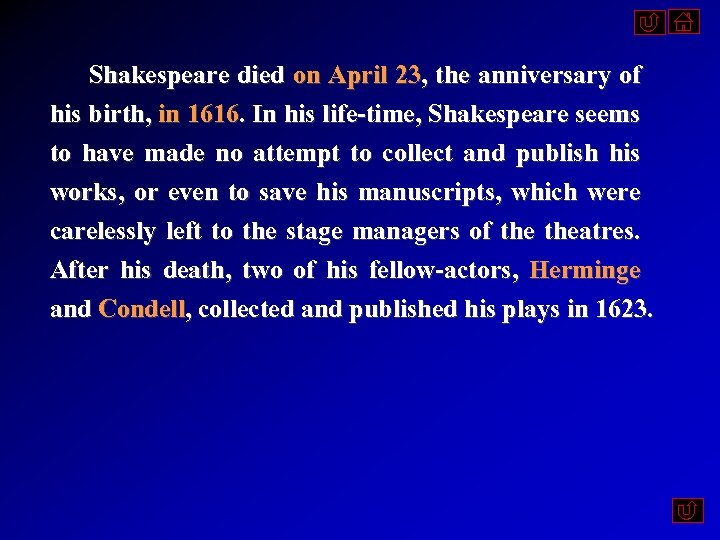
Shakespeare died on April 23, the anniversary of his birth, in 1616. In his life-time, Shakespeare seems to have made no attempt to collect and publish his works, or even to save his manuscripts, which were carelessly left to the stage managers of theatres. After his death, two of his fellow-actors, Herminge and Condell, collected and published his plays in 1623.
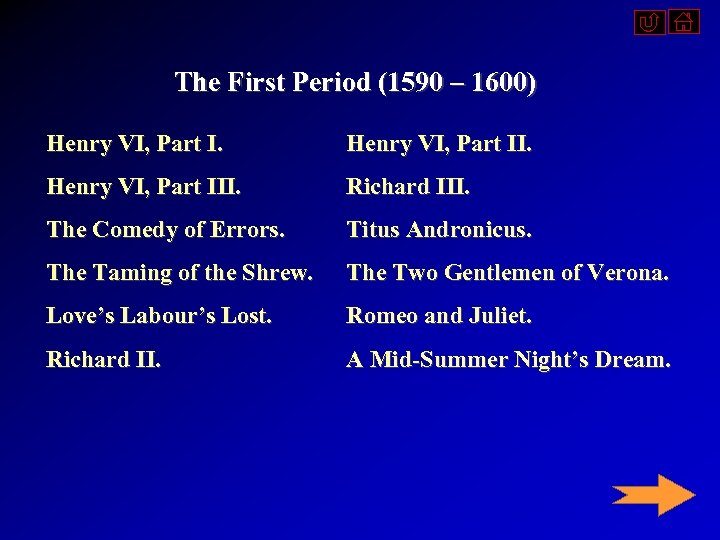
The First Period (1590 – 1600) Henry VI, Part II. Henry VI, Part III. Richard III. The Comedy of Errors. Titus Andronicus. The Taming of the Shrew. The Two Gentlemen of Verona. Love’s Labour’s Lost. Romeo and Juliet. Richard II. A Mid-Summer Night’s Dream.
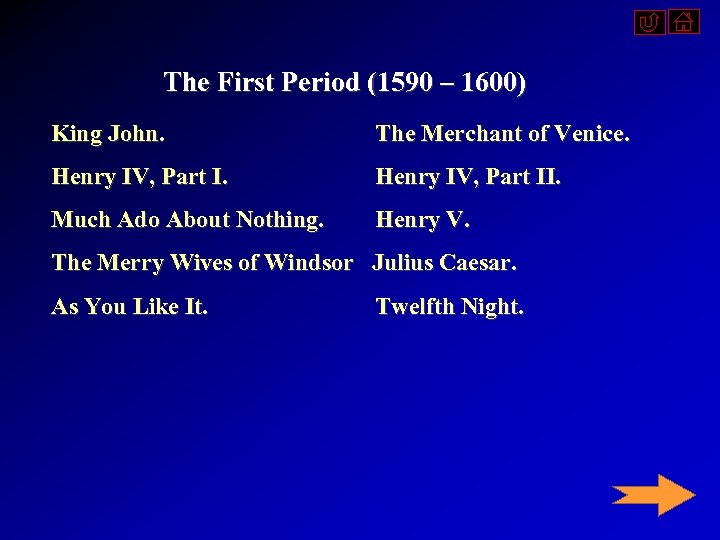
The First Period (1590 – 1600) King John. The Merchant of Venice. Henry IV, Part II. Much Ado About Nothing. Henry V. The Merry Wives of Windsor Julius Caesar. As You Like It. Twelfth Night.
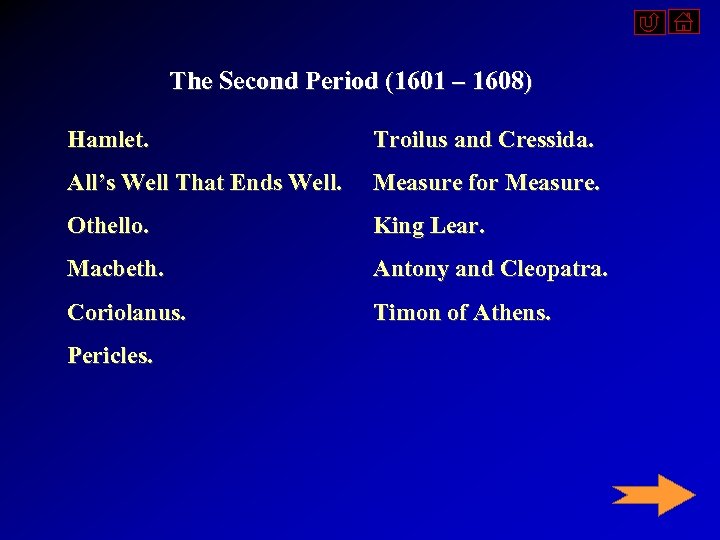
The Second Period (1601 – 1608) Hamlet. Troilus and Cressida. All’s Well That Ends Well. Measure for Measure. Othello. King Lear. Macbeth. Antony and Cleopatra. Coriolanus. Timon of Athens. Pericles.
a) Shakespeare is one of the founders of realism in world literature. He wrote abut his own people and for his own time. His plays have good plots and life-like characters, so his drama becomes an expression, a monument of the English Renaissance.
b) Within about twenty-two years of his writing career, Shakespeare gave to the world nearly forty plays, no two of which invoke the same feeling or image among the audience. He has the power to distil (提 取 …精 华 ) the most lyrical outburst of the human mind under a dramatic situation and the ability to set it into word music.
The Third Period (1609 – 1612) Cymbeline. The winter’s Tale. The Tempest. Henry VIII.
c) Shakespeare was skilled in many poetic forms: the song, the sonnet (十 四 行 诗 ), the couplet (对 句 ), and the dramatic blank verse (无韵诗).
d) Shakespeare is a great master of the English language. He commanded a vocabulary larger than any other English writers. He used about 16, 000 words. Shakespeare and the Authorized Version of the English Bible are the two great treasuries of the English language.
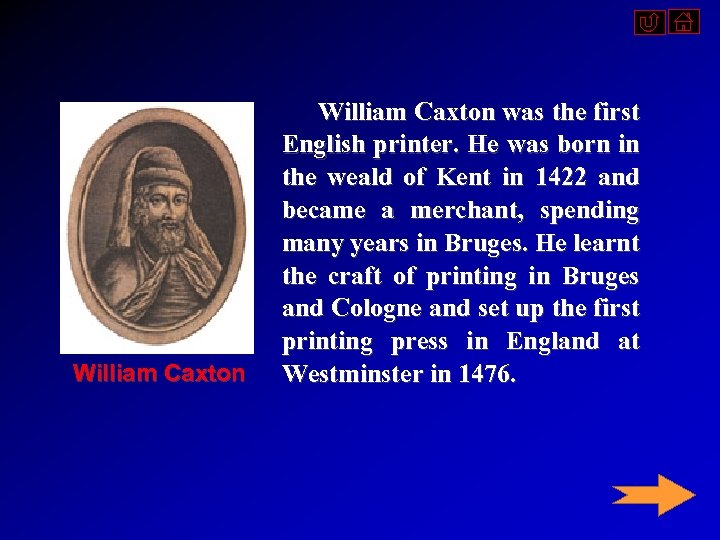
William Caxton was the first English printer. He was born in the weald of Kent in 1422 and became a merchant, spending many years in Bruges. He learnt the craft of printing in Bruges and Cologne and set up the first printing press in England at Westminster in 1476.
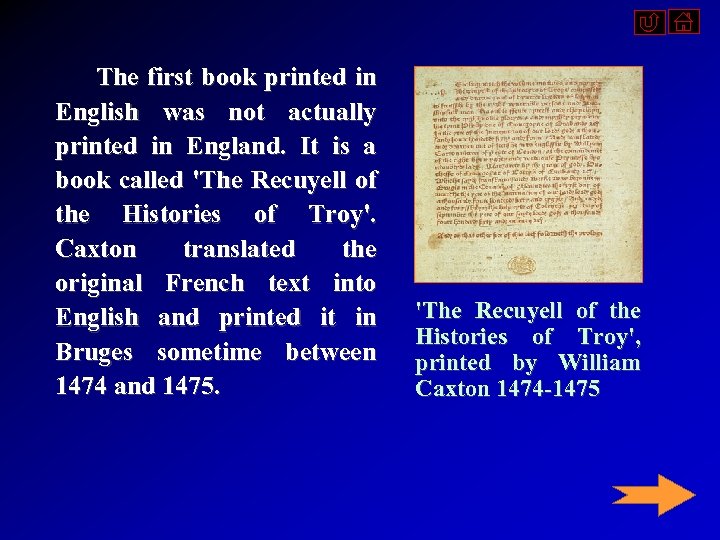
The first book printed in English was not actually printed in England. It is a book called 'The Recuyell of the Histories of Troy'. Caxton translated the original French text into English and printed it in Bruges sometime between 1474 and 1475. 'The Recuyell of the Histories of Troy', printed by William Caxton 1474 -1475
When Caxton died in 1491 his business was taken over by his assistant Wynkyn de Worde. Soon after he moved from Westminster to Fleet Street in London where for many years publishers and newspapers continued the tradition of printing.
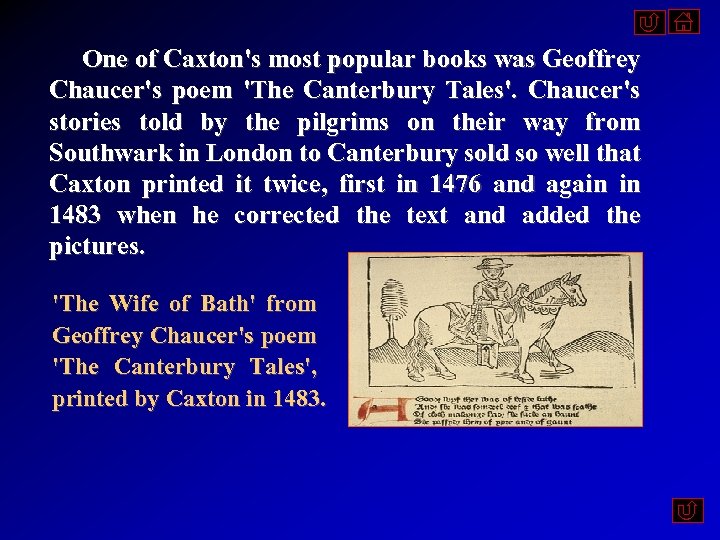
One of Caxton's most popular books was Geoffrey Chaucer's poem 'The Canterbury Tales'. Chaucer's stories told by the pilgrims on their way from Southwark in London to Canterbury sold so well that Caxton printed it twice, first in 1476 and again in 1483 when he corrected the text and added the pictures. 'The Wife of Bath' from Geoffrey Chaucer's poem 'The Canterbury Tales', printed by Caxton in 1483.
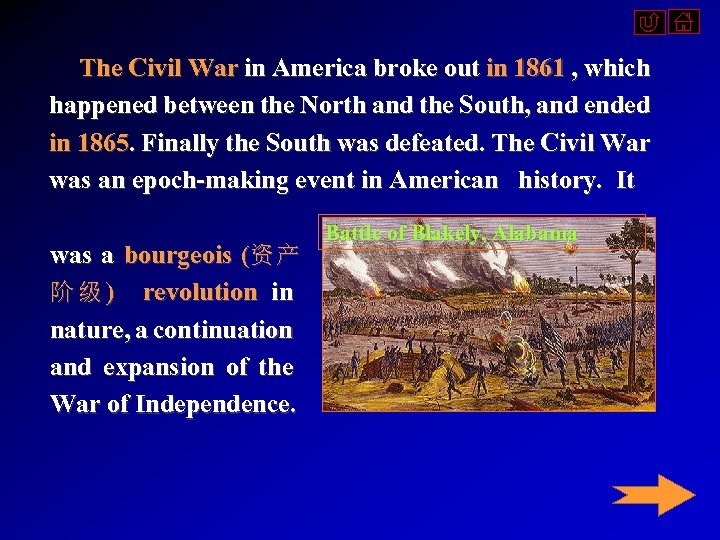
The Civil War in America broke out in 1861 , which happened between the North and the South, and ended in 1865. Finally the South was defeated. The Civil War was an epoch-making event in American history. It was a bourgeois (资 产 阶 级 ) revolution in nature, a continuation and expansion of the War of Independence. Battle of Blakely, Alabama
The abolition of slavery and the emancipation of the Negroes enabled the country to develop more rapidly in every field. It took America only three decades after the war to assume the lead as an industrial country in the world. The Civil War also extended its far-reaching influence to the European revolutions. Lenin pointed out that the war had “the greatest, world historical, progressive and revolutionary significance. ”
identify: say, show, prove, establish the identity of 认出,辨认,鉴定 e. g. • Could you identify your umbrella among a hundred others? • His accent was difficult to identify. (In the text) It means that William Caxton made his shop easily found by the others in the way of fixing a red-striped shield on it.
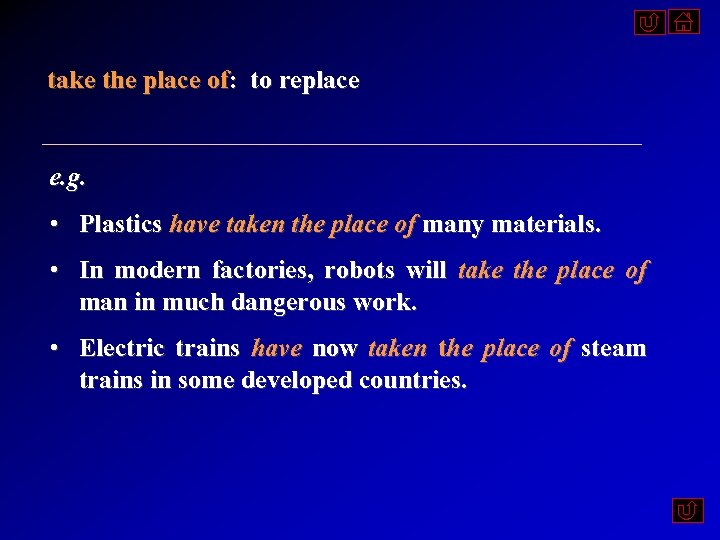
take the place of: to replace e. g. • Plastics have taken the place of many materials. • In modern factories, robots will take the place of man in much dangerous work. • Electric trains have now taken the place of steam trains in some developed countries.
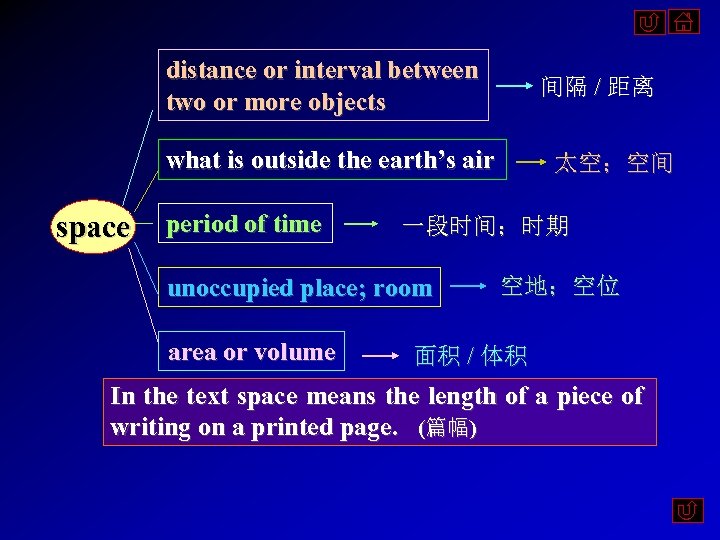
distance or interval between two or more objects 间隔 / 距离 what is outside the earth’s air space period of time 一段时间;时期 unoccupied place; room area or volume 太空;空间 空地;空位 面积 / 体积 In the text space means the length of a piece of writing on a printed page. (篇幅)
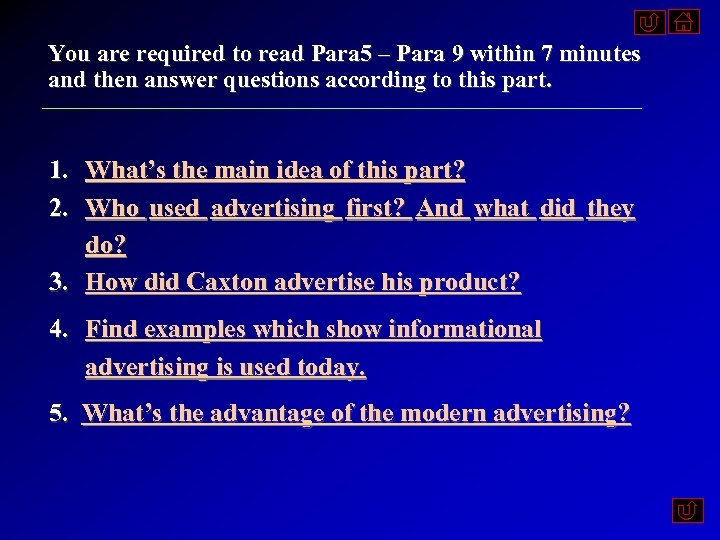
You are required to read Para 5 – Para 9 within 7 minutes and then answer questions according to this part. 1. What’s the main idea of this part? 2. Who used advertising first? And what did they do? 3. How did Caxton advertise his product? 4. Find examples which show informational advertising is used today. 5. What’s the advantage of the modern advertising?
1. What’s the main idea of this part? It’s a short history of advertising.
2. Who used advertising first? And what did they do? They are the public criers of ancient Greece. They shouted out messages about their clients’ products to one and all for a fee.
3. How did Caxton advertise his product? He posted small printed notices along London’s main streets.
4. Find examples which show informational advertising is used today. The roadside signs tell travelers that they can buy fresh corn just down the road or that there is a restaurant in the next town.
5. What’s the advantage of the modern advertising? It created new markets and helped to raise standards of living as people came to feel that they had a right to new and better products.
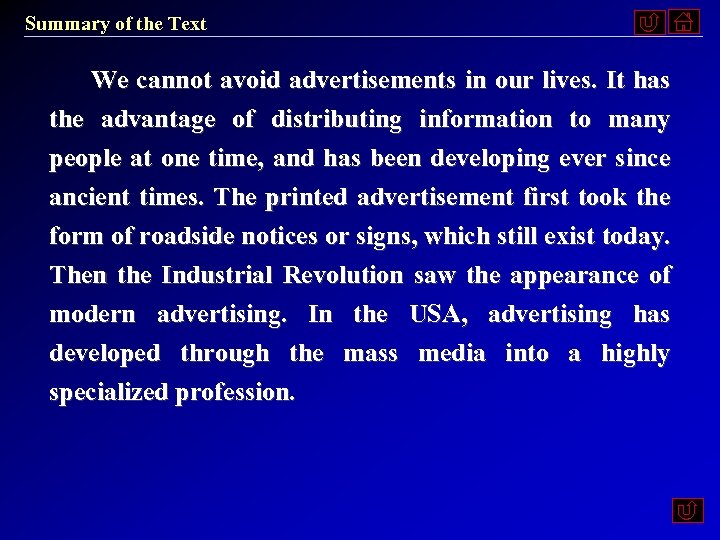
Summary of the Text We cannot avoid advertisements in our lives. It has the advantage of distributing information to many people at one time, and has been developing ever since ancient times. The printed advertisement first took the form of roadside notices or signs, which still exist today. Then the Industrial Revolution saw the appearance of modern advertising. In the USA, advertising has developed through the mass media into a highly specialized profession.
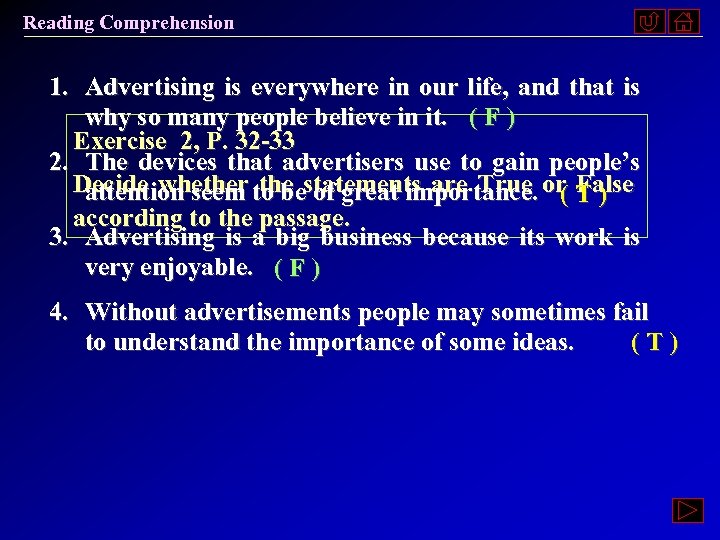
Reading Comprehension 1. Advertising is everywhere in our life, and that is why so many people believe in it. ( F ) Exercise 2, P. 32 -33 2. The devices that advertisers use to gain people’s Decide whether the statements are True or False attention seem to be of great importance. ( T ) according to the passage. 3. Advertising is a big business because its work is very enjoyable. ( F ) 4. Without advertisements people may sometimes fail to understand the importance of some ideas. ( T )
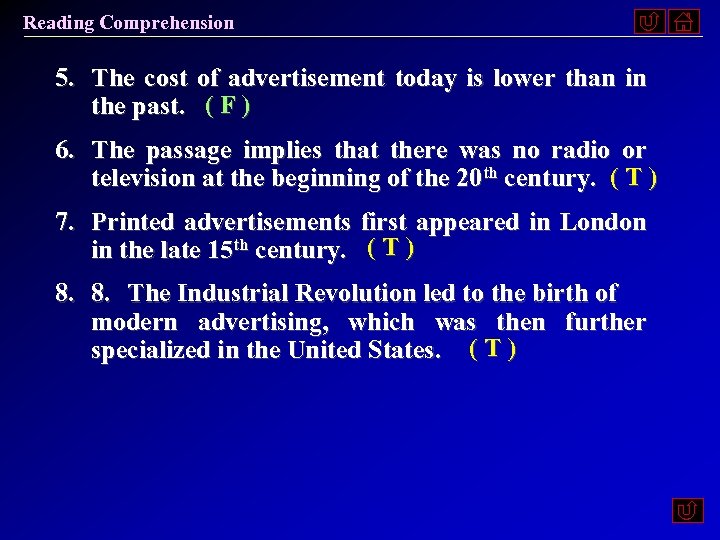
Reading Comprehension 5. The cost of advertisement today is lower than in the past. ( F ) 6. The passage implies that there was no radio or television at the beginning of the 20 th century. ( T ) 7. Printed advertisements first appeared in London in the late 15 th century. ( T ) 8. 8. The Industrial Revolution led to the birth of modern advertising, which was then further specialized in the United States. ( T )
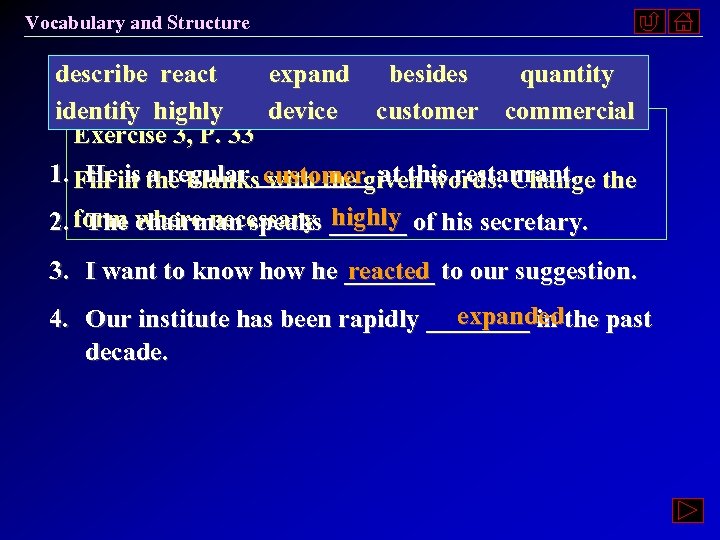
Vocabulary and Structure describe react expand besides quantity identify highly device customer commercial Exercise 3, P. 33 1. Fill in the blanks with the given words. Change the He is a regular _____ at this restaurant. customer 2. form where necessary. highly The chairman speaks ______ of his secretary. 3. I want to know he _______ to our suggestion. reacted expanded 4. Our institute has been rapidly ____ in the past decade.
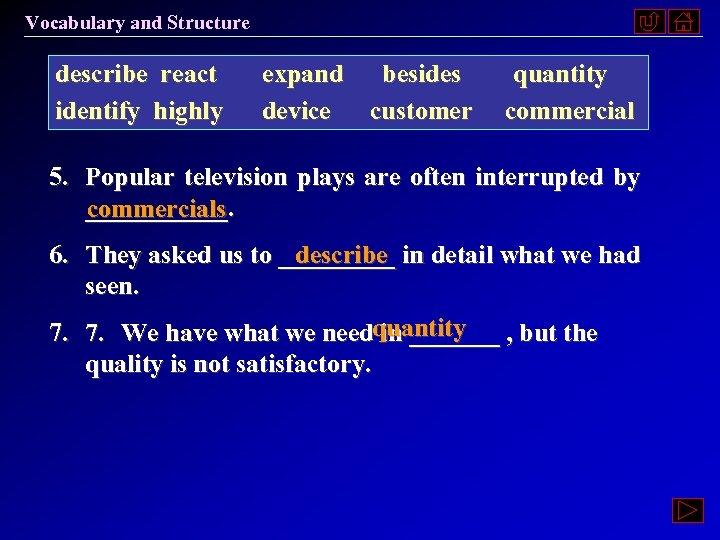
Vocabulary and Structure describe react expand besides quantity identify highly device customer commercial 5. Popular television plays are often interrupted by ______. commercials 6. They asked us to _____ in detail what we had describe seen. quantity 7. 7. We have what we need in _______ , but the quality is not satisfactory.
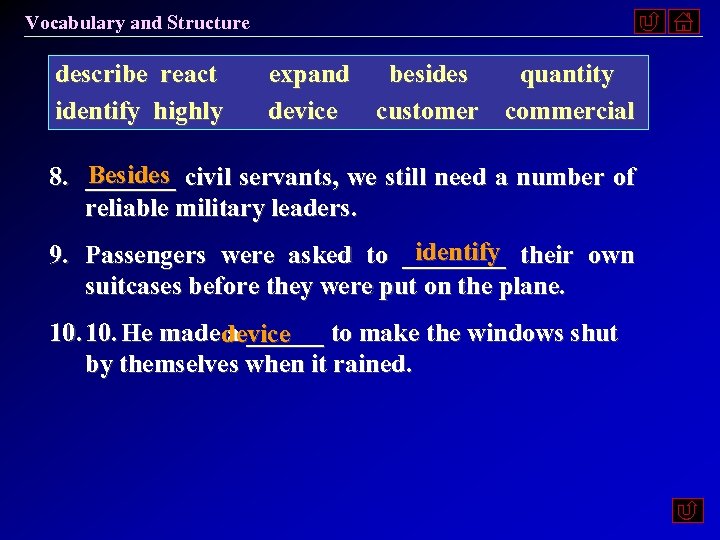
Vocabulary and Structure describe react expand besides quantity identify highly device customer commercial Besides 8. _______ civil servants, we still need a number of reliable military leaders. identify 9. Passengers were asked to ____ their own suitcases before they were put on the plane. 10. He made a ______ to make the windows shut device by themselves when it rained.
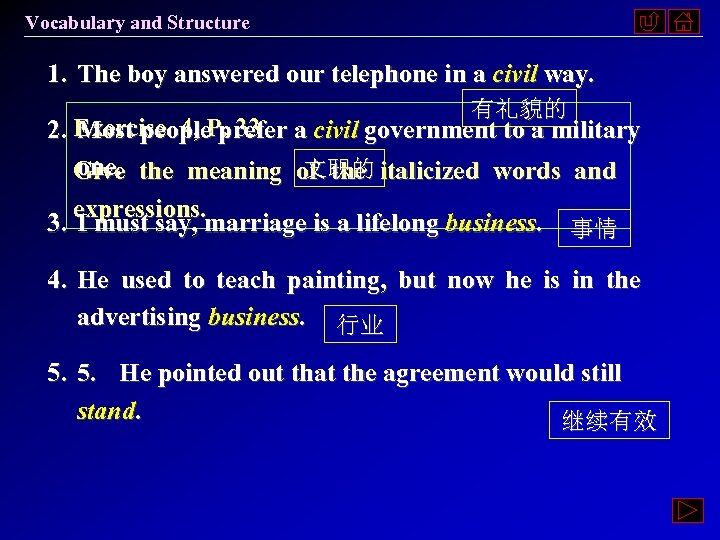
Vocabulary and Structure 1. The boy answered our telephone in a civil way. 有礼貌的 2. Exercise 4, P. 33 a civil government to a military Most people prefer one. 文职的 Give the meaning of the italicized words and expressions. 3. I must say, marriage is a lifelong business. 事情 4. He used to teach painting, but now he is in the advertising business. 行业 5. 5. He pointed out that the agreement would still stand. 继续有效
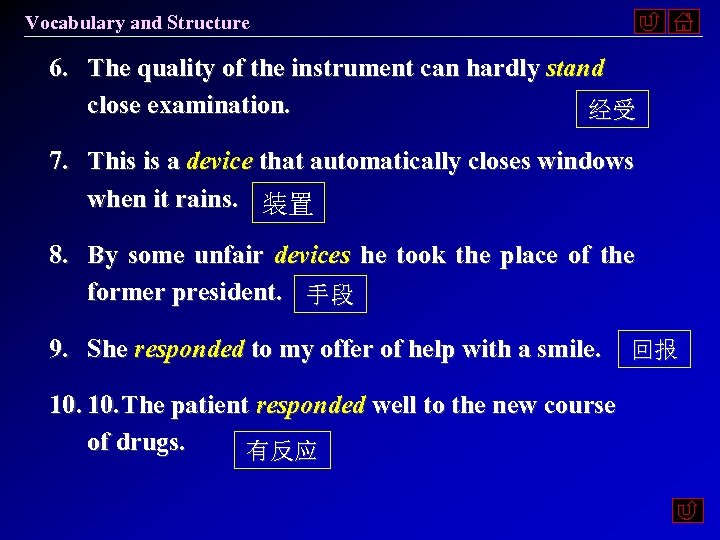
Vocabulary and Structure 6. The quality of the instrument can hardly stand close examination. 经受 7. This is a device that automatically closes windows when it rains. 装置 8. By some unfair devices he took the place of the former president. 手段 9. She responded to my offer of help with a smile. 10. The patient responded well to the new course of drugs. 有反应 回报
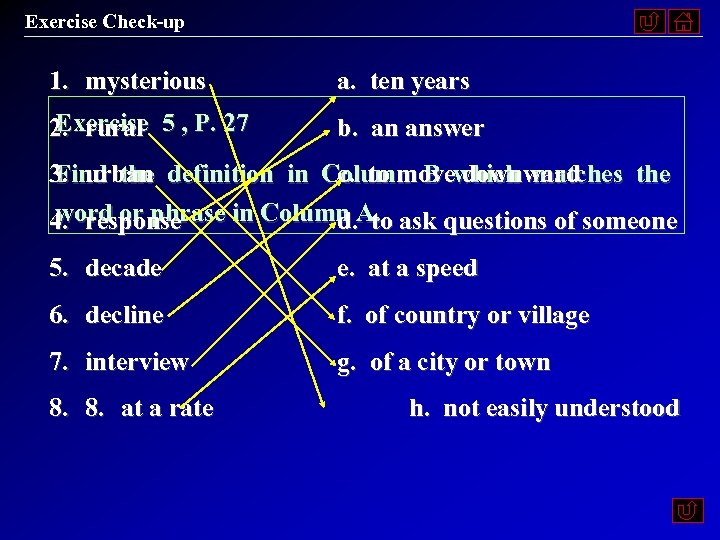
Exercise Check-up 1. mysterious a. ten years Exercise 5 , P. 27 2. rural b. an answer 3. urban definition in Column B which matches the c. to move downward Find the word or phrase in Column A. 4. response d. to ask questions of someone 5. decade e. at a speed 6. decline f. of country or village 7. interview g. of a city or town 8. 8. at a rate h. not easily understood
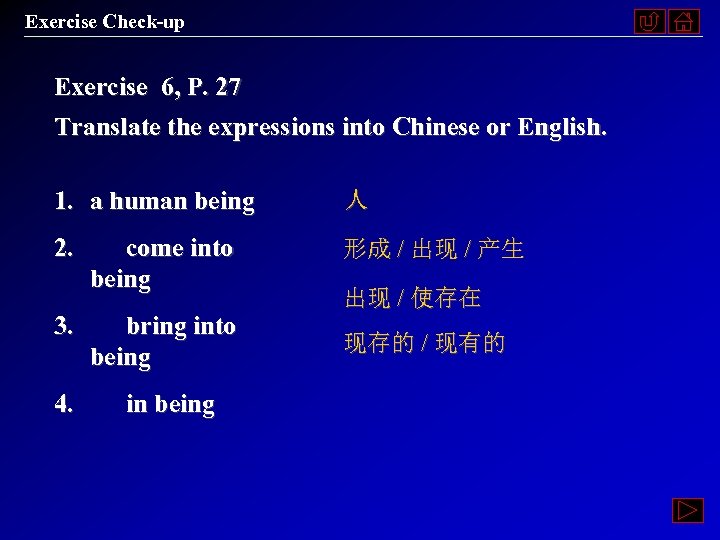
Exercise Check-up Exercise 6, P. 27 Translate the expressions into Chinese or English. 1. a human being 人 2. 形成 / 出现 / 产生 3. 4. come into being bring into being in being 出现 / 使存在 现存的 / 现有的
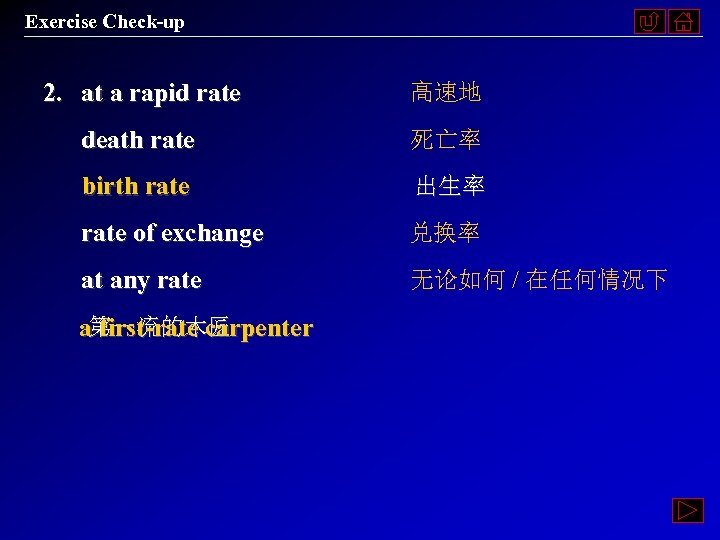
Exercise Check-up 高速地 2. at a rapid rate death rate 死亡率 出生率 birth rate of exchange 兑换率 at any rate 无论如何 / 在任何情况下 第一流的木匠 a first-rate carpenter
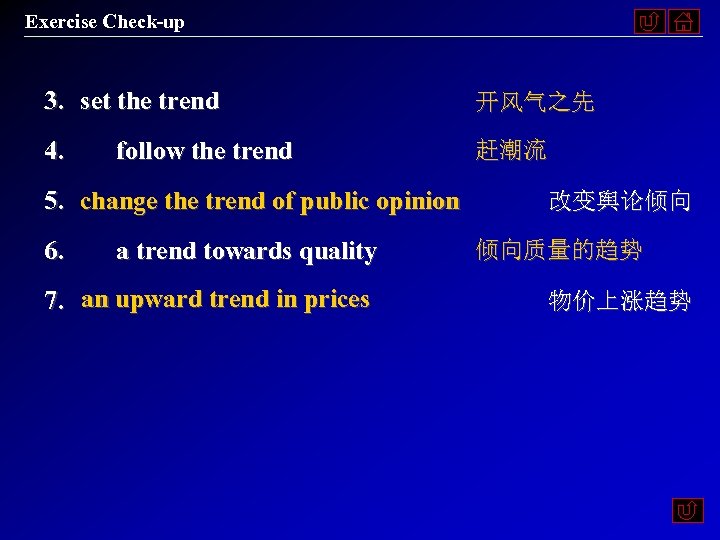
Exercise Check-up 3. set the trend 开风气之先 4. 赶潮流 follow the trend 5. change the trend of public opinion 改变舆论倾向 6. a trend towards quality 7. an upward trend in prices 倾向质量的趋势 物价上涨趋势
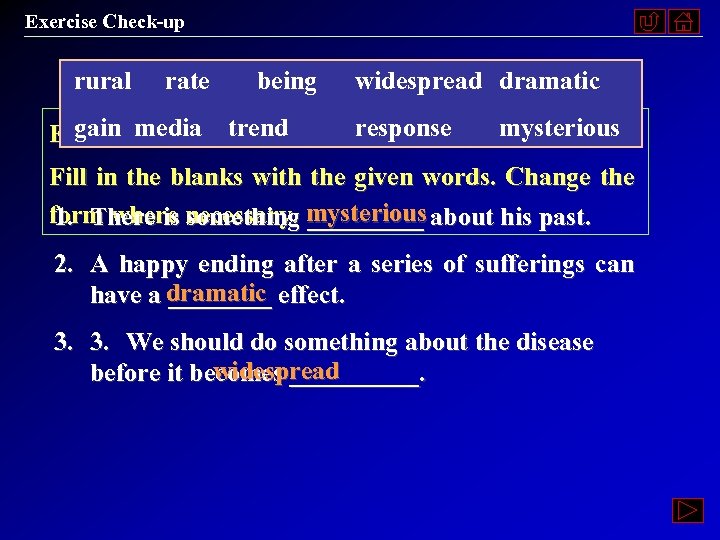
Exercise Check-up rural rate being gain media trend Exercise 8, P. 28 widespread dramatic response mysterious Fill in the blanks with the given words. Change the form where necessary. mysterious 1. There is something _____ about his past. 2. A happy ending after a series of sufferings can dramatic have a ____ effect. 3. 3. We should do something about the disease widespread before it becomes _____.
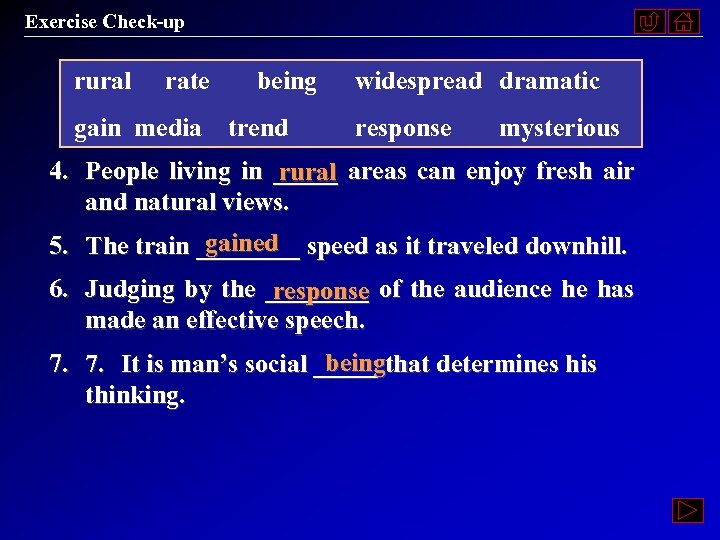
Exercise Check-up rural rate being widespread dramatic gain media trend response mysterious 4. People living in _____ areas can enjoy fresh air rural and natural views. gained 5. The train ____ speed as it traveled downhill. 6. Judging by the ____ of the audience he has response made an effective speech. being 7. 7. It is man’s social _____ that determines his thinking.
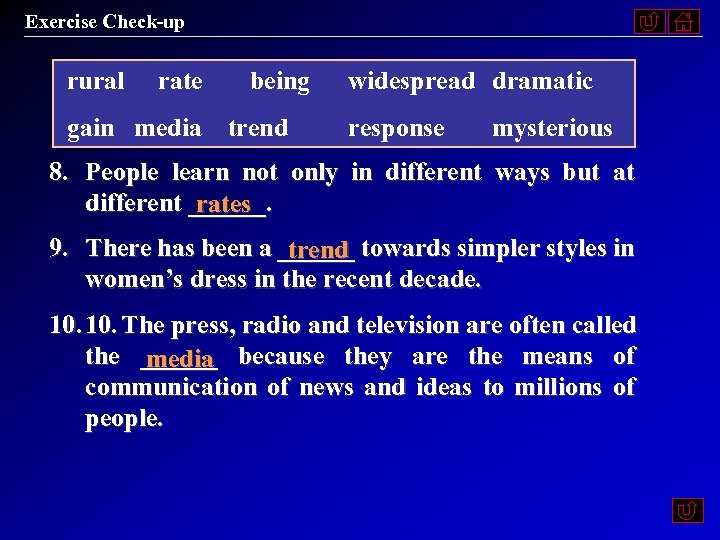
Exercise Check-up rural rate being widespread dramatic gain media trend response mysterious 8. People learn not only in different ways but at different ______. rates 9. There has been a ______ towards simpler styles in trend women’s dress in the recent decade. 10. The press, radio and television are often called the ______ because they are the means of media communication of news and ideas to millions of people.
Listening Practice • Part III-A: Short Conversation • Part III-B: Short Passage
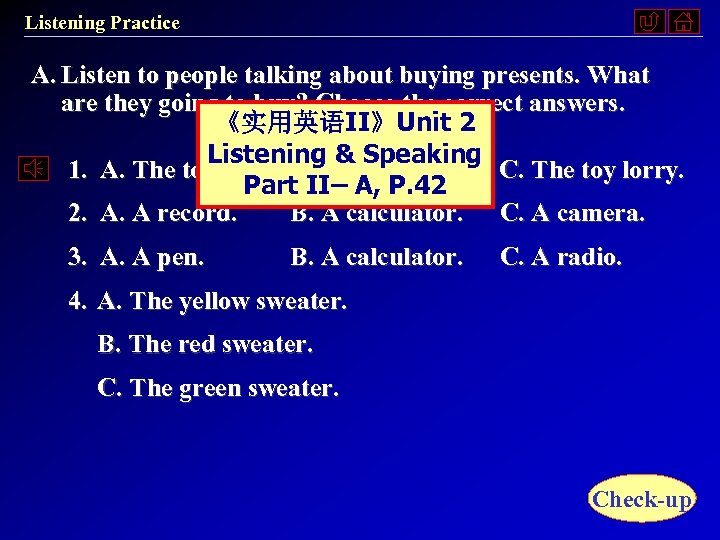
Listening Practice A. Listen to people talking about buying presents. What are they going to buy? Choose the correct answers. 《实用英语II》Unit 2 Listening & Speaking 1. A. The toy tank. B. The toy car. C. The toy lorry. Part II– A, P. 42 2. A. A record. B. A calculator. C. A camera. 3. A. A pen. B. A calculator. C. A radio. 4. A. The yellow sweater. B. The red sweater. C. The green sweater. Check-up
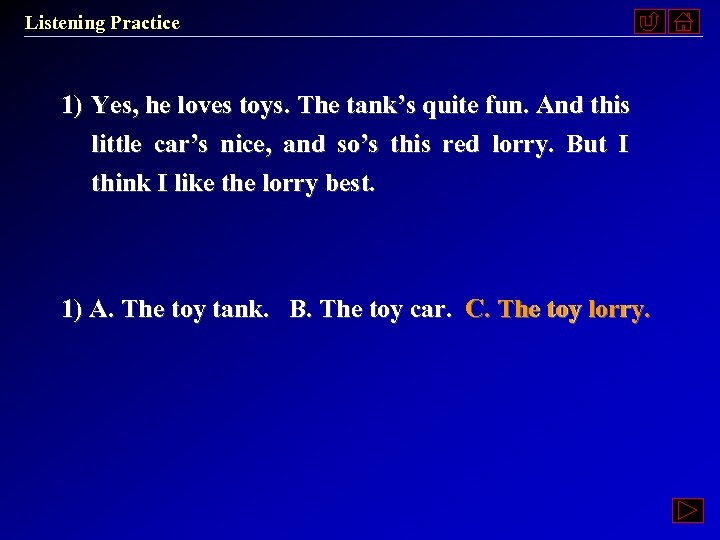
Listening Practice 1) Yes, he loves toys. The tank’s quite fun. And this little car’s nice, and so’s this red lorry. But I think I like the lorry best. 1) A. The toy tank. B. The toy car. C. The toy lorry.
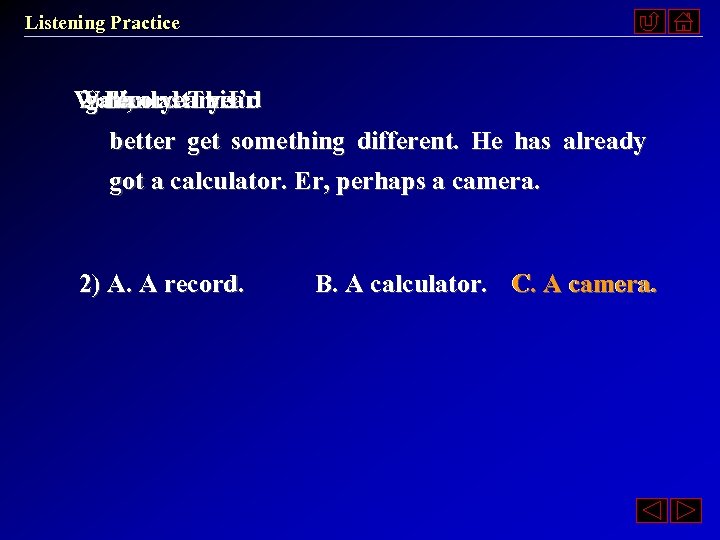
Listening Practice Well, last year 2) I a year. I’d gave record This him better get something different. He has already got a calculator. Er, perhaps a camera. 2) A. A record. B. A calculator. C. A camera.
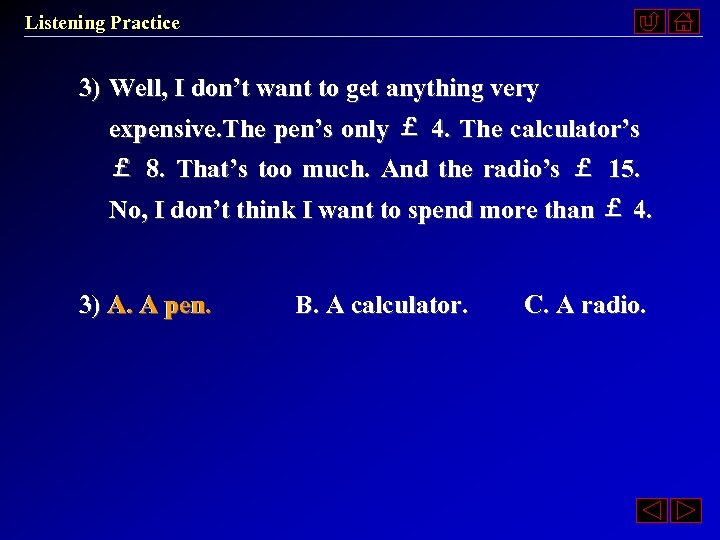
Listening Practice 3) Well, I don’t want to get anything very expensive. The pen’s only £ 4. The calculator’s £ 8. That’s too much. And the radio’s £ 15. No, I don’t think I want to spend more than £ 4. A. A pen. 3) A. A pen. B. A calculator. C. A radio.
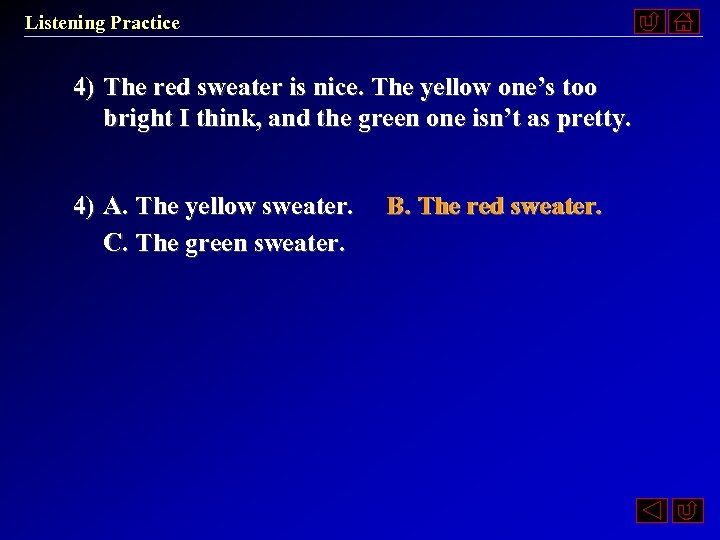
Listening Practice 4) The red sweater is nice. The yellow one’s too bright I think, and the green one isn’t as pretty. 4) A. The yellow sweater. B. The red sweater. C. The green sweater.
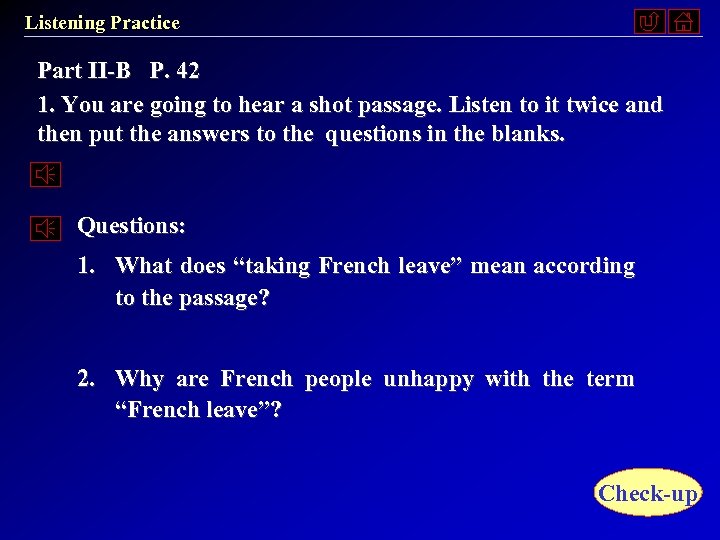
Listening Practice Part II-B P. 42 1. You are going to hear a shot passage. Listen to it twice and then put the answers to the questions in the blanks. Questions: 1. What does “taking French leave” mean according to the passage? 2. Why are French people unhappy with the term “French leave”? Check-up
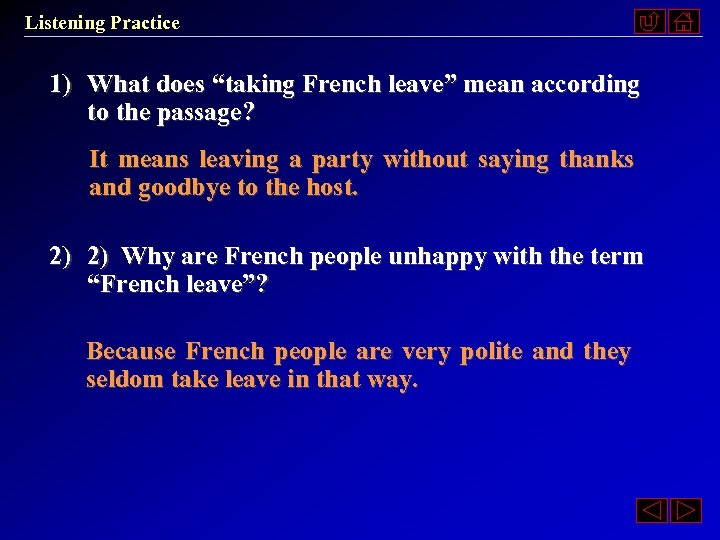
Listening Practice 1) What does “taking French leave” mean according to the passage? It means leaving a party without saying thanks and goodbye to the host. 2) 2) Why are French people unhappy with the term “French leave”? Because French people are very polite and they seldom take leave in that way.
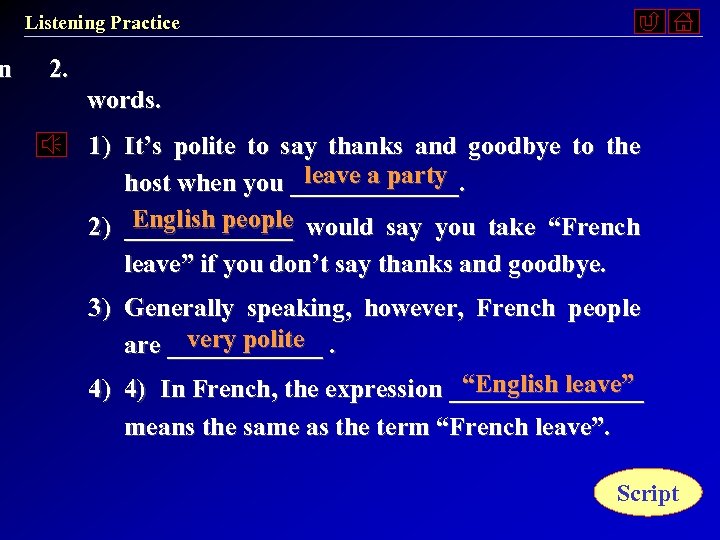
n Listening Practice 2. words. 1) It’s polite to say thanks and goodbye to the leave a party host when you _______. English people 2) _______ would say you take “French leave” if you don’t say thanks and goodbye. 3) Generally speaking, however, French people very polite are ______. “English leave” 4) 4) In French, the expression ________ means the same as the term “French leave”. Script
Listening Practice When you leave a party, it’s polite to say thanks and goodbye to the host. If you don’t do this, English people would say you take a “French leave. ” But as a matter of fact, French people are very polite. They seldom take leave like this. Of course, they feel unhappy with the term “French leave. ” So if somebody leaves a party in an impolite way, French people would say he takes an “English leave. ”
Скачать презентацию Practical English Book II Unit 2 Advertising Part
e771dc554b520e8a3e3252fdbf939a24.ppt