


 Скачать презентацию Practical Data Mining Lecture 2 Supervised learning part
lecture_2.pptx
- Количество слайдов: 31
 Practical Data Mining Lecture 2. Supervised learning (part 1). Victor Kantor MIPT 2014
 Plan 1. 2. 3. 4. 5. Course tasks and practice Previous lecture reminder Supervised learning: quality measures Distance (metric) based methods Bayesian methods (introduction)
 Course tasks • First deadline – 22 November: – Theoretical task – Intro Python task – Intro R task – 4 Contests • Second deadline – 13 December: – Team Data Mining Project – 2 -3 practical tasks on real data • Without deadlines: – “toys” – simple task on standard datasets or tasks “try to use package X in language Y and write a short report”
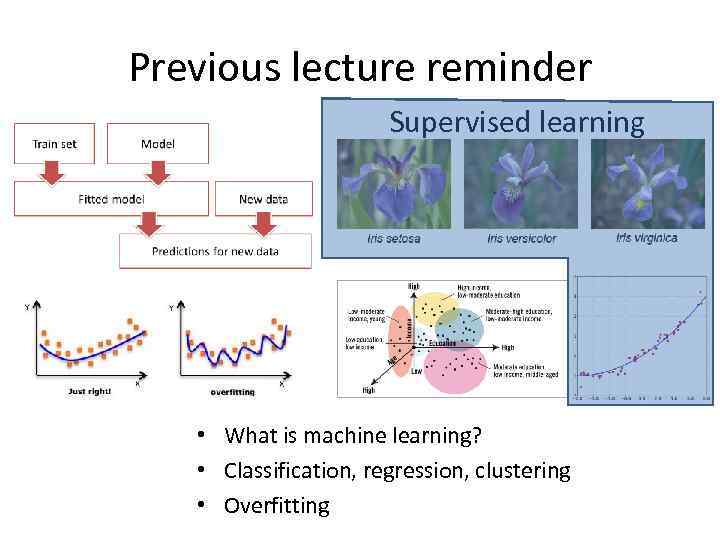 Previous lecture reminder Supervised learning • What is machine learning? • Classification, regression, clustering • Overfitting
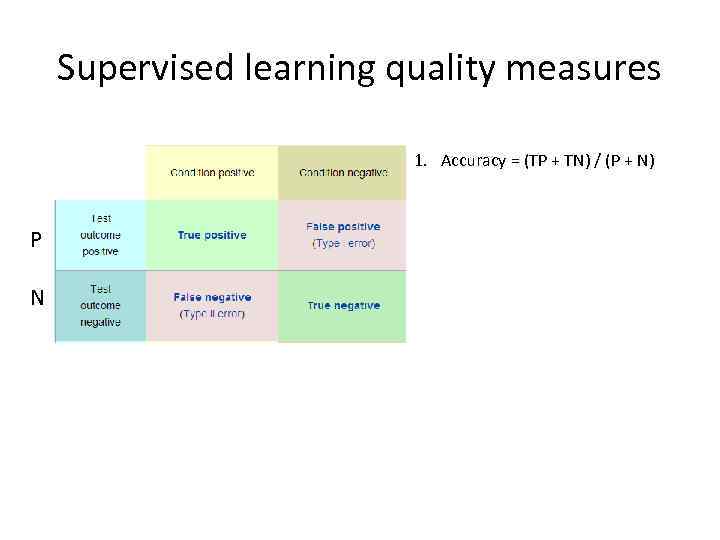 Supervised learning quality measures 1. Accuracy = (TP + TN) / (P + N) P N
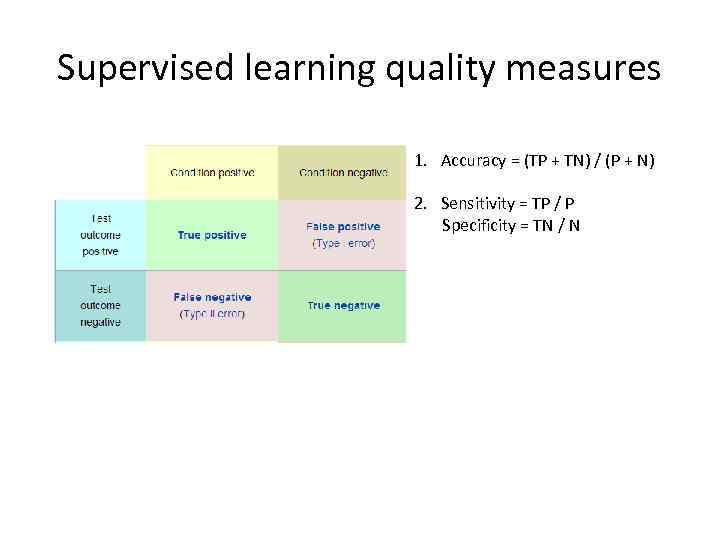 Supervised learning quality measures 1. Accuracy = (TP + TN) / (P + N) 2. Sensitivity = TP / P Specificity = TN / N
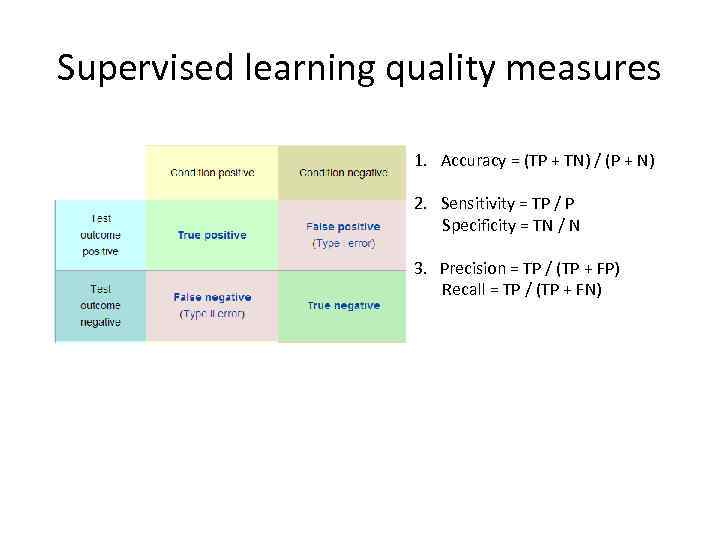 Supervised learning quality measures 1. Accuracy = (TP + TN) / (P + N) 2. Sensitivity = TP / P Specificity = TN / N 3. Precision = TP / (TP + FP) Recall = TP / (TP + FN)
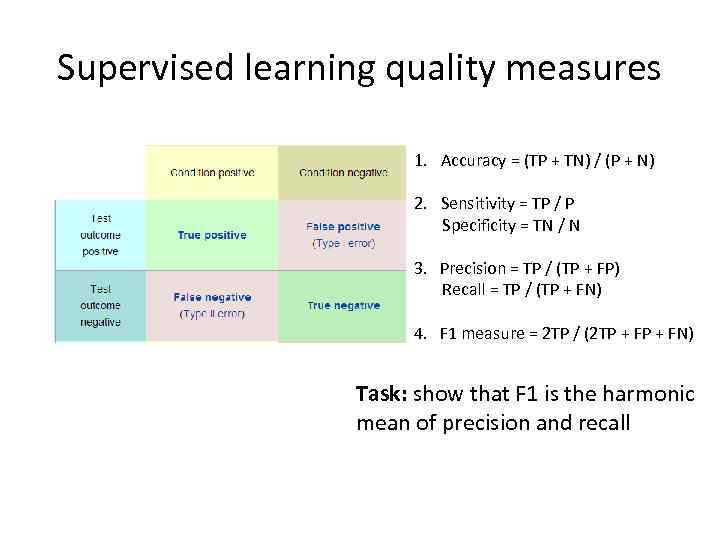 Supervised learning quality measures 1. Accuracy = (TP + TN) / (P + N) 2. Sensitivity = TP / P Specificity = TN / N 3. Precision = TP / (TP + FP) Recall = TP / (TP + FN) 4. F 1 measure = 2 TP / (2 TP + FN) Task: show that F 1 is the harmonic mean of precision and recall
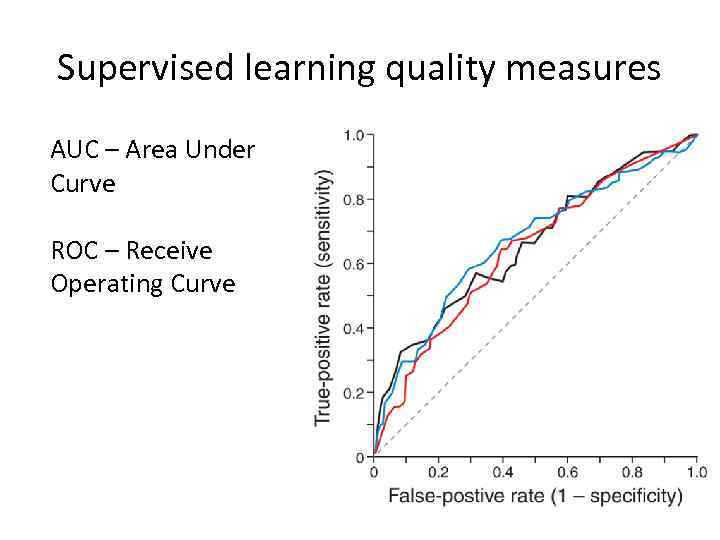 Supervised learning quality measures AUC – Area Under Curve ROC – Receive Operating Curve ROC curve
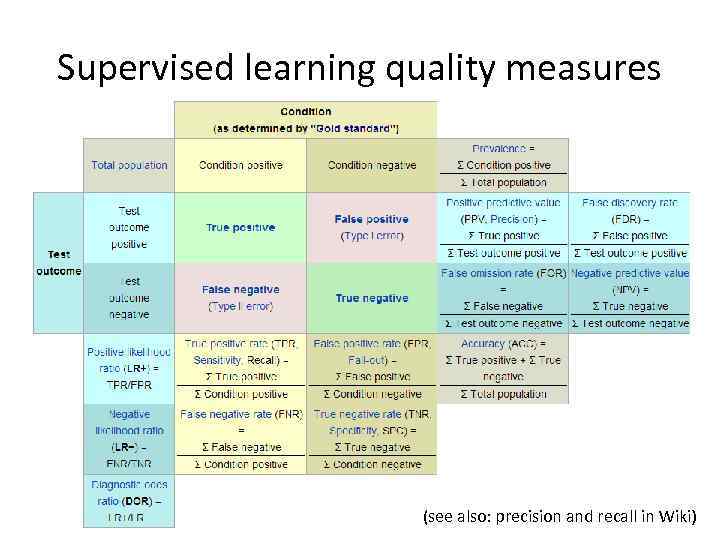 Supervised learning quality measures (see also: precision and recall in Wiki)
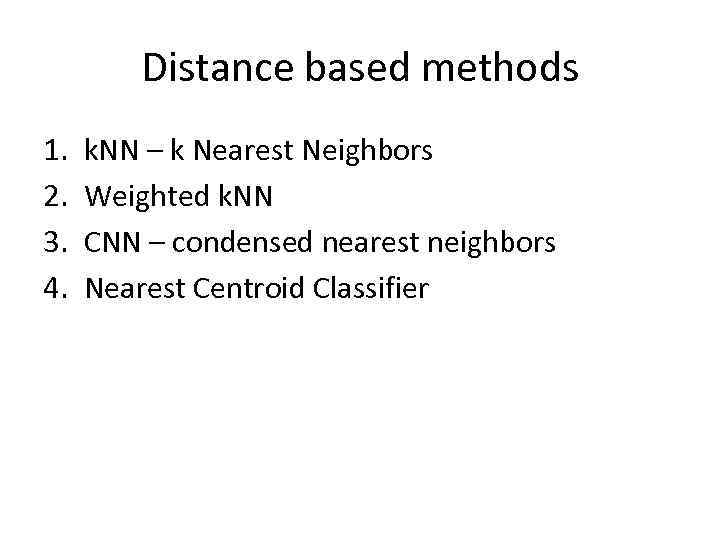 Distance based methods 1. 2. 3. 4. k. NN – k Nearest Neighbors Weighted k. NN CNN – condensed nearest neighbors Nearest Centroid Classifier
 k. NN Weighted k. NN with w(x(i)) = const(x(i))
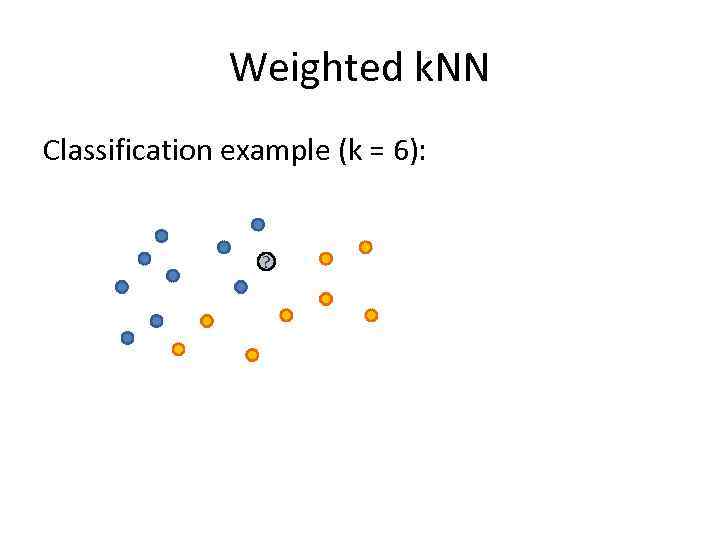 Weighted k. NN Classification example (k = 6): ?
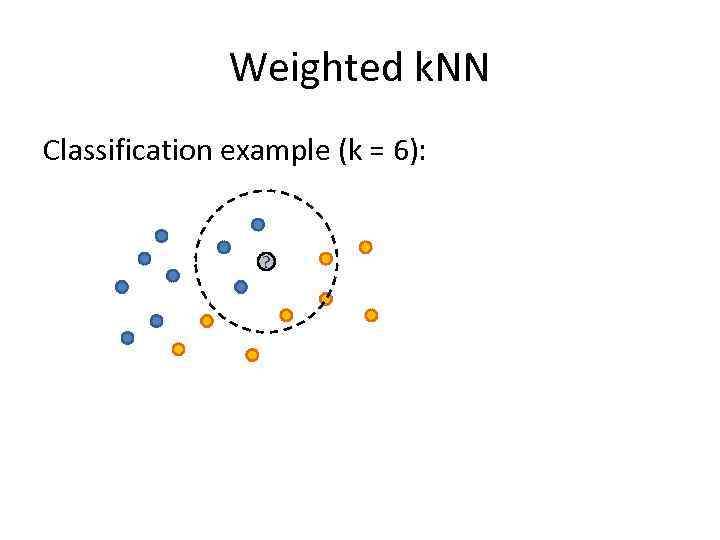 Weighted k. NN Classification example (k = 6): ?
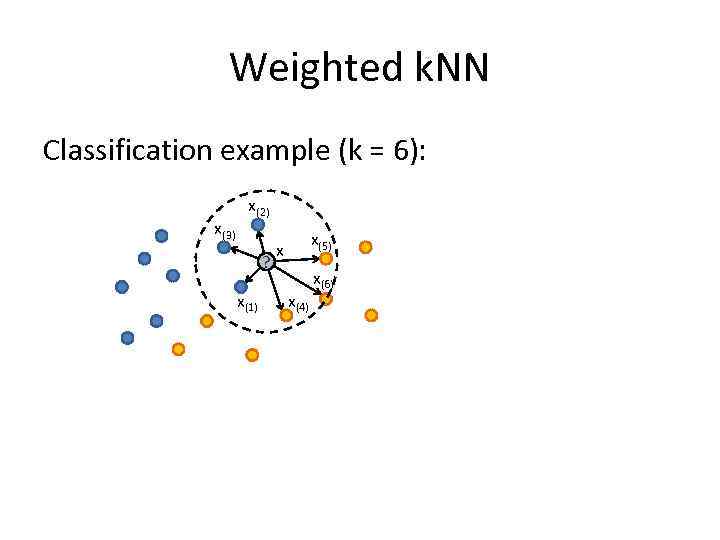 Weighted k. NN Classification example (k = 6): x(3) x(2) ? x(1) x(5) x x(4) x(6)
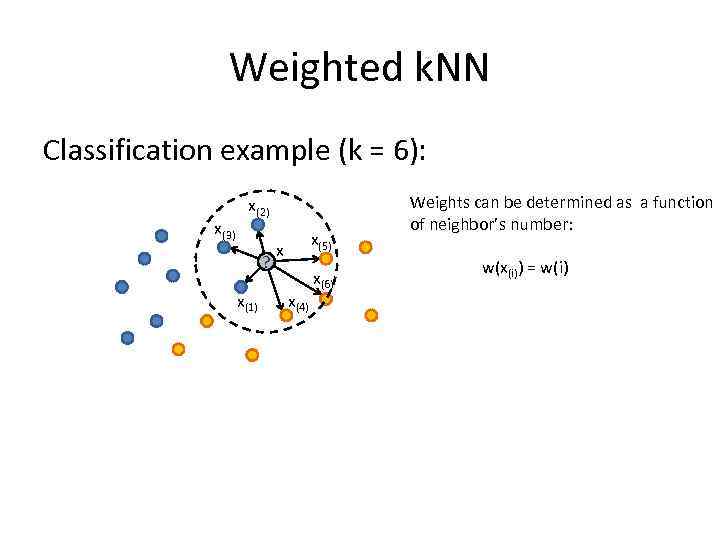 Weighted k. NN Classification example (k = 6): x(3) x(2) ? x(1) x(5) x x(4) x(6) Weights can be determined as a function of neighbor’s number: w(x(i)) = w(i)
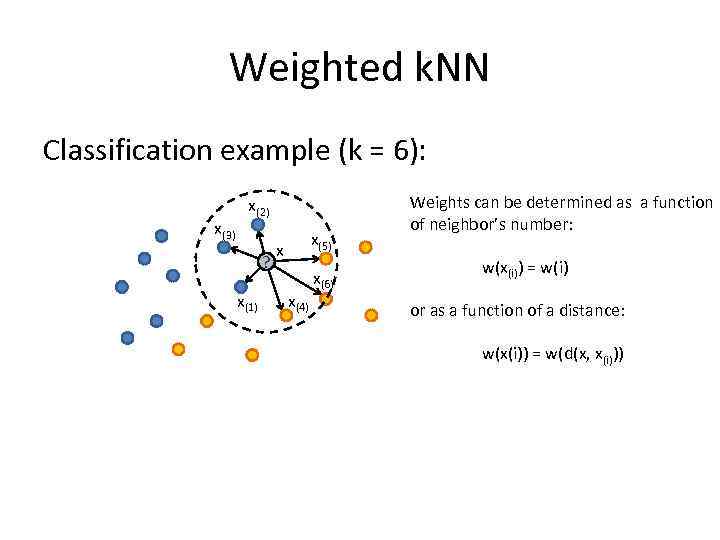 Weighted k. NN Classification example (k = 6): x(3) x(2) ? x(1) x(5) x x(4) x(6) Weights can be determined as a function of neighbor’s number: w(x(i)) = w(i) or as a function of a distance: w(x(i)) = w(d(x, x(i)))
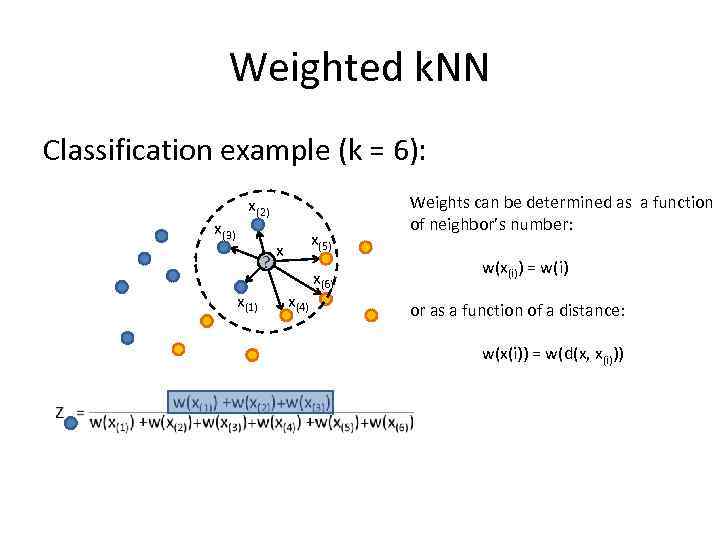 Weighted k. NN Classification example (k = 6): x(3) x(2) ? x(1) x(5) x x(4) x(6) Weights can be determined as a function of neighbor’s number: w(x(i)) = w(i) or as a function of a distance: w(x(i)) = w(d(x, x(i)))
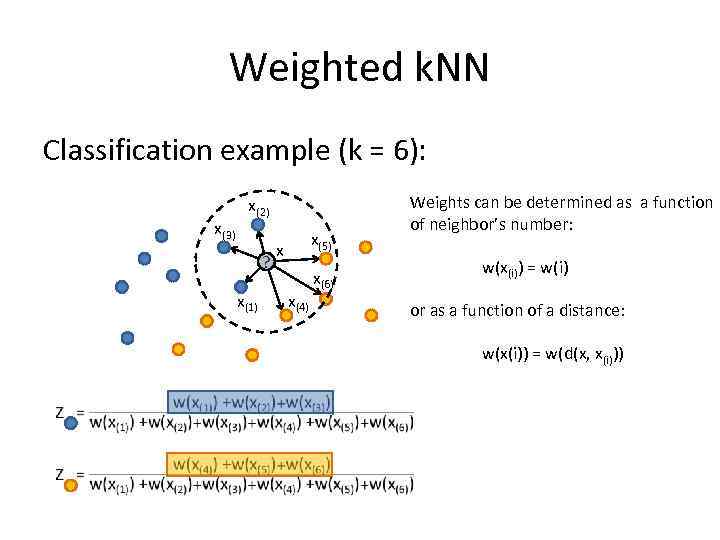 Weighted k. NN Classification example (k = 6): x(3) x(2) ? x(1) x(5) x x(4) x(6) Weights can be determined as a function of neighbor’s number: w(x(i)) = w(i) or as a function of a distance: w(x(i)) = w(d(x, x(i)))
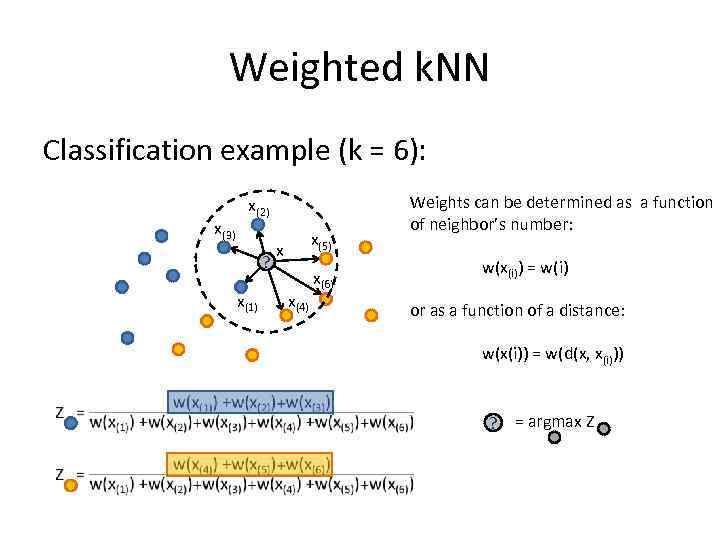 Weighted k. NN Classification example (k = 6): x(3) x(2) ? x(1) x(5) x x(4) x(6) Weights can be determined as a function of neighbor’s number: w(x(i)) = w(i) or as a function of a distance: w(x(i)) = w(d(x, x(i))) ? = argmax Z
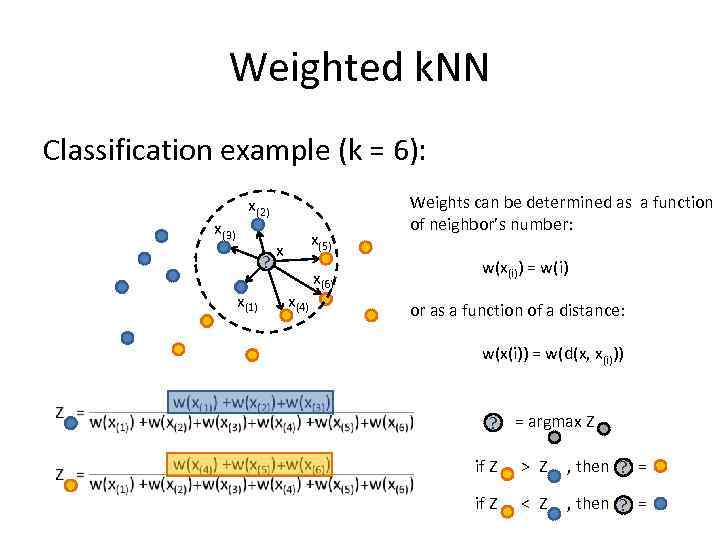 Weighted k. NN Classification example (k = 6): x(3) x(2) ? x(1) x(5) x x(4) x(6) Weights can be determined as a function of neighbor’s number: w(x(i)) = w(i) or as a function of a distance: w(x(i)) = w(d(x, x(i))) ? = argmax Z if Z > Z , then = ? if Z < Z , then = ?
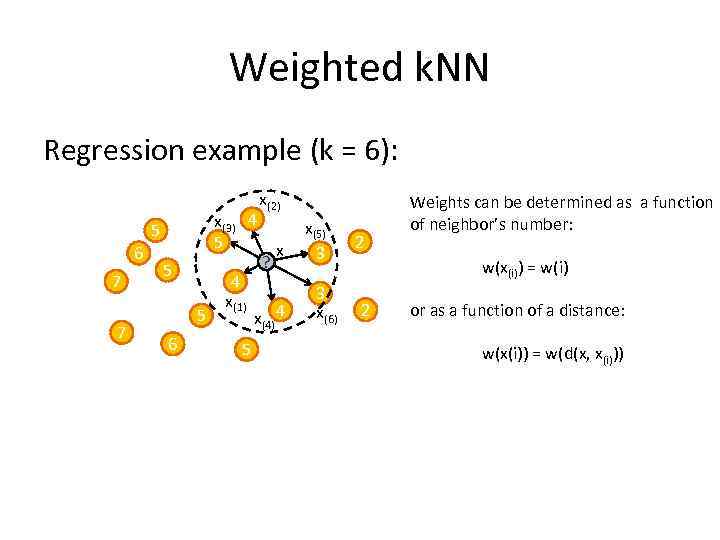 Weighted k. NN Regression example (k = 6): x(3) 4 5 5 6 7 7 5 5 6 4 x(1) 5 x(2) ? x x(4) 4 x(5) 3 3 x(6) 2 Weights can be determined as a function of neighbor’s number: w(x(i)) = w(i) 2 or as a function of a distance: w(x(i)) = w(d(x, x(i)))
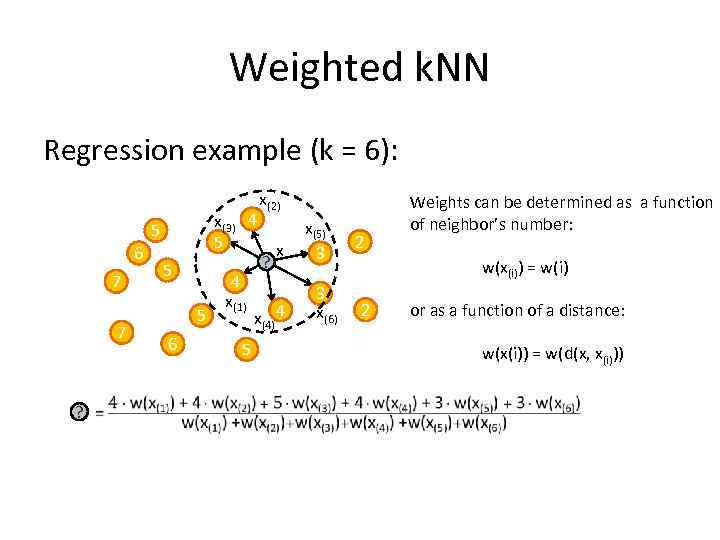 Weighted k. NN Regression example (k = 6): x(3) 4 5 5 6 7 7 ? 5 5 6 4 x(1) 5 x(2) ? x x(4) 4 x(5) 3 3 x(6) 2 Weights can be determined as a function of neighbor’s number: w(x(i)) = w(i) 2 or as a function of a distance: w(x(i)) = w(d(x, x(i)))
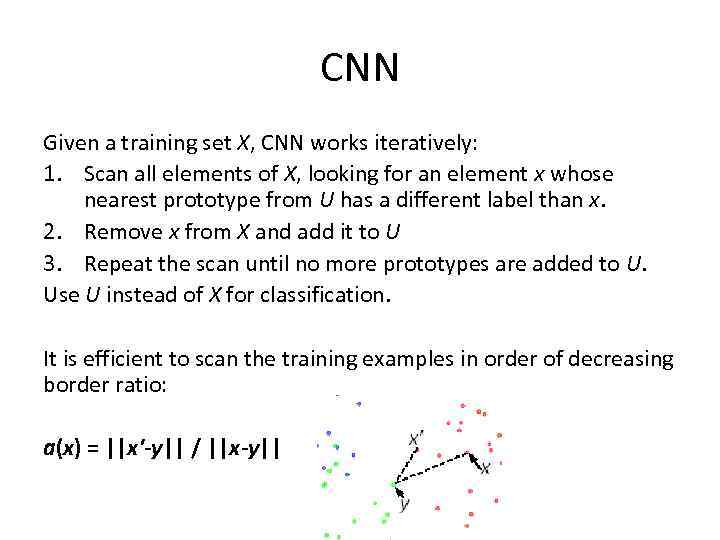 CNN Given a training set X, CNN works iteratively: 1. Scan all elements of X, looking for an element x whose nearest prototype from U has a different label than x. 2. Remove x from X and add it to U 3. Repeat the scan until no more prototypes are added to U. Use U instead of X for classification. It is efficient to scan the training examples in order of decreasing border ratio: a(x) = ||x'-y|| / ||x-y||
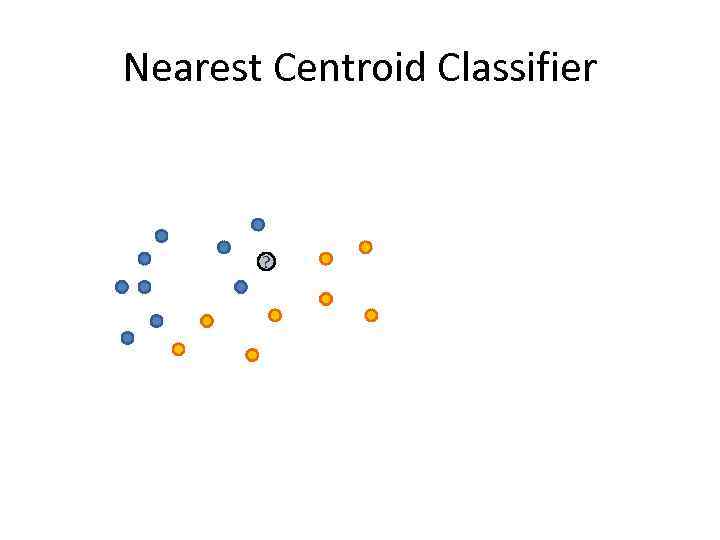 Nearest Centroid Classifier ?
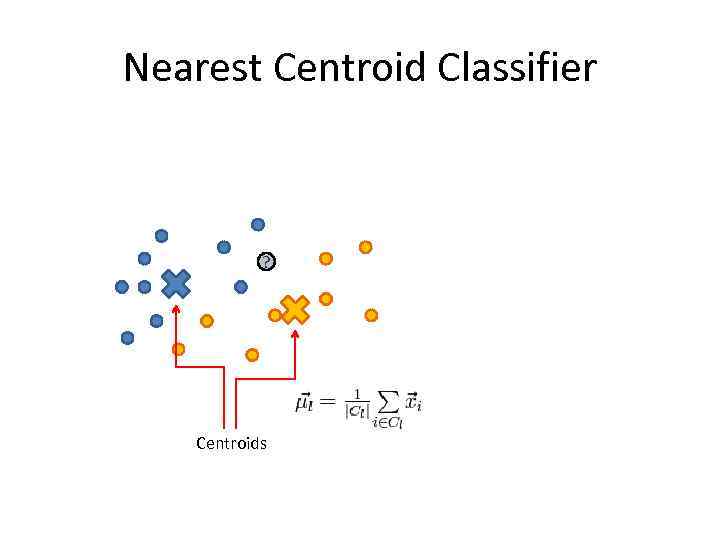 Nearest Centroid Classifier ? Centroids
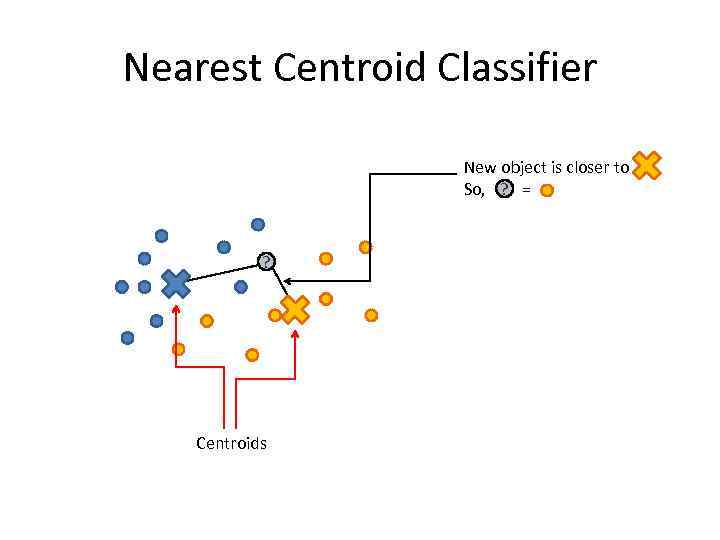 Nearest Centroid Classifier New object is closer to ? So, = ? Centroids
 Distance based methods 1. 2. 3. 4. k. NN – k Nearest Neighbors Weighted k. NN CNN – condensed nearest neighbors Nearest Centroid Classifier
 Bayesian methods 1. Data generation probabilistic model 2. Optimal Bayes classifier 3. PDF (Probabilistic Density Function) estimation 4. NDA - Normal Discriminant Analysis 5. Naïve Bayes classifier
 Plan 1. 2. 3. 4. Previous lecture reminder Supervised learning: quality measures Distance (metric) based methods Bayesian methods (introduction)
 Course tasks • First deadline – 22 November: – Theoretical task – Intro Python task – Intro R task – 4 Contests • Second deadline – 13 December: – Team Data Mining Project – 2 -3 practical tasks on real data • Without deadlines: – “toys” – simple task on standard datasets or tasks “try to use package X in language Y and write a short report”