Скачать презентацию Practical College English Course I Unit Three
85419a066006b21d2da9833cd53cedc3.ppt
- Количество слайдов: 29
 Practical College English Course (I)
 Unit Three Reading Listening and Speaking Practical Writing
 Reading Model Passage Reading The Two-storey House Practical Reading Families in the Future
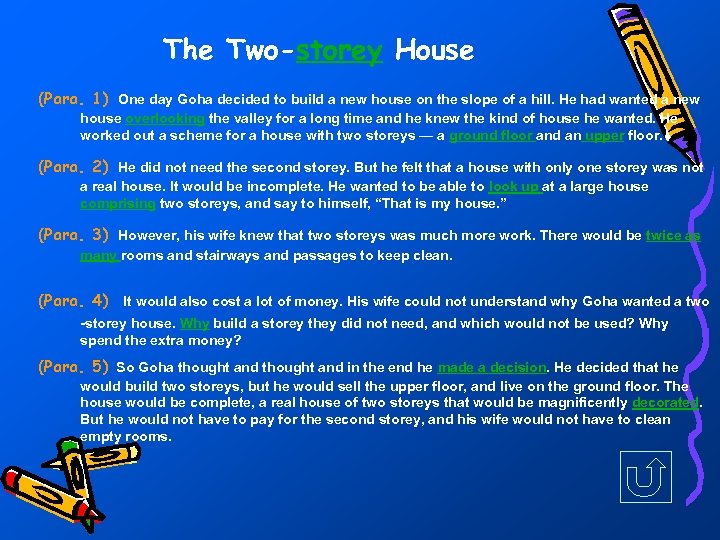 The Two-storey House (Para. 1) One day Goha decided to build a new house on the slope of a hill. He had wanted a new house overlooking the valley for a long time and he knew the kind of house he wanted. He worked out a scheme for a house with two storeys — a ground floor and an upper floor. (Para. 2) He did not need the second storey. But he felt that a house with only one storey was not a real house. It would be incomplete. He wanted to be able to look up at a large house comprising two storeys, and say to himself, “That is my house. ” (Para. 3) However, his wife knew that two storeys was much more work. There would be twice as many rooms and stairways and passages to keep clean. (Para. 4) It would also cost a lot of money. His wife could not understand why Goha wanted a two -storey house. Why build a storey they did not need, and which would not be used? Why spend the extra money? (Para. 5) So Goha thought and in the end he made a decision. He decided that he would build two storeys, but he would sell the upper floor, and live on the ground floor. The house would be complete, a real house of two storeys that would be magnificently decorated. But he would not have to pay for the second storey, and his wife would not have to clean empty rooms.
 (Para. 6) As the house was in a good district, Goha easily found a buyer. He sold the upper floor to a merchant. (Para. 7) The merchant was very glad, because he also knew the kind of house he wanted. The merchant had always wanted to live high up, above everybody else. He liked the idea of other people living under him. (Para. 8) So the merchant lived on the upper floor and Goha lived on the ground floor. They had both gotten what they wanted respectively, and they both lived happily in the house for many years. (Para. 9) But after some years Goha found that his house was no longer convenient. It was in a very remote location far away from the court. And by now, the Caliph — the emperor wanted to see Goha every day. Goha began to dream of a house that would be close to the palace. (Para. 10) He decided to build another house in the part of Baghdad near the palace. But first he wanted to sell his ground floor. And he wanted to do this quickly. (Para. 11) There is no sale without a buyer, and who would buy his ground floor? For a quick sale, Goha would have to sell the ground floor to the merchant. (Para. 12) So Goha thought about the problem. He knew that he had to persuade the merchant to buy the whole house. (Para. 13) While he was at home eating a meal with his wife, he decided what he would do. And the next day he visited the merchant.
 (Para. 14) He went upstairs and the merchant offered Goha coffee and they spoke of different things. They spoke of the weather and of the rise in food prices. (Para. 15) At last, Goha told the merchant that he had decided to live in another part of the city. (Para. 16) “Well, what are you going to do about the house here? ” asked the merchant. (Para. 17) “I don’t really know, ” said Goha. “I suppose I’ll have to sell my ground floor. ” (Para. 18) “Well, I don’t want to buy it; I am quite happy upstairs, ” replied the merchant. (Para. 19) “Then, ” said Goha, “I will have to find a land agent to sell it, won’t I? ” (Para. 20) “Yes, you will, ” said the merchant, who looked very pleased. (Para. 21) So Goha went away and waited for a week. Then he again went back and visited the merchant. The merchant offered Goha some coffee and again they talked of many things. They talked of the weather and of the price of food. Then they talked about their various illnesses. (Para. 22) “Oh, by the way, ” said Goha, “about the house…” (Para. 23) 24) 25) 26) “Yes? ” said the merchant. “I found no one to buy the ground floor, ” said Goha. “Then, ” said the merchant happily, “you will have to leave the ground floor empty. ” “Don’t you want to buy the ground floor? ” asked Goha tried not to show that he was worried about the house. (Para. 27) “Oh, no. I am quite happy here on the upper floor, ” said the merchant. “I like to live above everyone else. ”
 (Para. 28) “You are quite sure? ” asked Goha. (Para. 29) “Quite sure, ” said the merchant with a smile. He was looking more pleased than ever. (Para. 30) They began to talk of other things, and the day passed pleasantly. (Para. 31) Very early on Saturday morning, the merchant was very surprised to see Goha arrive at the house with twelve workmen. The workmen had come with large hammers and spades. (Para. 32) “Oh, ” said the merchant, “what are you going to do? ” (Para. 33) “Well, ” said Goha calmly, “you did not want to buy the ground floor of my house, so I am going to pull it down. ” (Para. 34) “Pull it down!” said the merchant. He had gone quite pale and he was no longer looking at all happy. In fact, he could not believe what Goha was saying. (Para. 35) “It’s quite simple, ” said Goha. “Let me explain. I don’t want my ground floor. I will not use it any more. As I told you, I am going to live in another part of the city and so I will pull down my ground floor. ” (Para. 36) The merchant began to shake. He did not know what to say. So he said nothing. (Para. 37) “You can keep your upper floor, ” Goha went on, “but I will dispose of the ground floor. ” (Para. 38) “No ground floor? !” said the merchant. (Para. 39) “No ground floor, ” said Goha. “When the ground floor has gone, don’t ask where it is because I am telling you now. These workmen will pull it down. ” (Para. 40)And all the workmen smiled at the merchant. From the way they smiled, the merchant could see how much they wanted to pull down the ground floor. (Para. 41) The merchant realized that he could not have an upper floor alone. The upper floor needed to stand on a ground floor. (Para. 42) So the merchant agreed. He bought the ground floor from Goha and he paid the price that Goha asked. (Para. 43) Goha, of course, was very pleased. The Caliph and all the court laughed loudly when Goha told them what had happened.
 NOtes 1. storey为英式英语拼法,在美式英语中为story。storey的复数形式为storeys。另 外,storey 和floor 是同义词,但用法有区别。在谈论楼房的结构时用storey, 谈论某人或某物在楼房里的位置时用floor。 e. g. (1) The office block was 20 stories high. 这栋办公大楼有20层楼那么高。 (2) We went up to the top floor. 我们一直爬到了顶楼。 (3) He works on the fifteenth floor. 他在 15楼上班。 2. overlooking the valley: 为现在分词短语,在句中作名词house 的后置定语,相 当于一个限定性定语从句which overlooks the valley。 overlook: vt. 俯瞰,眺望;看漏,忽略;宽容 e. g. (1) Our hotel room overlooked the harbor. 从我们住的饭店房间能眺望港口。 (2) The tower overlooks the city. 高塔俯视着城市。 (3) His film was nominated for an Oscar, but Reiner himself was overlooked as the best director. 赖纳的电影获得了奥斯卡的提名,但他自己 却与最佳导演奖失之交臂。
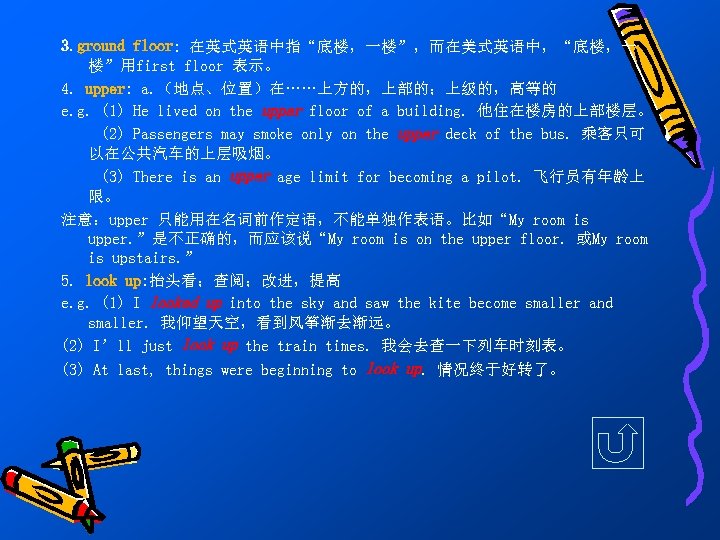 3. ground floor: 在英式英语中指“底楼,一楼”,而在美式英语中,“底楼,一 楼”用first floor 表示。 4. upper: a. (地点、位置)在……上方的,上部的;上级的,高等的 e. g. (1) He lived on the upper floor of a building. 他住在楼房的上部楼层。 (2) Passengers may smoke only on the upper deck of the bus. 乘客只可 以在公共汽车的上层吸烟。 (3) There is an upper age limit for becoming a pilot. 飞行员有年龄上 限。 注意:upper 只能用在名词前作定语,不能单独作表语。比如“My room is upper. ”是不正确的,而应该说“My room is on the upper floor. 或My room is upstairs. ” 5. look up: 抬头看;查阅;改进,提高 e. g. (1) I looked up into the sky and saw the kite become smaller and smaller. 我仰望天空,看到风筝渐去渐远。 (2) I’ll just look up the train times. 我会去查一下列车时刻表。 (3) At last, things were beginning to look up. 情况终于好转了。
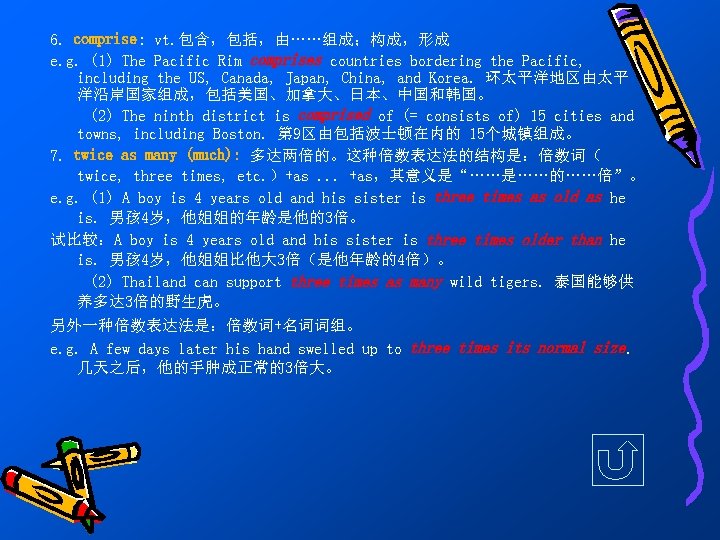 6. comprise: vt. 包含,包括,由……组成;构成,形成 e. g. (1) The Pacific Rim comprises countries bordering the Pacific, including the US, Canada, Japan, China, and Korea. 环太平洋地区由太平 洋沿岸国家组成,包括美国、加拿大、日本、中国和韩国。 (2) The ninth district is comprised of (= consists of) 15 cities and towns, including Boston. 第 9区由包括波士顿在内的 15个城镇组成。 7. twice as many (much): 多达两倍的。这种倍数表达法的结构是:倍数词( twice, three times, etc. )+as. . . +as,其意义是“……是……的……倍”。 e. g. (1) A boy is 4 years old and his sister is three times as old as he is. 男孩 4岁,他姐姐的年龄是他的3倍。 试比较:A boy is 4 years old and his sister is three times older than he is. 男孩 4岁,他姐姐比他大 3倍(是他年龄的4倍)。 (2) Thailand can support three times as many wild tigers. 泰国能够供 养多达 3倍的野生虎。 另外一种倍数表达法是:倍数词+名词词组。 e. g. A few days later his hand swelled up to three times its normal size. 几天之后,他的手肿成正常的3倍大。
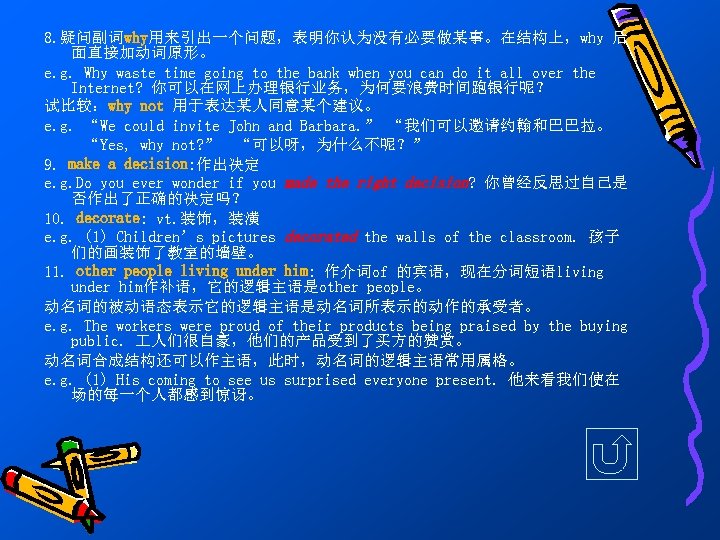 8. 疑问副词why用来引出一个问题,表明你认为没有必要做某事。在结构上,why 后 面直接加动词原形。 e. g. Why waste time going to the bank when you can do it all over the Internet? 你可以在网上办理银行业务,为何要浪费时间跑银行呢? 试比较:why not 用于表达某人同意某个建议。 e. g. “We could invite John and Barbara. ” “我们可以邀请约翰和巴巴拉。 “Yes, why not? ” “可以呀,为什么不呢?” 9. make a decision: 作出决定 e. g. Do you ever wonder if you made the right decision? 你曾经反思过自己是 否作出了正确的决定吗? 10. decorate: vt. 装饰,装潢 e. g. (1) Children’s pictures decorated the walls of the classroom. 孩子 们的画装饰了教室的墙壁。 11. other people living under him: 作介词of 的宾语,现在分词短语living under him作补语,它的逻辑主语是other people。 动名词的被动语态表示它的逻辑主语是动名词所表示的动作的承受者。 e. g. The workers were proud of their products being praised by the buying public. 人们很自豪,他们的产品受到了买方的赞赏。 动名词合成结构还可以作主语,此时,动名词的逻辑主语常用属格。 e. g. (1) His coming to see us surprised everyone present. 他来看我们使在 场的每一个人都感到惊讶。
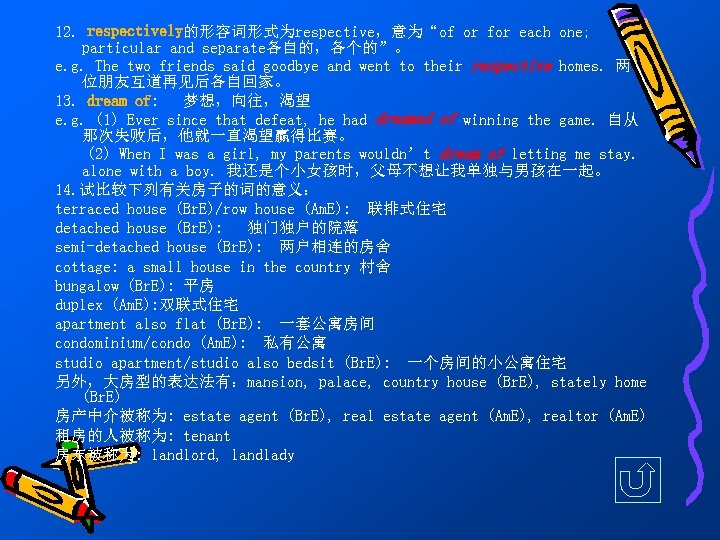 12. respectively的形容词形式为respective,意为“of or for each one; particular and separate各自的,各个的”。 e. g. The two friends said goodbye and went to their respective homes. 两 位朋友互道再见后各自回家。 13. dream of: 梦想,向往,渴望 e. g. (1) Ever since that defeat, he had dreamed of winning the game. 自从 那次失败后,他就一直渴望赢得比赛。 (2) When I was a girl, my parents wouldn’t dream of letting me stay. alone with a boy. 我还是个小女孩时,父母不想让我单独与男孩在一起。 14. 试比较下列有关房子的词的意义: terraced house (Br. E)/row house (Am. E): 联排式住宅 detached house (Br. E): 独门独户的院落 semi-detached house (Br. E): 两户相连的房舍 cottage: a small house in the country 村舍 bungalow (Br. E): 平房 duplex (Am. E): 双联式住宅 apartment also flat (Br. E): 一套公寓房间 condominium/condo (Am. E): 私有公寓 studio apartment/studio also bedsit (Br. E): 一个房间的小公寓住宅 另外,大房型的表达法有:mansion, palace, country house (Br. E), stately home (Br. E) 房产中介被称为: estate agent (Br. E), real estate agent (Am. E), realtor (Am. E) 租房的人被称为: tenant 房东被称为: landlord, landlady
![15. sale: n. [U, C]出售,卖;贱卖,廉价出售;[常pl. ] 销售额 Are these dresses on sale (=reduced in](https://present5.com/presentation/85419a066006b21d2da9833cd53cedc3/image-13.jpg "15. sale: n. [U, C]出售,卖;贱卖,廉价出售;[常pl. ] 销售额 Are these dresses on sale (=reduced in") 15. sale: n. [U, C]出售,卖;贱卖,廉价出售;[常pl. ] 销售额 Are these dresses on sale (=reduced in price)? 这些衣服现在打折吗? sale 的常见短语有:for sale 出售;on sale 上市;减价销售 16. persuade: vt. 说服,劝服;使相信 e. g. (1) The government is trying to persuade consumers to save more. 政 府正设法说服消费者多存钱。 (2) She tried to persuade them that they should leave. 她极力说服他 们离开。 下面是persuade的一些惯用法: persuade somebody into doing something: 劝某人做某事 e. g. Don’t let yourself be persuaded into buying things you don’t want. 不要禁不住诱导而去买自己不想要的东西。 persuade somebody of something: 使某人相信某事 e. g. Lucy must persuade the jury of her innocence. 露西必须使陪审团相信她 是无辜的。 17. won’t I为附加问句,但此处用法颇为微妙。该问句既不是要求对方提供信息, 也不是期待对方同意观点,因为课文中的商人并非房地产商,高哈知道他无法提 供售房信息,同时卖房是高哈自己的事,不关商人的事,无需征求商人的意见。 所以,高哈用won’t I的言外之意是希望商人买下底楼。
15. sale: n. [U, C]出售,卖;贱卖,廉价出售;[常pl. ] 销售额 Are these dresses on sale (=reduced in price)? 这些衣服现在打折吗? sale 的常见短语有:for sale 出售;on sale 上市;减价销售 16. persuade: vt. 说服,劝服;使相信 e. g. (1) The government is trying to persuade consumers to save more. 政 府正设法说服消费者多存钱。 (2) She tried to persuade them that they should leave. 她极力说服他 们离开。 下面是persuade的一些惯用法: persuade somebody into doing something: 劝某人做某事 e. g. Don’t let yourself be persuaded into buying things you don’t want. 不要禁不住诱导而去买自己不想要的东西。 persuade somebody of something: 使某人相信某事 e. g. Lucy must persuade the jury of her innocence. 露西必须使陪审团相信她 是无辜的。 17. won’t I为附加问句,但此处用法颇为微妙。该问句既不是要求对方提供信息, 也不是期待对方同意观点,因为课文中的商人并非房地产商,高哈知道他无法提 供售房信息,同时卖房是高哈自己的事,不关商人的事,无需征求商人的意见。 所以,高哈用won’t I的言外之意是希望商人买下底楼。
 18. 试比较pleased 的同义词: cheerful: behaving in a way that shows you are happy pleased/glad: happy because something good has happened delighted/thrilled/overjoyed/ecstatic: very happy because something good has happened contented: happy with your life optimistic/positive: believing that good things will happen in the future gleeful/gloating/smug: happy because something bad has happened to someone else 19. illness: n. [C, U] 病,疾病 e. g. (1) Her mother was just recovering from an illness. 他母亲生病了,正 在康复中。 (2) He died in hospital yesterday after a short illness. 一场急病后, 他昨天在医院病逝了。 (3) There seems to be a lot of illness in that family. 那户人家似乎 病痛很多。 注意,例(1)和例(2)中的illness用作可数名词,例(3)中的illness用作不可数名词。 试比较illness 和disease的用法: illness和disease在口语中经常互用。但是,illness常用来指身体长时间有恙。 e. g. He died after a long illness. 一场大病后,他死了。 illness不能用来谈论程度较轻的病,如头疼和感冒等。disease常用来指某一具体 的病,尤其指具有传播性质的病,也可以指影响身体某一部位功能的病。 e. g. infectious diseases传染病;heart disease 心脏病
 20. calmly的形容词形式为calm,意为“ 镇静的,镇定的;平静的,无风的”。 e. g. (1) The pilot said we’d have to make an emergency landing, and the flight attendants tried to keep us calm. 飞行员说我们必须要紧急着陆, 航空服务员尽力使我们镇定下来。 (2) The financial markets are calm at the moment. 目前金融市场风平浪 静。 calm还可作动词,意为“ 使平静,使镇定”。 e. g. (1) He tried his best to calm her (down). 他极力让她平静下来。 (2) I needed some time to calm down. 我需要一些时间让自己平静下来。 21. pull down: to destroy (esp. a building) 摧毁,拆毁 e. g. Many of those old buildings will soon be pulled down. 这些旧房子不久 将被拆除。 22. go/turn pale: 变得苍白 e. g. He suddenly went pale. 他的脸突然变得苍白起来。 23. dispose: vt. to get rid of (something); throw out or destroy (of) 去 掉,丢掉,消除,销毁;排列,布置;安排(事情),处理(事务) e. g. (1) They are accused of illegally disposing of dangerous materials. 他们因非法销毁危险品而被指控。 (2) I must dispose of the trouble. 我必须摆脱这个麻烦。 注意:dispose of为固定词组,意思为“去掉,丢掉,消除,销毁”。
 Families in the Future Language Points 1. In the 1970 s, the size of the average family in the United States was 3. 1 persons. Nowadays, with many single parent families, the average family size is about 2. 8 persons. 20世纪 70年代,美国家庭的平均人口 为 3. 1人。而今,随着许多单亲家庭的出现,每个家庭平均人口约为 2. 8人。 average: a. adding two or more amounts together and dividing the total by the number of amounts, or by another total 平均的;平常的,通常的 The average cost of making a movie has risen by 15%. 电影制作平均成本已经 上涨了15%。 average 作形容词时,没有比较级和最高级用法,不可以说more average或the most average。 average 作动词时,意为“to usually do something or usually happen a particular number of times, or to usually be a particular size or amount 平均”。 e. g. The water in the lake is not particularly deep, averaging about 12 metres. 这个湖不是很深,平均水深约 12米。 average 还可作名词,意为“a standard or level that is considered to be typical or usual; the result obtained by adding two or more amounts together and dividing the total by the number of amounts, or by another total 平均数,平均”。 e. g. On average (=usually), a person’s income is highest when they are in their mid-50 s. 通常,一个人的收入在 55岁时最高。
 2. For example, within a span of ten years, the number of people over 65 years of age in the United States has increased 28 percent. The median age of people in the United States now exceeds 30. 比如,10年内,美国 65岁以上的人口已经增长了28%。目前,美国人的中位数年龄超 过了30岁。 increase: vi. /vt. to become or make (something) larger or greater 增长, 增加,增强 e. g. (1) They have increased the price of petrol again. 他们又提高了汽油 的价格。 (2) The workers are trying their best to increase productivity. 人们正竭尽全力提高生产率。 increase 作名词时,意为“a rise in amount, number, or degree增长,增加, 增强”。 e. g. There was a steady increase in population. 人口在稳步增长。 exceed: vt. to be greater than (a number or amount), or to go beyond (a permitted limit) 超过,胜过 e. g. (1) His knowledge of history exceeds mine. 他的历史知识超过了我。 (2) If your liabilities exceed your assets, you may go bankrupt. 如果你所负的债务超过你的资产,你就会破产。 3. As a result of smaller families and more old people, life in the United States will change in many ways. 家庭变小以及人口老龄化使得美国人的生 活在许多方面都发生了变化。 as a result of: because of something else 由于……的结果 e. g. (1) As a result of the pilots’ strike, all flights have had to be cancelled. 由于飞行员罢 ,所有航班都被取消了。
 Listening and Speaking Part I Listening Part II Speaking
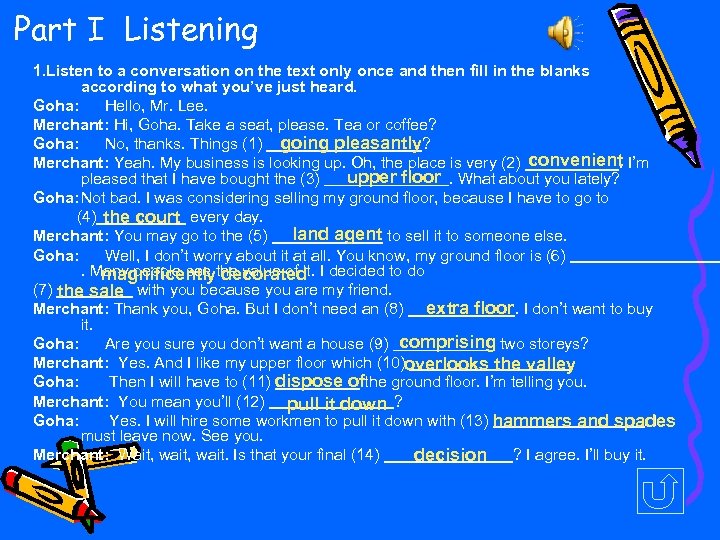 Part I Listening 1. Listen to a conversation on the text only once and then fill in the blanks according to what you’ve just heard. Goha: Hello, Mr. Lee. Merchant: Hi, Goha. Take a seat, please. Tea or coffee? Goha: No, thanks. Things (1) going pleasantly? Merchant: Yeah. My business is looking up. Oh, the place is very (2) convenient I’m. upper floor. What about you lately? pleased that I have bought the (3) Goha: Not bad. I was considering selling my ground floor, because I have to go to (4) the court every day. ____ land agent to sell it to someone else. Merchant: You may go to the (5) Goha: Well, I don’t worry about it at all. You know, my ground floor is (6). Many people see the value of it. I decided to do magnificently decorated (7) the sale with you because you are my friend. Merchant: Thank you, Goha. But I don’t need an (8) extra floor. I don’t want to buy it. Goha: Are you sure you don’t want a house (9) comprising two storeys? Merchant: Yes. And I like my upper floor which (10)overlooks the valley. Goha: Then I will have to (11) dispose ofthe ground floor. I’m telling you. Merchant: You mean you’ll (12) pull it down ? Goha: Yes. I will hire some workmen to pull it down with (13) hammers and spades. I must leave now. See you. Merchant: Wait, wait. Is that your final (14) decision ? I agree. I’ll buy it.
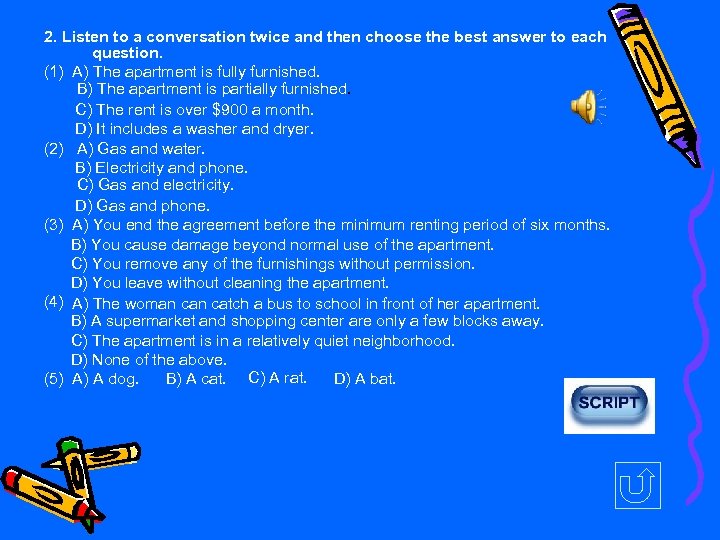 2. Listen to a conversation twice and then choose the best answer to each question. (1) A) The apartment is fully furnished. B) The apartment is partially furnished. C) The rent is over $900 a month. D) It includes a washer and dryer. (2) A) Gas and water. B) Electricity and phone. C) Gas and electricity. D) Gas and phone. (3) A) You end the agreement before the minimum renting period of six months. B) You cause damage beyond normal use of the apartment. C) You remove any of the furnishings without permission. D) You leave without cleaning the apartment. (4) A) The woman catch a bus to school in front of her apartment. B) A supermarket and shopping center are only a few blocks away. C) The apartment is in a relatively quiet neighborhood. D) None of the above. (5) A) A dog. B) A cat. C) A rat. D) A bat.
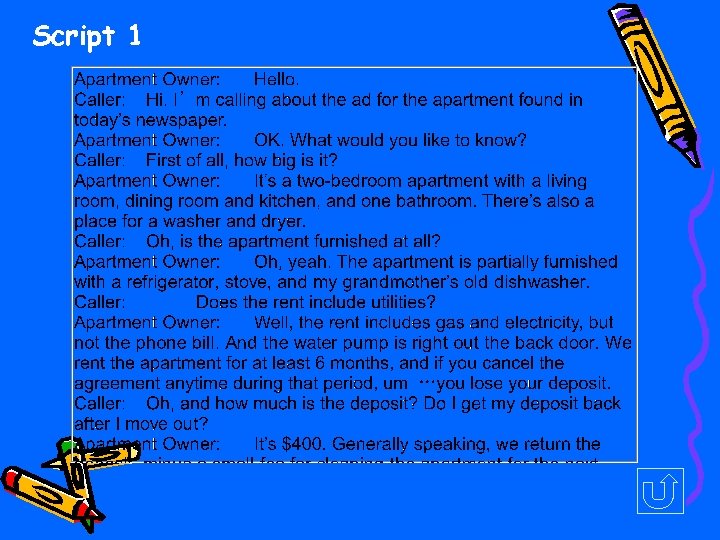 Script 1
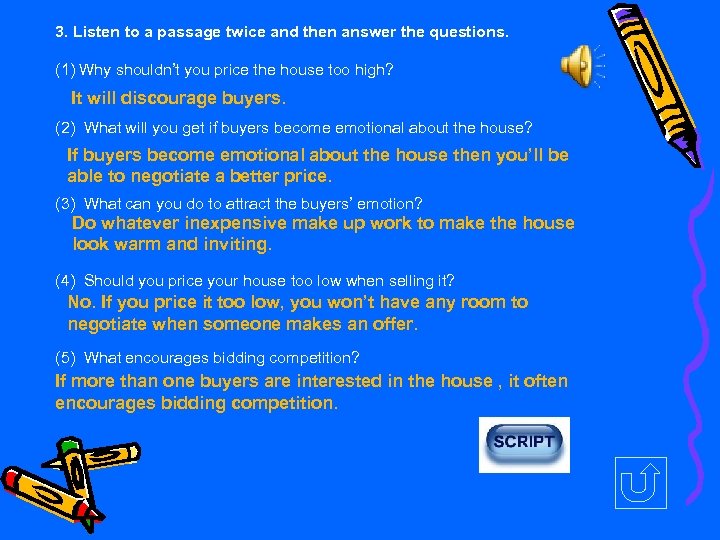 3. Listen to a passage twice and then answer the questions. (1) Why shouldn’t you price the house too high? It will discourage buyers. (2) What will you get if buyers become emotional about the house? If buyers become emotional about the house then you’ll be able to negotiate a better price. (3) What can you do to attract the buyers’ emotion? Do whatever inexpensive make up work to make the house look warm and inviting. (4) Should you price your house too low when selling it? No. If you price it too low, you won’t have any room to negotiate when someone makes an offer. (5) What encourages bidding competition? If more than one buyers are interested in the house , it often encourages bidding competition.
 Script 2
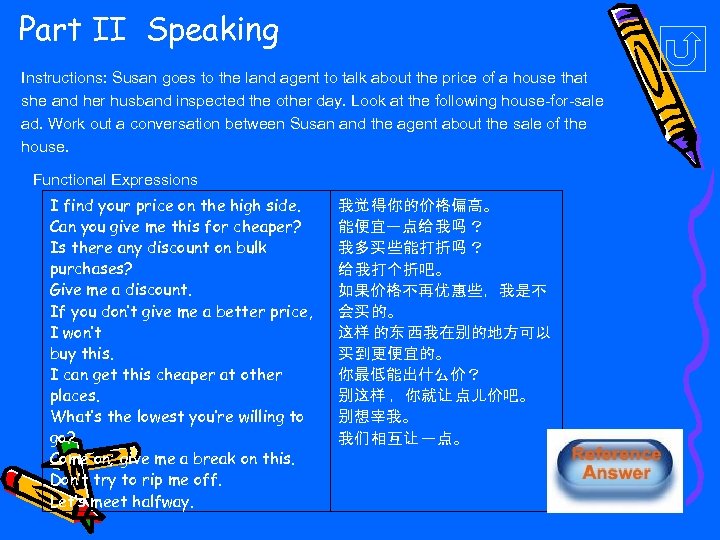 Part II Speaking Instructions: Susan goes to the land agent to talk about the price of a house that she and her husband inspected the other day. Look at the following house-for-sale ad. Work out a conversation between Susan and the agent about the sale of the house. Functional Expressions I find your price on the high side. Can you give me this for cheaper? Is there any discount on bulk purchases? Give me a discount. If you don’t give me a better price, I won’t buy this. I can get this cheaper at other places. What’s the lowest you’re willing to go? Come on; give me a break on this. Don’t try to rip me off. Let’s meet halfway. 我觉 得你的价格偏高。 能便宜一点给 我吗 ? 我多买 些能打折吗 ? 给 我打个折吧。 如果价格不再优 惠些,我是不 会买 的。 这样 的东 西我在别的地方可以 买 到更便宜的。 你最低能出什么价? 别这样 ,你就让 点儿价吧。 别想宰我。 我们 相互让 一点。
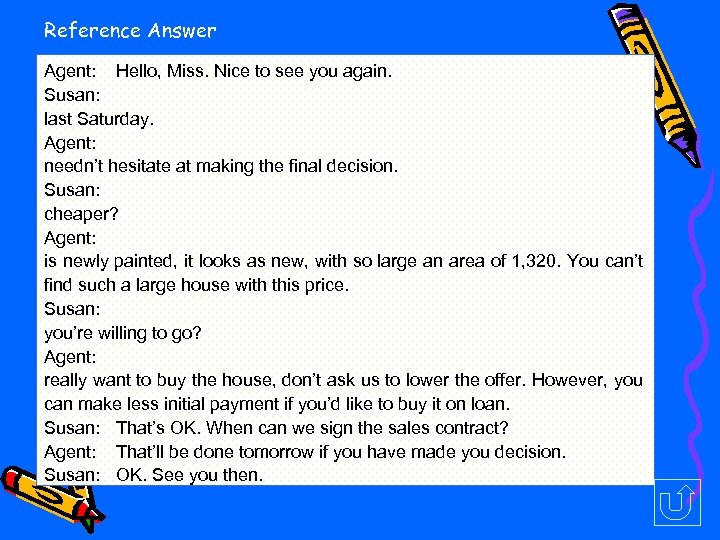 Reference Answer Agent: Hello, Miss. Nice to see you again. Susan: last Saturday. Agent: needn’t hesitate at making the final decision. Susan: cheaper? Agent: is newly painted, it looks as new, with so large an area of 1, 320. You can’t find such a large house with this price. Susan: you’re willing to go? Agent: really want to buy the house, don’t ask us to lower the offer. However, you can make less initial payment if you’d like to buy it on loan. Susan: That’s OK. When can we sign the sales contract? Agent: That’ll be done tomorrow if you have made you decision. Susan: OK. See you then.
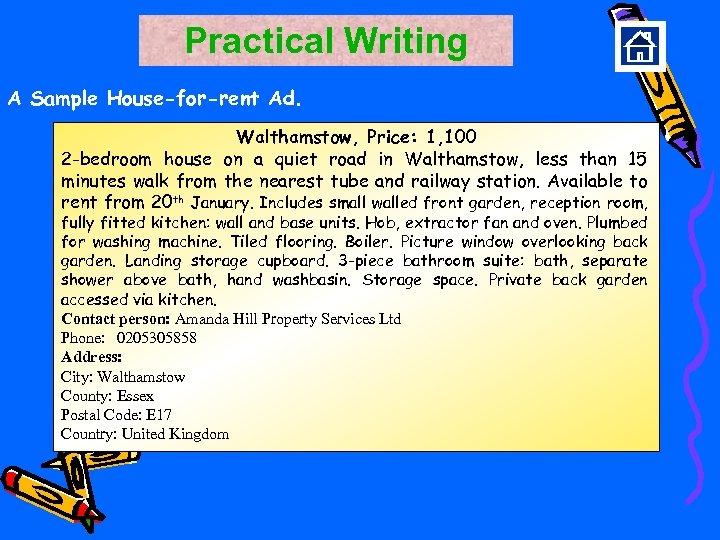 Practical Writing A Sample House-for-rent Ad. Walthamstow, Price: 1, 100 2 -bedroom house on a quiet road in Walthamstow, less than 15 minutes walk from the nearest tube and railway station. Available to rent from 20 th January. Includes small walled front garden, reception room, fully fitted kitchen: wall and base units. Hob, extractor fan and oven. Plumbed for washing machine. Tiled flooring. Boiler. Picture window overlooking back garden. Landing storage cupboard. 3 -piece bathroom suite: bath, separate shower above bath, hand washbasin. Storage space. Private back garden accessed via kitchen. Contact person: Amanda Hill Property Services Ltd Phone: 0205305858 Address: City: Walthamstow County: Essex Postal Code: E 17 Country: United Kingdom
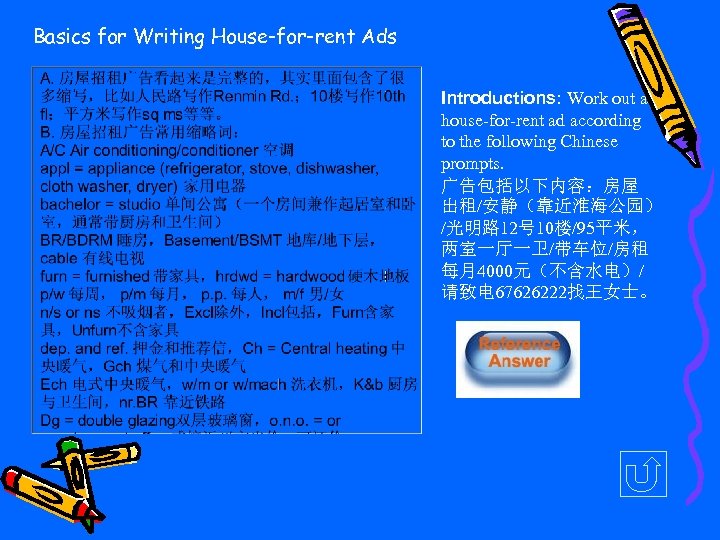 Basics for Writing House-for-rent Ads Introductions: Work out a house-for-rent ad according to the following Chinese prompts. 广告包括以下内容:房屋 出租/安静(靠近淮海公园) /光明路 12号 10楼/95平米, 两室一厅一卫/带车位/房租 每月4000元(不含水电)/ 请致电 67626222找王女士。
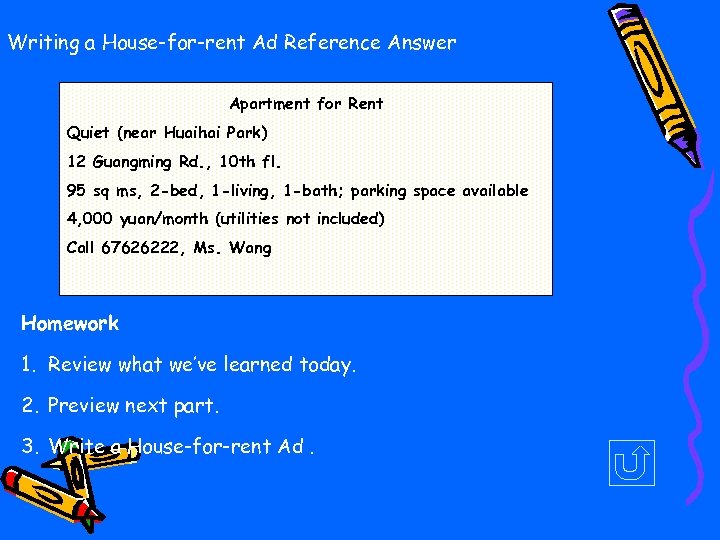 Writing a House-for-rent Ad Reference Answer Apartment for Rent Quiet (near Huaihai Park) 12 Guangming Rd. , 10 th fl. 95 sq ms, 2 -bed, 1 -living, 1 -bath; parking space available 4, 000 yuan/month (utilities not included) Call 67626222, Ms. Wang Homework 1. Review what we’ve learned today. 2. Preview next part. 3. Write a House-for-rent Ad.