 Скачать презентацию Practical Applications of Control Strategies 控制措施应用实例 1
c5df767749e31b761061692dbfaa9b1a.ppt
- Количество слайдов: 96



Practical Applications of Control Strategies 控制措施应用实例 1. © 2008 University of Wollongong and BP International Limited W 505 – Control of Hazardous Substances
Topics to be Discussed 讨论内容 • Addition of hydrated lime to cyanide tanks 向氰化物提取罐添加熟石灰 • Respirable silica during sand blasting 喷砂处理产生的呼吸性矽尘 • Ventilation in a laboratory sample room 实验室样品间的排风系统 • Mercury exposure in a gold room 炼金室的水银污染 • Manufacture of phthalic anhydride 生产邻苯二甲酸酐 • Control of powders in the pharmaceutical industry 制药业对粉末的控制 • Diesel particulate in underground coal mines 地下煤矿的柴油微粒 2. © 2008 University of Wollongong and BP International Limited W 505 – Control of Hazardous Substances
Addition of Hydrated Lime to Cyanide Tanks 向氰化物提取罐添加熟石灰 At a carbon‑pulp gold processing plant in Equatorial Africa, the need arose to make routine additions of hydrated lime (Ca(OH)2) to the cyanide extraction tanks in order to control p. H 一家位于赤道非洲使用含碳矿浆法的炼金厂,需要向氰化物提取罐中 例行添加熟石灰( Ca(OH)2 )以控制罐内p. H值 • To do this the mill decided to use bulk hydrated lime delivered to the site in 1000 kg bulk bags so as to minimise transportation costs 为此,该厂决定使用散装的熟石灰,为了最大限度地降低成本,这 些熟石灰装在 1000公斤一个的集装袋中运往 地 3. © 2008 University of Wollongong and BP International Limited W 505 – Control of Hazardous Substances
Addition of Hydrated Lime 添加熟石灰 • The p. H in the tanks was monitored and when required a 1000 kg bag was lifted by crane above a chute which had an internal spear to pierce the bag and release the hydrated lime to the cyanide mixing tanks below 提取罐内的p. H值是受到监控的,必要时起重机会将1000公斤的单个 熟石灰袋吊至溜槽上,用该溜槽上自带的锥刺破外袋,并向下方的 氰化物混合罐中倾倒熟石灰 • This process generated significant levels of dust 这一过程会产生大量的粉尘 4. © 2008 University of Wollongong and BP International Limited W 505 – Control of Hazardous Substances
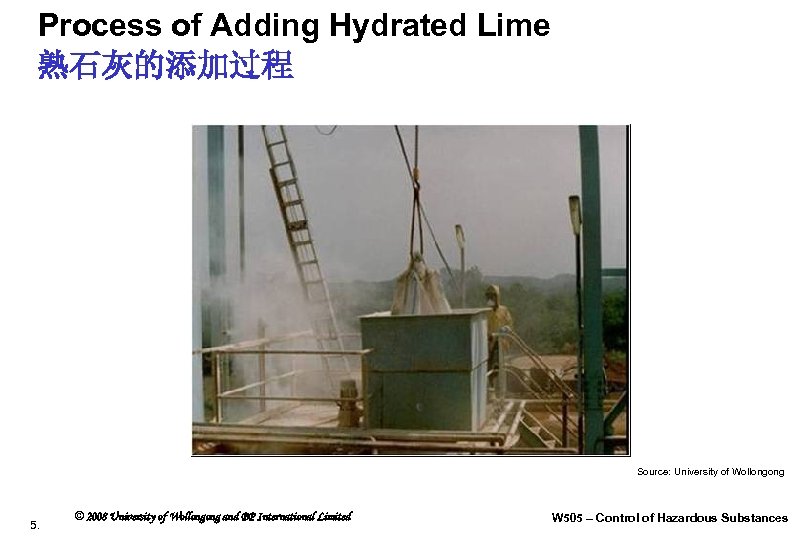
Process of Adding Hydrated Lime 熟石灰的添加过程 Source: University of Wollongong 5. © 2008 University of Wollongong and BP International Limited W 505 – Control of Hazardous Substances
Properties of Hydrated Lime 熟石灰的属性 • Reference to the product MSDS indicated that the material was corrosive by inhalation, ingestion, skin and eyes 据材料安全数据表(MSCS)显示,熟石灰对呼吸道、消化道、皮肤 和眼部都有腐蚀作用 • Inhalation would result in severe mucous membrane irritation of the nose and throat and prolonged and repeated contact with the skin would result in a severe skin rash, dermatitis and possible chemical ulceration 人体吸入熟石灰会导致严重的鼻、喉部的粘膜产生强烈的刺痛感, 而皮肤长期不断地同熟石灰接触会引发严重皮疹、各种皮肤病,甚 至有可能化学性溃烂。 6. © 2008 University of Wollongong and BP International Limited W 505 – Control of Hazardous Substances
Initial Issues 首要问题 • When the process initially commenced, operators experienced respiratory irritation and due to the hot humid equatorial climate, severe skin irritation and in one case, ulceration 这一过程一开始,操作员就得承受呼吸道不适再加上炙热 的赤道气候对皮肤的刺激,甚至还出现过一例皮肤溃烂。 7. © 2008 University of Wollongong and BP International Limited W 505 – Control of Hazardous Substances
Initial Control Measures 初级控制措施 • The response of the mill manager (an expatriate from North America) was to supply respiratory protection and impervious raincoats so that the product didn’t contact the skin 当时,炼金厂经理(一位北非侨民)采取的措施是给操作员提供呼 吸保护设备和防止物料与皮肤接触的厚雨衣。 • This was a practice that had previously been used during an emergency at a mill in a cold North American location 这种方法是过去在气候寒冷的北美洲地区的 厂采用的应急措施 8. © 2008 University of Wollongong and BP International Limited W 505 – Control of Hazardous Substances
Secondary Issues 衍生问题 • Initial issues of respiratory & skin irritation were significantly reduced; however 有关呼吸系统和皮肤不适的首要问题在很大程度上得到了解决;然 而 • Almost immediately that the initial control procedures were introduced the number of heat stress cases presenting to the onsite clinic increased 几乎就在初步的防护措施得到应用的同时, 地诊所里中暑病例的 数量也上升了 9. © 2008 University of Wollongong and BP International Limited W 505 – Control of Hazardous Substances
Results of Investigation 调查结果 • Upon investigation it was realised that the combination of impervious raincoats and a hot equatorial climate had resulted in the operators’ core body temperature increasing to the point of heat stress onset 调查表明,在严实的雨衣和炙热的赤道气候双重作用下,操作员体 温升高,以致中暑 • This had not occurred in the North American location when the same approach was previously used, due to the cold climate 北美以前用这种方法的时候从来没有出现过上述问题,因为那里的 气候寒冷。 10. © 2008 University of Wollongong and BP International Limited W 505 – Control of Hazardous Substances
Final Solution 最终方案 • Management response was to temporarily cease the addition of the hydrated lime in bulk bags until a series of fine water sprays could be installed inside the delivery chute 管理层的反应是临时叫停大袋熟石灰的添加 序,直到给传送溜槽 内部安装一套理想的喷水装置 • Once the spray system was activated the fine dust arising from the opening of the bags was contained, eliminating the need for any personal protective equipment 一旦启动了喷水装置,袋子破口处扬起的细石灰粉尘就受到了抑制, 也就用不着任何的个人防护用具了 11. © 2008 University of Wollongong and BP International Limited W 505 – Control of Hazardous Substances
Key Learnings 重要经验 • Need to consider all aspects of the process when evaluating a control solution 在评估控制方案时需要综合全面地考虑整个生产过程 • What works in one location may not be transferable to another 照搬其它地方的现成做法可能会适得其反 • Incorrect use of PPE can lead to a dangerous situation 个人防护用具使用不当也会导致危险 12. © 2008 University of Wollongong and BP International Limited W 505 – Control of Hazardous Substances
Respirable Silica Exposure During Sand Blasting 喷砂产生的呼吸性矽尘污染 • Sand blasting (or more correctly, grit blasting) is a common practice in industry to prepare steelwork for painting, welding or further processing 喷沙(或者说喷砂更准确)是 业生产中为钢件的涂漆、焊接或进 一步加 做准备的一种常规技术 • The term “sand blasting” is derived from the period when river or beach sand was forced at high pressure through a nozzle so as to clean surfaces “喷砂”这个术语源于用高压喷嘴向 件喷射河砂,或海滩砂粒,以 清理 件表面的这一 艺过程。 13. © 2008 University of Wollongong and BP International Limited W 505 – Control of Hazardous Substances
Sand Blasting 喷砂 • The high velocities involved in sand blasting results in the sand particles fracturing, thus reducing the particle size to the point that it could be respired by the operator. 喷砂的超高速度使得砂粒粉碎,从而把砂粒切割到操作员可以吸入 体内的粒度 • Many operators of such systems who were not adequately protected suffered silicosis and in some cases, death 许多此类 作的操作员因为没有采取足够的防护措施,因而患上了 矽肺病,更有致死的病例 14. © 2008 University of Wollongong and BP International Limited W 505 – Control of Hazardous Substances
Modern Practice 当代采取的措施 • To overcome the issue of silicosis, statutory authorities in many countries banned the use of sand, and low silica products such as garnet, ilmenite and copper slag were substituted 为克服矽肺病难题,许多国家的司法机关禁止了采用砂砾进行喷 砂,转而使用低硅材料,比如石榴石、钛铁矿和铜矿渣。 15. © 2008 University of Wollongong and BP International Limited W 505 – Control of Hazardous Substances
Workplace Situation 作现场环境 An occupational hygienist was visiting a construction site and observed significant dust clouds arising from a grit blasting operation 曾经有一位职业卫生专家,在检查某建筑 地时,发现了由喷砂导 致的巨大扬尘 • Upon closer investigation it was found that the material being used in the process was a fine dust containing 35% w/w crystalline silica as it was a cheap source of blasting material 经过细致的调查,该喷砂 序采用的材料是一种极细的砂砾,其中 含有35%w/w的石英,就因为它价格低廉 16. © 2008 University of Wollongong and BP International Limited W 505 – Control of Hazardous Substances
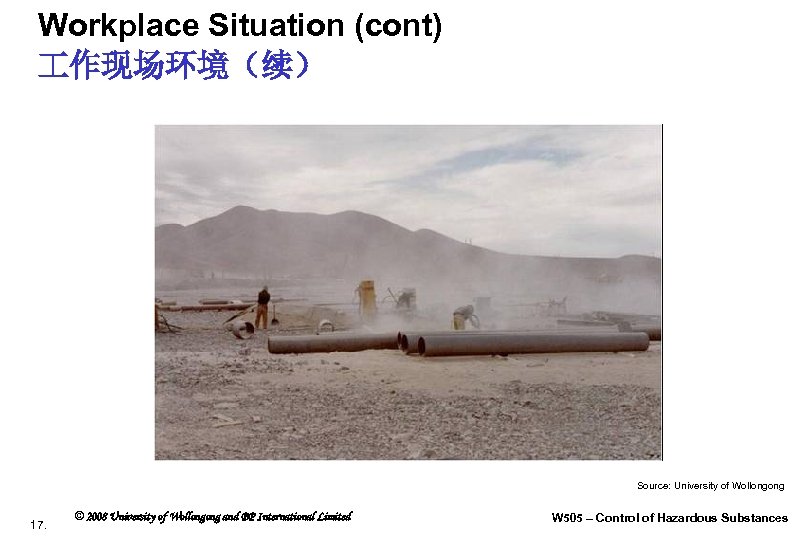
Workplace Situation (cont) 作现场环境(续) Source: University of Wollongong 17. © 2008 University of Wollongong and BP International Limited W 505 – Control of Hazardous Substances
Workplace Situation (cont) 作现场环境(续) • The airline respirator being used by the operator was found to be in poor condition and the air compressor being used for the blasting process was also the air supply for the air supplied respirator 调查发现现场操作员使用的是极差的民航呼吸器,并且喷砂使用的 空气压缩机同时也是呼吸器的气源 • No air quality monitoring results from the supplied air could be found 没有查到任何呼吸器气源质量的监控记录 18. © 2008 University of Wollongong and BP International Limited W 505 – Control of Hazardous Substances
Workplace Situation (cont) 作现场环境(续) • Discussions with the operator’s assistant indicated that it was not uncommon for the dust cloud from the blasting operation to drift over the position where he was shovelling the silica material into a supply hopper 专家在与操作员助手讨论后得知,在他将硅料铲入时,喷砂产生的 扬尘飘出加料斗是司空见惯的事情 • No respiratory protection had been supplied to this person 该 地没有向这位助手提供呼吸器 19. © 2008 University of Wollongong and BP International Limited W 505 – Control of Hazardous Substances
Occupational Hygienist’s Response 职业卫生专家的建议 • Process stopped immediately 立即停止作业 • Substitution of sand with more appropriate product 喷砂应使用更理想的材料 • Independent air supply for airline respirator with regular air quality monitoring 呼吸器须采用独立气源,并定期监控气源质量 • Introduction of a wind barrier to minimise wind drift 引入挡风设施,把风吹引起的扬尘控制在最小程度 • Introduction of an educational program for all employees 建立针对所有员 的安全卫生教育计划 20. © 2008 University of Wollongong and BP International Limited W 505 – Control of Hazardous Substances
Key Learning‘s 重要经验 • The need to understand the nature of products being used in a process and the effect the process may have in increasing the risk of a health hazard 必须了解生产使用的每一种物料的属性以及每一种生产 艺对人体健康的威胁程 度 • Consideration needs to be given to all potentially exposed workers not just those in the near area 应该全面照顾到所有可能进入污染区域的 人,而不是只考虑几个直接参与者 • Maintenance of PPE is a priority if the expected level of protection is to be achieved. 要达到预期的防护效果,就必须把个人防护用具的维护放在第一位 21. © 2008 University of Wollongong and BP International Limited W 505 – Control of Hazardous Substances
Ventilation in a Laboratory Sample Room 实验室样品间的排风系统 • Following complaints from laboratory technicians working in a sample preparation room regarding high levels of noise and dust, an inspection was undertaken by an occupational hygienist 在收到一些在实验室样品间 作的技术人员的关于高度噪音和灰尘的投诉后,某 职业卫生专家开展了一次检查 • Upon attendance, the occupational hygienist found the ventilation system to be somewhat of a “jigsaw puzzle” in that there were numerous branches off a main duct leading to grinding mills and furnaces all connected to the one fan 专家在现场发现样品间的排风系统就像一副“拼图玩具”,一个通向研磨机和火炉 的主管道又分出数个分管道,而所有的管道都同时使用同一个风扇 22. © 2008 University of Wollongong and BP International Limited W 505 – Control of Hazardous Substances
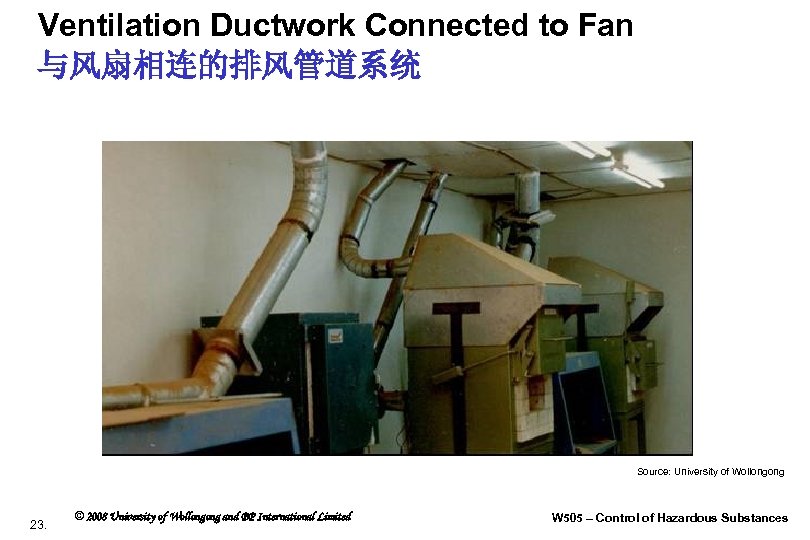
Ventilation Ductwork Connected to Fan 与风扇相连的排风管道系统 Source: University of Wollongong 23. © 2008 University of Wollongong and BP International Limited W 505 – Control of Hazardous Substances
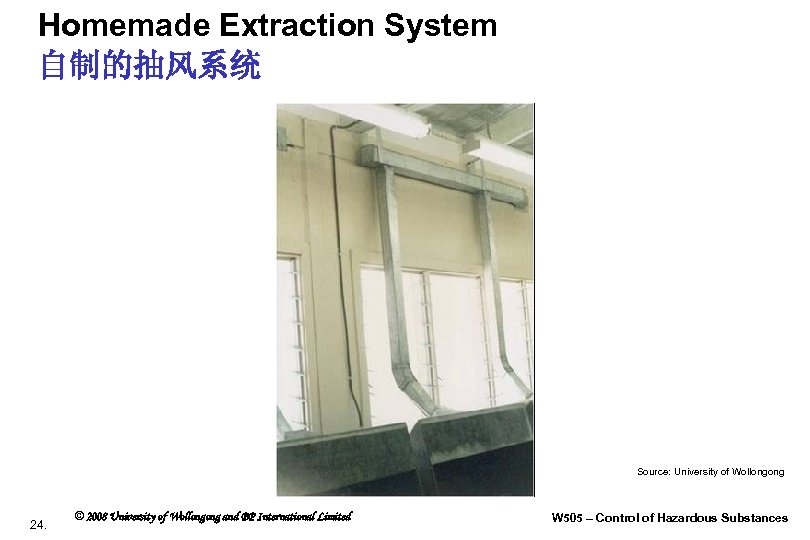
Homemade Extraction System 自制的抽风系统 Source: University of Wollongong 24. © 2008 University of Wollongong and BP International Limited W 505 – Control of Hazardous Substances
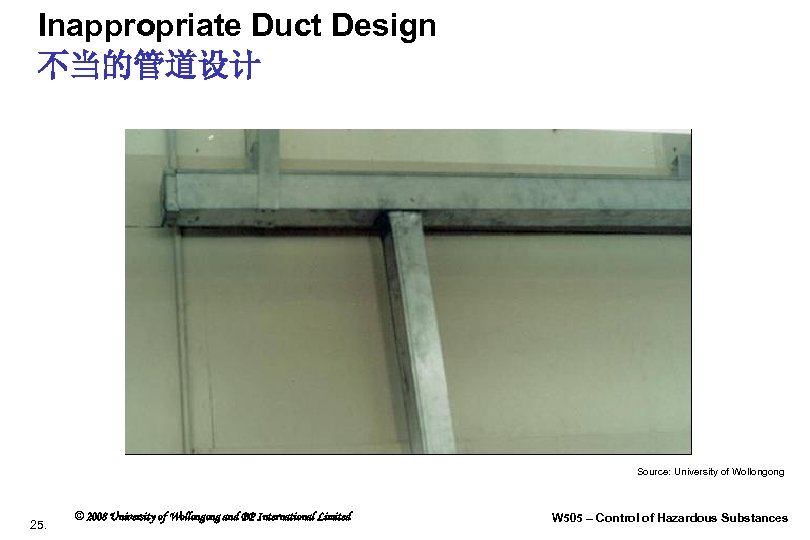
Inappropriate Duct Design 不当的管道设计 Source: University of Wollongong 25. © 2008 University of Wollongong and BP International Limited W 505 – Control of Hazardous Substances
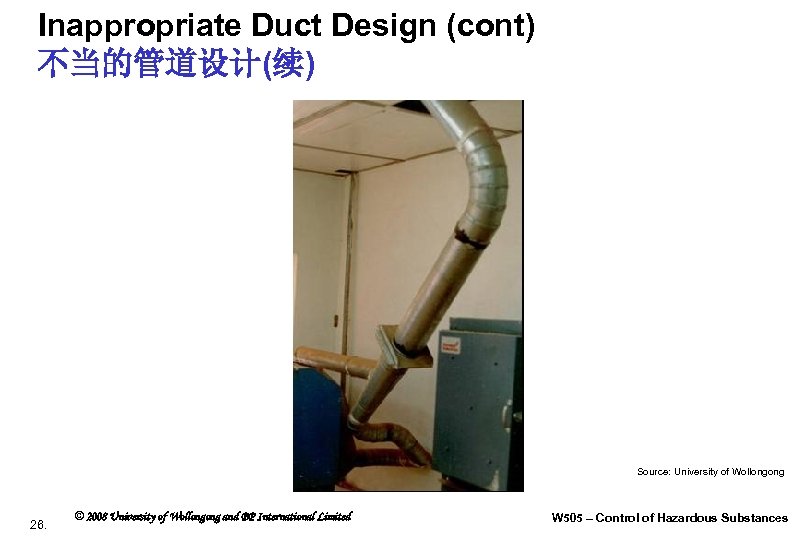
Inappropriate Duct Design (cont) 不当的管道设计(续) Source: University of Wollongong 26. © 2008 University of Wollongong and BP International Limited W 505 – Control of Hazardous Substances
Inspection of Ventilation System 排风系统检查结果 • Homemade ventilation system with numerous braches and poor duct design 自制的通风系统附带了数个分通风管,并且设计粗糙 • Only one fan installed for total system and in poor condition 整个系统只安装了一个风扇,而且装得很不好 • Fan capacity not matched to system requirement 风扇鼓风量与系统要求不相适应 • No balancing of system ever undertaken 从未进行过管道的系统分配 27. © 2008 University of Wollongong and BP International Limited W 505 – Control of Hazardous Substances
Performance Measurements 通风系统的性能测评 • Some tube and air velocity measurements confirmed that air was traversing duct closest to fan and little airflow in other branches 对管道和风速的进行的一些测评再次确认,气流能穿过那根离风扇最近的 管道,但其它分支管道几乎没有气流 • No maintenance or system performance records could be found 找不到任何对排风系统性能的养护记录 28. © 2008 University of Wollongong and BP International Limited W 505 – Control of Hazardous Substances
Additions to System over Time 排风系统日积月累的扩张 • Apparent that as the laboratory had expanded, the ventilation system had been extended without due consideration of the size of the fan, duct design or the extensive duct branching 很明显,随着实验室的扩大,其排风系统也随之膨胀,但从没有人正确思考过风 扇功率、管道设计或过多的管道分流等问题 • Unfortunately, the situation above is not uncommon and serves to highlight that any ventilation system should be fit for purpose and simply adding another branch can upset the whole system 不幸的是,上述情况并不罕见。它有力地证明:任何排风系统都应该切合使用对 象;简单增加分支管道会影响整个系统。 29. © 2008 University of Wollongong and BP International Limited W 505 – Control of Hazardous Substances
Key Learnings 重要经验 • Ventilation systems need to be designed to meet the individual process needs 在设计排风系统时需要切合具体的生产需求 • Implementation of a ventilation system is not the end of the exercise. Good maintenance practices need to be observed 通风系统投入使用并非是最终的结果,还需要注意对其进行良好的养护 • System performance needs to be regularly monitored 应该定期监测通风系统的综合性能 30. © 2008 University of Wollongong and BP International Limited W 505 – Control of Hazardous Substances
Mercury Exposure in a Gold Room 炼金室内水银污染 • The final stage of extracting gold from ore using the carbon‑in‑pulp method is to smelt the recovered elemental gold so as to remove impurities 从金矿石萃金的最后 序需要用到含碳矿浆法来提炼回收的黄金元素才能去除杂 质 • The smelting process involves heating the raw gold in a natural gas furnace and creating a slag on the surface of the molten gold using various minerals 提炼过程包括用天然气炉加热生金,并用各种矿物使得熔化的黄金表面形成熔渣 31. © 2008 University of Wollongong and BP International Limited W 505 – Control of Hazardous Substances
Treatment of Impurities 杂质的处理 • Many impurities transfer from the gold to the slag under controlled metallurgical conditions but others (eg: mercury) are released to the atmosphere as a vapour. 很多杂质在冶金 艺的控制下从金矿石中分离出来转化成熔渣,但 有些杂质(如水银)却是蒸发到空气中 • At the appropriate time the gold is poured, cooled, identified and sent to a specialist refinery for further processing 黄金会在适当的时间被倾倒,冷却,鉴定,然后送往专业的精炼厂 进一步加 32. © 2008 University of Wollongong and BP International Limited W 505 – Control of Hazardous Substances
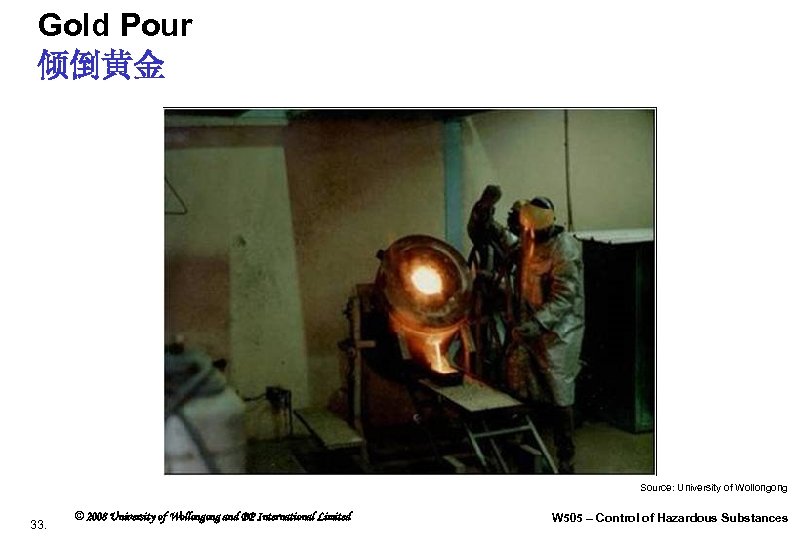
Gold Pour 倾倒黄金 Source: University of Wollongong 33. © 2008 University of Wollongong and BP International Limited W 505 – Control of Hazardous Substances
Current Control Measures 目前的控制措施 • The furnace is located under a canopy type hood which is linked to an extraction fan outside the building. The purpose of an extraction system is threefold 熔炉被置于一个伞形罩下,这个伞形罩与户外的一扇排风扇相连。 其目的有三: – To remove any combustion gases 排除所有燃烧废气 – To remove any contaminants 排除所有污染物 – To remove hot air 排除热空气 34. © 2008 University of Wollongong and BP International Limited W 505 – Control of Hazardous Substances
The Issue 问 题 • Following complaints from workers an examination of the gold room was undertaken 炼金 人的投诉招致了对炼金车间的检查 • Initial findings were that there were elevated levels of mercury present in the atmosphere (albeit below the exposure standard), capture velocities of the canopy hood were low and that there was minimal air movement within the gold room 初步的检查结果是,室内空气中水银的含量越来越高(尽管尚未达到 污染标准),伞形排风罩的抽风速度低下,导致了炼金车间内的空气 流动不畅 35. © 2008 University of Wollongong and BP International Limited W 505 – Control of Hazardous Substances
Ventilation System 排风系统 • Examination of the fan established that the belts between the drive motor and the fan impeller shaft were continually “slipping”, thus decreasing the degree of extraction 对排风扇的检查发现,连接驱动马达与叶轮轴的传动带越来越“疲软”,从 而导致抽风速度减慢。 • Closer examination of the outer fan housing and ductwork found significant openings due to corrosion (the fan was not protected in the harsh equatorial climate) again reducing the efficiency of the system 对外部风扇罩和管道系统进一步检查后,发现了由于腐蚀产生的开口(排 风扇在酷热的赤道气候下没有得到保护)进一步减弱了排风效果 36. © 2008 University of Wollongong and BP International Limited W 505 – Control of Hazardous Substances
Actions Taken to Address Issues 针对问题采取的措施 • Repairs were made to the ventilation system with a resultant improvement in capture velocities 维修提高了排风系统的排风速度 • Mercury levels were no longer detected, and while the airflow in the gold room increased it was not at a level that was expected 室内再没有探测到空气中存在水银,炼金室的气流增加的同时,水银的浓度就降低到比预 想还要低的程度 • Inspection of air intake vents for the air supply system established that many were blocked, thus limiting the amount of make‑up air entering the gold room. Once these were cleared, air movement within the gold room increased 通过检查系统风源的进风口证明许多进风口都堵住了,因此限制了对炼金室的进风补充。 进风口一经清理,炼金室内的空气流动就增加了 37. © 2008 University of Wollongong and BP International Limited W 505 – Control of Hazardous Substances
Key Learnings 重要经验 • The process itself may produce contaminants that require control (e. g. mercury) 生产本身就可能产生污染,而污染物(如水银)需要加以控制 • All ventilation systems are prone to failure if not adequately maintained 所有的排风系统在得不到良好维护的情况下都会失效 • A simple check of the hood face velocity or the hood static pressure would have highlighted the ventilation system issues 其实只要对伞形罩的表面风速或者罩内静态压力进行简单的检查,就能找到问题 的主要根源所在乃是通风系统出了问题 38. © 2008 University of Wollongong and BP International Limited W 505 – Control of Hazardous Substances
Manufacture of Phthalic Anhydride 生产邻苯二甲酸酐 • Phthalic anhydride is an important bulk chemical and is used in the manufacture of phthalate ester plasticisers, polyester formulations for boat hulls, glass reinforced plastic applications and in alkyd resins for paints 邻苯二甲酸酐是一种重要的散装化学用品,可用来制造酞酸酯增塑 剂、船体聚酯配方、玻璃钢和涂料用醇酸树脂 39. © 2008 University of Wollongong and BP International Limited W 505 – Control of Hazardous Substances
Production Process 生产过程 • Over 85% of commercial phthalic anhydride is produced from o‑xylene by gas phase oxidation using vanadium pentoxide as a catalyst 85%以上的 业邻苯二甲酸酐都是用气相氧化法,以五氧化二钒作催化剂,从邻 二甲苯中生产出来的。 • The final product is sold in bulk bags of 500 kg or 1, 000 kg capacity, road tanker and 25 kg bags as a flaked solid. The product is also sold in the molten form and transported in insulated road tankers 其成品被装在 500公斤或 1000公斤容量的集装袋、公路油罐车和25公斤的口袋中 以粉末状固体形态销售。也以熔液形态销售,并用绝缘油罐车运输。 40. © 2008 University of Wollongong and BP International Limited W 505 – Control of Hazardous Substances
Properties & Health Effects 属性和对健康的影响 • White solid at room temperature 在室温下呈白色固体 • Melting point of 131°C 熔点: 摄氏 131度 • Saturated vapour pressure of 1 mm Hg @ 96. 5°C 饱和蒸汽压摄氏 96. 5度时为 1 毫米汞柱 • Phthalic anhydride is a known respiratory sensitiser with established workplace exposure limits. 邻苯二甲酸酐是一种已知的可吸入感光剂,为限制其对生产场所的污染相关标准 已经成型 41. © 2008 University of Wollongong and BP International Limited W 505 – Control of Hazardous Substances
Workplace Situation 作现场环境 • Concern was raised as to the potential exposure of workers during the filling of bulk bags with phthalic anhydride immediately after manufacture 人在产品刚生产出来以后就装袋的过程中与邻苯二甲酸 酐的身体接触问题就引发了担心 42. © 2008 University of Wollongong and BP International Limited W 505 – Control of Hazardous Substances
Initial Survey by Occupational Hygienist 职业卫生专家的初步调查内容 • 24 hour production process 24小时作业过程 • Flaked solid main area of potential exposures 粉末状固体主要的潜在污染场所 • Re-handing of processed product due to quality issues 对因质量问题处理过的产品进行的二次装卸 • LEV system limited & subject to failure LEV体系作用受限并且失效 43. © 2008 University of Wollongong and BP International Limited W 505 – Control of Hazardous Substances
Initial Survey (cont) 初步调查内容(续) • LEV system not designed for capture & transport of phthalic anhydride & fume 局部排气通风体系没有根据邻苯二甲酸酐的运输保存方式和有害气体的管理来 设计 • Bulk bag system designed for 1000 kg bags but used for 500 kg bags 集装袋设计为 1000公斤装,但实际运用却只装500公斤 • Increased exposure due to need for manual connection, disconnection & tie-off of bags 手 对集装袋连接、断开和封口延长了 人与有害物质的接触时间 • All workers complying with PPE standards 所有 人都穿戴了防护用具 44. © 2008 University of Wollongong and BP International Limited W 505 – Control of Hazardous Substances
Preliminary Monitoring 初步监察 • Monitoring indicated that long term exposures ranged up to a maximum of 4. 1 mg/m 3 phthalic anhydride during bag filling operations. 监察结果显示,在装袋的操作环节物料长时间的暴露在空气中能产 生最高 4. 1 mg/m 3 浓度的含邻苯二甲酸酐的有害空气 • As the statutory exposure limit was 4. 0 mg/m 3 appropriate action was required to reduce employee exposures. 法定的污染标准是 4. 0 mg/m 3 。必须采取得当的措施缩短 人与有 毒物料的接触时间 45. © 2008 University of Wollongong and BP International Limited W 505 – Control of Hazardous Substances
Approach to Control Exposures 污染控制措施 • The approach to establish what exposures needed to be controlled and how they could be controlled was systematic, scientific and involved stakeholders 哪些有害物料需要进行污染控制,如何控制的问题应做到系统、科 学,并且要引入相关人员的问责制度 • Key actions included 重要措施包括 – Detailed task observation & measurement to identify exposure sources in bag filling system 对作业进行细致的观察和测量,确定装袋环节的污染源 46. © 2008 University of Wollongong and BP International Limited W 505 – Control of Hazardous Substances
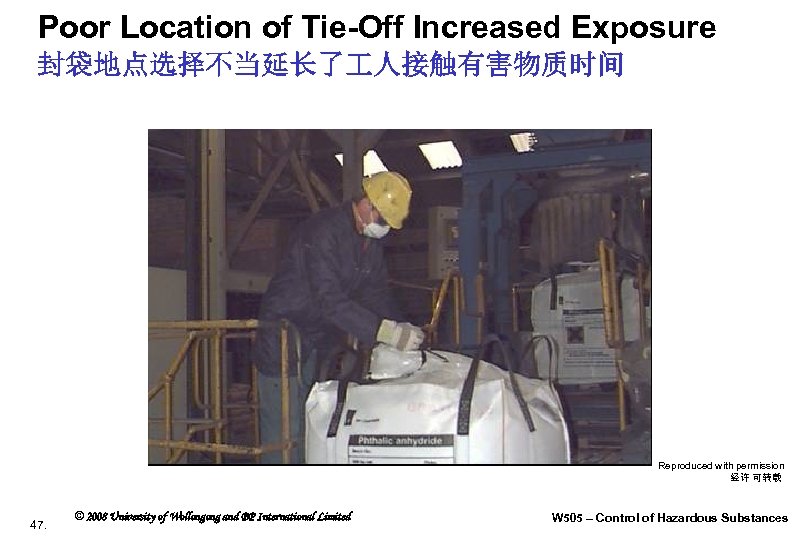
Poor Location of Tie-Off Increased Exposure 封袋地点选择不当延长了 人接触有害物质时间 Reproduced with permission 经许 可转载 47. © 2008 University of Wollongong and BP International Limited W 505 – Control of Hazardous Substances
Key Actions (cont) 重要措施(续) • The use of simple techniques such as the dust lamp (Tyndall beam) to identify phthalic anhydride fume loss from bags. Targeted workplace monitoring was also undertaken to confirm these observations 使用诸如粉尘监测灯(丁铎尔光束)等简单的设备用以确定是否有邻苯二甲酸酐毒气从 袋中外泄。还应该对目标场所进行监视,以确认观察结果。 • Redesign of bags to include double seams 重新设计一套带二重卷边的集装袋 • Introduction of lined bags 增加内衬袋 • The repositioning of the tie point to avoid the need to lean under the extraction system to tie‑off filled bags 重新选择封袋地点,避免 人在封袋时为了躲避抽风系统而弯屈身体 48. © 2008 University of Wollongong and BP International Limited W 505 – Control of Hazardous Substances
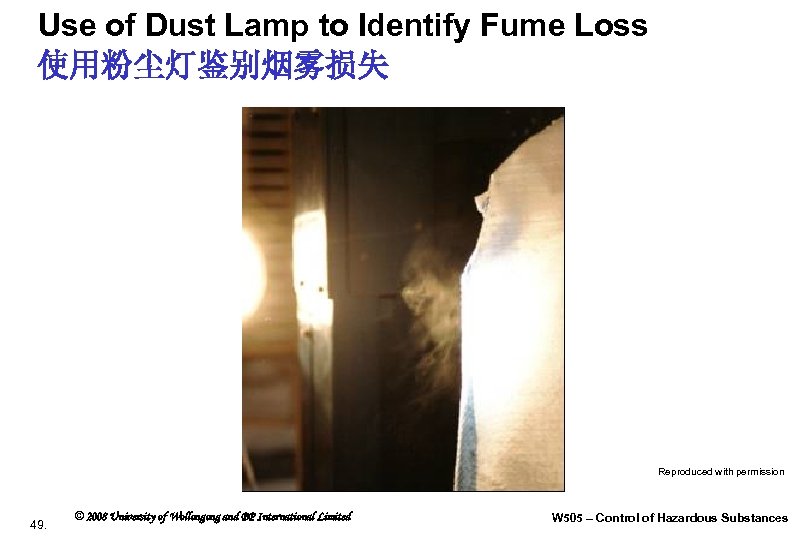
Use of Dust Lamp to Identify Fume Loss 使用粉尘灯鉴别烟雾损失 Reproduced with permission 49. © 2008 University of Wollongong and BP International Limited W 505 – Control of Hazardous Substances
Key Actions (cont) 重要措施 • Modifications were made to the flaking process to produce solid sheets of solidified phthalic anhydride which were then turned into flake using a mechanical nibber 对切片过程进行修改,产生固化邻苯二甲酸酐的固体板,然后使用 机械切割器将其切割成片状物 • This overcame the problem of solidification in the bulk bag and subsequent rehandling 这克服了塑料袋内的固化问题,并随后重新处理 • Introduction of new LEV system designed for process 新的LEV系统的介绍旨在过程 50. © 2008 University of Wollongong and BP International Limited W 505 – Control of Hazardous Substances
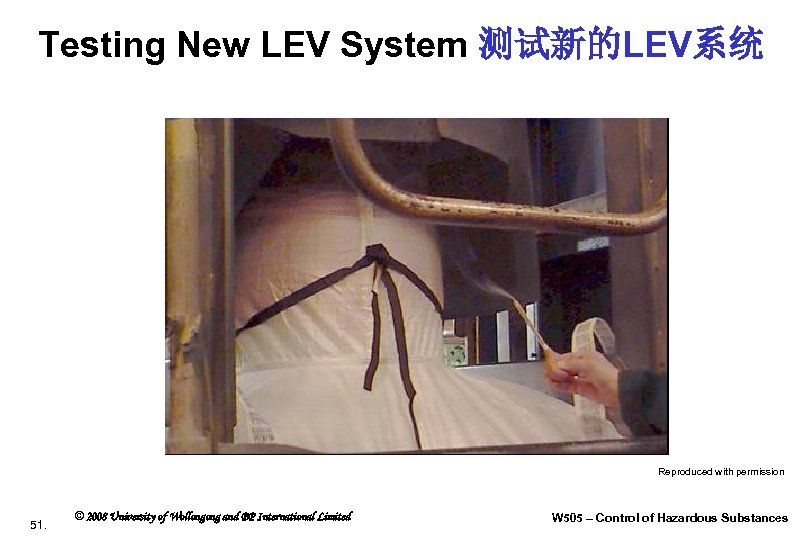
Testing New LEV System 测试新的LEV系统 Reproduced with permission 51. © 2008 University of Wollongong and BP International Limited W 505 – Control of Hazardous Substances
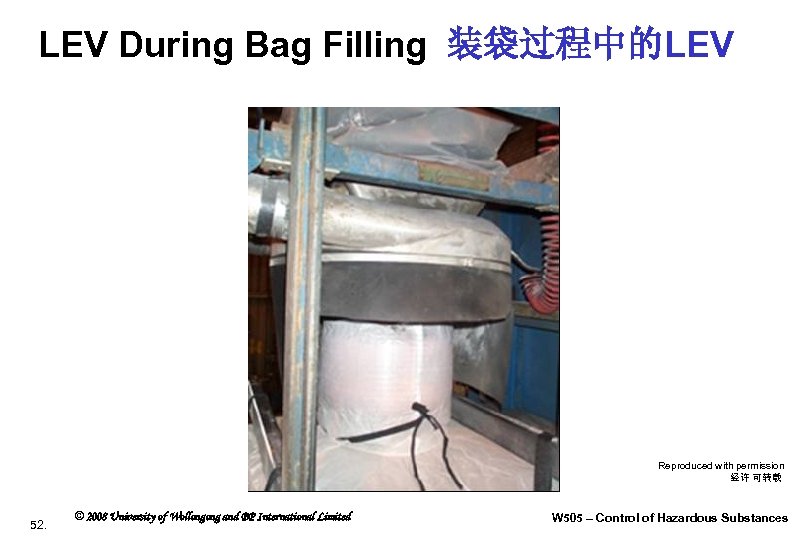
LEV During Bag Filling 装袋过程中的LEV Reproduced with permission 经许 可转载 52. © 2008 University of Wollongong and BP International Limited W 505 – Control of Hazardous Substances
Re-sampling after Controls Introduced 介绍控制后重新取样 • Personal exposures reduced to 0. 2 -0. 4 mg/m 3 PA 个人风险降低到 0. 2 -0. 4 mg/m 3 PA • Little dust or fume leakage from bags 几乎无粉尘或烟雾从袋中泄露 • Annual workplace monitoring introduced 介绍年度 作场所监测 • Health surveillance program introduced with pre-employment screening 介绍卫生监督方案与聘用前筛选 53. © 2008 University of Wollongong and BP International Limited W 505 – Control of Hazardous Substances
Key Learning‘s 重要知识 • Visual observation and simple techniques can highlight potential employee exposures 外部观察和简单的技术可以强调潜在的雇员暴露 • A systematic approach to developing suitable control strategies is very effective 用系统的办法发展适当的控制策略是非常有效的 • The involvement of stakeholders (including suppliers) can lead to significant improvements and lower exposures 涉众(包括供应商)的介入可引起显著的改善并降低暴露 • Process modifications may be necessary in order to control exposures 可能必要修改过程以控制暴露 54. © 2008 University of Wollongong and BP International Limited W 505 – Control of Hazardous Substances
Control of Powders in the Pharmaceutical Industry 制药 业粉末的控制 • In the pharmaceutical industry there is a constant need to transfer powders from one form of container to mixing or reaction vessels 在制药行业,不断需要把粉末从一种容器形式转移到混合或反应容 器里 • This case study details two situations where problems arose in the process of manually handling powders 该案例研究详细说明两种情况下,手动处理粉末的过程中出现的问 题 55. © 2008 University of Wollongong and BP International Limited W 505 – Control of Hazardous Substances
Situation A A类情况 • In this situation an operator is removing pre‑weighed bags (about 5 kg) of powder from a cardboard container before lifting and tipping the material into a chute connected to a mixing vessel 这种情况下,在将物质提起并倾卸到连接混合容器的斜槽之前,操作人员从硬纸 板容器处移除预先称过重的袋子(约 5公斤)的粉末 • The operator is wearing a Tyvek suit with a separate hood. The hood is fed with breathing air, taken from the local area by a battery operated pump and filtered 操作人员身穿一套带有单独烟尘罩的Tyvek套装。将呼吸气提供给烟尘罩,呼吸 气是由该区域内的电池驱动的水泵过滤得来的 56. © 2008 University of Wollongong and BP International Limited W 505 – Control of Hazardous Substances
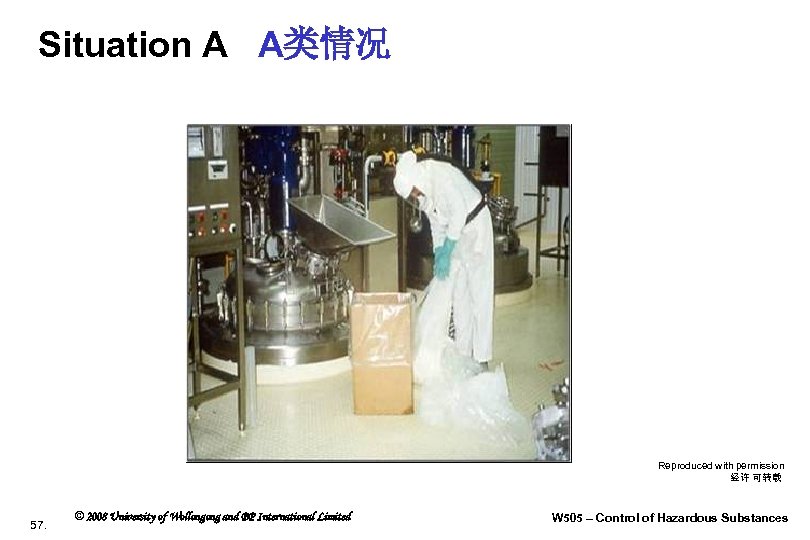
Situation A A类情况 Reproduced with permission 经许 可转载 57. © 2008 University of Wollongong and BP International Limited W 505 – Control of Hazardous Substances
Issues 问题 • Open work area allowing dust to travel & settle out on ledges & machinery 打开 作区允许粉尘移动并停留在架子和机器上 • Other persons working or walking through area potentially exposed during loading in not wearing PPE 在装载时没有穿戴个人防护设备的其他人员 作或步行通过该地区 时可能暴露 • Some powders when airborne easy to ignite 一些在空中运动的粉末容易燃烧 58. © 2008 University of Wollongong and BP International Limited W 505 – Control of Hazardous Substances
Issues (cont) 问题(续) • Dust layers can be disturbed and inhaled by others later who are not wearing protective equipment for supposed “safe” activities such as equipment checks (maintenance). 粉尘层可被其它那些不穿防护设备进行被认为“安全”活动的人员扰乱并吸 入粉尘,如设备检查(维护)活动 。 • They may react with moisture or other materials in the air to change their character sufficiently to pose additional risks (chemical burns). 它们可与水分或其他材料在空气中反应,以改变其性质并足以造成额外的 风险(化学烧伤)。 • They may fall onto exposed skin or into eyes or may be transferred by hand to the mouth or other surfaces such as door handles and light switches 它们可能遗落并接触到皮肤或眼睛,或可能从手上被转移到口里或其它表 面,如门把手和灯的开关 59. © 2008 University of Wollongong and BP International Limited W 505 – Control of Hazardous Substances
Control Strategy Implemented 控制策略补充 • Use of pre-weighed containers that can “dock” with vessel 使用预先称过重的容器,可以与容器瓶“对接” – Easy flow powders in rigid containers 易流动粉末装在刚性容器里 – Not so easy flow powders in flexible containers 不容易流动粉末装在挠性容器里 60. © 2008 University of Wollongong and BP International Limited W 505 – Control of Hazardous Substances
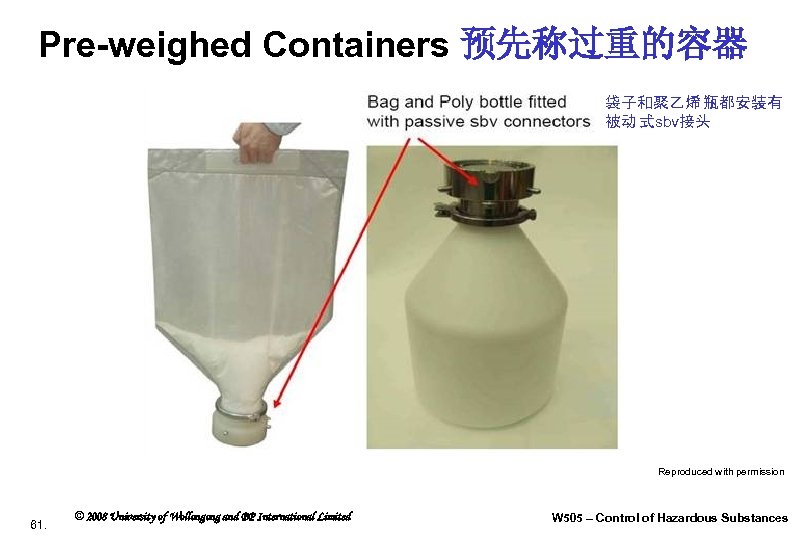
Pre-weighed Containers 预先称过重的容器 袋子和聚乙烯 瓶都安装有 被动 式sbv接头 Reproduced with permission 61. © 2008 University of Wollongong and BP International Limited W 505 – Control of Hazardous Substances
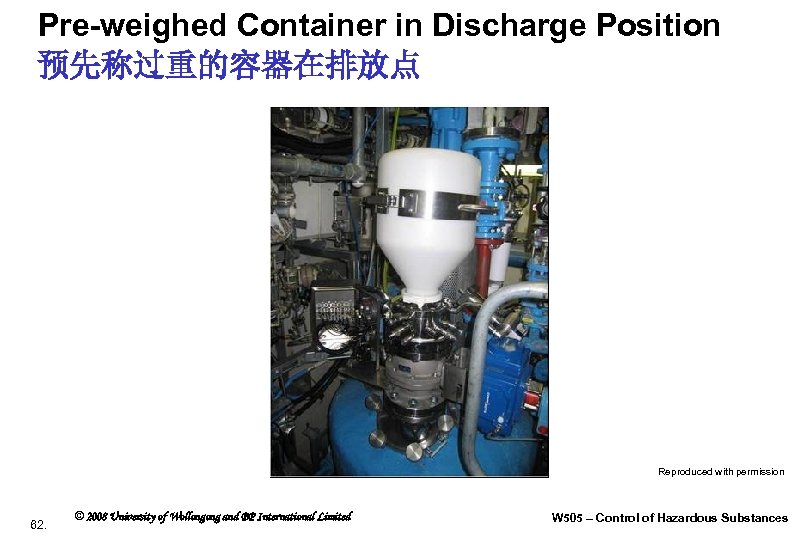
Pre-weighed Container in Discharge Position 预先称过重的容器在排放点 Reproduced with permission 62. © 2008 University of Wollongong and BP International Limited W 505 – Control of Hazardous Substances
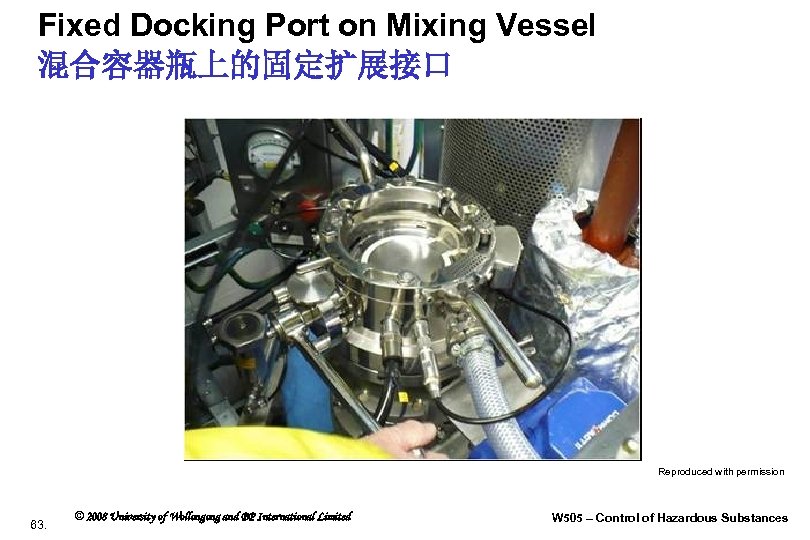
Fixed Docking Port on Mixing Vessel 混合容器瓶上的固定扩展接口 Reproduced with permission 63. © 2008 University of Wollongong and BP International Limited W 505 – Control of Hazardous Substances
Outcomes 结果 • Some material released during undocking but devices available to reduce exposures to <1 ug/m 3 某些物质在非对接期间排放,但设备可以减少暴露至小于 1 ug/m 3 • Solution involves capital cost but docking bags are reusable and have a reasonable life 解决方案涉及资本成本,但对接袋可重复使用,并有合理 的使用周期 64. © 2008 University of Wollongong and BP International Limited W 505 – Control of Hazardous Substances
Situation B B类情况 • Similar to situation A except there is a requirement to load significantly larger quantities into a dissolving vessel 类似于A类情况,但对负载大量物质进入溶解容器瓶时有 要求 • Quantities can be up to 25 kg 数量可达到 25公斤 65. © 2008 University of Wollongong and BP International Limited W 505 – Control of Hazardous Substances
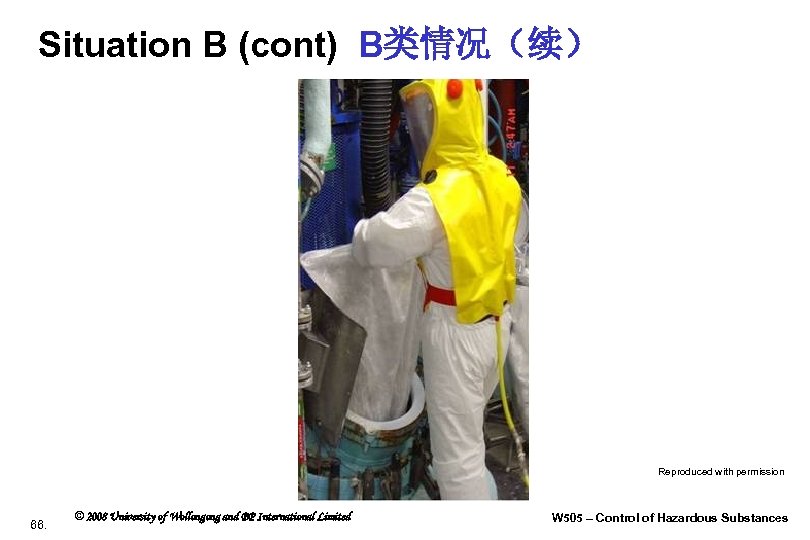
Situation B (cont) B类情况(续) Reproduced with permission 66. © 2008 University of Wollongong and BP International Limited W 505 – Control of Hazardous Substances
Situation B (cont) B类情况(续) • In this case there is no chute around the man way which is used for loading but some local exhaust ventilation has been provided nearby 这种情况下, 作人员周围没有用于装载的斜槽,但一些该区域附 近的排气通风的地方有 • The personal protective equipment is similar to that used by the worker in Situation A and the operating area is an open area of the workplace 个人防护设备是类似于A类情况中 人使用的的设备,操作区域是一 个开放的 作场所 67. © 2008 University of Wollongong and BP International Limited W 505 – Control of Hazardous Substances
Situation B (cont) B类情况(续) • If the approach adopted in Situation A was applied here, the greater volumes of material involved would mean repeated small loading operations, giving rise to potentially increased exposure (in the absence of other controls) 如果A类情况采用的方法用在这里,涉及的更大数量物质将意味着重复小装载操 作,从而使潜在暴露增加(在没有其他控制中) • If the other extreme was considered (ie: one large pre‑weighed bag or container) it would be difficult to handle and give rise to substantial ergonomic issues 如果考虑到是另一个极端(即:一个大型预先称过重的袋子或容器) ,那么难以 处理,并引起大量的人机控制相关问题 68. © 2008 University of Wollongong and BP International Limited W 505 – Control of Hazardous Substances
Control Strategy Implemented 控制策略补充 • The solution adopted was to install a drum lifter with an enclosure around the area above the discharge points 采取的解决办法是在排放点的附近区域安装一个带有密闭 空间的筒形吊顶 69. © 2008 University of Wollongong and BP International Limited W 505 – Control of Hazardous Substances
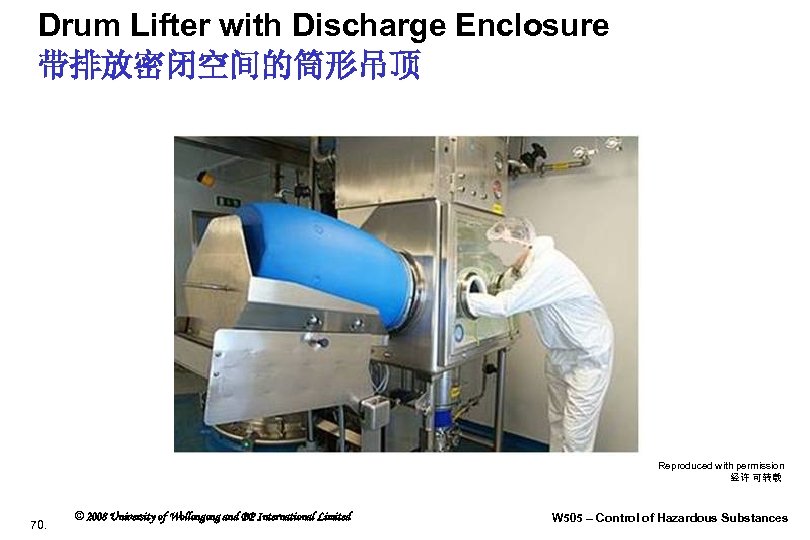
Drum Lifter with Discharge Enclosure 带排放密闭空间的筒形吊顶 Reproduced with permission 经许 可转载 70. © 2008 University of Wollongong and BP International Limited W 505 – Control of Hazardous Substances
Other Factors 其它因素 • Glove posts installed for access to remove drum lid, open liners and cleaning etc 安装手套标记目的是易于移除桶盖、打开衬层进行清洗等 • Mock-up of wood & cardboard made of isolator to ensure all ergonomic factors considered 用绝缘体制成木材和硬纸板模型,确保考虑到所有的人机控制因素 • Increased cost off-set by time saving & cost of PPE 成本增加弥补时间节省及个人防护设备的成本 71. © 2008 University of Wollongong and BP International Limited W 505 – Control of Hazardous Substances
Key Learning‘s 重要知识 • Containment is an effective means of controlling employee exposures 封闭控制是一种有效控制员 暴露的方法 • Implementation of any control strategy that involves the direct involvement of operators needs to take account of individual human factors if they are to be used by all personnel. 任何控制策略的实施, 涉及直接参与的操作人员, 如果它们被所有人员 使用时,必须考虑个人人为因素。 72. © 2008 University of Wollongong and BP International Limited W 505 – Control of Hazardous Substances
Diesel Particulate in Underground Coal Mines 地下煤矿的柴油微粒 • Diesel engines have been used in the underground mining industry for many years and have been a key factor in the increased productivity of such operations 柴油发动机很多年以前就应用于地下采矿业,是提高此类操作生产 力的一个关键因素 • While the health effects of gaseous emissions were well understood from their initial introduction, little or no attention was paid to the control of the particulate fraction 虽然从最初的介绍中很好的理解气体排放对健康有影响,但是很少 或根本没有注意控制微粒部分 73. © 2008 University of Wollongong and BP International Limited W 505 – Control of Hazardous Substances
The Situation 状况 • This case study details how one industry researched, evaluated and ultimately initiated strategies for the control of diesel particulate in underground coal mines 本案例研究详细介绍如何对产业进行研究、评估并最终确定采用战 略,对地下煤矿柴油微粒的控制 • As with the control of any contaminant, it is important to have a clear understanding of the physical and chemical properties of the substance plus knowledge as to the potential health effects 与所有污染控制一样,对物质的物理和化学属性有清晰的理解和认 识是很重要的,可避免潜在的健康影响 74. © 2008 University of Wollongong and BP International Limited W 505 – Control of Hazardous Substances
Properties of DP 柴油微粒属性 • Generated along with gaseous emissions in the exhaust of every diesel engine 柴油机排气装置排气时生成 • Small particles (15 -130 nm) called spherules 颗粒小( 15 -130 nm ),成为球粒。 • Agglomerate to form larger particles but still <1 µm in diameter 凝聚可形成较大颗粒,但直径<1 µm 75. © 2008 University of Wollongong and BP International Limited W 505 – Control of Hazardous Substances
Properties of DP (cont) 柴油微粒属性(续) • Absorb significant quantities of hydrocarbons and other organic compounds 能显著吸收大量碳氢化合物及其它有机化合物 • Contains traces of inorganic compounds 含有无机化合物 • Respirable by humans 可由人体吸入 • Has a central core of elemental carbon 具有无机碳中心核 76. © 2008 University of Wollongong and BP International Limited W 505 – Control of Hazardous Substances
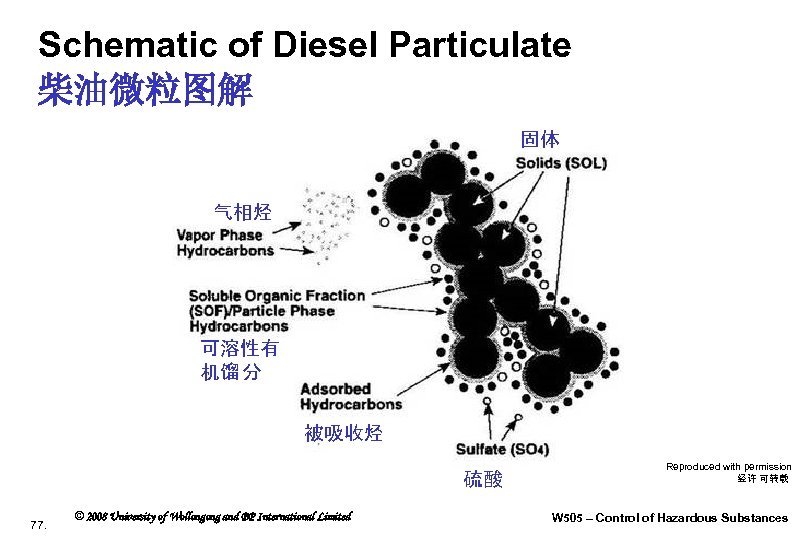
Schematic of Diesel Particulate 柴油微粒图解 固体 气相烃 可溶性有 机馏 分 被吸收烃 硫酸 77. © 2008 University of Wollongong and BP International Limited Reproduced with permission 经许 可转载 W 505 – Control of Hazardous Substances
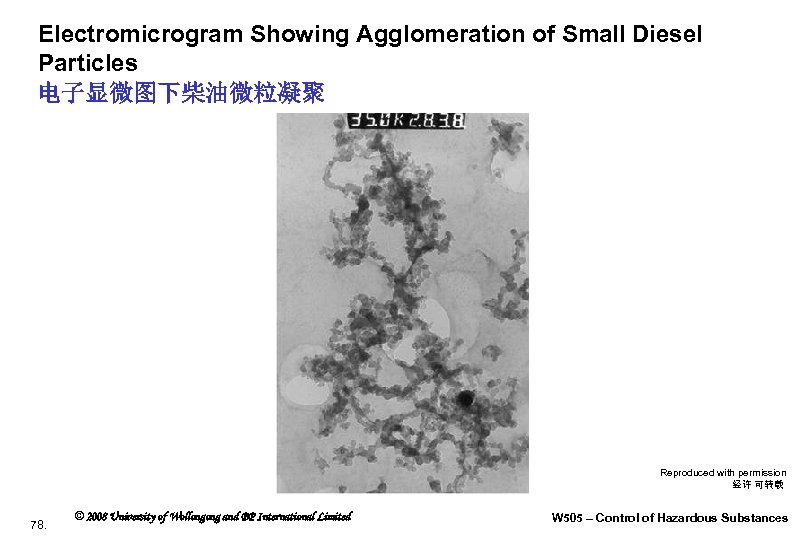
Electromicrogram Showing Agglomeration of Small Diesel Particles 电子显微图下柴油微粒凝聚 Reproduced with permission 经许 可转载 78. © 2008 University of Wollongong and BP International Limited W 505 – Control of Hazardous Substances
Health Effects 健康影响 • Classified as carcinogenic by many authorities throughout the world 世界上诸多权威认定其为致癌物 • Potency not well defined but significant 效能尚未明确定义,但很显著。 • Small particle size of diesel particulate has resulted in it being linked to non malignant health effects similar to PM 2. 5 其尺寸较小,仅与非恶性效应相关。 • Irritant (eyes, nasal and bronchial). 刺激性(眼睛、鼻和支气管) 79. © 2008 University of Wollongong and BP International Limited W 505 – Control of Hazardous Substances
Research on Control Strategies Indicated 控制策略研究 • No single simple strategy exists to cover all situations 没有一种策略能涵盖所有情况 • Individual operations using similar equipment could have significantly different exposure profiles due differences in ventilation patterns, work practices & maintenance 使用相似设备进行单独操作,由于通风模式、 作规范和 维护的不同,可能得出迥异的暴露概况。 80. © 2008 University of Wollongong and BP International Limited W 505 – Control of Hazardous Substances
Potential Control Options 可能的控制选项 • Low emission diesel fuel 低排放柴油机燃料 • Ventilation at levels commensurate with the size of the engine. In cases where ventilation is restricted (eg: mines) it may be appropriate to limit the number of diesel engines operating in an area 通风级别要与发动机尺寸相称,在限制通风的地方,要尽可能减少运行于 某一区域的柴油发动机数量。 • Exhaust treatment devices such as catalytic converters, wet scrubber systems, regenerative ceramic filters, disposable exhaust filters, exhaust dilution‑dispersal systems. 废弃处理设备,比如触媒转换器,湿刮洗系统、再生陶瓷过滤器、废弃过 滤器、废弃稀释——分散系统。 81. © 2008 University of Wollongong and BP International Limited W 505 – Control of Hazardous Substances
Potential Control Options (cont) 可能的控制选项(续) • New generation low emission engines 新一代小排量发动机 • Maintenance programmes targeted at minimising exhaust emissions 维修保养计划目标是最小化废弃排放 • Well‑sealed and filtered air‑conditioned operators’ cabins 密封良好、适当过滤的操作室 • Employee education 员 教育 • Personal protective equipment 个人防护装置 82. © 2008 University of Wollongong and BP International Limited W 505 – Control of Hazardous Substances
Emissions Based Maintenance Programme 基于排放的维修保养计划 • While combinations of the potential control strategies have been found to be effective, one strategy has the potential to deliver higher productivity with reduced employee exposures 尽管组合应用潜在控制策略会比较有效,单一策略能提高生产率, 同时减少人员暴露。 • The introduction of an emissions‑based maintenance programme has been shown by various researchers to result in improved fleet availability, increased power and thus productivity and lower exhaust emissions 不同研究人员已经介绍了基于排放的维修保养计划,它能提高车队 可用率,增加动力、提高生产率及降低废弃排放。 83. © 2008 University of Wollongong and BP International Limited W 505 – Control of Hazardous Substances
What’s the Problem? 存在的问题 • While emissions based maintenance seems apparent, it is based on the premise that individual engines can be tested during maintenance procedures 尽管基于排放的维修保养效果显而易见,可是它的前提是维修保养 过程中单个发动机可测。 • To do this, raw exhaust measurements for various gases and diesel particulate must be conducted & instrumentation must be available 为此,必须对各种气体及柴油颗粒进行原始废气测量,检测仪器也 要可用。 84. © 2008 University of Wollongong and BP International Limited W 505 – Control of Hazardous Substances
Initial Raw Exhaust Monitoring Equipment 初始原始废气监测设备 • Monitoring of raw exhaust gas emissions for control of workplace exposures has been in place for decades & has been very effective 为控制 作场所暴露而进行的原始废气监测已经存在了几十年,效果非常 明显。 • Measurement of DP in raw exhaust presents complex issues 原始废气的DP测量比较复杂 – Water vapour in exhaust effects laser based instruments 废气中的水汽影响激光测量仪器 – High DP concentrations flood ambient instrumentation DP浓度过高会淹没检测仪器 – Composition of DP make consistent measurement difficult DP复合使得连续测量难度加大 85. © 2008 University of Wollongong and BP International Limited W 505 – Control of Hazardous Substances
Initial Approach 初步做法 • Focus on elemental carbon as surrogate for DP 使用无机碳替代DP • Use of laboratory analyser mounted in a mobile trailer to measure raw exhaust EC 使用安装在移动拖车上的实验室分析仪测量原始废弃EC – Gave good results but, 测量结构精确 – Difficult to operate 但操作复杂 – Expensive & not cost effective 昂贵& 性价比低 86. © 2008 University of Wollongong and BP International Limited W 505 – Control of Hazardous Substances
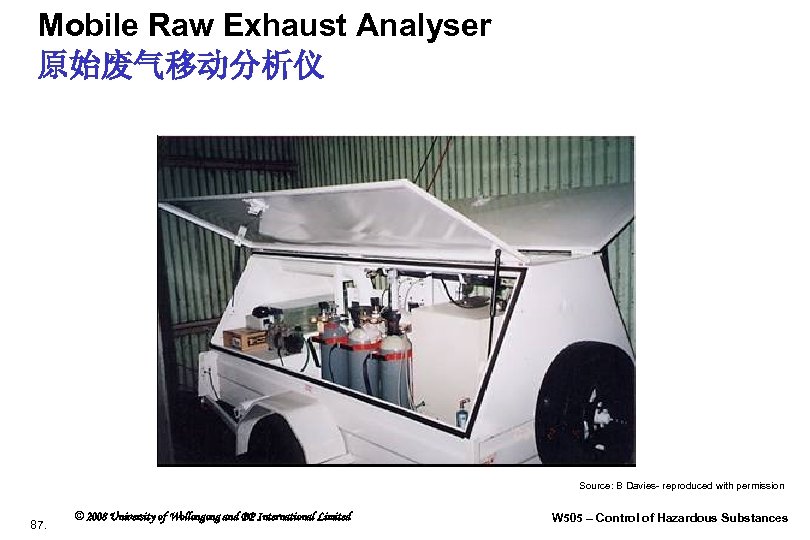
Mobile Raw Exhaust Analyser 原始废气移动分析仪 Source: B Davies- reproduced with permission 87. © 2008 University of Wollongong and BP International Limited W 505 – Control of Hazardous Substances
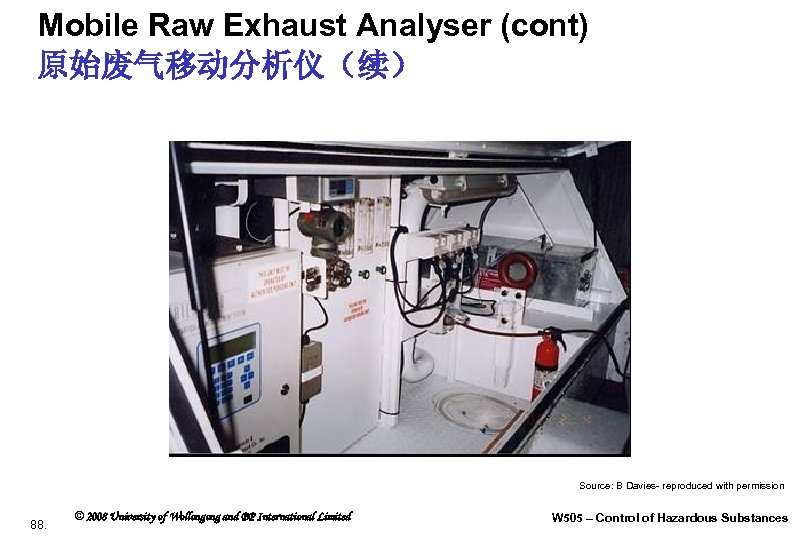
Mobile Raw Exhaust Analyser (cont) 原始废气移动分析仪(续) Source: B Davies- reproduced with permission 88. © 2008 University of Wollongong and BP International Limited W 505 – Control of Hazardous Substances
Maintenance Trial 维护试验 • Mobile EC analyser used to measure the raw exhaust EC levels in a fleet of 66 engines 移动EC分析仪过去常用来测量 66台发动机为一组的原始废气EC 水平 • Of the 66 engines initially tested 7 were found to be abnormal 最初测量的66台发动机中,发现有7台异常。 • Simple maintenance resulted in significant reductions in raw exhaust EC levels & hence worker exposures 简易维护可显著降低原始废气EC水平并减少 人接触 89. © 2008 University of Wollongong and BP International Limited W 505 – Control of Hazardous Substances
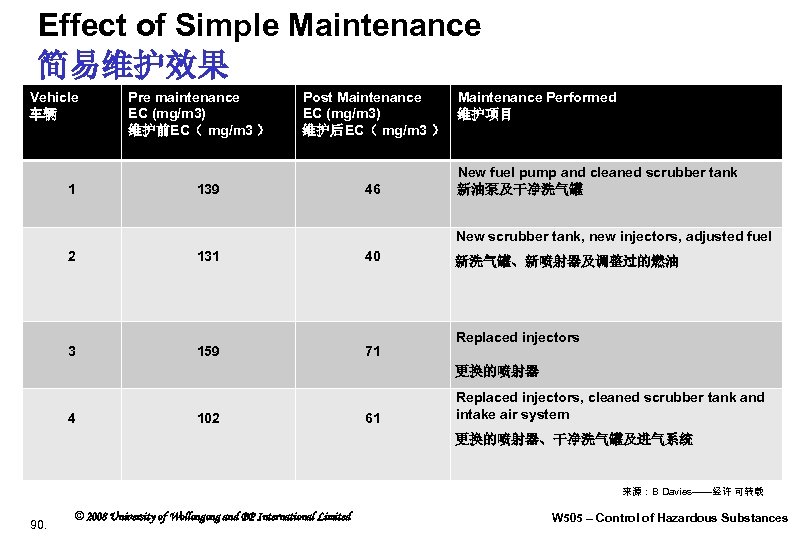
Effect of Simple Maintenance 简易维护效果 Vehicle 车辆 1 Pre maintenance EC (mg/m 3) 维护前EC( mg/m 3 ) Post Maintenance Performed EC (mg/m 3) 维护项目 维护后EC( mg/m 3 ) 139 46 New fuel pump and cleaned scrubber tank 新油泵及干净洗气罐 New scrubber tank, new injectors, adjusted fuel 2 131 40 3 159 71 新洗气罐、新喷射器及调整过的燃油 Replaced injectors 更换的喷射器 4 102 61 Replaced injectors, cleaned scrubber tank and intake air system 更换的喷射器、干净洗气罐及进气系统 来源:B Davies——经许 可转载 90. © 2008 University of Wollongong and BP International Limited W 505 – Control of Hazardous Substances
Development of More Practical Instrumentation 开发更多实用型仪器 • Once this concept was proved by various researchers, more practical instrumentation has been developed based on new laser technology and more recently backpressure on an exposed filter 各类研究人员证实该观念后,基于新型激光技术及在暴露 式过滤器上的更为新式的背压技术,已经开发了更多实用 型仪器。 91. © 2008 University of Wollongong and BP International Limited W 505 – Control of Hazardous Substances
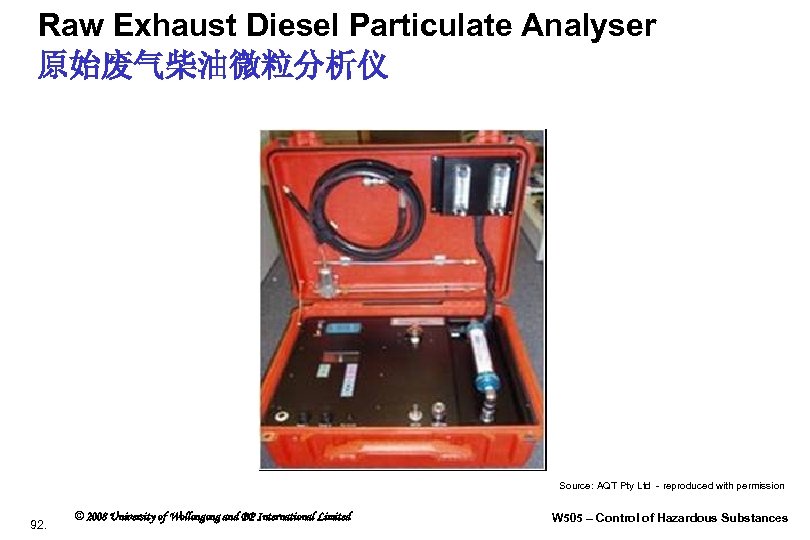
Raw Exhaust Diesel Particulate Analyser 原始废气柴油微粒分析仪 Source: AQT Pty Ltd - reproduced with permission 92. © 2008 University of Wollongong and BP International Limited W 505 – Control of Hazardous Substances
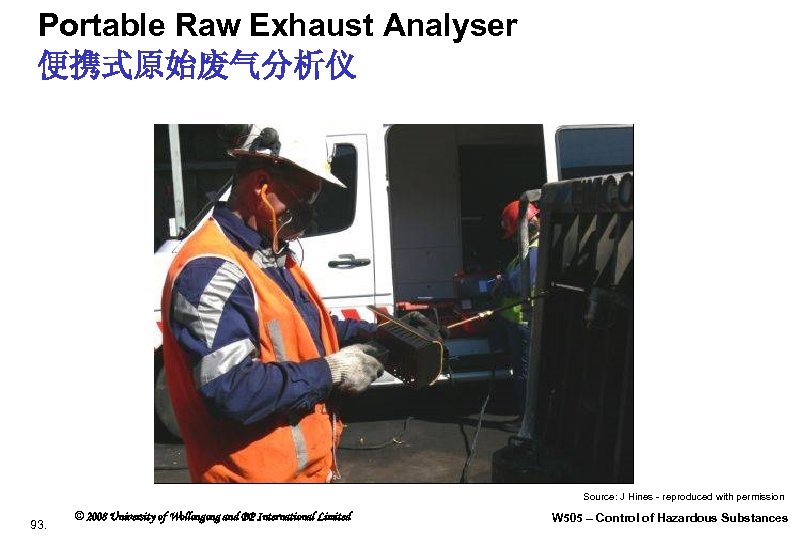
Portable Raw Exhaust Analyser 便携式原始废气分析仪 Source: J Hines - reproduced with permission 93. © 2008 University of Wollongong and BP International Limited W 505 – Control of Hazardous Substances
Key Learning‘s 学习要点 • No one simple solution exists. Each operation needs to evaluate which control technologies work best for their circumstances 不存在单一解决方案,每种操作都必须评估该环境下哪种控制技 术效果最佳。 • Control of diesel particulate requires a major commitment by all involved – equipment suppliers, mine operators, workers 控制柴油微粒需要所有设备供应商、矿操作员及 作人员的通力 合作。 94. © 2008 University of Wollongong and BP International Limited W 505 – Control of Hazardous Substances
Key Learning‘s (cont) 学习要点(续) • Emissions‑based maintenance programmes offer potential for major gains in emissions and through increased productivity. For this strategy to be effective, this required the development of a different approach to monitoring the contaminant at its source 基于排放的维护策略为通过提高生产率增加排放收益提供了可 能性,要使该策略有效,需要开发一种在源头监测污染物的方 法。 • Attention to detail is necessary to sustain control technologies 持续应用控制技术必须关注细节 95. © 2008 University of Wollongong and BP International Limited W 505 – Control of Hazardous Substances
Review of Today’s Topics 今日课题回顾 • Personal Protective Equipment 个人防护装置 • Principles of Containment 封闭控制原则 • Administrative elements 管理因素 • Practical applications of control strategies 控制策略实际应用 96. © 2008 University of Wollongong and BP International Limited W 505 – Control of Hazardous Substances
Скачать презентацию Practical Applications of Control Strategies 控制措施应用实例 1
c5df767749e31b761061692dbfaa9b1a.ppt