


 Скачать презентацию Practical adaptation of Value Chain Analysis and Tools
b0fe779b7cd9217620bb0d3134297a3b.ppt
- Количество слайдов: 27
 Practical adaptation of Value Chain Analysis and Tools in the TREE Methodology
 Contents of Presentation 1. The TREE Methodology 2. Latest country adaptation 3. Adaptation of Value Chain Analysis
 The TREE Methodology TREE - Training for (Rural) Economic Empowerment International Labour Organization (ILO)
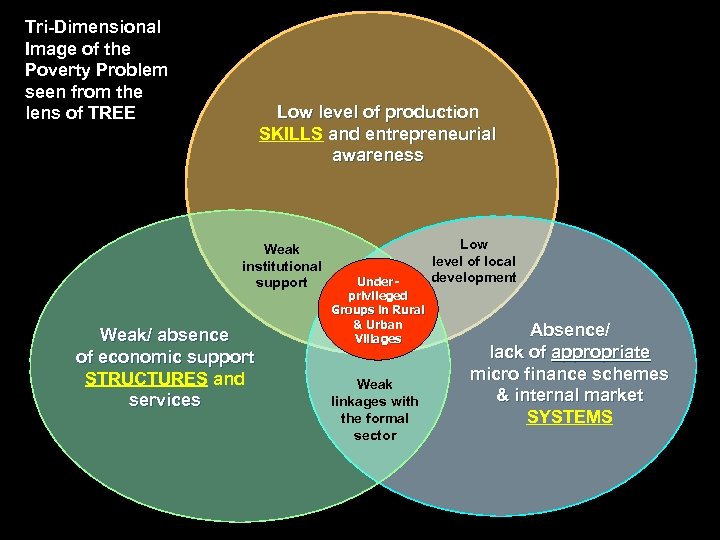 Tri-Dimensional Image of the Poverty Problem seen from the lens of TREE Low level of production SKILLS and entrepreneurial awareness Weak institutional support Weak/ absence of economic support STRUCTURES and services Underprivileged Groups in Rural & Urban Villages Weak linkages with the formal sector Low level of local development Absence/ lack of appropriate micro finance schemes & internal market SYSTEMS
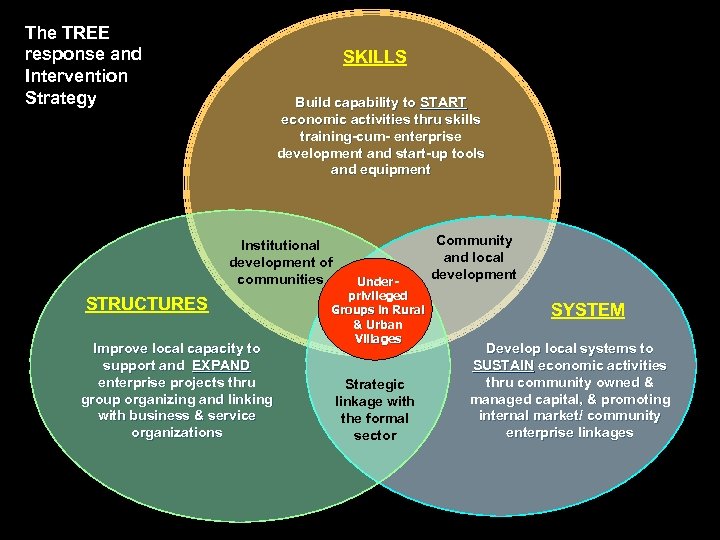 The TREE response and Intervention Strategy SKILLS Build capability to START economic activities thru skills training-cum- enterprise development and start-up tools and equipment Institutional development of communities STRUCTURES Improve local capacity to support and EXPAND enterprise projects thru group organizing and linking with business & service organizations Underprivileged Groups in Rural & Urban Villages Strategic linkage with the formal sector Community and local development SYSTEM Develop local systems to SUSTAIN economic activities thru community owned & managed capital, & promoting internal market/ community enterprise linkages
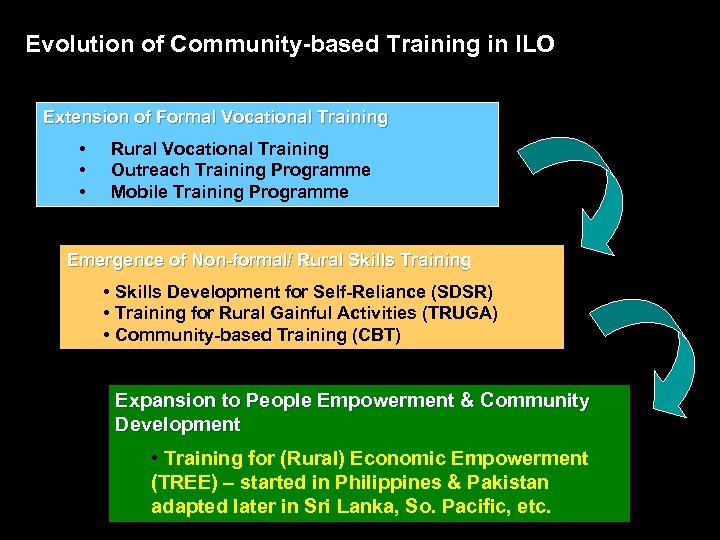 Evolution of Community-based Training in ILO Extension of Formal Vocational Training • • • Rural Vocational Training Outreach Training Programme Mobile Training Programme Emergence of Non-formal/ Rural Skills Training • Skills Development for Self-Reliance (SDSR) • Training for Rural Gainful Activities (TRUGA) • Community-based Training (CBT) Expansion to People Empowerment & Community Development • Training for (Rural) Economic Empowerment (TREE) – started in Philippines & Pakistan adapted later in Sri Lanka, So. Pacific, etc.
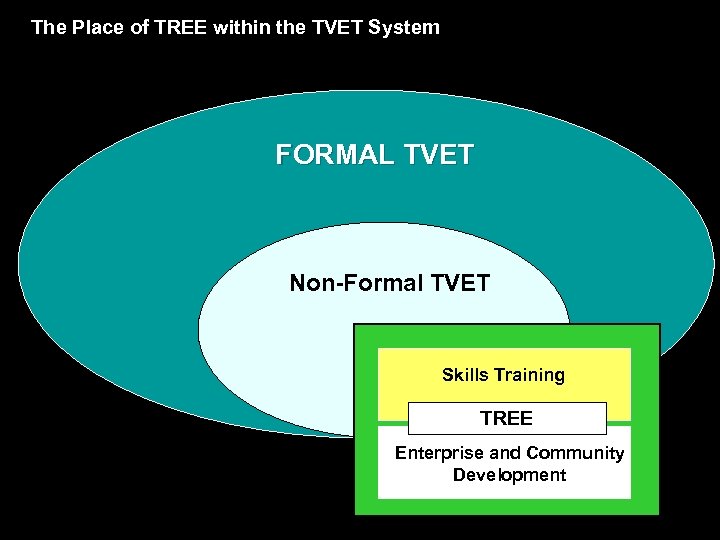 The Place of TREE within the TVET System FORMAL TVET Non-Formal TVET Skills Training TREE Enterprise and Community Development
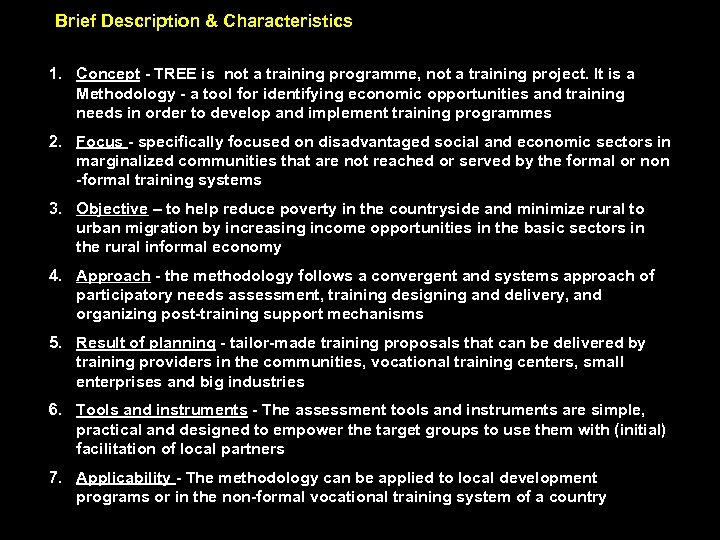 Brief Description & Characteristics 1. Concept - TREE is not a training programme, not a training project. It is a Methodology - a tool for identifying economic opportunities and training needs in order to develop and implement training programmes 2. Focus - specifically focused on disadvantaged social and economic sectors in marginalized communities that are not reached or served by the formal or non -formal training systems 3. Objective – to help reduce poverty in the countryside and minimize rural to urban migration by increasing income opportunities in the basic sectors in the rural informal economy 4. Approach - the methodology follows a convergent and systems approach of participatory needs assessment, training designing and delivery, and organizing post-training support mechanisms 5. Result of planning - tailor-made training proposals that can be delivered by training providers in the communities, vocational training centers, small enterprises and big industries 6. Tools and instruments - The assessment tools and instruments are simple, practical and designed to empower the target groups to use them with (initial) facilitation of local partners 7. Applicability - The methodology can be applied to local development programs or in the non-formal vocational training system of a country
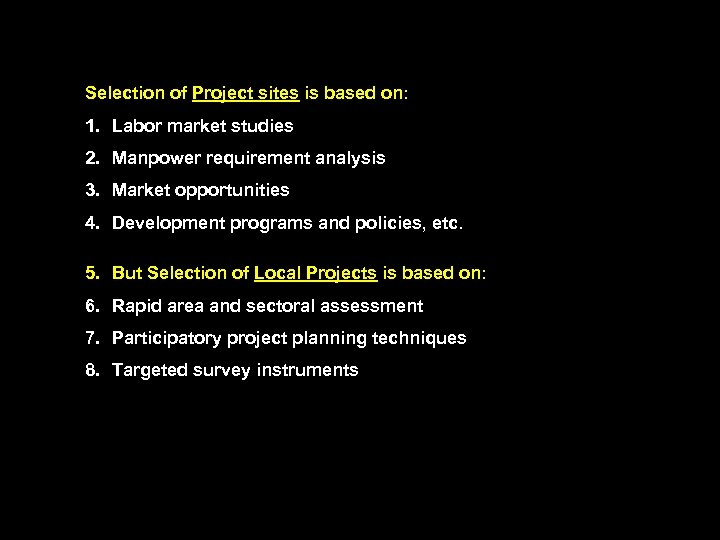 Selection of Project sites is based on: 1. Labor market studies 2. Manpower requirement analysis 3. Market opportunities 4. Development programs and policies, etc. 5. But Selection of Local Projects is based on: 6. Rapid area and sectoral assessment 7. Participatory project planning techniques 8. Targeted survey instruments
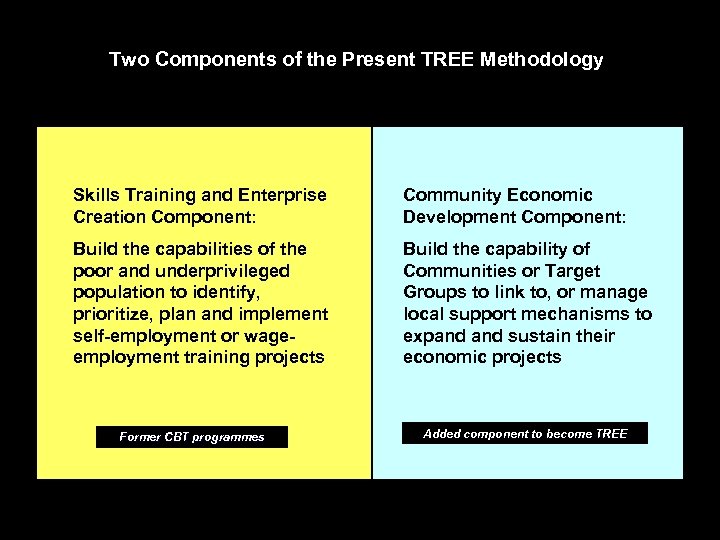 Two Components of the Present TREE Methodology Skills Training and Enterprise Creation Component: Community Economic Development Component: Build the capabilities of the poor and underprivileged population to identify, prioritize, plan and implement self-employment or wageemployment training projects Build the capability of Communities or Target Groups to link to, or manage local support mechanisms to expand sustain their economic projects Former CBT programmes Added component to become TREE
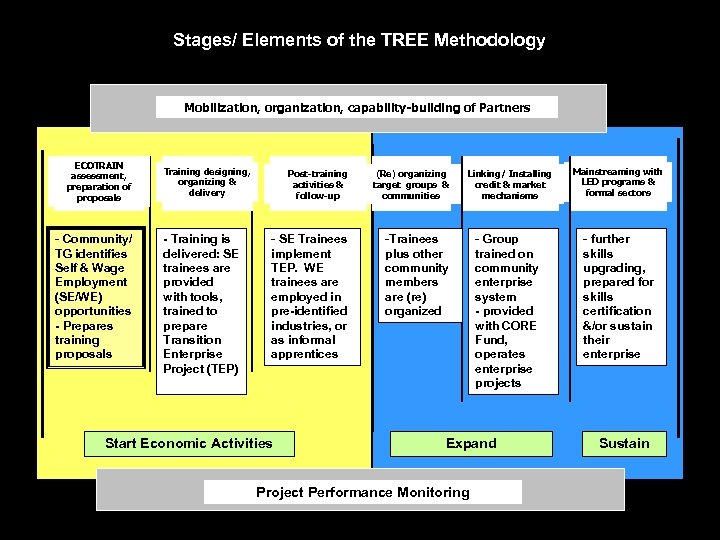 Stages/ Elements of the TREE Methodology Mobilization, organization, capability-building of Partners ECOTRAIN assessment, preparation of proposals - Community/ TG identifies Self & Wage Employment (SE/WE) opportunities - Prepares training proposals Training designing, organizing & delivery - Training is delivered: SE trainees are provided with tools, trained to prepare Transition Enterprise Project (TEP) Post-training activities & follow-up (Re) organizing target groups & communities - SE Trainees implement TEP. WE trainees are employed in pre-identified industries, or as informal apprentices -Trainees plus other community members are (re) organized Start Economic Activities Linking/ Installing credit & market mechanisms - Group trained on community enterprise system - provided with CORE Fund, operates enterprise projects Expand Project Performance Monitoring Mainstreaming with LED programs & formal sectors - further skills upgrading, prepared for skills certification &/or sustain their enterprise Sustain
 Latest Adaptation of the TREE Methodology TVET Reform Project Bangladesh
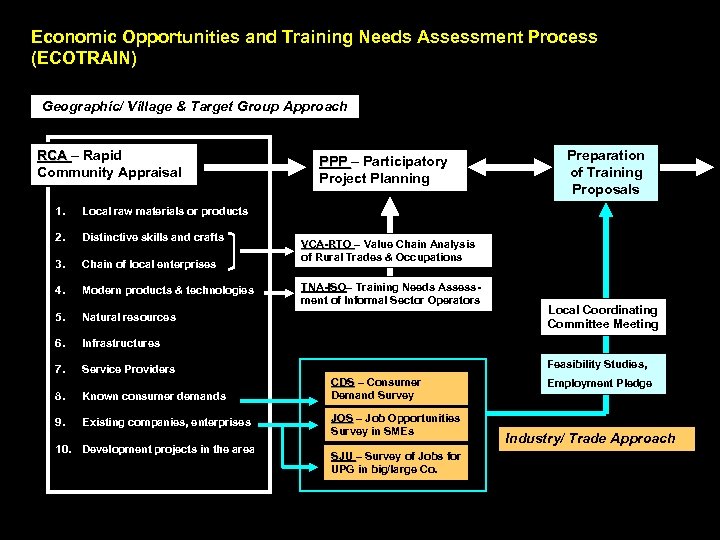 Economic Opportunities and Training Needs Assessment Process (ECOTRAIN) Geographic/ Village & Target Group Approach RCA – Rapid Community Appraisal 1. Distinctive skills and crafts 3. Chain of local enterprises 4. Modern products & technologies 5. Natural resources 6. Infrastructures 7. Service Providers 8. Known consumer demands 9. Existing companies, enterprises Preparation of Training Proposals Local raw materials or products 2. PPP – Participatory Project Planning 10. Development projects in the area VCA-RTO – Value Chain Analysis of Rural Trades & Occupations TNA-ISO– Training Needs Assess. TNA-ISO ment of Informal Sector Operators Local Coordinating Committee Meeting Feasibility Studies, CDS – Consumer Demand Survey JOS – Job Opportunities Survey in SMEs SJU – Survey of Jobs for UPG in big/large Co. Employment Pledge Industry/ Trade Approach
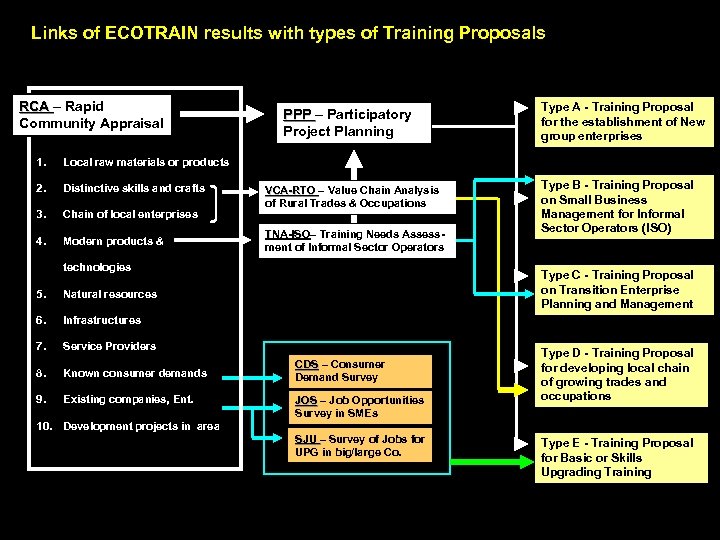 Links of ECOTRAIN results with types of Training Proposals RCA – Rapid Community Appraisal 1. Distinctive skills and crafts 3. Chain of local enterprises 4. Modern products & Type A - Training Proposal for the establishment of New group enterprises Local raw materials or products 2. PPP – Participatory Project Planning VCA-RTO – Value Chain Analysis of Rural Trades & Occupations TNA-ISO– Training Needs Assess. TNA-ISO ment of Informal Sector Operators technologies 5. Infrastructures 7. Type C - Training Proposal on Transition Enterprise Planning and Management Natural resources 6. Type B - Training Proposal on Small Business Management for Informal Sector Operators (ISO) Service Providers 8. Known consumer demands 9. Existing companies, Ent. 10. Development projects in area CDS – Consumer Demand Survey JOS – Job Opportunities Survey in SMEs SJU – Survey of Jobs for UPG in big/large Co. Type D - Training Proposal for developing local chain of growing trades and occupations Type E - Training Proposal for Basic or Skills Upgrading Training
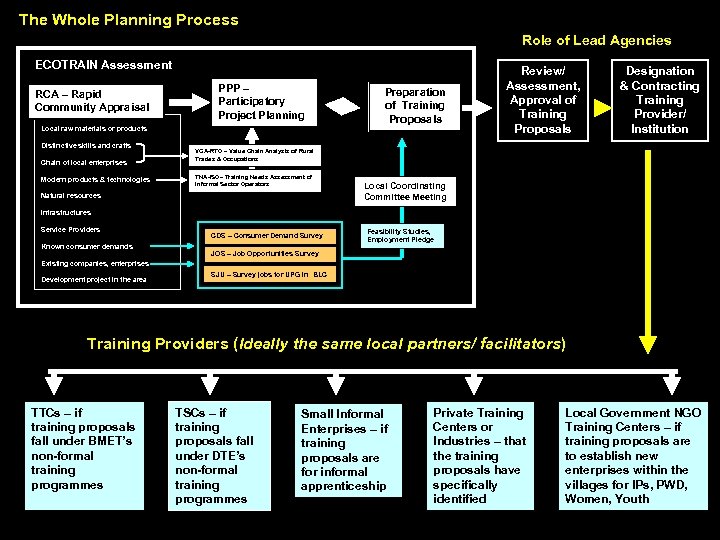 The Whole Planning Process Role of Lead Agencies ECOTRAIN Assessment RCA – Rapid Community Appraisal PPP – Participatory Project Planning Local raw materials or products Distinctive skills and crafts Chain of local enterprises Modern products & technologies Preparation of Training Proposals Review/ Assessment, Approval of Training Proposals Designation & Contracting Training Provider/ Institution VCA-RTO – Value Chain Analysis of Rural Trades & Occupations TNA-ISO– Training Needs Assessment of Informal Sector Operators Natural resources Local Coordinating Committee Meeting Infrastructures Service Providers Known consumer demands CDS – Consumer Demand Survey Feasibility Studies, Employment Pledge JOS – Job Opportunities Survey Existing companies, enterprises Development project in the area SJU – Survey jobs for UPG in BLC Training Providers (Ideally the same local partners/ facilitators) TTCs – if training proposals fall under BMET’s non-formal training programmes TSCs – if training proposals fall under DTE’s non-formal training programmes Small Informal Enterprises – if training proposals are for informal apprenticeship Private Training Centers or Industries – that the training proposals have specifically identified Local Government NGO Training Centers – if training proposals are to establish new enterprises within the villages for IPs, PWD, Women, Youth
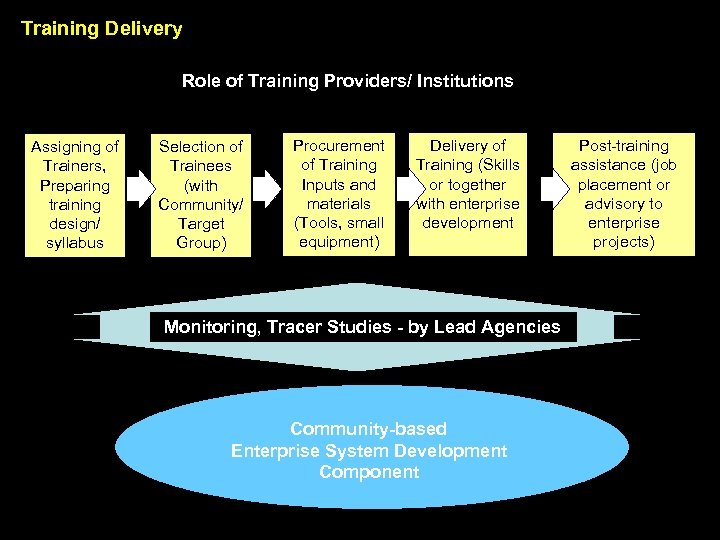 Training Delivery Role of Training Providers/ Institutions Assigning of Trainers, Preparing training design/ syllabus Selection of Trainees (with Community/ Target Group) Procurement of Training Inputs and materials (Tools, small equipment) Delivery of Training (Skills or together with enterprise development Monitoring, Tracer Studies - by Lead Agencies Community-based Enterprise System Development Component Post-training assistance (job placement or advisory to enterprise projects)
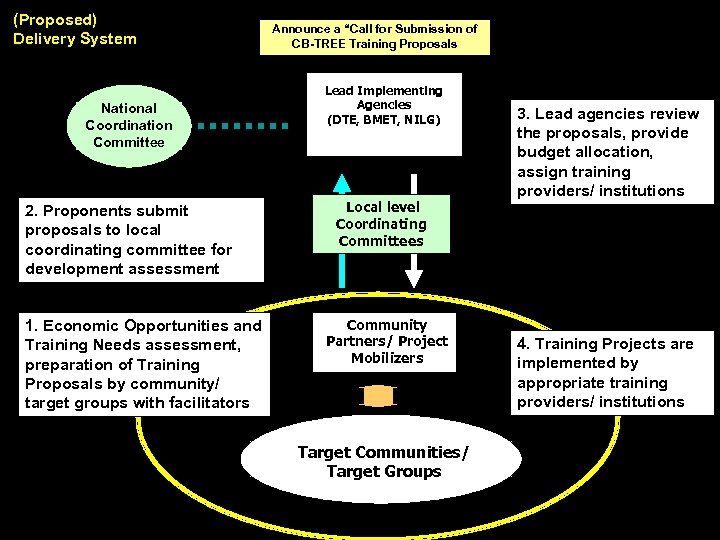 (Proposed) Delivery System National Coordination Committee 2. Proponents submit proposals to local coordinating committee for development assessment 1. Economic Opportunities and Training Needs assessment, preparation of Training Proposals by community/ target groups with facilitators Announce a “Call for Submission of CB-TREE Training Proposals Lead Implementing Agencies (DTE, BMET, NILG) Local level Coordinating Committees Community Partners/ Project Mobilizers Target Communities/ Target Groups 3. Lead agencies review the proposals, provide budget allocation, assign training providers/ institutions 4. Training Projects are implemented by appropriate training providers/ institutions
 Adaptation of Value Chain Analysis in the TREE Methodology
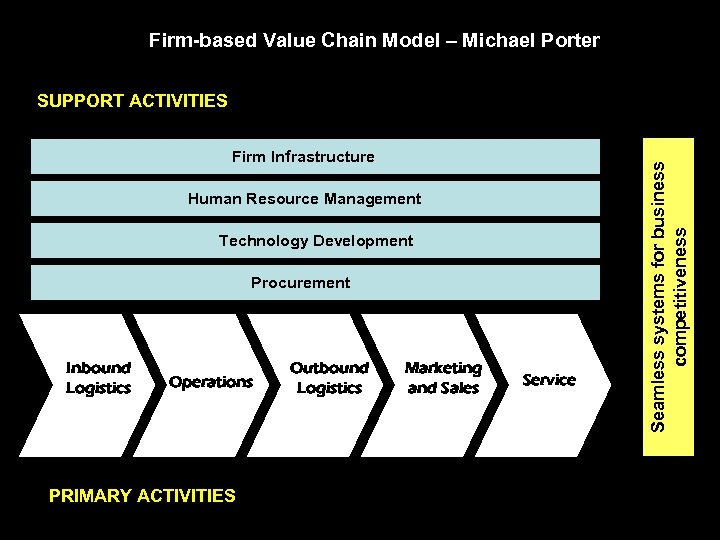 Firm-based Value Chain Model – Michael Porter Firm Infrastructure Human Resource Management Technology Development Procurement Inbound Logistics Operations PRIMARY ACTIVITIES Outbound Logistics Marketing and Sales Service Seamless systems for business competitiveness SUPPORT ACTIVITIES
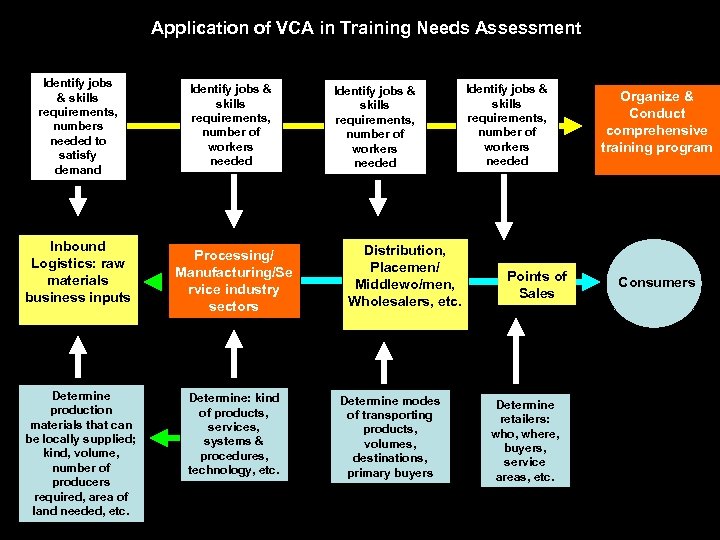 Application of VCA in Training Needs Assessment Identify jobs & skills requirements, numbers needed to satisfy demand Inbound Logistics: raw materials business inputs Determine production materials that can be locally supplied; kind, volume, number of producers required, area of land needed, etc. Identify jobs & skills requirements, number of workers needed Processing/ Manufacturing/Se rvice industry sectors Determine: kind of products, services, systems & procedures, technology, etc. Identify jobs & skills requirements, number of workers needed Distribution, Placemen/ Middlewo/men, Wholesalers, etc. Determine modes of transporting products, volumes, destinations, primary buyers Identify jobs & skills requirements, number of workers needed Points of Sales Determine retailers: who, where, buyers, service areas, etc. Organize & Conduct comprehensive training program Consumers
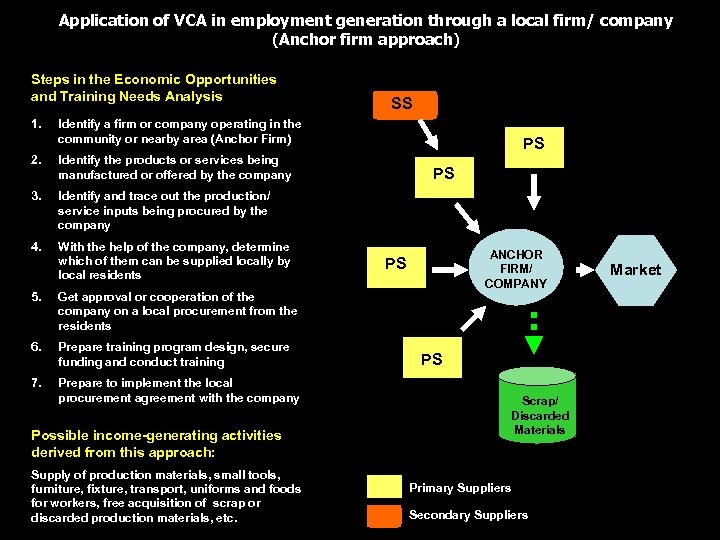 Application of VCA in employment generation through a local firm/ company (Anchor firm approach) Steps in the Economic Opportunities and Training Needs Analysis 1. SS Identify a firm or company operating in the community or nearby area (Anchor Firm) 2. Identify the products or services being manufactured or offered by the company 3. Identify and trace out the production/ service inputs being procured by the company 4. With the help of the company, determine which of them can be supplied locally by local residents PS 5. Prepare training program design, secure funding and conduct training 7. Prepare to implement the local procurement agreement with the company ANCHOR FIRM/ COMPANY PS Get approval or cooperation of the company on a local procurement from the residents 6. PS Possible income-generating activities derived from this approach: Supply of production materials, small tools, furniture, fixture, transport, uniforms and foods for workers, free acquisition of scrap or discarded production materials, etc. PS Scrap/ Discarded Materials Primary Suppliers Secondary Suppliers Market
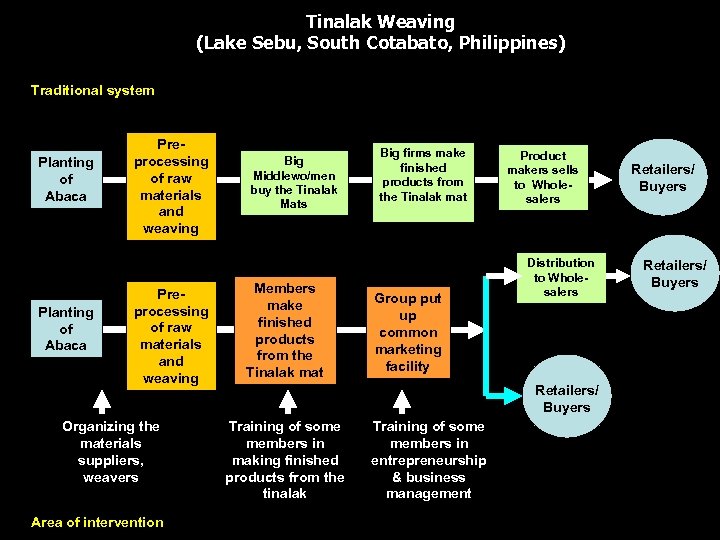 Tinalak Weaving (Lake Sebu, South Cotabato, Philippines) Traditional system Planting of Abaca Preprocessing of raw materials and weaving Organizing the materials suppliers, weavers Area of intervention Big Middlewo/men buy the Tinalak Mats Members make finished products from the Tinalak mat Big firms make finished products from the Tinalak mat Group put up common marketing facility Product makers sells to Wholesalers Distribution to Wholesalers Retailers/ Buyers Training of some members in making finished products from the tinalak Training of some members in entrepreneurship & business management Retailers/ Buyers
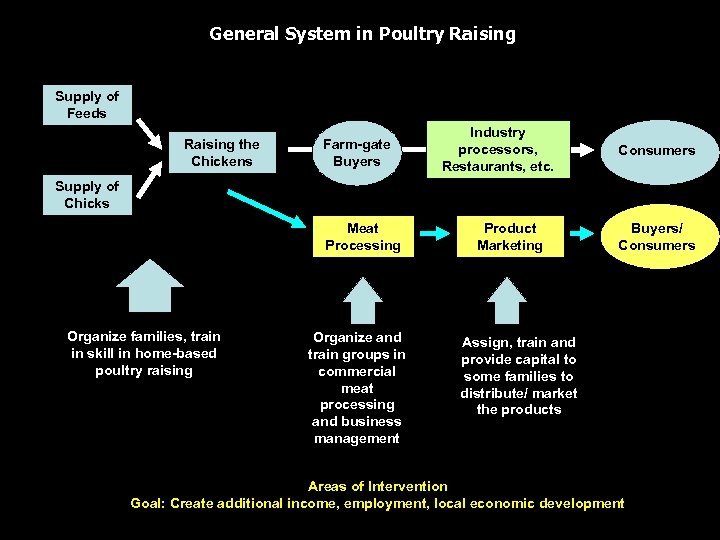 General System in Poultry Raising Supply of Feeds Raising the Chickens Farm-gate Buyers Industry processors, Restaurants, etc. Consumers Supply of Chicks Meat Processing Organize families, train in skill in home-based poultry raising Organize and train groups in commercial meat processing and business management Product Marketing Buyers/ Consumers Assign, train and provide capital to some families to distribute/ market the products Areas of Intervention Goal: Create additional income, employment, local economic development
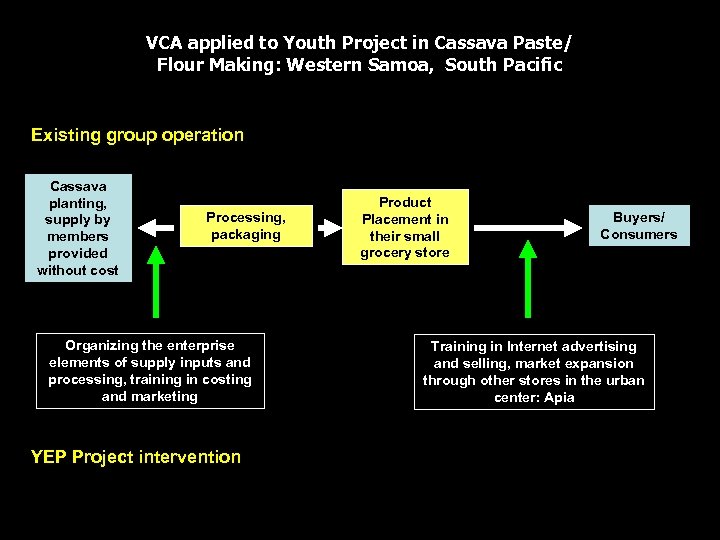 VCA applied to Youth Project in Cassava Paste/ Flour Making: Western Samoa, South Pacific Existing group operation Cassava planting, supply by members provided without cost Processing, packaging Organizing the enterprise elements of supply inputs and processing, training in costing and marketing YEP Project intervention Product Placement in their small grocery store Buyers/ Consumers Training in Internet advertising and selling, market expansion through other stores in the urban center: Apia
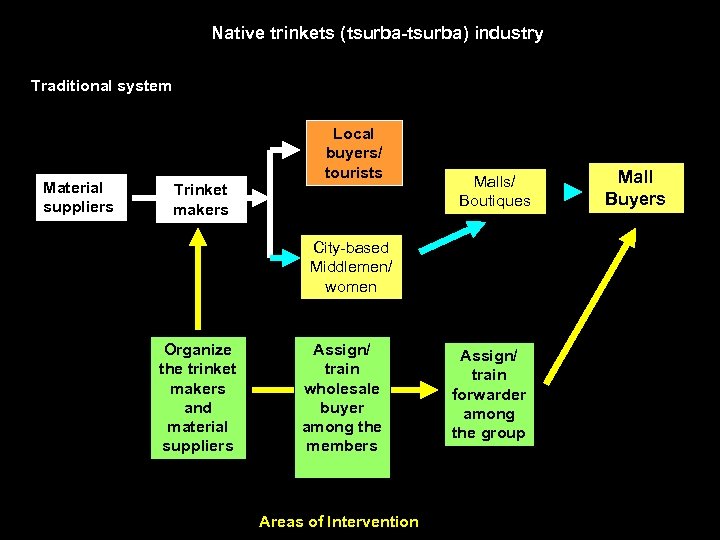 Native trinkets (tsurba-tsurba) industry Traditional system Material suppliers Trinket makers Local buyers/ tourists Malls/ Boutiques City-based Middlemen/ women Organize the trinket makers and material suppliers Assign/ train wholesale buyer among the members Areas of Intervention Assign/ train forwarder among the group Mall Buyers
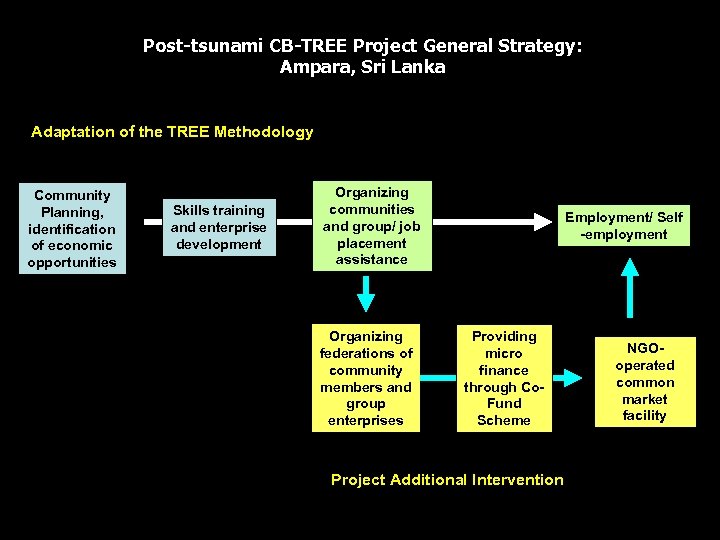 Post-tsunami CB-TREE Project General Strategy: Ampara, Sri Lanka Adaptation of the TREE Methodology Community Planning, identification of economic opportunities Skills training and enterprise development Organizing communities and group/ job placement assistance Organizing federations of community members and group enterprises Employment/ Self -employment Providing micro finance through Co. Fund Scheme Project Additional Intervention NGOoperated common market facility
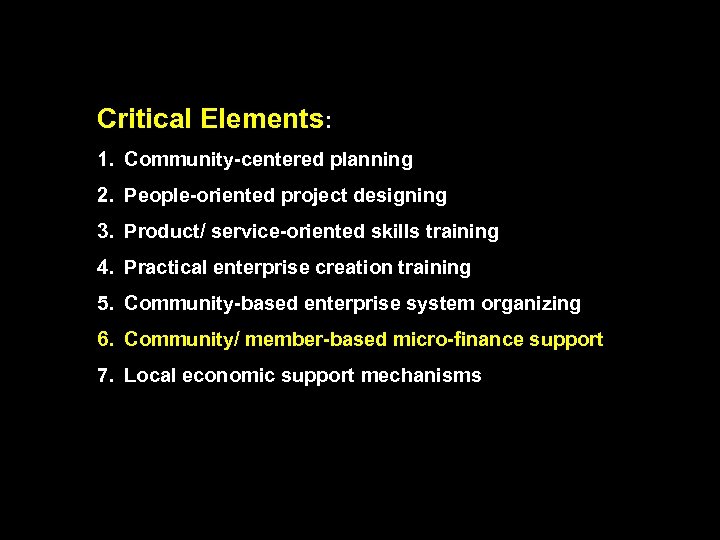 Critical Elements: 1. Community-centered planning 2. People-oriented project designing 3. Product/ service-oriented skills training 4. Practical enterprise creation training 5. Community-based enterprise system organizing 6. Community/ member-based micro-finance support 7. Local economic support mechanisms