


 Скачать презентацию PPP Projects in the Heating Sector Lithuanian Private
7c199c65a8aa3c7650678f54467e842d.ppt
- Количество слайдов: 18
 PPP Projects in the Heating Sector: Lithuanian Private Perspective 2006, November 22 th & 23 rd VILNIUS Jean SACRESTE Lithuania
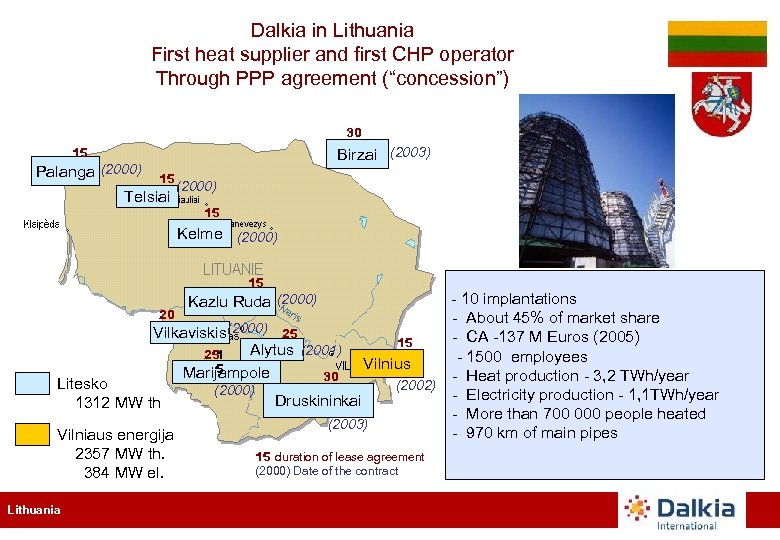 Dalkia in Lithuania First heat supplier and first CHP operator Through PPP agreement (“concession”) 30 15 Palanga (2000) Birzai (2003) 15 Telsiai (2000) 15 Kelme (2000) 15 te r. Kazlu Ruda (2000) 20 Ca Vilkaviskis(2000) 25 Litesko 1312 MW th Vilniaus energija 2357 MW th. 384 MW el. Lithuania - 10 implantations Alytus (2001) 25 1 5 Marijampole 30 (2000) 15 Vilnius Druskininkai (2002) (2003) 15 duration of lease agreement (2000) Date of the contract - About 45% of market share - CA -137 M Euros (2005) - 1500 employees - Heat production - 3, 2 TWh/year - Electricity production - 1, 1 TWh/year - More than 700 000 people heated - 970 km of main pipes
 Two examples of PPP in District Heating Sector in Lithuania, Vilnius and Marijampole: In 2000, was signed lease agreement for 15 years between Litesko (Dalkia) and the municipality of Marijampole. In 2004, the agreement was prolonged by 10 additional years including new commitments for Litesko Vilnius: In 2002, was signed lease agreement for 15 years between Vilniaus energija (Dalkia) and the municipality of Vilnius How and why these contracts fulfilled needs of the two municipalities? First because the form and the spirit of the agreements where ownership stays in public hands and operations in private ones under the control of the Regulator Lithuania
 The « business model » of Dalkia in Lithuania • Lease agreement (concession scheme) 15 to 30 years • Renting of assets to the municipal heating company. Transfer of activity, staff and liabilities • Commitment on investments to modernize and renovate, with commitment to give back assets with, as a minimum, the same book value as it was at the beginning of the contract • Heat tariff indexed on a formula (external index: gas price, inflation, etc…), under the control of Price Commission • Payment of renting fees to cover taxes, cost of control and municipal fee Lithuania
 WHY SUCH A MODEL? Lithuania
 District Heating Network : Types of Management Scheme • Regarding existing DHN many solutions exist: – State or Municipal company, owner of the assets and operator of the facilities – Private company (more frequently after a privatization scheme) – Former Municipal company progressively transformed in an quasi independent company (eg. some German Stadtwerke) – JV between municipality and a private company to create an operating company with or without transfer of ownership of assets to this operating company – Concession to an operator with various solutions regarding commitments on assets (maintenance, renovation, new devices…) Lithuania
 The two main models • In fact all these cases can be summarized in two main models for District Heating: – Privatization – Concession (or lease agreement) • Privatization means that the local authority sells to one company the DHN, assets, commitments, business without term. This privatization can be total or partial; – NB: If local authority keeps more than 50% or golden shares with direct control of operations, it is not really a privatization • • Lithuania Concession means that the local authority transfers to one company the operation of the DHN with some commitments on assets and other aspects NB: We must not make confusion between legal scheme (what kind of transfer) and type of regulation. Inside a privatization scheme, prices and other conditions connected to public service can be (and are) defined
 What are the issues? • Basically, for the local authority, the main questions regarding possible evolution of an existing DHN are: – Does the local authority want to keep the control of operations? – Does the local authority want to keep the ownership of the assets? – How is the situation regarding long term debts and the capacity to invest and to find financing? – What is the long term policy of the local authority regarding infrastructure? – What are the main needs of people supplied by the DHN? – Do exist, outside the issues specific to the DHN, some constraints able to influence choice? Lithuania
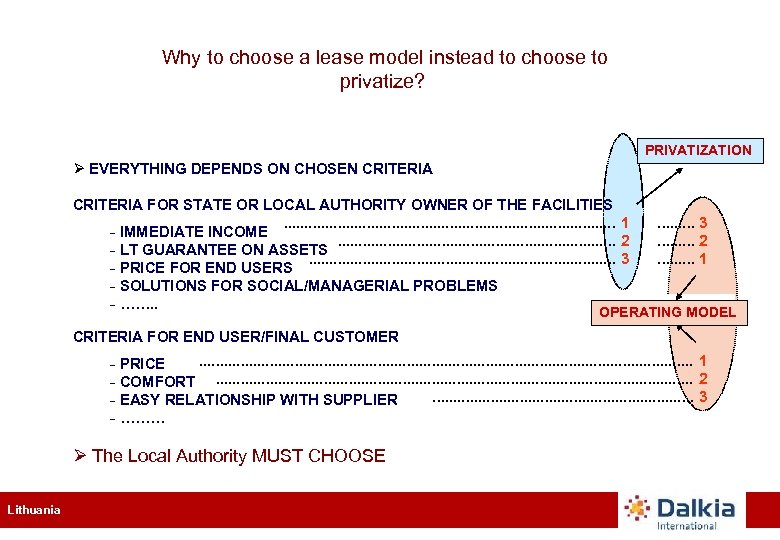 Why to choose a lease model instead to choose to privatize? PRIVATIZATION Ø EVERYTHING DEPENDS ON CHOSEN CRITERIA FOR STATE OR LOCAL AUTHORITY OWNER OF THE FACILITIES. . . . . 1 - IMMEDIATE INCOME. . . . . 2 - LT GUARANTEE ON ASSETS. . . . . 3 - PRICE FOR END USERS - SOLUTIONS FOR SOCIAL/MANAGERIAL PROBLEMS - ……. . . 3. . 2. . 1 OPERATING MODEL CRITERIA FOR END USER/FINAL CUSTOMER. . . . . . . . 1 - PRICE - COMFORT. . . . . . . . 2. . . . 3 - EASY RELATIONSHIP WITH SUPPLIER - ……… Ø The Local Authority MUST CHOOSE Lithuania
 What were the choices of Municipalities? Example of Vilnius In 2001, Vilnius Municipality who were facing more and more issues regarding future and sustainability of its District Heating, chose to launch an international tender for a 15 -year lease agreement, with goal to reach specific targets. - Decreasing of tariff, keeping predictability of future evolution - Keeping ownership of assets and control on them - Securing a modernization plan for the facilities first by focusing on demand side and renewal of the network - Transferring debts and liabilities from municipal budget - Obtaining long term income for the budget All these needs led the municipality to choose a concession scheme similar to what had be done in Marijampole, Alytus, … and in many cities in Europe Lithuania
 WHAT ARE THE ADVANTAGES OF A CONCESSION SCHEME? B Lithuania
 FOR THE COMMUNITY REPRESENTED BY LOCAL AUTHORITY OR DIRECTLY BY THE STATE Ø KEEPS THE OWNERSHIP OF ASSETS - LONG TERM POLICY OF INFRASTRUCTURE - EG: 20 -50 YEAR POLICY VERSUS 15 -25 CONTRACT Ø CAN ENSURE LIMITATION OF PRICES AND THEIR EVOLUTION TO END USERS Ø SETS UP A CLEAR COMMITMENT REGARDING - MEASURABLE RESULTS - INVESTMENTS (LONG TERM PLAN, REORIENTATIONS AND EVOLUTIONS, …) Ø TRANSFERS MANAGEMENT OF DAY-TO-DAY OPERATIONS TO A PRIVATE OPERATOR, INCLUDING STAFF ISSUES (MOTIVATIONS, ADJUSTMENTS, CAREER EVOLUTION, …) Ø RECEIVE A RENTAL FEE OR EQUIVALENT Ø AT THE END OF THE CONTRACT GETS BACK A “RENEWED” PUBLIC SERVICE COMPANY WITH INCREASED VALUE ON THE MARKET Lithuania
 FOR THE END USER Ø GETS POSITIVE IMPACT ON LEVEL OF PRICES. (IN VILNIUS HEAT PRICE FOR INHABITANTS WAS IMMEDIATELY DECREASED BY 5%) Ø GETS TRANSPARENCY OF PRICES AND THEIR EVOLUTION Ø HAS A COUNTERPART FOR ANY CLAIM OR INSATISFACTION - CHANGES HIS STATUS FROM USER TO CLIENT Ø PAYS FOR A SERVICE, NOT A TAX FOR THE REGULATORS Ø GLOBALLY THEY KEEP THE SAME ROLES AND RESPONSIBILITIES, MAYBE WITH ADDITIONAL DEGREES OF FREEDOM TO CONTROL PRICES AND INVESTMENTS Lithuania
 FOR THE PRIVATE OPERATOR Ø OPERATES A LONG TERM CONTRACT ON CLEAR BASES ALLOWING TO MANAGE PROFIT THROUGH IMPROVEMENT OF EFFICIENCY AND PRODUCTIVITY Ø KNOWS HIS COMMITMENTS AND CAN PLANIFY HIS ACTION Ø HAS A DIRECT RELATIONSHIP WITH END USER Ø DOES NOT “BUY” HIS CONTRACT. THUS CAN HAVE A NORMAL PROFIT : NO NEED TO INCREASE PRICES IN ORDER TO FINANCE THE PURCHASING COST [ CF. CRITERIA ABOVE ] – NO RETURN ON EQUITY Lithuania
 KEY FACTORS TO SUCCESS ØPOLITICAL DECISION ØCLEAR AND TRANSPARENT TENDERING PROCESS ØCLEAR DEFINITION OF GOALS AND RESPONSIBILITIES OF PARTNERS ØEFECTIVE MECHANISM TO SOLVE DISPUTES ØBALANCE OF INTERESTS BETWEEN PRIVATE OPERATOR, LOCAL AUTHORITIES AND CONSUMERS Lithuania
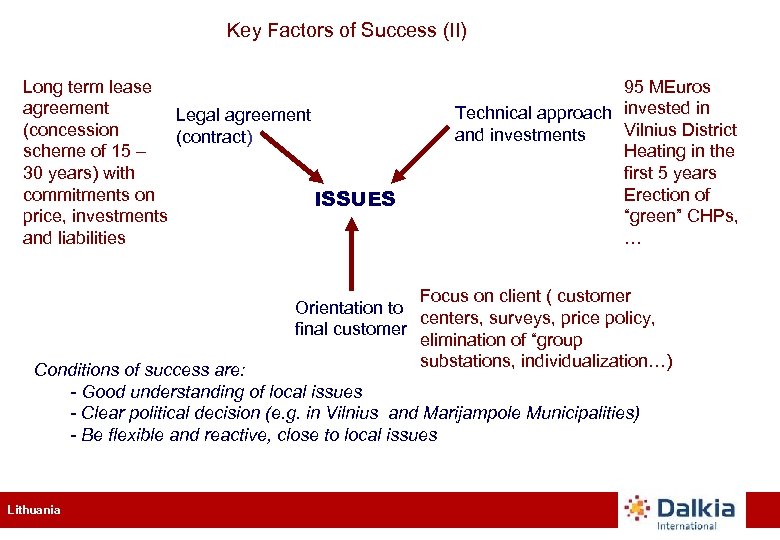 Key Factors of Success (II) Long term lease agreement Legal agreement (concession (contract) scheme of 15 – 30 years) with commitments on ISSUES price, investments and liabilities 95 MEuros Technical approach invested in Vilnius District and investments Heating in the first 5 years Erection of “green” CHPs, … Focus on client ( customer Orientation to centers, surveys, price policy, final customer elimination of “group substations, individualization…) Conditions of success are: - Good understanding of local issues - Clear political decision (e. g. in Vilnius and Marijampole Municipalities) - Be flexible and reactive, close to local issues Lithuania
 And now, what will be? After seven years of quasi stability of heat prices, Lithuania faces a new issue, the dramatic increase in gas cost: +45% in January 2006 A similar increase planned for 2007 and 2008 (maybe more !) That implies investments for diversifying fuels (around 19% of fuels for heating are from biomass) and increasing efficiency (development of CHP connected to district heating, reduction of heat losses, individualization of heating at flat level, …) We need operators focusing on solutions. PPP will be a good tool to mobilize funds and to realize efficient investments for future infrastructure through clear commitments Coupled with a policy of improvement of building insulation, we can reach a double target: increasing independency from Russian gas and decreasing in heat cost for inhabitants Lithuania
 CONCLUSION Experience of Dalkia in District Heating in Lithuania proved that PPP could be a prospective and efficient solution It allows a cooperation between local authorities in charge of long term infrastructure policy and a private operator aimed to renew this infrastructure in the most efficient way strongly, oriented towards clients It supposes common view on goals and targets with clear milestones … it is not the easiest way, we think it is a good one Lithuania