


 Скачать презентацию PPDR Communications A NATO Perspective Dr Michael Street
9e3ec8359dde6ee8d2daa26938a25571.ppt
- Количество слайдов: 34
 PPDR Communications: A NATO Perspective Dr Michael Street 1 NATO Command, Control and Consultation Agency NATO UNCLASSIFIED
 NATO • NATO - 19 nations • The fundamental role of NATO is to safeguard the freedom and security of its member countries. It is one of the foundations on which the stability and security of the Euro-Atlantic area depends and it serves as an essential forum for transatlantic consultations on matters affecting the vital security interests of all its members. Its first task is to deter and defend against any threat of aggression against any of them. • In order to improve security and stability in the area, the North Atlantic Alliance also plays a key role in the field of crisis management, by contributing to effective conflict prevention and, in the event of a crisis, by taking appropriate action to resolve the crisis when there is consensus among the member countries to do so. 2 NATO UNCLASSIFIED
 Introduction • NATOs Civil Emergency Planning Role • NATO C 3 Agency • Public Protection and Disaster Relief Scenarios • Military use of civil technology for PPDR • Military contribution to civil technology and standards 3 NATO UNCLASSIFIED
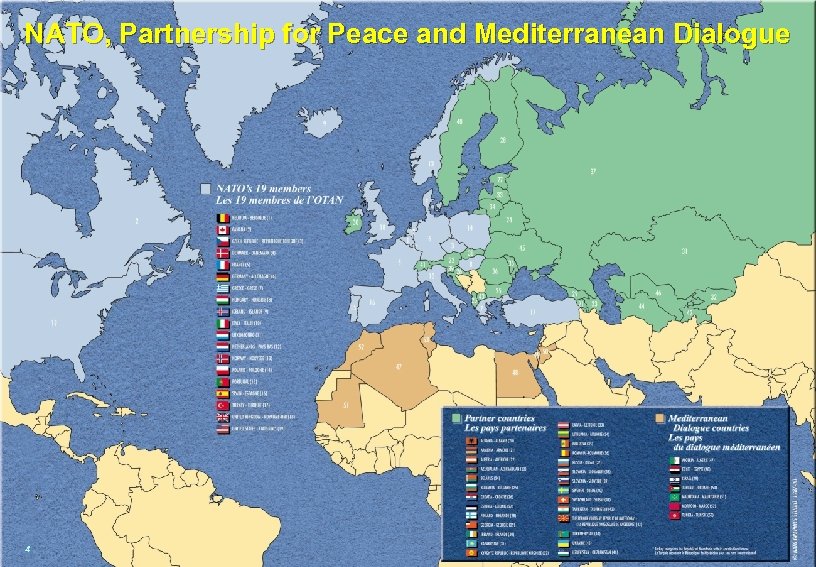 NATO, Partnership for Peace and Mediterranean Dialogue 4 NATO UNCLASSIFIED
 PPDR Regional Activities: NATO, the North Atlantic Region and beyond • Partnership for Peace - 27 nations • NATO + Pf. P = Euro-Atlantic Partnership Council (EAPC) • Euro-Atlantic Disaster Response Coordinating Centre (EARDCC) • Mediterranean Dialogue - 7 nations • Algeria, Egypt, Israel, Jordan, Mauritania, Morocco and Tunisia. • Security in Europe is closely linked to security in the Mediterranean region • http: //www. nato. int/med-dial/home. htm • . . and beyond the North Atlantic • Pacific nations co-operate with NATO, particularly for crisis response 5 NATO UNCLASSIFIED
 NATO’s Third Dimension • First and Second dimensions of NATO • “The fundamental roles of NATO have always been concerned with security cooperation between member countries and, in more recent years, with Partner countries, in the political and defence fields. These have therefore been regarded as the first and second "dimensions" of the Alliance. ” • Third dimension • Scientific and environmental co-operation • Responding to civil emergencies 6 NATO UNCLASSIFIED
 Civil Emergency Planning (CEP) in NATO • . . to coordinate civil planning efforts for using a nations civil capabilities (communications included) for the 5 roles of NATO CEP • civil support for Alliance Military operations under article 5; • support for non article 5 crisis response operations; • support for national authorities in civil emergencies; • protection populations against. . weapons of mass destruction; • co-operation with partners. • Civil communications planning in NATO • reviews existing civil communications • determines suitability to meet requirements of the Alliance (political, military and civil) • recommends (to the nations). . considering new and emerging technology, the role of international organisations in the civil communications field and national legislation and arrangements. 7 NATO UNCLASSIFIED
 Civil Communications Planning in NATO • Civil communications • Public telecommunications services - public, leased, postal • Excludes military communications assets • Activities • International Emergency Preference scheme – NATO CEP initiative – NATO initiative now offered to ITU • Agreed NATO CEP documents on • Use of network management in crises • Mobile cellular systems • Co-operation with International organisations • Civil Communications Planning • aims to have civil communications sectors available for all vital, civil and military users if required. 8 NATO UNCLASSIFIED
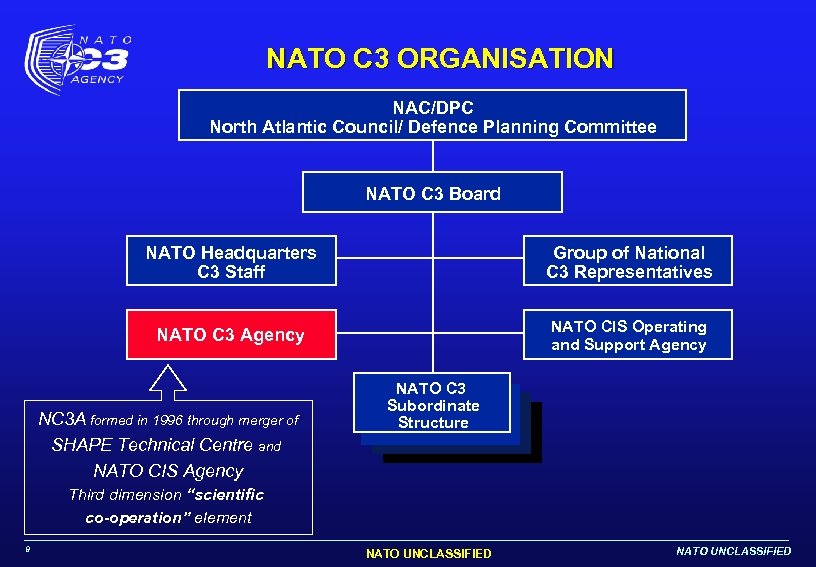 NATO C 3 ORGANISATION NAC/DPC North Atlantic Council/ Defence Planning Committee NATO C 3 Board NATO Headquarters C 3 Staff Group of National C 3 Representatives NATO C 3 Agency NATO CIS Operating and Support Agency NC 3 A formed in 1996 through merger of SHAPE Technical Centre and NATO CIS Agency NATO C 3 Subordinate Structure Third dimension “scientific co-operation” element 9 NATO UNCLASSIFIED
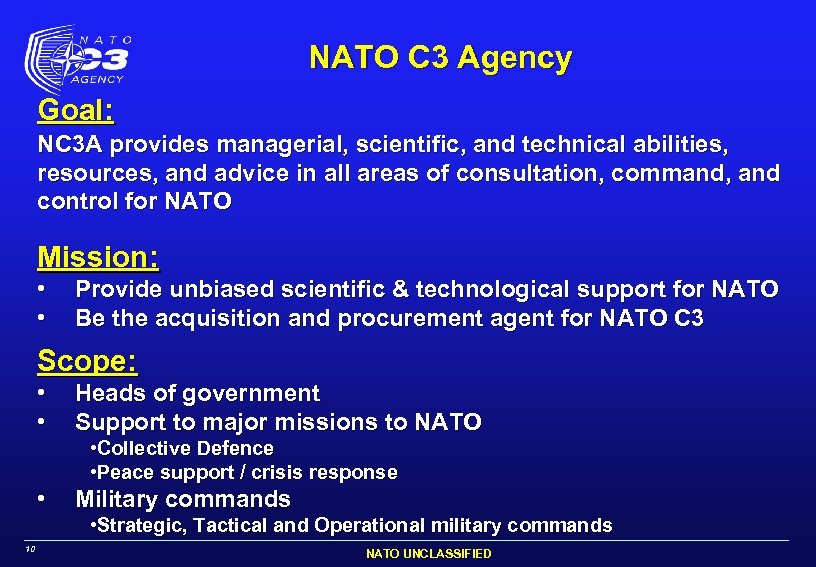 NATO C 3 Agency Goal: NC 3 A provides managerial, scientific, and technical abilities, resources, and advice in all areas of consultation, command, and control for NATO Mission: • • Provide unbiased scientific & technological support for NATO Be the acquisition and procurement agent for NATO C 3 Scope: • • Heads of government Support to major missions to NATO • Collective Defence • Peace support / crisis response • Military commands • Strategic, Tactical and Operational military commands 10 NATO UNCLASSIFIED
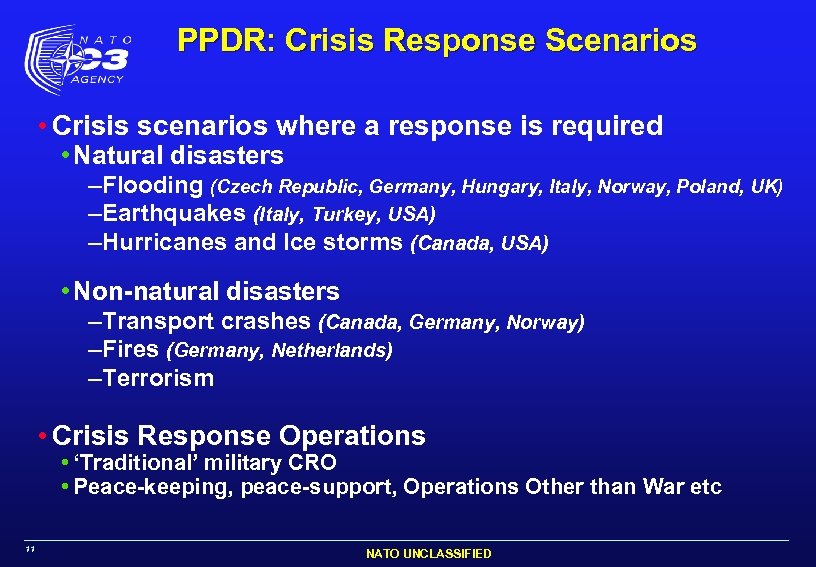 PPDR: Crisis Response Scenarios • Crisis scenarios where a response is required • Natural disasters –Flooding (Czech Republic, Germany, Hungary, Italy, Norway, Poland, UK) –Earthquakes (Italy, Turkey, USA) –Hurricanes and Ice storms (Canada, USA) • Non-natural disasters –Transport crashes (Canada, Germany, Norway) –Fires (Germany, Netherlands) –Terrorism • Crisis Response Operations • ‘Traditional’ military CRO • Peace-keeping, peace-support, Operations Other than War etc 11 NATO UNCLASSIFIED
 Military and Civil Communications • In all previous disaster scenarios the military has been involved to support civil emergency services in a co-ordinated manner • In ‘traditional’ CRO, military works with NGOs, local services etc • Communications between military and civil emergency services are vital • Both have effective individual communications systems - the interface between is vital 12 NATO UNCLASSIFIED
 Effect of Disasters on Telecoms • Area affected • Natural - widespread • Man-made - limited • Effect of disaster on communications • Fixed line –Congestion and/or disruption • Radio –Congestion and/or disruption –Loss of power –Loss of infrastructure –Priority mechanisms utilised occasionally – From Euro-Atlantic Partnership Council, Civil Communications Planning Committee (N/EAPC U) 13 NATO UNCLASSIFIED
 Emergency Telecoms: What is needed to overcome disaster effects • Communications system requirements: • Rapidly deployable • Easy to use –no time for operator training • Self supporting • Interconnected to other networks • High capacity –Congestion is a recurring problem in many emergency scenarios 14 NATO UNCLASSIFIED
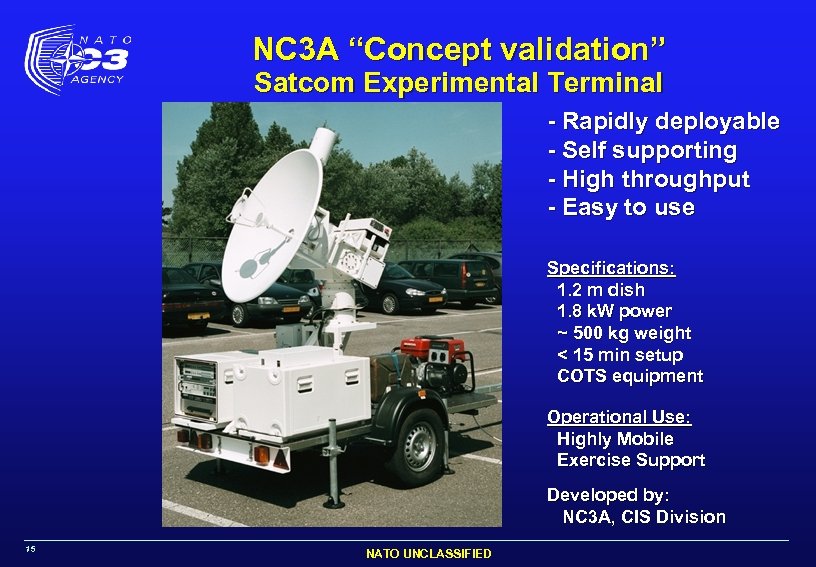 NC 3 A “Concept validation” Satcom Experimental Terminal - Rapidly deployable - Self supporting - High throughput - Easy to use Specifications: 1. 2 m dish 1. 8 k. W power ~ 500 kg weight < 15 min setup COTS equipment Operational Use: Highly Mobile Exercise Support Developed by: NC 3 A, CIS Division 15 NATO UNCLASSIFIED
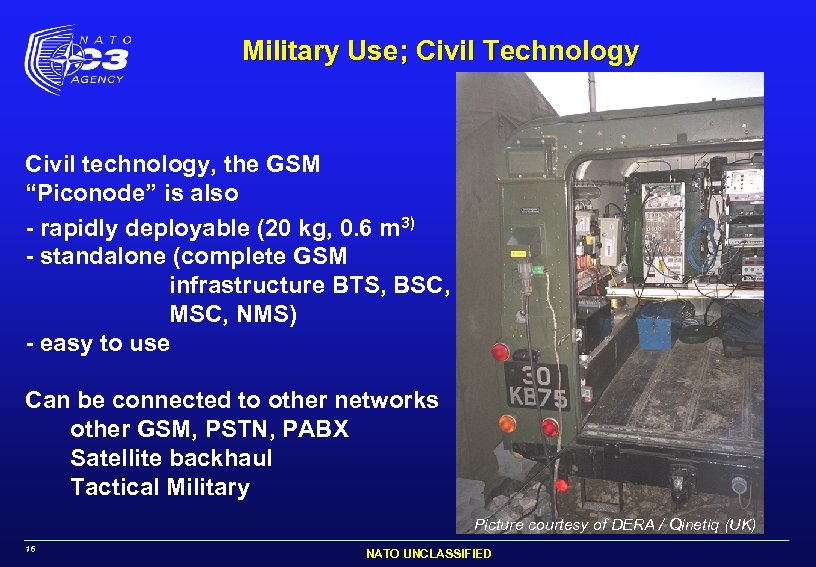 Military Use; Civil Technology Civil technology, the GSM “Piconode” is also - rapidly deployable (20 kg, 0. 6 m 3) - standalone (complete GSM infrastructure BTS, BSC, MSC, NMS) - easy to use Can be connected to other networks other GSM, PSTN, PABX Satellite backhaul Tactical Military Picture courtesy of DERA / Qinetiq (UK) 16 NATO UNCLASSIFIED
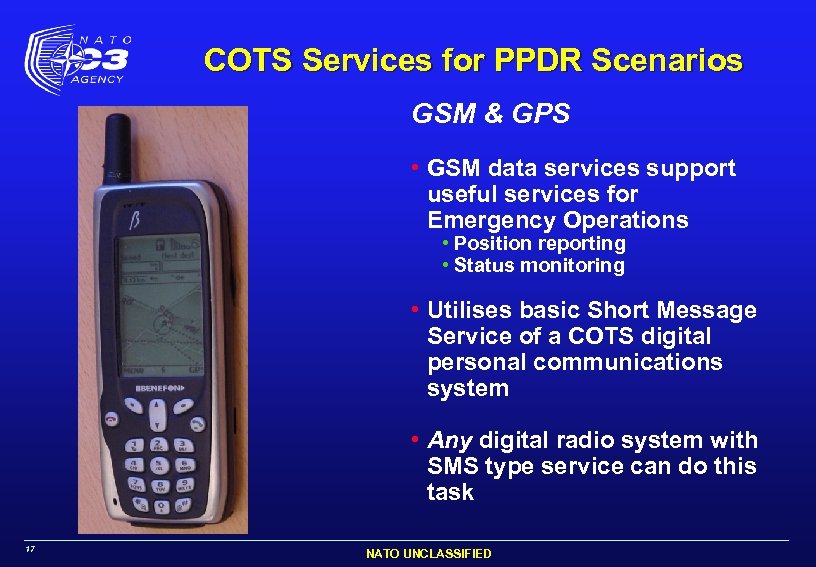 COTS Services for PPDR Scenarios GSM & GPS • GSM data services support useful services for Emergency Operations • Position reporting • Status monitoring • Utilises basic Short Message Service of a COTS digital personal communications system • Any digital radio system with SMS type service can do this task 17 NATO UNCLASSIFIED
 Reasons against “deployed” GSM • Security • No end-to-end encryption • Services don’t always match requirements • GSM not designed for Command & Control use …. . but other Professional Mobile Radio systems were • Spectrum • Frequency allocation • GSM bands usually licensed to commercial operators • So, GSM is not necessarily the best choice if deploying own infrastructure. • But it is VERY good if you want to use existing infrastructure 18 NATO UNCLASSIFIED
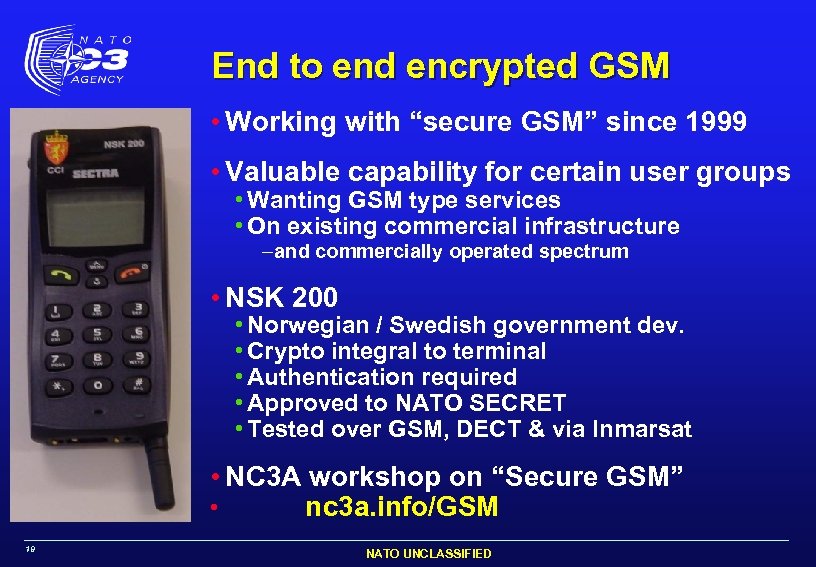 End to end encrypted GSM • Working with “secure GSM” since 1999 • Valuable capability for certain user groups • Wanting GSM type services • On existing commercial infrastructure – and commercially operated spectrum • NSK 200 • Norwegian / Swedish government dev. • Crypto integral to terminal • Authentication required • Approved to NATO SECRET • Tested over GSM, DECT & via Inmarsat • NC 3 A workshop on “Secure GSM” • nc 3 a. info/GSM 19 NATO UNCLASSIFIED
 NC 3 A PCS Study • GSM is one part of a wider NC 3 A programme to: • Study all available Personal Communications Systems • terrestrial, satcom, COTS & GOTS - includes GSM • Evaluate for use against a detailed Crisis Response scenario • Match for suitability • users e. g. military, policing, NGOs, VSOs • applications e. g. speech, location, data, video • tasks e. g. liaison, reconnaissance • phases e. g. initial deployment to long-term peace support – 2+ year lifespan 20 NATO UNCLASSIFIED
 TETRA - Military Services; Civil Standard · Developed for Public Safety & Security with C 3 features · Group Communication • Direct Mode Operation (when no infrastructure) • Emergency facilities (call priorities & preemption) • Dispatching • TETRA services @ Combat Net Radio features • has many large, security conscious user groups – Large user groups -- COTS equipment • Spectrum • Operates in Military UHF band • Spectrum efficient – Military UHF allocation is mainly 25 k. Hz A-G-A 21 NATO UNCLASSIFIED
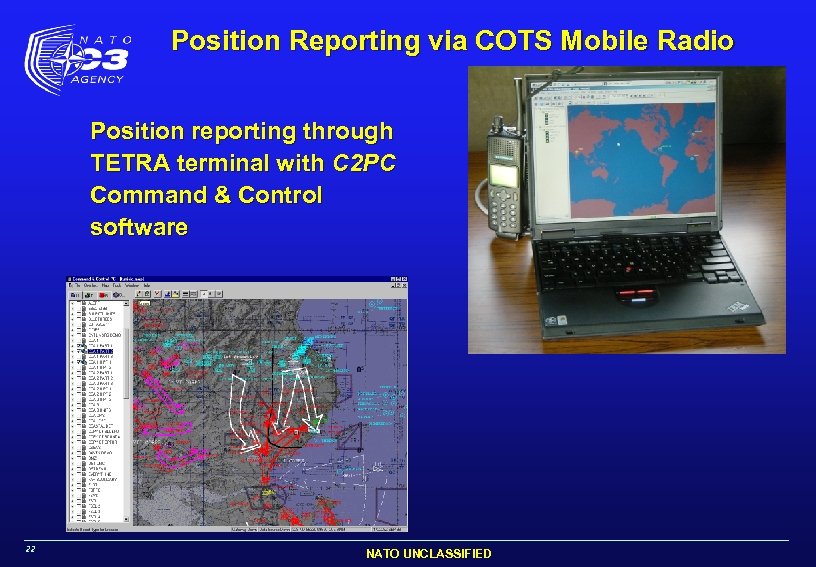 Position Reporting via COTS Mobile Radio Position reporting through TETRA terminal with C 2 PC Command & Control software 22 NATO UNCLASSIFIED
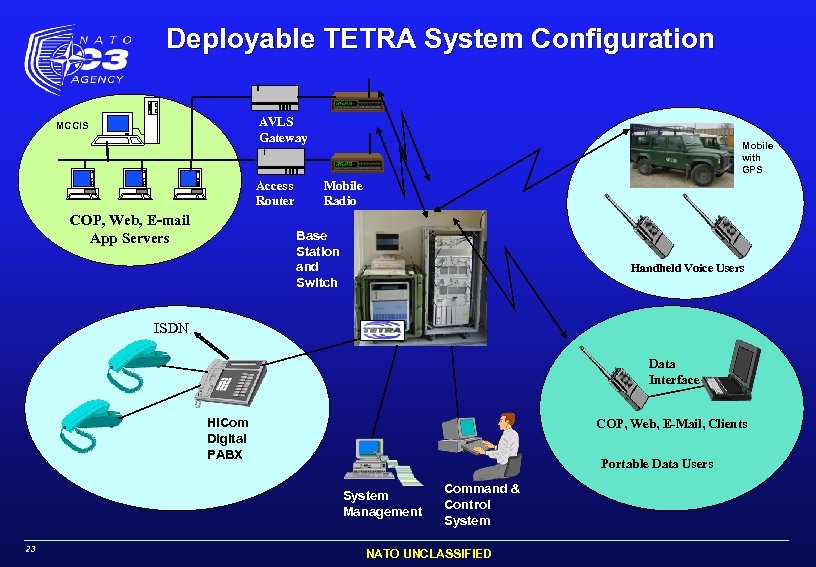 Deployable TETRA System Configuration AVLS Gateway MCCIS Access Router COP, Web, E-mail App Servers Mobile with GPS Mobile Radio Base Station and Switch Handheld Voice Users ISDN Data Interface Hi. Com Digital PABX COP, Web, E-Mail, Clients Portable Data Users System Management 23 Command & Control System NATO UNCLASSIFIED
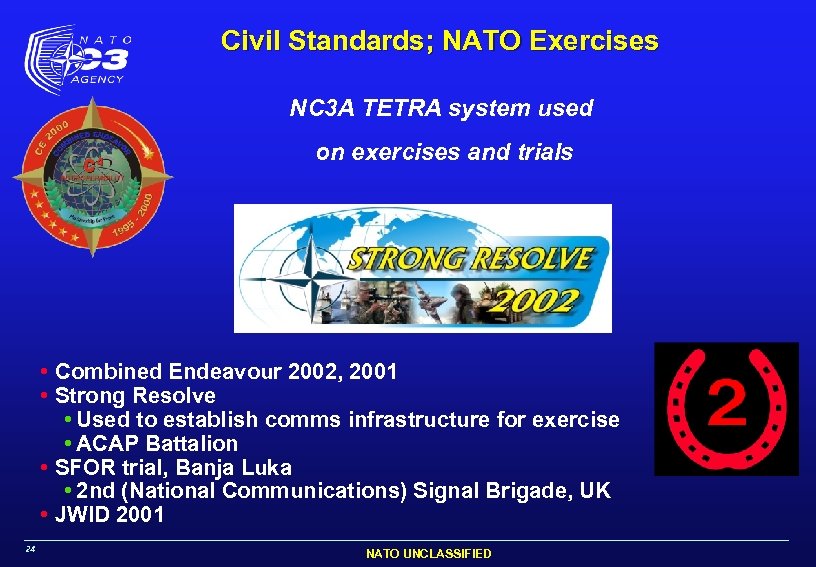 Civil Standards; NATO Exercises NC 3 A TETRA system used on exercises and trials • Combined Endeavour 2002, 2001 • Strong Resolve • Used to establish comms infrastructure for exercise • ACAP Battalion • SFOR trial, Banja Luka • 2 nd (National Communications) Signal Brigade, UK • JWID 2001 24 NATO UNCLASSIFIED
 NC 3 A Trial Results • Easy to deploy • Setup time approx 15 mins • Easy to use • Users like it • Basic services meet users needs • Group calls, low rate data etc • Range governed by terrain • Limitation is laws of physics, not technology 25 NATO UNCLASSIFIED
 Secure Voice Communications • Military and many public safety users want secure speech services • In emergency scenarios public safety users may want privacy from media • Security against eavesdropping and disruption • Must consider and protect against emergencies where cause is deliberate • Unprotected communications leaves rescuers vulnerable • Air interface and end-to-end encryption • Authentication • Key management • Users still want interoperability - securely 26 NATO UNCLASSIFIED
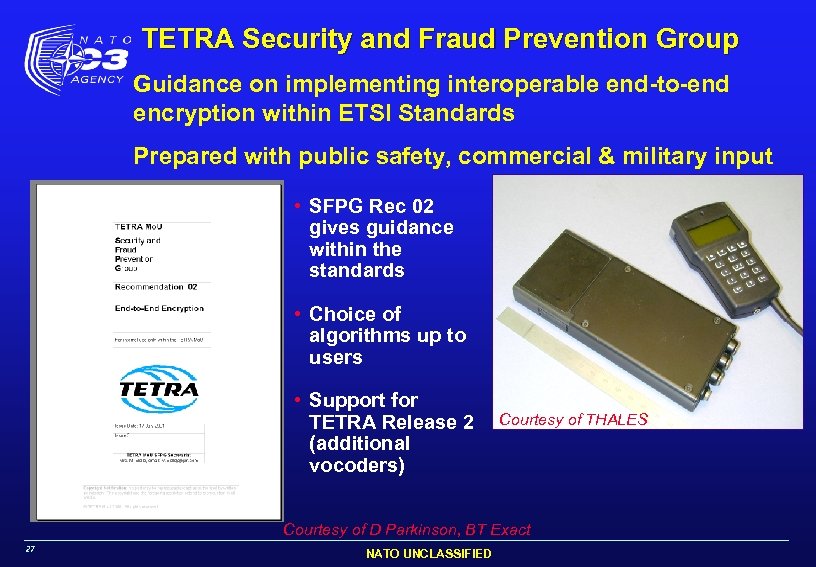 TETRA Security and Fraud Prevention Group Guidance on implementing interoperable end-to-end encryption within ETSI Standards Prepared with public safety, commercial & military input • SFPG Rec 02 gives guidance within the standards • Choice of algorithms up to users • Support for TETRA Release 2 (additional vocoders) Courtesy of THALES Courtesy of D Parkinson, BT Exact 27 NATO UNCLASSIFIED
 Avoiding Congestion • Congestion is a problem in emergency scenarios • Frequency congestion and allocation is affected by throughput requirements • affected by amount and type of traffic • Military is used to minimising throughput for low capacity channels • New NATO voice coder –Same speech intelligibility as COTS professional radio systems –At least half the throughput requirements –Works in noisy environments –Interoperability 28 NATO UNCLASSIFIED
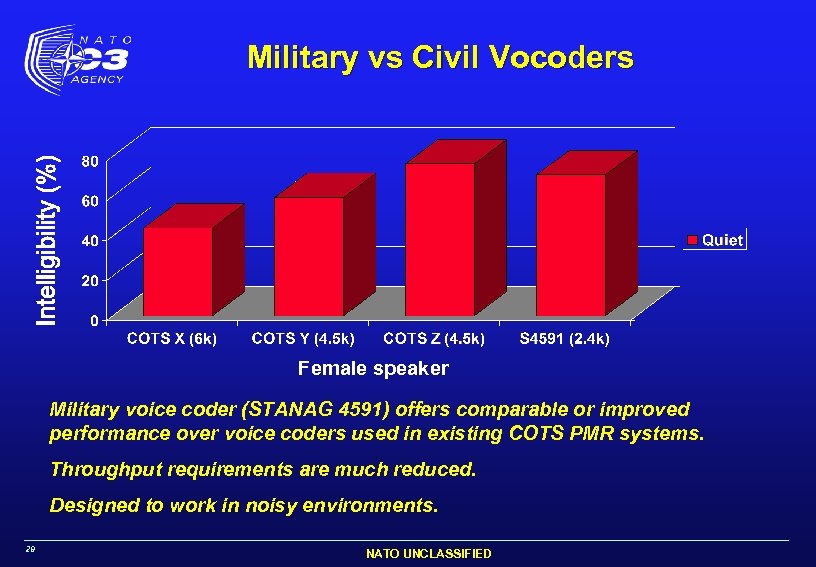 Military vs Civil Vocoders Female speaker Military voice coder (STANAG 4591) offers comparable or improved performance over voice coders used in existing COTS PMR systems. Throughput requirements are much reduced. Designed to work in noisy environments. 29 NATO UNCLASSIFIED
 Further information on STANAG 4591 Stanag 4591 test and selection process Street MD and Collura JS, “The test and selection of the future NATO narrow band voice coder”, RCMCIS - NATO Regional Conference on Military CIS, Warsaw, Zegrze, October 2001. http: //nc 3 a. info/Voice/mds_nc 3 a_nbvc. shtml MELPe: the selected voice coder Collura JS and Rahikka DJ, “Interoperable secure voice communications in tactical systems, IEE coll. on Speech coding algorithms for radio channels, London, February 2000. An overview of the MELP voice coder and its use in military environments http: //www. iee. org/On. Comms/pn/communications Collura JS, Rahikka DJ, Fuja TE, Sridhara D and Fazel T, “Error coding strategies for MELP vocoder in wireless and ATM environments”, IEE coll. on Speech coding algorithms for radio channels, London, February 2000. Performance of MELP with a variety of different error correction mechanisms http: //www. iee. org/On. Comms/pn/communications NC 3 A’s STANAG 4591 Server http: //s 4591. nc 3 a. nato. int 30 NATO UNCLASSIFIED
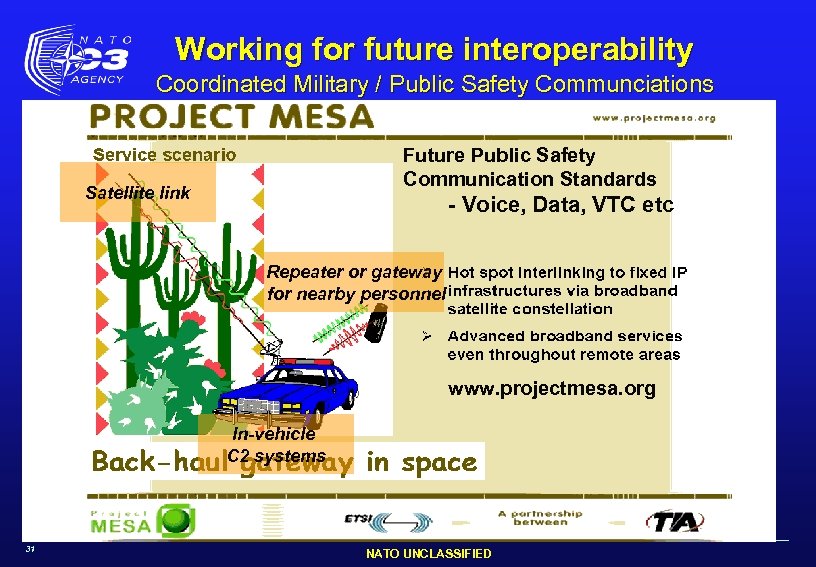 Working for future interoperability Coordinated Military / Public Safety Communciations Future Public Safety Communication Standards Satellite link - Voice, Data, VTC etc Repeater or gateway for nearby personnel www. projectmesa. org In-vehicle C 2 systems 31 NATO UNCLASSIFIED
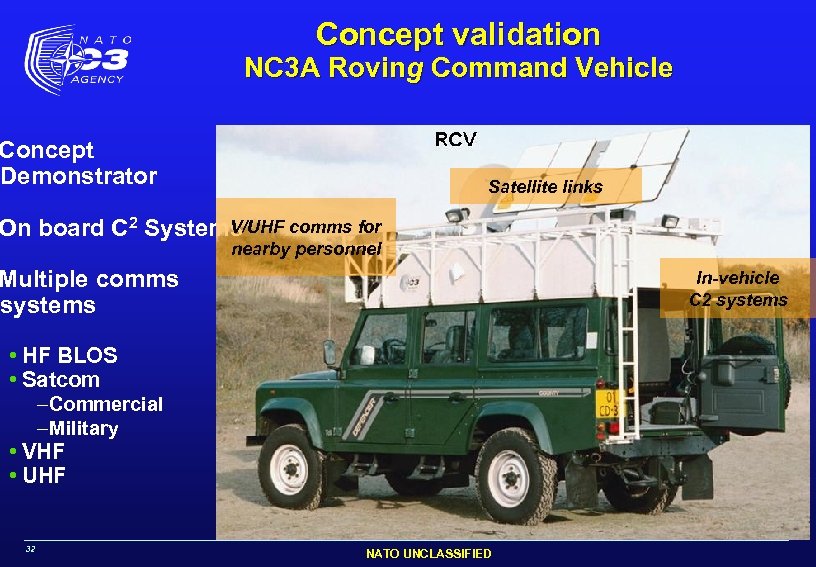 Concept validation NC 3 A Roving Command Vehicle Concept Demonstrator Satellite links V/UHF comms for On board C 2 Systems nearby personnel Multiple comms systems In-vehicle C 2 systems • HF BLOS • Satcom – Commercial – Military • VHF • UHF 32 NATO UNCLASSIFIED
 Summary I • Military forces work with public safety in emergencies • NATO is prepared for this role – NATO Civil Communications Planning Committee • Often NATO works with many other nations operating under a UN mandate – http: //www. nato. int/sfor/docu/d 981116 a. htm • Current crises require combined responses • Multi-national components • Needs effective, secure communications • CIS equipment from diverse sources • Technical interoperability • Interoperability isn’t just technical • technical problems will prevent it – technical interoperability does not guarantee operational interoperability 33 NATO UNCLASSIFIED
 Summary II • COTS equipment can meet military requirements • For scenarios such as PPDR and crisis response operations • Cost benefits of using COTS equipment • Standardisation can aid interoperability • Between national components, local services and others • NC 3 A is working with civil standards organisations to: • Get military requirements into standards definition • bring military expertise and technology to civil systems 34 NATO UNCLASSIFIED