 Скачать презентацию PPCS Safety and Environmental Analysis presented by Neill
c1d632d6dada5ee96e8dbcb2a8cfd99d.ppt
- Количество слайдов: 36



PPCS Safety and Environmental Analysis presented by Neill P. Taylor EURATOM/UKAEA Fusion Association Culham Science Centre Work performed by EURATOM Associations and European industry, including: ENEA, UKAEA, VR Studsvik, FZK, TEKES EFET-Belgatom, EFET-Framatome ANP, EFET-Ibertef, University of Pisa Japan/US workshop on Fusion Power Plants, with EU participation, 11 -13 January 2005, Tokyo
Outline n Neutron activation calculations n Accident analyses n Bounding accident modelling n Maximum public doses n Waste categorisation n Conclusions Japan/US workshop on Fusion Power Plants, with EU participation, 11 -13 January 2005, Tokyo
Neutron activation modelling n Complete knowledge of activation and related quantities essential for S&E assessment – source term for potential release in accident scenarios – origin of occupational radiation exposure – long-term activation and waste management issues n Computation for all PPCS models using 3 -D geometry – MCNP 4 C 3 calculations of 175 -group neutron spectra in all cells of 3 -D model out to TF coils – FISPACT calculation of inventories, activation and derived quantities (dose rates, decay heat, clearance index etc. ) • in every cell • at various decay times up to 10, 000 years – Calculations supervised by in-house code system HERCULES Japan/US workshop on Fusion Power Plants, with EU participation, 11 -13 January 2005, Tokyo
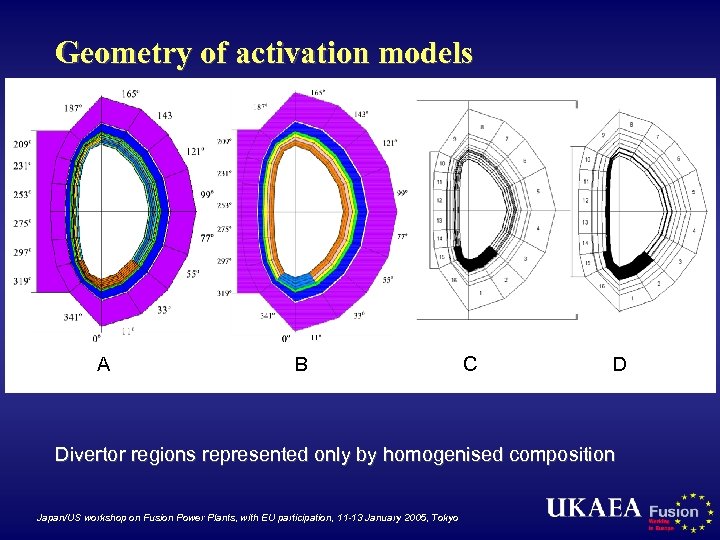
Geometry of activation models A B C D Divertor regions represented only by homogenised composition Japan/US workshop on Fusion Power Plants, with EU participation, 11 -13 January 2005, Tokyo
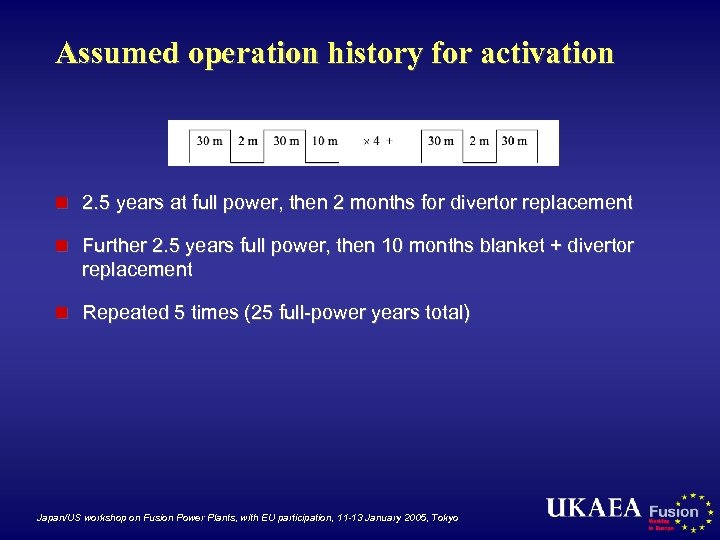
Assumed operation history for activation n 2. 5 years at full power, then 2 months for divertor replacement n Further 2. 5 years full power, then 10 months blanket + divertor replacement n Repeated 5 times (25 full-power years total) Japan/US workshop on Fusion Power Plants, with EU participation, 11 -13 January 2005, Tokyo
Model B activation - inboard midplane Japan/US workshop on Fusion Power Plants, with EU participation, 11 -13 January 2005, Tokyo
Model B activation - poloidal variation Japan/US workshop on Fusion Power Plants, with EU participation, 11 -13 January 2005, Tokyo
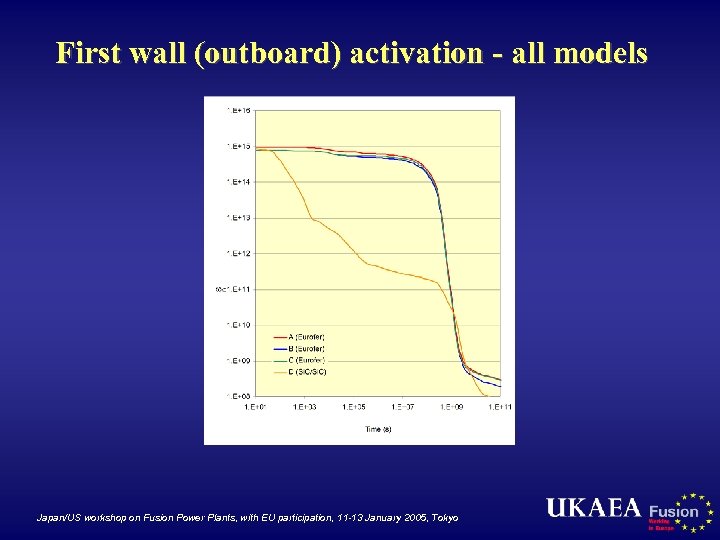
First wall (outboard) activation - all models Japan/US workshop on Fusion Power Plants, with EU participation, 11 -13 January 2005, Tokyo
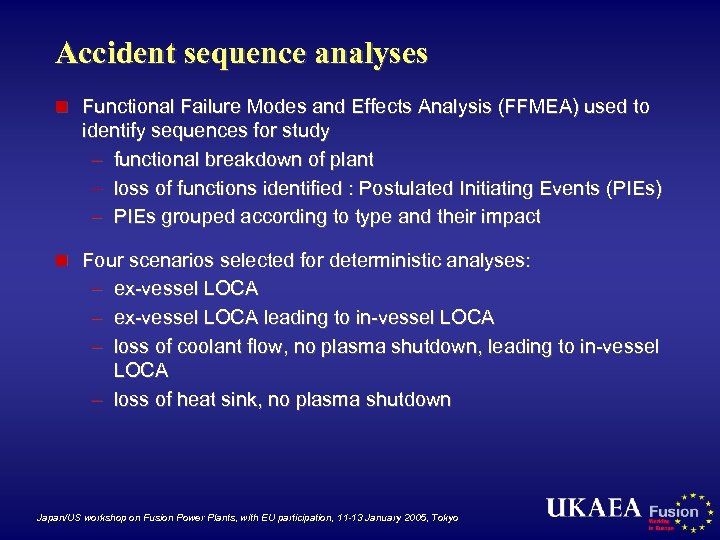
Accident sequence analyses n Functional Failure Modes and Effects Analysis (FFMEA) used to identify sequences for study – functional breakdown of plant – loss of functions identified : Postulated Initiating Events (PIEs) – PIEs grouped according to type and their impact n Four scenarios selected for deterministic analyses: – – – ex-vessel LOCA leading to in-vessel LOCA loss of coolant flow, no plasma shutdown, leading to in-vessel LOCA – loss of heat sink, no plasma shutdown Japan/US workshop on Fusion Power Plants, with EU participation, 11 -13 January 2005, Tokyo
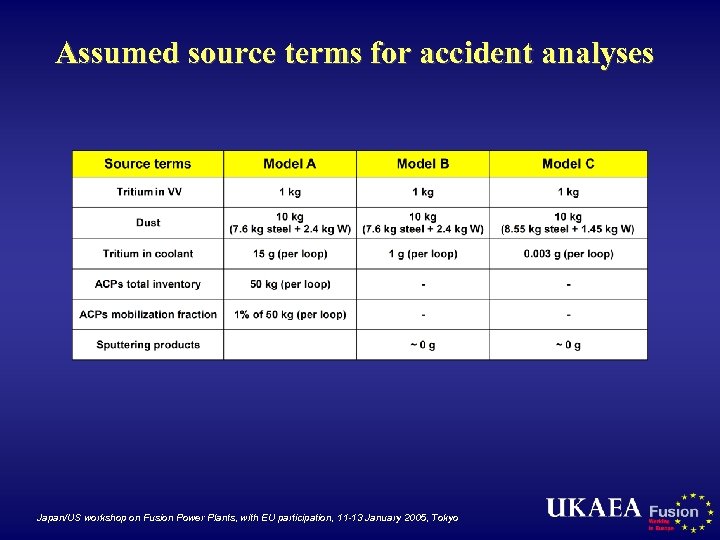
Assumed source terms for accident analyses Japan/US workshop on Fusion Power Plants, with EU participation, 11 -13 January 2005, Tokyo
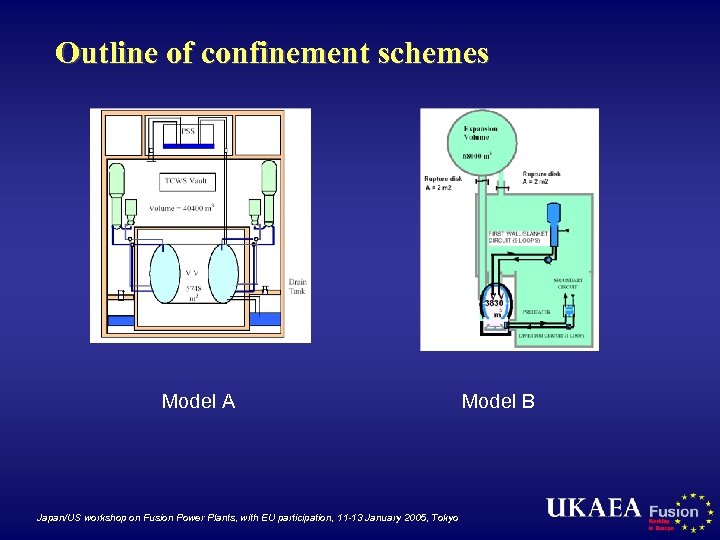
Outline of confinement schemes Model A Japan/US workshop on Fusion Power Plants, with EU participation, 11 -13 January 2005, Tokyo Model B
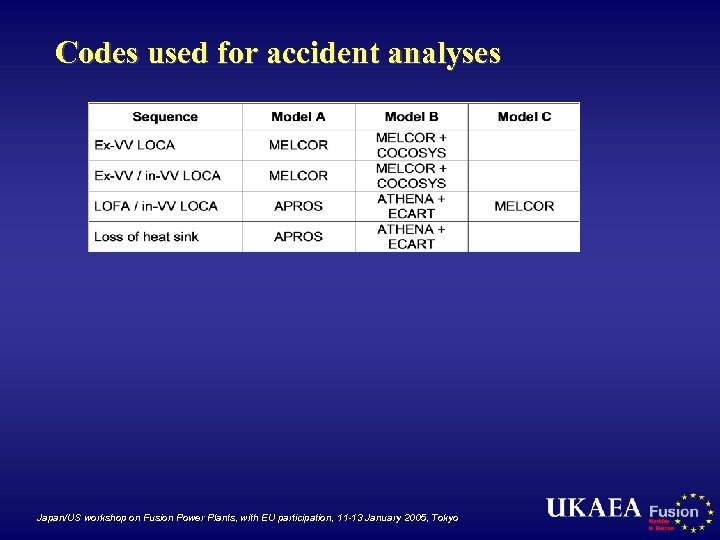
Codes used for accident analyses Japan/US workshop on Fusion Power Plants, with EU participation, 11 -13 January 2005, Tokyo
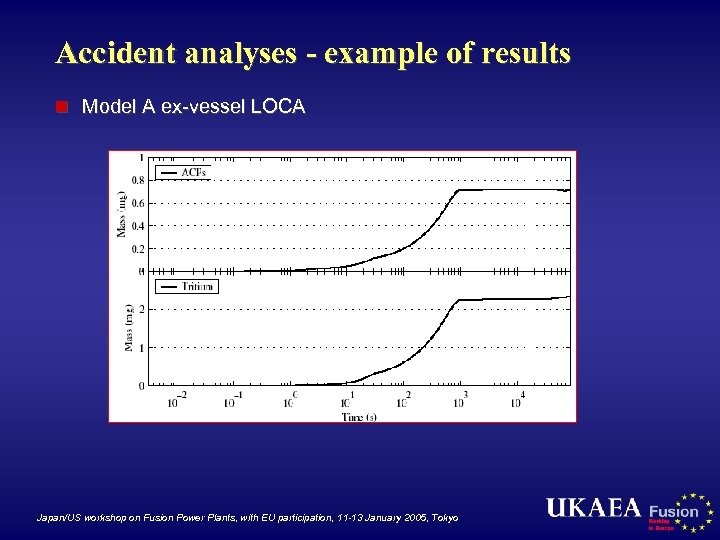
Accident analyses - example of results n Model A ex-vessel LOCA Japan/US workshop on Fusion Power Plants, with EU participation, 11 -13 January 2005, Tokyo
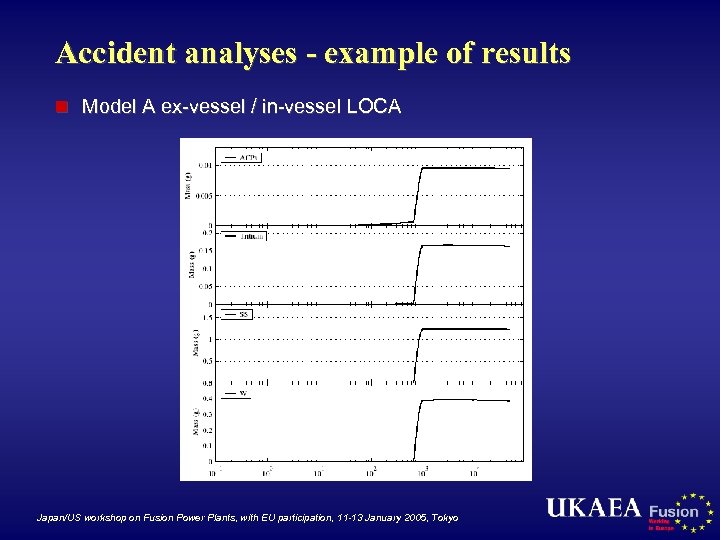
Accident analyses - example of results n Model A ex-vessel / in-vessel LOCA Japan/US workshop on Fusion Power Plants, with EU participation, 11 -13 January 2005, Tokyo
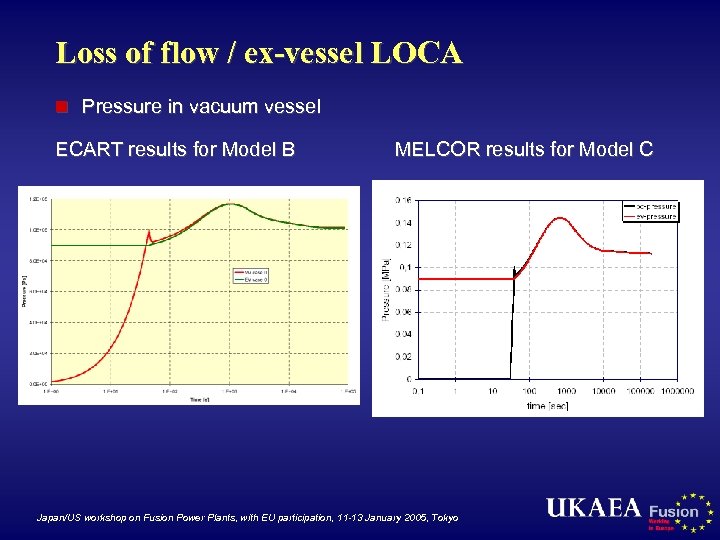
Loss of flow / ex-vessel LOCA n Pressure in vacuum vessel ECART results for Model B MELCOR results for Model C Japan/US workshop on Fusion Power Plants, with EU participation, 11 -13 January 2005, Tokyo
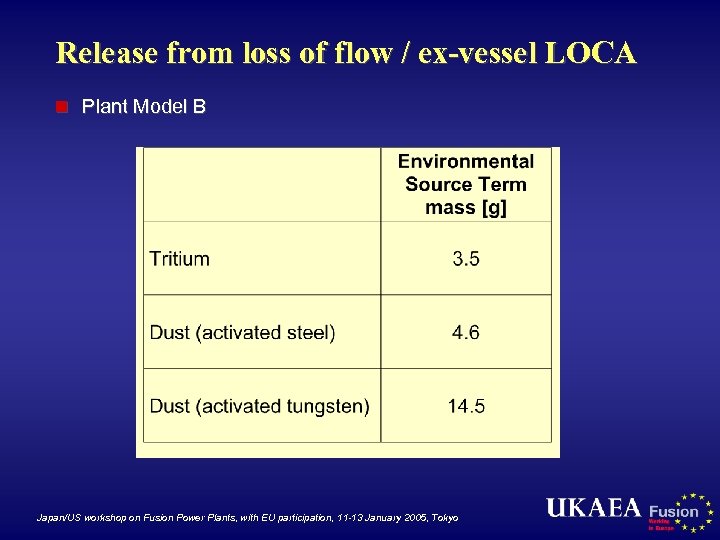
Release from loss of flow / ex-vessel LOCA n Plant Model B Japan/US workshop on Fusion Power Plants, with EU participation, 11 -13 January 2005, Tokyo
Assumptions in bounding accident modelling n Complete loss of all coolant from every loop in the plant – all first walls, blankets, divertors, shields, vacuum vessel – loss is instantaneous n No operation of any active safety system for indefinite period n Heat rejection is only by passive transport: – conduction through layers of material and radiation across gaps n Very conservative assumptions – to ensure result is bounding – assumptions may be non-physical or contradictory Japan/US workshop on Fusion Power Plants, with EU participation, 11 -13 January 2005, Tokyo
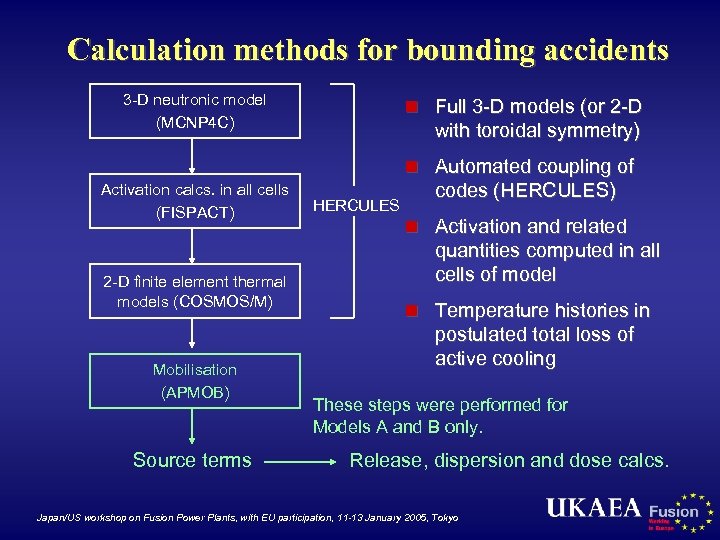
Calculation methods for bounding accidents 3 -D neutronic model (MCNP 4 C) n Full 3 -D models (or 2 -D with toroidal symmetry) n Automated coupling of Activation calcs. in all cells (FISPACT) 2 -D finite element thermal models (COSMOS/M) Mobilisation (APMOB) Source terms HERCULES codes (HERCULES) n Activation and related quantities computed in all cells of model n Temperature histories in postulated total loss of active cooling These steps were performed for Models A and B only. Release, dispersion and dose calcs. Japan/US workshop on Fusion Power Plants, with EU participation, 11 -13 January 2005, Tokyo
Bounding accident temperature distributions after 100 days Plant Model B Plant Model D Japan/US workshop on Fusion Power Plants, with EU participation, 11 -13 January 2005, Tokyo
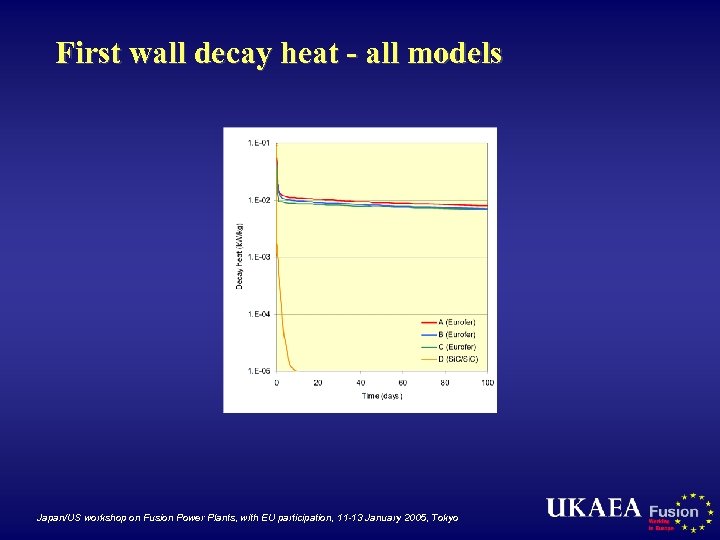
First wall decay heat - all models Japan/US workshop on Fusion Power Plants, with EU participation, 11 -13 January 2005, Tokyo
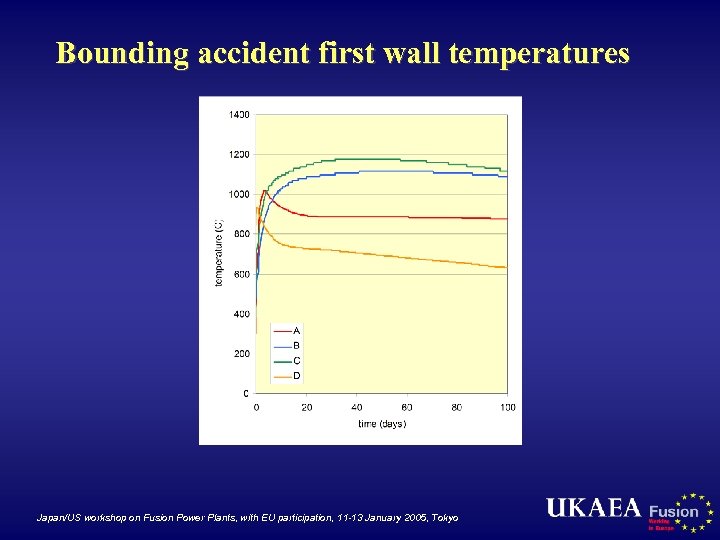
Bounding accident first wall temperatures Japan/US workshop on Fusion Power Plants, with EU participation, 11 -13 January 2005, Tokyo
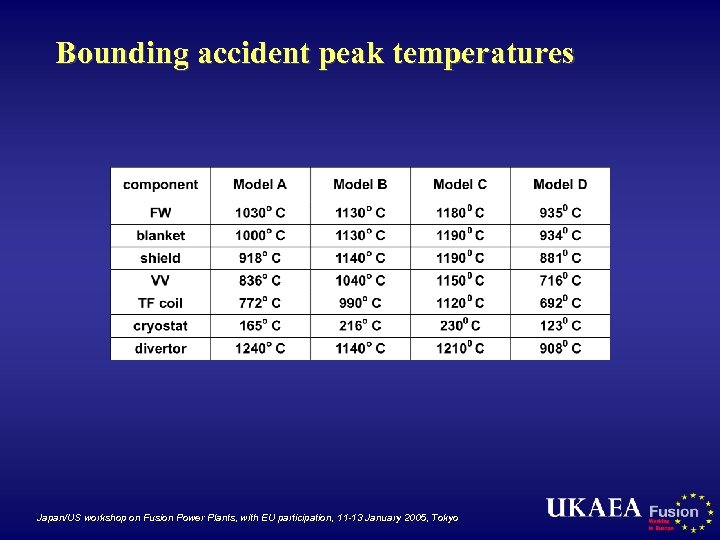
Bounding accident peak temperatures Japan/US workshop on Fusion Power Plants, with EU participation, 11 -13 January 2005, Tokyo
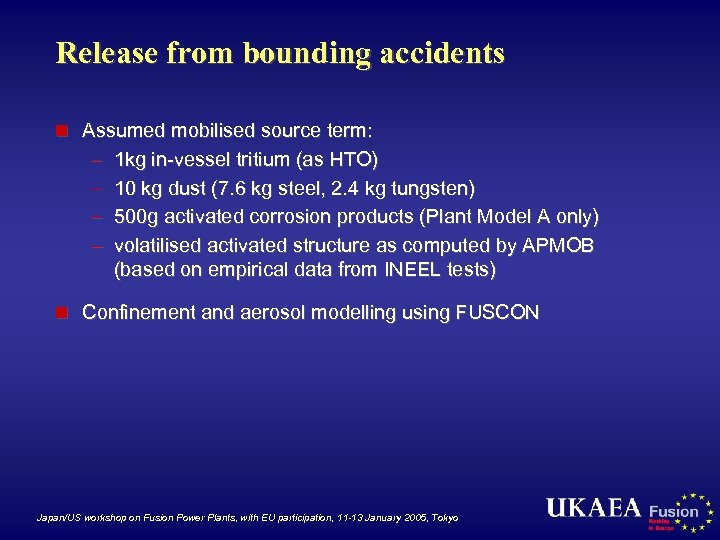
Release from bounding accidents n Assumed mobilised source term: – – 1 kg in-vessel tritium (as HTO) 10 kg dust (7. 6 kg steel, 2. 4 kg tungsten) 500 g activated corrosion products (Plant Model A only) volatilised activated structure as computed by APMOB (based on empirical data from INEEL tests) n Confinement and aerosol modelling using FUSCON Japan/US workshop on Fusion Power Plants, with EU participation, 11 -13 January 2005, Tokyo
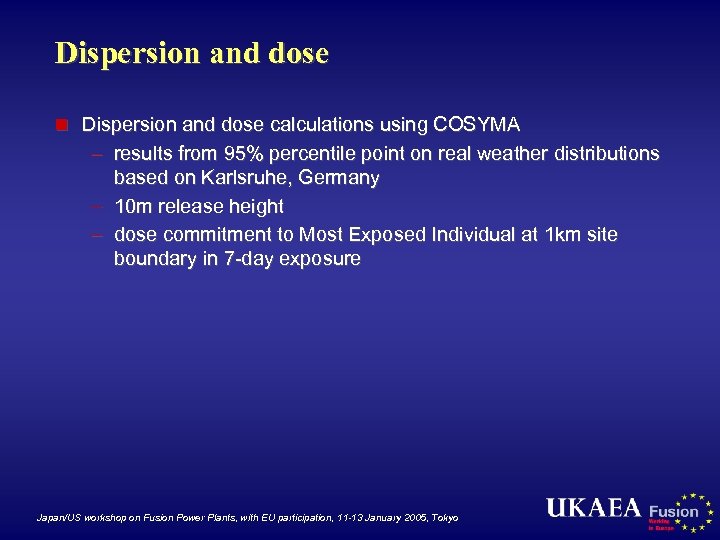
Dispersion and dose n Dispersion and dose calculations using COSYMA – results from 95% percentile point on real weather distributions based on Karlsruhe, Germany – 10 m release height – dose commitment to Most Exposed Individual at 1 km site boundary in 7 -day exposure Japan/US workshop on Fusion Power Plants, with EU participation, 11 -13 January 2005, Tokyo
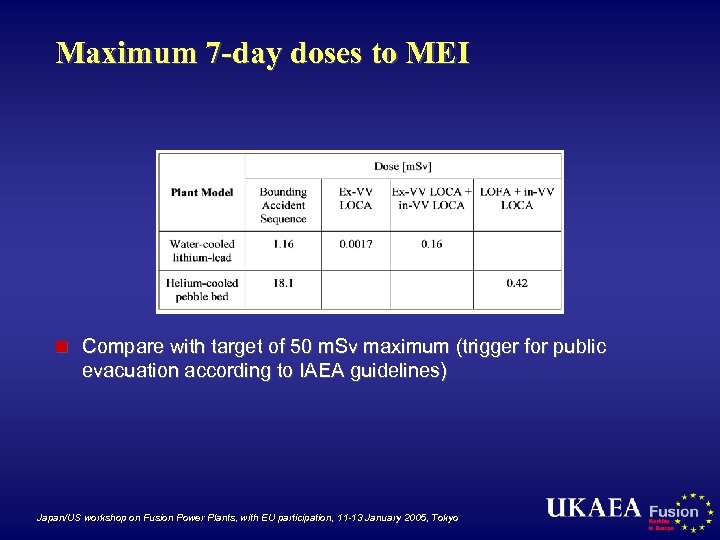
Maximum 7 -day doses to MEI n Compare with target of 50 m. Sv maximum (trigger for public evacuation according to IAEA guidelines) Japan/US workshop on Fusion Power Plants, with EU participation, 11 -13 January 2005, Tokyo
Occupational Safety n Largest ORE doses predicted for water-cooled Plant Model A – (but no new detailed study) n Study of ORE from fuel cycle system – vacuum pumping system largest potential contributor Japan/US workshop on Fusion Power Plants, with EU participation, 11 -13 January 2005, Tokyo
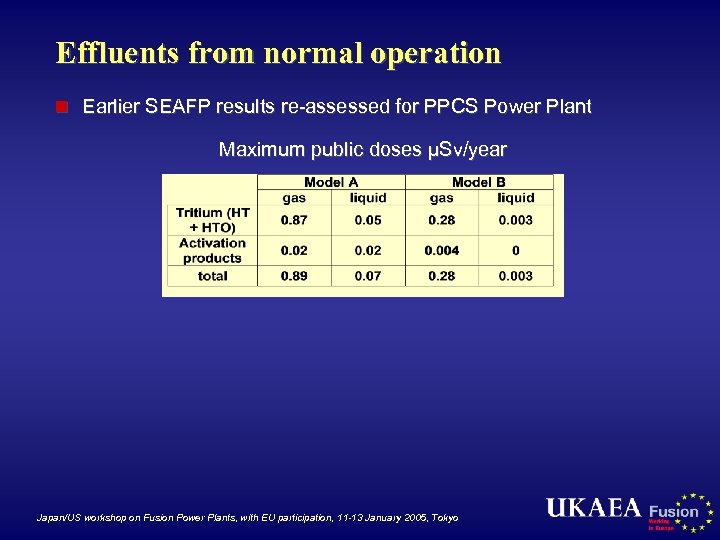
Effluents from normal operation n Earlier SEAFP results re-assessed for PPCS Power Plant Maximum public doses μSv/year Japan/US workshop on Fusion Power Plants, with EU participation, 11 -13 January 2005, Tokyo
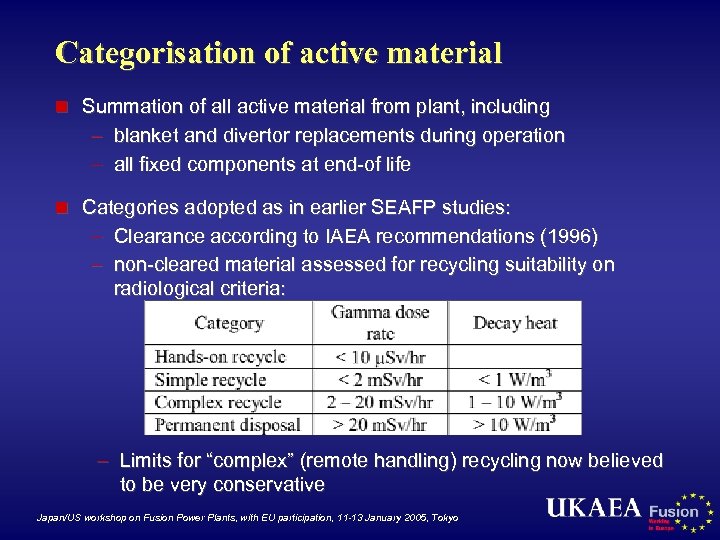
Categorisation of active material n Summation of all active material from plant, including – blanket and divertor replacements during operation – all fixed components at end-of life n Categories adopted as in earlier SEAFP studies: – Clearance according to IAEA recommendations (1996) – non-cleared material assessed for recycling suitability on radiological criteria: – Limits for “complex” (remote handling) recycling now believed to be very conservative Japan/US workshop on Fusion Power Plants, with EU participation, 11 -13 January 2005, Tokyo
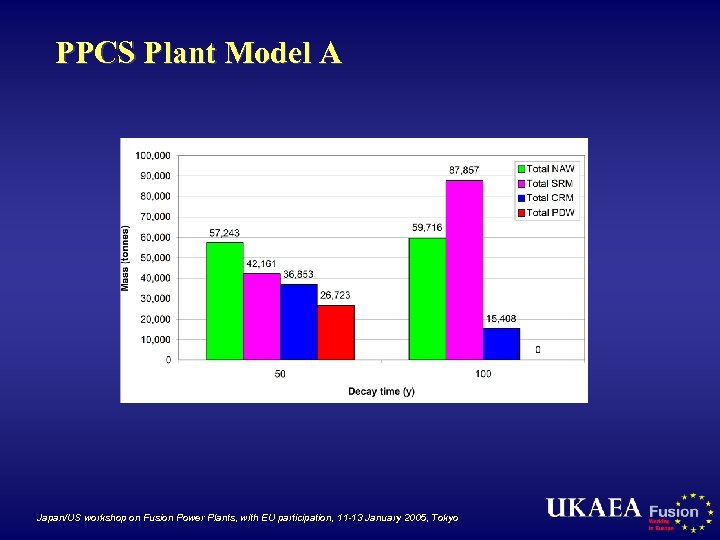
PPCS Plant Model A Japan/US workshop on Fusion Power Plants, with EU participation, 11 -13 January 2005, Tokyo
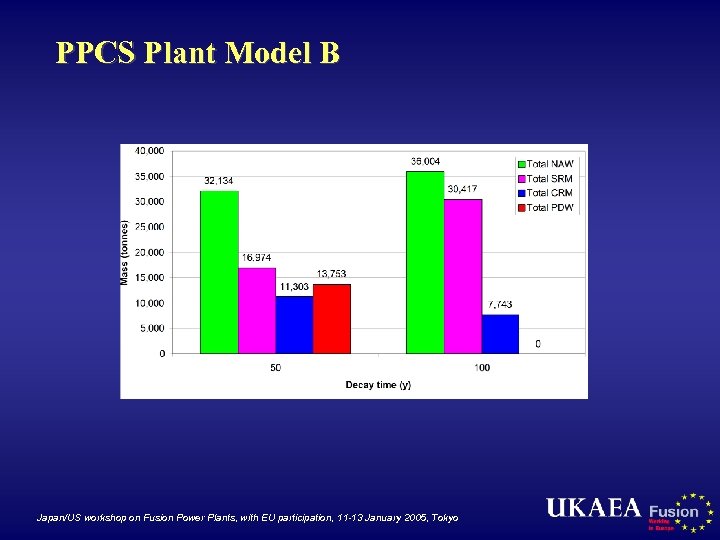
PPCS Plant Model B Japan/US workshop on Fusion Power Plants, with EU participation, 11 -13 January 2005, Tokyo
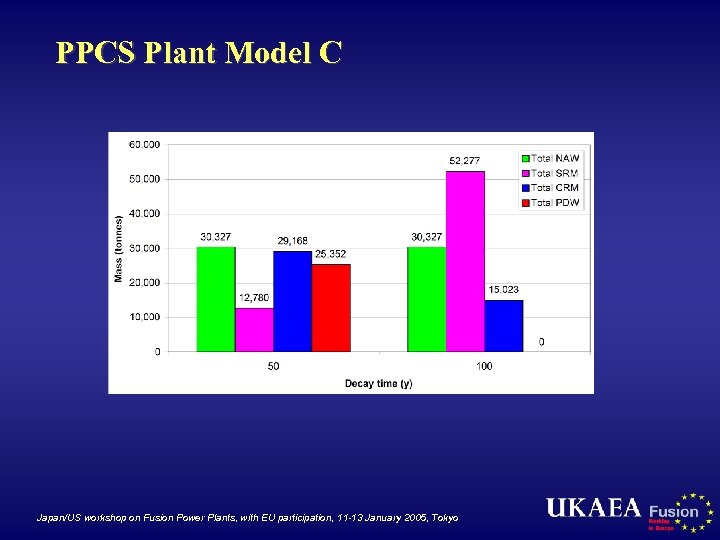
PPCS Plant Model C Japan/US workshop on Fusion Power Plants, with EU participation, 11 -13 January 2005, Tokyo
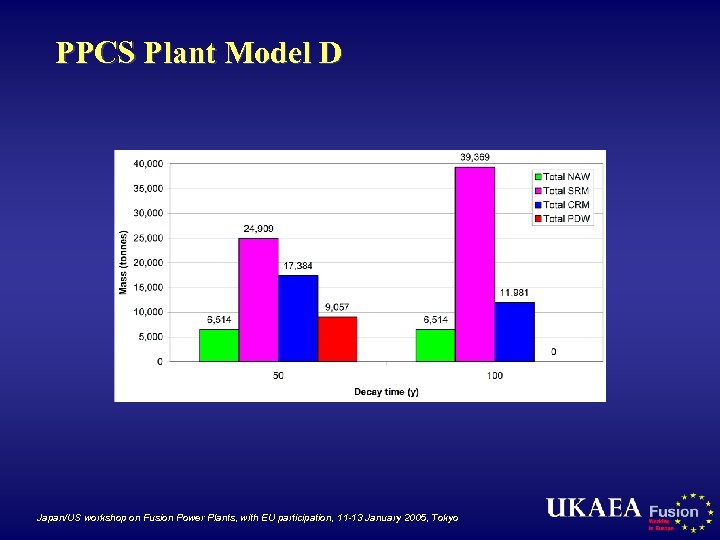
PPCS Plant Model D Japan/US workshop on Fusion Power Plants, with EU participation, 11 -13 January 2005, Tokyo
Categorisation of waste - summary n No permanent disposal waste after 100 years – result holds for all power plant designs and variants – except when TZM molybdenum alloy used in divertor (reminder of importance of materials selection) n Recycling of fusion material seems possible on radiological grounds n But there are other factors – Will there be feasible recycling operations for the relevant materials? – Will the processing be economically viable? n Proper evaluation of potential for recycling is essential Japan/US workshop on Fusion Power Plants, with EU participation, 11 -13 January 2005, Tokyo
PPCS overall conclusions on S&E (1) n The broad features of all the safety and environmental conclusions of earlier studies have been sustained, and demonstrated with increased confidence and understanding. n If a total loss of active cooling were to occur during the burn, the plasma would switch off passively and any temperature increase due to residual decay heat cannot lead to melting of the structures. This result is achieved without any reliance on active safety systems or operator actions. n The maximum radiological doses - assessed with deliberate pessimism - to the public arising from the most severe conceivable accident driven by in-plant energies would be below the level at which evacuation would be considered and needed and would not be much greater than typical annual doses from natural causes. This result also is achieved without reliance on active safety systems or operator actions. Japan/US workshop on Fusion Power Plants, with EU participation, 11 -13 January 2005, Tokyo
PPCS overall conclusions on S&E (2) n Confinement damage by an extremely rare (hypothetical) ultra- energetic ex-plant event, such as an earthquake of hitherto never experienced magnitude, would, on pessimistic assumptions, give rise to health effects smaller than the typical consequences of the external hazard itself. On realistic assumptions the maximum dose would be lower, and this very hypothetical scenario could be removed by design provision: essentially, this would be an economic issue. Japan/US workshop on Fusion Power Plants, with EU participation, 11 -13 January 2005, Tokyo
PPCS overall conclusions on S&E (3) n The radiotoxicity of the materials decays relatively rapidly – very rapidly at first and broadly by a factor ten thousand over a hundred years. n Much of this material, after an adequate decay time, falls to levels so low that it could be “cleared” from regulatory control. Other material could be recycled or reused in further fusion power plant construction, with no need for repository disposal. Thus the activated material from fusion power stations would not constitute a waste management burden for future generations. The decision on whether to actually recycle the recyclable material is a matter for future generations to determine, possibly on economic criteria. Japan/US workshop on Fusion Power Plants, with EU participation, 11 -13 January 2005, Tokyo
Скачать презентацию PPCS Safety and Environmental Analysis presented by Neill
c1d632d6dada5ee96e8dbcb2a8cfd99d.ppt