


 Скачать презентацию Pöyry s Experiences from Energy Efficiency Improvement Finnish-Polish energy
9896baa1013170952e5820dcecfc1260.ppt
- Количество слайдов: 16
 Pöyry's Experiences from Energy Efficiency Improvement Finnish-Polish energy seminar, Warsaw, September 17, 2010 Kari Kuisma
 Discussion topics · Introduction · Energy Efficiency Improvement - Case studies & lessons learnt · Summary and Conclusions Finnish-Polish energy seminar, Warsaw, September 17, 2010 Kari Kuisma 2
 Global experts in consulting and engineering · Pöyry is a global consulting and engineering company dedicated to balanced sustainability · 7000 experts in about 50 countries · Project experience in more than 100 countries · 17 000 projects annually · Net sales in 2009 EUR 674 million · Listed on the NASDAQ OMX Helsinki since 1997 3 Energy Business Group Presentation 2010 Finnish-Polish energy seminar, Warsaw, September 17, 2010 Kari Kuisma 3
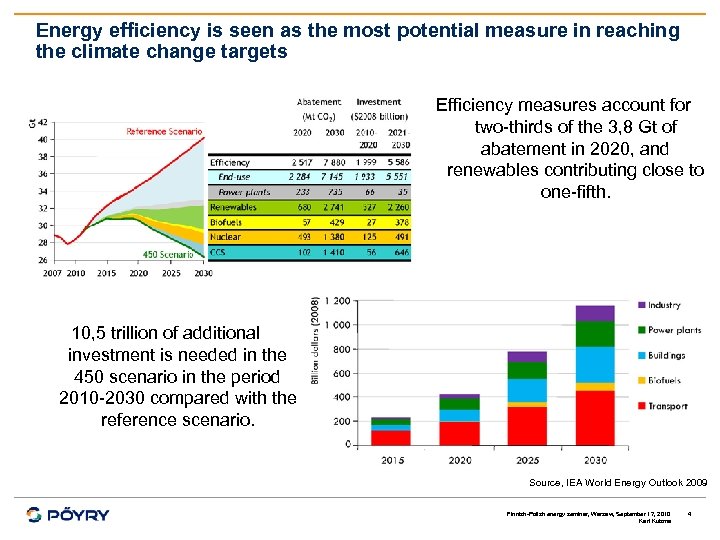 Energy efficiency is seen as the most potential measure in reaching the climate change targets Efficiency measures account for two-thirds of the 3, 8 Gt of abatement in 2020, and renewables contributing close to one-fifth. 10, 5 trillion of additional investment is needed in the 450 scenario in the period 2010 -2030 compared with the reference scenario. Source, IEA World Energy Outlook 2009 Finnish-Polish energy seminar, Warsaw, September 17, 2010 Kari Kuisma 4
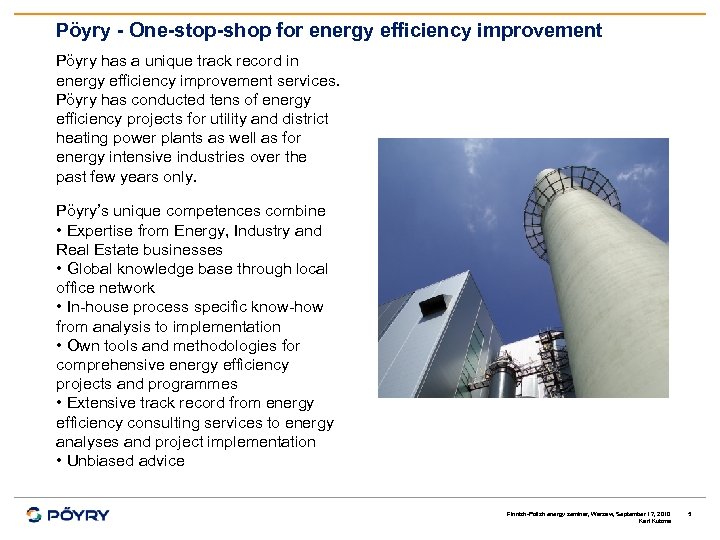 Pöyry - One-stop-shop for energy efficiency improvement Pöyry has a unique track record in energy efficiency improvement services. Pöyry has conducted tens of energy efficiency projects for utility and district heating power plants as well as for energy intensive industries over the past few years only. Pöyry’s unique competences combine • Expertise from Energy, Industry and Real Estate businesses • Global knowledge base through local office network • In-house process specific know-how from analysis to implementation • Own tools and methodologies for comprehensive energy efficiency projects and programmes • Extensive track record from energy efficiency consulting services to energy analyses and project implementation • Unbiased advice Finnish-Polish energy seminar, Warsaw, September 17, 2010 Kari Kuisma 5
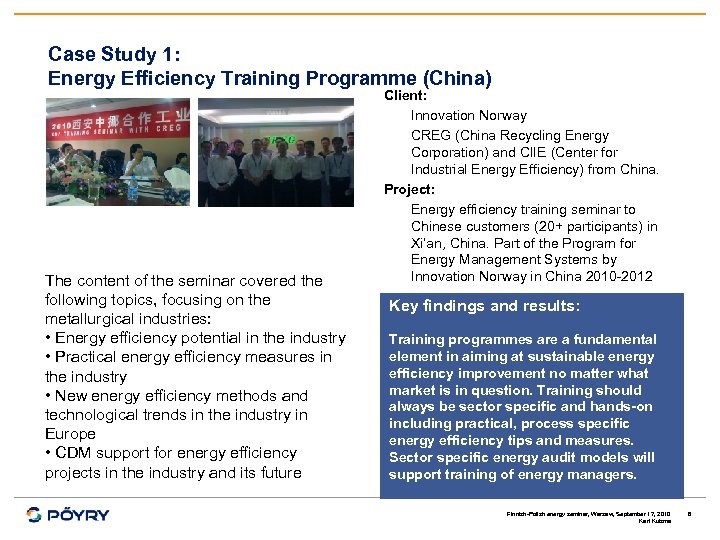 Case Study 1: Energy Efficiency Training Programme (China) The content of the seminar covered the following topics, focusing on the metallurgical industries: • Energy efficiency potential in the industry • Practical energy efficiency measures in the industry • New energy efficiency methods and technological trends in the industry in Europe • CDM support for energy efficiency projects in the industry and its future Client: Innovation Norway CREG (China Recycling Energy Corporation) and CIIE (Center for Industrial Energy Efficiency) from China. Project: Energy efficiency training seminar to Chinese customers (20+ participants) in Xi’an, China. Part of the Program for Energy Management Systems by Innovation Norway in China 2010 -2012 Key findings and results: Training programmes are a fundamental element in aiming at sustainable energy efficiency improvement no matter what market is in question. Training should always be sector specific and hands-on including practical, process specific energy efficiency tips and measures. Sector specific energy audit models will support training of energy managers. Finnish-Polish energy seminar, Warsaw, September 17, 2010 Kari Kuisma 6
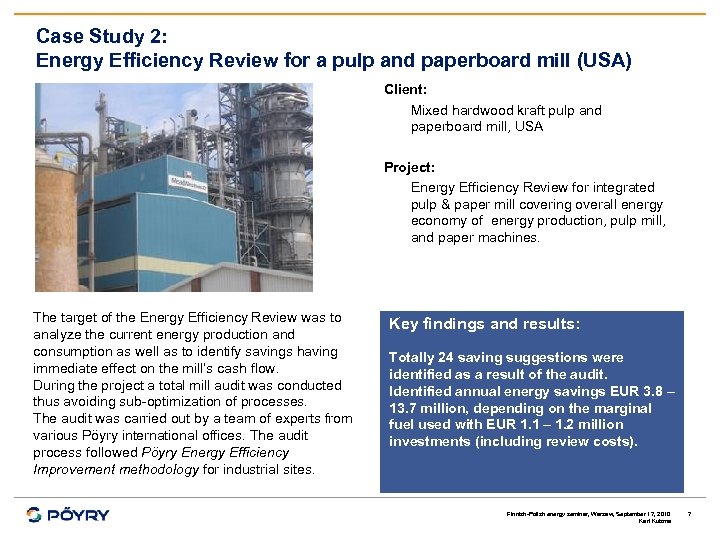 Case Study 2: Energy Efficiency Review for a pulp and paperboard mill (USA) Client: Mixed hardwood kraft pulp and paperboard mill, USA Project: Energy Efficiency Review for integrated pulp & paper mill covering overall energy economy of energy production, pulp mill, and paper machines. The target of the Energy Efficiency Review was to analyze the current energy production and consumption as well as to identify savings having immediate effect on the mill’s cash flow. During the project a total mill audit was conducted thus avoiding sub-optimization of processes. The audit was carried out by a team of experts from various Pöyry international offices. The audit process followed Pöyry Energy Efficiency Improvement methodology for industrial sites. Key findings and results: Totally 24 saving suggestions were identified as a result of the audit. Identified annual energy savings EUR 3. 8 – 13. 7 million, depending on the marginal fuel used with EUR 1. 1 – 1. 2 million investments (including review costs). Finnish-Polish energy seminar, Warsaw, September 17, 2010 Kari Kuisma 7
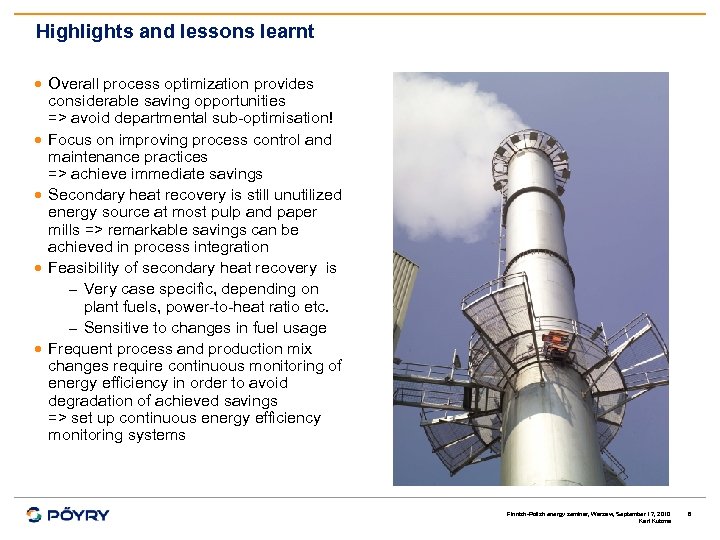 Highlights and lessons learnt · Overall process optimization provides · · considerable saving opportunities => avoid departmental sub-optimisation! Focus on improving process control and maintenance practices => achieve immediate savings Secondary heat recovery is still unutilized energy source at most pulp and paper mills => remarkable savings can be achieved in process integration Feasibility of secondary heat recovery is – Very case specific, depending on plant fuels, power-to-heat ratio etc. – Sensitive to changes in fuel usage Frequent process and production mix changes require continuous monitoring of energy efficiency in order to avoid degradation of achieved savings => set up continuous energy efficiency monitoring systems Finnish-Polish energy seminar, Warsaw, September 17, 2010 Kari Kuisma 8
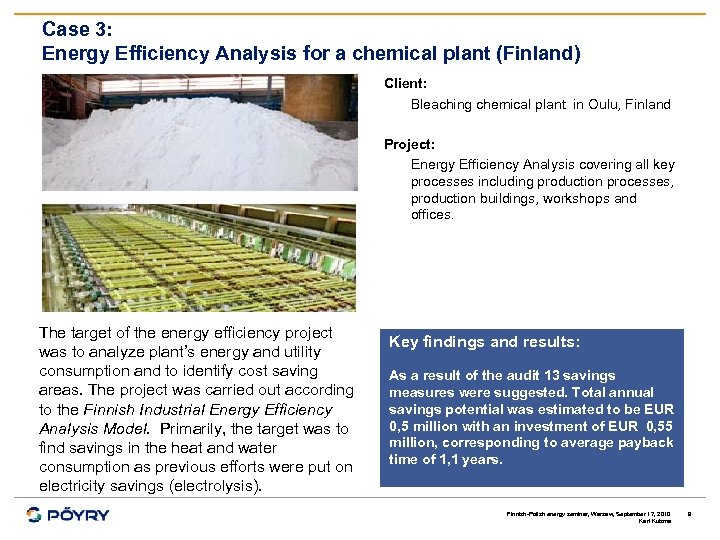 Case 3: Energy Efficiency Analysis for a chemical plant (Finland) Client: Bleaching chemical plant in Oulu, Finland Project: Energy Efficiency Analysis covering all key processes including production processes, production buildings, workshops and offices. The target of the energy efficiency project was to analyze plant’s energy and utility consumption and to identify cost saving areas. The project was carried out according to the Finnish Industrial Energy Efficiency Analysis Model. Primarily, the target was to find savings in the heat and water consumption as previous efforts were put on electricity savings (electrolysis). Key findings and results: As a result of the audit 13 savings measures were suggested. Total annual savings potential was estimated to be EUR 0, 5 million with an investment of EUR 0, 55 million, corresponding to average payback time of 1, 1 years. Finnish-Polish energy seminar, Warsaw, September 17, 2010 Kari Kuisma 9
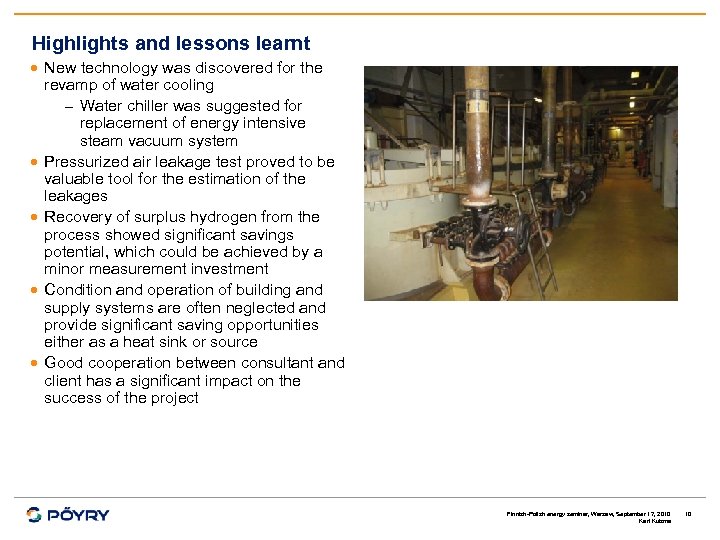 Highlights and lessons learnt · New technology was discovered for the · · revamp of water cooling – Water chiller was suggested for replacement of energy intensive steam vacuum system Pressurized air leakage test proved to be valuable tool for the estimation of the leakages Recovery of surplus hydrogen from the process showed significant savings potential, which could be achieved by a minor measurement investment Condition and operation of building and supply systems are often neglected and provide significant saving opportunities either as a heat sink or source Good cooperation between consultant and client has a significant impact on the success of the project Finnish-Polish energy seminar, Warsaw, September 17, 2010 Kari Kuisma 10
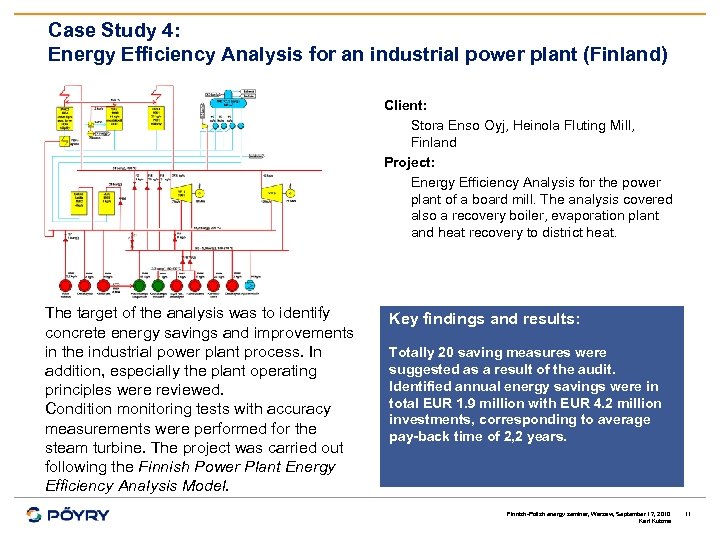 Case Study 4: Energy Efficiency Analysis for an industrial power plant (Finland) Client: Stora Enso Oyj, Heinola Fluting Mill, Finland Project: Energy Efficiency Analysis for the power plant of a board mill. The analysis covered also a recovery boiler, evaporation plant and heat recovery to district heat. The target of the analysis was to identify concrete energy savings and improvements in the industrial power plant process. In addition, especially the plant operating principles were reviewed. Condition monitoring tests with accuracy measurements were performed for the steam turbine. The project was carried out following the Finnish Power Plant Energy Efficiency Analysis Model. Key findings and results: Totally 20 saving measures were suggested as a result of the audit. Identified annual energy savings were in total EUR 1. 9 million with EUR 4. 2 million investments, corresponding to average pay-back time of 2, 2 years. Finnish-Polish energy seminar, Warsaw, September 17, 2010 Kari Kuisma 11
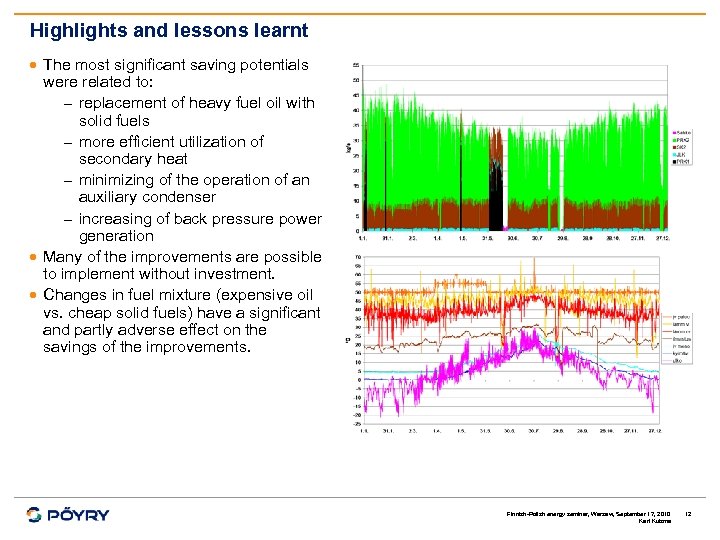 Highlights and lessons learnt · The most significant saving potentials were related to: – replacement of heavy fuel oil with solid fuels – more efficient utilization of secondary heat – minimizing of the operation of an auxiliary condenser – increasing of back pressure power generation · Many of the improvements are possible to implement without investment. · Changes in fuel mixture (expensive oil vs. cheap solid fuels) have a significant and partly adverse effect on the savings of the improvements. Finnish-Polish energy seminar, Warsaw, September 17, 2010 Kari Kuisma 12
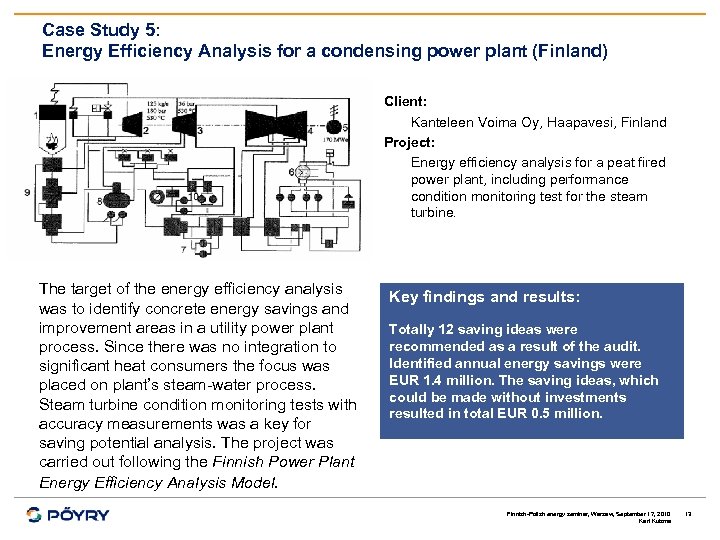 Case Study 5: Energy Efficiency Analysis for a condensing power plant (Finland) Client: Kanteleen Voima Oy, Haapavesi, Finland Project: Energy efficiency analysis for a peat fired power plant, including performance condition monitoring test for the steam turbine. The target of the energy efficiency analysis was to identify concrete energy savings and improvement areas in a utility power plant process. Since there was no integration to significant heat consumers the focus was placed on plant’s steam-water process. Steam turbine condition monitoring tests with accuracy measurements was a key for saving potential analysis. The project was carried out following the Finnish Power Plant Energy Efficiency Analysis Model. Key findings and results: Totally 12 saving ideas were recommended as a result of the audit. Identified annual energy savings were EUR 1. 4 million. The saving ideas, which could be made without investments resulted in total EUR 0. 5 million. Finnish-Polish energy seminar, Warsaw, September 17, 2010 Kari Kuisma 13
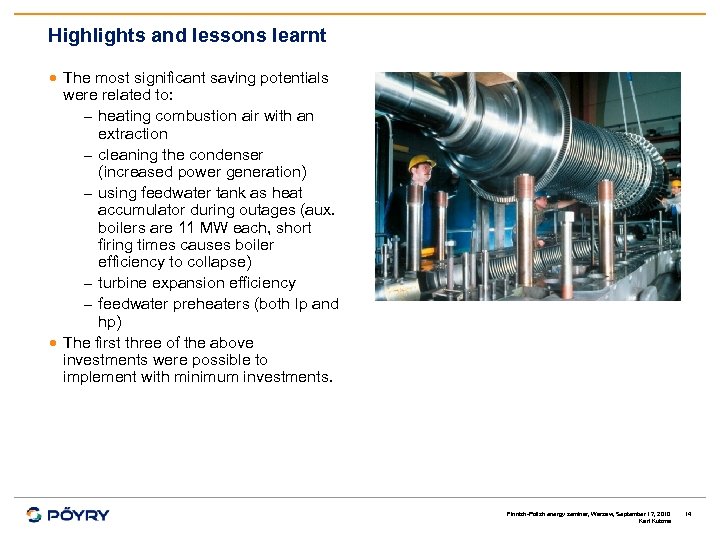 Highlights and lessons learnt · The most significant saving potentials were related to: – heating combustion air with an extraction – cleaning the condenser (increased power generation) – using feedwater tank as heat accumulator during outages (aux. boilers are 11 MW each, short firing times causes boiler efficiency to collapse) – turbine expansion efficiency – feedwater preheaters (both lp and hp) · The first three of the above investments were possible to implement with minimum investments. Finnish-Polish energy seminar, Warsaw, September 17, 2010 Kari Kuisma 14
 Summary and Conclusions · Increase Energy Efficiency Awareness at all levels from individuals to companies · Energy Efficiency Improvement training programmes and methodologies are fundamental elements in aiming at sustainable energy efficiency improvement · Develop industry specific methodologies for Energy Efficiency Improvement (EEI) from energy auditing to implementation · Focus on energy intensive industries (pulp & paper, steel, chemicals etc. ), where the overall energy saving potential is typically between 10 -20% in heat and 5 -10% in electricity even at modern industrial sites · Aim at increasing power generation by means of Combined Heat and Power · Focus on entire energy chain from energy production to distribution and consumption – don’t sub-optimise! · Consider especially means to secure implementation of identified feasible EEI projects · Energy Efficiency is a major business opportunity for wide range of industries from energy companies to manufacturers and consulting engineers · And last but not least…any saved k. Wh is for the benefit of our kids… Finnish-Polish energy seminar, Warsaw, September 17, 2010 Kari Kuisma 15
 END SLIDE. THANK YOU! CONTACT: KARI KUISMA PRESIDENT, ENERGY, PÖYRY FINLAND OY kari. kuisma@poyry. com Mobile ++358 400 704028 Finnish-Polish energy seminar, Warsaw, September 17, 2010 Kari Kuisma 16