


 Скачать презентацию Powers of Congress Article 1 Sections 4 -10
a34ea287e876127d4a87b41a48adf327.ppt
- Количество слайдов: 19
 Powers of Congress Article 1, Sections 4 -10 Unit 2 a QT 34 -53
 Objectives • • List and Define Expressed Powers of Congress Analyze Expressed for Implied Powers Analyze Expressed for Concurrent Powers Explain why certain powers were forbidden to Congress • C 2 PO 5
 Congressional Powers • Most of Congress’ powers are both expressed (listed) and concurrent (held by both at once) • This design balances the will of the people (House) vs. the will of the state (Senate) • Together they must agree on one final bill to send to the President
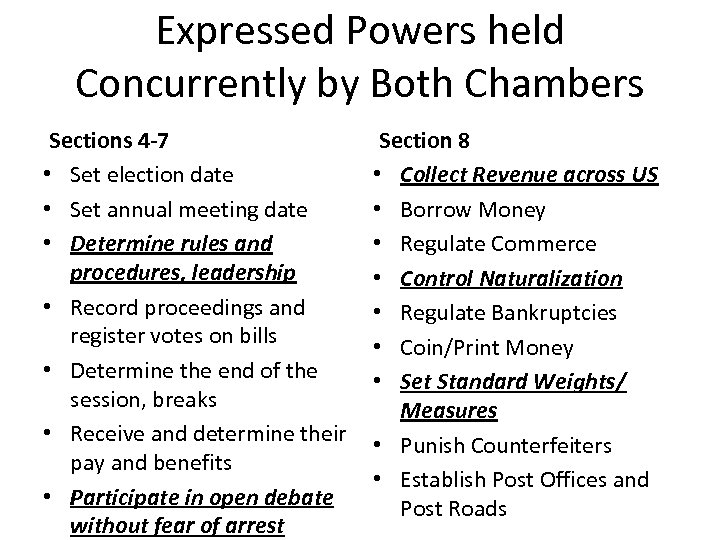 Expressed Powers held Concurrently by Both Chambers Sections 4 -7 • Set election date • Set annual meeting date • Determine rules and procedures, leadership • Record proceedings and register votes on bills • Determine the end of the session, breaks • Receive and determine their pay and benefits • Participate in open debate without fear of arrest Section 8 • Collect Revenue across US • Borrow Money • Regulate Commerce • Control Naturalization • Regulate Bankruptcies • Coin/Print Money • Set Standard Weights/ Measures • Punish Counterfeiters • Establish Post Offices and Post Roads
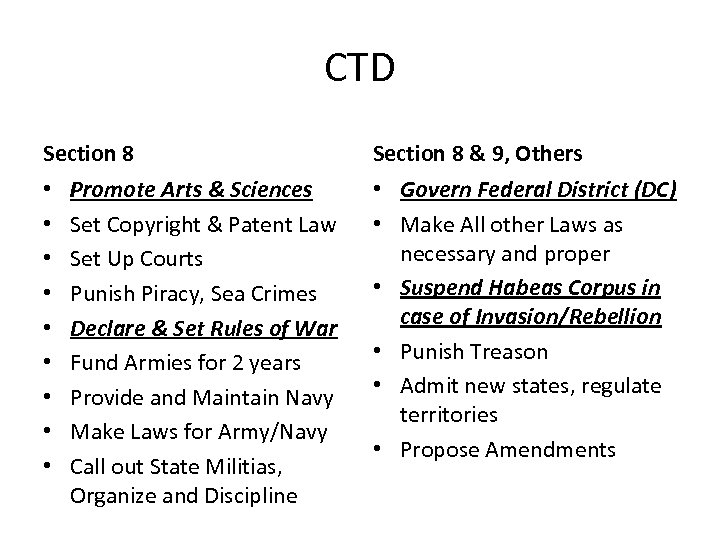 CTD Section 8 • • • Promote Arts & Sciences Set Copyright & Patent Law Set Up Courts Punish Piracy, Sea Crimes Declare & Set Rules of War Fund Armies for 2 years Provide and Maintain Navy Make Laws for Army/Navy Call out State Militias, Organize and Discipline Section 8 & 9, Others • Govern Federal District (DC) • Make All other Laws as necessary and proper • Suspend Habeas Corpus in case of Invasion/Rebellion • Punish Treason • Admit new states, regulate territories • Propose Amendments
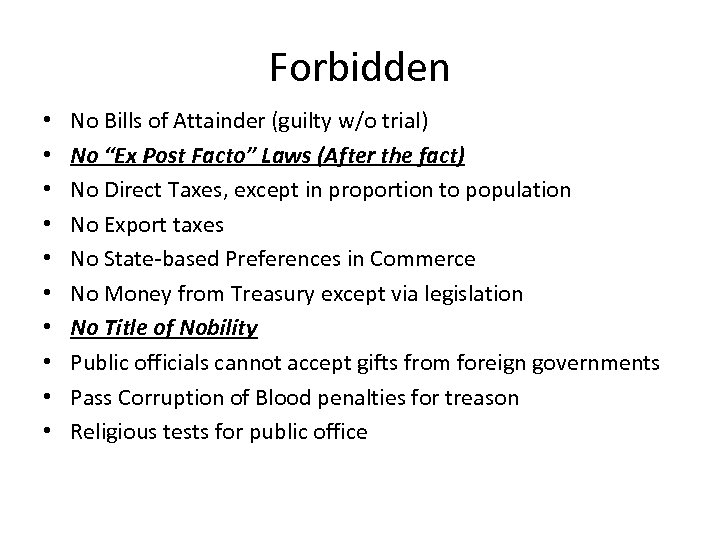 Forbidden • • • No Bills of Attainder (guilty w/o trial) No “Ex Post Facto” Laws (After the fact) No Direct Taxes, except in proportion to population No Export taxes No State-based Preferences in Commerce No Money from Treasury except via legislation No Title of Nobility Public officials cannot accept gifts from foreign governments Pass Corruption of Blood penalties for treason Religious tests for public office
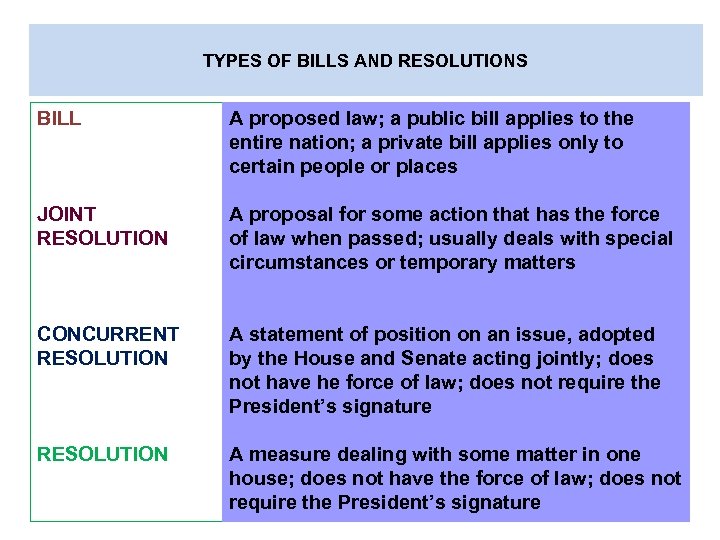 TYPES OF BILLS AND RESOLUTIONS BILL A proposed law; a public bill applies to the entire nation; a private bill applies only to certain people or places JOINT RESOLUTION A proposal for some action that has the force of law when passed; usually deals with special circumstances or temporary matters CONCURRENT RESOLUTION A statement of position on an issue, adopted by the House and Senate acting jointly; does not have he force of law; does not require the President’s signature RESOLUTION A measure dealing with some matter in one house; does not have the force of law; does not require the President’s signature
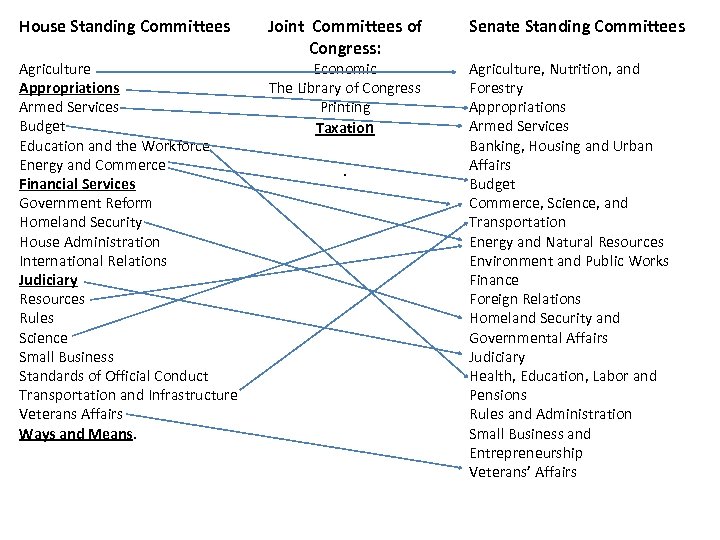 House Standing Committees Agriculture Appropriations Armed Services Budget Education and the Workforce Energy and Commerce Financial Services Government Reform Homeland Security House Administration International Relations Judiciary Resources Rules Science Small Business Standards of Official Conduct Transportation and Infrastructure Veterans Affairs Ways and Means. Joint Committees of Congress: Economic The Library of Congress Printing Taxation . Senate Standing Committees Agriculture, Nutrition, and Forestry Appropriations Armed Services Banking, Housing and Urban Affairs Budget Commerce, Science, and Transportation Energy and Natural Resources Environment and Public Works Finance Foreign Relations Homeland Security and Governmental Affairs Judiciary Health, Education, Labor and Pensions Rules and Administration Small Business and Entrepreneurship Veterans’ Affairs
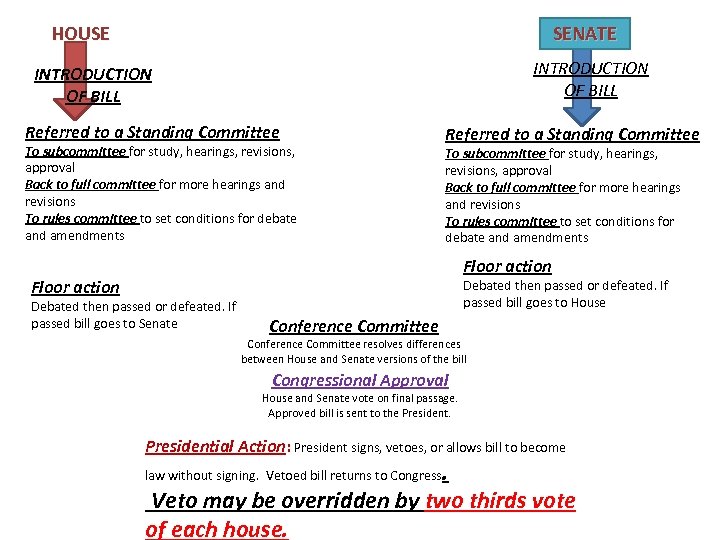 HOUSE SENATE INTRODUCTION OF BILL Referred to a Standing Committee To subcommittee for study, hearings, revisions, approval Back to full committee for more hearings and revisions To rules committee to set conditions for debate and amendments Floor action Debated then passed or defeated. If passed bill goes to Senate Debated then passed or defeated. If passed bill goes to House Conference Committee resolves differences between House and Senate versions of the bill Congressional Approval House and Senate vote on final passage. Approved bill is sent to the Presidential Action: President signs, vetoes, or allows bill to become . Veto may be overridden by two thirds vote of each house. law without signing. Vetoed bill returns to Congress
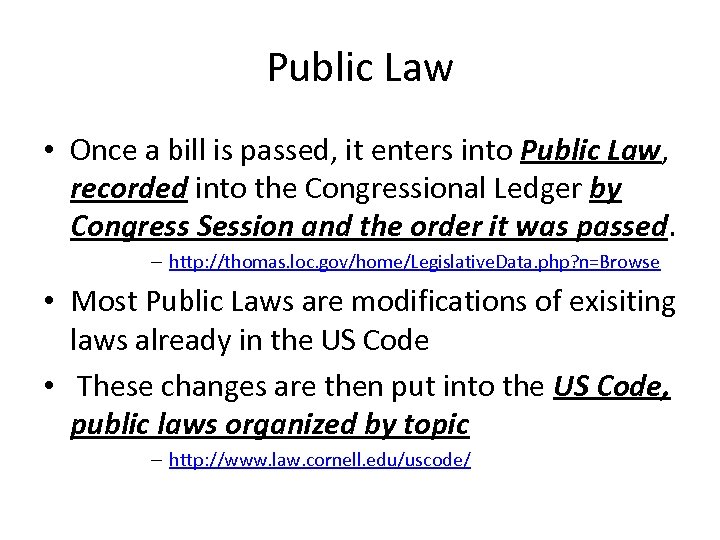 Public Law • Once a bill is passed, it enters into Public Law, recorded into the Congressional Ledger by Congress Session and the order it was passed. – http: //thomas. loc. gov/home/Legislative. Data. php? n=Browse • Most Public Laws are modifications of exisiting laws already in the US Code • These changes are then put into the US Code, public laws organized by topic – http: //www. law. cornell. edu/uscode/
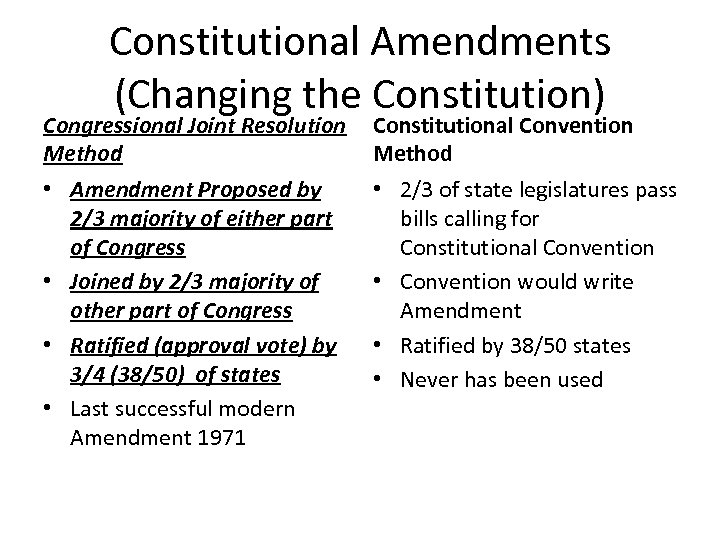 Constitutional Amendments (Changing the Constitution) Congressional Joint Resolution Method Constitutional Convention Method • Amendment Proposed by 2/3 majority of either part of Congress • Joined by 2/3 majority of other part of Congress • Ratified (approval vote) by 3/4 (38/50) of states • Last successful modern Amendment 1971 • 2/3 of state legislatures pass bills calling for Constitutional Convention • Convention would write Amendment • Ratified by 38/50 states • Never has been used
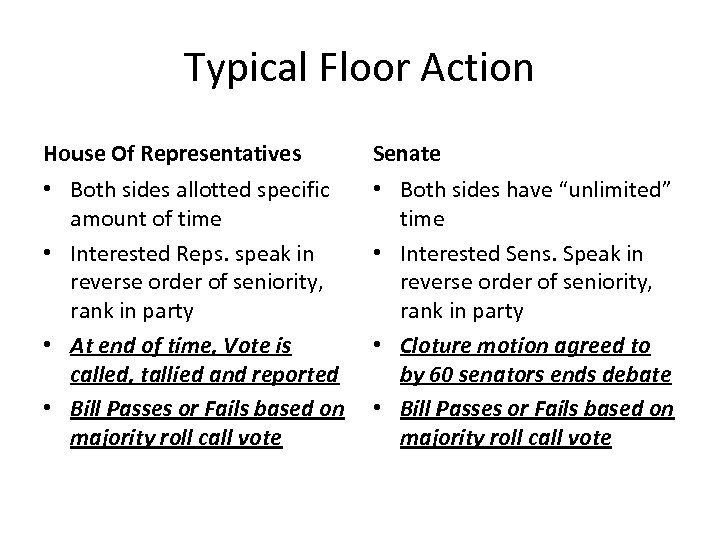 Typical Floor Action House Of Representatives Senate • Both sides allotted specific amount of time • Interested Reps. speak in reverse order of seniority, rank in party • At end of time, Vote is called, tallied and reported • Bill Passes or Fails based on majority roll call vote • Both sides have “unlimited” time • Interested Sens. Speak in reverse order of seniority, rank in party • Cloture motion agreed to by 60 senators ends debate • Bill Passes or Fails based on majority roll call vote
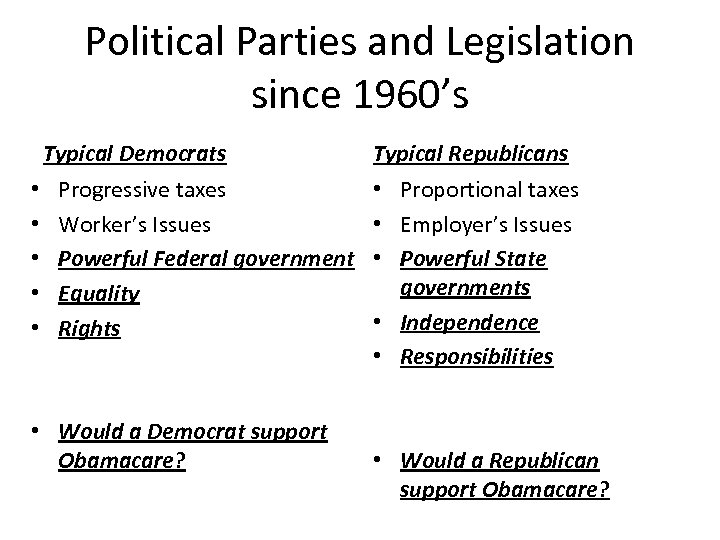 Political Parties and Legislation since 1960’s Typical Democrats • • • Progressive taxes Worker’s Issues Powerful Federal government Equality Rights • Would a Democrat support Obamacare? Typical Republicans • Proportional taxes • Employer’s Issues • Powerful State governments • Independence • Responsibilities • Would a Republican support Obamacare?
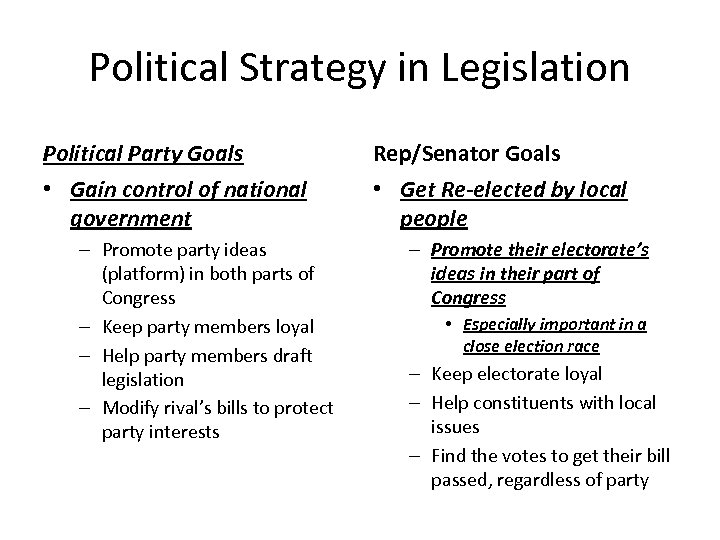 Political Strategy in Legislation Political Party Goals Rep/Senator Goals • Gain control of national government • Get Re-elected by local people – Promote party ideas (platform) in both parts of Congress – Keep party members loyal – Help party members draft legislation – Modify rival’s bills to protect party interests – Promote their electorate’s ideas in their part of Congress • Especially important in a close election race – Keep electorate loyal – Help constituents with local issues – Find the votes to get their bill passed, regardless of party
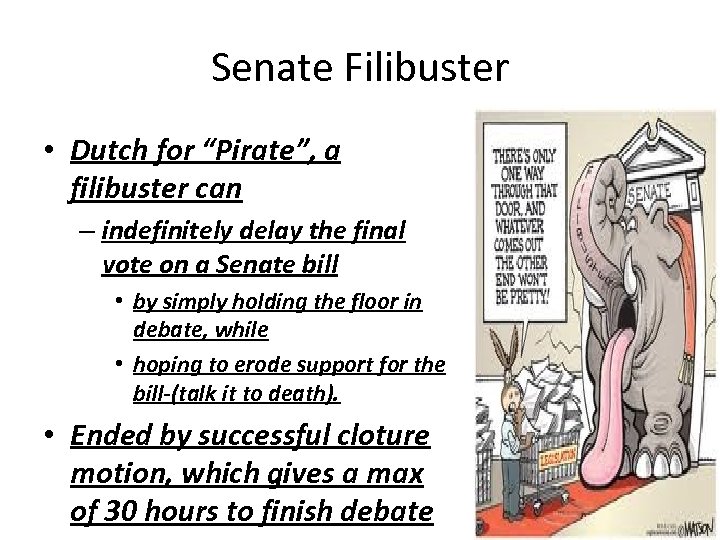 Senate Filibuster • Dutch for “Pirate”, a filibuster can – indefinitely delay the final vote on a Senate bill • by simply holding the floor in debate, while • hoping to erode support for the bill-(talk it to death). • Ended by successful cloture motion, which gives a max of 30 hours to finish debate
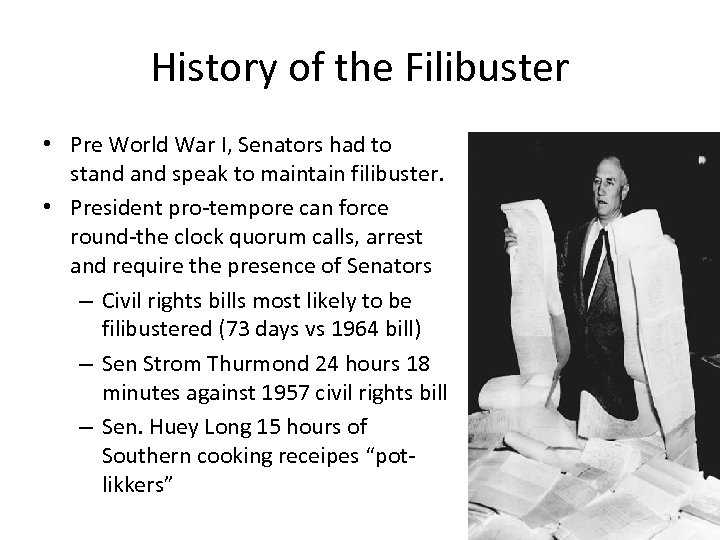 History of the Filibuster • Pre World War I, Senators had to stand speak to maintain filibuster. • President pro-tempore can force round-the clock quorum calls, arrest and require the presence of Senators – Civil rights bills most likely to be filibustered (73 days vs 1964 bill) – Sen Strom Thurmond 24 hours 18 minutes against 1957 civil rights bill – Sen. Huey Long 15 hours of Southern cooking receipes “potlikkers”
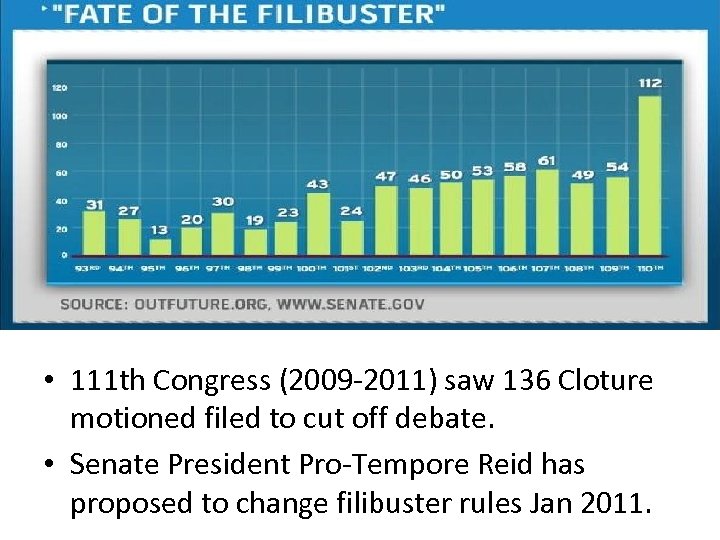 • 111 th Congress (2009 -2011) saw 136 Cloture motioned filed to cut off debate. • Senate President Pro-Tempore Reid has proposed to change filibuster rules Jan 2011.
 The President has four options after a bill has been presented to him after passage by the House and Senate. They are: 1. Sign the bill – it then becomes law. 2. Veto – refuses to sign bill into law. The measure then returns to the chamber in which it started. Congress may then override the veto with two-thirds 2/3 rd vote of the full membership of the House and Senate. George W. Bush only vetoed one bill during his first term compared to 37 by Bill Clinton. Congress overrode only 4 out of 12 Bush vetos in 8 years
 3. The President may allow the bill to become law without signing it – by not acting on it within 10 days, not counting Sundays, of receiving it. 4. Pocket Veto – if Congress adjourns its session within 10 days of submitting a bill to the President, and the President does not act the measure dies.