 Скачать презентацию POWERPOINT LECTURE SLIDE PRESENTATION by ZARA OAKES MS
27961696cbee35d28338fdcc015285a7.ppt
- Количество слайдов: 24



POWERPOINT® LECTURE SLIDE PRESENTATION by ZARA OAKES, MS, The University of Texas at Austin Additional Text by J Padilla exclusively for physiology at ECC UNIT 4 24& 15 The Lymphatic & Immune System HUMAN PHYSIOLOGY AN INTEGRATED APPROACH DEE UNGLAUB SILVERTHORN Copyright © 2007 Pearson Education, Inc. , publishing as Benjamin Cummings FOURTH EDITION
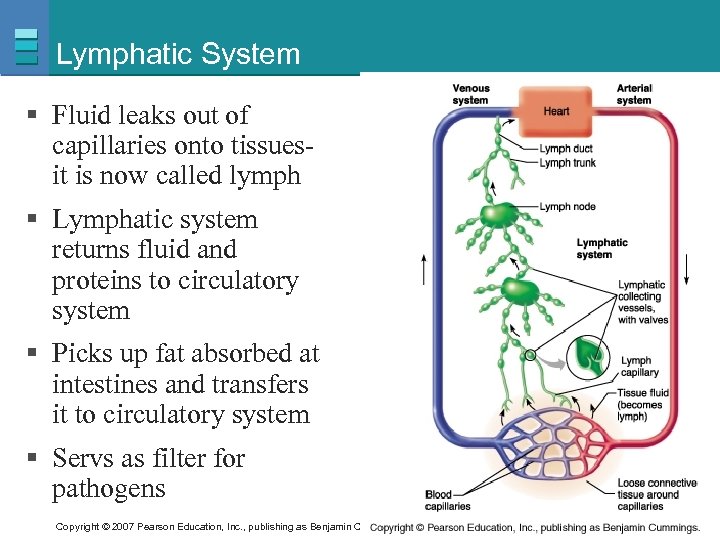
Lymphatic System § Fluid leaks out of capillaries onto tissuesit is now called lymph § Lymphatic system returns fluid and proteins to circulatory system § Picks up fat absorbed at intestines and transfers it to circulatory system § Servs as filter for pathogens Copyright © 2007 Pearson Education, Inc. , publishing as Benjamin Cummings
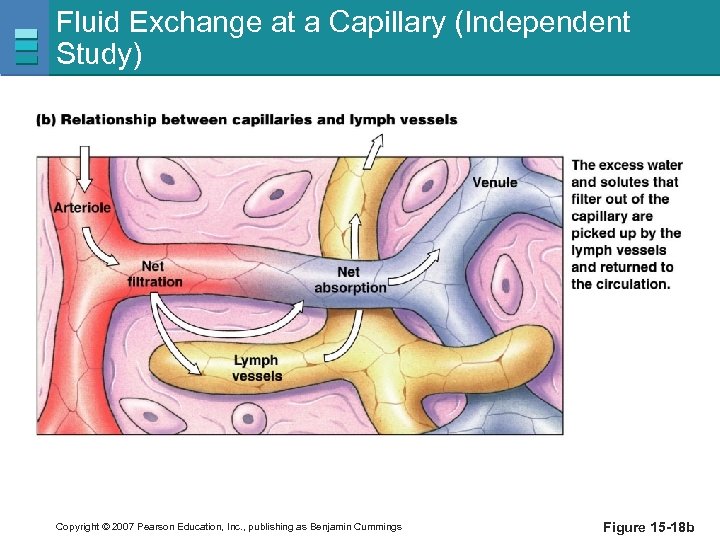
Fluid Exchange at a Capillary (Independent Study) Copyright © 2007 Pearson Education, Inc. , publishing as Benjamin Cummings Figure 15 -18 b
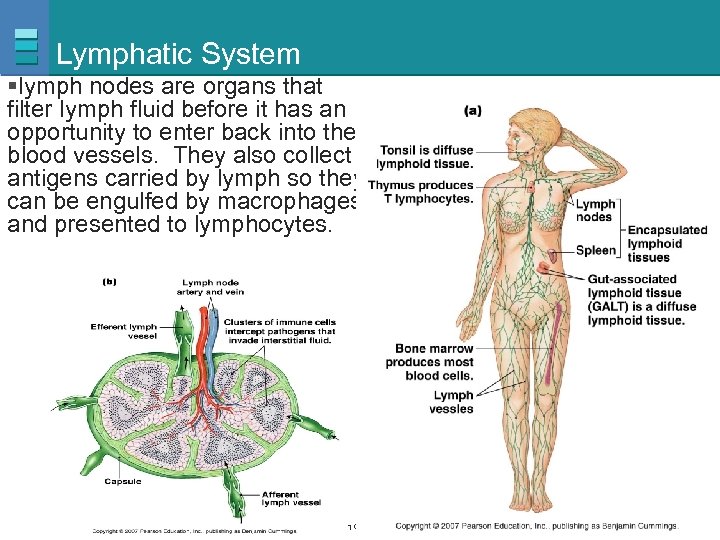
Lymphatic System §lymph nodes are organs that filter lymph fluid before it has an opportunity to enter back into the blood vessels. They also collect antigens carried by lymph so they can be engulfed by macrophages and presented to lymphocytes. Copyright © 2007 Pearson Education, Inc. , publishing as Benjamin Cummings Figure 15 -19
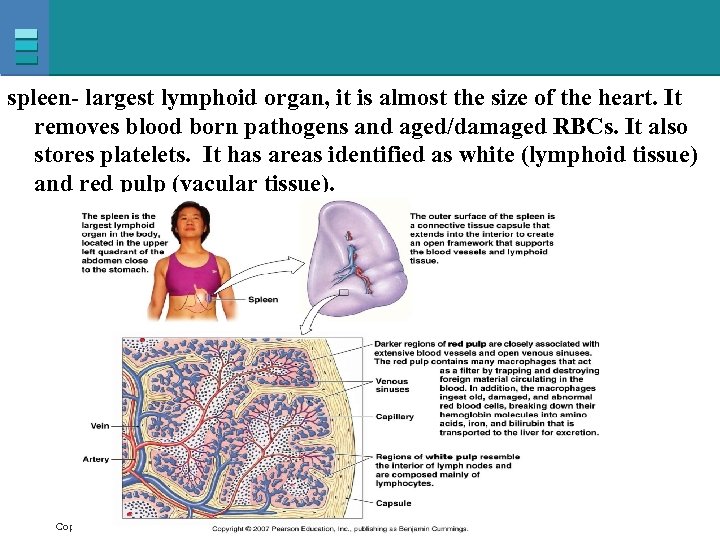
spleen- largest lymphoid organ, it is almost the size of the heart. It removes blood born pathogens and aged/damaged RBCs. It also stores platelets. It has areas identified as white (lymphoid tissue) and red pulp (vacular tissue). Copyright © 2007 Pearson Education, Inc. , publishing as Benjamin Cummings
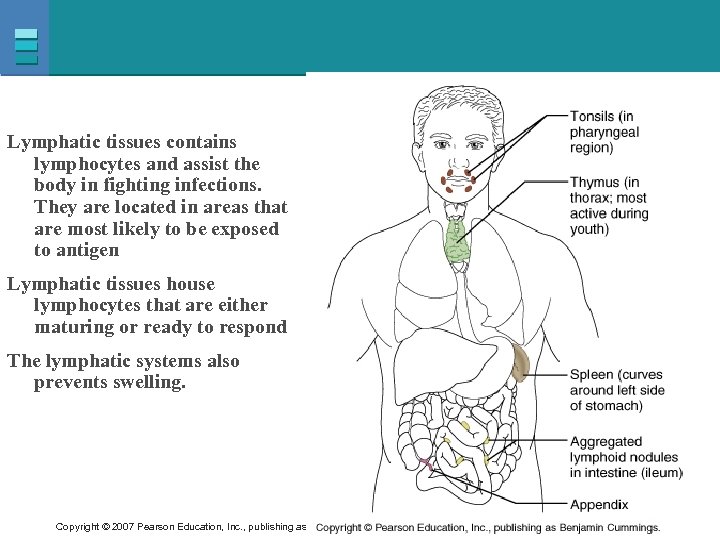
Lymphatic tissues contains lymphocytes and assist the body in fighting infections. They are located in areas that are most likely to be exposed to antigen Lymphatic tissues house lymphocytes that are either maturing or ready to respond The lymphatic systems also prevents swelling. Copyright © 2007 Pearson Education, Inc. , publishing as Benjamin Cummings
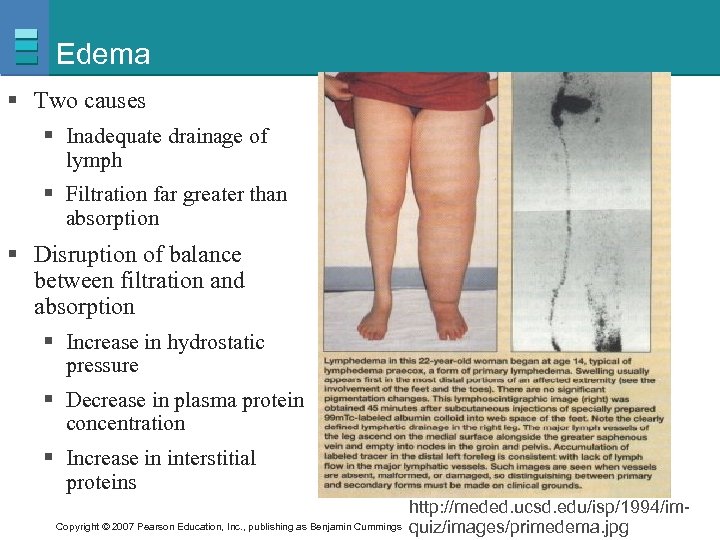
Edema § Two causes § Inadequate drainage of lymph § Filtration far greater than absorption § Disruption of balance between filtration and absorption § Increase in hydrostatic pressure § Decrease in plasma protein concentration § Increase in interstitial proteins Copyright © 2007 Pearson Education, Inc. , publishing as Benjamin Cummings http: //meded. ucsd. edu/isp/1994/imquiz/images/primedema. jpg
Immune System: Functions § Protects from pathogens and foreign molecules (antigen) § Parasites § Fungus § Protozoans § Bacteria § Viruses § Removes dead or damaged cells § Attempts to recognize and remove abnormal cells developing from mutation (ex Cancer) or viral infections § May respond to incorrectly, over respond, or not respond § Autoimmune disease (Type 1 diabetes) § Allergies (respond to non-harmful molecules) § Immunodeficiency disease (AIDS) Copyright © 2007 Pearson Education, Inc. , publishing as Benjamin Cummings
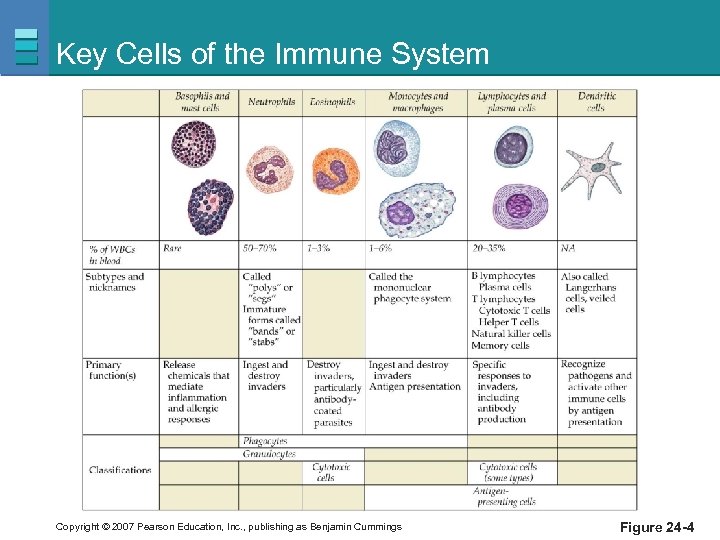
Key Cells of the Immune System Copyright © 2007 Pearson Education, Inc. , publishing as Benjamin Cummings Figure 24 -4
Body Defenses: Two Lines § First Line of defense § Physical and chemical barrier § Skin, epithelial linings, and cilia § Acids, mucous, and lysozymes § Second Line of Defense § Immune responses include: § Detect and identify invader/foreign cells § Communicate, alarm, and recruit immune cells § Coordinate response among all participants § Suppress or destroy invader § Types of Immunity § Innate, non-specific, immediate response § Responses that don’t retain memory § Guided by granulocytes and macrophages § Acquired; attack a specific pathogen (antigen) § Retain memory § Guided by lymphocytes and antigen presenting cells Copyright © 2007 Pearson Education, Inc. , publishing as Benjamin Cummings
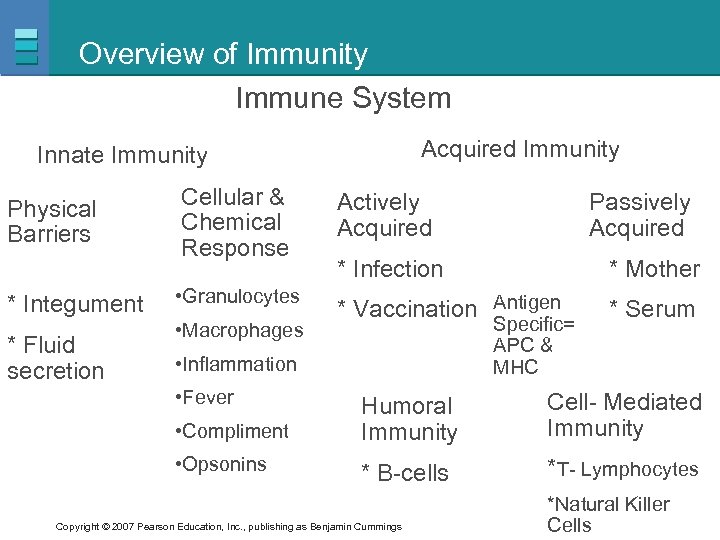
Overview of Immunity Immune System Acquired Immunity Innate Immunity Physical Barriers * Integument * Fluid secretion Cellular & Chemical Response Actively Acquired • Granulocytes * Vaccination Antigen • Macrophages * Infection * Mother Specific= APC & MHC • Inflammation • Fever Passively Acquired * Serum • Compliment Humoral Immunity Cell- Mediated Immunity • Opsonins * B-cells *T- Lymphocytes Copyright © 2007 Pearson Education, Inc. , publishing as Benjamin Cummings *Natural Killer Cells
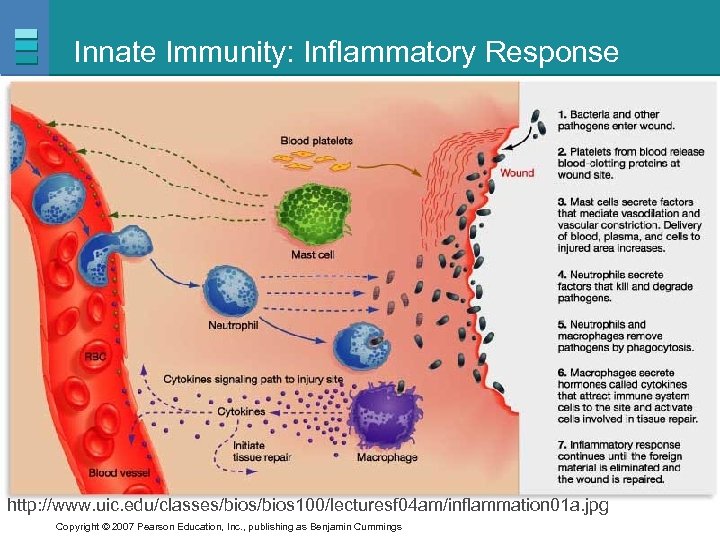
Innate Immunity: Inflammatory Response http: //www. uic. edu/classes/bios 100/lecturesf 04 am/inflammation 01 a. jpg Copyright © 2007 Pearson Education, Inc. , publishing as Benjamin Cummings
Innate Immunity: Inflammatory Response § Attract immune cells and chemical mediators to site of infection § Produce physical barrier to prevent infection from spreading § Promote tissue repair § Histamines from mast cells § Swelling, edema, vasodilation § Interleukins § Fever, blood vessels more permeable to white blood cells and proteins, acute-phase proteins § Bradykinin § Pain and swelling § Complement cascade § Membrane attack complex Copyright © 2007 Pearson Education, Inc. , publishing as Benjamin Cummings
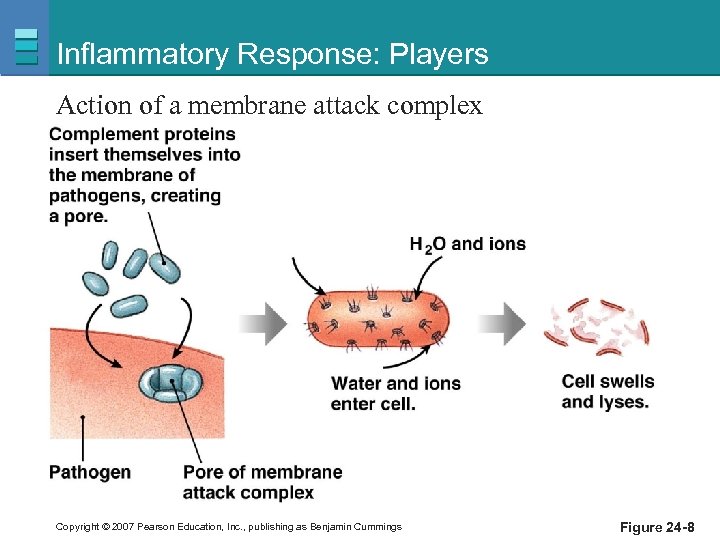
Inflammatory Response: Players Action of a membrane attack complex Copyright © 2007 Pearson Education, Inc. , publishing as Benjamin Cummings Figure 24 -8
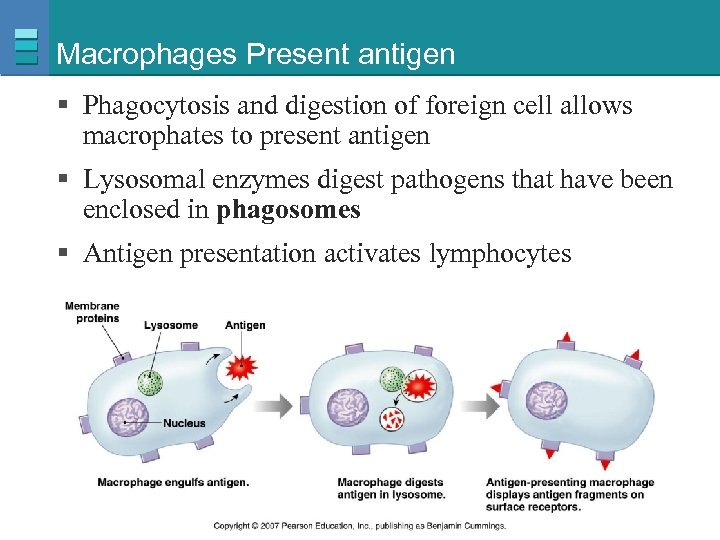
Macrophages Present antigen § Phagocytosis and digestion of foreign cell allows macrophates to present antigen § Lysosomal enzymes digest pathogens that have been enclosed in phagosomes § Antigen presentation activates lymphocytes Copyright © 2007 Pearson Education, Inc. , publishing as Benjamin Cummings
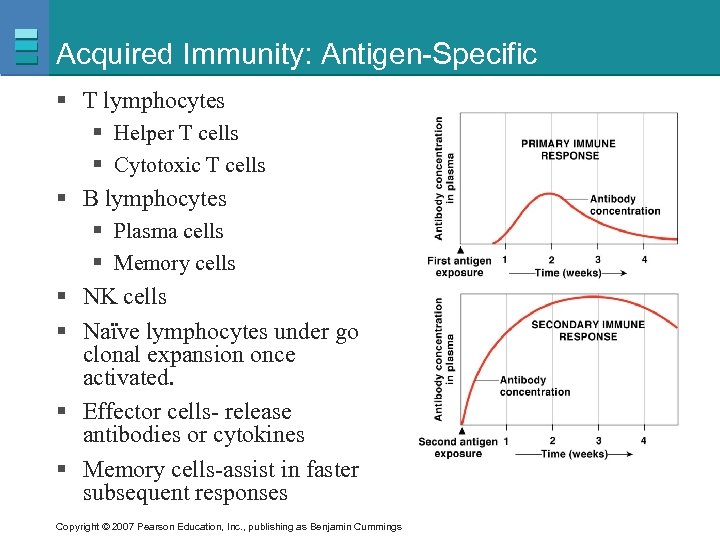
Acquired Immunity: Antigen-Specific § T lymphocytes § Helper T cells § Cytotoxic T cells § B lymphocytes § Plasma cells § Memory cells § NK cells § Naïve lymphocytes under go clonal expansion once activated. § Effector cells- release antibodies or cytokines § Memory cells-assist in faster subsequent responses Copyright © 2007 Pearson Education, Inc. , publishing as Benjamin Cummings
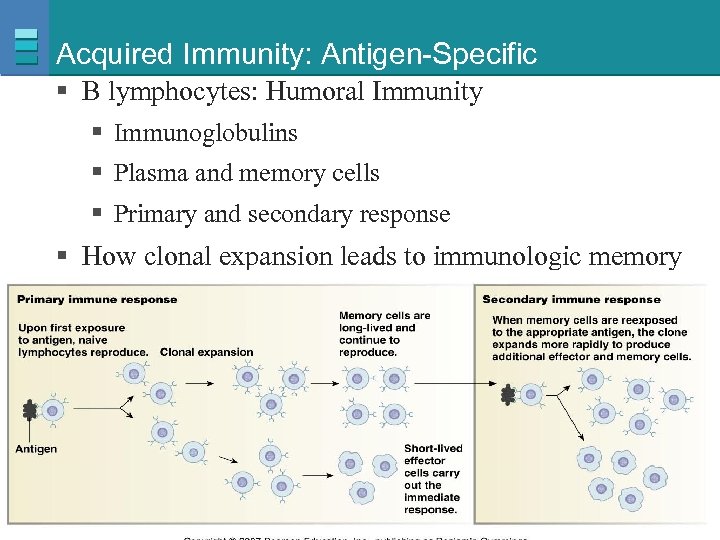
Acquired Immunity: Antigen-Specific § B lymphocytes: Humoral Immunity § Immunoglobulins § Plasma and memory cells § Primary and secondary response § How clonal expansion leads to immunologic memory Copyright © 2007 Pearson Education, Inc. , publishing as Benjamin Cummings
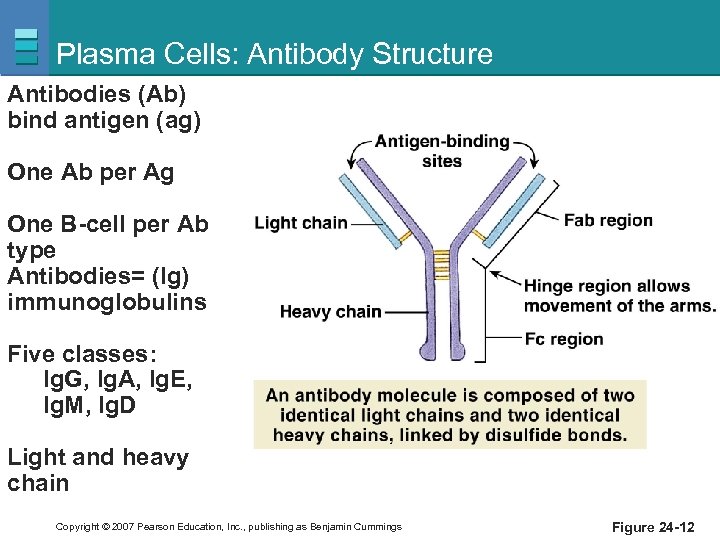
Plasma Cells: Antibody Structure Antibodies (Ab) bind antigen (ag) One Ab per Ag One B-cell per Ab type Antibodies= (Ig) immunoglobulins Five classes: Ig. G, Ig. A, Ig. E, Ig. M, Ig. D Light and heavy chain Copyright © 2007 Pearson Education, Inc. , publishing as Benjamin Cummings Figure 24 -12
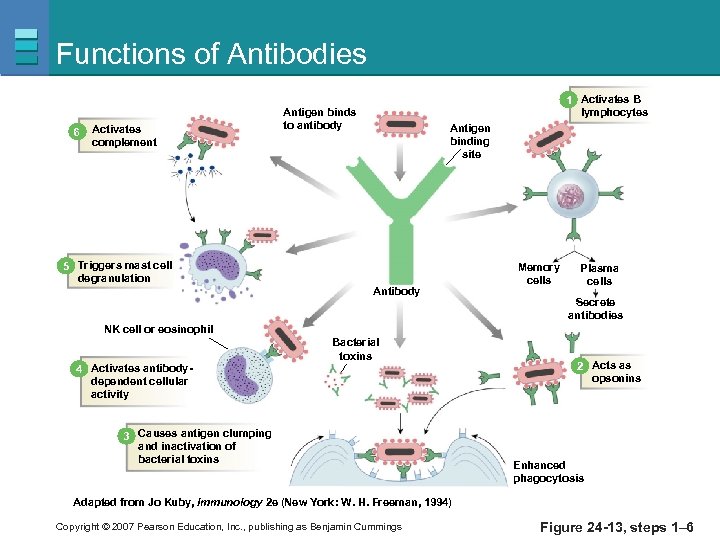
Functions of Antibodies 6 Activates complement 1 Activates B lymphocytes Antigen binds to antibody Antigen binding site 5 Triggers mast cell degranulation Antibody Memory cells Plasma cells Secrete antibodies NK cell or eosinophil 4 Activates antibodydependent cellular activity Bacterial toxins 3 Causes antigen clumping and inactivation of bacterial toxins 2 Acts as opsonins Enhanced phagocytosis Adapted from Jo Kuby, Immunology 2 e (New York: W. H. Freeman, 1994) Copyright © 2007 Pearson Education, Inc. , publishing as Benjamin Cummings Figure 24 -13, steps 1– 6
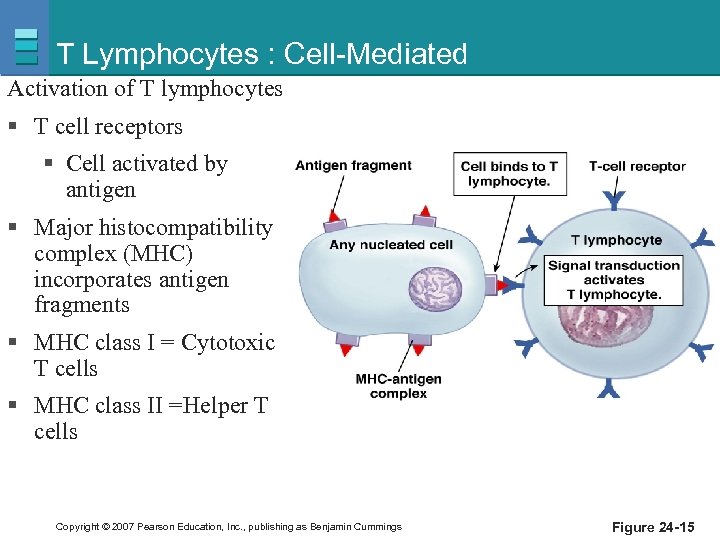
T Lymphocytes : Cell-Mediated Activation of T lymphocytes § T cell receptors § Cell activated by antigen § Major histocompatibility complex (MHC) incorporates antigen fragments § MHC class I = Cytotoxic T cells § MHC class II =Helper T cells Copyright © 2007 Pearson Education, Inc. , publishing as Benjamin Cummings Figure 24 -15
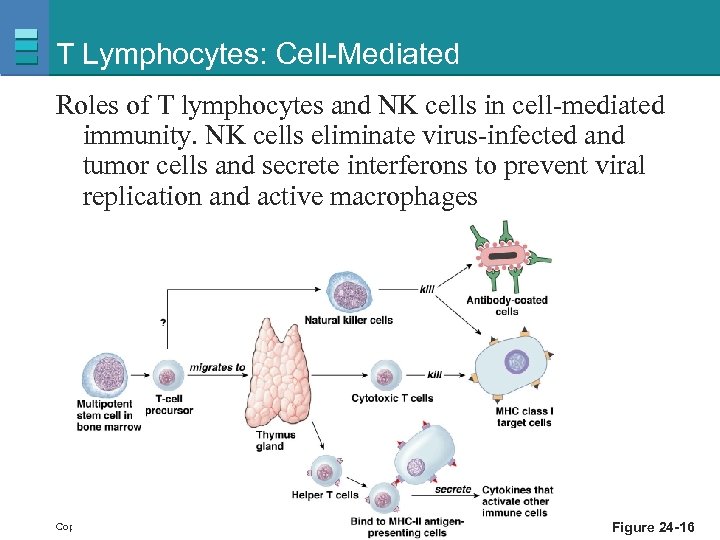
T Lymphocytes: Cell-Mediated Roles of T lymphocytes and NK cells in cell-mediated immunity. NK cells eliminate virus-infected and tumor cells and secrete interferons to prevent viral replication and active macrophages Copyright © 2007 Pearson Education, Inc. , publishing as Benjamin Cummings Figure 24 -16
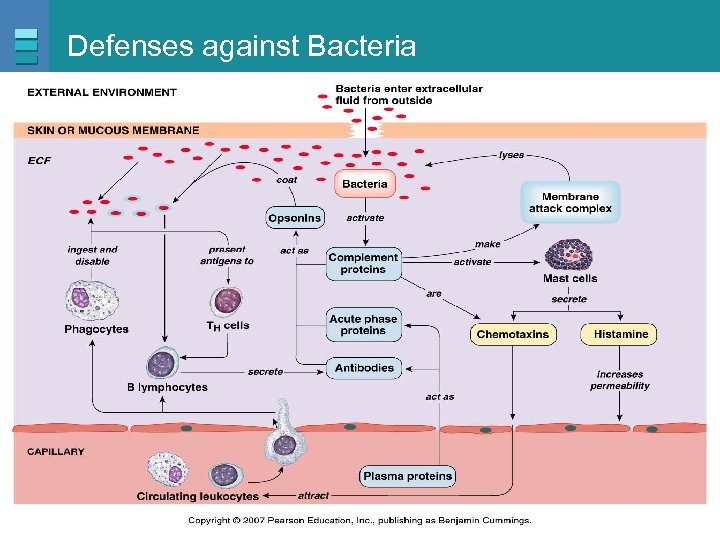
Defenses against Bacteria Copyright © 2007 Pearson Education, Inc. , publishing as Benjamin Cummings
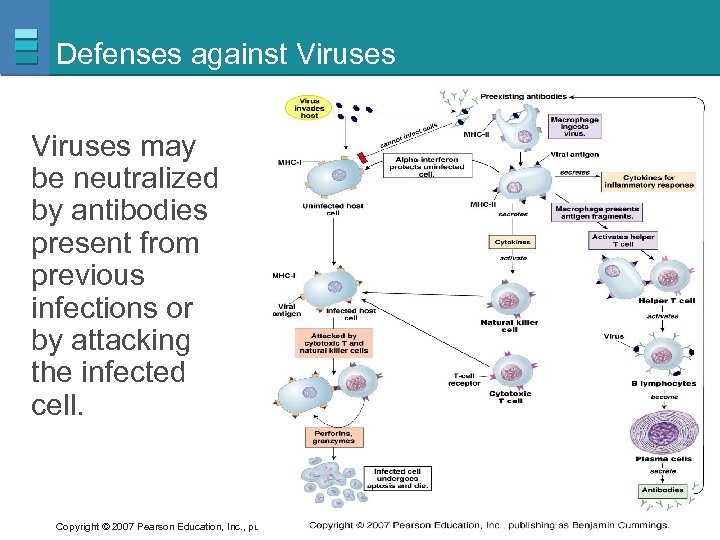
Defenses against Viruses may be neutralized by antibodies present from previous infections or by attacking the infected cell. Copyright © 2007 Pearson Education, Inc. , publishing as Benjamin Cummings Figure 24 -18
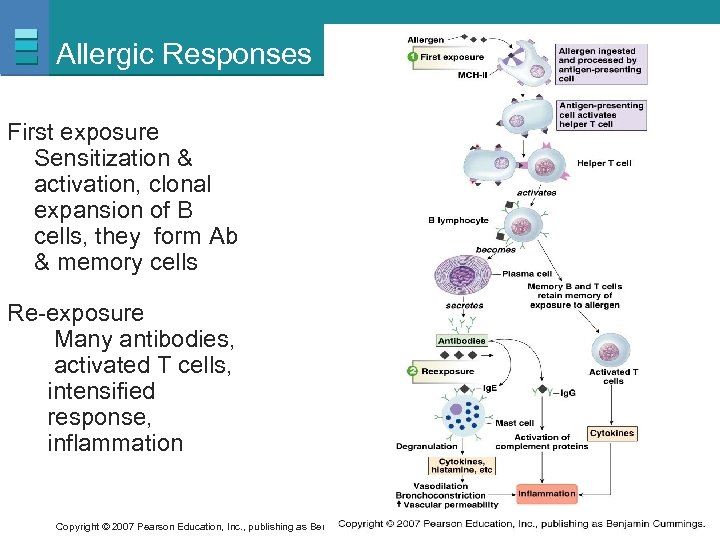
Allergic Responses First exposure Sensitization & activation, clonal expansion of B cells, they form Ab & memory cells Re-exposure Many antibodies, activated T cells, intensified response, inflammation Copyright © 2007 Pearson Education, Inc. , publishing as Benjamin Cummings Figure 24 -19
Скачать презентацию POWERPOINT LECTURE SLIDE PRESENTATION by ZARA OAKES MS
27961696cbee35d28338fdcc015285a7.ppt